Louis Vuitton Authentication Specialist
Handbag authentication specialist. Has reviewed submissions across Hermès, Chanel, Louis Vuitton, and Dior since 2019.
Last updated November 2026 · Published October 2026 · Contact
How Do You Know If a Louis Vuitton Bag Is Real?
To tell if a Louis Vuitton bag is real, compare its interior details with a verified bag of the same model, and do not treat any single matching mark as proof. The date code, the heat stamp, the hardware engraving and the chip are all copied by counterfeiters, so a bag can pass every one of them and still be fake. What separates real from fake is usually a contradiction: a detail the model never carries, a code that cannot be decoded, or a lining that genuine bags of that model do not use.
About 4 in 10 of the Louis Vuitton bags sent to us for checking between 2024 and 2026 came back fake, and many of them looked right at first glance. This page is the entry point to our Louis Vuitton guides. It covers the checks that hold across models, ranked by how much each one proves, and the table below sends you to the guide for your bag, where the details are specific to the model.
Worth knowing
We do not have one tell that separates every real Louis Vuitton from every fake, and this guide does not pretend to. When it says a mark matches, that means the bag is consistent with a genuine one, not that it is confirmed. A bag that passes everything here and costs real money still deserves a professional review.
What to check, ranked by reliability
| Checkpoint | Reliability | What it tells you |
|---|---|---|
| 1. Details That Do Not Belong on That Model | ★★★★★ | A printed QR-code label, or a pocket, patch or label that genuine bags of that model do not carry, rejects the bag; a plain interior proves nothing. |
| 2. The Date Code: What a Mismatch Tells You | ★★★★★ | A code that will not decode, has the wrong format or predates the model is a strong warning; a clean code proves nothing because fakes copy real ones. |
| 3. The Interior Stamp and Tab | ★★★★★ | Crowded or misspelled lettering is a reason to stop, but fakes with clean stamps are common and the made-in country is never a tell. |
| 4. Hardware, Rivets and Zip Pulls | ★★★★★ | Decisive on models built around it (a mirrored Noé rivet), but most fakes reproduce the engraving closely. |
| 5. Canvas, Leather and Shape | ★★★★★ | The better counterfeits look convincing at normal viewing distance; use it to decide whether to look closer, not to clear a bag. |
| 6. The NFC Chip and Newer Bags With No Code | ★★★★★ | A recent bag with no code is normal, and a chip scan proves nothing because an ordinary tag can be sewn into a fake. |
| 7. What the Box, Dust Bag and Receipt Do and Do Not Prove | ★★★★★ | Packaging is context only, and Louis Vuitton issues no authentication certificate or card. |
Which Louis Vuitton Bag Do You Have?
Louis Vuitton makes the same mark in different places on different models, so the model decides what to look at first. Find yours, and read that guide alongside the checks further down.
| Bag | What its guide checks first | Guide |
|---|---|---|
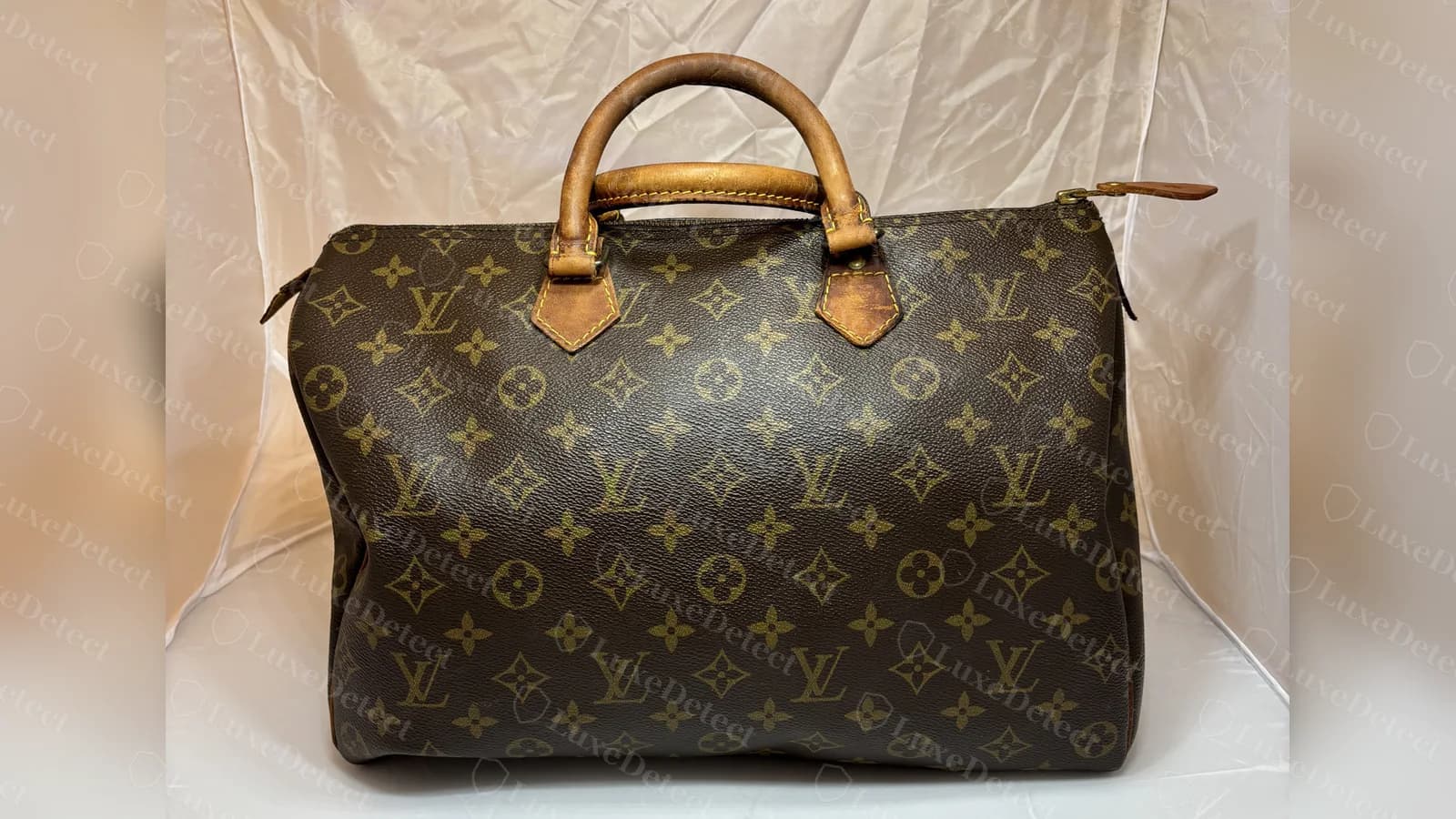
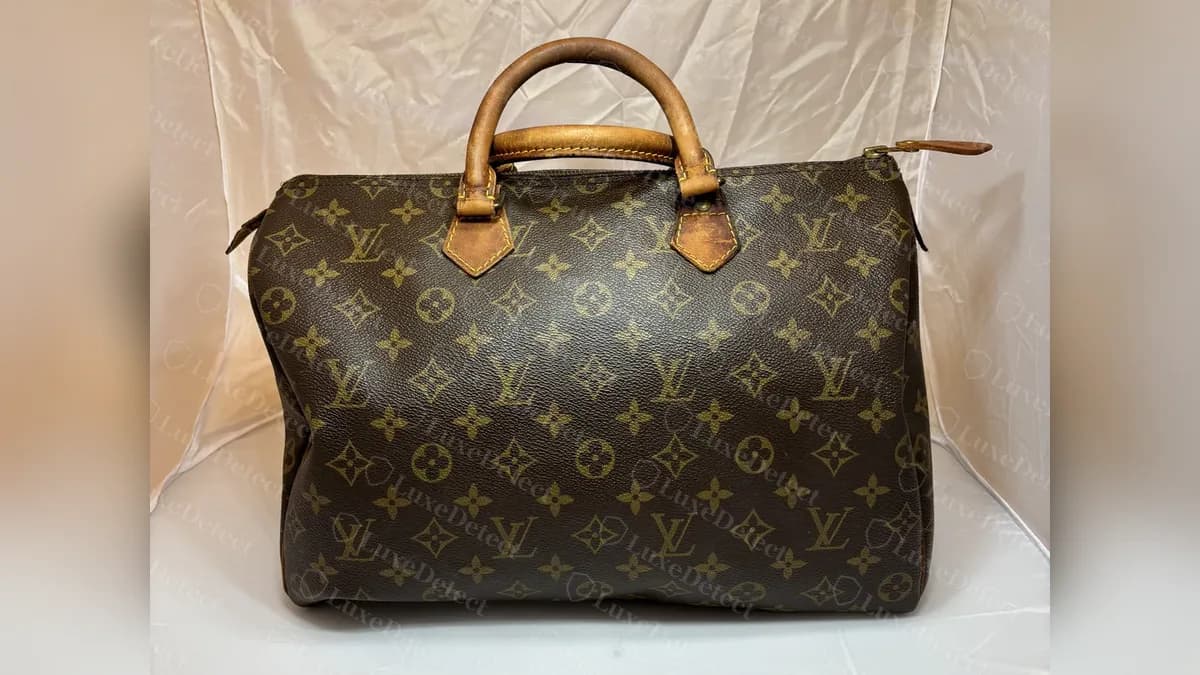
| Speedy (25, 30, 35, 40, Bandoulière) | Side-tab heat stamp, interior date-code tab, lining, handle tabs and rivets | Speedy guide |
| Neverfull (PM, MM, GM) | Lining colour and label for the version, pocket tab, date-code tag, rivets | Neverfull guide |
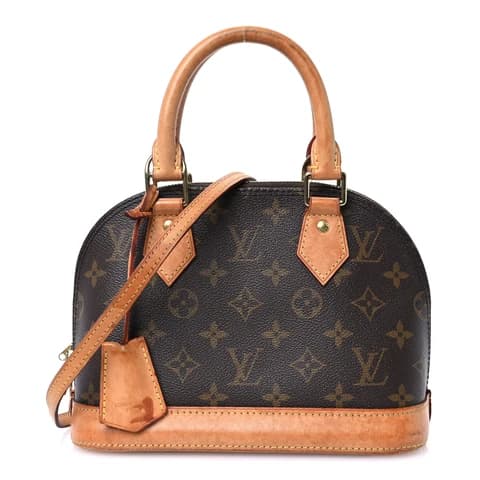
| Alma | Canvas placement on the dome, trim leather, double zip, heat stamp, date code | Alma guide |
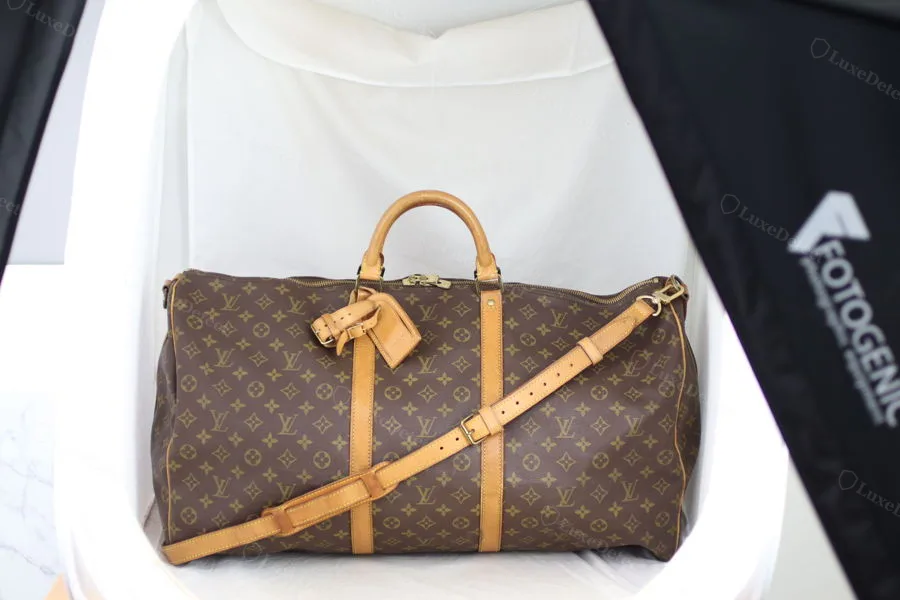
| Keepall | Vachetta tab and rivet, date-code tab, and whether the interior is bare | Keepall guide |
| Pochette Accessoires | Canvas cut, vachetta tab, zipper, heat stamp, date code or chip | Pochette Accessoires guide |
| Multi Pochette Accessoires | The round coin purse, the leather tag in the large pochette, canvas across the set | Multi Pochette guide |
| Pochette Métis | S-lock, back zip pocket, interior tab, date code or chip, strap clasps | Pochette Métis guide |
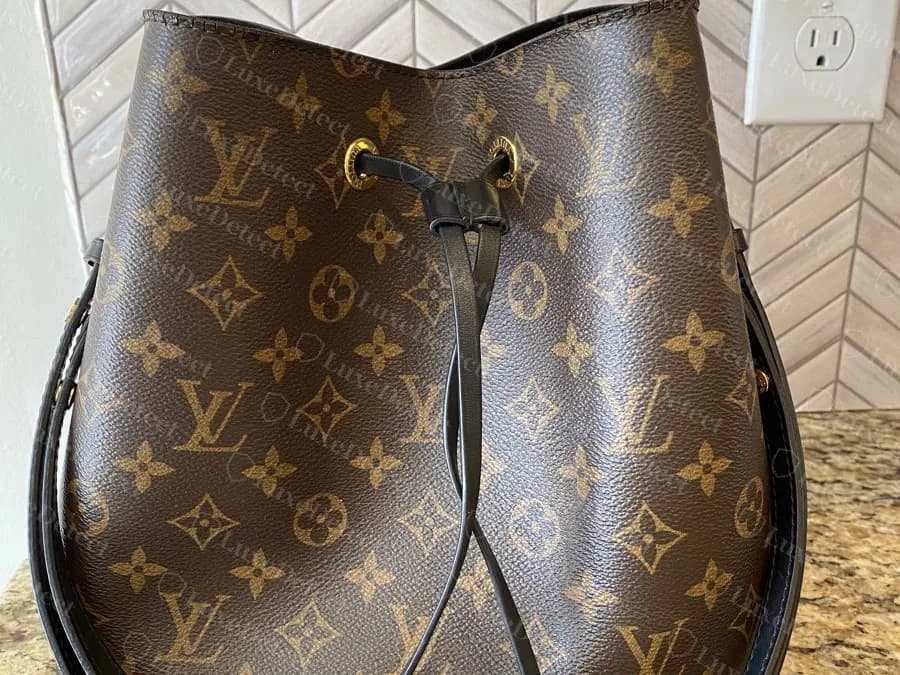
| Noé and Petit Noé | Rivets (mirrored text), leather heat stamp, drawstring and toggle | Noé guide |
| Montaigne | Interior lining fabric, interior heat stamp and date code, base studs | Montaigne guide |
| Twist | Twist-lock alignment, Epi grain, interior stamp and date code | Twist guide |
| OnTheGo | Swivel clasp engraving, interior date code, interior tags on collaboration prints | OnTheGo guide |
| Palm Springs backpack | Twill lining, interior heat stamp, date-code tab | Palm Springs guide |
| Papillon | Lining stamp or label, date code, hardware and canvas | Papillon guide |
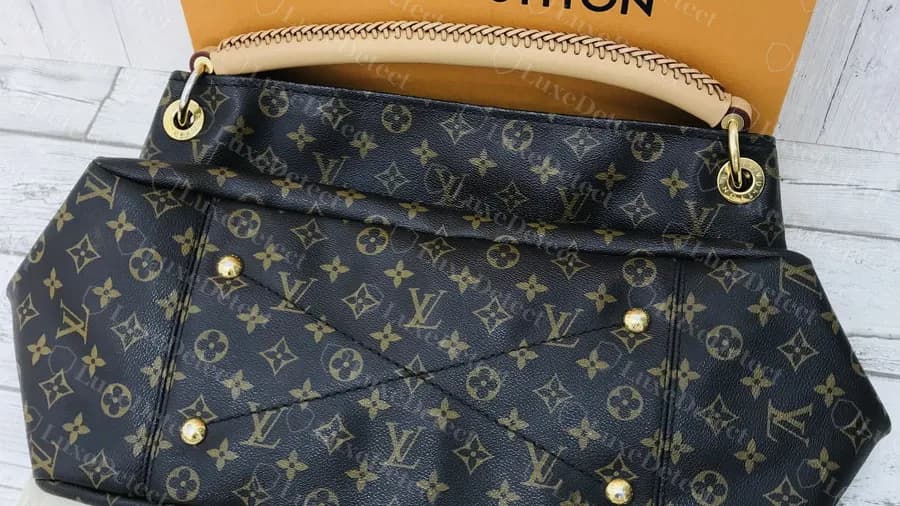
| Artsy | What a genuine bag looks like, and why hardware alone does not separate real from fake | Artsy guide |
| Neonoe | Grommets and strap rivets, strap tab, zip pocket, date-code tab | Neonoe guide |
| Musette | Flap stamp, date code on the suede lining, hardware, snap and strap | Musette guide |
| Favorite | Plaque and hardware, interior leather patch, date code, strap tab | Favorite guide |
| Capucines | Turn-lock and flap logo, interior heat stamp, handle hardware | Capucines guide |
| Bumbag (belt bag) | Front patch and zips, stamped handle, zip pull, interior tab and date code | Bum bag guide |
Not a bag? We also have guides for the wallet, the cosmetic pouch, the belt, the bracelet, shoes and clothing. For a bag with no date code that predates the chip, start with our vintage Louis Vuitton buyer's guide. If your model is not listed, the checks below still apply.
A Note on the Fake Nano Speedy
The Nano Speedy is the miniature of the Speedy, much smaller than a Speedy 25 and usually carried on a detachable strap. Our Speedy guide is built on the full-size bags, and we do not have enough confirmed Nano Speedys to list tells of their own, so we will not give you any. Check a Nano the way you would any Louis Vuitton: what is inside it, the stamp, the hardware, and a date code on an older bag or no code on a chip-era one, all compared with a verified Nano rather than a full-size Speedy. Listings mislabel Speedy sizes too, so confirm that the bag in the photos is the size the listing names.
What Fake Louis Vuitton Bags Get Right
Fake Louis Vuitton bags are often better than their price suggests. In the fakes we reviewed, many carried the things buyers are told to look for: a clean interior stamp on a tab that looks right, hardware marked LOUIS VUITTON, the lining print the model should have, and a date code that decodes to a plausible week and year. One fake messenger bag we looked at had a "made in France" tab and an ordinary-looking code. A fake-labelled bum bag carried a code that decodes cleanly to a real week of 2020.
That is why none of those marks can clear a bag on its own. Listings add to the confusion: orders filed under a model name are sometimes a different bag, so the name in a listing is not evidence either.
What the Inside of a Real Louis Vuitton Bag Looks Like
Most of what separates a real Louis Vuitton bag from a fake is inside it. Open the bag fully, empty every pocket and look at three things: the lining, the interior stamp or tab, and where the date code (or, on newer bags, the chip) should be. What is right differs by model, so use this as a map and your model's guide for the detail.
The lining. Louis Vuitton pairs specific linings with specific materials. On the genuine bags in our guides, Monogram Speedys were lined in smooth, tightly woven brown cotton canvas, Damier Ebène bags in red and Damier Azur in beige or cream. The Neverfull has a striped lining carrying the "LOUIS VUITTON ARTICLES DE VOYAGE" lettering, with a script "Louis Vuitton 101 Champs-Élysées Paris" label on older bags and a "MAISON FONDÉE EN 1854" label on later ones. The Palm Springs backpack has a matte twill lining, and the Musette a suede-type lining.
The interior heat stamp. Many bags carry LOUIS VUITTON, PARIS and a "made in" line on a leather tab or patch inside, such as the tab beneath the Neverfull's flat zip pocket. The Speedy is the well-known exception: its stamp is on the outside side tab, and the tab inside carries the date code.
The date code or the microchip. Up to about 2021 the code is stamped on a small leather tab sewn to the lining, on a tag stitched into a lining seam, or on a pocket wall. From about 2021 there is no stamped code: the chip is sewn in out of sight, and on the chip-era bags we reviewed the interior showed the same "LOUIS VUITTON PARIS made in ..." label as older bags, with no code on it. Owners and resellers report the chip near the interior leather label, the interior pocket or the lining seams; Louis Vuitton does not publish where it goes.
| Bag | Lining on the genuine bags we reviewed | Where the stamp and the date code sit |
|---|---|---|
| Speedy | Brown woven canvas (Monogram), red (Damier Ebène), beige (Damier Azur) | Stamp on the outside side tab; code on a rivet-fixed leather tab inside, often under the inner pocket or beside the zip |
| Neverfull | Striped lining with "ARTICLES DE VOYAGE" lettering, coloured by version | Stamp on the tab under the zip pocket; code on a small woven or leather tag in a lining seam |
| Keepall (canvas-lined) | Canvas, with nothing added | A small rivet-fixed tab by the zip carrying the code, and nothing else |
| Palm Springs | Matte twill | Interior heat stamp and a date-code tab |
| Musette | Suede-type | Stamp on the flap; code on the suede lining |
Worth knowing
A correct interior is consistent with a genuine bag, not proof of one, because fakes copy linings, stamps and codes too. What the inside is best at is catching a contradiction, which is the first check below.
Details That Do Not Belong on That Model
The strongest evidence against a bag is an addition. Counterfeiters put inside a bag what a generic buyer expects to find there, and genuine bags of that model do not have it. Our model guides found this pattern on several bags:
- Keepall: an interior zip pocket, a stitched leather patch or a sewn label inside a canvas-lined bag. None of the genuine Keepalls we compared had one.
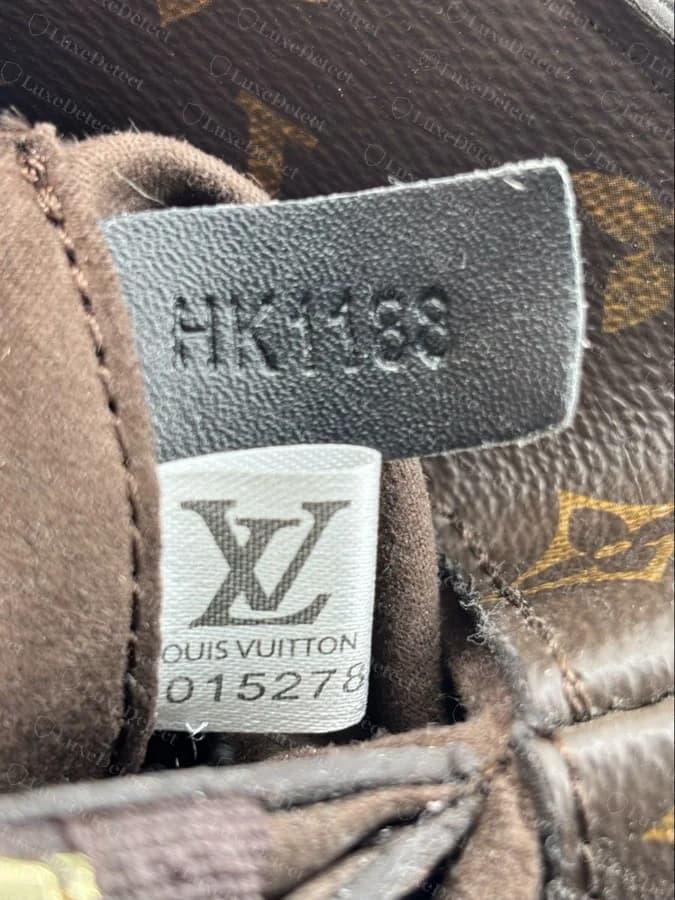
- Montaigne: a printed QR-code or numbered woven label stitched in beside (or instead of) the stamped date code, and a printed monogram fabric used as the lining.
- Papillon: a stitched leather label carrying a model number inside a standard monogram bag, which we saw only on fakes.
- Palm Springs: a shiny, satin-like or smooth nylon lining in a standard colourway, where the genuine bags we reviewed had a matte twill lining.
- Speedy: some fakes were lined in a fuzzy, suede-like brown fabric instead of the smooth woven canvas we saw in every genuine Monogram Speedy. That is a small sample, so treat it as a reason to look closer.
We saw the same thing on an OnTheGo that was ruled fake: a woven LV label printed with a QR code sewn into the lining, next to a plain black leather patch.
| Element | Authentic | Counterfeit |
|---|---|---|
| Inside the bag | Only what that model carries; a canvas-lined Keepall has a small rivet-fixed tab by the zip and nothing else | An added zip pocket, stitched patch or sewn label |
| Printed tags | A stamped date code, or no code on a newer bag with a chip | A printed QR-code label or a numbered woven label |
| Lining | The lining that model uses for its material | Printed monogram fabric in a Montaigne, a satin-like lining in a Palm Springs |
Red flag
A printed QR-code label, or an added pocket, patch or label that genuine bags of that model do not have, is enough to reject the bag on its own for the models listed above. Check your model's guide for what is right inside it.
Worth knowing
This check only works when you know what is correct for the model, which is what the guides in the table are for. And a plain interior clears nothing: most fakes keep the inside plain.
The Date Code: What a Mismatch Tells You
Louis Vuitton uses date codes, not serial numbers. The code records roughly when and where a bag was made, so many bags share one and all of them can be genuine. It sits on a small leather tab sewn to the lining, in the lining itself or on a pocket wall, and the position changes by model and era.
From 1990 to 2006 the code is two factory letters and four digits, where the first and third digits are the month and the second and fourth are the year. From 2007 to about 2021 the layout is the same but the first and third digits are the week. SA2200, for example, is week 20 of 2020. Our date code guide covers every era, and the checker below decodes yours.
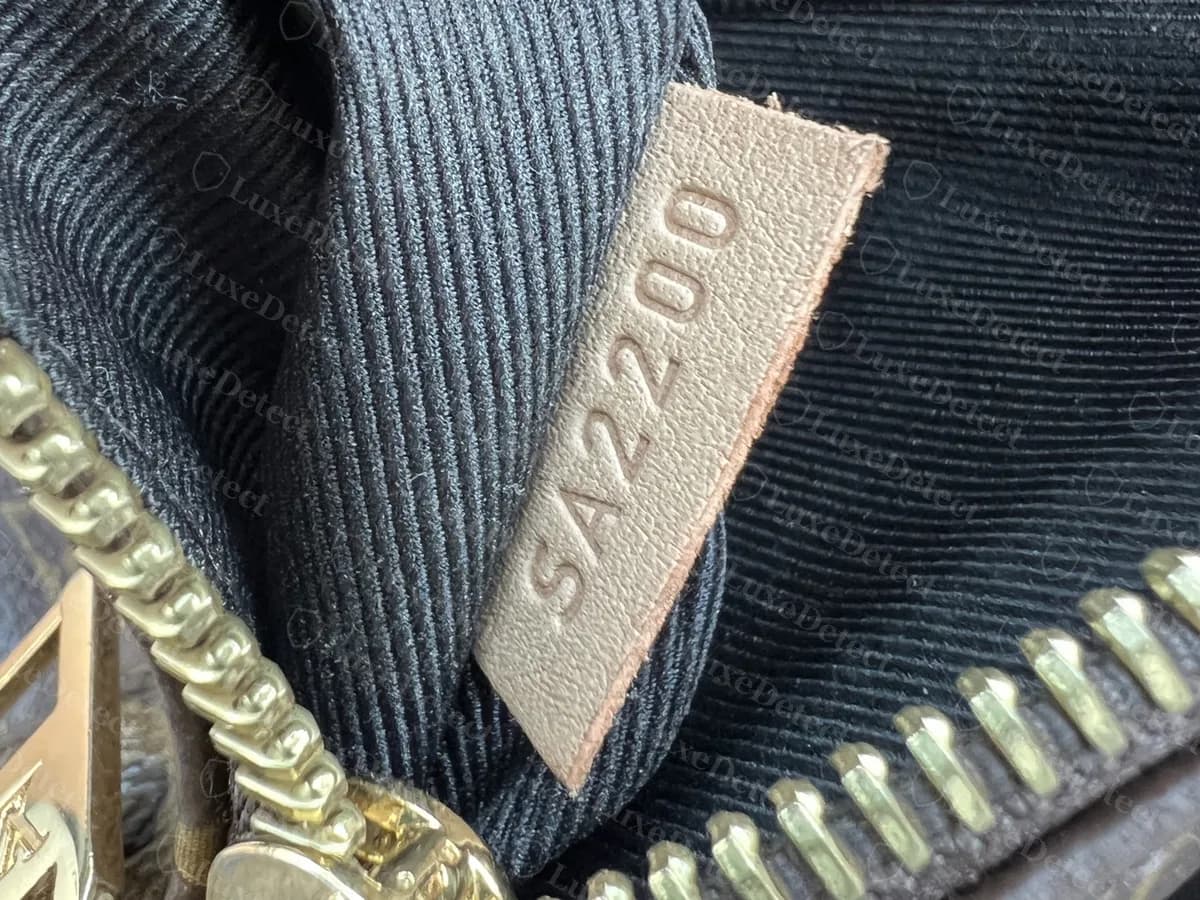
What the code can do is catch a mismatch. What it cannot do is clear a bag.
| Element | Authentic | Counterfeit |
|---|---|---|
| Format (1990 to about 2021) | Two letters and four digits | Seen on fakes: a letter followed by five digits, or extra digits and a dash after a normal-looking code |
| Month or week | Fits the rule for its year digits | Seen on a fake: a "week" of 58, which does not exist |
| Year against the model | Not earlier than the model or colourway | A code that dates the bag before the model existed |
| A code that decodes cleanly | Present on genuine bags | Also present on fakes, so it proves nothing |
Red flag
A code you can read clearly that does not decode under the rule for its year digits, or has the wrong format, or dates the bag before the model existed, is a strong warning. Weigh it against the rest of the bag. A code you cannot read because the stamp has worn away is simply unknown, not wrong.
Worth knowing
The date code tells you when and where a bag was made. It does not tell you whether it is real, because counterfeiters copy genuine codes. A match proves nothing and a mismatch is a red flag. The two factory letters are not an official list either: the compilations overlap, so a factory that seems to contradict the "made in" line is a reason to look closer, not a verdict.
The Interior Stamp and Tab
Most Louis Vuitton bags carry a heat stamp reading LOUIS VUITTON, PARIS and a "made in" line. On a Speedy it is on the outside side tab; on many other bags it is on an interior tab or patch. Where it sits, and whether the tab is a stamped leather patch or a stamp pressed into the lining, differs by model and era, and both can be genuine on the same model.
Three things from our guides are worth knowing before you judge a stamp:
- The country is not a tell. Genuine bags are made in France, Spain, Italy and the USA, among others. A "made in" country on its own never decides anything.
- Wear is normal. A genuine stamp on a used bag can be faint or partly gone.
- A clean stamp proves nothing. Some of the fakes we reviewed had well-formed stamps on a tab that looked right.
What does count is an obvious error: letters crowded and running together, or a misspelling. On one counterfeit Keepall the invented patch read "made in Franco". Some model guides go further into the letterforms, such as the shape of the O and the spacing of the T's in VUITTON. Use them for that model and compare with a verified stamp of the same model; across models we found fakes with clean, correct stamps, so we do not rate the letterforms as reliable on their own.
Worth knowing
A stamp that matches proves nothing. A stamp with obvious errors, or one placed where the model never has a stamp, is a reason to stop and compare against a verified bag of the same model.
Hardware, Rivets and Zip Pulls
On genuine bags the rivets, zip pulls and clasps carry LOUIS VUITTON or the LV logo, cleanly struck. The trouble is that counterfeits carry them too. In our Neverfull and Artsy guides the fakes reproduced the engraving closely, so correct markings on a rivet or zip pull are not enough to call a bag genuine.
Hardware matters most on models built around it. On the Noé, a rivet where the text reads backward or mirrored is enough to reject the bag, a defect we saw on several independent fakes. On the OnTheGo, a swivel clasp with a soft, off-centre logo was one of the more consistent tells in our sample. On the Artsy, the opposite holds: the grommets, studs and pull are copied so well that they settle nothing. Off-model hardware is a quicker check than fine engraving: silver-tone metal on a bag that should be gold, or enamel inside grommets that should be plain.
Worth knowing
Hardware is corroboration. An obviously wrong piece is a reason to stop; a good-looking one clears nothing.
Canvas, Leather and Shape
This is where most buyers start and where it is hardest to be sure. Counterfeits copy the monogram and the shape well enough that, on several models, the better ones looked convincing at normal viewing distance.
- Monogram placement and scale. Some model guides treat uneven spacing, a scaled-down pattern or upside-down motifs on a front panel as fake tells. On other models we could not confirm that against our own fakes, so read your model's guide and compare with a verified bag rather than relying on a general rule.
- Vachetta. The natural leather starts pale and darkens to honey and caramel with use, so both pale and dark tabs can be genuine. Patina shows age, not origin, and a seller who points to dark patina as proof has told you nothing.
- Shape. Judge it with the bag standing on a table, not propped or stuffed. Ask a seller for a plain front-on and side-on photo.
Worth knowing
Canvas and leather are the easiest things to copy and the easiest to misjudge. Use them to decide whether to look closer, never to close the case.
The NFC Chip and Newer Bags With No Code
From about 2021 Louis Vuitton replaced the stamped date code with an internal NFC (RFID) chip, so a recent bag with no visible code is normal and is not a fake tell. For the same reason, a bag described as older than 2021 with no code at all is worth checking, though codes also wear away or sit on a tab that has been replaced.
A chip is not a verdict. A phone with NFC can often detect that a tag is present, but it cannot read the data that matters, and we know of no public Louis Vuitton page that verifies a chip for a customer. Do not trust a seller who says a scan confirmed the bag. Our Louis Vuitton NFC chip guide shows how to scan one and what a reader app does and does not tell you.
Worth knowing
A chip does not prove the bag is real. A counterfeiter can sew an ordinary NFC tag into a fake, and a genuine chip can be moved from one bag to another. Detecting a tag is not evidence of authenticity.
What the Box, Dust Bag and Receipt Do and Do Not Prove
Packaging is context, not evidence. Dust bags are reproduced and sold loose, boxes are easy to buy, and receipts can be forged. Louis Vuitton does not issue authentication certificates for its bags, so a plastic "authenticity card" packed with a bag is not a point in its favour. A receipt is worth reading only to see whether the style and description match the bag in front of you.
Quick Authentication Checklist
- Find your model in the table and read its guide before you judge anything.
- Look inside for anything that model does not carry: an added pocket, patch, label, QR-code tag or a lining it does not use.
- Read the date code and decode it with the checker. Reject nothing for a clean code; treat a code that will not decode, has the wrong format or predates the model as a strong warning.
- Check the interior stamp for obvious errors. Ignore the "made in" country.
- Look at rivets, zip pulls and clasps for obvious errors, and for metal that is wrong for the model.
- Compare canvas, leather and shape with a verified bag of the same model.
- On a bag from about 2021 onward, expect no stamped code and do not rely on a chip scan.
- Treat the box, dust bag, card and receipt as context only.
Two or more failures means walk away, and a single hit on the first check, or a code that cannot be decoded, is a strong reason to stop. Passing every step means the bag is consistent with a genuine one, not that it is confirmed.
When to Get a Professional Opinion
Fake Louis Vuitton bags are common enough, and good enough, that a bag matching every check on this page is still unproven. If the price is significant, a second pair of eyes is the reliable next step, especially for a private sale, a bag with no receipt or a gift you cannot inspect. Our authentication service reviews clear photos of the interior stamp and tab, the date code, the hardware and the construction and gives a verdict within 24 hours.
Getting a Louis Vuitton Bag Authenticated by a Service
An LV authenticator works from the same evidence this guide describes, compared against verified bags of the same model. With our Louis Vuitton authentication service you start an order with Louis Vuitton selected and upload clear photos: the whole bag, the logo, the inside label, the hardware engravings and the date code tab, plus the "made in" label and anything else the form asks for. An authenticator reviews them and you get a verdict within 24 hours. Before you order, you can decode the date code yourself with our free LV date code checker, which tells you when and where the code says the bag was made.
A code that checks out doesn't prove the item is real. Counterfeiters copy genuine codes.
Our authenticators check the stamps, hardware and construction of your Louis Vuitton against verified references, from $25. You get a verdict within 24 hours, and a Certificate of Authenticity if the item passes.
Authenticate My Louis Vuitton →FAQ
How can you tell if a Louis Vuitton bag is real?
Compare the inside of the bag with a verified bag of the same model, not just the outside. Look for details the model should not have, decode the date code and check it makes sense for the model and year, and read the stamp for obvious errors. No single mark proves a bag is real, because fakes copy the code, the stamp and the hardware. Start with the guide for your model in the table above.
Can you tell if an LV bag is real from the date code?
No. A date code only tells you roughly when and where a bag was made, and counterfeiters copy genuine codes. A code that decodes cleanly proves nothing, but a code that does not decode, has the wrong format or dates the bag before the model existed is a red flag. Use our date code checker to read it.
Is a Louis Vuitton bag with no date code fake?
Not necessarily. From about 2021 Louis Vuitton stopped stamping codes and moved to an internal chip, so a recent bag with no code is normal. A bag described as older than that with no code is worth checking, since stamps wear away or sit on a tab you have not found. Empty the pockets and look with raking light before you conclude anything.
Can I scan a Louis Vuitton chip to see if the bag is real?
A phone with NFC can often detect that a chip is present, but it cannot verify the bag, and we know of no public Louis Vuitton tool that does. A fake can carry an ordinary NFC tag. See our chip guide for what a scan does and does not show.
Does a real Louis Vuitton come with an authenticity card or certificate?
No. Louis Vuitton does not issue authentication certificates for its bags, so a plastic card or a certificate sold with a bag does not count as evidence. A dust bag, box or receipt is context only.
Is a Louis Vuitton bag made in Spain, Italy or the USA fake?
No. Louis Vuitton makes bags in several countries, and the country is not a quality grade or a tell. What matters is whether the rest of the bag fits that model and year.
Can I tell if an LV bag is real from photos?
Yes. How the stamp, the date code, the hardware, the lining and the construction fit together against verified pairs of the same model is what decides it, and clear close photos of the interior tab, stamp, hardware and lining are what a review needs. On an expensive bag a professional review is the safer route, because a good fake copies the individual marks.
How do I tell a real LV monogram from a fake?
The monogram on its own is not a dependable check. Counterfeits copy the pattern well, and the rules that apply to one model do not always hold on another. Compare your bag with a verified bag of the same model, and use the canvas as a reason to look closer, not as proof.
What does the inside of a real Louis Vuitton bag look like?
It depends on the model, but a genuine interior carries only what that model has: the lining Louis Vuitton uses for that material (brown woven canvas in a Monogram Speedy, red in Damier Ebène, a striped "ARTICLES DE VOYAGE" lining in a Neverfull), a LOUIS VUITTON, PARIS stamp with a "made in" line on a tab or patch, and a date code on a small tab or tag, or no code on a bag made from about 2021. An added pocket, patch, sewn label or QR-code tag that the model does not have is a red flag.
How do you see if a Louis Vuitton bag is real inside vs fake?
Open it fully and compare the lining, the interior stamp and the date code tab with a verified bag of the same model. Fakes often copy all three, so the useful question is whether anything contradicts the model: a lining it does not use, a label it never carries, or a code that does not decode. The table in the section on the inside of a real bag shows where to look on the most common models.
What is the difference between a fake Louis Vuitton and a real bag?
Usually a contradiction rather than an obvious flaw. Good fakes copy the canvas, the stamp, the hardware and even a plausible date code, so the difference tends to be a detail that genuine bags of that model do not have, a code that cannot be decoded or that predates the model, or obvious errors in the stamp or hardware. That is why this guide ranks the checks by what each one proves.
Where is the date code inside a Louis Vuitton bag?
On a small leather tab sewn to the lining, on a tag stitched into a lining seam, or on a pocket wall, depending on the model and era. On a Speedy it is on the interior tab, often under the inner pocket or beside the zip; on a Neverfull it is on a small tag in a lining seam. Bags made from about 2021 have a chip instead and no stamped code. Our date code checker decodes the code once you find it.
How do I get a Louis Vuitton bag authenticated?
Use an authentication service that compares your bag with verified bags of the same model. With ours you start an order, upload clear photos of the whole bag, the logo, the inside label, the hardware and the date code tab, and get a verdict within 24 hours. Louis Vuitton itself does not issue authenticity certificates for its bags.
How can you tell if a Nano Speedy is fake?
Check it like any Louis Vuitton bag: the inside, the stamp, the hardware and the date code or chip, compared with a verified Nano Speedy rather than a full-size Speedy. We do not have enough confirmed Nano Speedys to list tells specific to it, so a Nano that passes these checks and costs real money deserves a professional review.