Handbag Authentication Specialist
Handbag authentication specialist. Has reviewed submissions across Hermès, Chanel, Louis Vuitton, and Dior since 2019.
Published September 2026 · Contact
Why the Montaigne's Structure Works Against Counterfeiters
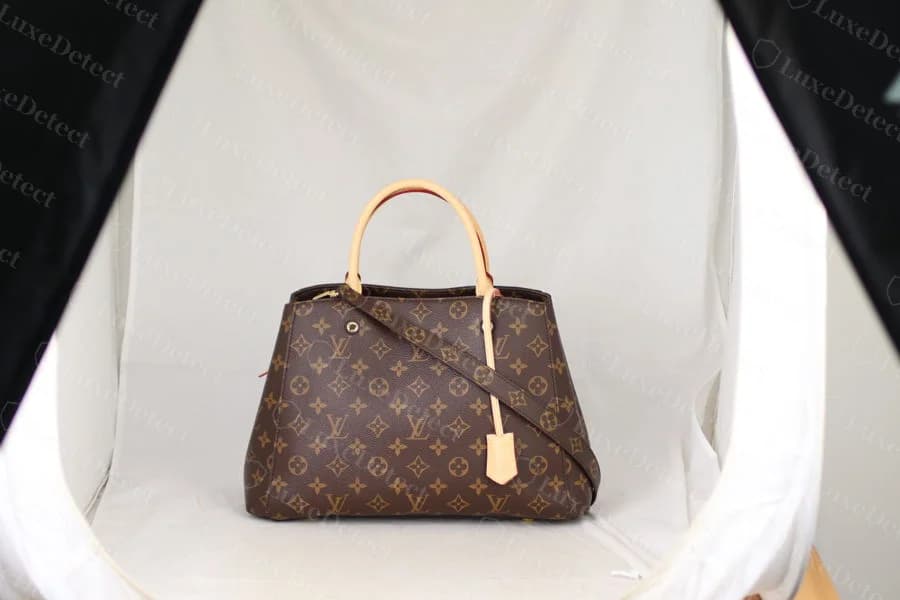
The Montaigne launched in 2013 as part of Louis Vuitton's structured-bag revival, built as a boxy top-handle tote with a squared-off base, two rolled handles, and a detachable shoulder strap, sold in three sizes (BB, MM, GM) across Monogram canvas, Monogram Empreinte debossed leather, and a separate Epi leather "Bowling" silhouette with a triangular turn-lock closure. It has never carried the volume of a Neverfull or Speedy, which keeps it a lower-profile target, but it still draws enough counterfeit traffic to show a consistent pattern once you look at enough real cases side by side.
That pattern is the interior lining. The Montaigne's structured shape means the interior is fully visible the moment the bag opens, no gathered fabric or soft slouch to hide behind, and Louis Vuitton lines this bag in a solid-color textile: a plain suede-look fabric on Monogram canvas versions, a tonal pinstripe toile on Empreinte versions. Never a printed brown monogram-canvas pattern. Counterfeiters, working from cheaper and more widely available lining stock, repeatedly default to a printed LV-monogram fabric that Louis Vuitton simply doesn't use inside this bag. We reviewed photo evidence across dozens of Montaigne authentication cases in our archive, both Monogram and Empreinte, to see where this and other checks actually hold up.
What to check, ranked by reliability
| Checkpoint | Reliability | What it tells you |
|---|---|---|
| 1. The Interior Lining Fabric | ★★★★★ | A printed LV-monogram-pattern lining fabric is decisive on its own; genuine Montaigne interiors are always a solid, unpatterned textile. |
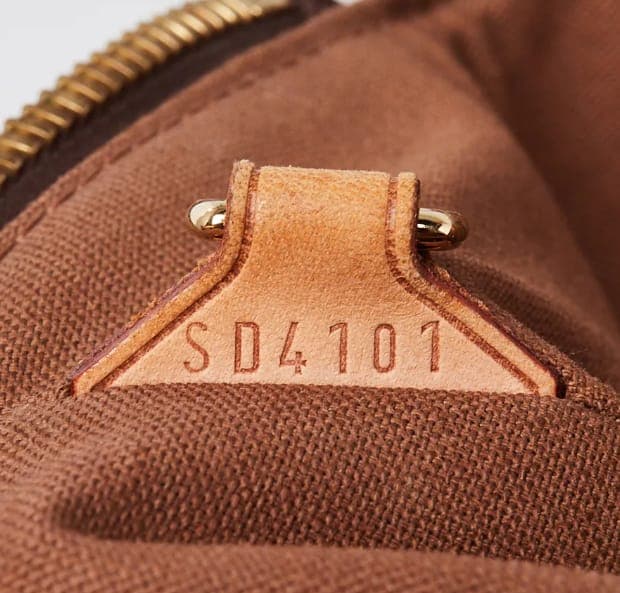
| 2. The Interior Heat Stamp and Date Code | ★★★★★ | A printed QR-code or barcode fabric tag stitched in alongside the date code is decisive; a plausible code format alone is not. |
| 3. Base Studs and Hardware Casting | ★★★★★ | A useful supporting signal, but casting quality varied too much across our counterfeit sample to treat as decisive by itself. |
| Model Reference Before You Start | ★★★★★ | Rules out a mislabelled Bowling or wrong-size listing; will not catch a good fake of the correct configuration. |
| What the Box and Dust Bag Do and Do Not Prove | ★★★★★ | Packaging is context only, both sides of our sample had it and lacked it in comparable proportions. |
Model Reference Before You Start
- Sizes: BB (smallest), MM (mid), GM (largest) — all legitimate; the size code is usually on the interior date-code tab area or box label
- Materials: Monogram coated canvas (most common), Monogram Empreinte (debossed calfskin, soft-structured), and a separate Epi leather "Montaigne Bowling" line with a triangular turn-lock plaque closure instead of the tote's magnetic snap and cadena. The Bowling is a genuinely different silhouette; this guide focuses on the tote-shaped Monogram and Empreinte Montaigne, where our sample depth is strongest. We did not have counterfeit Bowling examples to compare, so treat that specific line as outside this guide's scope
- Hardware finish: gold-tone on Monogram canvas; either gold or occasionally silver-tone on Empreinte, depending on colorway
- Closure: a magnetic snap plus a decorative brass cadena (padlock) hanging from a leather loop near the handles on most Monogram/Empreinte totes — this padlock is ornamental on the Montaigne (unlike the Speedy or Alma, it doesn't actually lock the bag) but it's still a genuine LV part and should be stamped "LOUIS VUITTON PARIS," not just "LV"
- No-microchip vs RFID: Montaigne bags made before Louis Vuitton's roughly 2021 switch to embedded RFID chips carry a stamped two-letter, four-digit date code instead. This guide covers the no-microchip construction era, which is what the vast majority of Montaigne bags in resale circulation still are. If yours has no visible date code and was purchased new recently, see our guide to scanning and verifying the LV RFID chip
The Interior Lining Fabric
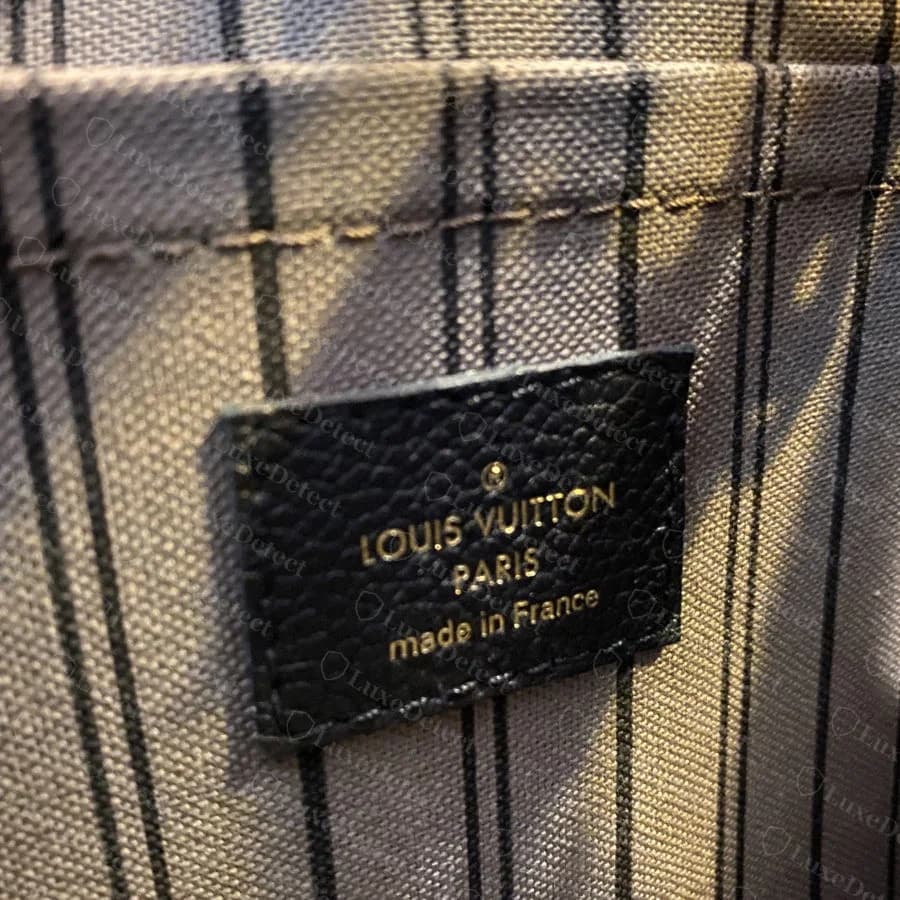
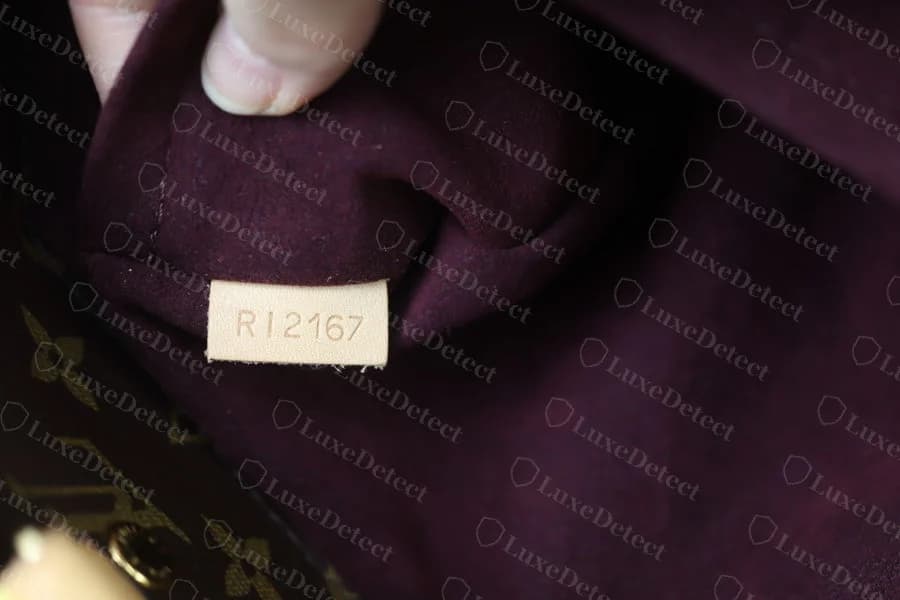
Open the bag fully and look at the lining, not just the exterior canvas. On a genuine Monogram-canvas Montaigne, the interior is a solid, unpatterned fabric, in our verified examples a plain taupe or aubergine suede-like textile, with a small leather tab stamped "LOUIS VUITTON PARIS made in [country]" sewn at one interior seam. On a genuine Empreinte-leather Montaigne, the lining is instead a tonal woven toile with a fine pinstripe, color-matched to the bag's exterior (grey pinstripe on black, magenta pinstripe on a magenta bag), again with the same leather stamp tab. In neither material does Louis Vuitton print an LV monogram pattern onto the lining fabric itself.
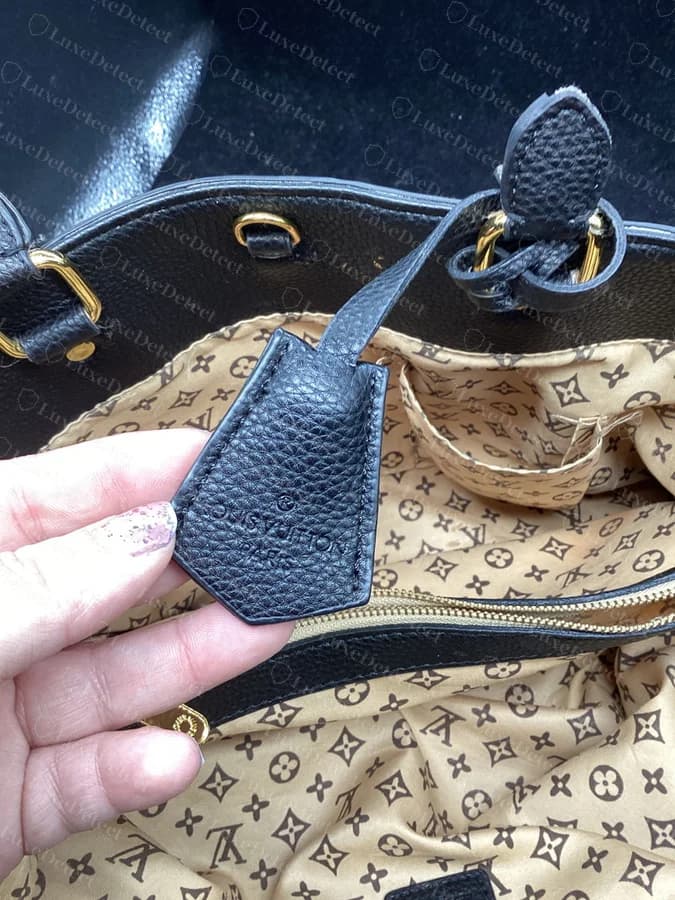
Several counterfeits in our sample used a printed tan fabric carrying a brown LV monogram print as the interior lining, the kind of stock more associated with a Neverfull or Speedy's exterior canvas than anything Louis Vuitton puts inside a Montaigne. It's a cheap, visually "on-brand" shortcut that doesn't match what the real bag actually does.
| Element | Authentic | Counterfeit |
|---|---|---|
| Monogram canvas lining | Plain suede-look fabric, single solid color | Printed brown LV-monogram-pattern fabric |
| Empreinte lining | Tonal pinstripe toile, color-matched to exterior | Printed brown LV-monogram-pattern fabric |
| Interior leather tab | "LOUIS VUITTON PARIS made in [country]," clean stamp | Present but paired with the wrong lining fabric |
| Lining texture | Woven textile or suede-look, matte | Often a stiffer, shinier printed canvas-style fabric |
Red flag
A printed LV-monogram-pattern fabric used as the interior lining is decisive on its own. We checked this against Monogram canvas, Empreinte, and multiple colorways of genuine Montaigne bags in our archive and never found it used as a lining material; genuine Montaigne interiors are always a solid, unpatterned textile, never a printed monogram fabric.
The Interior Heat Stamp and Date Code
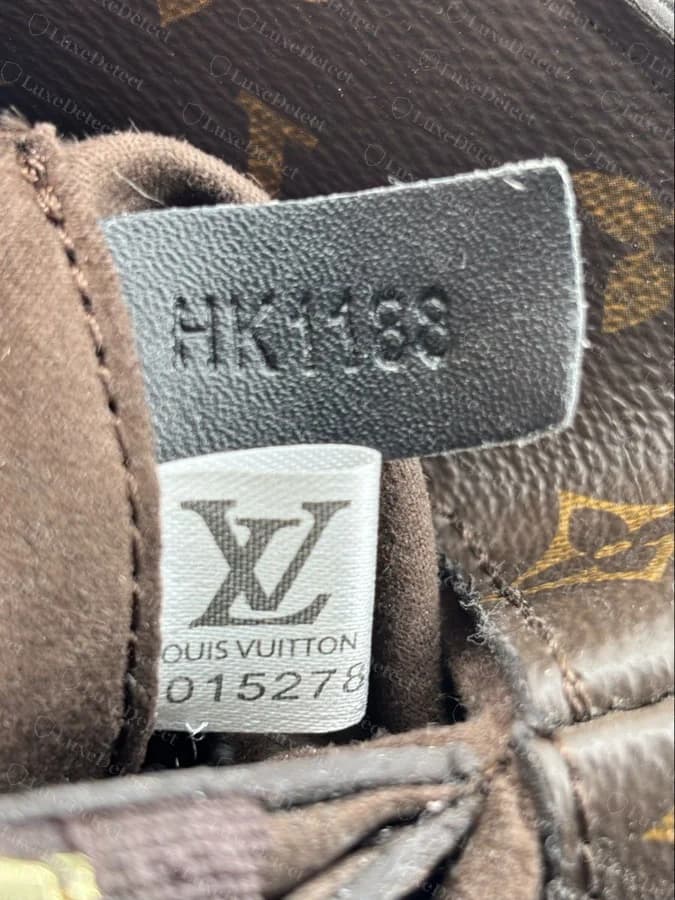
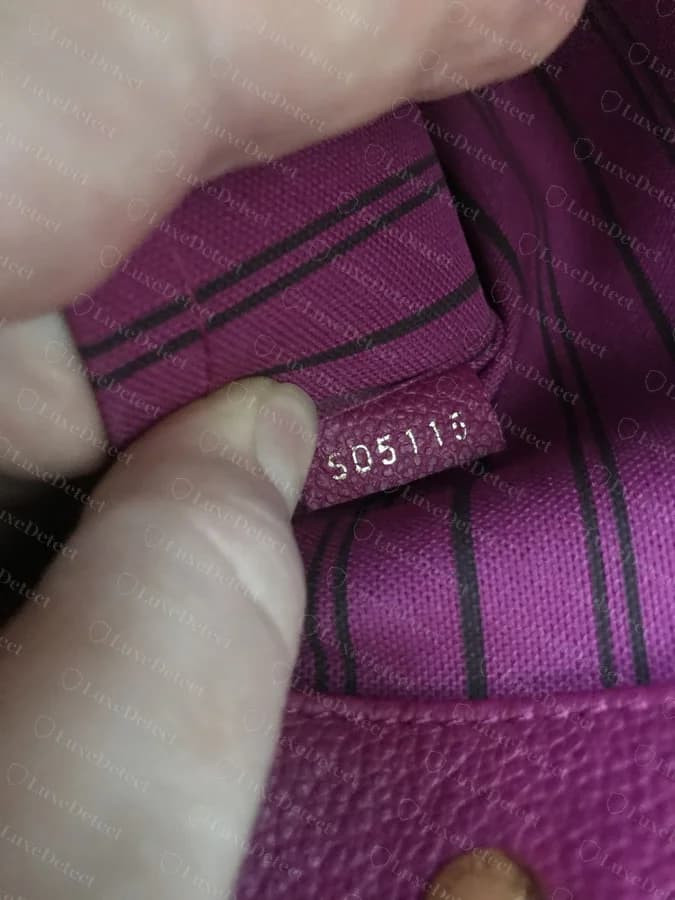
Near the lining tab, or on the same small leather panel, is the stamped date code: two letters followed by four digits on bags made before the RFID transition. In our sample, the code format itself (letters-then-digits) was often correctly replicated even on fakes that failed elsewhere, so a plausible-looking code alone doesn't clear a bag. What varies more is execution: a shallow, faint, or crookedly-struck stamp versus a crisp, evenly-pressed one, and in a small number of cases in our archive we also found a printed QR-code fabric label, or a separate numbered woven tag with a barcode-style number, stitched in alongside the date code. Louis Vuitton has never used a printed QR-code or barcode "authenticity" tag inside its bags; the date code stamp is the only serialization the house uses on a no-microchip bag.
| Element | Authentic | Counterfeit |
|---|---|---|
| Date code format | 2 letters + 4 digits, evenly stamped | Often correctly formatted; not decisive alone |
| Stamp quality | Crisp, consistent depth | Sometimes shallow or uneven, but varied in our sample |
| QR code / barcode tag | Never present | Seen stitched in alongside the date code on some fakes |
| Tag construction | Single leather tab, stamped directly | Sometimes an added printed fabric label with a QR code |
Red flag
A printed QR-code or numbered barcode fabric tag stitched in alongside (or instead of) the stamped date code is decisive on its own. Louis Vuitton's authentication method on a no-microchip bag is the heat-stamped code alone, never a printed QR or barcode label.
Worth knowing
A correctly formatted date code is not proof by itself; it gives you the production year, not the verdict. One well-executed counterfeit in our sample carried a plausible-looking code (correct two-letter, four-digit format) with no other visible defect in that photo, a reminder that this check alone won't catch a good fake. For the full breakdown of LV's date-code system by era, see our [complete guide to Louis Vuitton date codes](/blog/louis-vuitton-date-code-serial-number-guide).
Base Studs and Hardware Casting
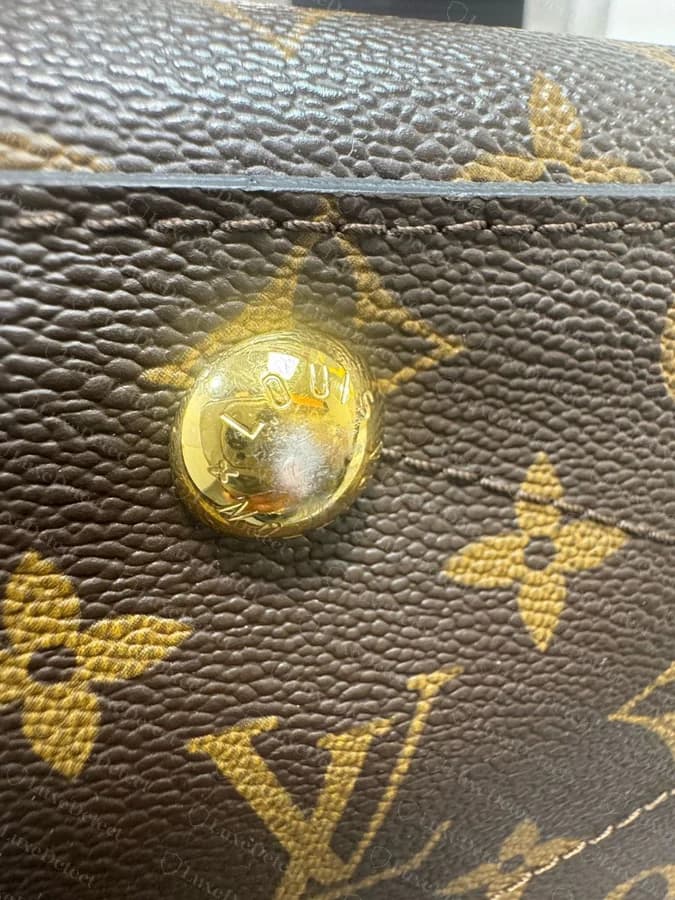
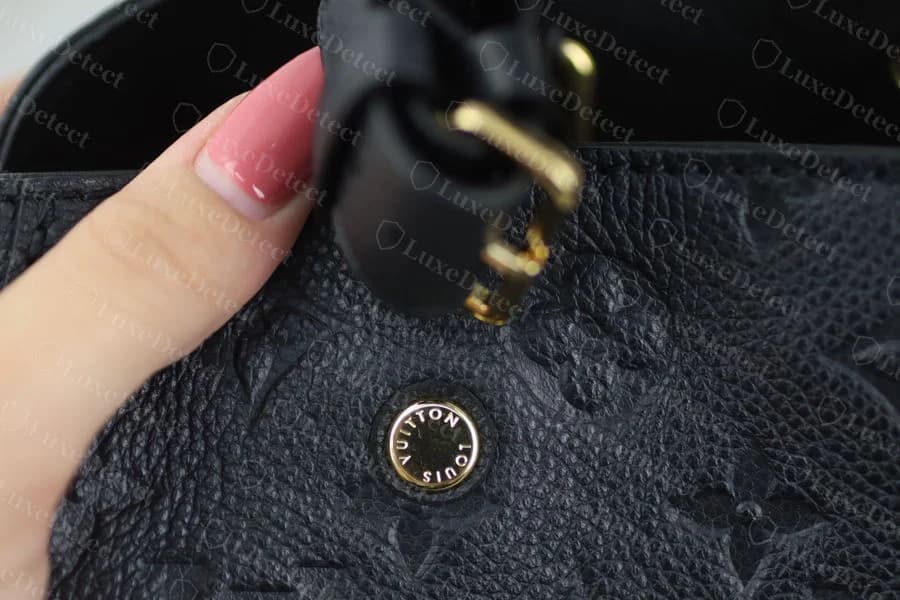
The Montaigne's base has four protective studs, and the handles, cadena, and zipper pulls all carry a stamped or engraved "LOUIS VUITTON" (or "LV" on the padlock). On genuine hardware, the lettering is evenly spaced, fully legible, and cast at a consistent depth around the circular stud face or along the flat plaque.
This check is a useful supporting signal but not a reliable one on its own: our sample included both a counterfeit with obviously distorted, bulging lettering on the base studs (letters crowding together, the dome itself slightly lopsided) and other counterfeits with base studs, cadena engravings, and zipper pulls that were cleanly and evenly struck, close enough to genuine that this detail alone wouldn't have separated them from the real thing.
| Element | Authentic | Counterfeit (varies) |
|---|---|---|
| Base stud lettering | Even spacing, consistent depth, true round dome | Sometimes crowded, bulging, or unevenly struck |
| Cadena engraving | Clean "LOUIS VUITTON PARIS," even depth | Ranged from clean to slightly shallow in our sample |
| Zipper pull | "LOUIS VUITTON" stacked cleanly on the pull tab | Generally well-executed even on fakes we reviewed |
Worth knowing
Hardware casting quality is worth checking but varies too much across the counterfeits we reviewed to treat as decisive by itself. Weigh it alongside the lining and tag checks above rather than as a standalone verdict.
What the Box and Dust Bag Do and Do Not Prove
A Louis Vuitton box, ribbon, and dust bag are easy to source separately from the bag itself and are frequently sold or reused on their own. Their presence tells you nothing about the bag inside; their absence tells you nothing either, since plenty of genuine resale bags were long ago separated from original packaging. Treat packaging as context for cross-referencing a listing, never as evidence.
Quick Authentication Checklist
- Open the bag fully and check the lining fabric: solid suede-look (Monogram) or tonal pinstripe toile (Empreinte), never a printed LV-monogram pattern
- Check for any added printed QR-code or numbered barcode fabric tag stitched in near the date code — genuine bags never carry one
- Read the stamped date code: confirm the two-letter, four-digit format, but don't treat a plausible code as proof by itself
- Inspect the base studs, cadena, and zipper pull lettering for even spacing and consistent depth, as a supporting check only
- Confirm the silhouette matches a genuine configuration (BB/MM/GM tote in Monogram or Empreinte, or the separate Epi Bowling with its turn-lock plaque)
A printed monogram lining fabric or a printed QR/barcode tag is sufficient on its own to reject the bag. Hardware casting quality and a clean-looking date code should be weighed together with the other checks, not relied on alone.
When to Get a Professional Opinion
The Montaigne's structured shape makes the interior lining check accessible to most buyers from photos alone, which is unusual for a mid-tier LV bag. Where DIY hits its limit is the base stud and hardware casting check, since our sample showed real variation in counterfeit quality there, and on the separate Epi Bowling line, where we simply didn't have enough verified counterfeit examples to write confident checks. If your lining and date-code checks come back clean but something still feels off, or you're looking at the Bowling variant specifically, a professional photo-based review starts at $25 and comes with a certificate of authenticity.
FAQ
Where is the date code on a Louis Vuitton Montaigne?
It's stamped on a small leather tab sewn into the interior, usually near the same seam as the "LOUIS VUITTON PARIS" lining stamp. On bags made after Louis Vuitton's roughly 2021 switch to RFID, there's no visible stamped code at all; see our guide to the LV RFID chip for that system instead.
What does the interior lining of a real Louis Vuitton Montaigne look like?
A solid, unpatterned fabric: a plain suede-look textile on Monogram canvas bags, or a tonal pinstripe toile color-matched to the exterior on Empreinte bags. It is never a printed brown LV-monogram-pattern fabric; that's one of the clearest tells we found across our counterfeit sample.
Does the Montaigne's padlock actually lock the bag?
No. Unlike the Speedy or Alma, the Montaigne's cadena is decorative, hanging from a leather loop near the handles rather than threading through the zipper pulls. The bag closes with a magnetic snap. The padlock should still be stamped "LOUIS VUITTON PARIS" and cast cleanly, but its presence or absence doesn't affect how the bag actually closes.
Is a QR code or barcode tag inside a Louis Vuitton bag ever genuine?
No. Louis Vuitton's authentication method on a no-microchip bag is limited to the stamped date code. A printed QR-code fabric label or a separate numbered barcode tag stitched in alongside it is not something the house uses and is a decisive red flag in our sample.
What's the difference between the Montaigne tote and the Montaigne Bowling?
The tote (BB, MM, GM) is the boxy top-handle shape most people mean by "Montaigne," closed with a magnetic snap and decorative cadena. The Bowling is a separate line in Epi leather with a rounder silhouette and a triangular turn-lock plaque closure instead. We didn't have enough verified counterfeit Bowling examples in our sample to build confident checks for that line specifically.
How much does it cost to authenticate a Louis Vuitton Montaigne?
Photo-based authentication starts at $25 for handbags with a 24-hour turnaround, with faster options available. It's worth it whenever the lining and date-code checks in this guide don't resolve cleanly, or on the Epi Bowling variant this guide doesn't cover in depth.