Luxury Accessories Authentication Specialist
Luxury accessories authenticator. Covers small leather goods, belts, and eyewear.
Published October 2026 · Contact
Why a Louis Vuitton Beanie Comes Down to the Labels Inside
A Louis Vuitton beanie is a small knitted hat with a very large reputation, which is why "lv beanie" is searched so often, and why fakes are sold under the name. It is also an awkward item to authenticate. There is no serial plate, no heat stamp and no stamped date code to read. A knit has no hardware to inspect, and the Damier or Monogram pattern is not a reliable check, because fakes copy it.
What a Louis Vuitton beanie does have is a set of labels sewn into the inside of the knit and a small logo patch on the cuff. That is where the fakes we have reviewed gave themselves away, in two different ways. Some were never trying to match Louis Vuitton's label system at all: a generic white acrylic care label, another maker's woven label, or a patch of LV canvas sewn onto a plain hat. Others copied the labels closely, and for those a label that looks right tells you very little.
This guide is built from a small sample. Beanies are a minor part of the Louis Vuitton hats we authenticate, most of which are caps and bucket hats, so every check below is worded with how sure we are. Each can condemn a beanie, and none can clear one. If the beanie passes everything here and the price is real money, the next step is an expert look at the item, not more label reading.
What to check, ranked by reliability
| Checkpoint | Reliability | What it tells you |
|---|---|---|
| 1. Labels From Another System: Acrylic, Another Maker, or a Patched Hat | ★★★★★ | A beanie with no woven Louis Vuitton label, a plain acrylic care label or a label from another maker is not a Louis Vuitton beanie. |
| 2. The Fibre and Reference Code on the Care Label | ★★★★★ | A fibre that does not fit the model, or a missing reference code, counts against the beanie; a plausible care label proves nothing. |
| 3. The Cuff Patch: Stitch and Contrast | ★★★★★ | A flat, tone-on-tone patch can raise doubts on a Damier beanie, but colourways vary, so it cannot condemn one alone. |
| Which Louis Vuitton Beanie Do You Have? | ★★★★★ | Tells you which design to expect and rules out reworked hats; will not catch a good fake. |
| Date Codes, Chips and Hangtags: What a Beanie Does Not Give You | ★★★★★ | We have seen no date code or chip on a genuine beanie, and tags and stickers are context only. |
Worth knowing
Louis Vuitton is a French house and calls a beanie a bonnet, so you may see that word on stickers and listings. This guide covers knitted beanies. Louis Vuitton caps and bucket hats are different items with different labels, so do not judge one against the other.
Which Louis Vuitton Beanie Do You Have?
The checks differ a little between designs. The ones that came up in our archive were:
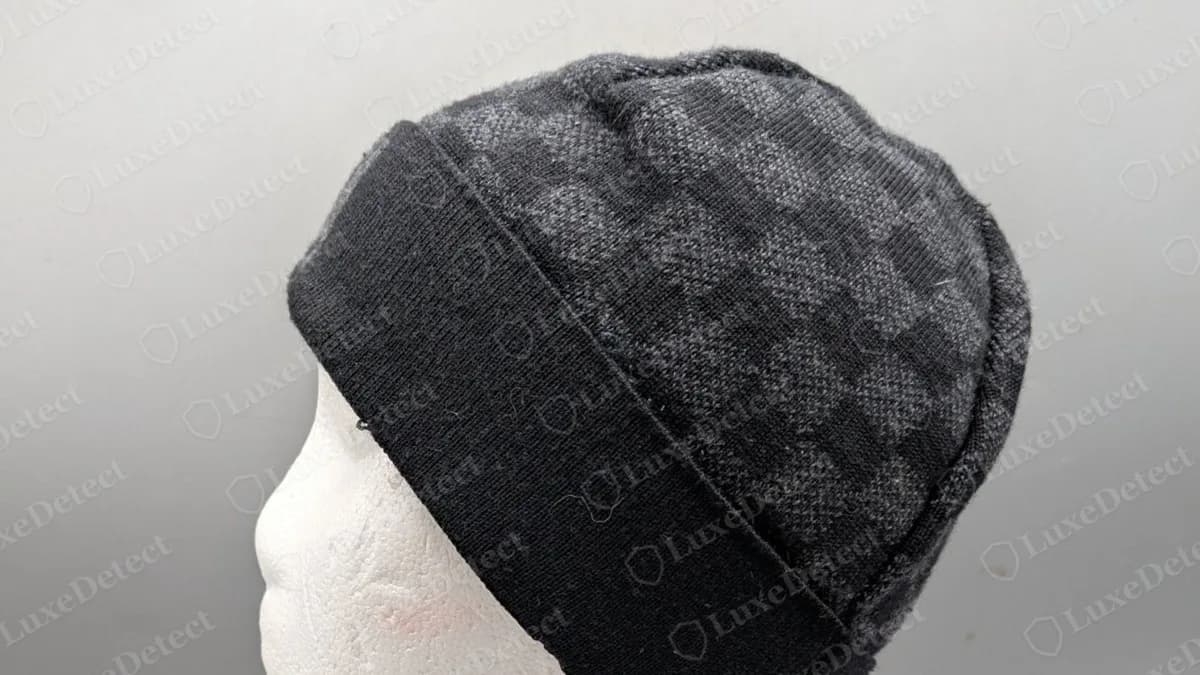
- Damier beanies (Petit Damier and Damier Graphite): a checkerboard knit with a plain ribbed cuff and a small embroidered LV patch on the cuff. This is the classic shape most buyers mean.
- Monogram knit beanies: the Monogram flowers and LV letters knitted all over, sometimes with a coloured band at the cuff or a collaboration motif.
- Logo-band beanies: a plain knit with the name or a logo knitted into the cuff, or a patch on the front.
- Reworked or "upcycled" hats: another maker's hat with a piece of Louis Vuitton canvas or a patch added. These are not Louis Vuitton products, even when the canvas is real.
Find the reference on the care label. The newer genuine beanies we examined carried a code starting with M followed by five digits, which you can search to identify the model.
What a Genuine Louis Vuitton Beanie Carries
On the genuine beanies we checked, the labels followed a consistent pattern. Use it as a reference for what to expect, not as a test: counterfeiters reproduce parts of it.
- A woven brand label reading LOUIS VUITTON over PARIS, sewn into the inside of the knit near the cuff or seam. On the newer pieces we saw it is navy with orange or gold lettering; on an older piece it was olive-brown with yellow lettering.
- A separate care label with the fibre content in percentages, DRY CLEAN ONLY, care symbols, Made in Italy and a reference code beginning with M. The older piece carried a shorter numeric code instead.
- An embroidered LV patch on Damier beanies: a square with a stitched frame and the letters in contrasting thread.
- Wool or a wool blend. The genuine beanies we checked were wool, wool with a little elastane, or a cotton and cashmere blend.
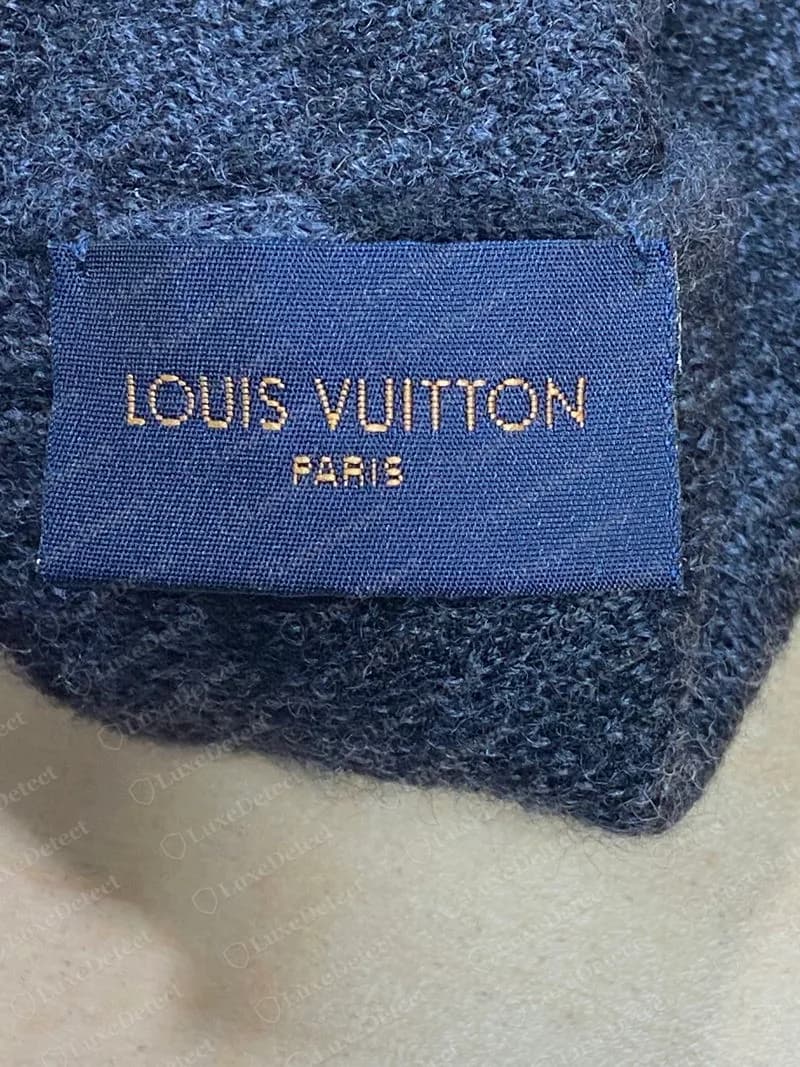
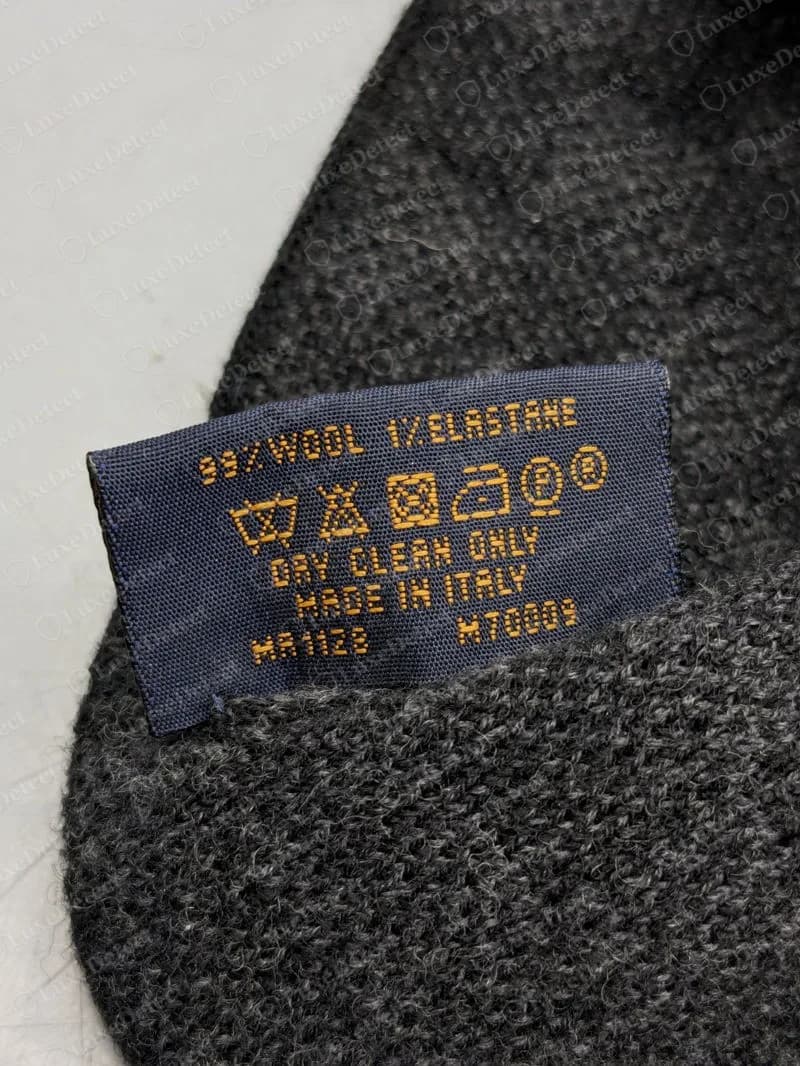
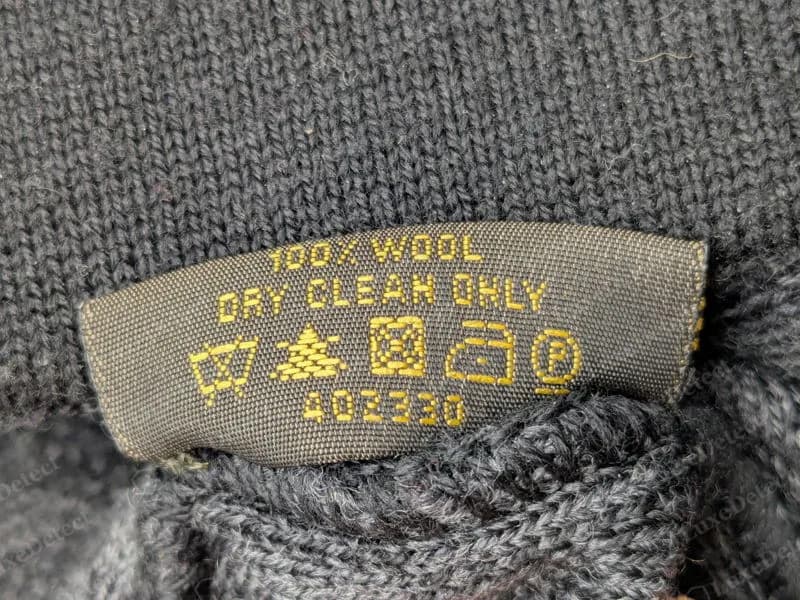
Genuine pieces vary by season, line and age, so none of this is a reason to pass or fail a beanie on its own. "Made in Italy" is on the genuine labels above, but a made-in line is never a tell by itself, because fakes print it too.
Labels From Another System: Acrylic, Another Maker, or a Patched Hat
This is the easy tier, and the clearest slip we found. Some of the fakes sold as Louis Vuitton beanies were plain hats made by someone else:
- a white printed care label reading 100% ACRYLIC with care symbols and MADE IN CHINA, inside a beanie knitted in an all-over Monogram print or a leopard print with a pompom;
- a woven black label from another maker, with that maker's name and a US registration number, on a cable-knit beanie with a faux fur pompom;
- a rectangle of Monogram canvas or leather held by brass rivets, sewn on the front of that kind of hat. It looks like Louis Vuitton material, but the hat around it is another maker's.
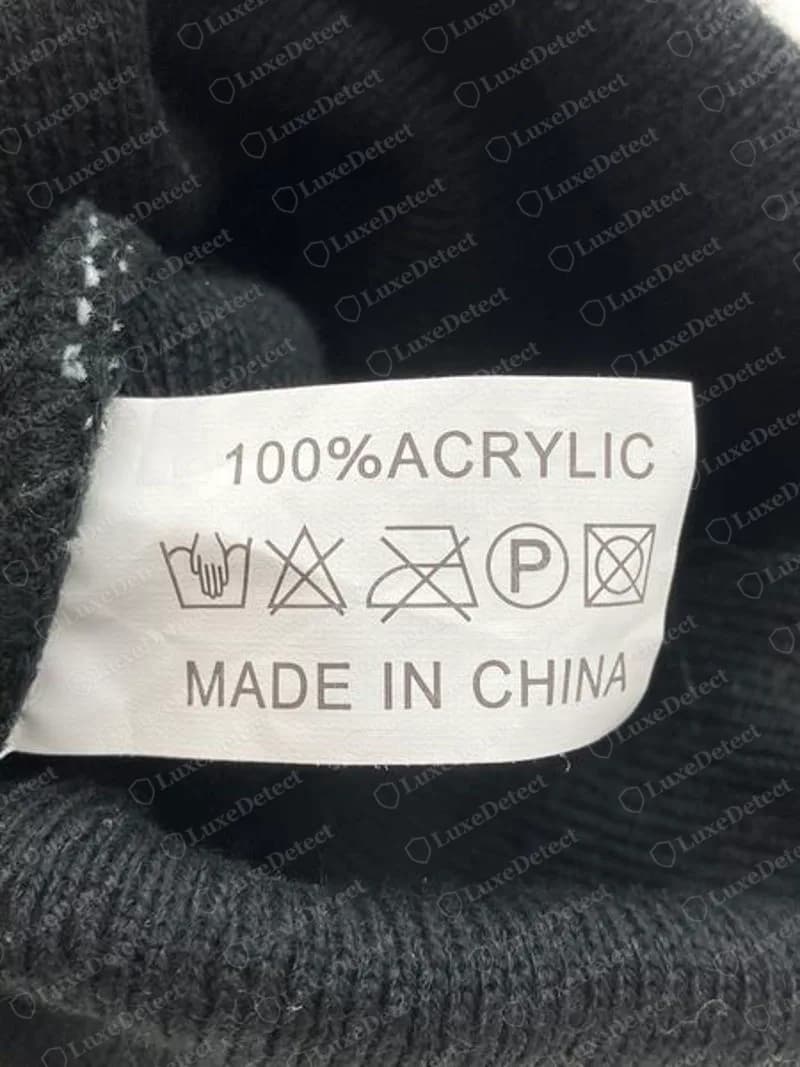
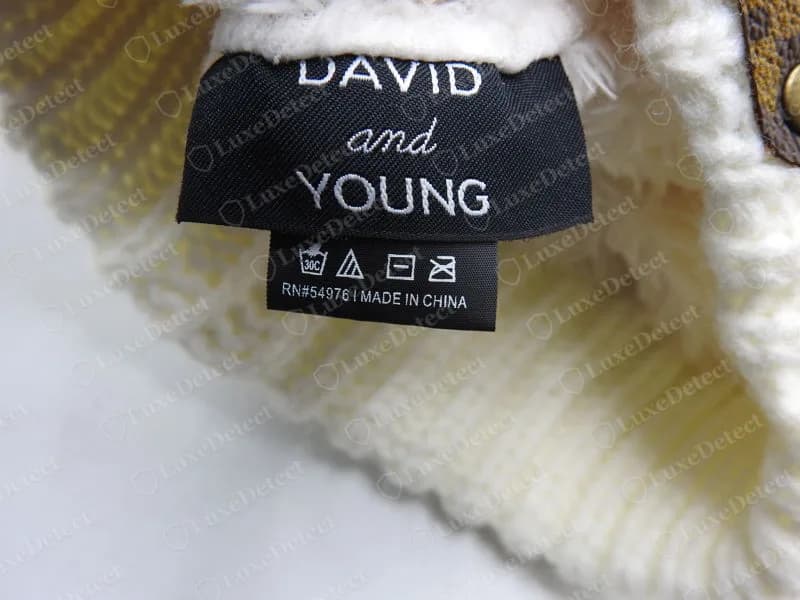
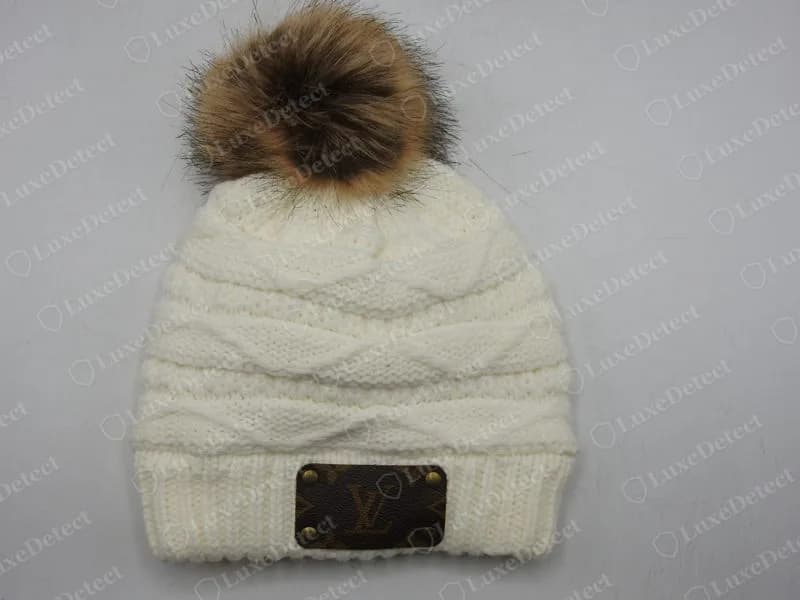
| Element | Authentic | Counterfeit |
|---|---|---|
| Inside label | Woven LOUIS VUITTON PARIS label | No Louis Vuitton label, or another maker's name (several fakes) |
| Care label | Louis Vuitton care label with a reference code | Plain white printed label, 100% acrylic (several fakes) |
| Logo | Knitted in or embroidered as part of the cuff | A riveted canvas or leather patch on a generic hat (some fakes) |
| Fibre on the genuine pieces we checked | Wool, wool and elastane, or cotton and cashmere | 100% acrylic |
Red flag
A beanie with no woven Louis Vuitton label, or another maker's label sewn in. Every genuine beanie we checked carried the woven LOUIS VUITTON PARIS label, and a hat made by someone else cannot be a Louis Vuitton hat however much real canvas is stitched to it.
Worth knowing
"Made in China" is not the tell here. It is the whole label that is wrong: a plain printed acrylic care label and no Louis Vuitton woven label. A fibre percentage on its own does not decide anything either, because we only checked a small number of genuine knits.
The Fibre and Reference Code on the Care Label
The better counterfeits do have a label that looks like Louis Vuitton's. The care label is where they slip, because it has to carry a fibre percentage and a reference that agree with the beanie in your hands.
On the genuine Damier beanies we checked, the care label read 99% WOOL 1% ELASTANE or 100% WOOL, with a reference starting with M or a short numeric code on the older piece. One counterfeit Damier beanie had a single black label combining the brand name and the care text, reading 100% CASHMERE and MADE IN UNITED KINGDOM, with no reference code at all. Not one of the genuine pieces we looked at had that combination.
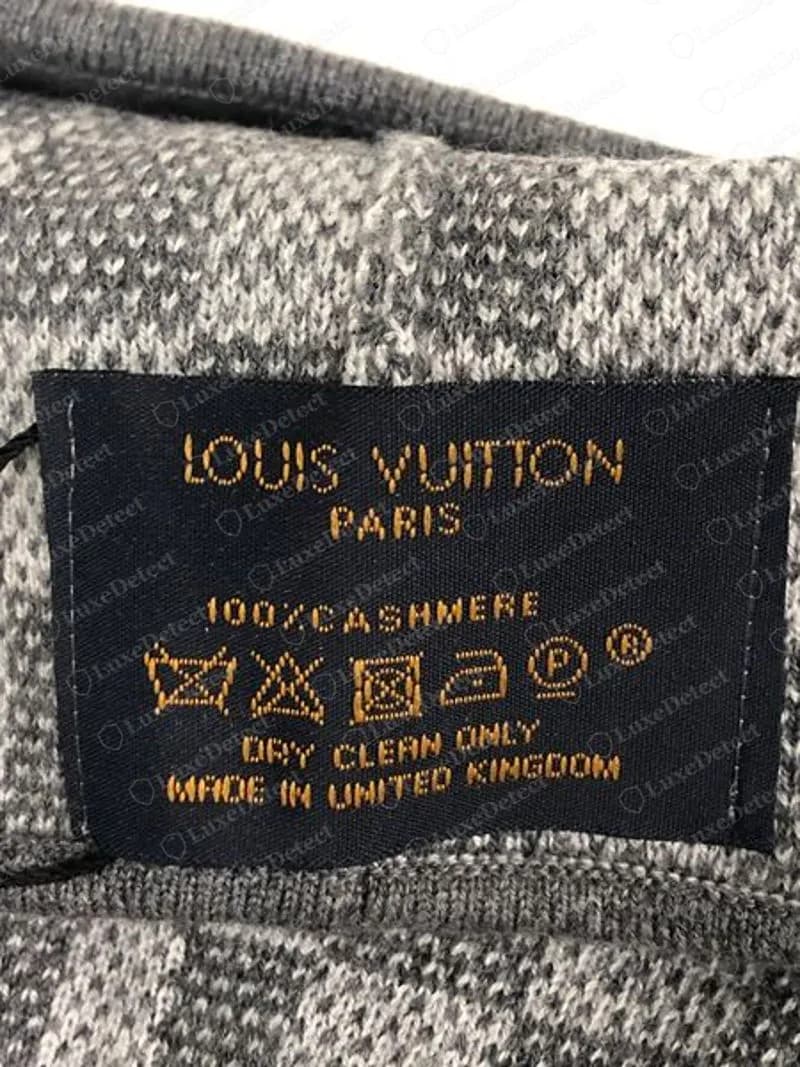
| Element | Authentic | Counterfeit |
|---|---|---|
| Layout | Separate woven brand label and care label | Brand name and care text on one label (seen on a fake) |
| Fibre | Matches the model (wool or wool and elastane on the Damier beanies we checked) | 100% cashmere on a Damier beanie (seen on a fake) |
| Reference code | Present, starting with M on the newer pieces | Missing (seen on a fake) |
Red flag
A care label that lists a fibre that does not match the model, or has no reference code at all. Search the reference and compare the composition and design it belongs to with the beanie in your hands. A mismatch is strong evidence against the beanie. Our sample is small, so treat it as evidence, not proof.
Worth knowing
Some fakes carry a reference code that is real. A reference only helps when it disagrees with what is on the hat, such as the wrong fibre, the wrong colour or the wrong design for that code.
The Cuff Patch: Stitch and Contrast
On Damier beanies the small LV square on the cuff is the one place a counterfeiter has to reproduce embroidery rather than a print. On the genuine patches we checked, the letters were stitched in a dark thread that contrasts with the ground, inside a stitched border.
On the grey Damier fakes we looked at, the patch was flatter, closer to tone-on-tone, with thinner, paler letters and a weaker contrast between the frame and the ground.
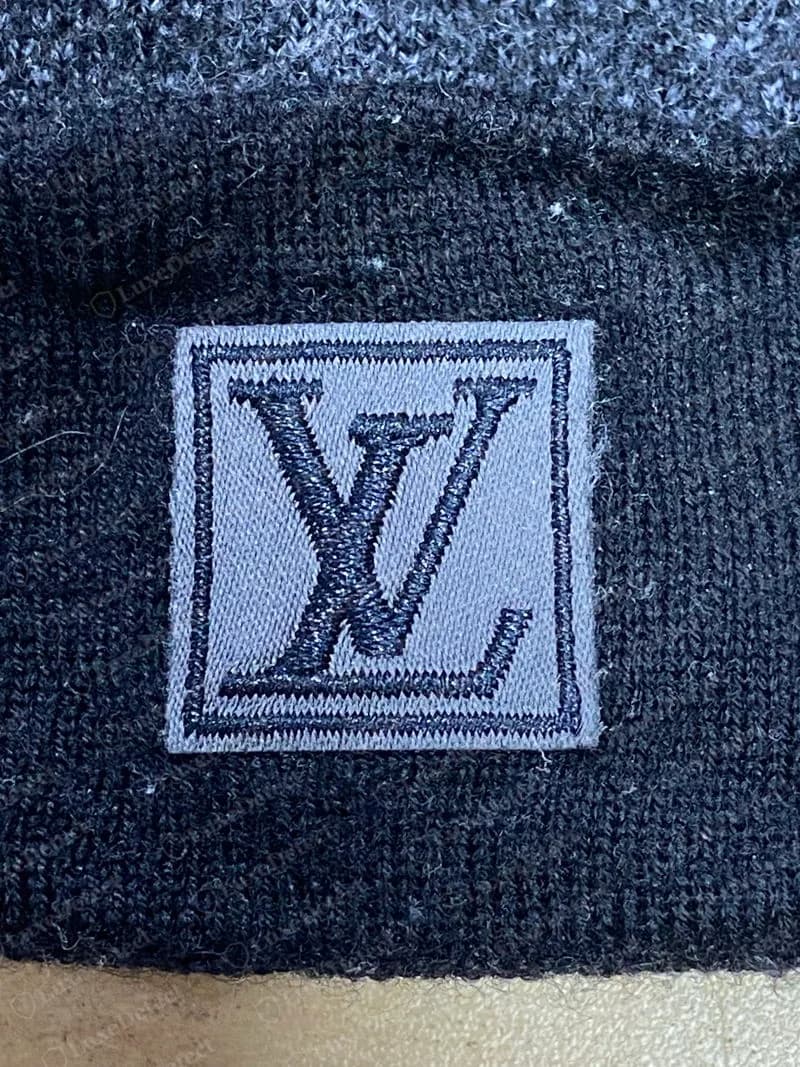
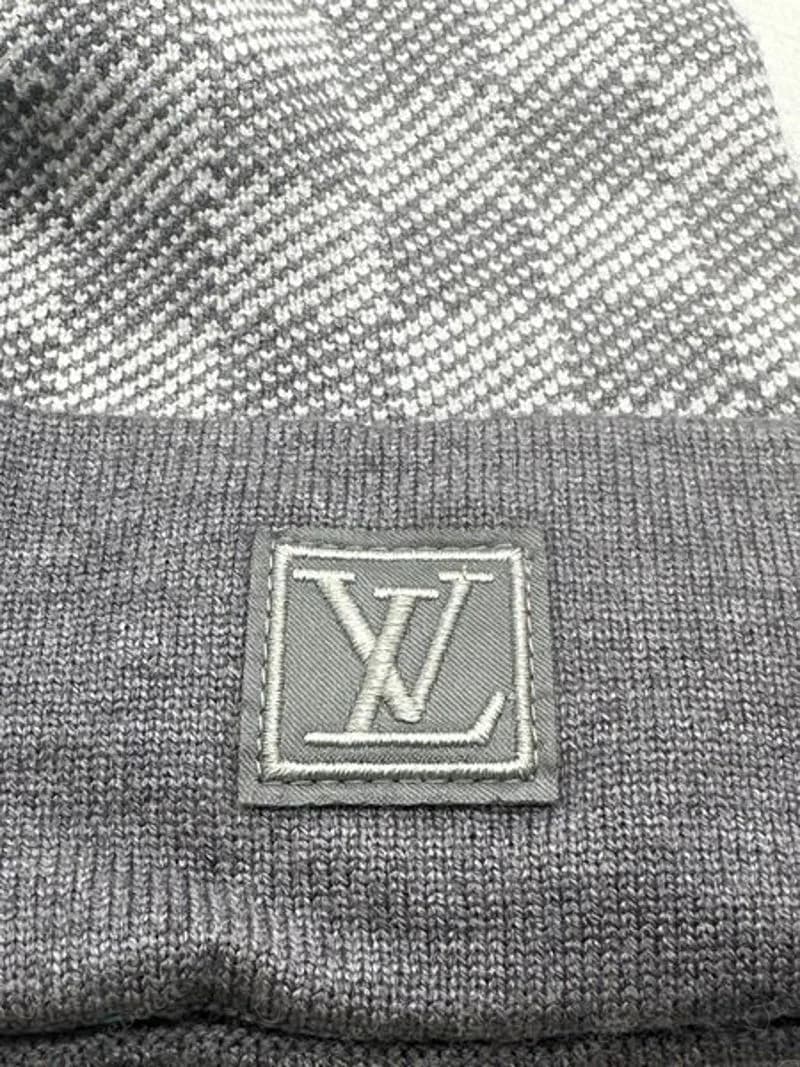
| Element | Authentic | Counterfeit |
|---|---|---|
| Patch | Embroidered square, dark thread on a contrasting ground | Flatter, tone-on-tone, thinner lines (some grey fakes) |
Worth knowing
This is the weakest of the three checks. Louis Vuitton makes many colourways, and a tone-on-tone patch can be correct on some of them. Use the patch to question a beanie that has already raised doubts elsewhere, not to condemn one on its own.
Date Codes, Chips and Hangtags: What a Beanie Does Not Give You
Many buyers ask where the date code is on an LV beanie. We have not seen a stamped date code or a chip on any genuine Louis Vuitton beanie. Date codes and chips are a feature of bags and leather goods. We could not confirm from Louis Vuitton itself what, if anything, a beanie contains, so do not look for a code and do not accept one as proof.
The date code guide and the chip guide cover bags and leather goods. They do not apply to a knit hat. A hangtag or sticker is the same: it is context, and a beanie with a perfect tag and a wrong label is still wrong. Fakes arrive with tags, boxes and stickers.
What Copied Labels Can and Cannot Prove
Put the checks together and the summary is one-way. Finding a slip is strong evidence against a beanie, but not finding one clears nothing, because some fakes have a complete label set. The fake below carried a LOUIS VUITTON PARIS label marked MADE IN ITALY, a model code and a multilingual care label.
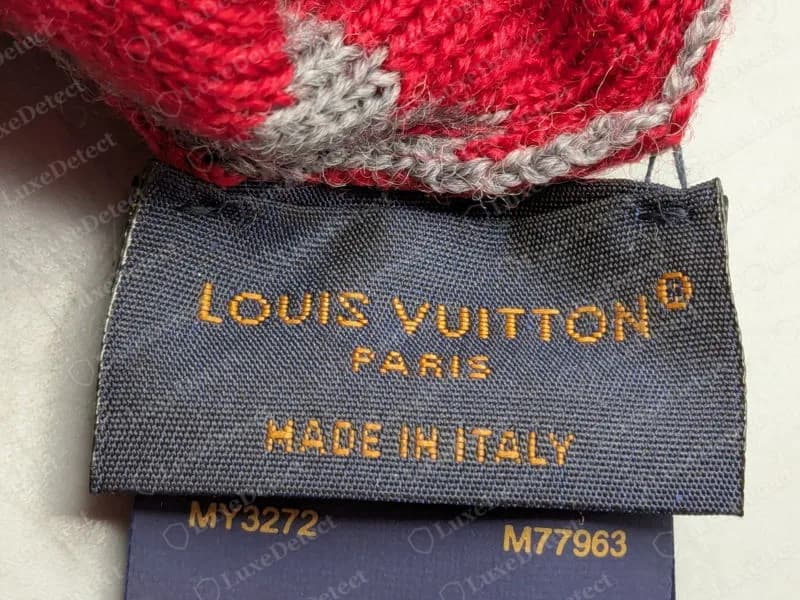
A correct label set does not prove a beanie is genuine, because fakes reproduce:
- the woven navy label, its colours and the PARIS line;
- a made-in line, including Made in Italy;
- care symbols and a plausible reference code;
- the knit pattern itself, including the Damier checks and the Monogram flowers.
We also found no repeatable pattern in the shape or weight of the knit across such varied beanies, so we make no claim about them here. The same logic runs through our Louis Vuitton clothing guide and the belt guide, where a copied label set also proves nothing.
Quick Checklist
- Find the woven LOUIS VUITTON PARIS label inside. No label, or another maker's name, is a fake.
- Read the care label. A plain white printed acrylic label is a fake.
- Check that the fibre and reference code agree with each other and with the model.
- Compare the cuff patch on a Damier beanie, as a weak extra check.
- Do not look for a date code or chip, and ignore tags, boxes and stickers.
- Treat every pass as neutral. A fully correct label set proves nothing.
When to Get a Professional Opinion
Most of the label slips in this guide are the easy tier. The better counterfeits reproduce the labels, and a single beanie in your hands can look right and still be wrong. If your beanie passes this checklist and the price is real money, the reliable next step is an expert look at the item. LuxeDetect authenticates Louis Vuitton accessories from $15 with a verdict in 24 hours. Start an authentication with clear photos of the woven label, the care label, the cuff patch and the beanie from every side.
A code that checks out doesn't prove the item is real. Counterfeiters copy genuine codes.
Our authenticators check the stamps, hardware and construction of your Louis Vuitton against verified references, from $15. You get a verdict within 24 hours, and a Certificate of Authenticity if the item passes.
Authenticate My Louis Vuitton →FAQ
How can you tell if a Louis Vuitton beanie is real?
Start inside the knit. A genuine LV beanie carries a woven LOUIS VUITTON PARIS label and a separate care label with a fibre percentage and a reference code. A plain white acrylic label, another maker's label or a missing reference is a fake signal. A matching label set does not make a beanie genuine, because fakes copy it.
Does a real LV beanie have a date code or serial number?
We have not seen one. A Louis Vuitton beanie has no stamped date code like a bag, and we could not confirm any chip in one. The reference code on the care label starts with M and identifies the model, not the production date.
What are real Louis Vuitton beanies made of?
The genuine beanies we checked were wool, wool with a little elastane, or a cotton and cashmere blend. A beanie labelled 100% acrylic is not one of them. A fibre percentage still proves nothing alone, because a counterfeit can print a believable one.
Is a Louis Vuitton beanie with "Made in China" fake?
Not because of the country, which is never a tell by itself. The problem is the label around it: a plain white printed acrylic care label and no woven Louis Vuitton label. The genuine beanies we checked carried Made in Italy, but copies print that as well.
Where is the label on an LV beanie?
Inside the knit, near the cuff or the seam. There is a woven LOUIS VUITTON PARIS label and a care label, sometimes joined, and a small embroidered LV patch on the outside of the cuff on Damier beanies.
Are Louis Vuitton Monogram beanies with a leather patch real?
A rectangle of Monogram canvas or leather with brass rivets sewn onto a generic knit hat is a reworked piece, not a Louis Vuitton product. Check the inside: another maker's label or a plain acrylic care label settles it.
Can a fake Louis Vuitton beanie have perfect labels?
Yes. Fakes with a complete label set exist, including a woven label, a made-in line and a multilingual care label. That is why every check in this guide can only condemn a beanie, never clear it.