Hermès Authentication Specialist
Handbag authentication specialist. Has reviewed submissions across Hermès, Chanel, Louis Vuitton, and Dior since 2019.
Last updated September 2026 · Published January 2026 · Contact
Why the Birkin Is the Most-Faked Bag on Earth
Hermès makes fewer than 70,000 Birkins a year; counterfeiters make that many in a week. A years-long waitlist and a resale spread from $14,000 to over $200,000 for exotics fuel an industry of "super fakes" that fool many sellers and some boutique staff.
The good news: an authentic Birkin is roughly 2,600 manual operations by one craftsman over 18–24 hours, and each leaves a fingerprint mass production cannot replicate. You need a checklist and patience, not a UV lamp.
This guide runs the checks in the order a professional authenticator uses them: blind stamp, stitching, hardware, leather, interior, accessories, provenance. For the exotic-leather symbols stamped next to the Hermès logo, see Hermès Special Stamps: What Every Mark Means.
The Blind Stamp — Production Year and Craftsman ID
The most diagnostic mark on a Birkin is the blind stamp: a small, heat-debossed group of characters for the production year and the artisan. "Blind" means pressed into the leather without ink — you see the impression, not a printed character. Counterfeiters almost always print or paint it, the fastest tell of all.
Where to find it
- Pre-2015: front of the right-side sangle (strap), under the buckle when closed
- 2015–2016: a small leather tab inside the bag
- 2017 onward: a small leather square stitched inside, usually on the right near the lining seam
If a seller says a "2022 Birkin" has the stamp on the sangle, the bag is fake.
How to read the year
Hermès has used three different year-encoding systems:
| Era | Format | Example |
|---|---|---|
| 1945–1970 | Single letter, no enclosing shape | A = 1945 … Z = 1970 |
| 1971–1996 | Single letter inside a circle | Ⓚ = 1981 (A = 1971 … Z = 1996) |
| 1997–2014 | Single letter inside a square, A to R | A in a square = 1997 … R in a square = 2014 |
| 2015–present | Single letter, no enclosing shape, in an order Hermès does not publish | T = 2015, X = 2016, A = 2017, C = 2018, D = 2019, Y = 2020, Z = 2021, U = 2022, B = 2023, W = 2024, K = 2025 |
Since 2015 the year letters rotate in a non-sequential order that Hermès does not publish. The list above is compiled by collectors and resellers from bags of known year, and the 2022 and 2023 entries are the least firmly confirmed, so a decoder is the practical way to date a post-2014 bag. Try the free Hermès Date Stamp Decoder — paste the characters and it returns the production year, format era, and where the stamp should physically appear.
Use our free Hermès Date Stamp Decoder to identify the production year of any Birkin, Kelly, or Constance — circle, square, or modern alphanumeric format.
Decode Hermès Stamp →The craftsman code
Below the year stamp (or alongside it on modern bags) is a second mark — a letter, a letter+number, or a few digits — identifying the artisan who built the bag, used for warranty and repair tracking. It should match the year stamp in depth and font, sit on the same line evenly spaced, and be present: a blind stamp with a year and no craftsman mark is a fake about 95% of the time.
Stamp execution
- Heat-debossed, not printed. Run a fingernail across it — you should feel a clean depression. Flush with the surface means printed.
- Crisp character edges. Hermès uses a metal type punch (sharp lines); fakes use rubber stamps (slightly fuzzy).
- Even pressure — all characters to the same depth, not one corner deeper.
- Correct font — a specific serifed typeface; the "Ⓞ" on O-year bags is a narrow oval, not a perfect circle.
The Sellier Saddle Stitch
Birkins are hand-stitched with the point sellier (saddle stitch) — two needles on one waxed linen thread through every hole from opposite sides — which no factory machine has replicated. It is the second most reliable marker after the blind stamp: each loop locks independently, so a cut stitch cannot unravel.
Lay a ruler along a straight body seam:
- 7–9 stitches per inch (about 3 per cm) on the top binding and handle seams of a 30cm; slightly fewer on 35/40, slightly more on 25.
- A consistent ~30° angle, upper-left to lower-right when the bag is upright — the signature of a hand-pulled saddle stitch.
- Identical stitch length the whole seam, no drift, no compression at corners.
- Waxed linen thread, slightly shiny with a faint yellow undertone even on white. Synthetic fake thread is bone-white and matte.
Machine stitching sits perpendicular to the seam and is perfectly straight; if a single stitch loosens and takes its neighbours with it, it's a lock stitch, not a saddle stitch — and not a Birkin.
Hardware — Weight, Engraving, and Mechanics
Birkin hardware is solid brass, plated in palladium, 18k gold, or set with stones. The metal is heavy, the plating thick, the engraving laser-cut.
The weight test
A new 30cm Togo Birkin in palladium hardware is roughly 1.1–1.4 kg (2.4–3.1 lbs) empty, the hardware accounting for 180–230 g. Pick it up empty and the weight sits at the base and the closure. A fake's hardware is usually zinc alloy or hollow-cast brass — lighter overall, with a too-uniform distribution.
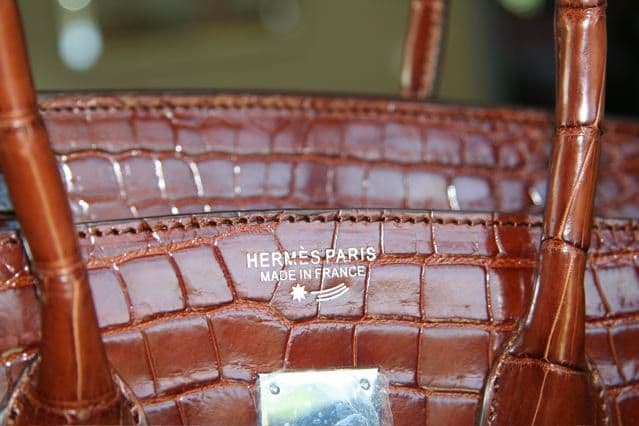
"HERMÈS PARIS" engraving
On the turn-lock plate, the cadenas, and the base feet: HERMÈS PARIS (sometimes "MADE IN FRANCE" on the lock), all caps, sharp serifs, evenly spaced, laser-cut so the depth shows under angled light, with a proper grave accent slanted at ~45°. Fake tells: "HERMES" with no accent, "Hermès" in mixed case, an accent that's a flat bar or slanted the wrong way, or flat-bottomed stamped channels instead of V-shaped laser cuts.
The turn lock
The toggle turn lock should rotate smoothly through ~90° with weighted, damped resistance — not loose, not stiff, not gritty — clicking softly into the closed and open positions with no metal-on-metal scrape, sitting perfectly horizontal when released. A fake feels rattly-loose or springy-stiff and snaps audibly.
Cadenas and keys
A brass padlock and two keys in a leather clochette. The padlock's serial number must match the number on both keys — any mismatch, even one digit, is a counterfeit signal — and the padlock body carries the same "HERMÈS PARIS" engraving quality as the bag.
Base feet and screws
Four feet on the base, engraved underneath. The screws holding them, seen from inside, should be slotted brass (not Phillips, not steel), consistently oriented, with no tool marks — fakes show scratches from mass-assembly tools.
Leather — The Hand Test
Common Birkin leathers:
- Togo: pebbled, scratch-resistant calfskin, most common; grain irregular and natural, no two square inches alike.
- Clemence: like Togo with a larger, softer grain; heavier and slouchier.
- Epsom: embossed, machine-grained calfskin, holds structure crisply; grain uniform and geometric, which is correct for Epsom.
- Swift: smooth calfskin, deep colour saturation, glove-soft.
- Box calf: vintage smooth leather, glossy, patinas; mostly older Birkins.
- Chèvre: goat leather, lightweight, common for the lining.
Smell: vegetable-tanned leather — slightly earthy, slightly sweet, natural, like a saddler's workshop. A fake smells of rubber cement, solvent, plastic, or harsh leather treatments. If you have to convince yourself it's real, it isn't.
Hand feel: authentic Togo has temperature mass (warms slowly under your hand), feels dry (not sticky or waxy), rebounds within seconds from a firm press, and redistributes rather than cracking when you bend a corner.
The Interior — Where Fakes Often Slip Up
Counterfeiters focus on the exterior, so the inside of a fake is where giveaways pile up.
- Lining: usually chèvre (goat leather), sometimes a contrasting colour — smooth, slightly grippy, faint natural sheen. Fake linings are often pleather, suede, or vinyl.
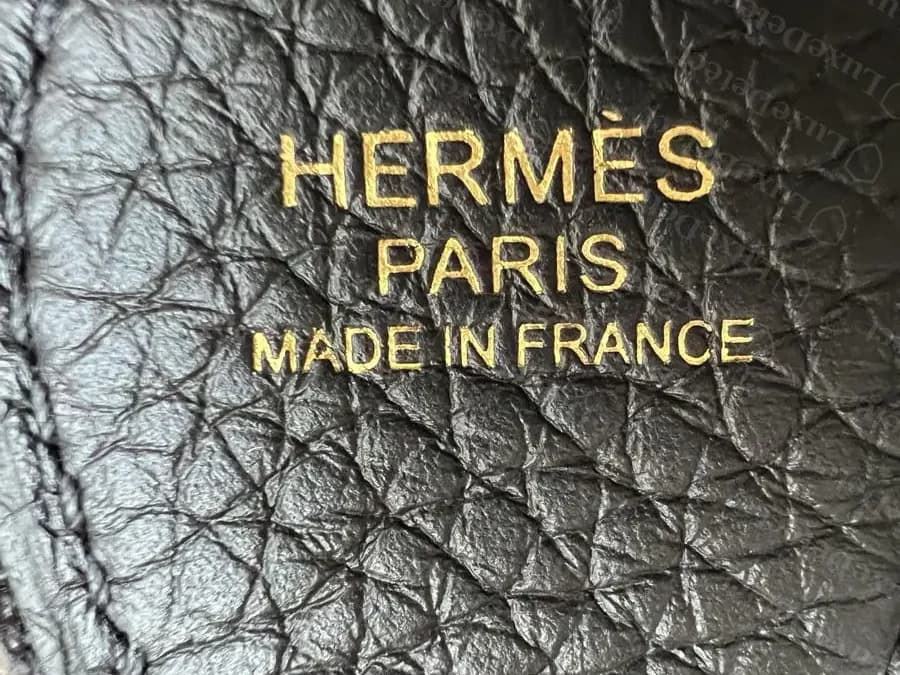
- Interior leather square: embossed HERMÈS PARIS MADE IN FRANCE in three lines, font matching the hardware. The post-2017 blind stamp sits here.
- Pockets: a Birkin 30 has one flat and one zipped, the zipper pull branded "Hermès" with the hardware's engraving quality.
- Stitching: the same saddle stitch as the exterior — not machine-stitched, not glued.
No leather square, no zipper branding, or a printed (not embossed) interior stamp means a fake.
Sangles, Clochette, and Closure Geometry
Close the bag as for everyday use, without the lock, and look down the centreline:
- The two sangles must align within ~1 mm — Hermès tunes this by hand. A 2+ mm misalignment is one of the most reliable fast tells on super-fakes.
- The strap holes sit dead centre over the toggle, equal leather either side.
- The clochette hangs from one handle, hand-stitched with the same saddle stitch as the body — visible glue or machine stitching means a fake.
Box, Dust Bag, and Documentation
Provenance accessories are faked too, but they're where amateur counterfeiters slip:
- Dust bag: warm, slightly red-leaning Hermès orange (never neon or yellow-orange), with a brown stamped logo. Post-2014 is a softer felt-like cotton, older ones flatter.
- Box: rigid, ribbed orange cardboard, magnetic closure (post-2010) or ribbon tie, brown logo correctly positioned.
- Receipt: specific codes — colour (e.g. "89 noir"), leather, hardware, and a unique reference number, in a consistent font and layout. Typeface inconsistencies are a flag.
- Rain protector and felt protectors for storage.
A bag with no accessories should be authenticated with extra rigour and priced accordingly.
The 2026 Super-Fake Landscape
The current "super fakes" out of Guangzhou and Istanbul get the silhouette right, the hardware weight close, and the smell partly convincing. What they still get wrong: the blind stamp is almost always printed, not debossed; the saddle stitch is machine-imitated and not 30° all the way through; the craftsman code is often missing or misformatted; the leather has a chemical undertone; and the interior leather square is frequently printed with a font that doesn't match the hardware.
For any bag over $5,000, run the full sequence and submit photos for professional authentication if anything feels off.
FAQ
How can I quickly tell if a Birkin is fake?
Run a fingernail across the blind stamp — an authentic one is heat-debossed and you feel a clear depression; a fake is almost always printed flat. A stamp missing the craftsman code (the small mark below the year) is a near-certain fake regardless of the rest of the bag.
Where is the date stamp on a Birkin?
Pre-2015, on the front of the right-hand sangle. 2015–2016, an interior leather tab. 2017 onward, a small leather square stitched inside, usually on the right near the lining seam. A "modern" Birkin with the stamp on the sangle is fake.
What does the letter inside a circle or square on a Hermès bag mean?
The production year: circle = 1971–1996, square = 1997–2014, a plain letter with no frame = 2015 onward (T 2015, X 2016, A 2017 and so on, in an order Hermès does not publish and collectors compile from bags of known year). The Hermès Date Stamp Decoder reads any of these.
How many stitches per inch should a Birkin have?
About 7–9 hand-pulled saddle stitches per inch (~3 per cm) on the top binding and handle seams of a 30cm, slightly fewer on larger bags. The angle matters more than the count: ~30° upper-left to lower-right, perfectly consistent along the seam. Machine stitches sit perpendicular — the fastest stitching tell.
How much does an authentic Birkin 30 weigh?
Roughly 1.1–1.4 kg (2.4–3.1 lbs) empty in Togo with palladium hardware, the weight concentrated at the closure and base feet. Fakes are typically 150–300 g lighter with a more uniform distribution.
Should I get my Birkin professionally authenticated?
For any Birkin over a few thousand dollars — essentially all of them — yes. Submit well-lit photos of the blind stamp, the saddle stitch on the top binding, the turn-lock engraving, the interior leather square, the padlock-and-key serial match, and the base feet. A professional can usually issue a verdict within 24 hours.
Final Checklist
- Blind stamp present, heat-debossed, year and craftsman code on the same line — decode it
- Stamp location matches the era (strap or sangle before 2015, interior from 2015)
- Saddle stitch ~30° NW→SE, 7–9 per inch on a 30cm
- Hardware engraving reads HERMÈS PARIS, grave accent slanted, laser-cut crisp
- Turn lock rotates smoothly with damped resistance
- Padlock and both keys share one serial number
- Four base feet, slotted brass interior screws
- Interior leather square embossed, not printed
- Sangles align within 1 mm closed
- Leather smells of natural tanning, not chemicals
- Empty weight 1.1–1.4 kg for a 30cm
- Accessories: dust bag (warm orange), box (ribbed, magnetic), receipt with colour and leather codes, rain cover, felt protectors
If any one fails, get a professional authentication before committing. At Birkin prices, a verification report is rounding error.