Handbag Authentication Specialist
Handbag authentication specialist. Has reviewed submissions across Hermès, Chanel, Louis Vuitton, and Dior since 2019.
Published September 2026 · Contact
Why the Noé Is a Hardware Test, Not a Canvas Test
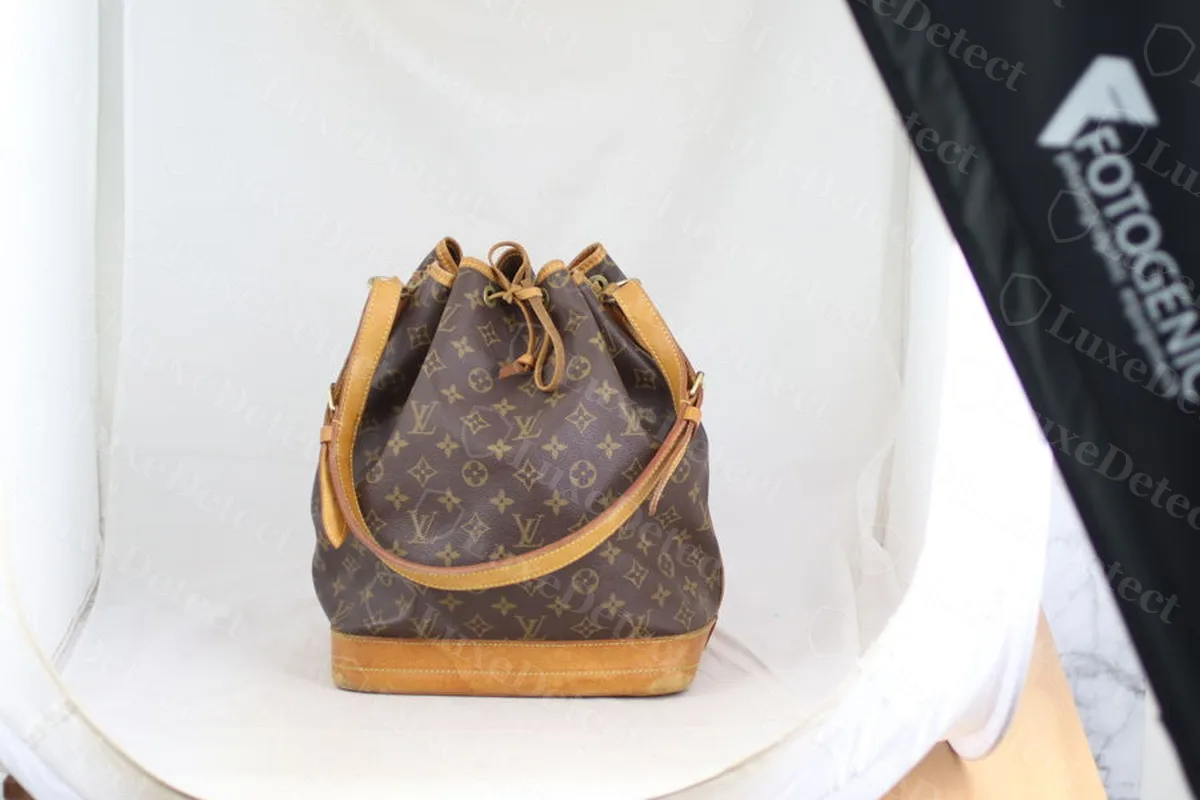
The Noé was built in 1932 as a champagne-bottle carrier for Moët & Chandon's cellar master, and the drawstring bucket shape that resulted has stayed close to unchanged for nearly a century, through a Petit Noé version in 1975, and later Epi leather, Damier Azur, and Multicolore editions. Because the silhouette is so simple, a cone-shaped panel, a leather-bound top, four brass eyelets, and a drawstring, counterfeiters get the overall shape right almost every time. What we found reviewing LuxeDetect's own submission photos is that the fakes fall apart at a much smaller scale: the brass rivets and the interior leather heat stamp, both of which require a die or a press that most counterfeit workshops either can't source correctly or don't bother replacing when it wears out. We saw the same die-level printing defect, mirrored or backward lettering, repeat across multiple unrelated fake Noé and Petit Noé submissions, in different materials and different eras of construction. That's the angle for this guide: don't waste time squinting at the monogram from three feet away, get close to the hardware.
What to check, ranked by reliability
| Checkpoint | Reliability | What it tells you |
|---|---|---|
| 1. The Rivets: Correctly Struck vs Mirrored Text | ★★★★★ | Mirrored or backward "LOUIS VUITTON" text on any rivet is decisive on its own; confirmed across four independent fakes in different materials. |
| 2. The Leather Heat Stamp: Letter Spacing and Registration | ★★★★★ | Cramped, unevenly spaced lettering caught several fakes carrying the correct wording, but a very well-made stamp could still pass. |
| 4. Canvas, Epi, and Damier Azur: Material and Print Quality | ★★★★★ | A mirrored monogram motif is decisive when present, but overall material and colorway are easy to copy convincingly from a distance. |
| 3. The Drawstring Closure and Toggle | ★★★★★ | Confirms the same rivet stamp defect at the eyelets, but the cord and toggle themselves show mostly normal wear on both real and fake bags. |
| Model Reference Before You Start | ★★★★★ | Rules out a mislabelled NeoNoé or Nano Noé; will not catch a good fake of the correct model. |
| What the Box and Dust Bag Do and Do Not Prove | ★★★★★ | Packaging is context only, most vintage Noé bags on the resale market never had retained packaging to begin with. |
Use our free LV Date Code Checker to instantly decode your bag's factory and production year.
Check My Date Code →Model Reference Before You Start
- Noé (GM) — the original size, roughly 30cm tall, a deep bucket meant to hold four bottles upright. Monogram canvas with vachetta (untreated) leather trim, four brass eyelets around the top, a leather-wrapped drawstring, and adjustable shoulder strap.
- Petit Noé — introduced in 1975, a smaller, more structured version of the same silhouette, closer to a handbag than a carryall. Sold in monogram canvas, Epi leather, Damier Azur, and the 2003 Murakami Multicolore collaboration (which adds a small front flap pocket with a padlock-style clasp not found on the plain monogram version).
- NeoNoé and Nano Noé are different, newer models, not older or younger versions of the Noé. NeoNoé (launched 2017) has a flat leather base, a drawstring that cinches differently, and a rounder overall body. If a listing says "NeoNoé," "Nano Noé," or "NN," you're authenticating a different bag with different reference points than the ones in this guide.
- Materials found across genuine examples: monogram canvas (most common), Epi leather (textured, dyed-through calfskin, in black, red, and other solid colors), Damier Azur canvas (pale blue-and-white check), and the Multicolore canvas used on some Petit Noé pieces.
- Made in France is standard on vintage and most modern production; later pieces from other Louis Vuitton ateliers (Spain, USA) also exist and are not on their own a red flag. What matters is whether the stamp reading it is struck cleanly, not which country it names.
The Rivets: Correctly Struck vs Mirrored Text
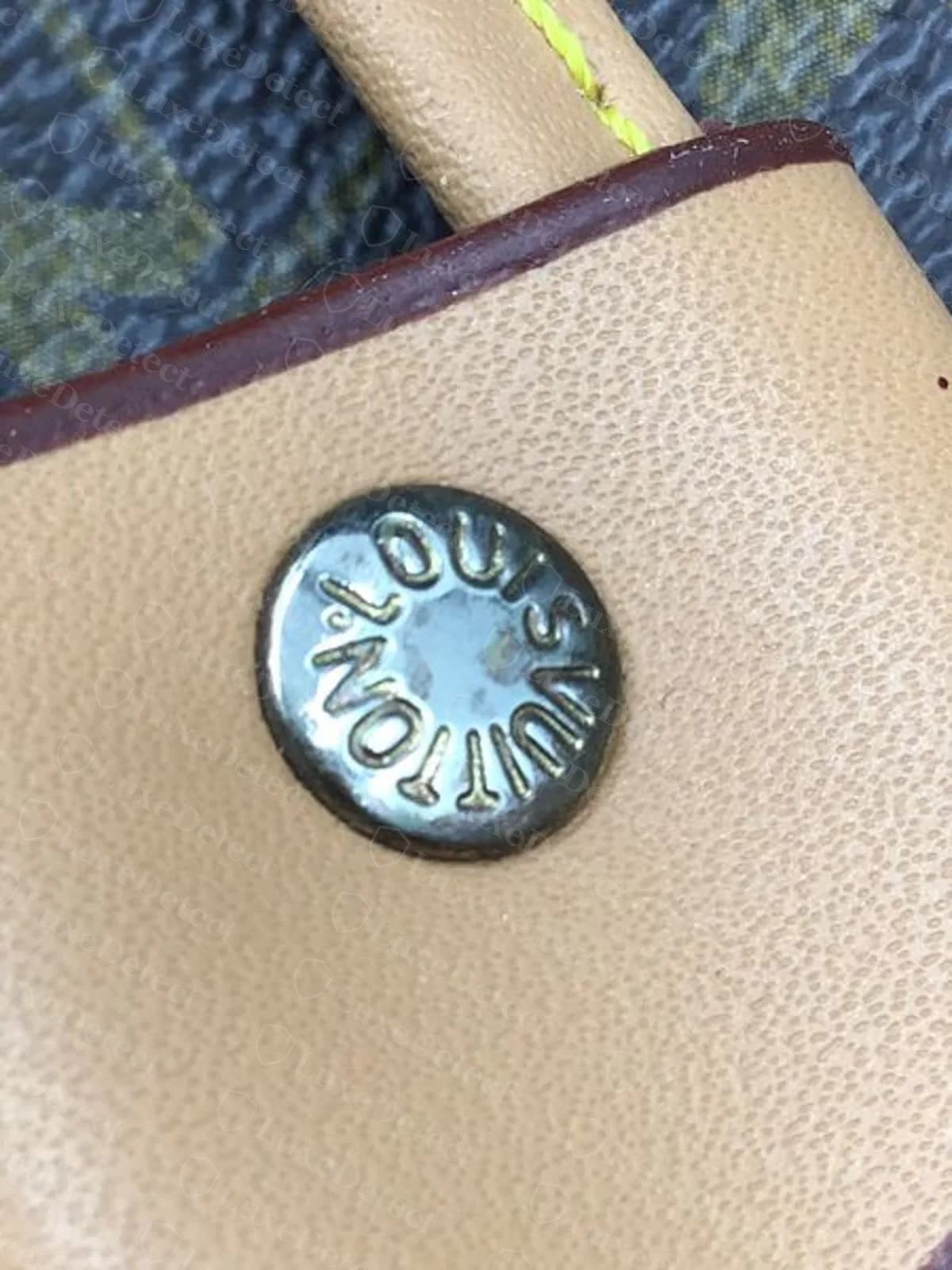
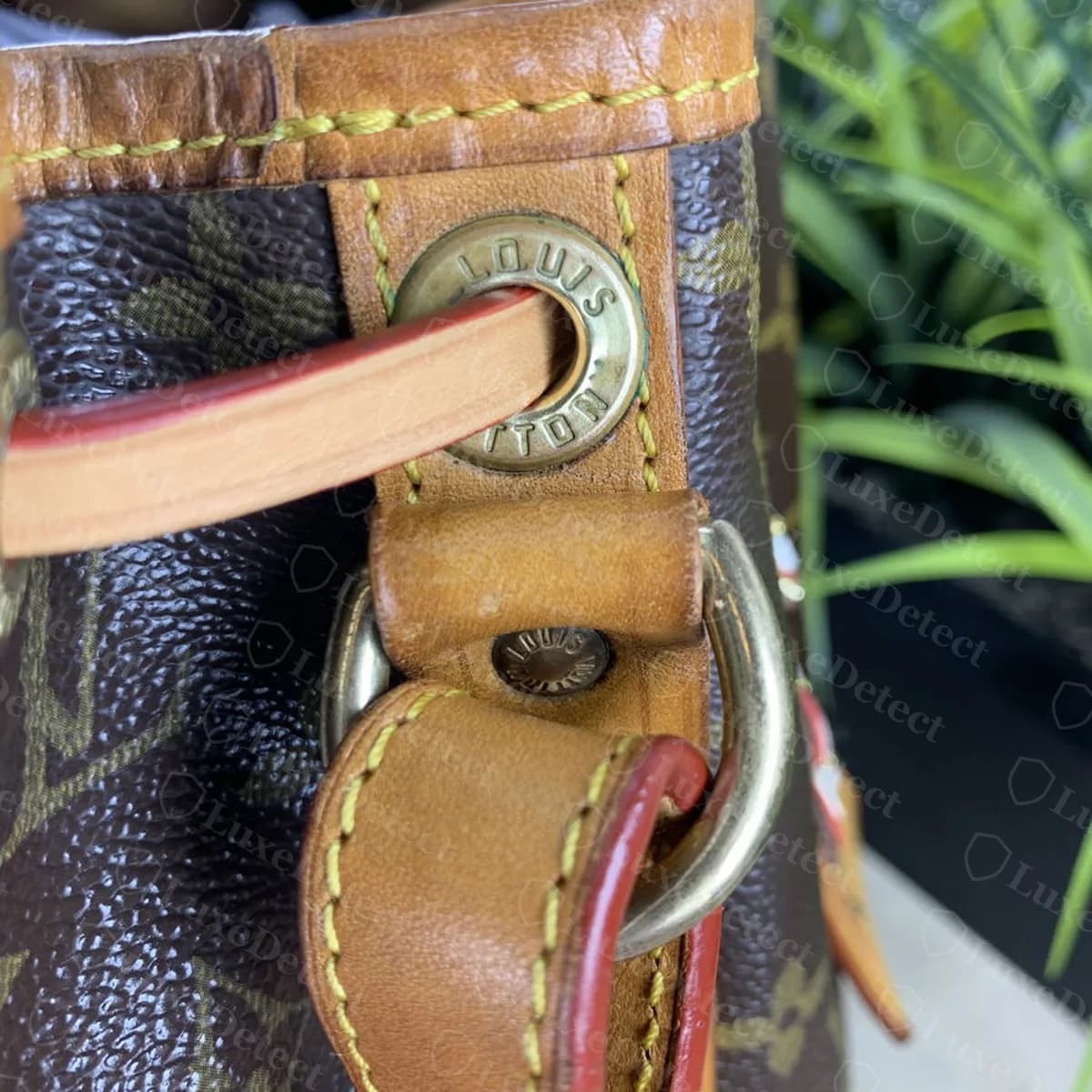
Every Noé and Petit Noé has small brass rivets, at the strap attachment points and holding the leather tabs in place, each stamped in a circle with "LOUIS VUITTON." On a genuine bag, every rivet on the bag reads cleanly and correctly, letter by letter, no matter which one you look at. Across the fake submissions we reviewed, we found the opposite: rivets where half the text struck correctly and the other half printed as a mirror image, "LOUIS" reading normally on one side of the circle and "NOTTIUV" (Vuitton, reversed) on the other. We confirmed this defect independently on four separate fake bags, spanning different eras of construction and at least two different materials (monogram canvas and Epi leather), which rules out a one-off manufacturing accident and points to a shared bad die used by multiple counterfeit sources.
| Element | Authentic | Counterfeit |
|---|---|---|
| Rivet text | Reads "LOUIS VUITTON" correctly all the way around, on every rivet on the bag | One or more rivets show partially or fully mirrored text |
| Consistency across the bag | All rivets struck from the same correct die | Mixed: some rivets correct, others reversed, even on the same bag |
| Letter depth and clarity | Even, consistent depth, slightly worn with age but always legible | Sometimes shallow or blurred in addition to the mirroring |
Red flag
Any rivet on the bag where the text reads backward or mirrored, even partially, is enough to reject the bag on its own. We verified this exact defect on four independent fake submissions in different materials, which means it isn't a fluke of one photo or one bag, it's a repeatable tell tied to the tooling counterfeiters are using.
The Leather Heat Stamp: Letter Spacing and Registration
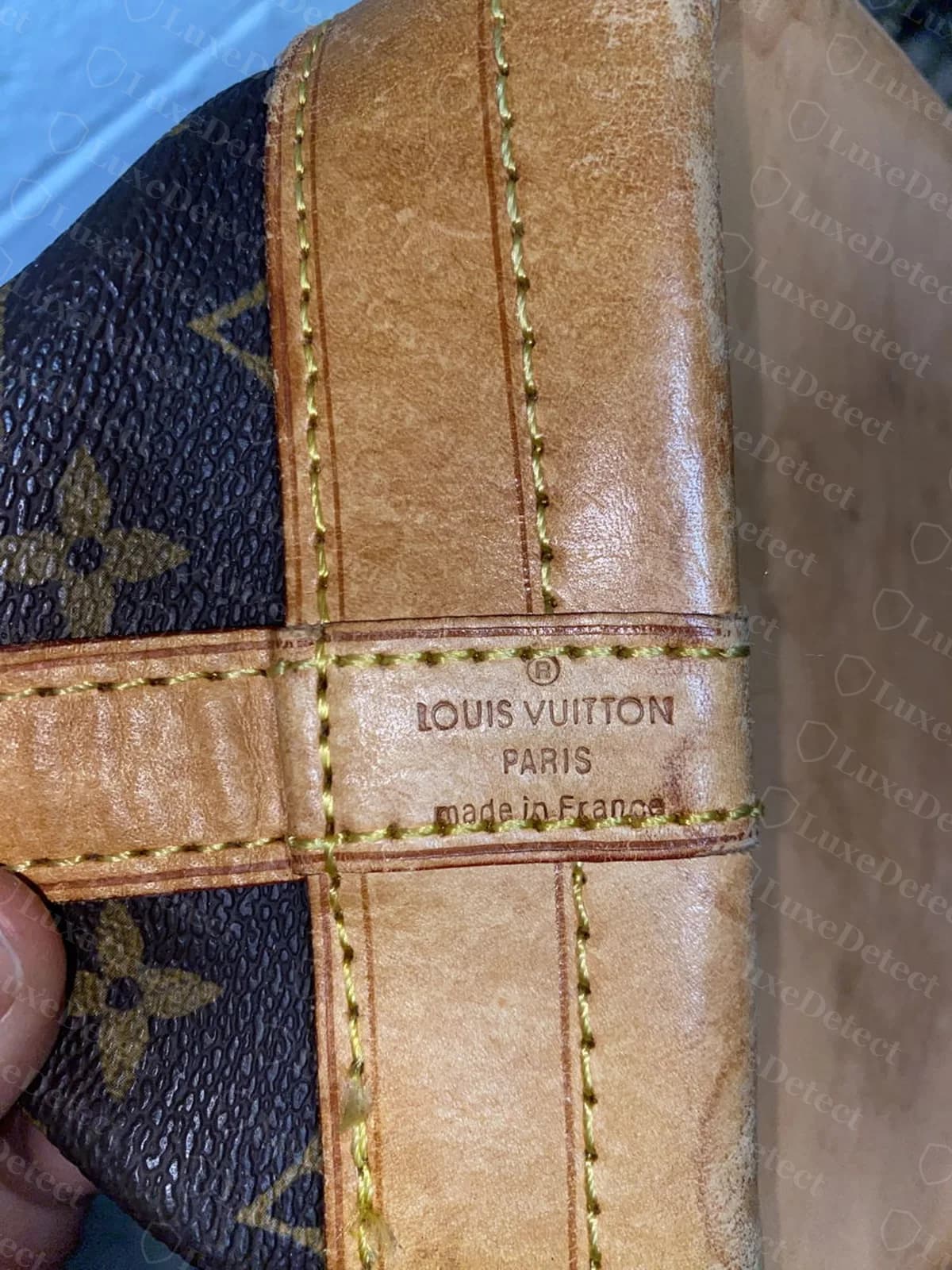
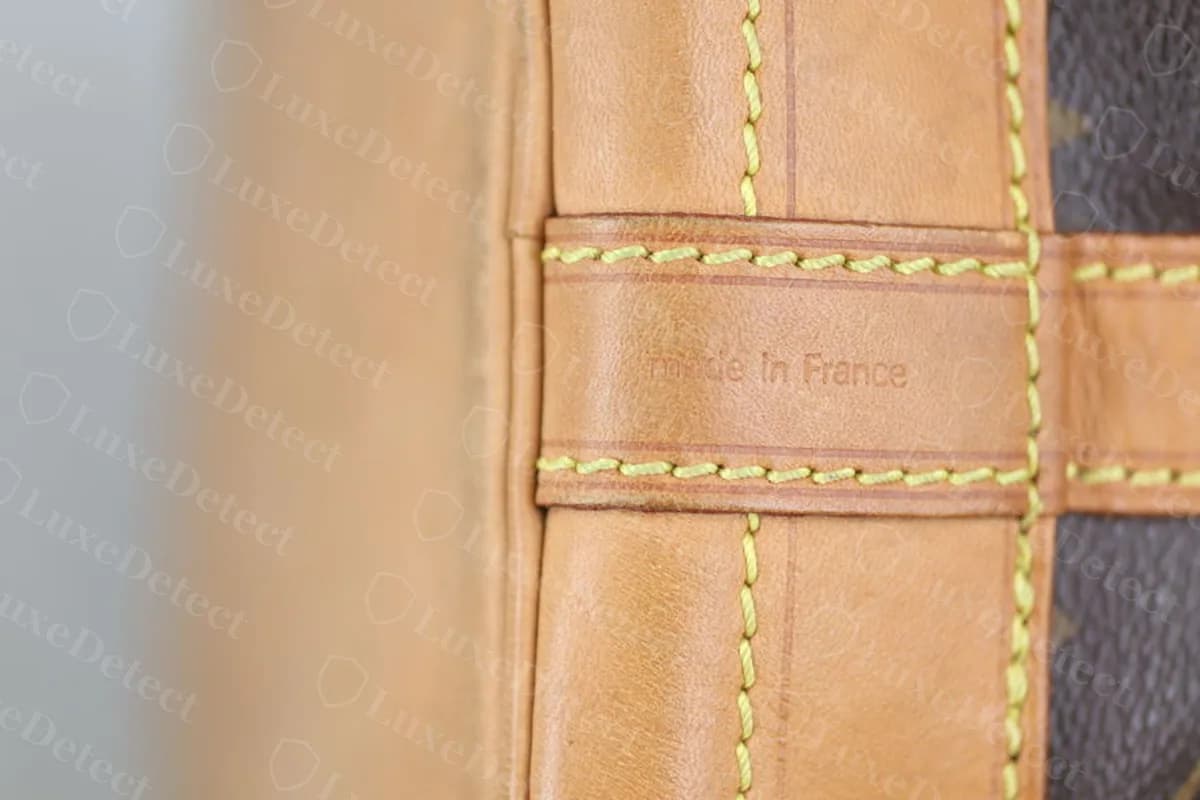
The "LOUIS VUITTON PARIS made in France" heat stamp sits on one of the leather tabs, usually near the base or where the strap attaches. On genuine bags this stamp is evenly spaced, with consistent letter height and a clean baseline; each word sits on its own line without crowding the one above or below it. On several of the fakes we reviewed, the same stamp was visibly cramped, with the "L" of "LOUIS" nearly touching the line above it, inconsistent spacing between letters within a single word, and a "made in France" line set noticeably smaller and tighter than the "LOUIS VUITTON PARIS" line above it. This is a font-and-press-quality tell rather than a wording tell, the words themselves were usually correct, it's the execution that gives it away.
| Element | Authentic | Counterfeit |
|---|---|---|
| Letter spacing | Even, deliberate spacing within and between words | Crowded, uneven, letters sometimes touching |
| Line separation | Clear gap between "LOUIS VUITTON PARIS" and "made in France" | Lines sit close together, sometimes nearly overlapping |
| Stamp depth | Consistent depth across the whole stamp | Shallow in places, deeper in others, inconsistent pressure |
Worth knowing
A worn or faded stamp on its own is not suspicious on a decades-old bag, vachetta leather patinas and old stamps soften with handling. What's decisive is bad letterforms and spacing on a stamp that's otherwise still legible, not a stamp that's simply aged.
The Drawstring Closure and Toggle
The Noé closes with a leather-wrapped cord drawstring threaded through four brass eyelets, cinched with a small leather toggle. On genuine bags the cord is a single continuous leather-wrapped strip, the stitching along its length is straight and even, and the eyelets it passes through show the correct, non-mirrored "LOUIS VUITTON" stamp discussed above. Because the drawstring and its eyelets are handled every time the bag is opened and closed, they're also one of the first places wear shows on a genuine, well-used bag, uneven fraying, a slightly loosened toggle, is normal and expected, not a red flag by itself.
Worth knowing
Full-bag listing photos of the drawstring cinched shut can look correct on both genuine and fake bags at a glance, the silhouette is easy to get right. The eyelets themselves need a close, well-lit photo before you can trust what the drawstring tells you.
Canvas, Epi, and Damier Azur: Material and Print Quality
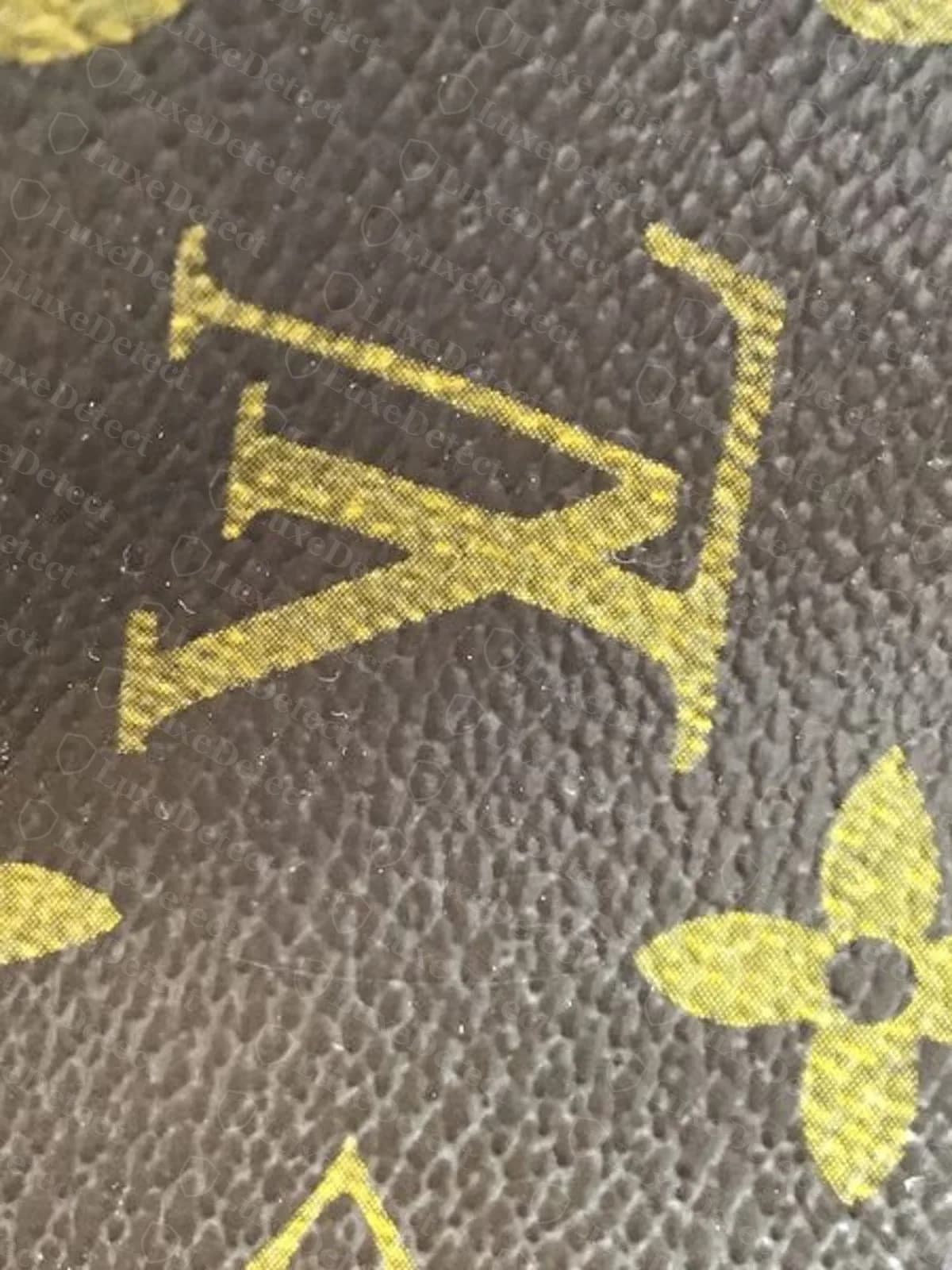
Monogram canvas is by far the most common material for both sizes. The LV monogram, flowers, and quatrefoils should print with sharp, consistent edges and even color saturation, brownish-gold on the classic monogram, with no visible printing artifacts. We found one fake where a single "LV" motif on the base panel printed as a mirror image next to correctly-oriented motifs around it, the same underlying printing-die problem behind the mirrored rivets, showing up on the canvas itself in at least one case. Epi leather should have a consistent, fine vertical grain across every panel with no flat or smooth patches; Damier Azur should show crisp, even checks with sharp corners, not soft or blurred edges. All three materials can look convincing from three feet away in a listing photo, the pattern and colorway are not hard to copy, so treat material appearance as a starting filter, not a verdict.
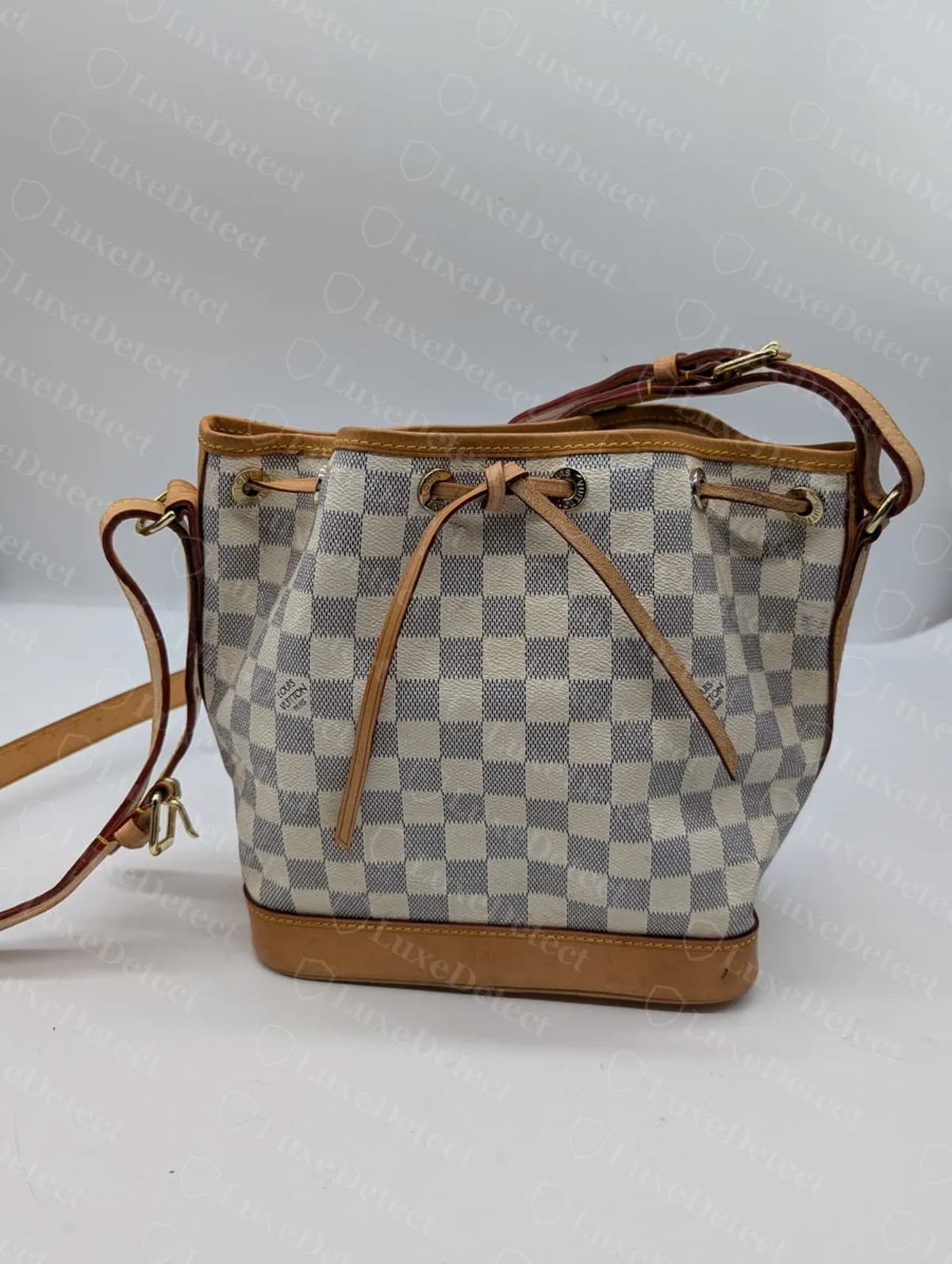
Worth knowing
A genuinely well-made fake can nail the overall silhouette, the strap drop, the base shape, even the canvas colorway, in a photograph taken from normal viewing distance. That's exactly why this guide leads with hardware close-ups rather than the canvas pattern: the canvas is the easiest part to get right, and the hardest to be wrong about on purpose.
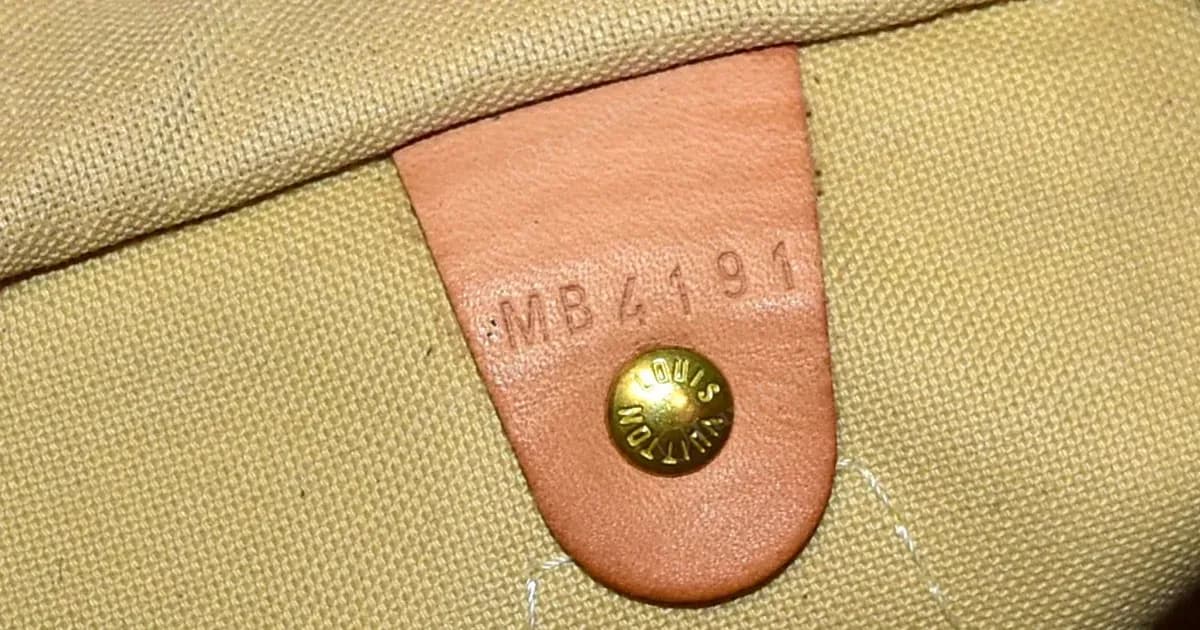
The exact date code stamped inside a Noé (two letters plus four digits on later bags) tells you the factory and production week and year, not whether the bag is genuine, a correctly formatted code appears on convincing fakes too. See our complete guide to Louis Vuitton date codes for how to read the code once you've confirmed the hardware checks above; treat it as a cross-reference, not a first check.
What the Box and Dust Bag Do and Do Not Prove
A Louis Vuitton box, ribbon, or dust bag traveling with a Noé is context, not evidence. Packaging is trivially easy to source separately from the bag itself, and a large share of vintage Noé bags, which is most of what circulates on the resale market, never came with retained packaging in the first place because they were bought decades before dust bags were standard practice. Use packaging only to cross-reference details (does the dust bag's era match the bag's construction era) never as a stand-alone reason to trust a listing.
Quick Authentication Checklist
- Look at every rivet on the bag under good light or a zoomed photo. Confirm "LOUIS VUITTON" reads correctly, not mirrored, on each one.
- Read the leather heat stamp closely. Check letter spacing and the gap between "LOUIS VUITTON PARIS" and "made in France."
- Trace the drawstring cord and check its eyelets for the same correct, non-mirrored stamping.
- Confirm the material (monogram, Epi, or Damier Azur) shows sharp, consistent printing or grain with no flat or mirrored sections.
- Confirm you're looking at a Noé or Petit Noé, not a NeoNoé or Nano Noé, before applying any of the checks above.
- Cross-reference the date code against the bag's claimed era, after the hardware checks, not instead of them.
A single mirrored rivet or eyelet stamp is sufficient on its own to walk away. Two or more failures elsewhere, cramped heat-stamp lettering plus a flat, poorly-printed canvas section, for example, should have the same effect even without a mirrored stamp.
When to Get a Professional Opinion
The checks in this guide require sharp, well-lit, close-up photos of small hardware, which most casual listing photos don't provide. If a seller won't or can't provide a clear photo of the rivets and heat stamp, that's worth treating as a caution sign on its own, not proof of anything, but a reasonable seller of a genuine bag usually has no reason to avoid the request. Where this guide is limited: our fake sample came from a modest number of independently confirmed submissions, enough to establish the mirrored-stamp defect as a repeatable pattern across materials and eras, but not enough to claim we've seen every counterfeit approach currently in circulation, particularly for the rarer Multicolore Petit Noé and Damier Azur pieces. For a bag you're about to pay real money for, LuxeDetect's handbag authentication service starts at $25 with a same-day option, and includes a written Certificate of Authenticity you can keep with the bag or show a buyer.
FAQ
How can I tell a Louis Vuitton Noé from a NeoNoé?
The Noé (and Petit Noé) has a soft, cone-shaped bucket body with a leather-bound top edge and four brass eyelets; the NeoNoé (launched 2017) has a flatter, structured base and a rounder silhouette with a different drawstring mechanism. They're related in concept but are different models with different reference points, so make sure you're comparing the right one before applying any authentication checks.
Where is the date code on a Louis Vuitton Noé?
On bags produced after roughly 2007, look for a small stamped leather tab inside the bag, near a seam or the lining, reading two letters followed by four digits. Earlier vintage Noé bags may carry an older code format or, on the oldest pieces, no visible code at all. See our Louis Vuitton date code guide for the full breakdown by era.
Is a Louis Vuitton Noé with no box or dust bag still worth buying?
Yes, potentially. Most vintage Noé bags on the resale market are decades old and never came with retained packaging, since dust bags weren't standard practice when many were originally sold. Missing packaging is not itself a red flag; focus on the hardware and stamping checks in this guide instead.
What materials did the Louis Vuitton Noé come in?
Monogram canvas is the most common by far. Louis Vuitton also produced the Noé and Petit Noé in Epi leather (a textured, dyed-through calfskin), Damier Azur canvas, and, for a 2003 collaboration with artist Takashi Murakami, a Multicolore monogram canvas used on some Petit Noé pieces.
Why do the rivets matter more than the canvas pattern on a Noé?
Because the canvas pattern is the easiest part of the bag for a counterfeiter to copy convincingly, it's a flat, repeating print. The small brass rivets require a correctly cut die to stamp "LOUIS VUITTON" cleanly in a circle, and we found that several counterfeit sources are using a die that mirrors part of the text, a defect that doesn't show up unless you look closely, but is decisive once you do.
Can a fake Noé still have a correctly formatted date code?
Yes. A date code that matches the expected two-letter, four-digit format for the claimed era tells you the code was copied correctly, not that the bag is genuine. Treat the date code as a cross-reference after you've checked the hardware, not as a stand-alone authentication check.