Louis Vuitton Authentication Expert
Watch authentication specialist. Focuses on movement inspection, case finishing, and serial verification.
Last updated September 2026 · Published February 2026 · Contact
What Louis Vuitton Date Codes Actually Are
Louis Vuitton uses date codes, not serial numbers. The difference matters: a date code does not identify one individual bag, because LV does not run a one-bag-one-number system. It records roughly where and when the piece was made, so many bags share the same code and all of them can be genuine.
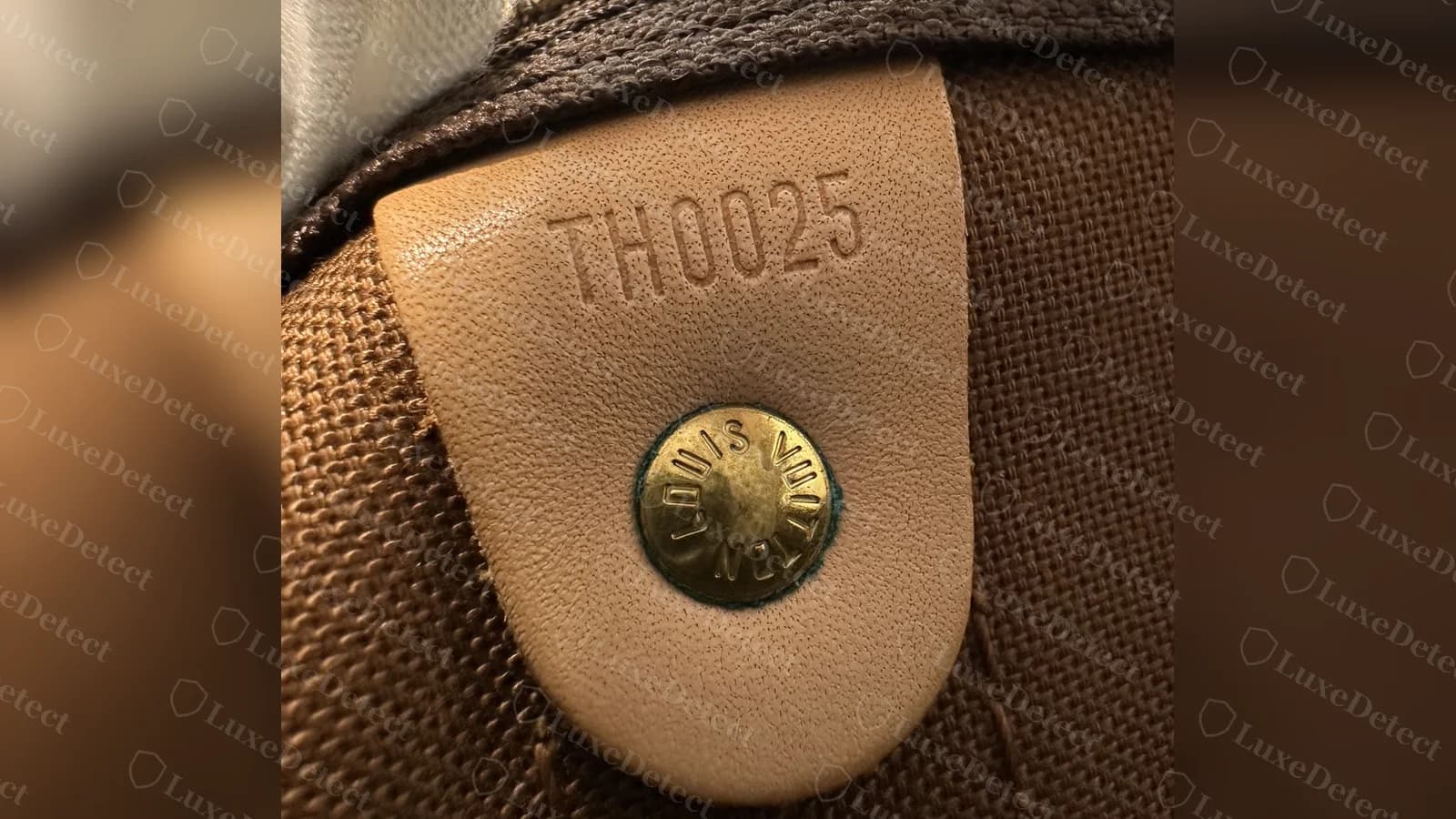
The code is stamped into a small leather tab sewn to the lining, into the lining itself, or into a pocket wall. Placement changes by model and by era. From about 2021 Louis Vuitton stopped stamping visible codes and moved to an internal chip, so a recent bag with no visible code is normal and not a fake tell.
A code is useful for three things. It tells you whether the format fits the age the seller claims. It tells you whether the factory letters are plausible for the "Made in" line. And it can show that a bag claims to be older than the model itself (a model cannot carry a code from before it existed). It cannot prove a bag is real, because counterfeiters copy genuine codes.
Worth knowing
This guide is built from date-code tabs on authenticated Louis Vuitton orders in our own archive, with examples from each era, plus published conventions that authenticators and resellers use. Louis Vuitton has never published an official decoding table, so the factory list below is a reseller and authenticator compilation, not something we can confirm with the brand. The [LV date code tool](/lv-date-code) below applies the same rules.
The Formats, Era by Era
The digits change meaning over time. The easiest way to keep them straight is to read the year digits first, because the two main systems never overlap in year.
Before the early 1980s: no code
Pieces made before date codes existed carry none. That is expected on genuine older stock, not a warning sign. Published sources put the start of codes somewhere between 1980 and 1982, which is why you will see different start years quoted. Our vintage buyer's guide covers what to check when there is no code to read.
About 1982 to the late 1980s: three or four digits
The first two digits are the year and the last one or two are the month. 836 reads as June 1983, and 882 as February 1988. In the mid-1980s factory letters were added; on these older pieces the letters usually come after the digits (a code like "882 VI") rather than before.
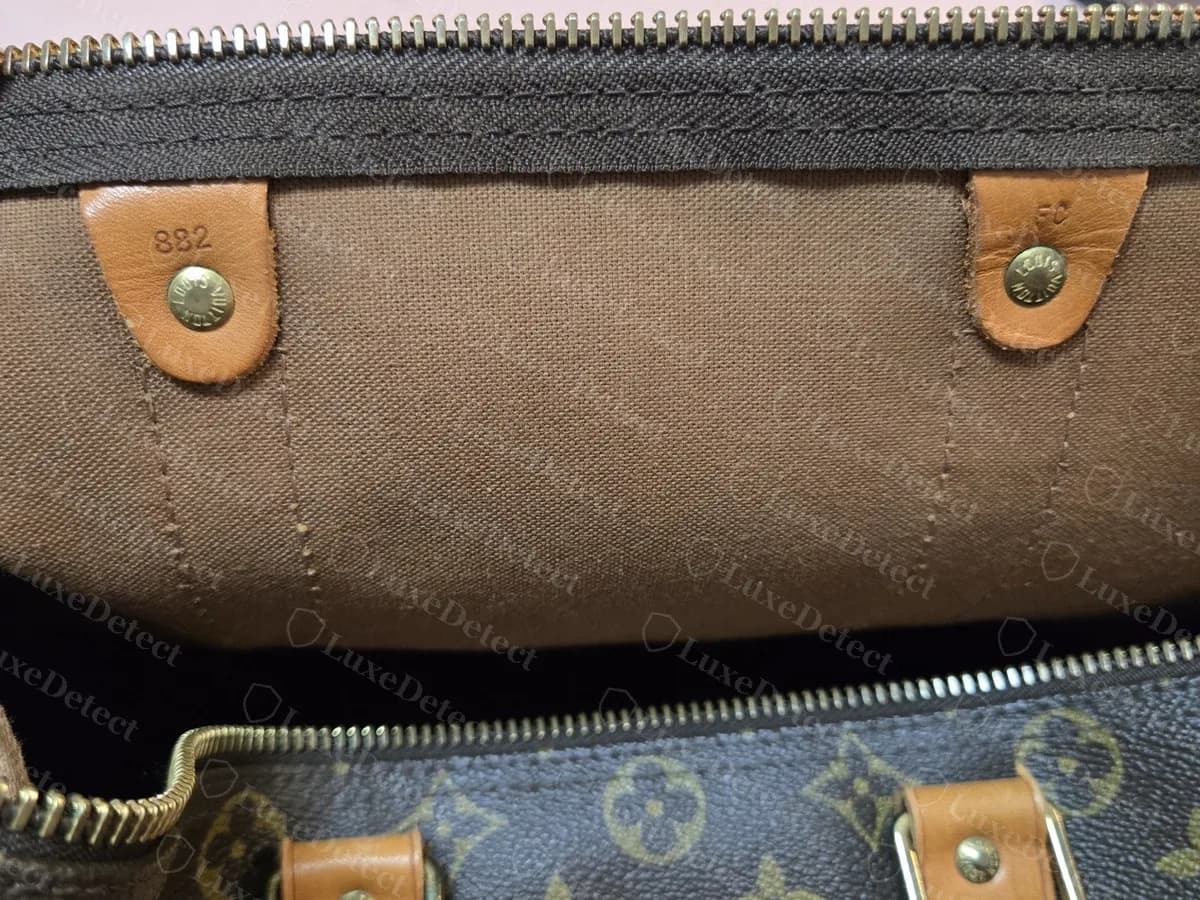
In this photo the left tab reads 882 with no letters, and a second tab beside it carries a shorter mark that is not legible at this size. We only read the digits; we would not decode the second mark.
1990 to 2006: two letters and four digits, month and year
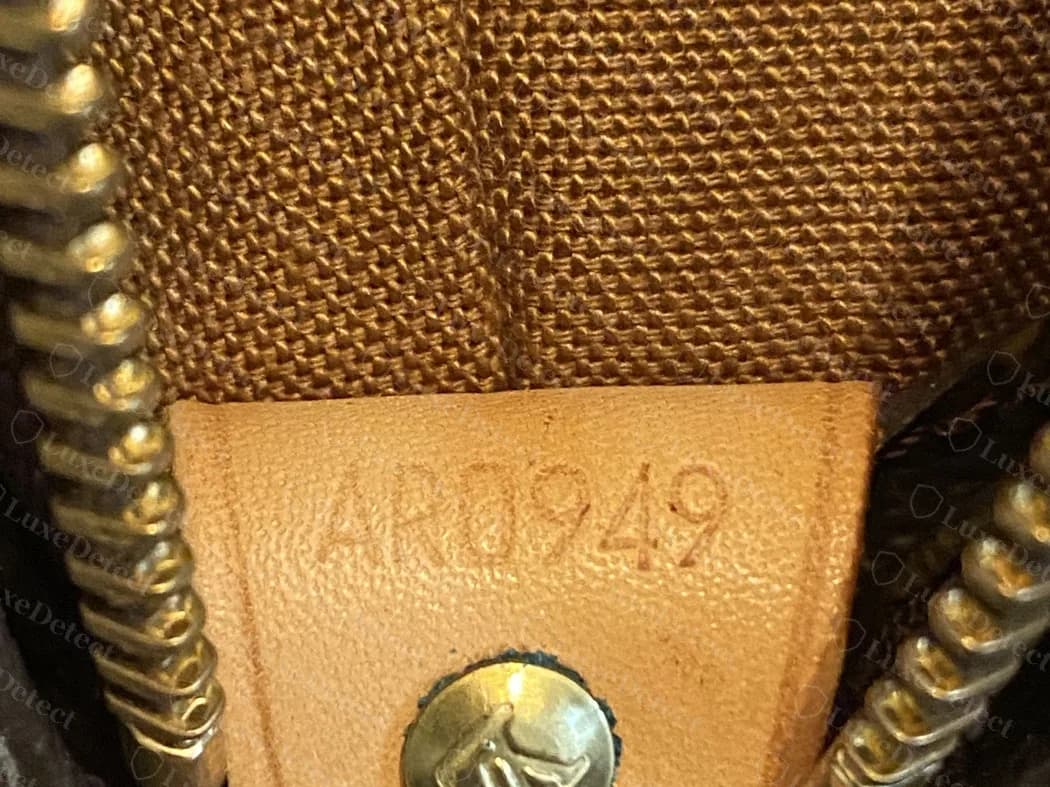
Two factory letters, then four digits. The first and third digits together are the month, the second and fourth together are the year. AR0949 is April 1999: month 04, year 99.
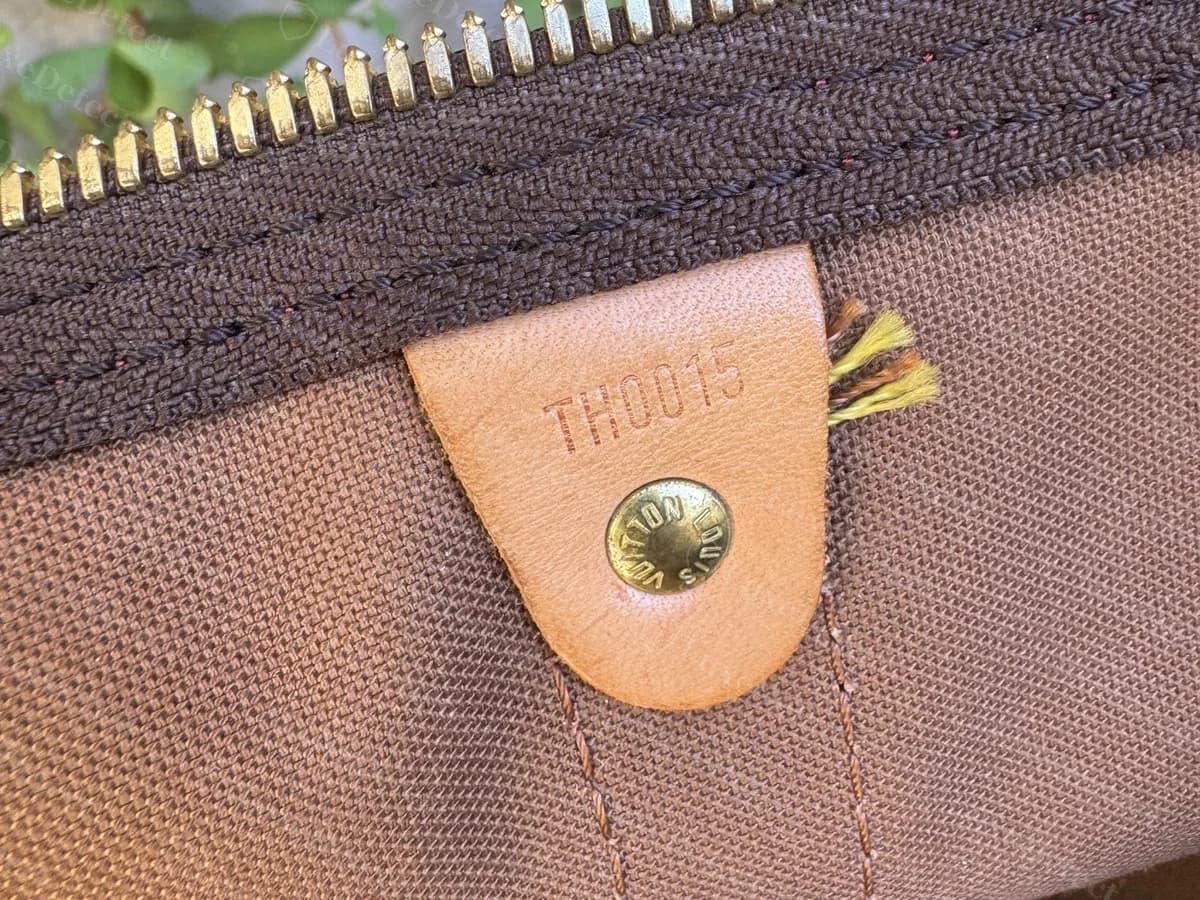
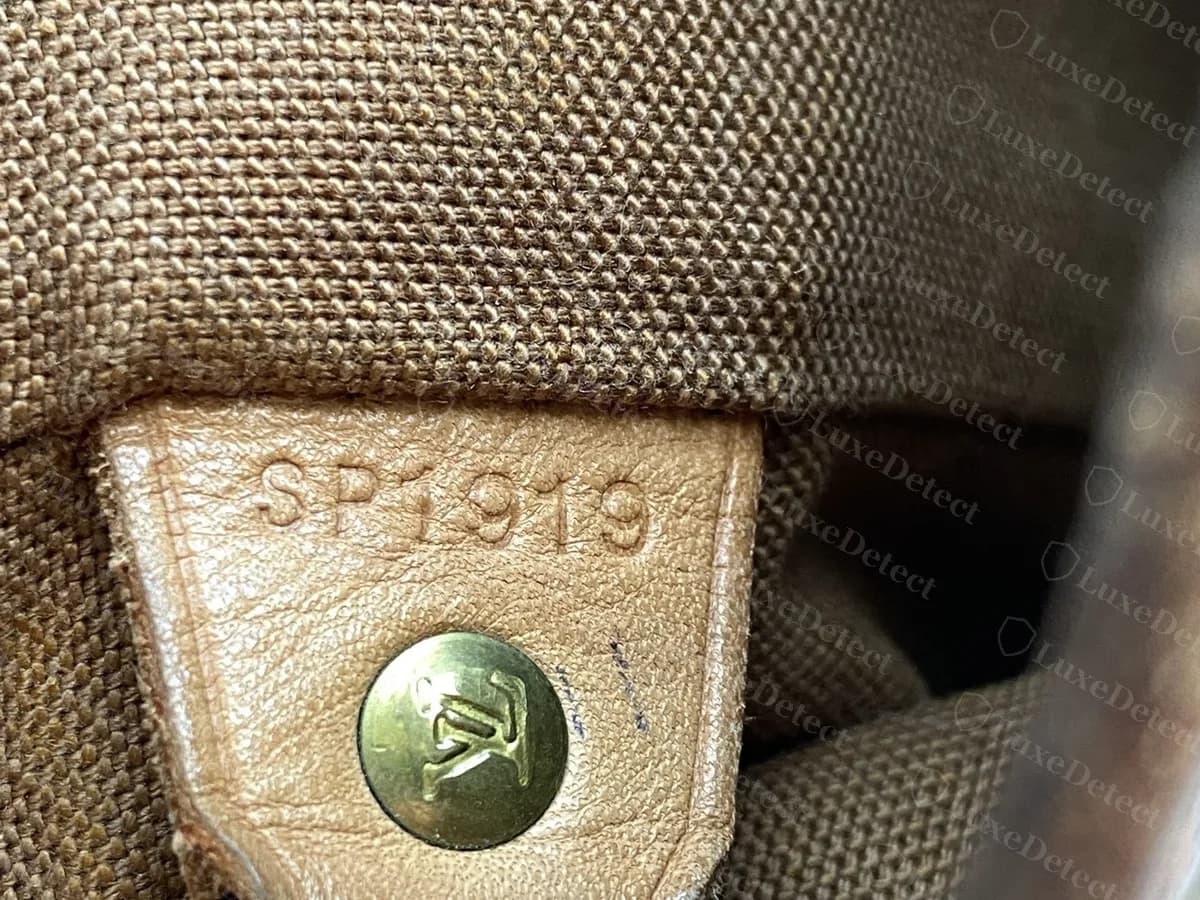
SP1919 is November 1999 by the same rule (month 11, year 99), and TH0015 in the first photo above is January 2005 (month 01, year 05).
2007 to about 2021: two letters and four digits, week and year
The layout is identical, but now the first and third digits are the week of the year and the second and fourth are still the year. SA2200 is week 20 of 2020: digits one and three give 20, digits two and four give 20.
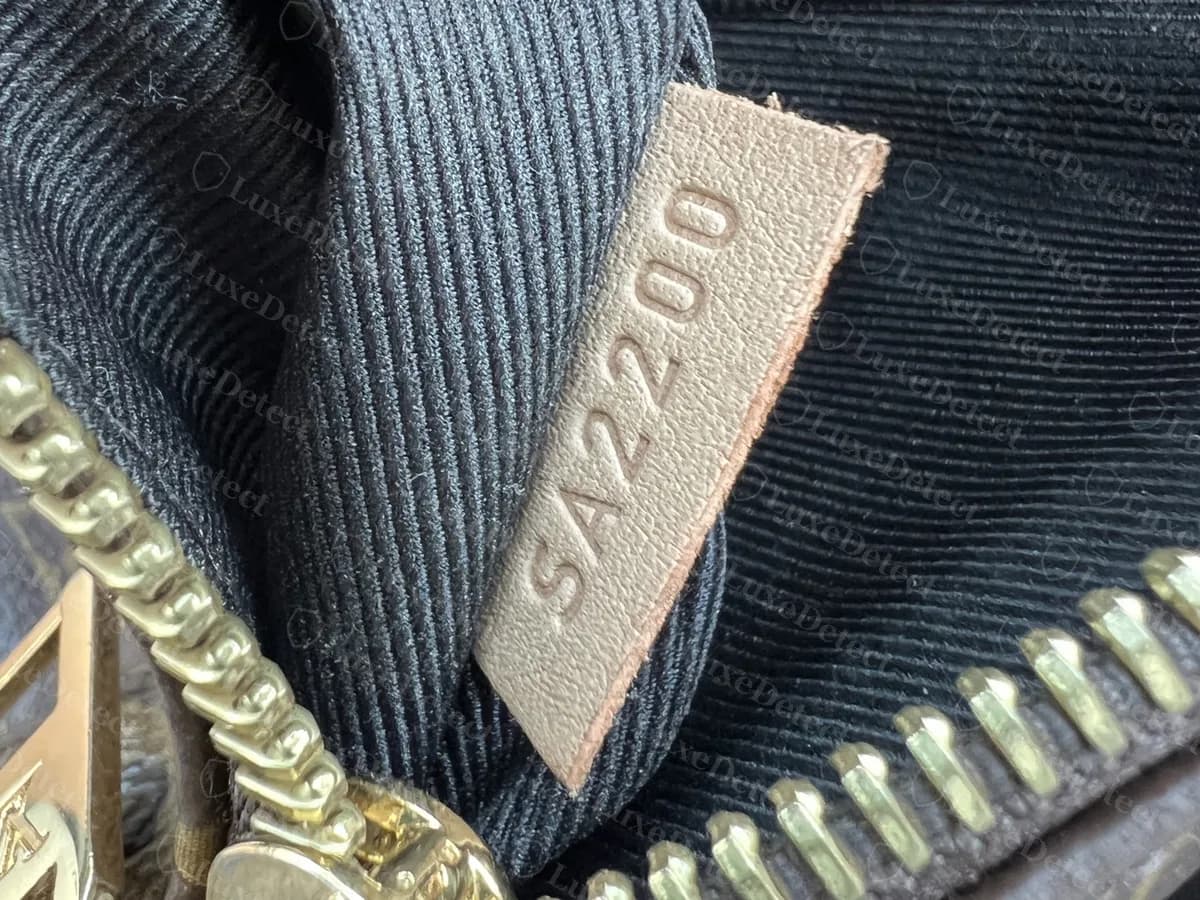
The practical check: year digits 90 to 99 and 00 to 06 use the month rule, and year digits 07 to about 21 use the week rule. A code that is impossible under the rule its year digits point to (a "month" of 58, for example, or a week of 61) does not decode, and that is worth noting. For a worked example of the week rule on a bag, see our bum bag guide.
From about 2021: a chip instead of a stamped code
Louis Vuitton replaced the stamped code with an internal chip during 2021, and some sources report chips in a few products earlier than that. A recent bag with no code is expected. What the chip does and does not tell you is narrower than many listings claim:
- A phone with NFC can usually detect that a chip is present, but it cannot read the data that matters. The information on the chip is read with tools Louis Vuitton staff use internally.
- We can find no public Louis Vuitton page that verifies a chip for a customer, so do not trust a seller who says a scan "confirmed" a bag.
- A chip does not prove the bag is real. It is a separate object from the bag it is sewn into, and a blank chip is not a guarantee of anything.
Our chip guide goes into it in more detail.
A code that checks out doesn't prove the item is real. Counterfeiters copy genuine codes.
Our authenticators check the stamps, hardware and construction of your Louis Vuitton against verified references, from $25. You get a verdict within 24 hours, and a Certificate of Authenticity if the item passes.
Authenticate My Louis Vuitton →Factory Codes: What Is Usually Listed, and Why to Hold It Loosely
The two letters identify the workshop. There is no official list, and the compilations that resellers and authenticators circulate overlap: some codes appear under more than one country. Treat the table as a guide to what is plausible, not a rulebook.
| Country | Codes commonly listed |
|---|---|
| France | A0, A1, A2, AA, AH, AN, AR, AS, BA, BJ, BU, CO, CT, CX, DR, DU, ET, FL, LA, LM, LW, MB, MI, NO, RA, RI, SA, SD, SF, SL, SN, SP, SR, TH, TJ, TR, TS, VI |
| Spain | BC, CA, GI, LB, LM, LO, LW, UB |
| Italy | BC, CE, FH, FO, MA, RC, RE, SA |
| USA | FC, FH, FL, LA, OS, SD, TX |
| Germany | LP, OL |
| Switzerland | DI, FA |
Codes such as BC, FH, FL, LA, LM, LW, SA and SD show up under more than one country in different lists, so a single code cannot always settle where a bag was made. In our own photos the pairs we saw fit: a Bumbag stamped CA4200 has a tab reading "made in Spain", and one stamped SA2200 has a "made in France" tab. A factory that contradicts the country label is worth a second look, but with lists this loose it is a reason to check more closely, not a verdict on its own.
Worth knowing
The decoder gives you the production period and a likely factory. It does not give you a verdict. A code that decodes cleanly narrows down when a bag was made, and says nothing about whether the object holding it is genuine.
When a Stamp Is Too Worn to Read
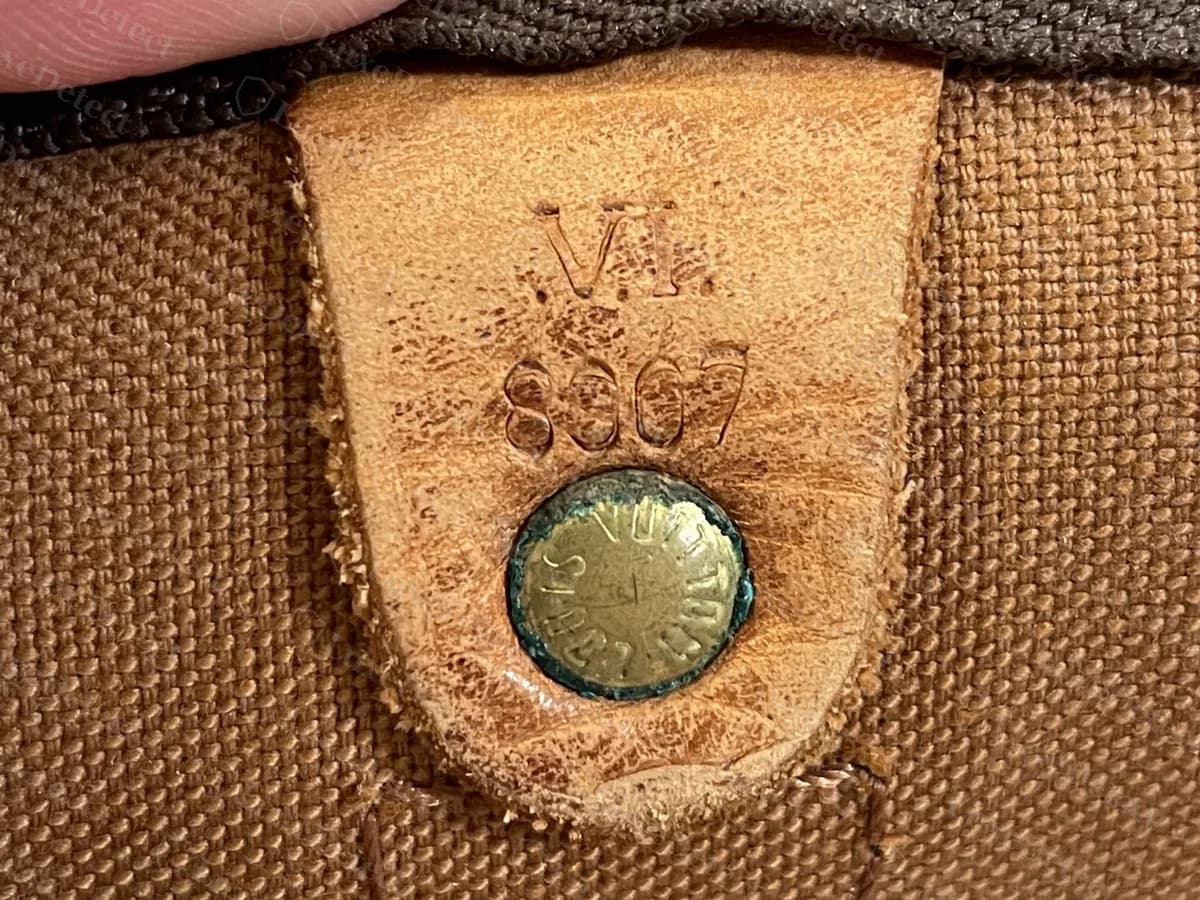
Codes wear. Vachetta darkens, hand oils soften the impression, and a shallow stamp can fade almost completely. In the tab above we can read the letters VI, but the digits are worn enough that we would not decode them. Do not guess at an unreadable code. Ask for a photo taken with raking light (a torch held at a low angle across the surface, not pointed straight at it), and treat a code you cannot read as unknown rather than as wrong.
Where the Code Sits by Model
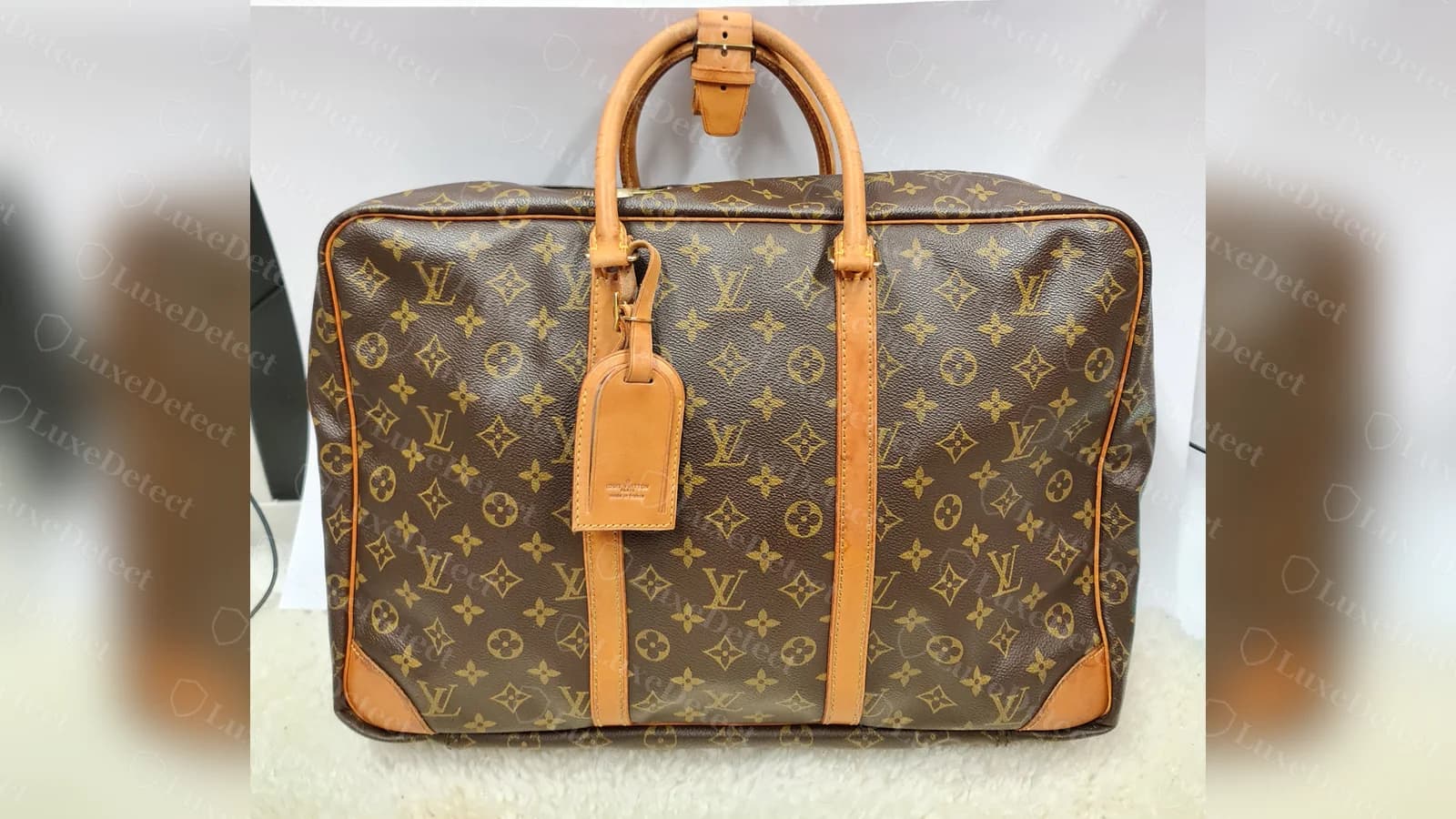
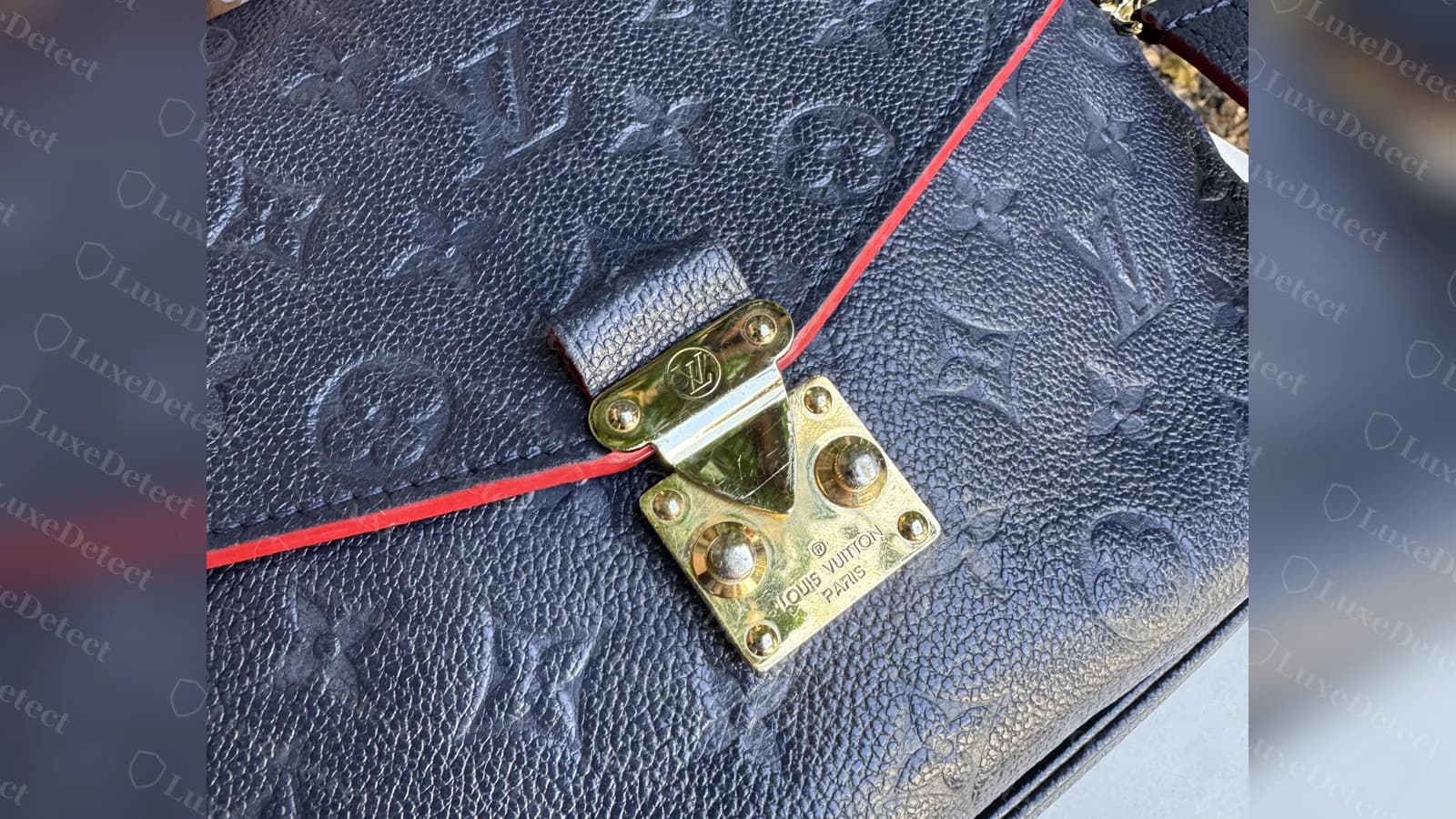
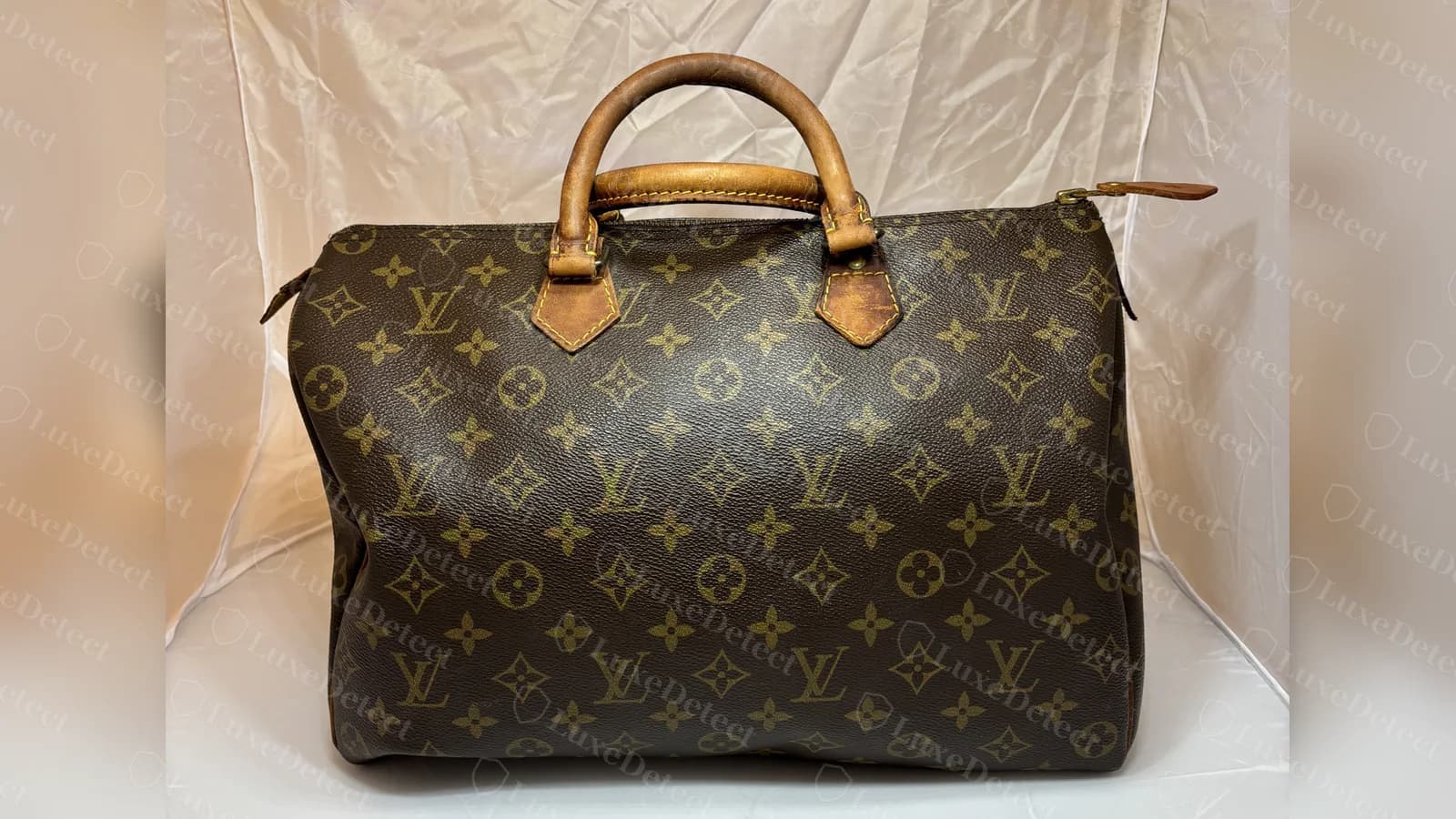
Placement varies enough that "I cannot find a code" is often a search problem. On the Keepall and Cabas Mezza bags above, the code is on a small leather tab inside the bag, sewn to the lining near the zip and fixed with a rivet. On the Montsouris it is on a rivet-fixed tab sewn inside the bag. On the Bumbag it sits on a small tab inside, beside the zip. On wallets and small leather goods it tends to sit under a card slot or inside the note compartment, so empty the piece before you conclude anything. Pieces from before the early 1980s never carried a code.
What We Did and Did Not Find on Fakes
In a sample of fake-labelled bum bag orders from our archive, some codes were worth noting. One carried FL1290, which decodes cleanly: week 19 of 2020, a plausible date. Another carried SP5288, which does not decode under either rule (there is no week or month 58). Isolated examples do not make a pattern, and the fake-labelled orders in that sample also included items that were not bum bags at all, so we do not treat either as a repeatable tell.
What this does show is the limit of the check. A code that decodes cleanly appeared on a fake, so a valid code proves nothing on its own. We also could not confirm the older claim that fake codes are stamped deeper or more evenly than genuine ones, so we have dropped that comparison table. Impression depth varies with the leather, the tool and the age of the piece.
What to Rely On, and What Not To
- Rely on: a code whose format fits the era the seller claims, whose year is not earlier than the model, and whose factory is at least plausible for the "Made in" line, alongside a match on the other physical details of the bag.
- Do not rely on: a code on its own, a chip scan on its own, the box, the dust bag, or a receipt. Louis Vuitton does not issue authentication certificates for its bags.
When to Get a Professional Opinion
If a bag's code decodes cleanly and the rest of the photos look right but the price is significant, that is the situation where a second pair of eyes helps most, because a clean code is exactly what a careful counterfeit also has. Our authentication service reviews close photos of the code tab, stamps, hardware and construction and gives a verdict within 24 hours.
A code that checks out doesn't prove the item is real. Counterfeiters copy genuine codes.
Our authenticators check the stamps, hardware and construction of your Louis Vuitton against verified references, from $25. You get a verdict within 24 hours, and a Certificate of Authenticity if the item passes.
Authenticate My Louis Vuitton →Related Guides
- How to authenticate a Louis Vuitton Speedy
- How to authenticate a Louis Vuitton Keepall
- How to authenticate a Louis Vuitton Neverfull
- How to authenticate a Louis Vuitton bum bag
- Louis Vuitton RFID chip guide
- Vintage Louis Vuitton bags buyer's guide
FAQ
What does it mean if there is no date code on a pre-2021 bag?
It depends on the age. Pieces from before the early 1980s never carried one. On a bag claimed to be from the 1990s to about 2020, a missing code is worth checking, but codes do wear away, sit in awkward places, or are on a tab that has been replaced. Look with raking light, empty every pocket, and weigh the physical details before you draw a conclusion.
Can I check a Louis Vuitton date code myself?
Yes. Our Louis Vuitton date code tool decodes the formats from the early 1980s to about 2021 and shows the factory country and the production year or week. For the very early three-digit codes the tool notes the limited documentation. It reports what a code says, not whether the bag is genuine.
Do LV bags made in Spain have lower quality than French ones?
No. Louis Vuitton produces in several countries, and the country of manufacture is not a quality grade. A Spanish-made bag is not less genuine than a French one.
Does a date code from 2015 mean the bag was sold new in 2015?
No, it means it was produced in that period. Production and sale dates can differ, so a bag may have sat in stock or been bought later.
What should I do if the date code format does not match any era?
First re-check the year digits: month and week decoding is the most common mix-up. If the code still fits no rule after correcting for era, that is a genuine concern, but it is still one signal among several. Have the bag looked at by someone who can handle it or review close photos alongside the code.
Can I verify a Louis Vuitton chip with my phone?
A phone can often tell that a chip is present, but it cannot read the data Louis Vuitton uses, and we know of no public Louis Vuitton page that verifies a chip for customers. Louis Vuitton staff use internal tools. A chip also does not prove authenticity by itself.