Handbag Authentication Specialist
Handbag authentication specialist. Has reviewed submissions across Hermès, Chanel, Louis Vuitton, and Dior since 2019.
Published September 2026 · Contact
Why the Twist's Hardware Is the Whole Story
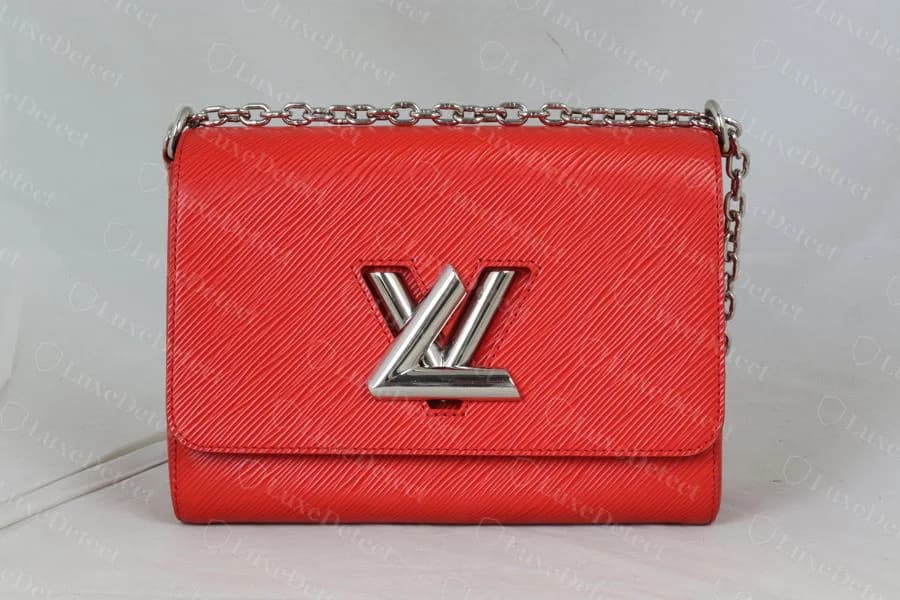
Louis Vuitton introduced the Twist in 2015, built around a single design idea: a chunky, interlocking "LV" turn-lock cut directly into the flap, doing double duty as both the closure mechanism and the bag's only decoration. There's no monogram canvas, no repeating pattern to hide behind, just a solid panel of Epi leather (LV's dyed, cross-grained calfskin) and that one clasp. It comes in MM and PM sizes, plus a rarer mini, and in dozens of Epi colorways over the years, along with occasional exotic-skin and canvas variants.
That minimalism cuts sharply against counterfeiters. There's no busy print to blur into passable at a glance; the clasp is right in the middle of every photo, and it either interlocks cleanly or it doesn't. We pulled the confirmed-authentic and confirmed-counterfeit Twist bags in our archive, cross-checked each one against its photos rather than trusting the listing title, and found that the fakes split into two clear groups: a few that copy the clasp shape closely but fail on the leather or the interior stamp, and others where the clasp itself is visibly off, misaligned in its cutout, or cast from mismatched metal tones. Both groups are catchable, just not always from the same photo.
What to check, ranked by reliability
| Checkpoint | Reliability | What it tells you |
|---|---|---|
| 2. Epi Leather — Grain Depth and Consistency | ★★★★★ | Epi leather with no raised texture, where the pattern is printed onto a flat hide, is decisive on its own in any colorway. |
| 3. The Interior Stamp and Date Code | ★★★★★ | A run-together "LOUISVUITTON" with a missing "made in France" line, on an untextured panel, is decisive. |
| 1. The Twist-Lock Clasp — Alignment and Mitring | ★★★★★ | A crooked or unevenly gapped clasp is a strong tell, but a well-copied mitring alone does not clear a bag. |
| 4. Interior Lining and Small Hardware Details | ★★★★★ | Useful supporting evidence when photographed, but many listings never show the lining or chain anchor. |
| Model Reference Before You Start | ★★★★★ | Rules out a mislabelled size or material variant; will not catch a well-made fake. |
| What the Box and Dust Bag Do and Do Not Prove | ★★★★★ | Packaging is context only — useful for cross-referencing, never as evidence. |
Model Reference Before You Start
- Sizes: PM (Petite Modèle, the smaller/original size) and MM (Moyen Modèle, larger, added a couple of years after launch); a rarer Mini Twist and a top-handle Twist variant with a resin or acrylic handle also exist and are genuine Louis Vuitton lines, not just a resale-listing quirk
- Material: almost always Epi leather, LV's dyed calfskin with a fine, regular, diagonal cross-grain pressed into the surface. Occasional Monogram canvas, python, or crocodile Twist bags exist but are far rarer and outside the scope of this guide
- Twist Wallet on Chain (WOC) and various Epi Twist wallets share the same clasp and leather, so most of the checks below apply to them too, though this guide is written around the full-size bag
- Where it's made: Twist bags are made in France; "made in France" on the interior stamp is expected, not itself proof of anything
- RFID vs date code: like most of LV's leather line, Twist bags made before roughly 2021 carry a stamped date code on an interior leather tab; bags made after that transition use an embedded RFID chip instead and won't show a visible code. Neither is a red flag on its own — see our Louis Vuitton date code guide for the full format breakdown by era
The Twist-Lock Clasp — Alignment and Mitring
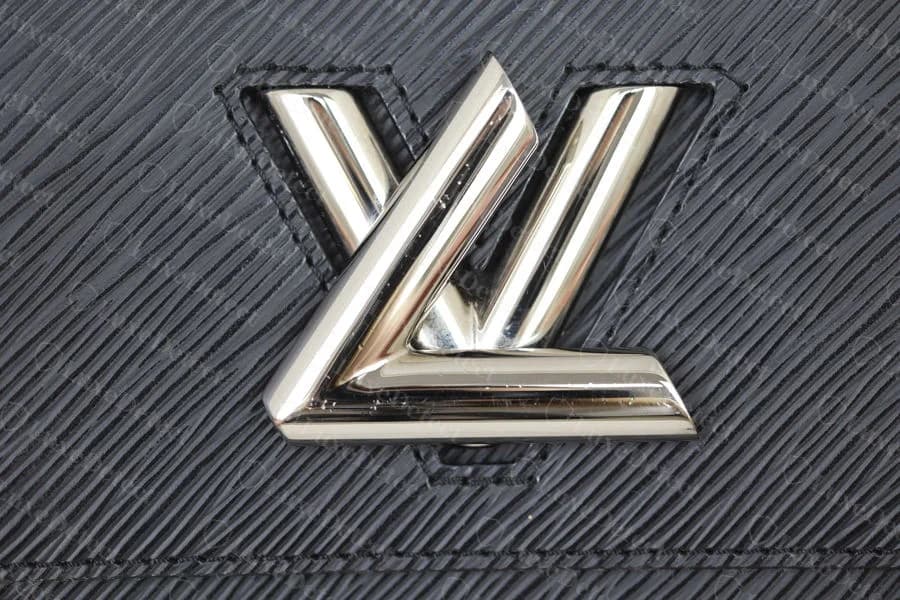
The clasp is a solid metal "LV" monogram, cut so the two letters interlock at a shared diagonal seam, mounted through a die-cut window in the leather flap and secured by a stitched perimeter. This is the single most photographed detail on every Twist listing, which makes it the easiest check to run from photos alone, and also, on the better fakes, the one counterfeiters spend the most effort copying.
On a genuine bag the L and the V meet at a crisp, symmetrical point with even wall thickness on both letters, sit flush against the leather with no visible gap around the edges of the cutout, and the surrounding stitching is tight, evenly spaced, and follows the window's outline precisely. We compared this across several colorways and both sizes in our archive and the mitring geometry was consistent every time: however the bag is lit, the seam between L and V lands in the same place relative to the letterforms.
What we found on the counterfeit side split into two patterns. Some fakes get the mitring itself close to right (a careful die can copy the shape), but the clasp sits crookedly in its window, tilted off the vertical axis of the flap, with an uneven gap between the metal and the leather cutout on one side. Others get the seating right but the metal itself is wrong: two-tone plating where the bag's actual hardware color should be consistent throughout, or a visible mismatch where one stroke of the letter reads a different finish than the other.
| Element | Authentic | Counterfeit |
|---|---|---|
| L/V seam | Crisp, symmetrical, consistent across examples | Present but sometimes uneven wall thickness |
| Seating in window | Flush, centered, even gap on all sides | Tilted, off-center, or an uneven gap on one side |
| Metal finish | Single consistent tone across the whole clasp | Two-tone or mismatched finish between strokes |
| Perimeter stitching | Tight, even spacing, follows the cutout exactly | Loose, uneven spacing, or a visibly different thread color |
Red flag
A clasp that sits crooked or unevenly gapped in its cutout, rather than flush and centered, is a strong tell on its own — genuine Twist bags are die-cut and hand-fitted to a tolerance the fakes in our sample never matched.
Worth knowing
A close, correctly seated mitring is not proof by itself. We found more than one counterfeit with a genuinely well-executed clasp shape, which is exactly why this check should be read together with the leather grain and interior stamp below, not in isolation.
Epi Leather — Grain Depth and Consistency
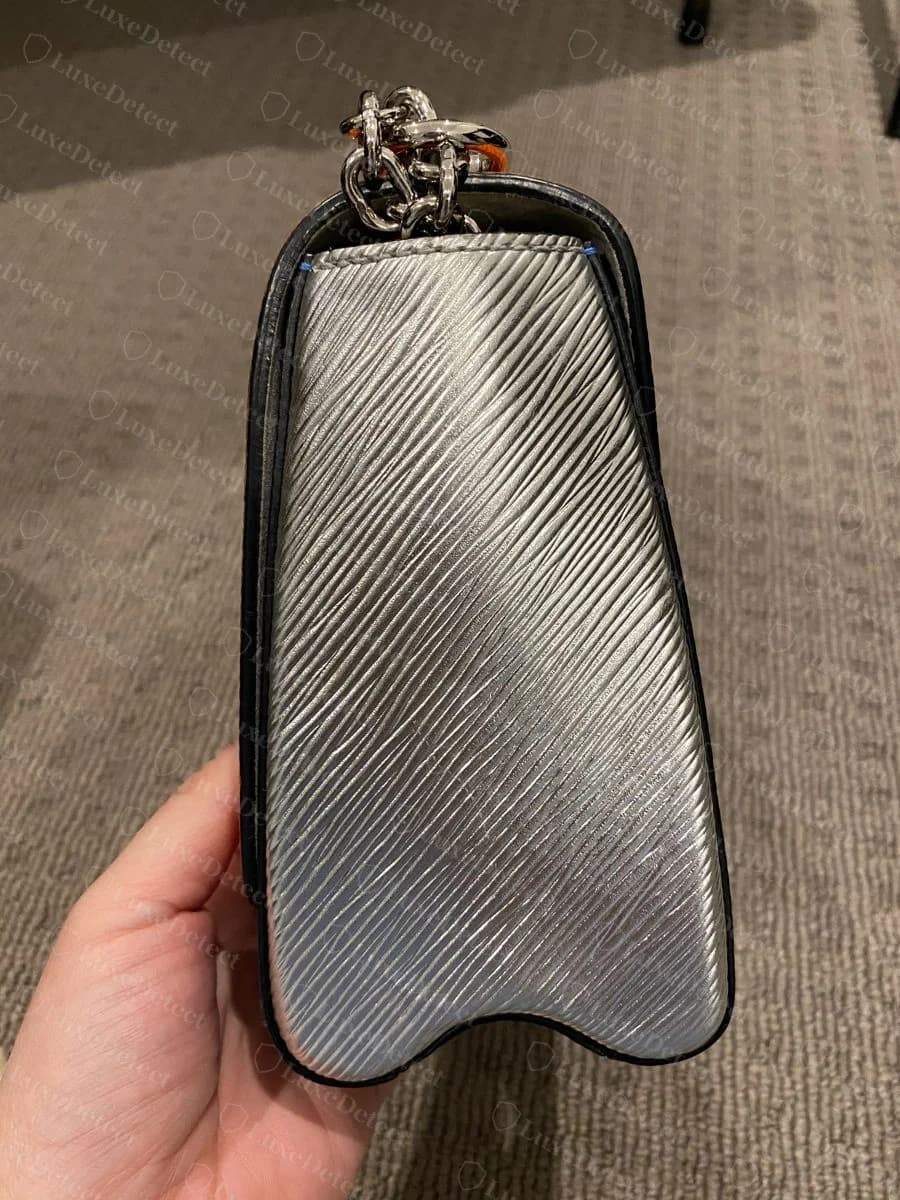
Epi leather is LV's signature textured calfskin for this bag: a fine, regular, diagonal cross-hatch pressed into the surface during tanning, giving it a slightly raised, almost woven appearance that catches light differently depending on the angle. It is a dyed-through, debossed leather, not a printed pattern on a smooth hide.
Across every genuine example we reviewed, the grain stayed deep and evenly spaced across curves, corners, and seams, on the front flap, the sides, and the base equally. It doesn't flatten out or go shallow anywhere on the bag.
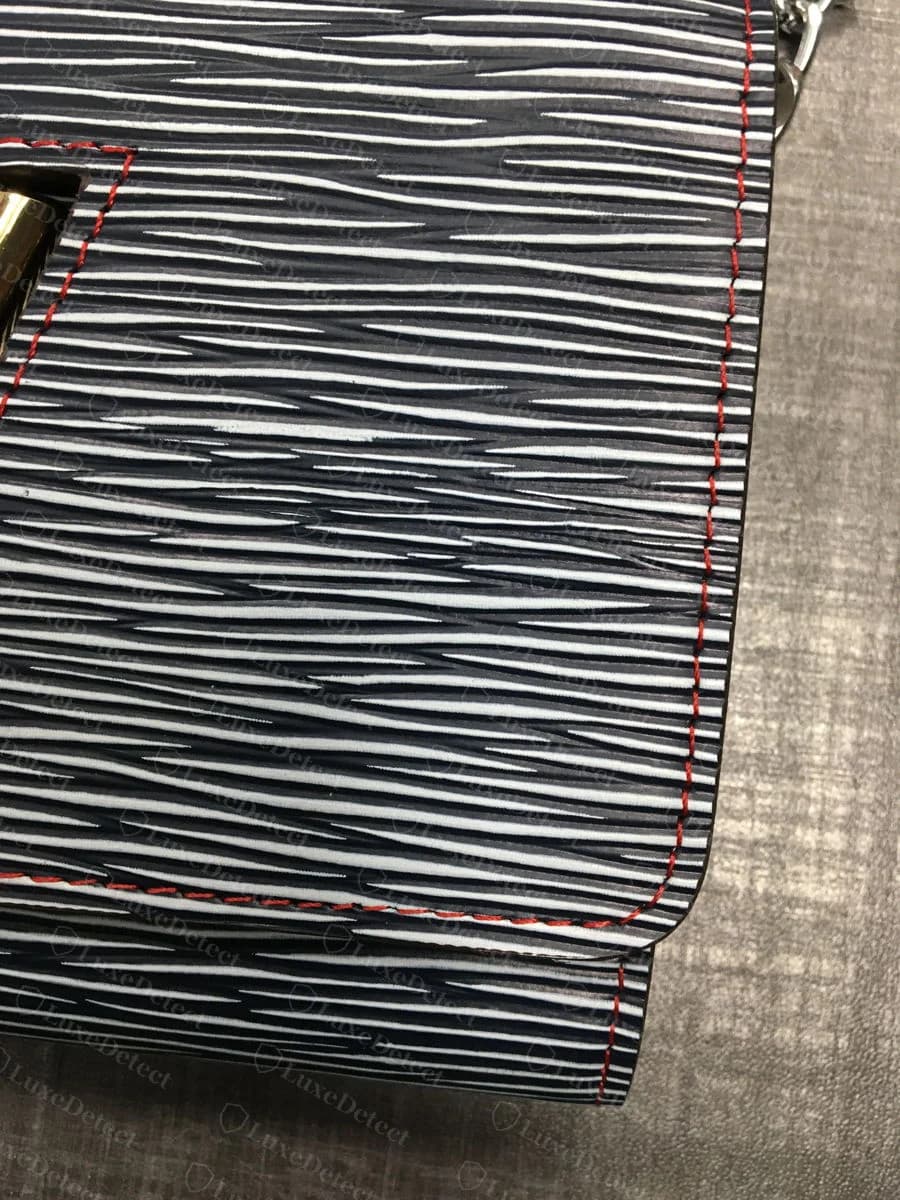
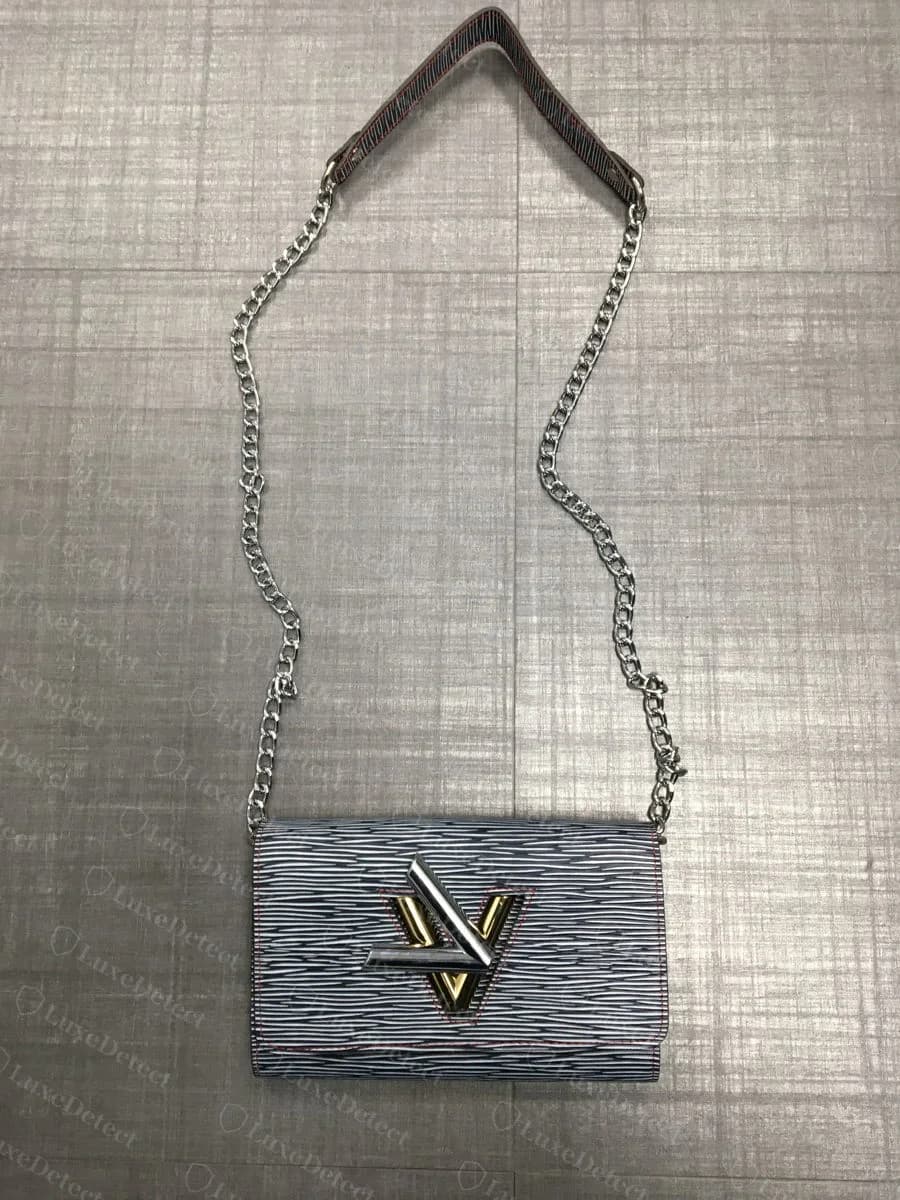
The most decisive thing we found in the fake sample was a Twist bag in a striking navy-and-white "zebra" colorway where the pattern is not debossed at all; it's printed flat onto a smooth leather surface with no raised texture whatsoever. Run a finger or an eye across it at a raking angle and there's simply nothing there, no ridges, no depth, just ink on a flat hide. This is different from (and more decisive than) a fake merely getting the grain scale slightly wrong; it's the absence of the leather's core physical characteristic.
| Element | Authentic | Counterfeit |
|---|---|---|
| Grain type | Debossed, dyed-through, physically raised | Sometimes flat-printed with no texture at all |
| Depth across the bag | Consistent depth on flap, sides, and base | Can be uneven, or entirely absent on a printed fake |
| Behavior at a raking angle | Ridges catch and scatter light | A flat print shows no light-catching texture |
Red flag
Epi leather with no raised texture, where the pattern is clearly printed onto a flat hide, is decisive on its own — genuine Epi is a debossed, dyed-through leather, never a flat print, in any colorway.
Worth knowing
This tell is easiest to catch on unusual or limited colorways, where a counterfeiter is more likely to be working from a printed approximation rather than genuine tanned Epi stock. A standard black or colored Epi fake may get the grain closer to right, which is why the clasp and interior stamp checks matter just as much.
The Interior Stamp and Date Code
Inside the bag, on a leather panel near the top edge of the lining, is LV's heat stamp: "LOUIS VUITTON" and "PARIS" on separate lines, with "made in France" beneath in a smaller, distinct script-style font, all debossed directly into the same Epi-grained leather as the exterior. Nearby, usually on a small separate leather tab, is the date code: two letters followed by four digits.
Every genuine example we checked showed the same pattern: "LOUIS VUITTON" and "PARIS" correctly spaced as two words each, struck at an even depth into leather that still shows the Epi ribbing underneath the lettering, with "made in France" in the correct smaller script beneath. The date code tab was a separate, cleanly stitched leather rectangle with the code embossed or printed cleanly.
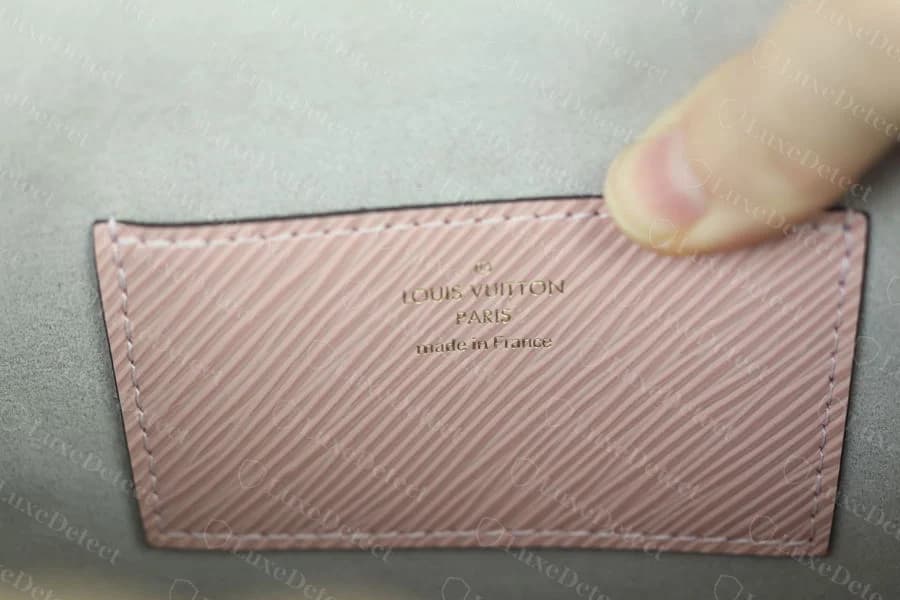
The clearest counterfeit example in our sample failed on several of these points simultaneously: "LOUISVUITTON" run together as one word with no space, no "made in France" line at all, stamped into a smooth panel that lacked the Epi texture found everywhere else on a genuine bag's leather, with visibly uneven, slightly fraying stitching around the panel edge in a mismatched thread color. Any one of these alone would be worth noting; together, on the same panel, they're conclusive.
| Element | Authentic | Counterfeit |
|---|---|---|
| Word spacing | "LOUIS VUITTON" as two words | Sometimes run together as one word |
| "made in France" line | Present, smaller script beneath the main stamp | Sometimes missing entirely |
| Panel texture | Same Epi ribbing as the exterior leather | Can be smooth, unribbed leather |
| Stitching | Clean, even, matching thread color | Uneven, fraying, or mismatched thread color |
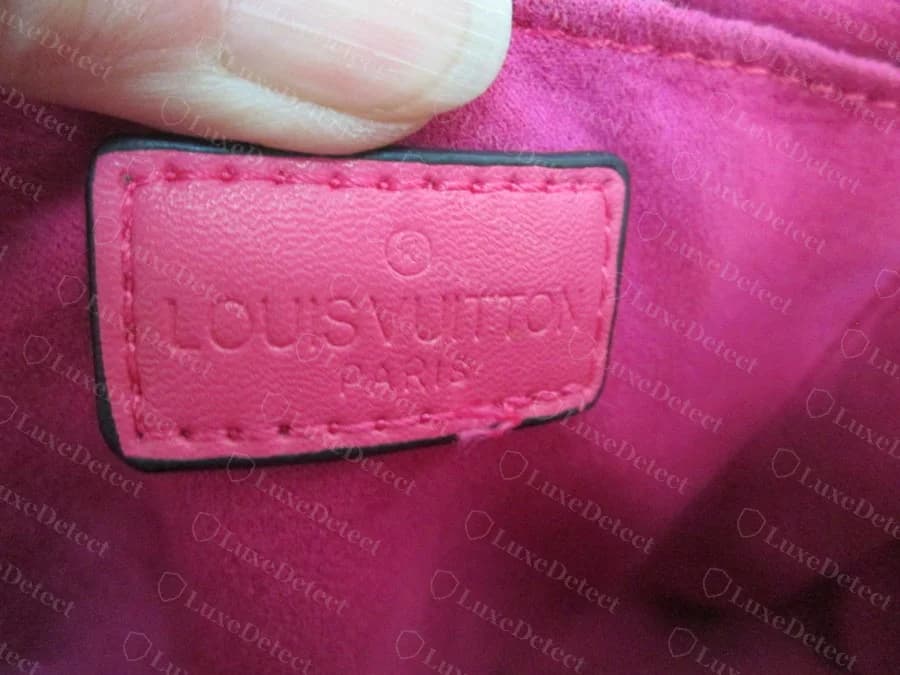
Red flag
"LOUISVUITTON" run together with no space between the two words, combined with a missing "made in France" line, is decisive — we did not find this combination on a single verified-authentic Twist bag in our archive.
Worth knowing
A correctly formatted date code gives you the production year, not the verdict. Treat it as a cross-reference against the bag's claimed age and condition, not as standalone proof. For the full breakdown of LV's date-code system by era, see our [complete guide to Louis Vuitton date codes](/blog/louis-vuitton-date-code-serial-number-guide).
Interior Lining and Small Hardware Details
Beyond the headline checks, a handful of smaller details are worth a look when photos allow it. Genuine Twist bags line the interior in a soft suede microfiber, in a tone that either matches or deliberately contrasts the exterior color, never a smooth synthetic or vinyl-feel lining. The chain strap's anchor hardware carries a small debossed "LV" mark on a smooth cylindrical link where the chain meets the leather tab, not a visibly screwed or riveted plate.
We found a counterfeit in our sample with a flat black synthetic lining with no suede texture at all, and a chain-anchor hardware piece held on with two visible Phillips-head screws rather than the smooth debossed link genuine bags use. Neither detail is something every listing photographs, so treat this as a supporting check rather than a first-line one.
Worth knowing
This check depends entirely on photo coverage. A seller who photographs only the exterior won't give you a chance to apply it, which is not itself suspicious, just a gap you'll need the clasp, leather, and stamp checks to fill instead.
What the Box and Dust Bag Do and Do Not Prove
Packaging is context, not evidence. A correct box, dust bag, and ribbon tell you the seller has access to genuine LV packaging, which counterfeit operations increasingly do too, not that the bag inside is authentic. Conversely, a Twist bag with no retained packaging is not itself suspicious; many bags change hands years after purchase, long after packaging is lost or discarded. Weigh packaging only as a small, secondary consideration after the clasp, leather, and stamp checks above.
Quick Authentication Checklist
- Check the twist-lock clasp: is the L/V seam crisp and symmetrical, sitting flush and centered in its window with even stitching?
- Look at the Epi leather at a raking angle: does the diagonal grain actually rise off the surface, or is the pattern flat and printed?
- Read the interior stamp: does it say "LOUIS VUITTON PARIS made in France," correctly spaced, debossed into Epi-textured leather?
- If visible, check the date code format and cross-reference it against the bag's claimed age
- Check the interior lining (suede, not synthetic) and chain-anchor hardware (debossed link, not visible screws) if photos allow
A flat-printed leather pattern or a run-together "LOUISVUITTON" stamp missing "made in France" is sufficient on its own to reject the bag. A crooked or unevenly seated clasp is a strong red flag that should be confirmed against at least one other check before you're fully certain.
When to Get a Professional Opinion
The checks above depend on sharp, well-lit close-ups of the clasp, the leather grain, and the interior stamp, exactly the photos a casual resale listing often doesn't provide. If a seller can't produce a clear photo of the interior stamp panel, that's worth treating as a reason to ask again, not as proof of anything by itself. Where this guide is limited: our fake sample, while enough to establish the flat-printed-leather and run-together-stamp defects as real, repeatable patterns, was a modest number of independently confirmed submissions, not exhaustive coverage of every counterfeit approach currently in circulation, particularly for rarer colorways and the Mini or top-handle Twist variants. For a bag you're about to pay real money for, LuxeDetect's handbag authentication service starts at $25 with a same-day option, and includes a written Certificate of Authenticity you can keep with the bag or show a buyer.
FAQ
What is the difference between the Twist PM and Twist MM?
PM (Petite Modèle) is the smaller, original size; MM (Moyen Modèle) is larger and was added to the line a couple of years after the Twist launched in 2015. Both use the same clasp and Epi leather construction, so the authentication checks in this guide apply equally to either size.
Where is the date code on a Louis Vuitton Twist bag?
On bags made before roughly 2021, look for a small leather tab inside the bag, near the interior stamp panel, stamped with two letters followed by four digits. Bags made from around 2021 onward carry an embedded RFID chip instead and won't have a visible code, which is expected, not suspicious.
Is Epi leather always textured, or does Louis Vuitton make a smooth version?
Epi leather is defined by its debossed, dyed-through diagonal grain; that texture is the material, not an optional finish. A Twist bag with a completely flat, untextured surface, especially one with a printed pattern like a zebra or animal print, is not genuine Epi leather regardless of how correct the color looks.
Can a fake Louis Vuitton Twist have a well-made clasp?
Yes. We found counterfeits in our archive with a closely copied L/V mitring, which is exactly why this guide checks the clasp's seating and finish, not just its basic shape, and why it should be read together with the leather grain and interior stamp rather than trusted alone.
Does the Twist come in materials other than Epi leather?
Occasionally. Louis Vuitton has produced limited Twist pieces in Monogram canvas, python, and crocodile, but the overwhelming majority in circulation, and the checks in this guide, are built around the standard Epi leather version.
Why does the interior stamp matter more than the exterior look of the bag?
Because the exterior silhouette and even the clasp shape can be closely copied by a patient counterfeiter, but the interior stamp requires a correctly cut die, correct spacing, and a debossing process into textured leather, several separate things to get right simultaneously. In our sample, the clearest counterfeits failed on multiple points of the stamp at once, which is a harder combination to fake convincingly than a single exterior detail.