Louis Vuitton Authentication Specialist
Handbag authentication specialist. Has reviewed submissions across Hermès, Chanel, Louis Vuitton, and Dior since 2019.
Published September 2026 · Contact
Why the Keepall's Simplicity Cuts Both Ways
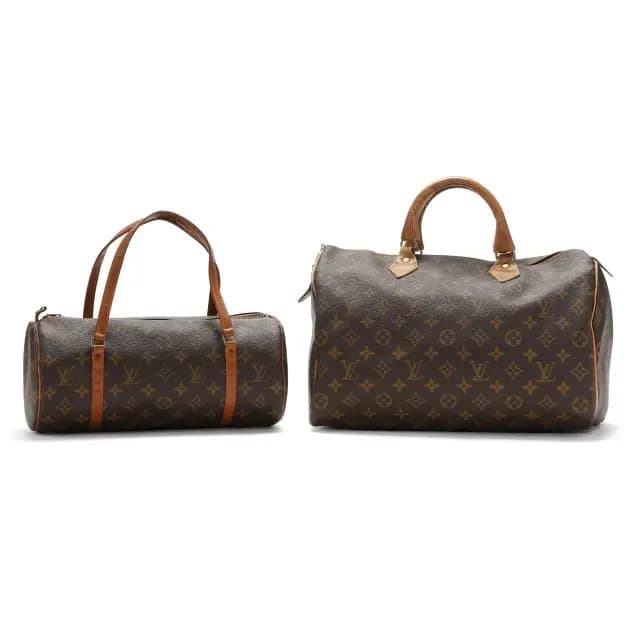
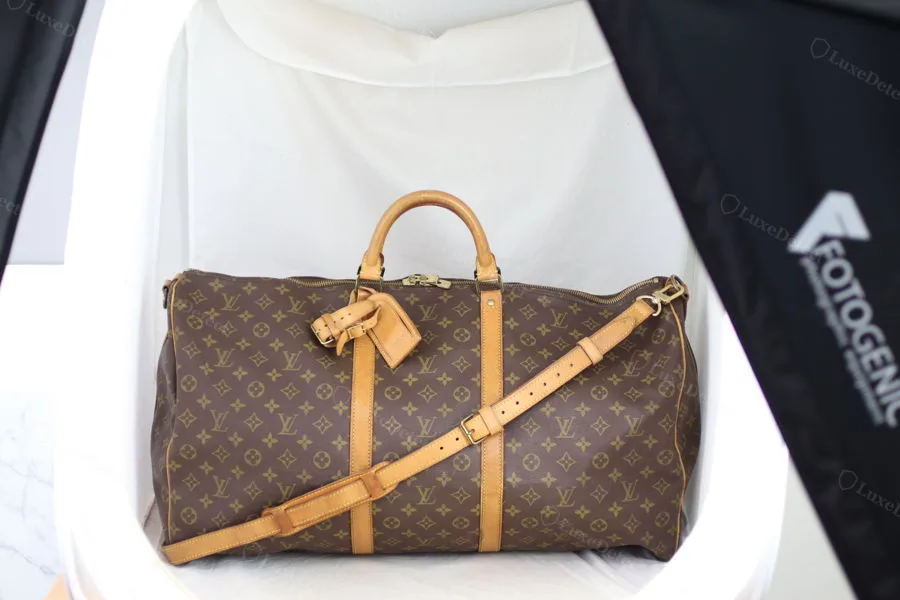
The Keepall has been in Louis Vuitton's lineup since 1930, making it one of the house's oldest continuously produced designs, and its shape has barely changed: a soft-sided cylindrical duffel with two rolled handles, a single top zip, and (on the Bandoulière versions) a detachable canvas-and-leather strap. It comes in four sizes — 45, 50, 55, and 60 — with the number referring to the bag's length in centimetres, and it's made in Monogram canvas, Damier Ebène, Damier Azur, Damier Graphite, and Epi and Empreinte leather, along with occasional limited runs (a Stephen Sprouse Graffiti print, a Supreme collaboration, an Eclipse reflective canvas).
That plainness is exactly what makes it a hard bag to fake convincingly and, at the same time, an easy bag to fake badly. There's no hardware-heavy lock plate to get wrong, no elaborate clasp, no complex silhouette — just a stitched canvas cylinder, two handles, a zip, and a small handful of leather and metal details. A low-effort counterfeit trips almost immediately on canvas quality or handle construction. A well-made one gets the silhouette and even the hardware engravings close enough that the difference comes down to the vachetta leather tab, the interior heat stamp, and the date code, all of which take more skill and cost to fake than a cheap operation is willing to spend. We reviewed photo evidence across several hundred Keepall authentication cases in our archive, spanning all four sizes and most of the canvas and leather variants, to see where that line actually falls.
What to check, ranked by reliability
| Checkpoint | Reliability | What it tells you |
|---|---|---|
| 2. The Interior Heat Stamp and Date Code | ★★★★★ | A date code that does not reduce to a real two-letter-plus-four-digit format is decisive on its own. |
| 1. The Vachetta Leather Tab and Rivet | ★★★★★ | Strike quality (crisp vs shallow/uneven) separates real from fake; the word order alone does not. |
| 4. Handle Construction and Wear Pattern | ★★★★★ | Premature splitting that exposes a different core material is a strong supporting tell, but genuine wear can look similar over decades. |
| 3. Hardware: Zipper, Pull, and Padlock | ★★★★★ | Useful corroboration, but some fakes in our sample had genuinely well-executed engravings. |
| 5. Canvas Pattern and Overall Silhouette | ★★★★★ | The better counterfeits looked convincing at normal viewing distance; this check alone will not catch them. |
| Model Reference Before You Start | ★★★★★ | Rules out an impossible size or made-up variant; will not catch a good fake of a real configuration. |
Model Reference Before You Start
- Sizes: Keepall 45, 50, 55, and 60 (centimetres, roughly the bag's length). All four are legitimate; there is no "Keepall 40" or "Keepall 65" in the standard line
- Bandoulière versions (Keepall Bandoulière 45/50/55) add a detachable, adjustable canvas-and-leather shoulder strap with a clip on each end; the plain Keepall has only the two rolled top handles
- Canvas and leather options: Monogram coated canvas (the most common and most copied), Damier Ebène, Damier Azur, Damier Graphite, Epi leather (textured, dyed), Empreinte leather (debossed monogram in soft calfskin), plus limited editions like Eclipse (grey monogram on technical canvas), Stephen Sprouse Graffiti, and the 2019 Supreme collaboration in monogram camouflage
- Where it's made: Monogram canvas Keepalls are typically made in France; Damier and some leather versions can be made in France, Spain, or the USA depending on era and line. "Made in \[country\]" alone is not a red flag — check it against the specific line, not against the brand as a whole
- RFID vs date code: Louis Vuitton phased out the stamped date code in favour of an embedded RFID microchip starting around 2021. If your Keepall was made after that transition, the absence of a visible date code is expected, not suspicious — see our guide to scanning and verifying the LV RFID chip for that system specifically. This guide focuses on the classic no-microchip construction checks that apply to the vast majority of Keepalls in circulation
The Vachetta Leather Tab and Rivet
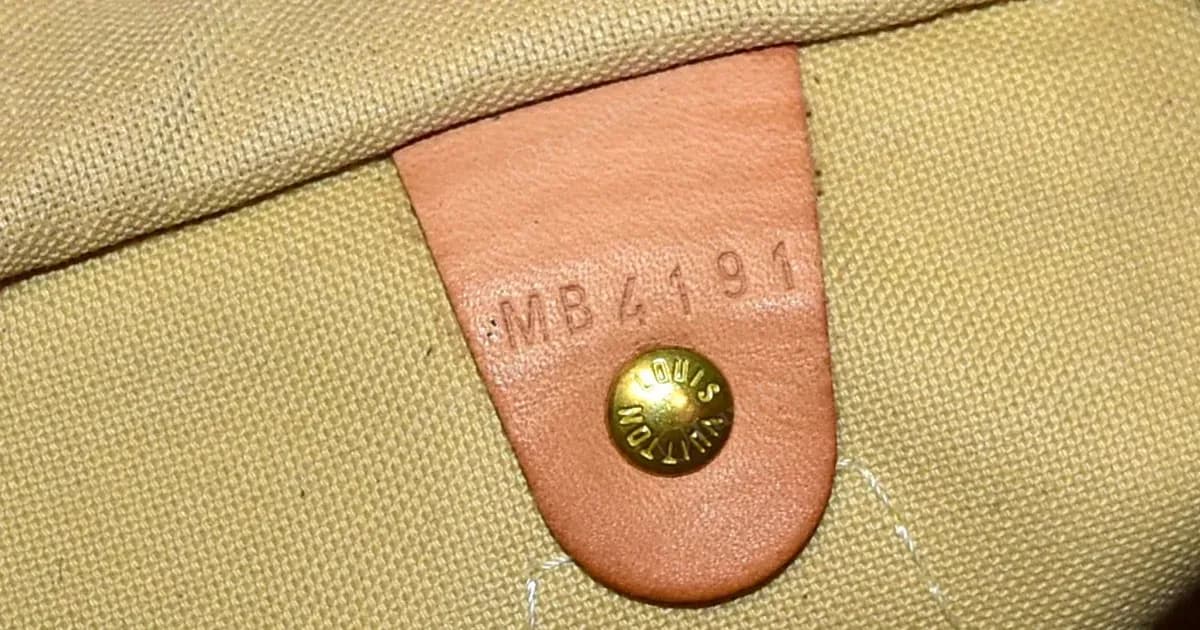
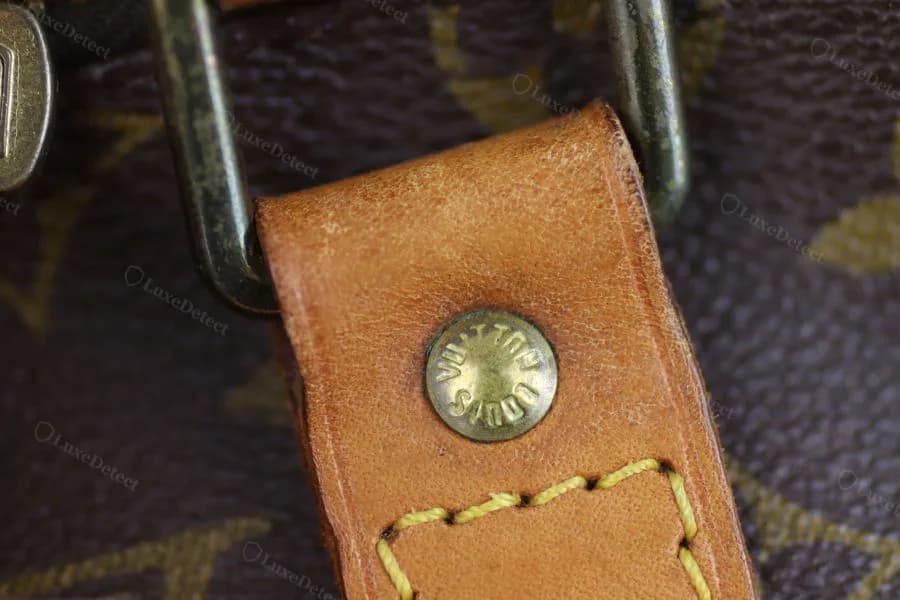
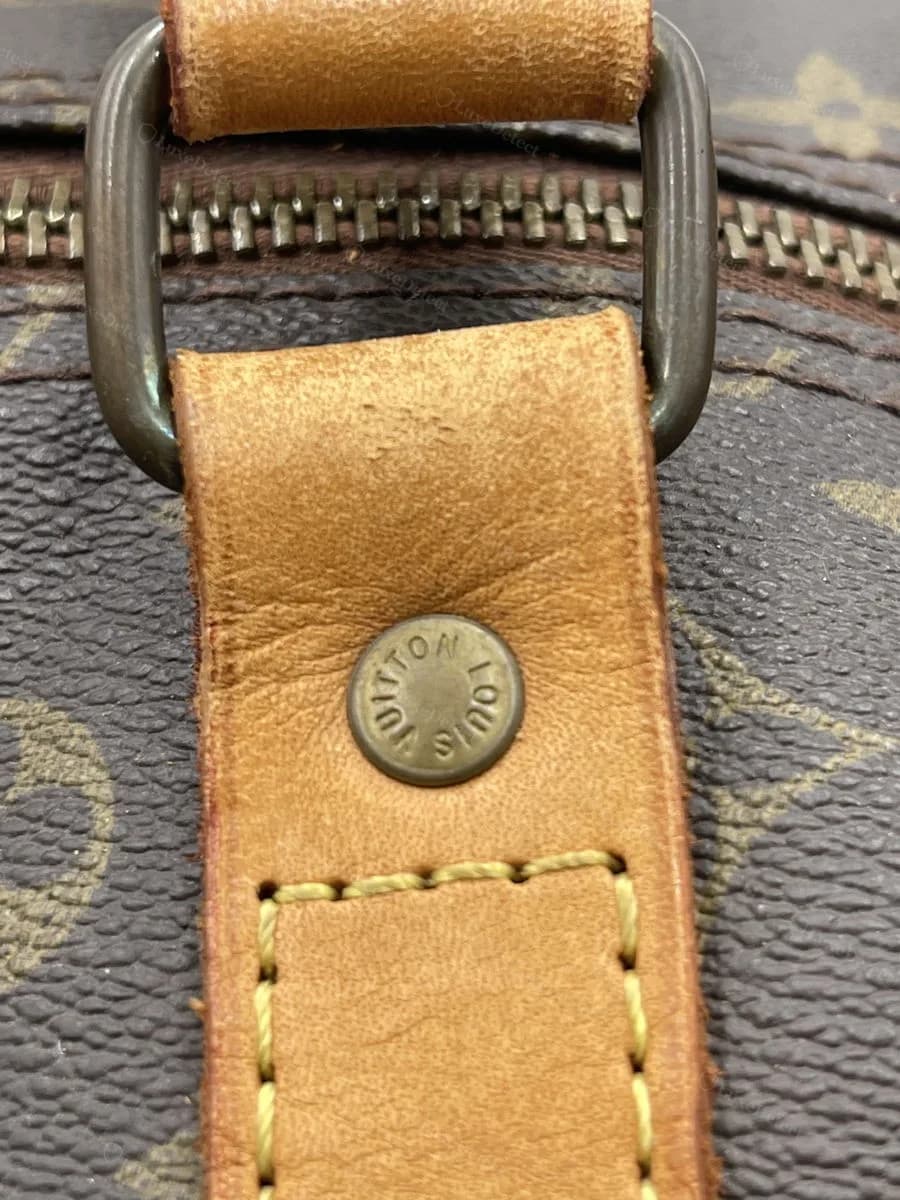
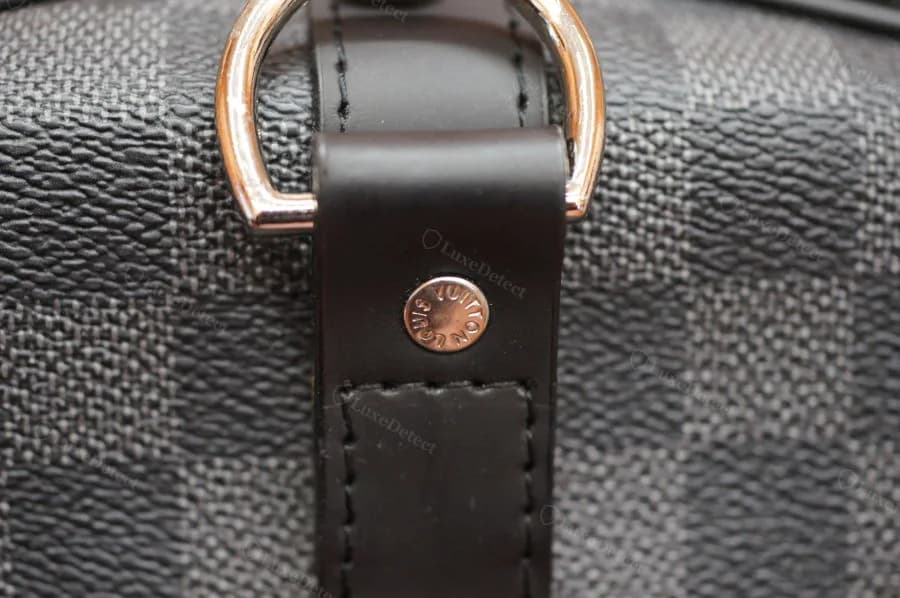
Every Keepall has at least one vachetta (untreated, undyed) leather tab — most commonly the pull-tab at the handle base, secured with a small round rivet. On many bags this rivet is stamped with "LOUIS VUITTON" arranged in a circle around the shank.
On a genuine bag, the vachetta starts as a pale, pinkish-beige leather with a fine, tight, matte grain. It develops an even honey-to-tan patina with light exposure and handling — this is expected aging, not a defect. The rivet stamp itself is crisply struck at a consistent depth, fully legible, with the lettering evenly spaced around the circle.
One thing worth being precise about: the text on this rivet can read "VUITTON LOUIS" (i.e., VUITTON first going clockwise) on genuine bags — we confirmed this reading on multiple verified-authentic examples in our archive, so that word order by itself is not a red flag. What does separate real from fake is the strike quality: shallow, uneven, or partially illegible lettering, or a rivet that looks stamped by a worn or low-quality die.
| Element | Authentic | Counterfeit |
|---|---|---|
| Leather grain | Fine, tight, matte, pale when new | Coarse, shiny, or starts too orange/grey |
| Patina | Even honey-to-tan development with handling | Blotchy, or a flat pre-dyed "aged" look |
| Rivet strike | Crisp, fully legible, even depth | Shallow, partial letters, uneven depth |
| Stitching around tab | Tight, even stitch count, clean thread color | Loose, uneven spacing, fraying |
Worth knowing
We checked this rivet's wording across multiple verified-authentic Keepalls before writing this section, because the same "VUITTON LOUIS" order shows up on fakes too — a reminder that a single visual detail, however distinctive it looks, needs to be checked against real examples before it becomes a red flag.
The Interior Heat Stamp and Date Code
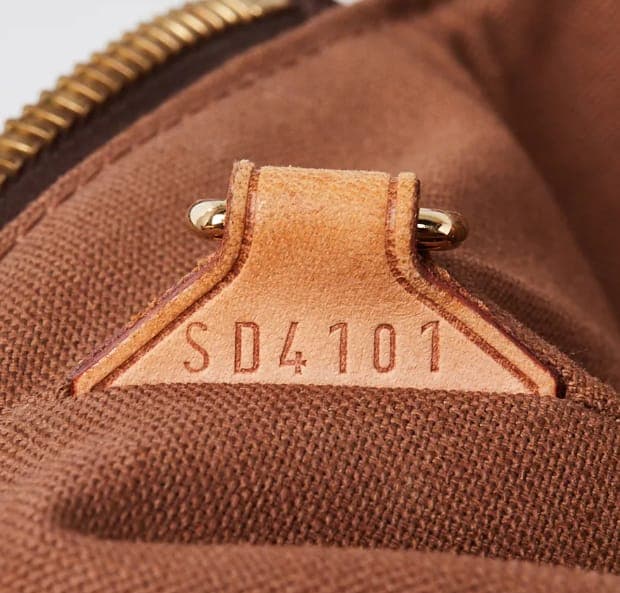
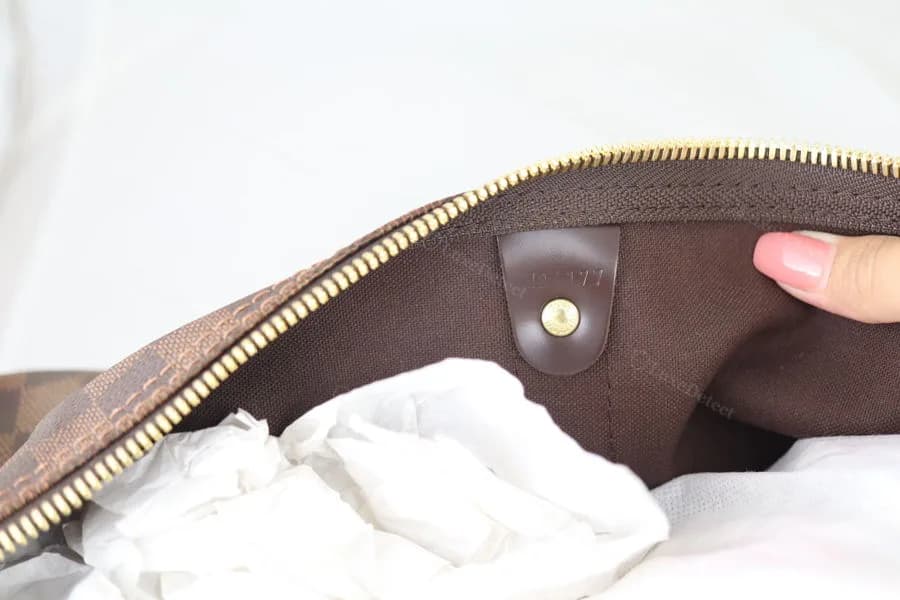
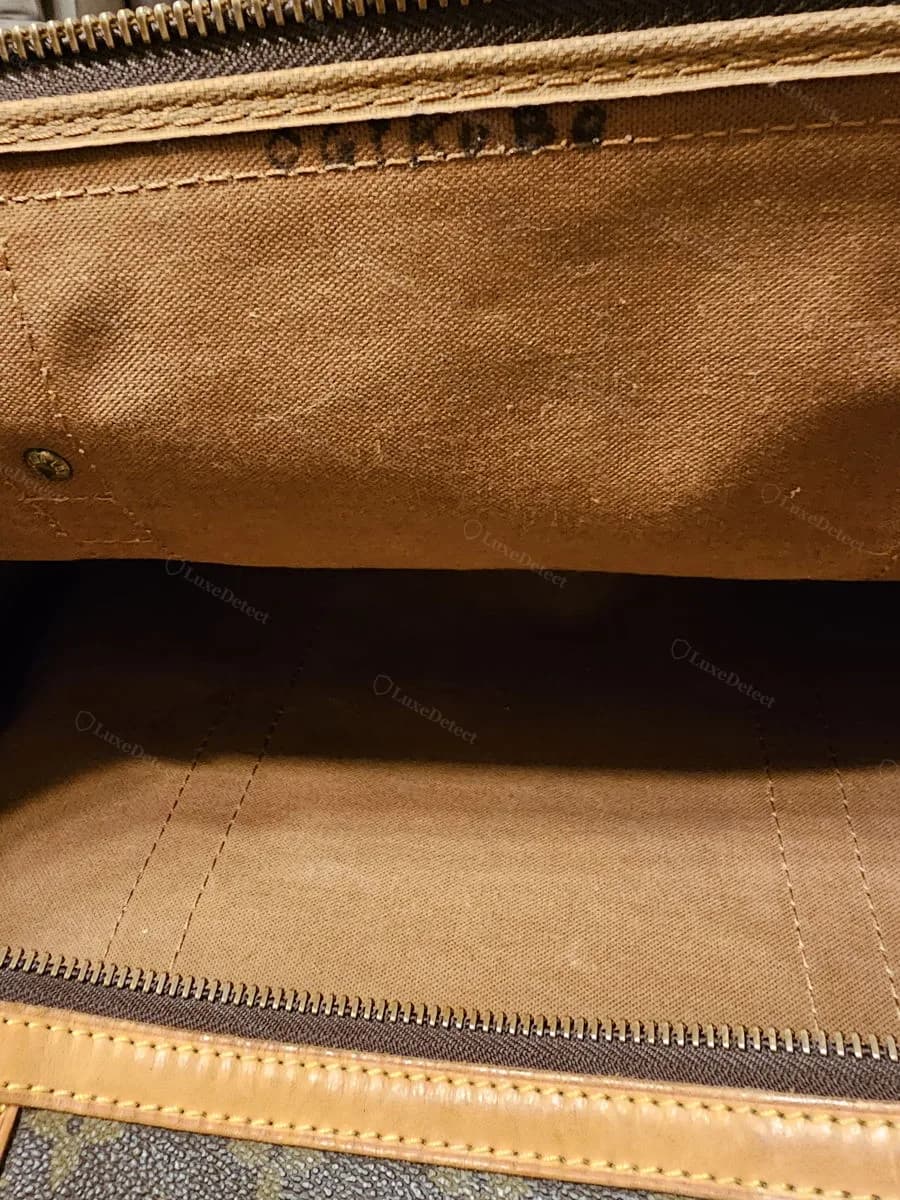
Inside the bag, near the top of the lining or on a leather tab at a seam, is LV's interior heat stamp: "LOUIS VUITTON PARIS made in [country]," in the house's fixed sans-serif letterforms, with an ® symbol after VUITTON on most examples. Nearby (or in the same location, on a separate leather tab) is the date code: two letters followed by four digits on bags made before the 2021 RFID transition.
On genuine bags this stamp is pressed at an even, moderate depth, level, with crisp, fully legible letters. The date code follows a real format — two letters, then four digits, where (for codes issued from 2007 onward) the digits alternate as week-week-year-year. In our archive sample, one confirmed counterfeit Keepall had a code that didn't resemble any valid LV format at all: the characters were misshapen and didn't reduce to a coherent two-letter-plus-four-digit reading. That kind of garbled, non-format code is a much stronger tell than a blurry-but-readable one, because it shows the counterfeiter wasn't even attempting to replicate the real system.
| Element | Authentic | Counterfeit |
|---|---|---|
| Stamp depth | Even, moderate, crisp | Too shallow, too deep, or uneven across the line |
| Letterforms | Consistent LV house font throughout | Subtly wrong spacing or shape |
| Date code format | 2 letters + 4 digits (WWYY from 2007) | Garbled, illegible, or not reducible to that format |
| Code vs. bag | Consistent with the bag's apparent age and wear | Contradicts patina, or nonsensical |
Red flag
A date code that does not reduce to a real two-letter-plus-four-digit format is decisive on its own — it means the counterfeiter wasn't copying a genuine code, just approximating the idea of one.
Worth knowing
A valid-format code is not proof by itself — it gives you the production year, not the verdict. Counterfeiters do copy real-looking codes onto fakes. Its main value is catching a contradiction: an impossible week number, or a "recent" code on a bag with heavy vachetta patina that doesn't match. For the full breakdown of LV's date-code system by era, see our [complete guide to Louis Vuitton date codes](/blog/louis-vuitton-date-code-serial-number-guide).
Hardware: Zipper, Pull, and Padlock
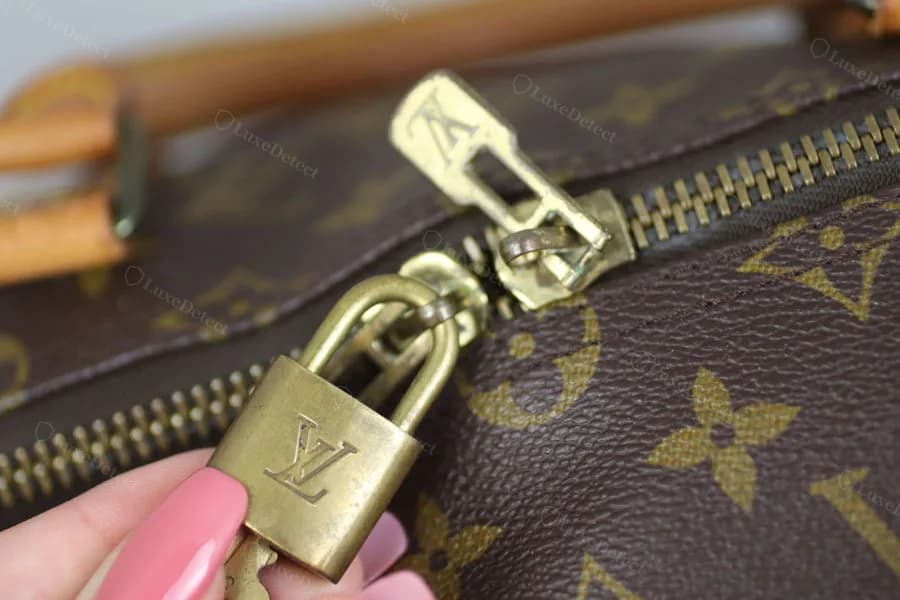
The Keepall's zipper runs the full length of the top opening, usually with two pulls that meet in the middle. Bandoulière versions add a padlock (a "LOUIS VUITTON PARIS MADE IN FRANCE" engraved brass lock with a numbered keyed cylinder) and matching keys on some bags, plus D-rings and a clip-on strap.
On a genuine bag, the zipper teeth are even, run smoothly without catching, and the pull tabs are stamped with a crisp "LV" monogram at consistent depth. Where a padlock is present, the engraving is deep and fully legible, the lock body has a substantial weight to it, and the cylinder is numbered to match a set of two keys. D-rings and clips are solid metal with even plating and no visible casting seam.
We found that hardware quality varies more than any other single check in the Keepall's construction — some of the fakes in our archive had genuinely well-executed "LV" pull engravings and correctly worded padlock text, which is the honest caveat here: hardware alone, especially on a photo rather than in hand, is not always conclusive on a well-made counterfeit. It's one input, best read together with the leather and stamp checks.
| Element | Authentic | Counterfeit |
|---|---|---|
| Zip action | Smooth, even teeth, no catching | Catches, uneven tooth spacing |
| Pull stamp | Crisp "LV," consistent depth | Soft, shallow, or slightly wrong proportions |
| Padlock | Deep engraving, substantial weight, numbered cylinder matches keys | Light weight, shallow engraving, mismatched or absent numbering |
| D-rings/clips | Solid, even plating, no seam | Seamed, wobbly, brassy plating |
Handle Construction and Wear Pattern
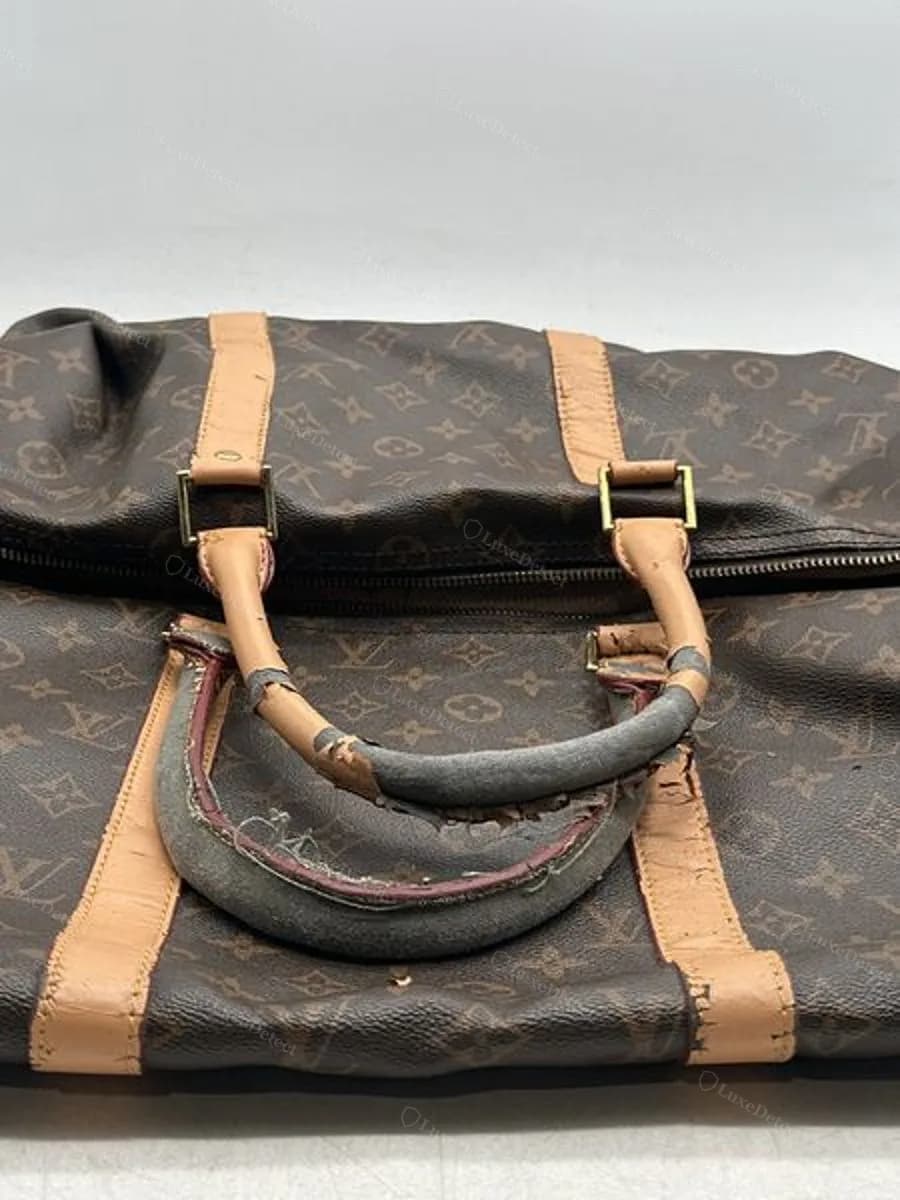
The Keepall's two rolled top handles are a fabric or leather core wrapped in a thin vachetta or coated-canvas covering, stitched or glued along a seam. This is a genuine wear point on any bag, real or fake, decades old or nearly new, so distinguishing normal age from poor construction matters.
On a well-made bag — genuine or a very good fake — the handle covering stays intact for years of normal use, with only gradual, even surface wear. What we found repeatedly on lower-effort counterfeits in the archive was premature structural failure: the rolled covering splitting and peeling away in chunks to expose a visibly different core material (grey foam or fiber padding, sometimes with a contrasting colored lining strip) far earlier than genuine vachetta or leather would fail under comparable use. This is a construction-quality tell rather than a stamp-and-die tell, and it's most useful as a supporting signal rather than a first check, because genuine handles can also show real wear on a well-used bag.
Worth knowing
Judge handle wear in context. A 20-year-old genuine Keepall with honestly worn, darkened handles is not a red flag. A "brand new" or lightly used bag with a handle already splitting to expose its core is inconsistent with normal use at any age and is worth further scrutiny.
Canvas Pattern and Overall Silhouette
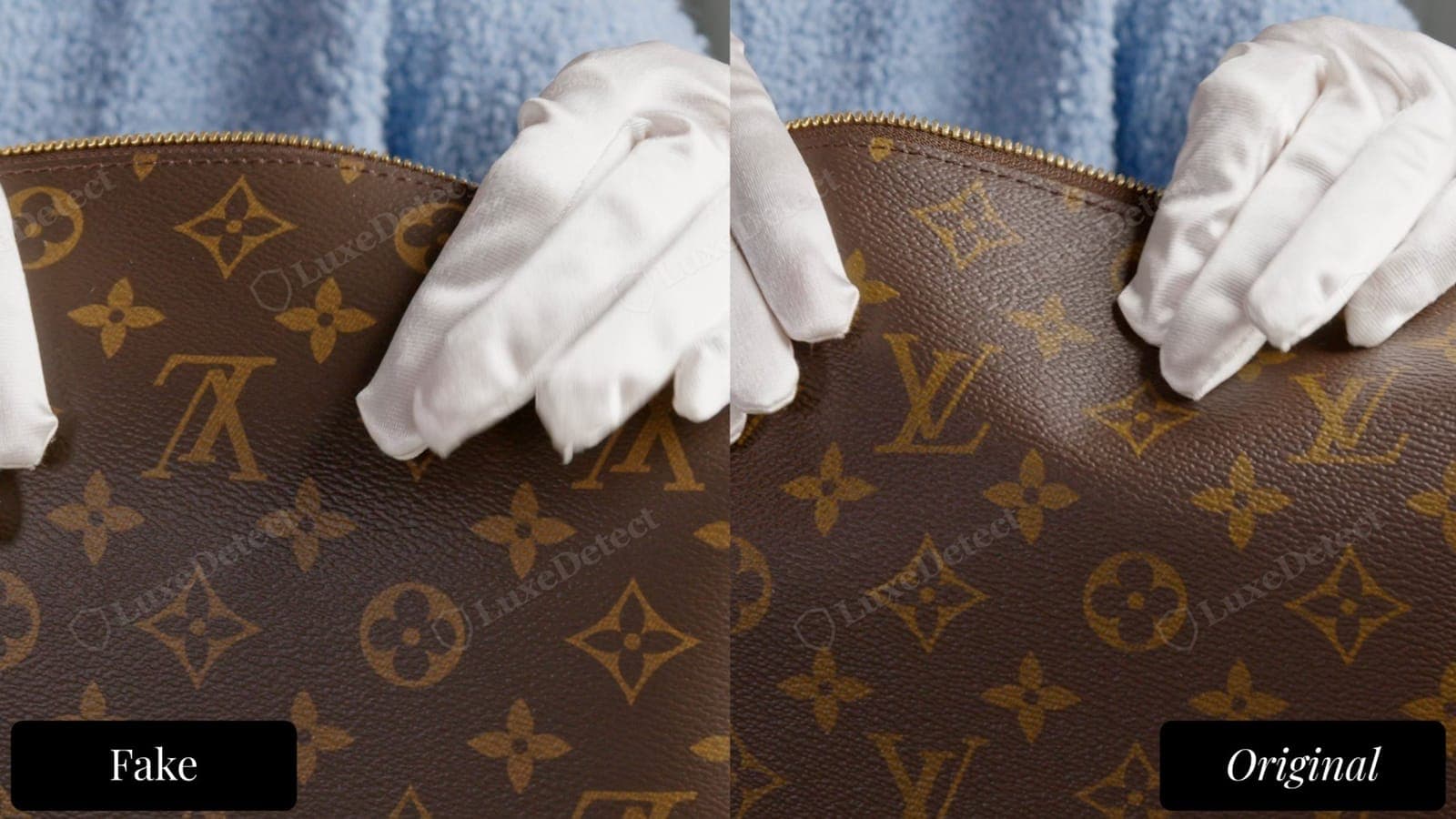
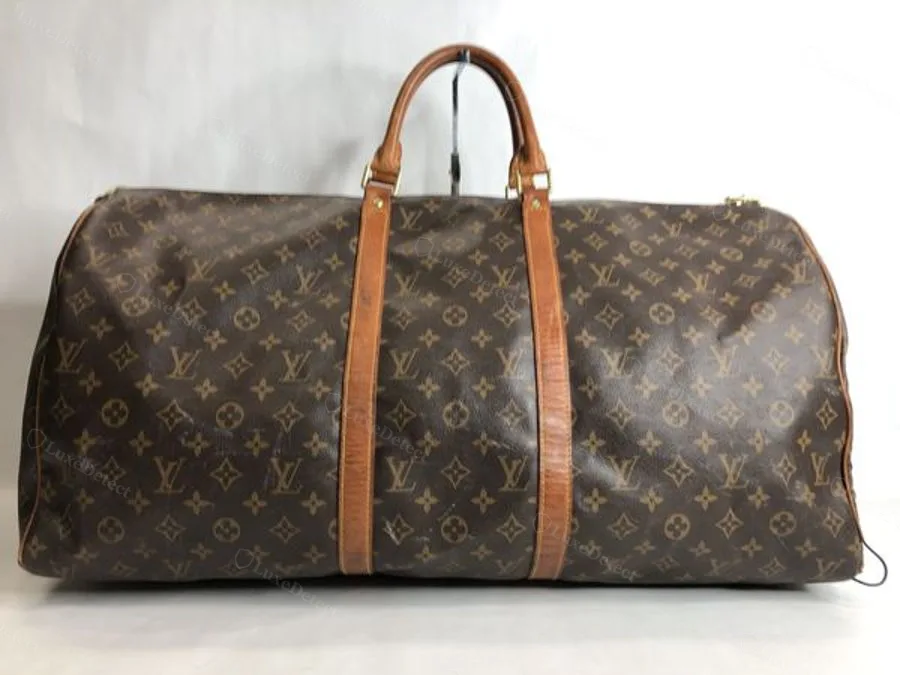
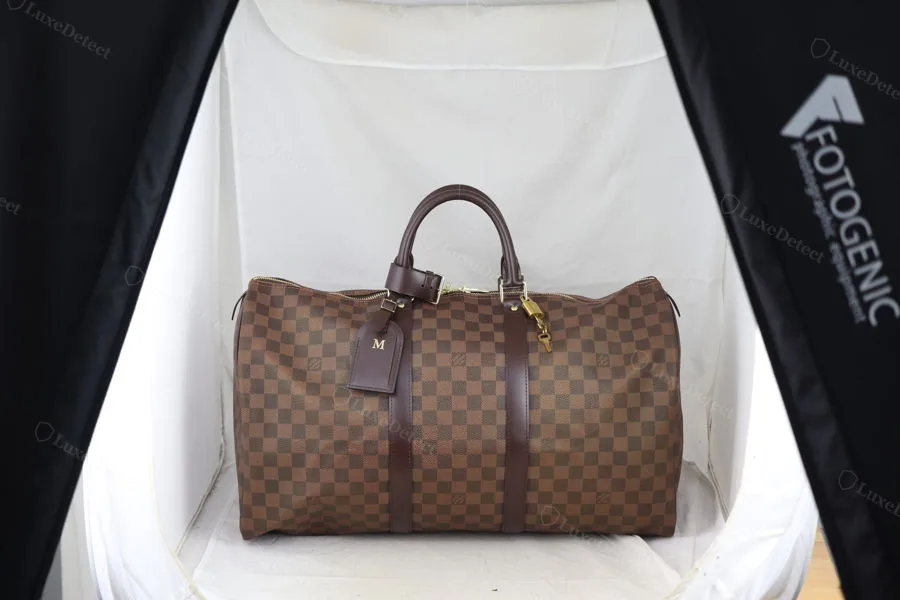
Whatever canvas or leather the bag uses, the motif or grain should be consistent, correctly scaled, and evenly applied across every panel — the front, back, ends, and the strip running under the handles. On Monogram canvas, the LV monogram and quatrefoil motifs should be crisp and evenly spaced with no distortion near seams. On Damier (checkerboard) patterns, the grid should be sharp and even, without drifting or warping where panels meet.
Being direct about this one: the overall silhouette and canvas application on a Keepall is where the better counterfeits in our sample looked genuinely close to authentic at normal viewing distance. A well-executed monogram canvas print, cut and assembled by someone who has done it many times, can produce a bag that passes a casual glance. This is exactly why the vachetta tab, interior stamp, date code, and hardware checks above carry more of the weight in this guide than the canvas does on its own.
| Element | Authentic | Counterfeit |
|---|---|---|
| Motif/grid scale | Correct, fixed size across all panels | Subtly stretched, compressed, or inconsistent |
| Panel alignment | Motifs read consistently across seams | Pattern breaks or shifts oddly at seams |
| Canvas coating | Smooth, consistent sheen | Overly matte, plasticky, or uneven texture |
Worth knowing
Treat the canvas and silhouette as a first impression, not a verdict. A bag that looks right from three feet away can still fail the vachetta tab, date code, or interior stamp up close.
What the Box and Dust Bag Do and Do Not Prove
A genuine Keepall may come with an LV dust bag (soft cotton, crisp printed logo) and, for a newer purchase, a receipt. Louis Vuitton does not issue plastic "authenticity cards" — a card included with the bag as proof of authenticity is itself a red flag, not a reassurance.
None of the packaging authenticates the bag on its own. Dust bags are reproduced and sold separately from the item. A convincing dust bag around a bag that fails the vachetta, stamp, or date-code checks does not change the verdict. Packaging is context for cross-referencing (does the dust bag's printed logo and stitching match what's expected for the claimed era?) — never standalone evidence.
Quick Authentication Checklist
- Check the vachetta tab and rivet — fine tight grain, even patina, crisply struck lettering at consistent depth
- Read the interior date code — valid two-letter-plus-four-digit format (or an RFID chip instead, on 2021+ bags), consistent with the bag's apparent age
- Inspect the interior heat stamp — even depth, crisp house-font letterforms, correct country of manufacture for the line
- Work the zipper and check the padlock (Bandoulière) — smooth action, crisp "LV" pull stamp, deep padlock engraving, numbered cylinder matching the keys
- Look at the handle covering for premature splitting that exposes a different core material
- Check the canvas or leather pattern is consistently scaled and aligned across every panel, including at seams
- Treat a plastic "authenticity card" as a red flag; a dust bag or receipt alone proves nothing
Two or more failures means walk away. A date code that does not reduce to a real two-letter-plus-four-digit format is, on its own, sufficient to reject the bag.
When to Get a Professional Opinion
Low-effort Keepall fakes fail immediately on canvas quality or handle construction. The harder cases are the better-made copies that get the silhouette, the canvas application, and even some hardware engravings close enough that separating them from genuine requires comparing the vachetta tab's strike quality, the date code's actual format validity, and the interior stamp's letterforms side by side with verified references — not something a single photo at a normal angle reliably settles.
If you're buying secondhand, from a resale marketplace, or as a gift you can't inspect in person, get a second opinion before the money moves. LuxeDetect authenticates Louis Vuitton handbags from $25 with a verdict and Certificate of Authenticity within 24 hours. Send clear photos of the vachetta tab and rivet, the interior heat stamp and date code straight-on, the zipper pulls and padlock if present, and the full exterior in even light.
FAQ
What sizes does the Louis Vuitton Keepall come in?
45, 50, and 55 are the most common sizes, with 60 also part of the standard line; the number refers to the bag's approximate length in centimetres. There is no "Keepall 40" or "Keepall 65" in Louis Vuitton's regular lineup, so a listing using an off-size number is worth double-checking against the seller's photos.
Where is the date code on a Louis Vuitton Keepall?
Heat-stamped on a small leather tab inside the bag, often near a seam or tucked by the interior lining, formatted as two letters followed by four digits. On bags made from around 2021 onward, Louis Vuitton replaced the visible date code with an embedded RFID microchip, so no visible code on a recent Keepall is expected rather than suspicious.
Does the "VUITTON LOUIS" word order on the leather tab rivet mean a Keepall is fake?
No. We checked this specifically because it looked like a promising tell at first, and found the same word order on multiple verified-authentic Keepalls in our archive. What matters on that rivet is the strike quality — crisp, fully legible, even depth — not which word comes first.
Is a Keepall with no visible date code automatically suspicious?
Not if it was made after Louis Vuitton's roughly 2021 switch to RFID microchips — in that case, no stamped code is normal. If a seller claims the bag is older (pre-2021) but there's no code and no chip either, that inconsistency is worth investigating further; see our guide to the LV RFID chip system for how to check for and scan the chip.
Can I tell a fake Keepall just from the canvas pattern in photos?
Not reliably on its own. The better counterfeits in our review had canvas application and overall silhouettes that looked convincing at normal photo distance. The more decisive checks are the vachetta tab's rivet strike, the interior date code's format validity, and the heat stamp's letterforms, ideally viewed up close or in person.
What's the difference between a Keepall and a Keepall Bandoulière?
The Bandoulière versions include a detachable, adjustable canvas-and-leather shoulder strap that clips onto D-rings at each end of the bag, plus the padlock and keys often included with that configuration. The plain Keepall has only the two rolled top handles and no shoulder strap.