Luxury Accessories Authentication Specialist
Handbag authentication specialist. Has reviewed submissions across Hermès, Chanel, Louis Vuitton, and Dior since 2019.
Last updated September 2026 · Published May 2026 · Contact
Why the Hermès Constance Belt Is Heavily Faked
Logo buckle belts have returned to the forefront of fashion, and the Hermès Constance, with its iconic H clasp, sits at the top of the counterfeit market. The belt seems simple: a leather strap and a buckle. But the authentic version encodes authenticity in very specific ways that replicas consistently fail to reproduce, the same craftsmanship discipline covered in depth in our guide to Birkin bag authentication secrets.
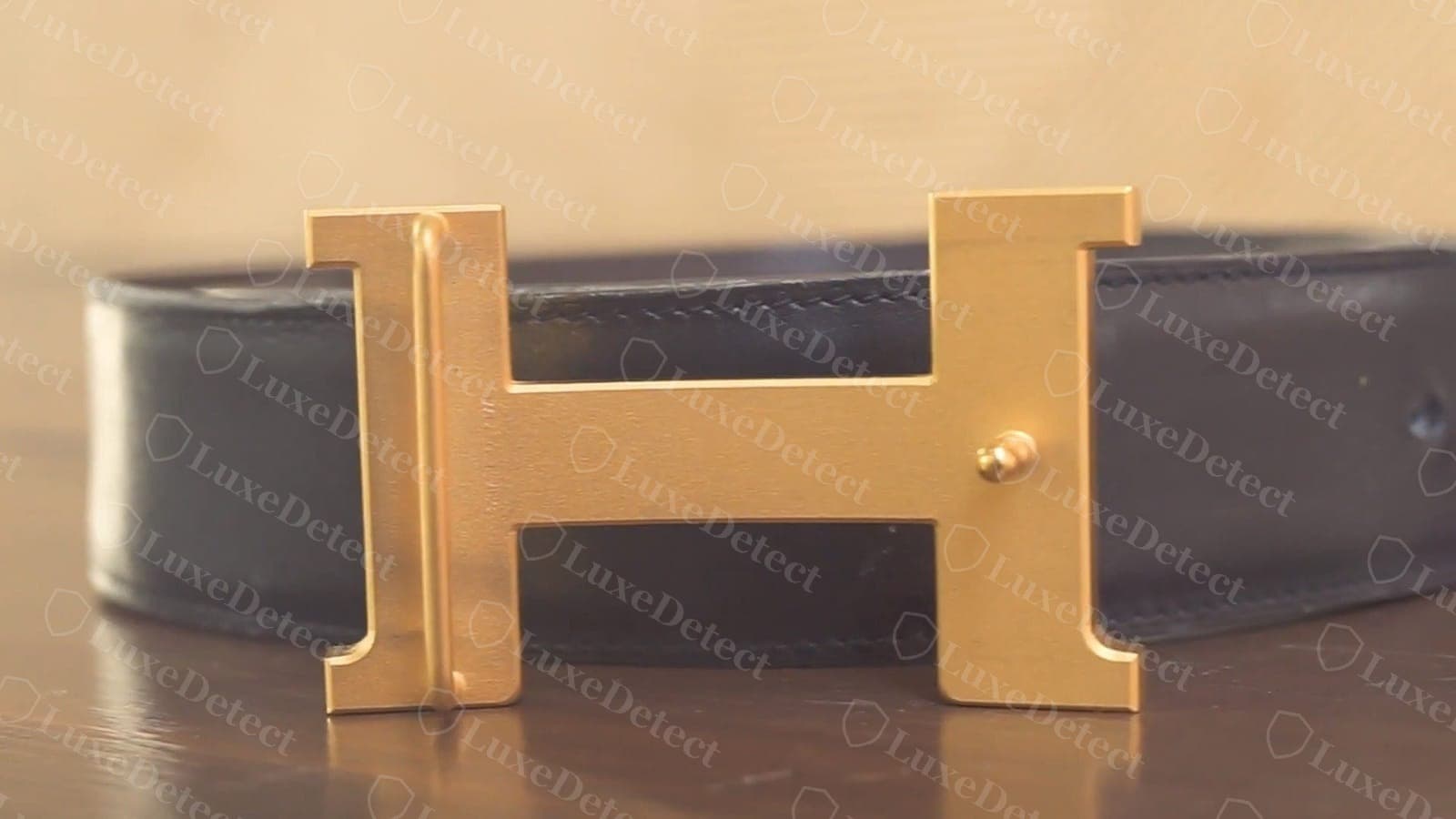
What to check, ranked by reliability
| Checkpoint | Reliability | What it tells you |
|---|---|---|
| 2. Buckle Reverse — Finish Is the First Tell | ★★★★★ | A shiny or reflective buckle reverse is decisive on its own; the genuine reverse is always completely matte. |
| 3. Buckle Crossbar — Brand Stamp | ★★★★★ | A boxed brand name or a 14K/18K karat marking is one of the most reliable counterfeit tells - Hermès never uses either. |
| 4. Belt End Stamps — Three Required Marks | ★★★★★ | A missing origin stamp, a size given in inches, or an illegible year code is decisive - all three marks are required. |
| 5. Stamp Color and Year Code | ★★★★★ | A stamp colour that contradicts the year code corroborates a fake but requires knowing the era-specific rule. |
| 1. Reversible Construction | ★★★★★ | A single-sided strap rules out authenticity outright, but reversibility alone does not confirm it. |
Reversible Construction
Every authentic Hermès Constance belt is double-sided. The strap is reversible, with a different type of calfskin on each face. This is a non-negotiable feature — a single-sided Constance belt is not authentic.
In most cases, the two sides are different colors. However, a belt with the same color on both sides is not automatically a fake — Hermès has produced monochrome reversible versions. The key is that both sides must be genuine calfskin with a different leather finish or texture, not identical surfaces.
Worth knowing
A single-sided strap rules out authenticity outright, but a reversible strap alone doesn't confirm it — reversibility is necessary, not sufficient.
Buckle Reverse — Finish Is the First Tell
Turn the buckle over. The reverse of an authentic Hermès Constance buckle is completely matte. No shine, no polish. A shiny or reflective reverse face is the hallmark of a low-quality counterfeit and one of the fastest ways to eliminate a fake.
The front face of the buckle, by contrast, can legitimately be smooth, matte, or hammered (martelé) depending on the model and season — so the front finish alone cannot be used to determine authenticity. It is the reverse that must always be matte.
"Made in France" on the reverse of the H: On modern authentic Constance belts, the back of the H buckle does not carry a "Made in France" stamp. On older authentic pieces, this stamp may be present. Crucially: if you are examining a piece being sold as a vintage or older model and it bears "Made in France" on the back of the H, this is a fake tell — authentic older Constance belts also did not carry this on the buckle back.
Red flag
A shiny or reflective buckle reverse is decisive on its own and one of the fastest ways to eliminate a fake, the reverse of a genuine Constance buckle is always completely matte, regardless of the front finish.
Real vs. Fake: Buckle Reverse at a Glance
| Detail | Authentic | Counterfeit |
|---|---|---|
| Reverse finish | Completely matte, no shine | Shiny or reflective |
| Front finish | Smooth, matte, or hammered (martelé) — varies by model/season | Not diagnostic on its own |
| "Made in France" on modern pieces | Not present on the back of the H | Presence on a piece sold as modern is suspect |
| "Made in France" on older/vintage pieces | May legitimately be present | Also should not appear on the buckle back |
Buckle Crossbar — Brand Stamp
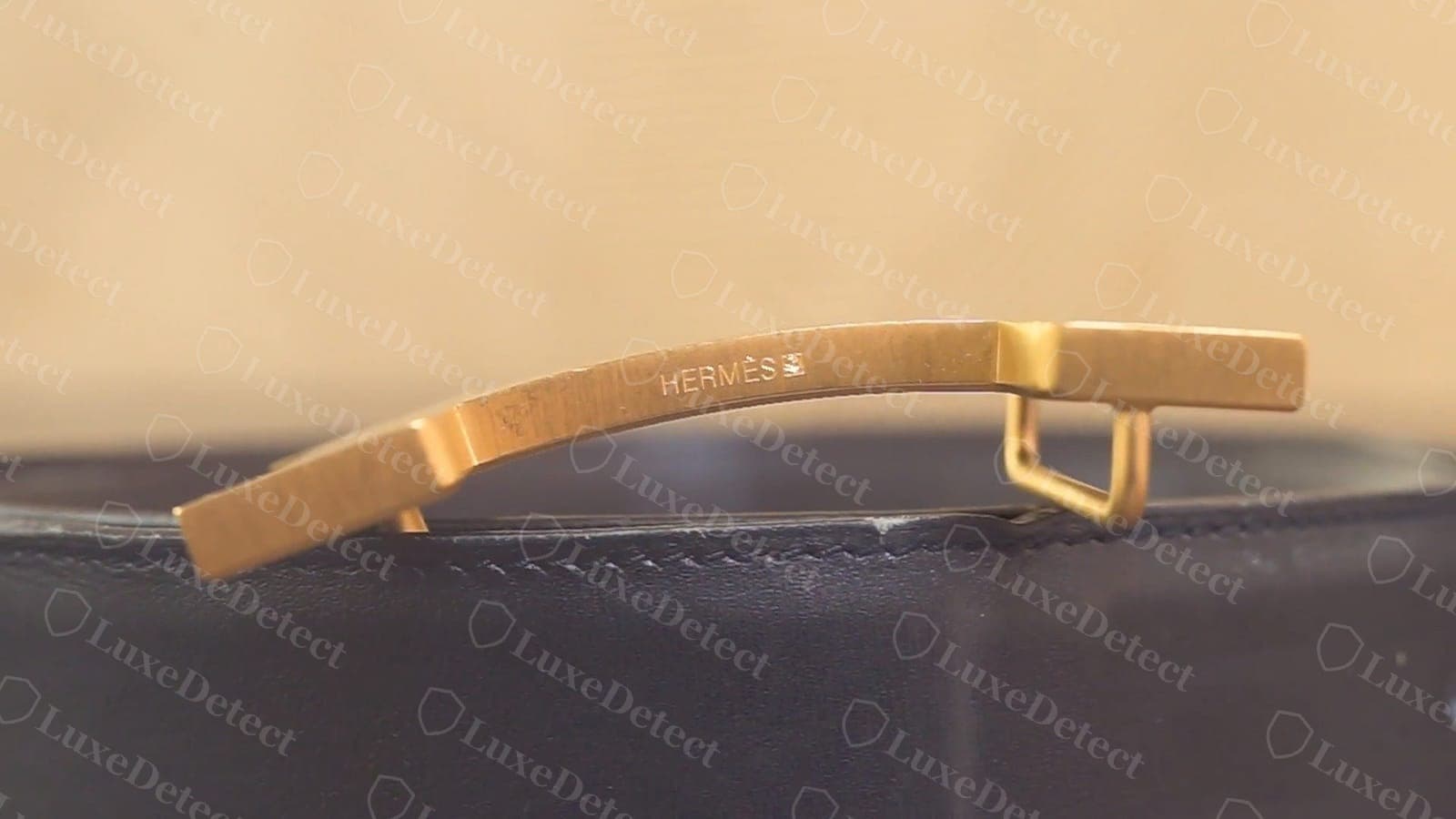
On the horizontal crossbar of the H, you will find the brand name stamped. This stamp is always present on authentic pieces. Two points to check:
Spelling: The brand name appears either as Hermès (with the accent on the è) or as Hermes (without the accent). Both are authentic — different production eras used different formats. Neither is more or less genuine than the other.
Format: The name must appear as plain text on the crossbar. If the brand name is enclosed in a rectangle or box, the piece is a fake. This is one of the most reliable counterfeit tells on the buckle.
Additional markings: On newer authentic models, small dashes may appear before or after the brand name. A letter enclosed in a small square may also appear near the stamp — this indicates the plating type (gold or palladium). These are authentic markers.
What is never present: The markings 14K or 18K never appear on authentic Hermès Constance buckles. Hermès does not use karat gold designations on its belt hardware. If you see 14K or 18K on the buckle, do not buy the belt.
Red flag
A brand name enclosed in a rectangle or box on the crossbar, or a 14K/18K karat marking, is one of the most reliable counterfeit tells on the entire belt — Hermès never uses either format.
Belt End Stamps — Three Required Marks
On the tail end of the belt (the pointed end that threads through the buckle), authentic Hermès Constance belts carry at least three distinct stamps:
Left side: The origin stamp — HERMÈS PARIS MADE IN FRANCE — in three lines. All three lines must be present and legible.
Right side: Two pieces of information:
- The belt length in centimetres (e.g., 75, 80, 85, 90, 95)
- A letter enclosed in a circle or square — this is the year of production code
If any of these stamps is absent, or if you see only worn leather where a stamp should be with no trace of ink or impression, the belt is not authentic. Casual canvas-and-leather pieces like the Hermès Herbag use a different stamp layout entirely, so don't assume the Constance's three-stamp rule transfers to every Hermès bag.
Size in inches is always a fake tell: Authentic Hermès belts are sized in centimetres only. If the belt shows a size in inches (23, 24, 25 and up), it is a counterfeit.
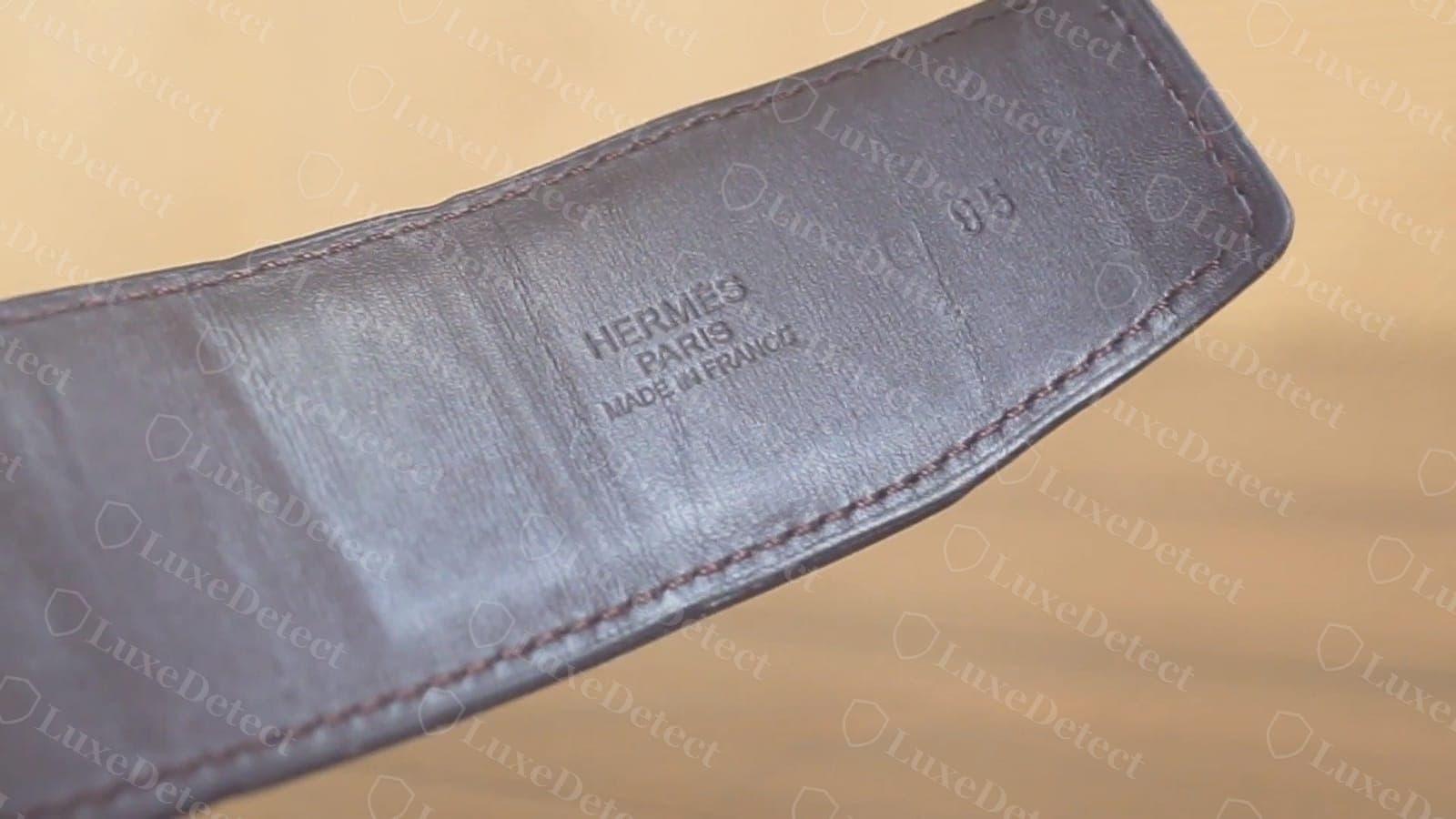
Red flag
A missing origin stamp, a size given in inches, or a year-code letter with no ink or impression trace is decisive — all three marks are required on every authentic Constance belt end.
Use our free Hermès Date Stamp Decoder to identify the production year of any Birkin, Kelly, or Constance — circle, square, or modern alphanumeric format.
Decode Hermès Stamp →Stamp Color and Year Code
The color of the origin stamp correlates with the year production code:
- Year codes A or B (in either a circle or square): The origin stamp — HERMÈS PARIS MADE IN FRANCE — appears in gold or silver.
- Year code C or later letters in a square: The origin stamp must be colorless (blind-embossed into the leather with no foil or pigment).
This is a precise and consistent rule on authentic pieces. A stamp color that doesn't match the year code is a fake indicator even if all other details appear correct. The same letter-in-a-shape date-code logic governs Birkin and Kelly special stamps, so it's worth learning once and applying across every Hermès leather good you evaluate.
Worth knowing
Stamp colour versus year code is a useful cross-check but requires knowing the exact date-code rule for the era, it corroborates the belt-end stamps rather than standing alone.
Quick Authentication Checklist
- Reversible strap — two different calfskin faces, two sides present
- Buckle reverse — completely matte (never shiny)
- "Made in France" on buckle back — not present on modern authentic pieces
- Crossbar stamp — brand name in plain text (never enclosed in a rectangle)
- Crossbar spelling — "Hermès" or "Hermes" both valid; never "14K" or "18K"
- Letter in square near stamp — indicates plating type; this is authentic
- Belt end — three stamps present: HERMÈS PARIS MADE IN FRANCE / size in cm / year letter
- Size format — centimetres only (inches = fake)
- Stamp color — gold/silver for A or B year codes; colorless for C+ in square
FAQ
Does "Hermès" vs "Hermes" (no accent) indicate a fake?
No. Both spellings appear on authentic Hermès hardware across different production eras. The accent is not required. What matters is the format: plain text on the crossbar. If the name is boxed in a rectangle, that is the fake tell.
What year does each letter correspond to?
Hermès uses a rotating single-letter date code system. The sequence runs A, B, C, D... with each letter representing a specific year. The letter enclosed in a circle (older system) or square (newer system) on the belt end identifies the production year. A full date code chart is available in our Hermès date code guide.
My belt is marked with only one stamp on the end — is it fake?
Yes, very likely. Authentic Constance belts carry at minimum the origin stamp (HERMÈS PARIS MADE IN FRANCE) plus the size and year code on the end. A belt with only one stamp, or stamps that are partially present, should be treated as suspect.
Can vintage Constance belts look different?
Yes — older models may have different stamp formats, different crossbar markings, and the "Made in France" on the buckle reverse rule changes by era. If you're evaluating a vintage piece, cross-reference the specific production year's known characteristics rather than applying only the rules for current models.
What does the letter in a square near the crossbar stamp mean?
It indicates the type of metal plating on the buckle — either gold-tone (gold plating) or silver-tone (palladium plating). This marking is authentic and helpful context for the hardware type, but its presence or absence does not alone confirm or deny authenticity.