Luxury Accessories Authentication Specialist
French luxury house specialist. Covers Chanel, Celine, and Saint Laurent construction and date coding.
Last updated September 2026 · Published June 2026 · Contact
Why the Gucci Belt Is Faked at Every Price Point
The Gucci GG Marmont belt retails between $450 and $650 depending on width and hardware finish, and holds roughly 60–70% of retail on the resale market. That combination — instantly recognizable design, entry-level luxury price, and strong resale — makes it the most counterfeited luxury belt in the world.
The economics explain the quality spread. A fake Birkin needs to clear thousands of dollars to be worth a counterfeiter's effort, so fakes cluster at the high end. A Gucci belt only needs to clear $80–$150, which means the market is flooded at every tier: $20 street-market copies that fail on sight, $150 "mirror" replicas that copy the buckle geometry convincingly, and a growing middle tier assembled from genuine-looking components sourced separately.
The practical consequence for buyers: price tells you almost nothing. A belt sold at $380 is not safer than one sold at $180. Counterfeiters price to the market, and the most dangerous fakes are the ones priced close enough to real that the discount doesn't trigger suspicion. The buckle, the leather, and the stamp are what tell you — in that order.
What to check, ranked by reliability
| Checkpoint | Reliability | What it tells you |
|---|---|---|
| 1. The Double G Buckle — Engraving and Weight | ★★★★★ | A hollow-sounding, underweight buckle or shallow surface-level engraving rejects the belt outright. |
| 2. The Leather Strap | ★★★★★ | Edge paint already cracking on a new belt, or a rubber/solvent smell instead of leather, is a strong indicator. |
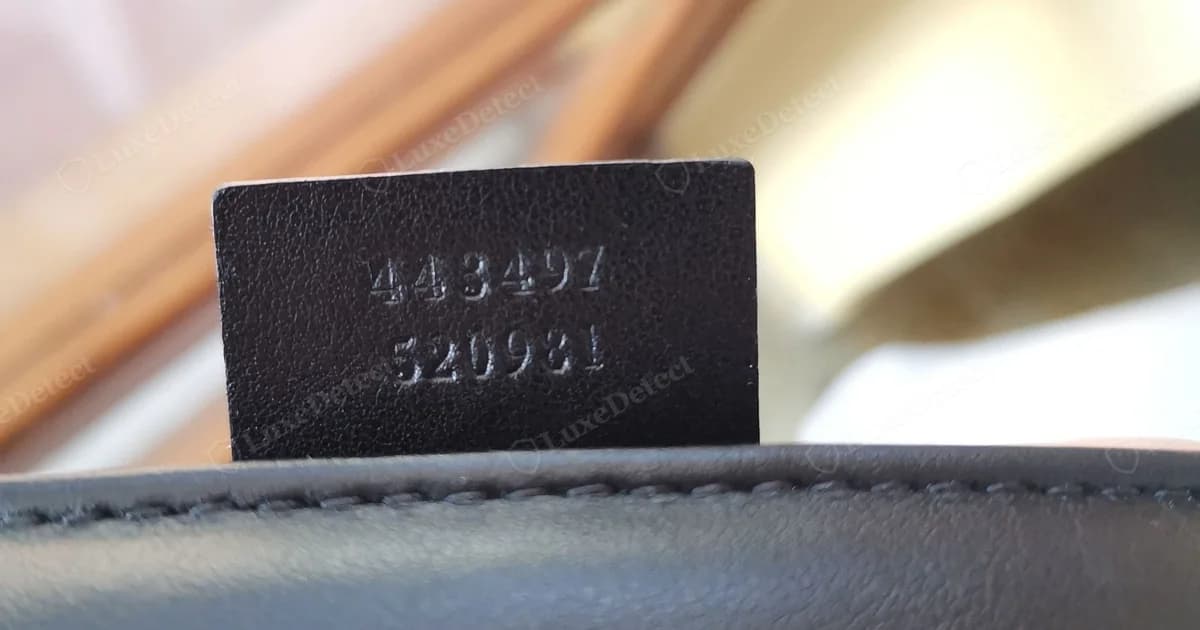
| 3. The Interior Stamp | ★★★★★ | A printed rather than heat-debossed stamp, wrong font spacing, or an incorrect country line is a strong indicator, though a correctly formatted serial alone proves nothing. |
| 4. Hardware — Prong and Keepers | ★★★★★ | Mismatched keeper edge paint or an off-tone prong corroborates a fake, especially on component-sourced builds with a genuine buckle. |
The Double G Buckle — Engraving and Weight
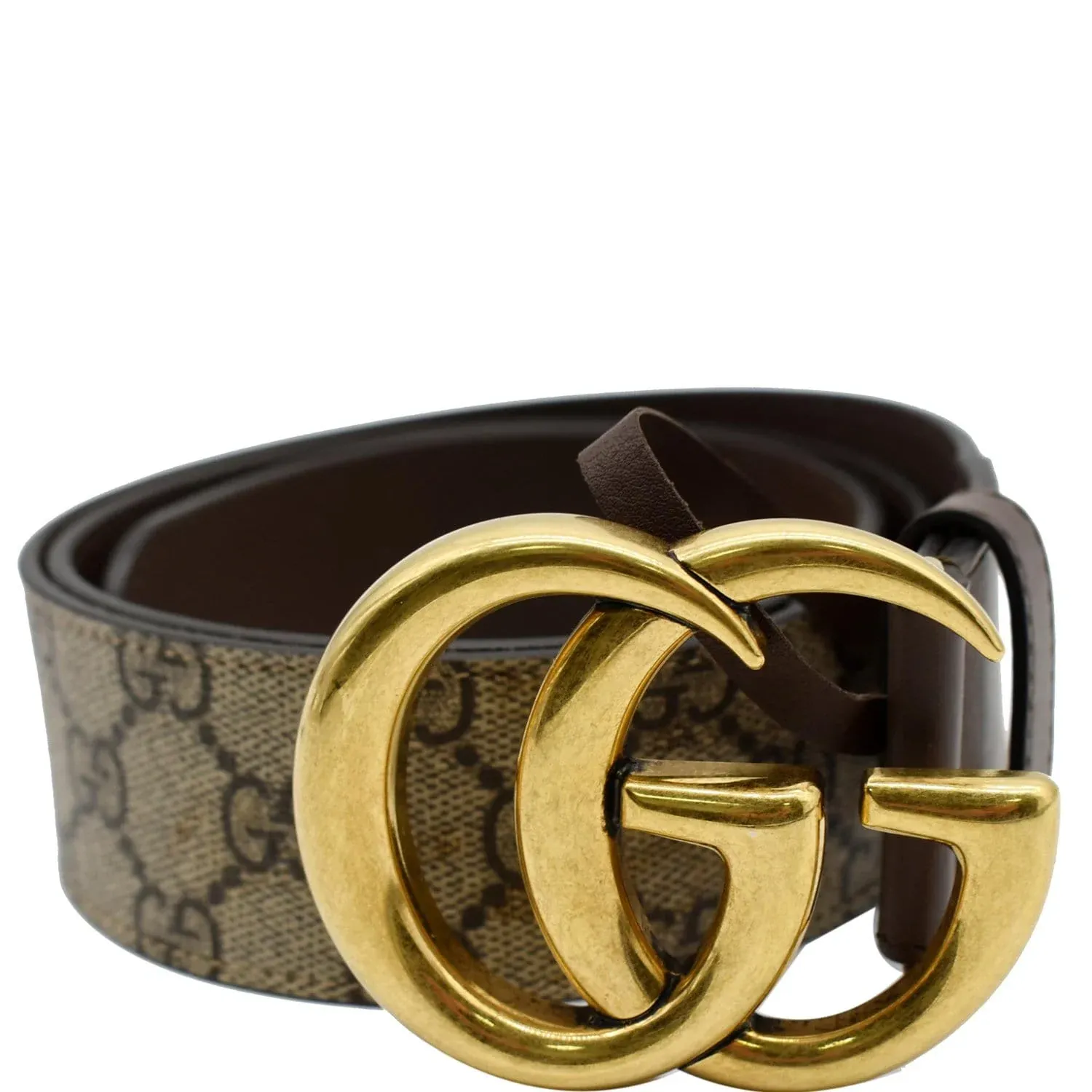
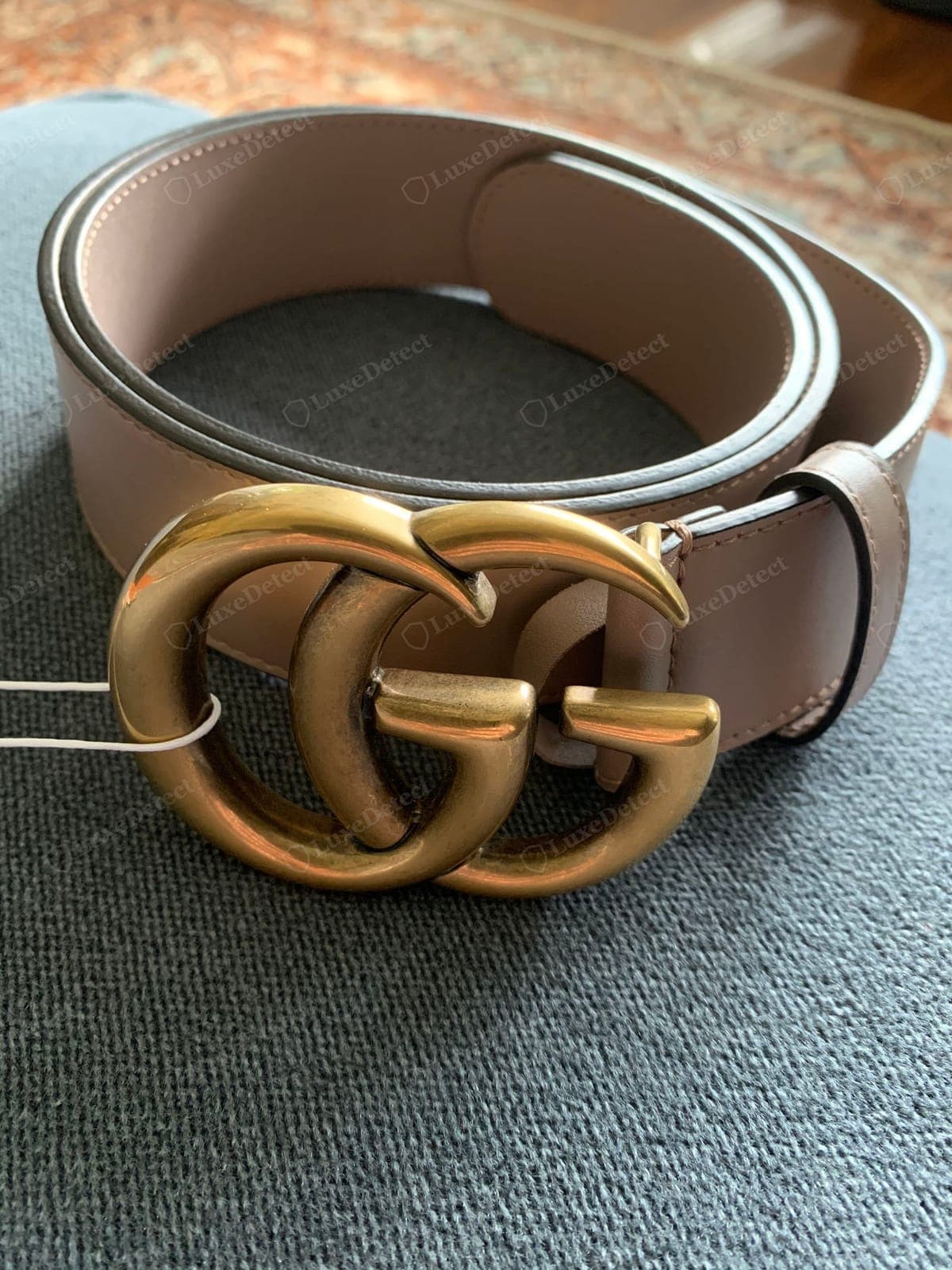
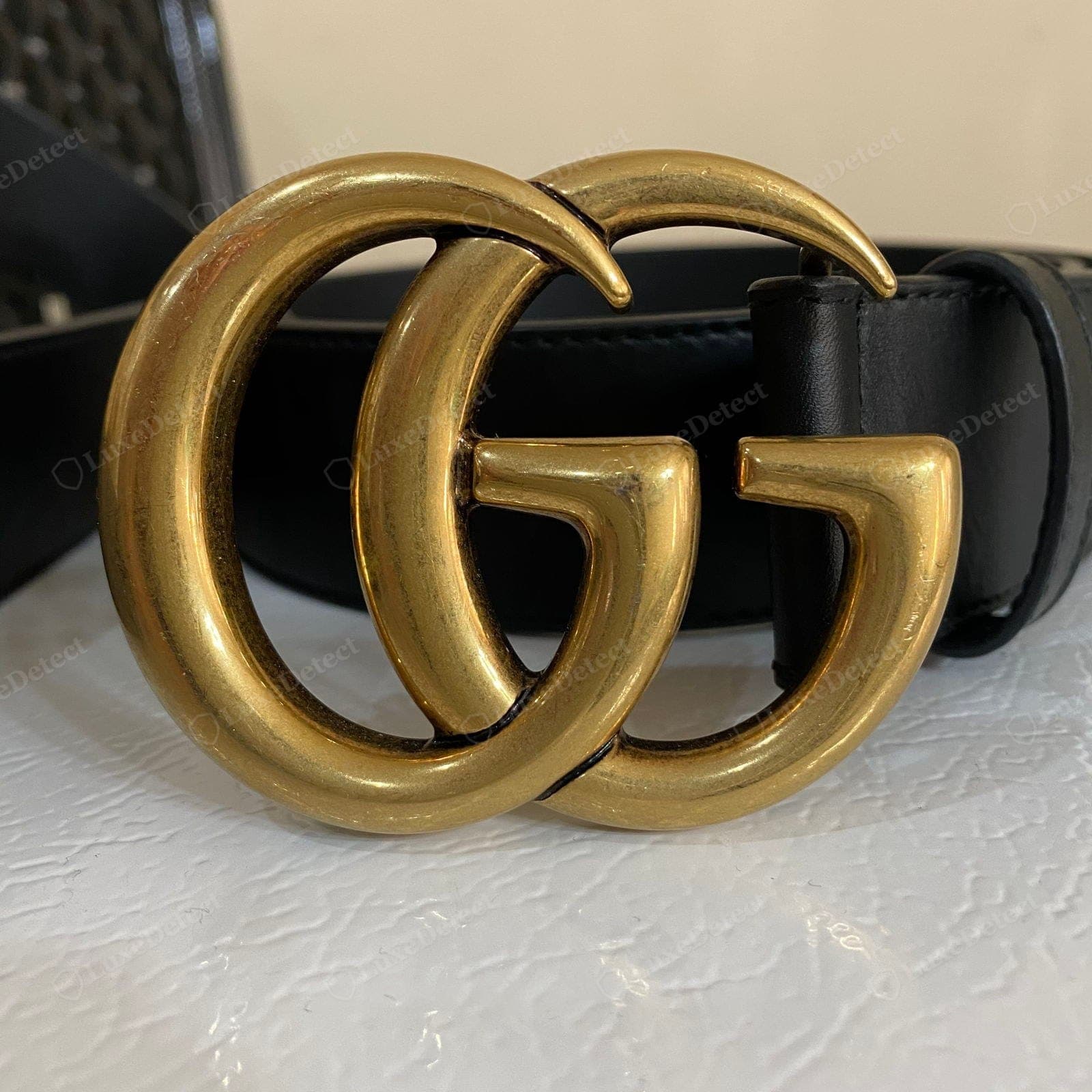
The interlocking GG buckle is the single most diagnostic component on the belt, and the one counterfeiters get closest on without quite landing.
Weight and material
Authentic: The buckle is solid brass, typically with a palladium or gold-tone plating. On a standard 3cm belt the buckle alone weighs 55–70 grams — enough that the belt feels front-heavy when you hold it by the strap. There is no hollow ring when you tap it against a hard surface; the sound is a dull, dense click.
Fake tells: Zinc alloy or hollow-cast buckles weigh 30–45 grams and feel disproportionately light for their size. Tapped, they ring rather than click. If the belt hangs level when held by the strap end instead of tipping toward the buckle, the hardware is almost certainly not solid brass.
The G curves
This is where most fakes fail under magnification.
Authentic: Each G is a continuous arc with no flat segments. Gucci's tooling produces curves with a consistent radius throughout the sweep — where the stroke turns, it turns smoothly. The two Gs interlock with an even gap between them along the full overlap; that gap does not widen or narrow.
Fake tells: Counterfeit buckles are cast from copies of copies, and each generation flattens the curve slightly. Look for subtle straight sections where the arc should be continuous, especially at the outer edge of each G. Uneven interlock spacing — wider at the top of the overlap than the bottom — is a reliable tell.
Engraving depth
Authentic: The GG is cut into the metal, not stamped onto it. Run a fingernail across the engraving and you feel a distinct edge on both sides of each stroke. Depth is uniform across the whole motif.
Fake tells: Shallow, surface-level marking that your nail glides over. Variable depth — one G cut deeper than the other, or one stroke fading toward its end — indicates worn or imprecise tooling.
Plating and finish
Authentic: Plating is even across the entire buckle including the back face and the inner edges of the GG cutouts. Gucci finishes the reverse to the same standard as the front.
Fake tells: Darker patches at the edges, or a visible tone shift where the plating thins over a curve. The most common shortcut is an unfinished or poorly finished back face — always turn the buckle over.
Red flag
A buckle that rings rather than clicks when tapped, or hangs level instead of tipping the belt toward the buckle end, is not solid brass — this alone is enough to reject the belt.
The Leather Strap
Full-grain leather versions
Authentic: Consistent fine-pored grain across the full length. The strap has a uniform thickness of roughly 3.5–4mm with no thinning near the buckle or the tip. Edge paint is smooth, evenly applied, and slightly domed rather than flat, with no bubbles or brush texture. Genuine hide has a distinct smell — leather and faint tannin, never chemical.
Fake tells: Edge paint that is already cracking or flaking on a supposedly new belt is the single most common giveaway; genuine edge paint takes years of flexing to craze. A sharp rubber or solvent smell means bonded or coated leather. Grain that repeats in a visible pattern indicates an embossed synthetic rather than natural hide.
GG Supreme canvas versions
Authentic: The GG pattern is precisely placed, and — critically — aligned at both ends of the strap. Gucci cuts the canvas so the motif meets the buckle end and the tip in a consistent position. The coating has a waxy, slightly tacky hand; it resists a fingernail rather than scratching.
Fake tells: Pattern misalignment at either end, or a motif that runs off the edge of the strap asymmetrically. Papery or dry-feeling coating. Print that sits on top of the weave rather than saturating into it — check the cut edge, where authentic canvas shows color penetration.
Stitching
Authentic: Where the strap is stitched, the stitch count is consistent at roughly 7–8 stitches per inch, with each stitch entering the leather at the same slight angle. Thread tension is even; no stitch sits proud of the surface.
Fake tells: Irregular spacing, visible thread ends, or stitching that wanders relative to the edge. Perfectly perpendicular machine stitching with no angle is also a tell — Gucci's saddle-stitch machines produce a characteristic lean.
Red flag
Edge paint that is already cracking or flaking on a belt sold as new is the single most common giveaway — genuine edge paint takes years of flexing to craze, so cracking on a "new" belt means the paint or the leather underneath is wrong.
The Interior Stamp
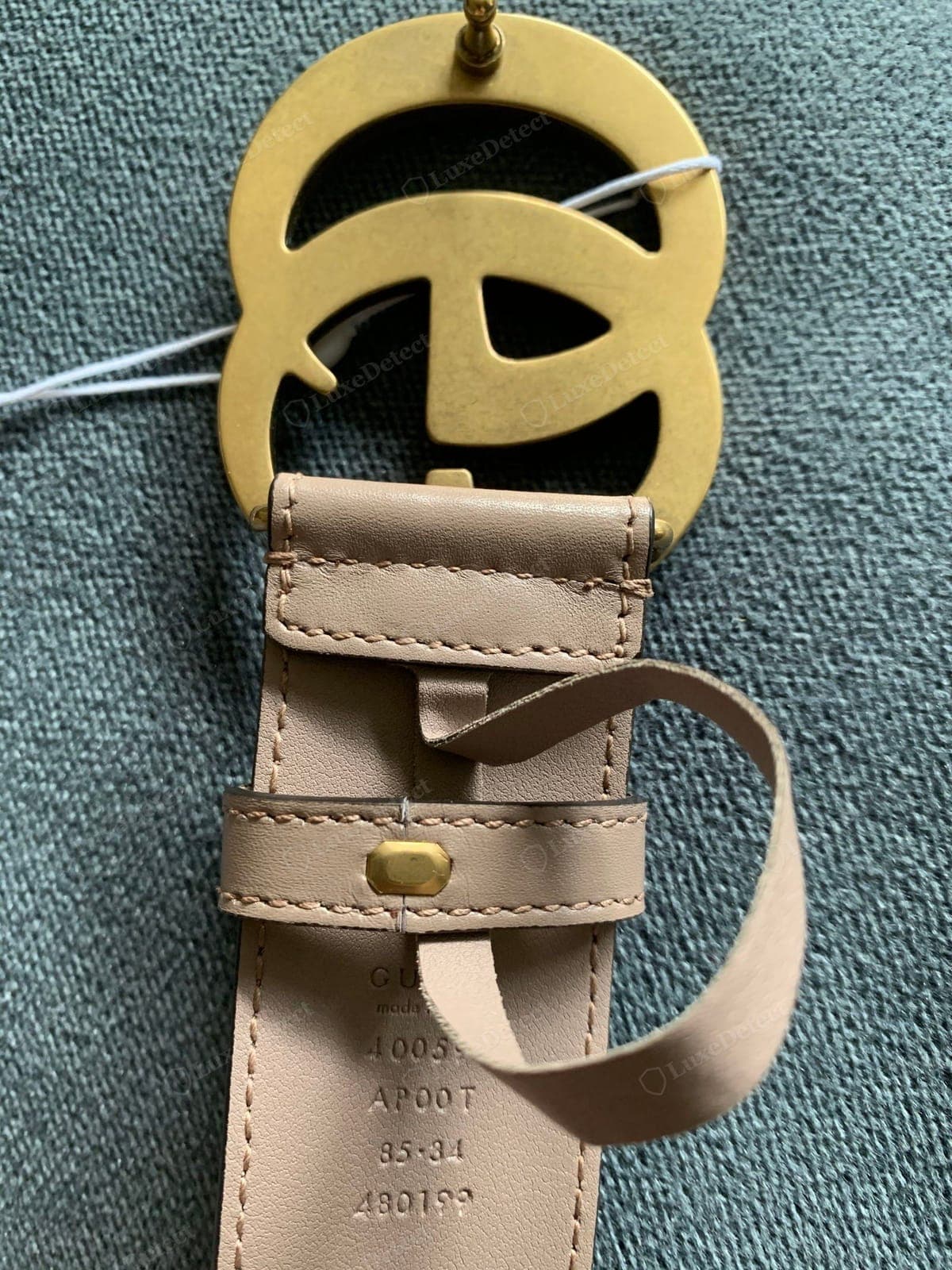
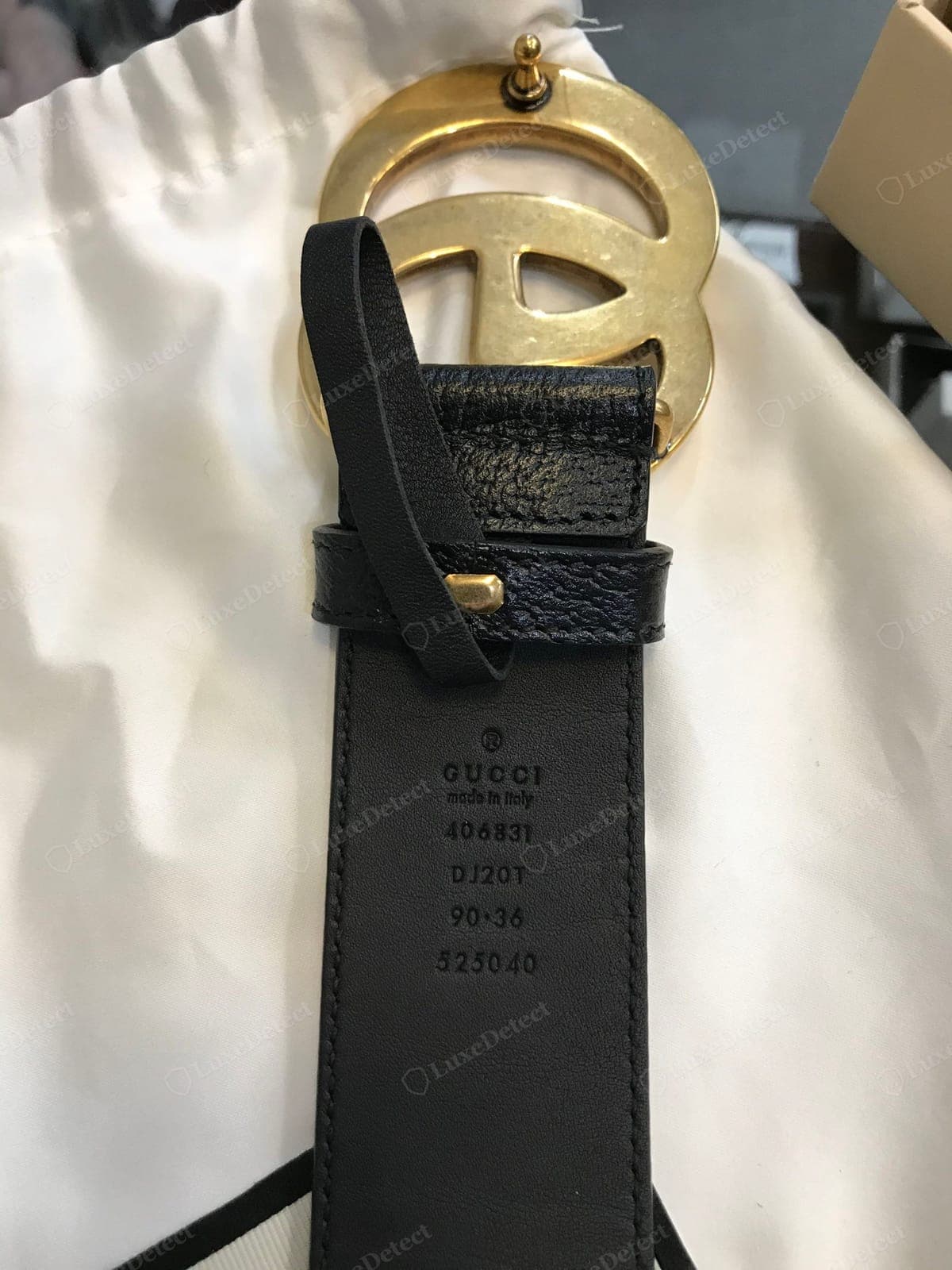
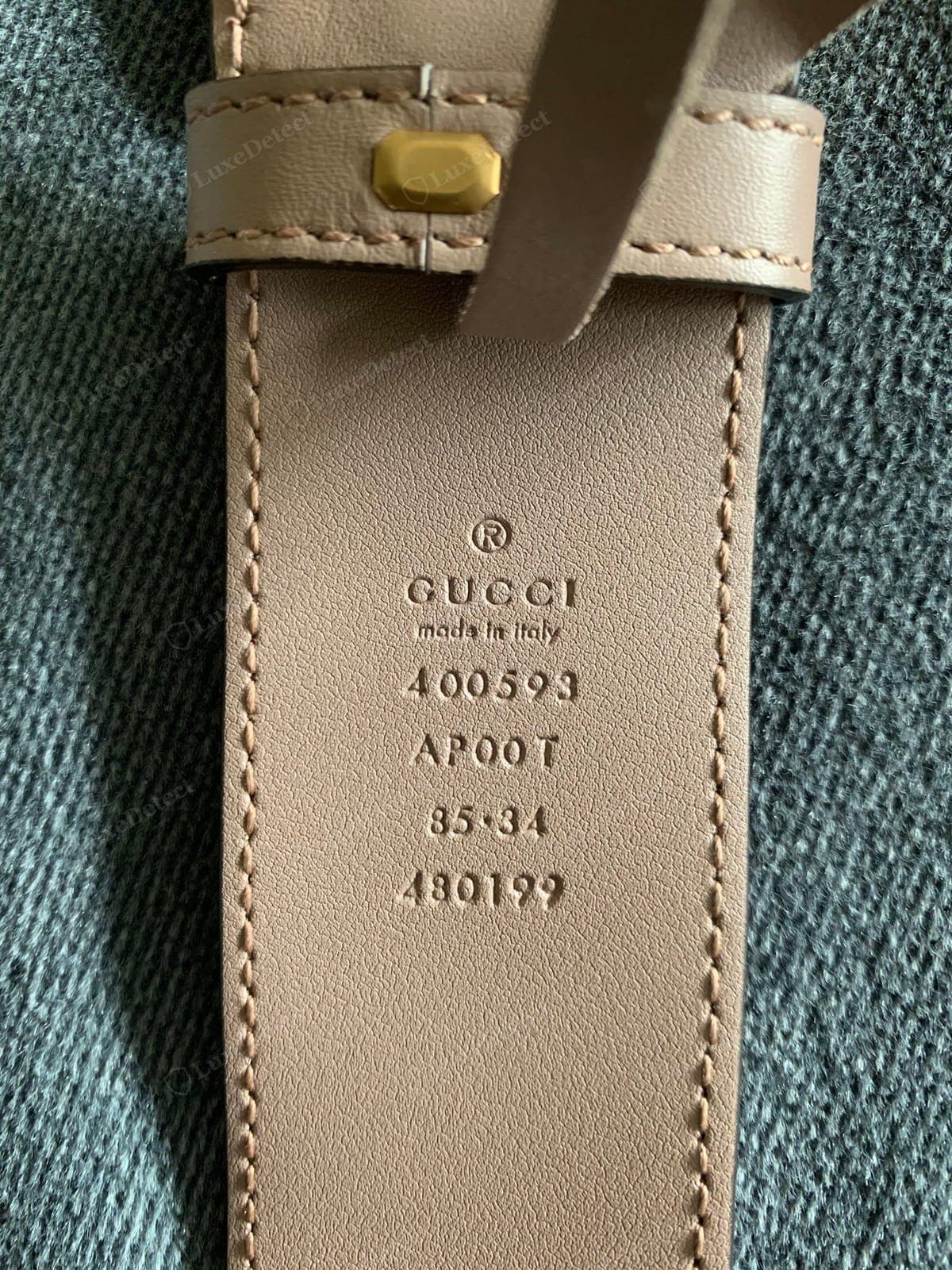
Inside the strap near the buckle you will find the maker's mark and serial number. This is where a genuine belt records its identity, and where fakes most often break format.
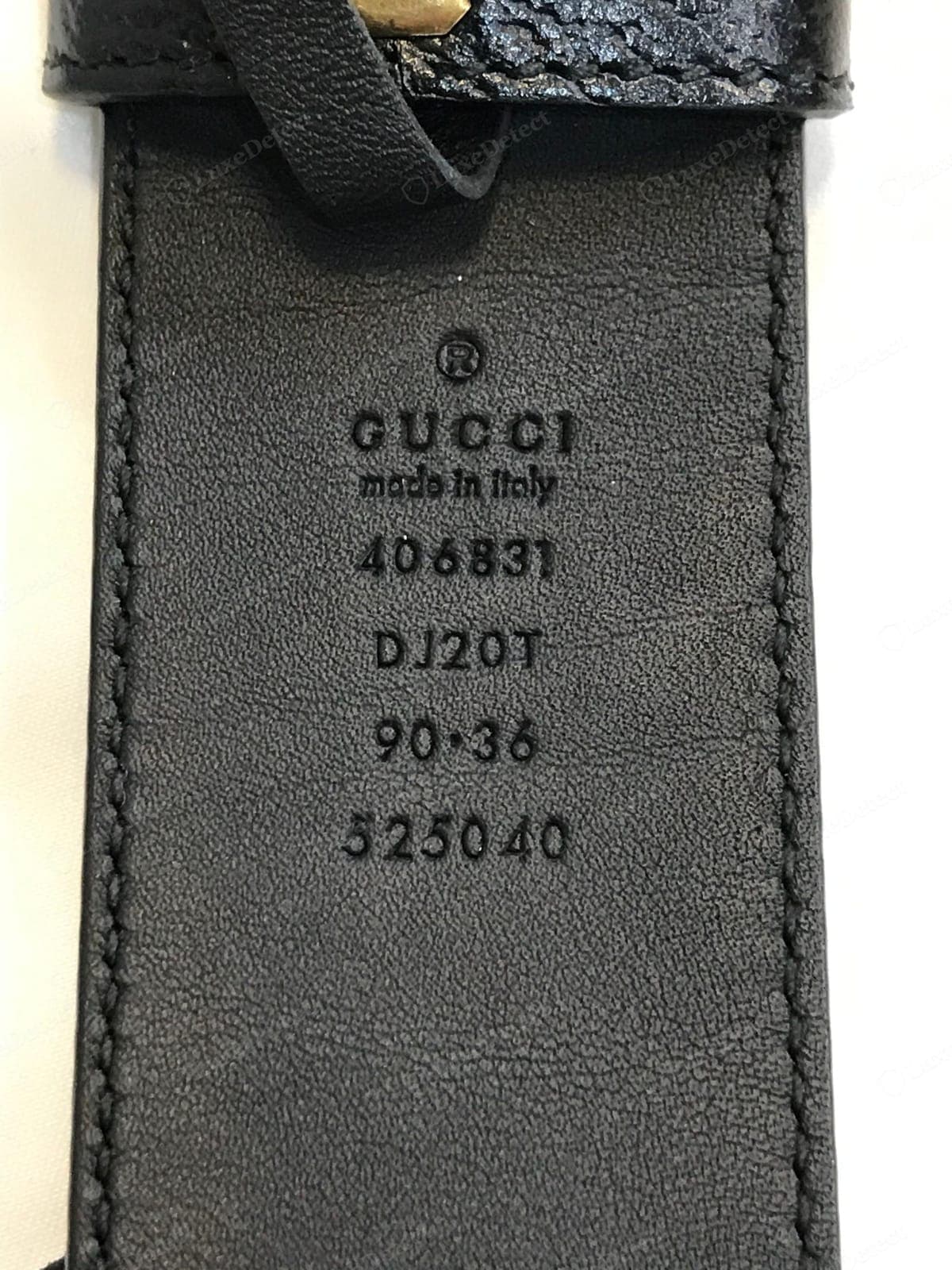
What the stamp should say
Authentic: "GUCCI" on the first line, "MADE IN ITALY" on the second, and a serial number formatted as XXX XX XXXX — three digits, a space, two digits, a space, four digits. Some eras place the serial on the reverse of the strap tip instead; both placements exist.
Fake tells: "Made in China," "Made in Italy" in the wrong case, a missing serial number entirely, or a serial that does not match the XXX XX XXXX grouping. Run-together digits with no spacing are a frequent error.
Stamp execution
Authentic: Gucci uses a specific sans-serif typeface with notably wide letter spacing on "GUCCI." The impression is heat-debossed — pressed into the leather without ink — and consistent in depth across every character. Letter edges are crisp.
Fake tells: Printed or inked stamps that sit flush with the leather surface. Fuzzy character edges from rubber tooling. Compressed letter spacing. Uneven depth where one end of the stamp is deeper than the other, which indicates hand-pressing rather than a calibrated press.
On serial lookups
A serial in the correct format is necessary but not sufficient. Counterfeiters copy valid serials from genuine belts, so a well-formed number confirms only that the format is right — not that this specific belt is genuine. Treat the serial as one signal among four, and weight the physical checks above it.
Worth knowing
A correctly formatted serial gives you a plausible number, not proof — serials are harvested from marketplace photos and reused, so weight stamp execution (heat-debossed depth, font, spacing) over the serial format itself.
Hardware — Prong and Keepers
The prong and keepers are low-priority components for counterfeiters, which makes them high-value checks for you.
The prong
Authentic: Cast in the same metal and finished with the same plating as the buckle, so the tone matches exactly under daylight. The tip is rounded and smooth, with no casting seam or flash. It sits under light spring tension — pushed aside, it returns to its resting position.
Fake tells: A prong that reads slightly warmer or cooler in tone than the buckle indicates separately sourced parts. A sharp or squared-off tip, visible seam lines along the shaft, or a prong that stays where you push it rather than springing back.
The keepers
Authentic: Cut from the same hide as the strap, with edge paint that matches the strap's in both color and finish. The keeper slides along the strap with light, consistent friction.
Fake tells: Unmatched edge paint — a slightly different shade, or matte paint against a glossy strap — is one of the most reliable single tells on the entire belt, because keepers are usually made last and from offcuts. A keeper that is too loose or binds when slid indicates imprecise sizing.
Worth knowing
Prong and keeper mismatches are especially valuable on component-sourced fakes, where a genuine buckle is paired with a counterfeit strap — a perfect buckle with unmatched keeper edge paint is the signature of that build.
Holes and punching
Authentic: Punched holes are cleanly cut with no leather fibers protruding, and the edges are burnished slightly darker than the surrounding strap. Spacing between holes is consistent to the millimeter.
Fake tells: Ragged hole edges with visible fiber. Inconsistent spacing. Holes punched through the finish so the raw core color shows as a bright ring.
The 2026 Counterfeit Landscape
Three developments have changed what a fake Gucci belt looks like.
Component-sourced fakes. Rather than manufacturing whole belts, some operations buy genuine buckles from damaged or stolen stock and pair them with counterfeit straps. A perfect buckle on a belt whose keeper edge paint doesn't match is the signature of this build.
Improved buckle casting. The gap between a $150 replica buckle and a genuine one has narrowed. Weight and back-face finishing remain reliable, but curve geometry alone is no longer decisive at the top of the fake market.
Serial harvesting at scale. Marketplace listings publish serials in photographs, and counterfeiters reuse them. A serial appearing on multiple listings is now common enough that format-checking is a weaker signal than it was three years ago.
The practical response is unchanged: check multiple independent signals. A fake can now pass any single test. Passing all four — buckle weight and geometry, leather and edge paint, stamp execution, hardware match — remains very difficult to fake at any price point.
Quick Authentication Checklist
- Buckle: 55–70g solid brass weight, continuous G curves with no flat sections, engraving cut deep enough to feel, even plating including the back face
- Leather: consistent fine-pored grain, 3.5–4mm uniform thickness, smooth domed edge paint with no cracking, genuine hide smell
- Canvas (GG Supreme): pattern aligned at both ends, waxy coating, color penetrating the cut edge
- Interior stamp: "GUCCI / MADE IN ITALY," wide-spaced sans-serif, heat-debossed not printed, serial in XXX XX XXXX format
- Prong: exact tone match to buckle, rounded tip, springs back under tension
- Keepers: same hide and edge paint as strap, consistent slide friction
- Holes: clean burnished edges, millimeter-consistent spacing
Any single failure warrants closer inspection. Two or more failures across different components is conclusive.
FAQ
What size is a standard Gucci belt?
Gucci belts are sized in European waist measurements, typically 75–110. Add 20–25cm to your US waist size in inches converted to centimeters — practically, a 32" US waist corresponds to a Gucci 80 or 85. Buy to the middle hole, not the end hole, so the belt has adjustment range in both directions.
Is a belt without a serial number automatically fake?
Not necessarily. Vintage Gucci belts produced before the current stamping convention may carry no serial at all, or a different format entirely. Authenticate those on era-appropriate stamp style, hardware construction, and leather quality rather than expecting a modern serial. On any belt produced in the last two decades, a missing serial is a serious red flag.
Can a Gucci boutique authenticate a belt?
Boutique staff can examine a piece and look up a serial in their system, and many will tell you informally whether something looks right. However, Gucci does not issue written authentication statements for items not purchased through their channels, and store policy on how much they will say varies. For resale, insurance, or dispute purposes you need documented third-party authentication.
Does the buckle finish wear differently on real versus fake belts?
Yes, and it is a useful check on used belts. Genuine brass with quality plating wears through gradually at high-contact points — the prong tip, the outer edge of the buckle frame — revealing warm brass underneath. Plated zinc alloy on fakes tends to flake or bubble rather than thin, and what shows through is a dull grey rather than yellow brass.
Are Gucci outlet belts authentic?
Yes. Gucci operates genuine outlet channels, and outlet-specific production exists with its own style codes. These are authentic Gucci products, though some collectors distinguish them from mainline production. Outlet pieces carry the same stamp conventions and hardware standards, so the authentication checks in this guide apply unchanged.
How much does professional Gucci belt authentication cost?
Photo-based authentication typically runs $15 for accessory authentication with a 24-hour turnaround, which is proportionate for an item in the $200–$600 resale range. The check pays for itself on a single avoided fake, and a certificate materially helps resale value if you sell later.