Luxury Accessories Authenticator
Luxury accessories authenticator. Covers small leather goods, belts, and eyewear.
Published September 2026 · Contact
Why the Inner Temple Decides It
Chanel sunglasses are among the brand's more accessible products, priced far below a flap bag, so they reach a far wider audience and get copied at every quality tier. Chanel eyewear is produced under licence (Luxottica has been the licensee, though arrangements can change) to optical-industry standards, which means the frames carry a structured marking set that a counterfeiter has to reproduce exactly rather than approximate.
That is the opening. Fakes can copy the frame shape, the applied CHANEL lettering on the temple, even the CC nose pads. What they consistently get wrong is the inner-temple marking string — because a genuine one carries more fields than most fakes bother to print, in a specific format.
What to check, ranked by reliability
| Checkpoint | Reliability | What it tells you |
|---|---|---|
| The Inner-Temple Marking String | ★★★★★ | A string missing fields a genuine frame carries — no ©/® symbols, no colour code, no lens category — or an origin other than Italy, settles it. |
| The Lens Etch | ★★★★★ | A faint, broken etch is a reliable fail; its absence is only meaningful on a frame claimed to be post-2000s. |
| The Nose Pads and Small Hardware | ★★★★★ | A blobby, malformed CC on the pad is the meaningful tell — a plain pad proves nothing, since pads get replaced. |
| Applied Lettering and Frame Finish | ★★★★★ | Uneven lettering or visible glue supports a verdict, but better fakes get the applied letters close. |
Model Reference Before You Start
Chanel eyewear model numbers are typically four digits, sometimes with a letter suffix indicating the temple detailing. Sunglasses are commonly prefixed "CH" on the frame or box; optical frames use the number alone.
- Cat-eye and square acetate — the most-copied silhouettes, usually with applied metal CHANEL lettering or a CC at the temple.
- Rimless and semi-rimless — often crystal-set; check the lens drilling and the mount screws.
- Aviator and pilot metal frames — check plating consistency and the nose-pad detail.
- Chain and pearl temple models — runway pieces; the hardware quality tracks the rest of the frame.
Chanel eyewear is made in Italy. That, plus a CE mark, should appear on the temple. Any other country of origin is a fake indicator.
The Inner-Temple Marking String
This is the decisive check. Open both temples and read everything printed inside — the information is usually split across the two arms, so checking only one is how people miss it.
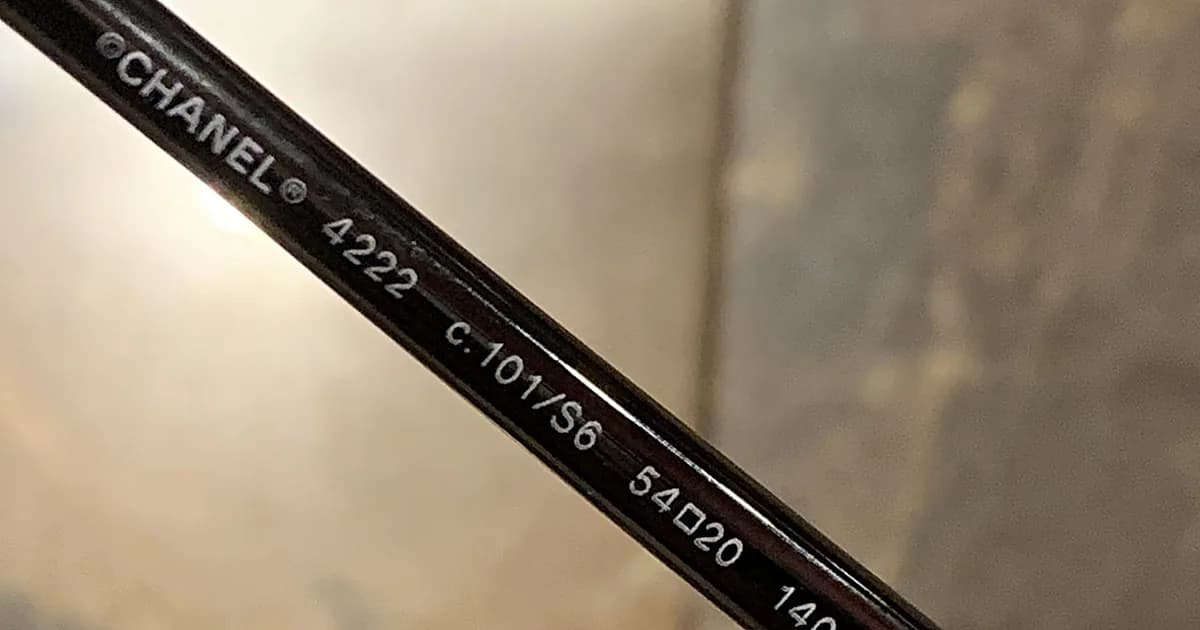
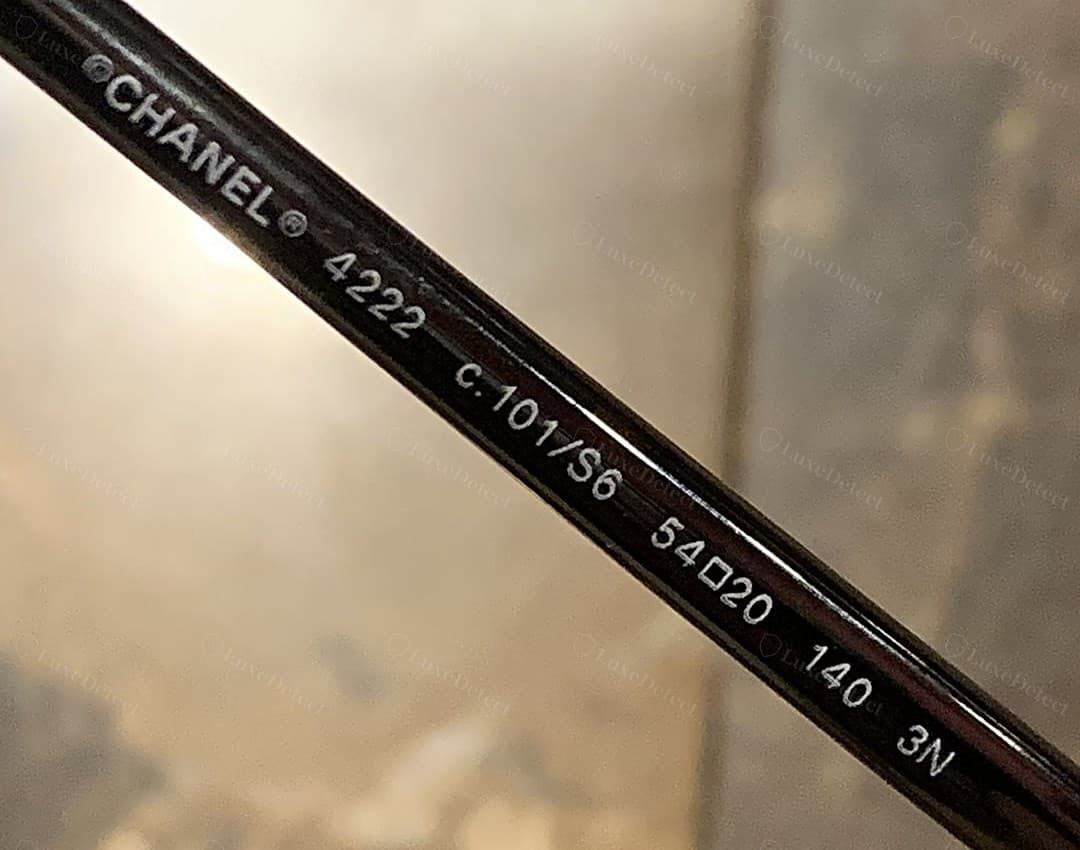
A genuine frame carries, in a clean and evenly spaced string: "©CHANEL®" with the copyright and registered symbols, the four-digit model number, a colour code in Chanel's format (for example "c.101/S6"), the size string — lens width, a square separator, bridge width — then the temple length, and a lens category mark such as "3N" indicating the tint category. On the other arm you should find "MADE IN ITALY" and the CE mark. Every character is sharply printed, evenly spaced, and aligned straight along the temple.
Fakes usually print a shorter string that is missing fields. The example below is typical: it carries a model number and a size, but no ©/® symbols, no colour code, and no lens-category mark, and it uses a hyphen between bridge and temple length where a genuine frame uses a space. Character edges are softer and spacing is less even.
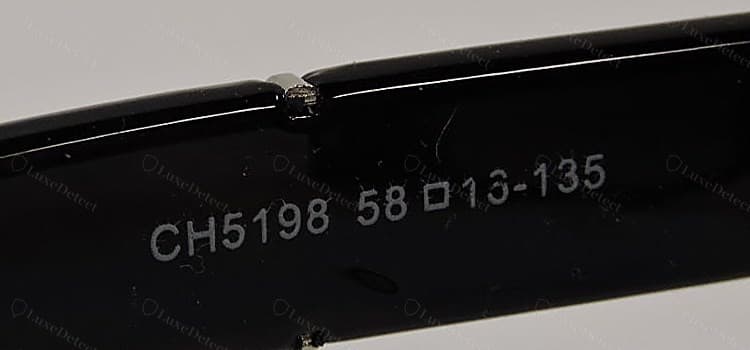
| Element | Authentic | Counterfeit |
|---|---|---|
| Brand mark | "©CHANEL®" with both symbols | Absent, or brand name without symbols |
| Model number | Four digits (sometimes a letter suffix) | Present but often the only real field |
| Colour code | Chanel format, e.g. "c.101/S6" | Frequently missing entirely |
| Size string | Lens ▫ bridge, then temple length, space-separated | Hyphenated, or wrong format |
| Lens category | Category mark such as "3N" | Usually absent |
| Origin / CE | "MADE IN ITALY" plus CE, on the other arm | Missing, or a different country |
| Print quality | Sharp, evenly spaced, straight | Softer edges, uneven spacing |
Red flag
An inner-temple string that is missing fields a genuine frame carries — no ©/® symbols, no colour code, no lens-category mark — or an origin that is not Italy. Chanel eyewear is marked to a fixed specification; a short string is the single most reliable tell on the frame.
The Lens Etch
Chanel laser-etches a small mark into a lens on frames from the early 2000s onward, typically on the right lens.
A genuine etch is precisely cut with consistent stroke weight: the letters are complete, evenly spaced, and sit at a uniform depth. You need angled light to read it clearly — it should not jump out head-on, and it should not catch a fingernail.
Fake etches are faint, broken and scratchy. Letter strokes disintegrate partway through, character weight varies across the word, and the surrounding lens often carries stray tool scratches. Some fakes cut it far too deep instead, making it obvious from any angle.
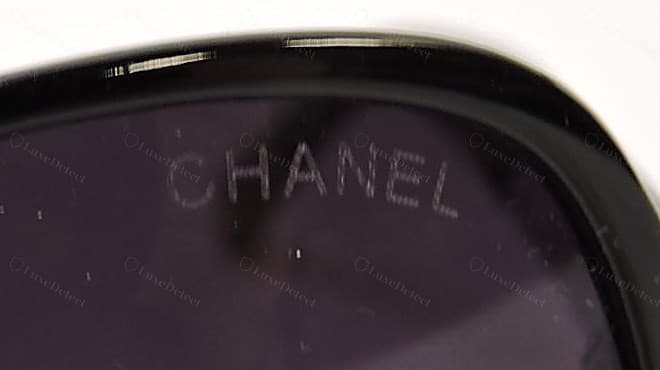
| Element | Authentic | Counterfeit |
|---|---|---|
| Cut quality | Precise, consistent stroke weight, complete letters | Faint, broken strokes, varying weight |
| Visibility | Subtle — needs angled light | Obvious head-on, or absent |
| Surrounding lens | Clean | Stray tool scratches |
Worth knowing
Etching began in the early 2000s, so a genuine vintage pair may carry no lens etch at all — its absence is only meaningful on a frame claimed to be recent. A badly cut etch, though, is a reliable fail at any age.
The Nose Pads and Small Hardware
Chanel puts brand detail into places counterfeiters often overlook.
On many genuine frames the silicone nose pads carry a CC logo moulded into them — small, cleanly formed, with both C's legible and correctly interlocked. Mount screws are cleanly slotted and seated square. On metal frames the plating is even across every component with no bare patches; on rimless models the lens drilling is clean with no crazing around the holes.
Fakes commonly fit plain nose pads with no logo, or a CC that is blobby and misshapen. Screws may be pressed pins rather than slotted, and plating is often thin enough to show base metal at the edges.
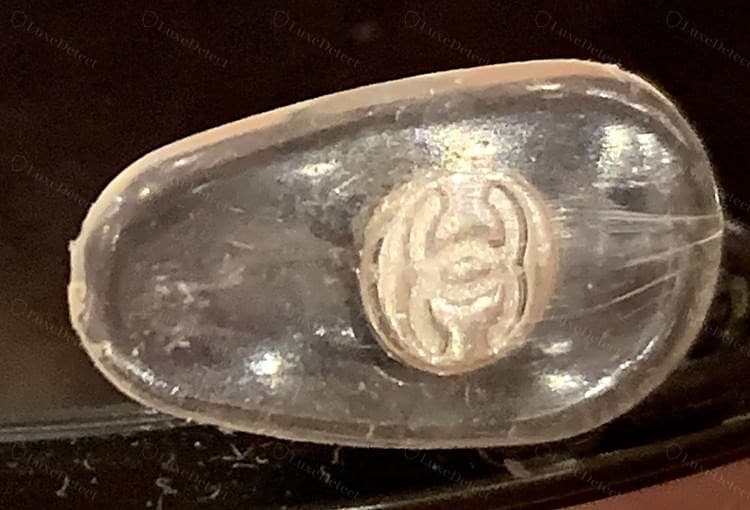
| Element | Authentic | Counterfeit |
|---|---|---|
| Nose pads | CC moulded in cleanly, both C's legible | Plain, or a blobby misshapen CC |
| Screws | Cleanly slotted, seated square | Pressed pins, or crooked |
| Plating (metal) | Even across all components | Thin, patchy, base metal at edges |
| Rimless drilling | Clean holes, no crazing | Crazing or stress marks around holes |
Worth knowing
A plain nose pad is not decisive on its own — pad style varies by model and pads are a common replacement part on a used frame. A malformed CC on a pad is the meaningful version of this check.
Applied Lettering and Frame Finish
Most Chanel acetate frames carry CHANEL spelled out in applied metal letters or a CC at the temple. On a genuine frame the letters are individually set, evenly spaced, level along a straight baseline, and securely seated flush in the acetate with no gaps or adhesive showing.
Genuine acetate is cut from solid sheet: held to light it shows depth and subtle variation rather than flat uniform colour, the surface is polished with no mould seam, and the frame has real weight. Fakes are usually injection-moulded — flat colour, a faint seam along the temple, noticeably light — with lettering that sits unevenly or shows glue at the edges.
| Element | Authentic | Counterfeit |
|---|---|---|
| Applied letters | Individually set, level, flush, no adhesive | Uneven baseline, gaps, visible glue |
| Acetate | Cut sheet, depth in the colour, weighty | Moulded, flat colour, seam, light |
| Surface | Polished smooth, no seam | Mould seam along temple or rim |
Worth knowing
Lettering quality is the weakest of the four checks — better fakes get the applied letters close, so the lettering alone proves little. Weigh the inner-temple string far more heavily.
What the Case and Papers Do and Do Not Prove
Chanel eyewear ships with a quilted or leather-look case, a cloth, a booklet, and a box label carrying the model, colour code and size. All of it is reproduced and sold loose.
The useful move is cross-referencing: the model number and colour code on the box label must match the inner temple exactly, and the lens etch where present should agree too. Three sources that disagree is a flag; three that agree proves only that someone assembled a consistent set.
Quick Authentication Checklist
- Open both temples and read every marking — the information is split across the two arms
- Confirm the full string: ©CHANEL®, four-digit model, colour code, size ▫ bridge, temple length, lens category
- Confirm "MADE IN ITALY" and the CE mark — any other origin is a fail
- Check print quality: sharp, evenly spaced, straight along the temple
- Angle the lens to light: if there's an etch, it should be precise and complete, not scratchy
- Look at the nose pads: a moulded CC should be cleanly formed, both C's legible
- Cross-check model and colour code against the box label
Two or more failures means walk away. A marking string missing fields a genuine frame carries (check 2), or an origin other than Italy (check 3), is on its own sufficient.
When to Get a Professional Opinion
Cheap fakes fail on the temple string alone — a short marking set, a missing colour code, soft printing. The harder cases print a fuller string and get the lettering close, and the decision moves to the exact character spacing under magnification, the etch quality in angled light, and whether the model and colour code resolve to a frame Chanel actually made.
If you're buying secondhand and anything about the markings or the etch looks soft, get a second opinion before the money moves. LuxeDetect authenticates eyewear from $15 with a verdict and Certificate of Authenticity within 24 hours. Send both inner temples straight on and fully legible, the lens etch in angled light, the nose pads close up, and the box label.
FAQ
What is the fastest way to spot fake Chanel sunglasses?
Read the inside of both temples. A genuine frame carries a full marking string — ©CHANEL® with both symbols, a four-digit model number, a colour code, the size, the temple length, and a lens-category mark — plus "MADE IN ITALY" and a CE mark on the other arm. Fakes routinely print a much shorter string that is missing the symbols, the colour code, or the lens category.
Where are the markings on Chanel sunglasses?
Split across both temples. One arm typically carries the model number, colour code and measurements; the other carries "MADE IN ITALY" and the CE mark. Checking only one arm is the most common way buyers miss a missing field, so always open both.
Are all Chanel sunglasses made in Italy?
Yes. Chanel eyewear is produced under licence in Italy, and the temple says so. An origin marking naming any other country is a fake indicator on its own, regardless of how good the rest of the frame looks.
Do real Chanel sunglasses have a mark etched on the lens?
Chanel began laser-etching a mark into a lens in the early 2000s, usually the right one. Because of that start date, a genuine vintage pair may legitimately carry no etch — its absence only matters on a frame sold as recent. What is always meaningful is a badly cut etch: faint, broken strokes indicate a fake at any age.
Should the nose pads have a CC logo?
On many models, yes — the CC is moulded cleanly into the silicone with both C's legible. But pad style varies by model and pads are a common replacement part on used frames, so a plain pad is not proof of anything. A blobby, malformed CC is the version of this check that carries weight.