Eyewear Authentication Specialist
Last updated September 2026 · Published June 2026 · Contact
Why Cartier Eyewear Is Faked
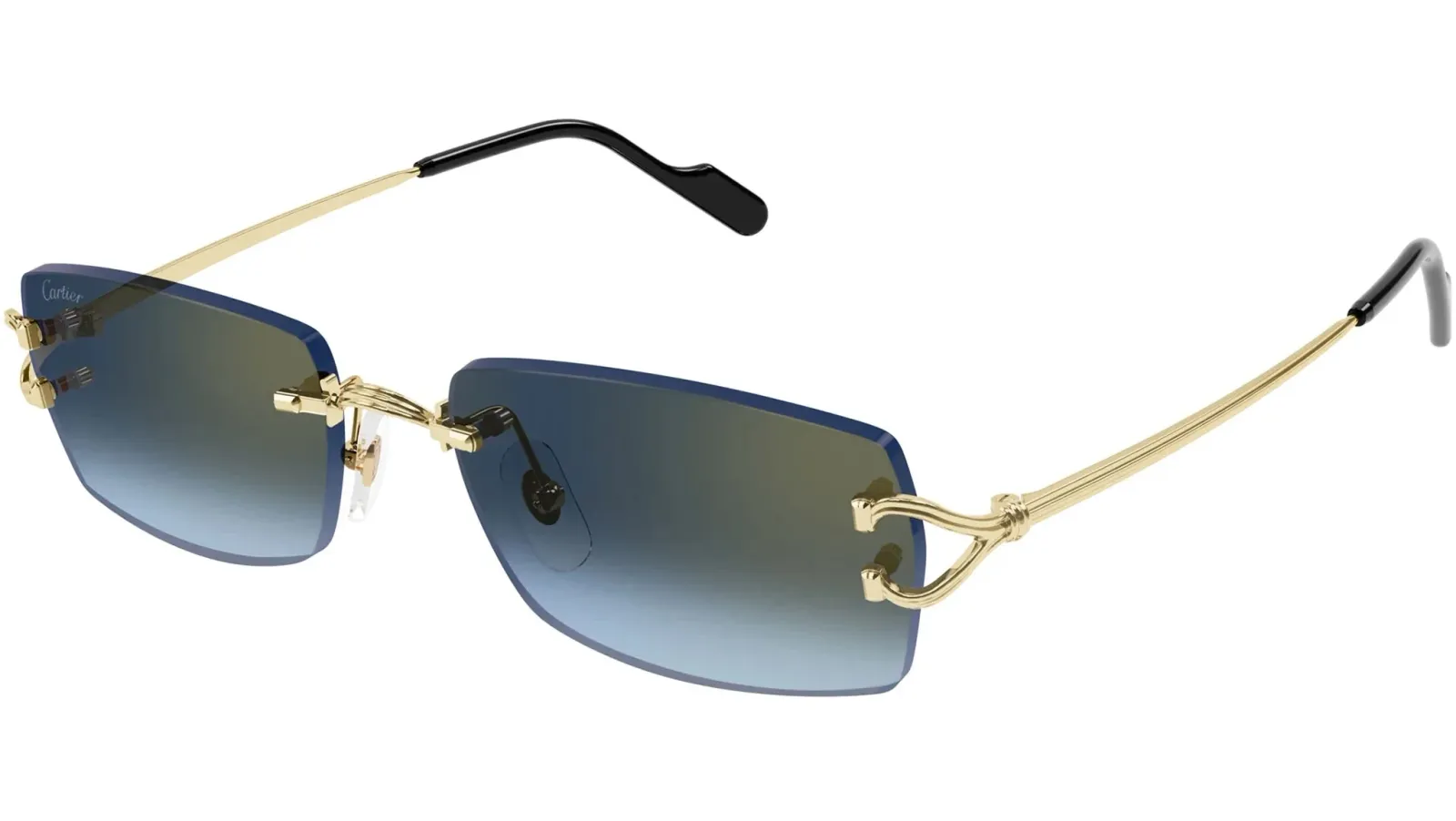
Cartier sunglasses occupy the top tier of luxury eyewear. The Panthère de Cartier retails around $1,200; the Santos starts at $900; rimless formats in gold reach $3,000–$5,000. High price point and strong brand recognition make them a prime counterfeit target.
The Cartier fake market has an unusual shape. Because the wood-and-gold "Buffs" of the 1980s became culturally significant far beyond luxury eyewear's normal audience, demand for Cartier frames extends into markets where genuine retail distribution barely exists. That gap is filled almost entirely by counterfeits, and the better ones are now built with real precious-metal plating and genuine buffalo horn temples — components expensive enough that the finished fake sells for $400–$700 and does not read as cheap in the hand.
The practical consequence: weight and material quality alone no longer settle it. The engraving, the hinge, and the lens optics are where genuine Cartier remains difficult to reproduce, and those are the checks weighted most heavily below.
What to check, ranked by reliability
| Checkpoint | Reliability | What it tells you |
|---|---|---|
| 4. Lens Quality | ★★★★★ | Any distortion of a straight edge as the frame rotates is decisive on its own — genuine Cartier optics show none at any angle. |
| 2. The "CARTIER PARIS" Temple Engraving | ★★★★★ | A too-closed "C" or stamped-not-engraved character walls rejects the frame regardless of how convincing the rest is. |
| 1. Frame Material and Weight | ★★★★★ | Weight and plating quality are necessary but not sufficient, since the upper fake tier now uses genuine precious-metal plating. |
| 3. Hinge Construction | ★★★★★ | Smooth click action and matching finish corroborate a finding but a decent generic hinge can pass this alone. |
| 5. The Cartier Case | ★★★★★ | The case is context only — the cheapest component to reproduce and frequently sold separately from the frame. |
Use our free Cartier Serial Checker to check the engraved serial against the formats Cartier is documented to use.
Check My Serial →Frame Material and Weight
Acetate frames
Authentic: Cartier acetate is block-cut and polished rather than injection-moulded. Viewed edge-on at the temple or rim, genuine acetate shows visible colour depth — layers within the material rather than a single flat tone. The surface is warm to the touch and takes a deep polish with no orange-peel texture.
Fake tells: Injection-moulded acetate reads flat in colour when viewed edge-on, with no internal depth. A slightly plasticky surface sheen. Visible mould seams along the inner rim or temple edge, which block-cut acetate cannot have.
Metal frames
Authentic: Cartier uses specific alloys, frequently with gold or palladium plating over a substantial base. The frames carry noticeable weight for their size — a Santos frame feels dense when balanced across a finger. Plating is applied evenly, including inside the bridge and along the temple's inner face.
Fake tells: A hollow, tinny feel when handled. Plating that thins visibly at high-contact points on a supposedly new frame. Unfinished or roughly finished inner surfaces where a counterfeiter assumed nobody would look.
Buffalo horn and wood temples
Authentic: Genuine horn shows non-repeating natural grain with subtle translucency at thin edges. Each temple differs from the other, because horn is a natural material. Wood temples show real end-grain at the cut.
Fake tells: Two temples with visually identical grain, indicating a printed or moulded synthetic. Uniform opacity with no translucency at the edge. A repeating grain pattern under magnification.
Worth knowing
Weight and material feel are necessary but not sufficient — the upper tier of the fake market now uses genuine precious-metal plating over substantial bases specifically to defeat this check.
The "CARTIER PARIS" Temple Engraving
Inside both temple arms: "CARTIER PARIS," the frame size (for example "53□18 145"), a model reference code, and the country of origin — "MADE IN FRANCE" or "MADE IN ITALY."
Execution
Authentic: Laser-engraved to a consistent depth, with crisp walls to each character. Under magnification the engraving floor is uniform, not ragged. Cartier's typeface has specific proportions — the "C" is a generous open arc that does not close toward a circle, and the "T" crossbar sits high relative to the stem.
Fake tells: Stamped rather than engraved, producing raised displacement around each character. Rough or ragged character edges. A "C" drawn too closed, which is the most frequently missed proportion. Missing model reference code. "MADE IN CHINA" on any current Cartier eyewear.
Content consistency
Authentic: The size code follows the standard eyewear convention — lens width, bridge width, temple length — and the numbers correspond to the physical frame. Measure the lens at its widest point; it should match the first figure within a millimetre.
Fake tells: Size codes that do not match the physical frame, which happens when counterfeiters copy engraving text from one model onto another body. A model reference that does not correspond to any documented Cartier range.
Red flag
A "C" drawn too closed toward a circle is the most frequently missed proportion in fake Cartier engraving and, combined with stamped-not-engraved character walls, is enough to reject the frame.
Hinge Construction
Authentic: Cartier hinges operate with smooth, precise resistance across their full travel and settle with a distinct click at both open and closed positions. There is no side-to-side play in the temple when the frame is open. The hinge exterior is finished to exactly match the adjacent frame — same plating, same polish level, no visible transition.
Fake tells: Stiff, loose, or gritty operation. Temple wobble perpendicular to the hinge axis, indicating an imprecise pin. A hinge whose finish differs subtly in tone from the frame around it, which reveals a separately sourced component. Visible casting flash at the hinge barrel.
Screws
Authentic: Screw heads sit flush with the surrounding metal, with clean, undamaged drive slots. Cartier uses consistent screw sizing across a model.
Fake tells: Proud or recessed screw heads. Burred or chewed slots on a new frame, indicating hand assembly with imprecise tooling.
Worth knowing
Hinge quality corroborates a finding but a well-made fake can source a decent generic hinge — weight it below engraving and lens optics.
Lens Quality
Authentic: Cartier lenses show no optical distortion at any viewing angle. Hold the frame at arm's length and look through the lens at a straight edge — a door frame or window mullion — then rotate the frame slowly. The line must remain straight throughout. The anti-reflective coating shows a subtle green or blue cast when the lens is tilted under light, applied evenly to the full lens surface including the extreme edges.
Fake tells: Waviness or bowing in the straight edge as the frame rotates, indicating inconsistent lens curvature. Blotchy or patchy AR coating, most visible near the lens perimeter. Coating that stops short of the edge. Surface imperfections or fine scratches on a lens described as new.
Etching and markings
Authentic: Where a model carries a lens etching, it is precise and permanent, visible only when the lens is angled to catch light.
Fake tells: A printed or stickered mark. An etching that is visible from every angle, which suggests it was cut too deep by imprecise tooling.
Red flag
Waviness or bowing in a straight edge viewed through the lens while rotating the frame is decisive on its own — genuine Cartier optics show zero distortion at any viewing angle, and this tooling is very hard for a counterfeiter to match.
The Cartier Case
Authentic: The case is the same deep burgundy-red used across Cartier jewellery packaging — never bright red and never orange-toned. The Cartier logotype is debossed into the lid, so you can feel the impression; it is not printed flat. The interior is white satin, evenly applied with no adhesive visible at the seams. Stitching around the case perimeter is even and tight.
Fake tells: A red that reads bright or orange against a genuine Cartier reference. A printed rather than debossed lid logo. Cream or off-white interior lining instead of white satin. Visible glue at the interior seams.
A caution on packaging: cases, cloths, and paperwork are the cheapest elements to reproduce and are frequently sold separately. A correct case raises confidence slightly; it never settles the question. Authenticate the frame, not the box.
Worth knowing
The case is context, not evidence — it is the cheapest component to reproduce and is often sold separately from the frame itself.
Quick Authentication Checklist
- Frame: block-cut acetate with visible colour depth, or dense metal with even plating including inner surfaces
- Horn/wood temples: non-repeating natural grain differing between left and right, translucent at thin edges
- Temple engraving: laser-cut with crisp walls, correct Cartier typeface, size code matching the physical frame, valid country of origin
- Hinges: smooth travel with a definite click, no temple wobble, finish matching the frame exactly
- Lenses: no distortion when rotated against a straight edge, even blue-green AR cast to the extreme edge
- Case: deep burgundy-red, debossed lid logo, white satin interior
FAQ
Are Cartier sunglasses always made in France?
Most current production is French, with some ranges manufactured in Italy. Both are legitimate. "Made in China" on any current Cartier eyewear is a fake indicator without exception.
Can a Cartier boutique authenticate eyewear?
Boutique staff will examine a piece and can often look up a frame reference in their system. However, Cartier does not issue written authentication statements for items not purchased through their own channels, and what staff will say informally varies by location. For resale, insurance, or dispute purposes, you need documented third-party authentication.
Are vintage Cartier "Buffs" authenticated the same way?
The principles hold, but the specifics differ. Vintage frames from the 1980s use engraving conventions, serial formats, and hinge designs that current guidance does not describe, and genuine period wear will have thinned the plating. Authenticate vintage pieces against era-appropriate references rather than expecting them to match a current frame.
The frame is heavy and the gold looks real — is that enough?
No. The upper tier of the Cartier fake market uses genuine precious-metal plating over substantial bases precisely because buyers treat weight as decisive. Weight is necessary but not sufficient. Move to the engraving typeface, the hinge action, and the lens distortion test, all of which require tooling that counterfeiters have not matched.
How much does professional Cartier eyewear authentication cost?
Photo-based authentication typically runs $15 for eyewear authentication with a 24-hour turnaround. Against a frame worth $900–$5,000, that is a rounding error relative to the downside, and a certificate materially supports resale value in a category where buyers are unusually wary.