Eyewear Authentication Specialist
Last updated September 2026 · Published June 2026 · Contact
Why Ray-Ban Is Faked More Than Any Other Eyewear
Ray-Ban is the world's best-selling sunglasses brand. The Wayfarer retails at $161; the Aviator at $153. Those prices are accessible enough that buyers don't think twice about resale offers at $40–$80 — which is exactly where the counterfeit market operates.
Volume is what makes Ray-Ban different from other counterfeit categories. A fake Birkin is a considered purchase by someone who knows the risk; a fake Wayfarer is bought at a market stall, an airport kiosk, or a marketplace listing by someone who simply wanted sunglasses. The result is a counterfeit tier structure unlike any other brand: enormous numbers at $10–$25 that fail on sight, a middle tier at $40–$80 that copies the lens etching and temple script competently, and a small top tier that gets everything right except the engraving depth and lens optics. That middle tier is what makes this guide different from a simple "look for the RB logo" checklist — the logo alone stopped being a reliable test years ago.
There is also a safety dimension absent from handbag authentication. Sunglasses that darken the visual field cause the pupil to dilate. If the lens does not block ultraviolet light, that dilated pupil admits more UV to the retina than no sunglasses at all. A fake Ray-Ban is not merely a waste of money — it can be actively worse than wearing nothing.
What to check, ranked by reliability
| Checkpoint | Reliability | What it tells you |
|---|---|---|
| 4. Hinge Construction | ★★★★★ | A wobbling hinge, casting flash, or a wrong barrel count for the model is hard for cheap fakes to hide. |
| 2. The "Ray-Ban" Script on the Temple | ★★★★★ | Genuine script is deep and embossed; a flat, shallow laser mark with no tactile depth is a strong tell. |
| 1. Temple Engraving Quality | ★★★★★ | Crispness and size-code accuracy help, but the country-of-origin line proves nothing by itself. |
| 5. G-15 Lens Properties | ★★★★★ | The scratch, colour, and weight tests confirm real glass, not authenticity on their own. |
| 3. The Lens Etching and Script | ★★★★★ | Reproduced accurately by the mid-tier fake market for years — clears the first hurdle only. |
| What the Case and Cleaning Cloth Do and Do Not Prove | ★★★★★ | Packaging and cloths are sourced separately from the glasses at every quality tier — context only. |
Model Reference Before You Start
- Wayfarer (RB2140) and New Wayfarer (RB2132) carry different model codes and differ in frame geometry and size range. A listing describing an original Wayfarer while the temple reads RB2132 is either mislabelled or fake.
- Aviator (RB3025 / RB3026) uses a thin double-bridge metal frame with a single-pin hinge, not the Wayfarer's barrel hinge — don't apply a Wayfarer hinge check to an Aviator.
- Current production runs through Luxottica (and, since 2023, EssilorLuxottica) facilities. Both "Made in Italy" and "Made in China" appear on genuine current-production Ray-Bans — China is standard on junior lines, some folding and clubmaster-style models, and increasingly on mainstream lines too. Treat the country line as a data point to cross-reference against the model code, never as a pass/fail test on its own.
- Genuine vintage Ray-Bans predating Luxottica's 1999 acquisition — Bausch & Lomb era — carry entirely different markings ("B&L RAY-BAN" or similar) and are authenticated against period references instead of this guide's current-production checks.
Temple Engraving Quality
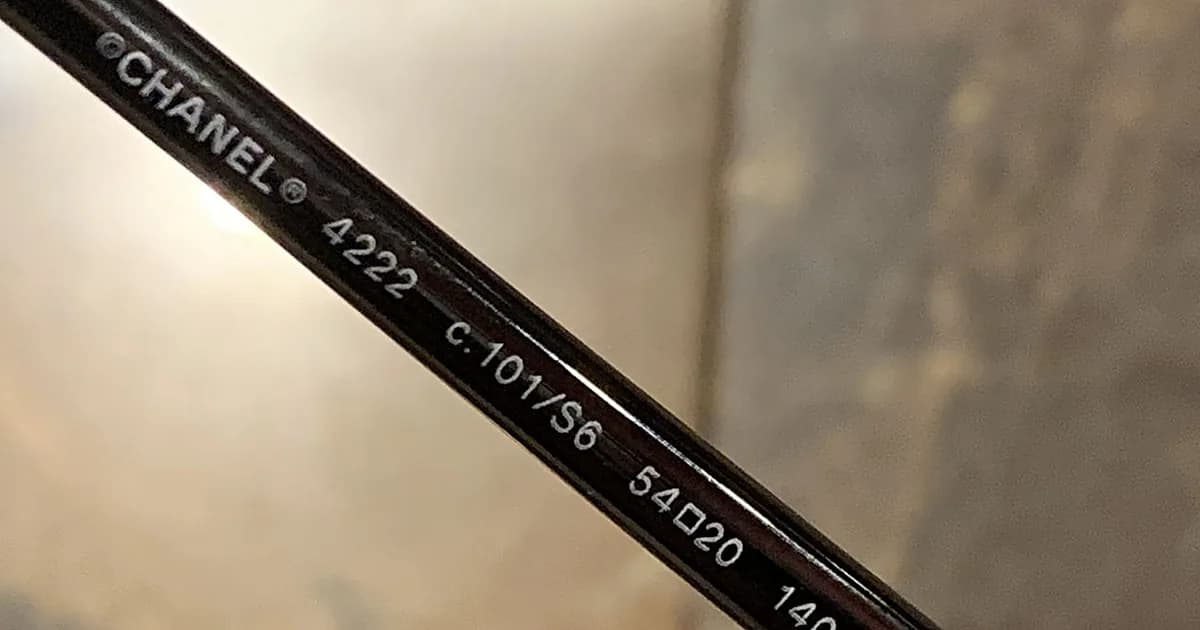
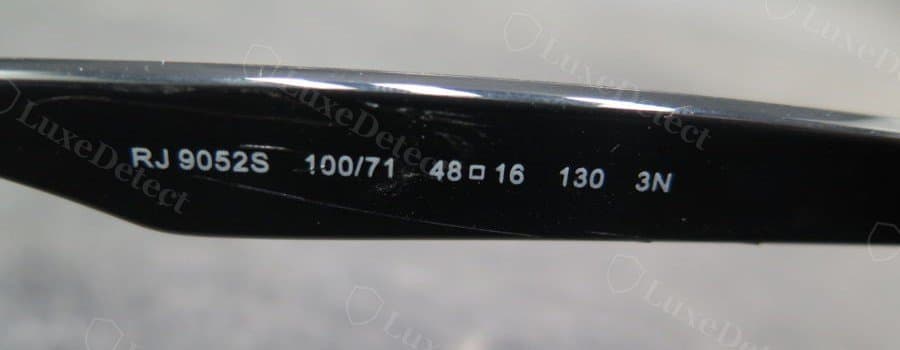
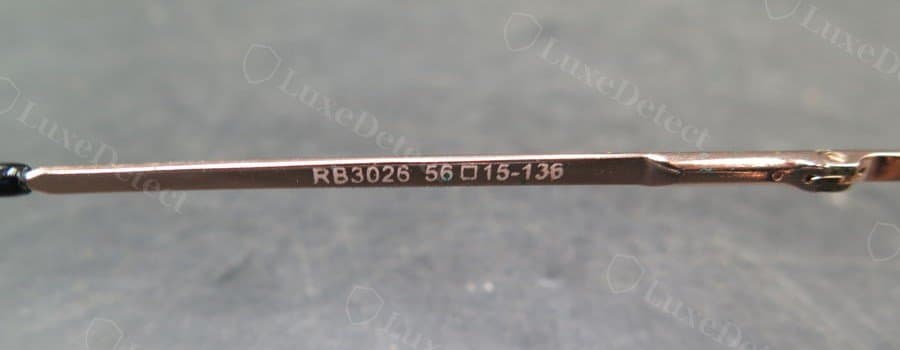
Every genuine temple carries the model code, colour code, and size, laser-engraved into the material.
Authentic: The engraving sits at a clean, consistent depth with crisp, high-contrast character edges — the mark reads sharply even in a close photo. On acetate frames it typically appears as bright white lettering that looks embossed rather than merely printed; on metal frames it's a fine, evenly-spaced laser line. The size code corresponds to the physical frame — measure the lens at its widest point and confirm it matches the first figure within a millimetre.
| Element | Authentic | Counterfeit |
|---|---|---|
| Depth | Consistent laser depth, crisp edges under magnification | Shallower or uneven depth; edges look slightly soft |
| Spacing | Evenly spaced, aligned to the temple's centreline | Occasionally cramped or off-centre |
| Country line | "Made in Italy" or "Made in China," both legitimate depending on model | Missing entirely, or present but paired with a wrong model code |
| Size code | Matches the physical lens width within 1mm | Often correct — mid-tier fakes copy this well |
Worth knowing
Engraving crispness is a useful tiebreaker, not a standalone test. A sharp mark alone does not prove authenticity, and country of origin proves even less — verify it alongside the model code and, ideally, against Ray-Ban's official model lookup.
The "Ray-Ban" Script on the Temple
Separately from the model code, most current frames carry an embossed or engraved "Ray-Ban" script logo on the outside of one temple, near the hinge.
Authentic: A deep, glossy, metal-finish script with a distinctive closed-loop capital R and a straight descending leg on the second stroke. The mark has real depth you can feel with a fingernail, and the finish contrasts cleanly against the frame material with no bleed at the edges.
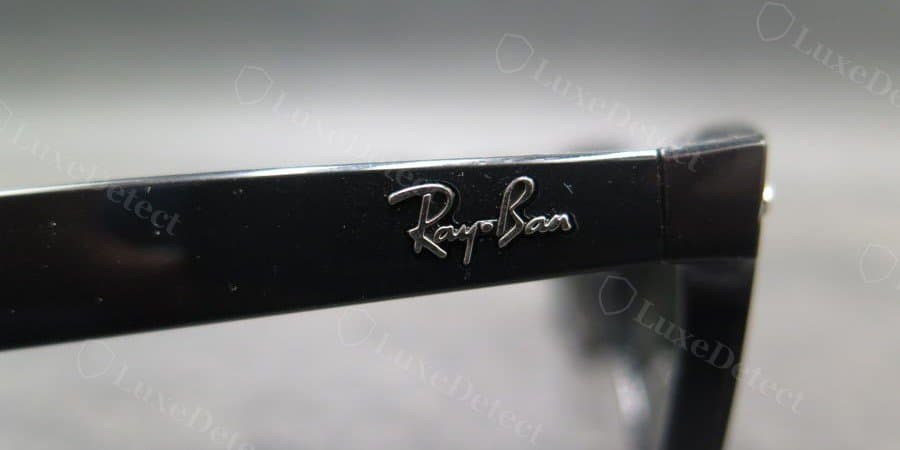
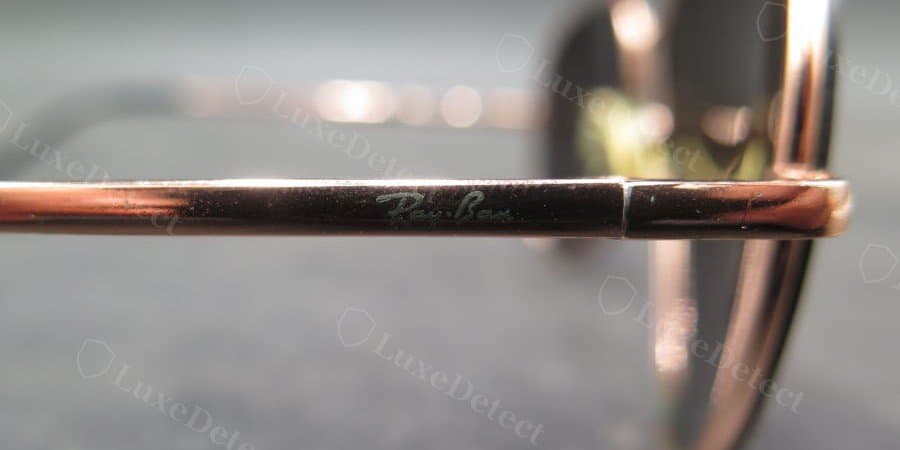
Red flag
A script that reads as a flat, shallow laser etching with no embossed depth — the fake example above is legible but visibly thinner-stroked and lower-contrast than the deep, glossy mark genuine frames carry. Run a fingertip over it: genuine embossing is tactile, a thin laser mark is not.
The Lens Etching and Script
Most models carry a small "RB" (or, on polarised lenses, "Ray-Ban P") etched into one lens, and many also carry the full "Ray-Ban" cursive script on the lens itself.
Authentic: The RB mark is etched into the glass or polycarbonate, appearing frosted or subtly embossed, visible mainly when the lens is tilted to catch light at an angle. It does not scratch off with a fingernail and does not disappear when cleaned. Placement varies by model and era (Ray-Ban's own guidance is inconsistent between the left and right lens across product lines), so treat placement as informational, not diagnostic. The cursive script uses a specific hand-lettered typeface: the capital "R" has a closed loop with a straight descending leg, the "y" drops to a consistent depth, and the application shows no ink bleed into the surrounding lens.
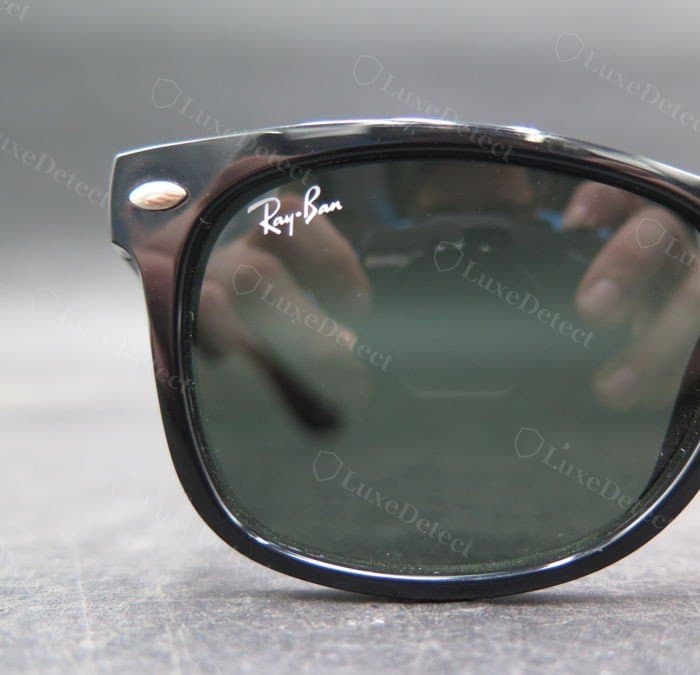
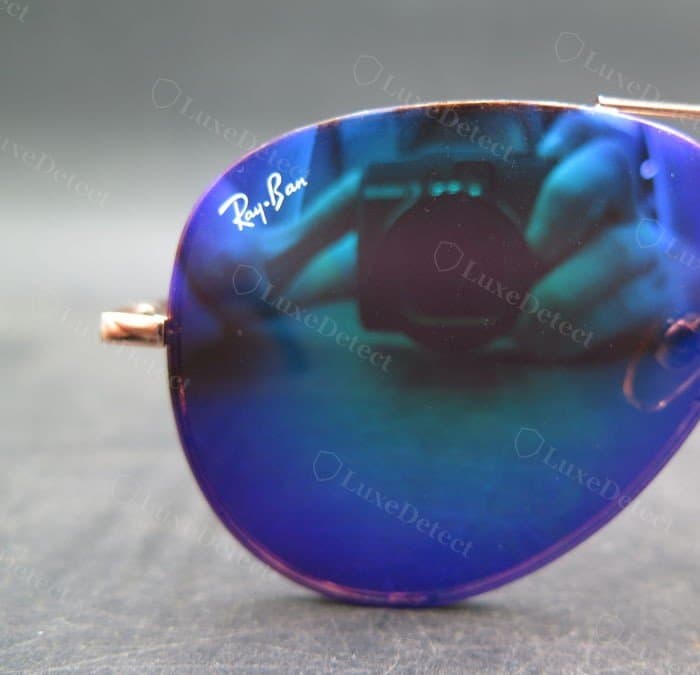
Worth knowing
The pair photographed above is a confirmed counterfeit, and its lens script is close to indistinguishable from genuine at a glance. The mid-tier fake market has reproduced this etching and script well for years — its presence clears the first hurdle only. A fake can pass this single test; passing the engraving, hinge, and construction checks together is considerably harder.
Hinge Construction
Ray-Ban uses metal hinges across the range, but the construction differs by model family, so compare like with like.
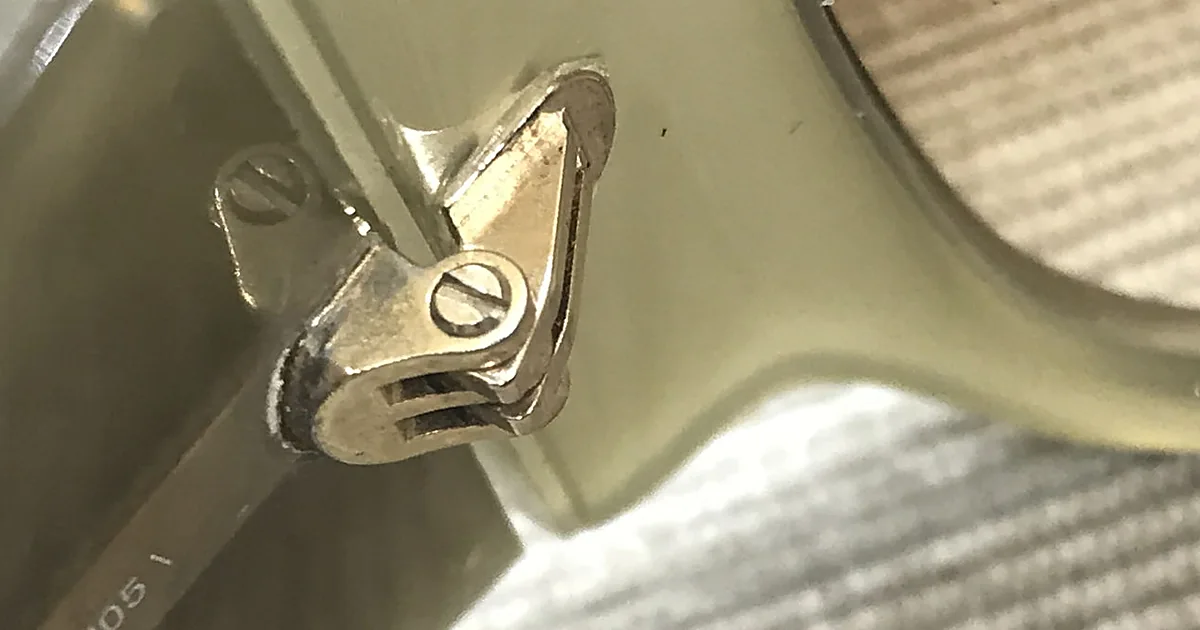
Authentic, Wayfarer family: A distinctive multi-barrel hinge (commonly described as seven interleaving barrels) machined cleanly with no casting flash at the knuckles. Hinges open and close with smooth, consistent resistance through their full travel, and hinge pins are tight enough that the temple doesn't wobble side to side when flexed.
Authentic, Aviator/metal-frame family: A simpler single-pin hinge, soldered cleanly to the temple and brow bar with no visible glue, uneven solder pooling, or gaps.
Fake tells across families: Loose or gritty hinge operation, perceptible temple wobble, casting flash or rough edges at the joint, and — specifically on Wayfarers — a barrel count that doesn't match the model.
Worth knowing
Don't compare a Wayfarer's barrel hinge against an Aviator's pin hinge and call a mismatch a red flag — they are different hardware by design. Confirm the hinge type matches what that specific model uses before judging it.
Temple flex
Authentic: Acetate temples flex outward under light pressure and return to position; the material has spring rather than rigidity. Fakes using cheaper acetate or moulded plastic substitutes often feel brittle and resist flexing, or stay bent after being flexed.
G-15 Lens Properties
Classic Wayfarers and Aviators use G-15 lenses — Ray-Ban's proprietary grey-green glass. This is a construction check available even without a photo-based reference, so it's worth doing in person on any secondhand pair.
The scratch test: Glass will not scratch under a fingernail; polycarbonate will. Draw a nail firmly across an inconspicuous edge of the lens. Note that Ray-Ban also produces legitimate polycarbonate lenses in certain lines, so this test confirms glass rather than authenticity on its own — but a lens sold specifically as classic G-15 glass that scratches is wrong.
The colour test: G-15 transmits colour accurately. Look at a white surface through the lens; it should read neutral with a slight grey-green cast, never yellow, brown, or blue. Fakes commonly overshoot toward brown.
The weight test: Glass lenses give a Wayfarer a distinct front-heaviness. Balance the folded frame across a finger at the hinge point; a genuine glass-lensed pair tips forward.
UV protection
Authentic Ray-Ban lenses are UV400 rated, blocking essentially all UVA and UVB. This cannot be verified by eye. An optician will test a lens on a UV meter in seconds, usually at no charge — worth doing on any secondhand purchase, both to confirm authenticity and because the safety consequence of getting it wrong is real.
What the Case and Cleaning Cloth Do and Do Not Prove
A genuine-looking Ray-Ban case, pouch, and cleaning cloth are easy to source separately from the glasses themselves and are reproduced at every quality tier. Packaging is context, useful for cross-referencing a printed model number against the frame, never evidence of authenticity on its own.
Quick Authentication Checklist
- Confirm the model code on the temple matches the physical frame shape and size being sold
- Inspect temple engraving depth and crispness; don't treat "Made in China" alone as a fail
- Check the "Ray-Ban" script on the temple for embossed depth, not just a legible outline
- Verify hinge type matches the model family, then check for wobble and casting flash
- Confirm the RB etch and lens script are clean, but don't stop there — they're the easiest thing to fake well
- On classic G-15 lenses: scratch test, colour test, and weight test
- Get UV400 confirmed on a meter for any secondhand purchase
Two or more failures means walk away. A loose or wobbling hinge, or a temple script with no embossed depth, is on its own sufficient grounds to reject a pair.
When to Get a Professional Opinion
DIY checks catch the bulk of the market, but the top tier of Ray-Ban counterfeits now gets the model code, the lens etching, and even the script right, and only falls down on engraving depth and lens optics that are hard to judge from a listing photo. If you're buying a discontinued colourway, a collaboration piece, or a bulk lot secondhand, photo-based authentication is a fast, low-cost screening step. LuxeDetect's accessories authentication runs $35 with a same-day turnaround, which is proportionate for anything trading meaningfully above the $40–$80 fake-market range.
FAQ
Are all current Ray-Bans made in Italy?
No. Current production runs across both Italy and China depending on the model line — junior, folding, and several clubmaster-style frames commonly carry "Made in China," and this is legitimate. Genuine vintage Ray-Bans predating the 1999 Luxottica acquisition carry entirely different Bausch & Lomb-era markings and need period-specific references instead.
Do fake Ray-Bans protect against UV?
Most do not. Authentic lenses are UV400 rated. Because tinted lenses dilate the pupil, wearing fakes that darken without blocking UV admits more ultraviolet light to the retina than wearing no sunglasses at all. This is the one authentication category where getting it wrong carries a health consequence rather than only a financial one.
The "RB" etching and lens script are there but the glasses look cheap — can they still be fake?
Yes, and this is the most common way buyers are caught out. The mid-tier fake market has reproduced the RB etching and even the cursive lens script accurately for years. Verify against multiple independent checks: temple engraving depth, hinge construction for the correct model family, and size code accuracy. A fake can pass any single test; passing all of them together is considerably harder.
Are Ray-Ban Wayfarers and New Wayfarers marked differently?
Yes. The original Wayfarer (RB2140) and the New Wayfarer (RB2132) carry different model codes and differ in frame geometry and size range. Confirm the model code on the temple matches the physical shape being sold.
Does "Made in China" always mean a pair is fake?
No — this is a common misconception. Several genuine current-production Ray-Ban lines are legitimately made in China, alongside Italian-made lines. Don't use country of origin alone as a pass/fail test; cross-reference it against the model code and the rest of the engraving instead.
Is it worth authenticating sunglasses at this price point?
For a single new pair at retail, no — buy from an authorised retailer. It becomes worthwhile for secondhand purchases of discontinued colourways or collaborations trading above retail, and for bulk purchases where a single verified sample validates a batch.