Luxury Leather Goods Specialist
Luxury leather goods specialist. Works on Italian house construction, hardware, and interior stamping.
Last updated October 2026 · Published September 2026 · Contact
Why Ferragamo Doesn't Have One Signature Model to Check
Salvatore Ferragamo's shoe range spans decades of lines and categories: the Vara bow pump, Gancini-buckle loafers and pumps, driving mocassins, and dress heels. Unlike a house with one dominant counterfeit target, Ferragamo fakes are spread across all of it, which means there is no single model reference to memorise. What is constant, though, is the Gancini — the interlocking double-ring motif Salvatore Ferragamo introduced in the 1970s, inspired by a decorative gate hinge. It appears as cast metal hardware on loafers and pumps, stamped into soles, and set into belt buckles, and because it is a manufactured metal part rather than a printed graphic, it is the hardest single element for a counterfeiter to get exactly right at low cost.
This guide starts with the lining print inside the shoe, because it is the quickest check to photograph and the one that exposes the clearest fakes, then runs the Gancini hardware, the sole and insole markings, and general construction. Reading the printed label before judging the hardware works the same way when authenticating Jimmy Choo shoes.
What to check, ranked by reliability
| Checkpoint | Reliability | What it tells you |
|---|---|---|
| 1. The Lining Print: Code, US Size and Width | ★★★★★ | An EU size, a hyphenated number or a centimetre size where the US size belongs is a format we have only seen on fakes. A well-formed print proves nothing: most fakes with a readable code get it right. |
| 2. The Gancini Hardware: Casting, Not Finish | ★★★★★ | Finish varies on genuine pairs and fakes copy every finish; a shallow, smeared or misspelled script or a flat, thin casting corroborates a fake but rarely settles it alone. |
| 3. The Sole Stamp | ★★★★★ | Wording alone is easy to copy and a generic "VERO CUOIO" shield proves nothing; a shallow stamp or pristine gold foil on an otherwise worn shoe corroborates a fake finding but should be read alongside the lining print. |
| 4. The Vara Bow and Trim Hardware | ★★★★★ | A centre clasp with no legible "Ferragamo" script engraving is a strong tell; a floppy ribbon corroborates but is secondary on its own. |
| 5. Leather and General Construction | ★★★★★ | Stiff leather or wandering stitching corroborates a verdict but a good fake can get base construction close. |
| Model Reference Before You Start | ★★★★★ | Confirms which line and origin to expect; will not catch a good fake on its own. |
| What the Box and Dust Bag Do and Do Not Prove | ★★★★★ | Packaging is reproduced constantly — useful only for cross-referencing the label against the shoe. |
Model Reference Before You Start
- Ferragamo's shoe and accessory lines include the Vara bow pump, Gancini bit loafers and pumps, driving moccasins, and dress and evening heels. This guide covers checks that apply broadly across the catalogue rather than one named model.
- Ferragamo's shoe production is centred in Florence, Italy. That is background only: "Made in Italy" is printed on fakes too and is never a test.
- Box labels give a style name or number, size, and colour, and the size uses the same US size + width as the lining (e.g. 8 B). The box should agree with the shoe's own markings.
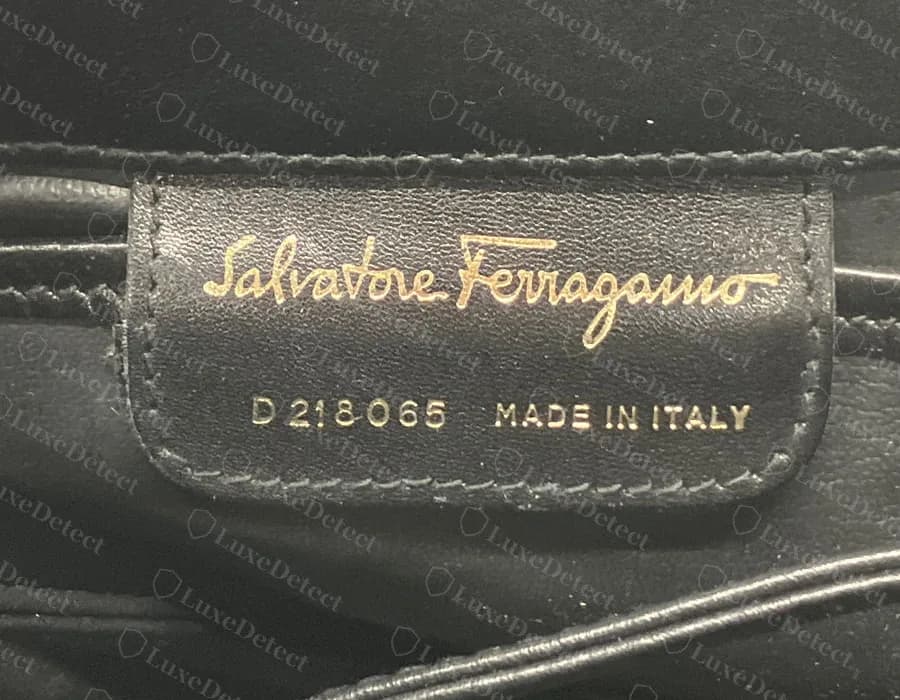
The Lining Print: Code, US Size and Width
Inside every Ferragamo shoe there is a printed line of code: on the side lining of women's pairs, and on the tongue or heel lining of men's. It reads as a letter prefix, a model number, a variant, a US size and a US width letter, for example DS 58304 B69 7½ B or UG72206 C14 13 D. The spacing varies, men's pairs often put the width before the size (ZM 044665 D 10), and some pairs print no model number at all (LN 9½ E). None of that is a tell.
The size is. The genuine pairs we have reviewed with a legible lining print all used a US size and a width from Ferragamo's own run: AAAA to EEE, plus M on some casual and espadrille lines. Many counterfeit pairs with a readable print break that format, usually in one of a few ways: an EU size next to a hyphenated number (902-2 38, 595-73 41), a bare number and an EU size (16703 43), a Japanese centimetre size (245 (1.5)) on Vara-style pumps, or a width letter Ferragamo does not use (6 N).
The rest of the fakes carry a well-formed print, and some reuse one code across several pairs, so a correct-looking code proves nothing on its own. There is no public Ferragamo lookup for the model number. Type the print into the checker below to see whether it fits the format.
| Element | Authentic | Counterfeit |
|---|---|---|
| Size | US size, whole or half (7½, 10) | Often an EU size (38, 43) or a cm size (245) |
| Code | Letter prefix and model number (DS 58304) | Often a hyphenated number (902-2, 595-73) |
| Width | AAAA to EEE, or M | Sometimes a letter Ferragamo doesn't use, such as N |
Red flag
A lining print with an EU size and a hyphenated number (for example "902-2 38" or "595-73 41") where a genuine pair shows a letter code, a US size and a width letter (for example "DS 58304 B69 7½ B"). We have only seen the EU-size format on counterfeits.
Worth knowing
A well-formed print is context, not confirmation. Many counterfeit pairs with a readable code get the format right, so a clean code means you move on to the sole, the hardware and the construction.
The Gancini Hardware: Casting, Not Finish
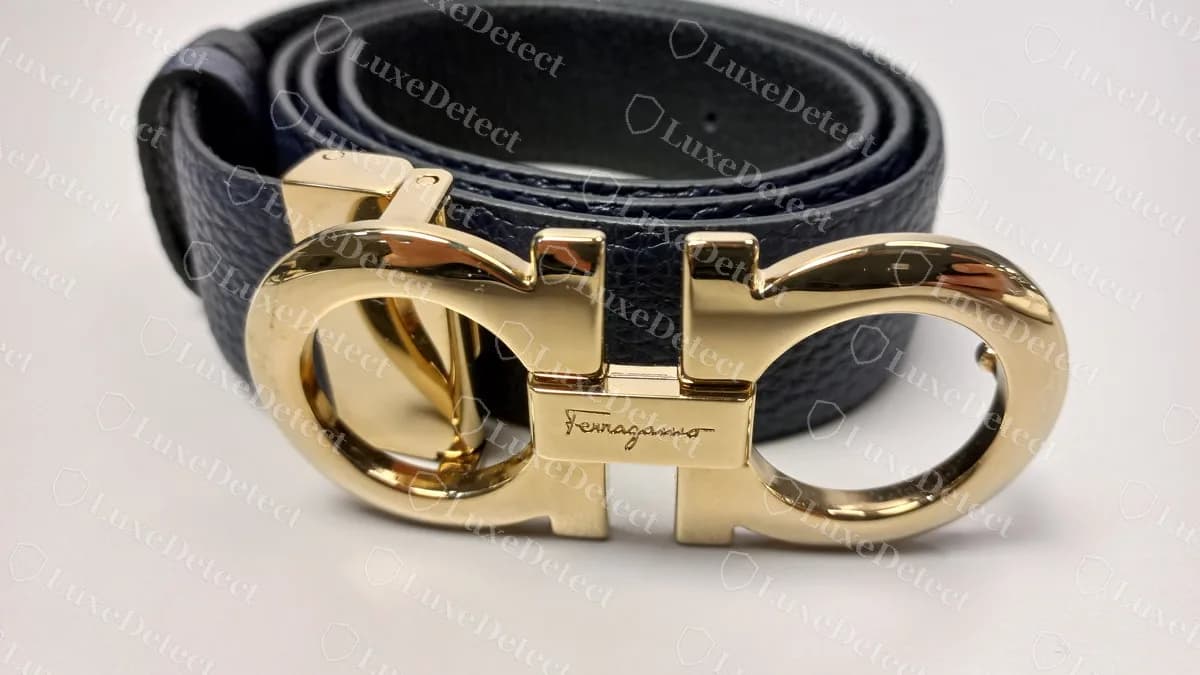
The Gancini bit on loafers and pumps is cast metal, and the casting is where cost-cutting shows.
Genuine Gancini hardware on shoes comes in several finishes: smooth polished gold or silver, brushed or antiqued gunmetal, and matte black. The finish alone does not tell real from fake. What to check is the casting: the rings and bar are solid and rounded, the joins are clean, and the "Ferragamo" script on the centre bar is cut with real depth.
Fakes come in the same finishes as genuine pairs, so look at the casting instead: a script that reads shallow, smeared or misspelled, a misshapen or uneven ring, and a bar that looks flat and thin rather than rounded.
| Element | Authentic | Counterfeit |
|---|---|---|
| Surface finish | Polished, brushed, gunmetal or matte black, all seen on genuine pairs | The same finishes; not a useful split |
| Engraving | "Ferragamo" script on the centre bar, cut with real depth | Shallow, smeared or misspelled |
| Ring/bar profile | Rounded, three-dimensional, noticeable weight | Flatter, thinner, lighter in hand |
Worth knowing
A mirror-polished Gancini is normal on genuine Ferragamo shoes and belts. Judge the hardware by the depth and spelling of the "Ferragamo" script and the shape of the casting, not by how shiny it is.
The Sole Stamp
Ferragamo leather soles carry a small stamped panel, not a large printed logo.
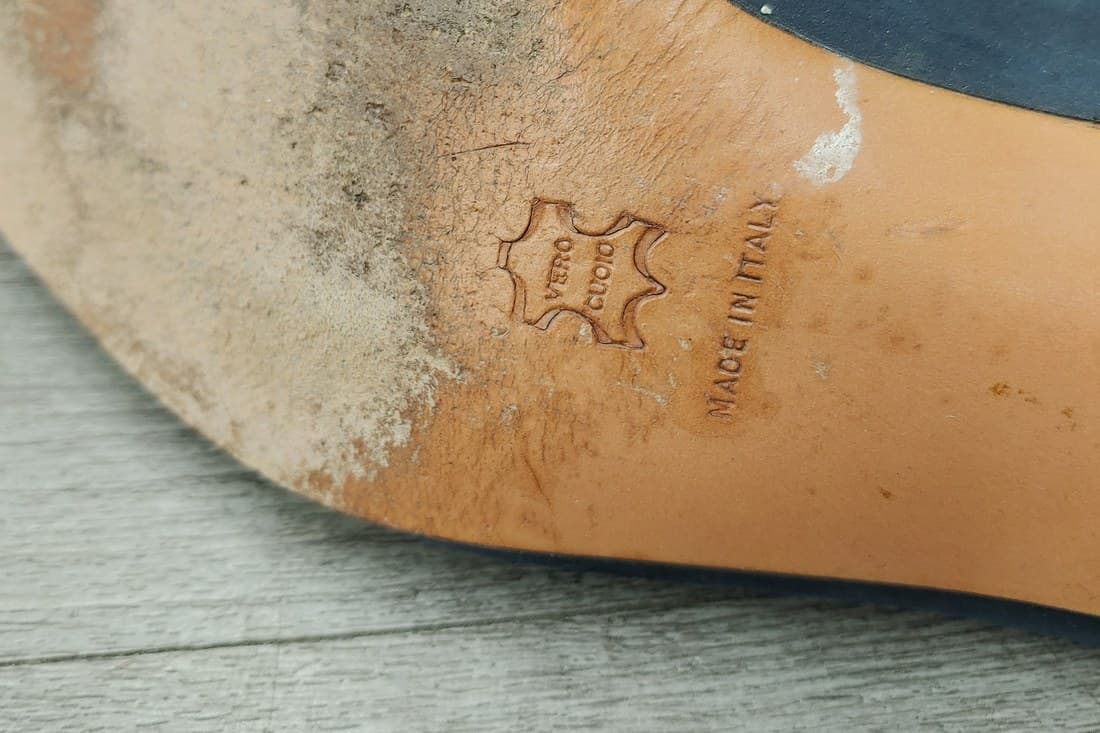
On a genuine leather sole, the sole reads "Salvatore Ferragamo" in script over "MADE IN ITALY", often with the US size and width. Some older pairs also carry a generic "VERO CUOIO" shield. That shield is a standard Italian leather mark that fakes copy too, so it proves nothing. The stamp is pressed into the leather, not printed on top of it, sits flush with the leather grain and shows honest wear consistent with the rest of the sole. The insole carries the name in gold or silver foil: either the "Salvatore Ferragamo" script with "Made in Italy" beneath it, or the "SALVATORE FERRAGAMO / FLORENCE / MADE IN ITALY" block logo, hot-stamped into the leather footbed.
Fakes get the wording roughly right more often than not, so the tell is usually in execution: a stamp that sits too shallow to have been pressed (more like a light branding iron pass), lettering that is slightly too thick or condensed compared with Ferragamo's actual spacing, or a gold-foil insole stamp that looks freshly applied and pristine on a shoe that is otherwise worn.
| Element | Authentic | Counterfeit |
|---|---|---|
| Wording | "Salvatore Ferragamo" over "MADE IN ITALY", often with the US size and width | Often similar; a generic "VERO CUOIO" shield alone proves nothing |
| Stamp method | Pressed/stamped into the leather | Shallow, more like a light branding pass |
| Lettering | Clean, evenly spaced | Slightly thick, condensed, or uneven spacing |
| Wear consistency | Wear on the stamp matches wear on the sole | Pristine gold foil on an otherwise worn shoe |
Worth knowing
A correctly worded sole stamp does not settle it on its own — the wording is public information and easy for a counterfeiter to copy. Execution quality and consistency with the rest of the shoe's wear carry more weight than the words themselves.
The Vara Bow and Trim Hardware
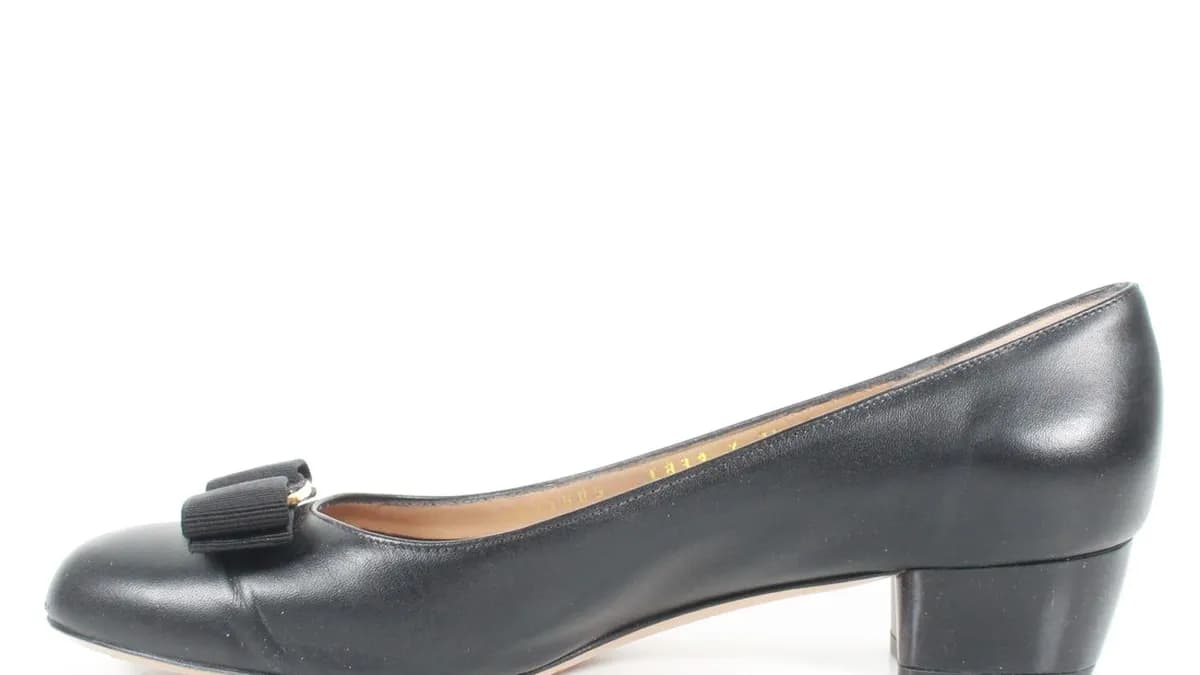
On pumps and flats carrying the house's grosgrain bow, the bow itself is a good secondary check.
Genuine: the grosgrain ribbon is a tight, structured weave that holds a crisp bow shape without collapsing, and the small metal Gancini-style clasp set into the centre of the bow is cast to the same standard as the loafer hardware (see Check 2), with a deeply engraved "Ferragamo" script — not a flat stamped disc.
Fakes show a thinner, floppier ribbon that doesn't hold its bow shape as crisply, and a centre clasp that is often a flat stamping rather than a genuinely cast piece, the same casting-versus-stamping distinction that matters on Manolo Blahnik's Hangisi buckle.
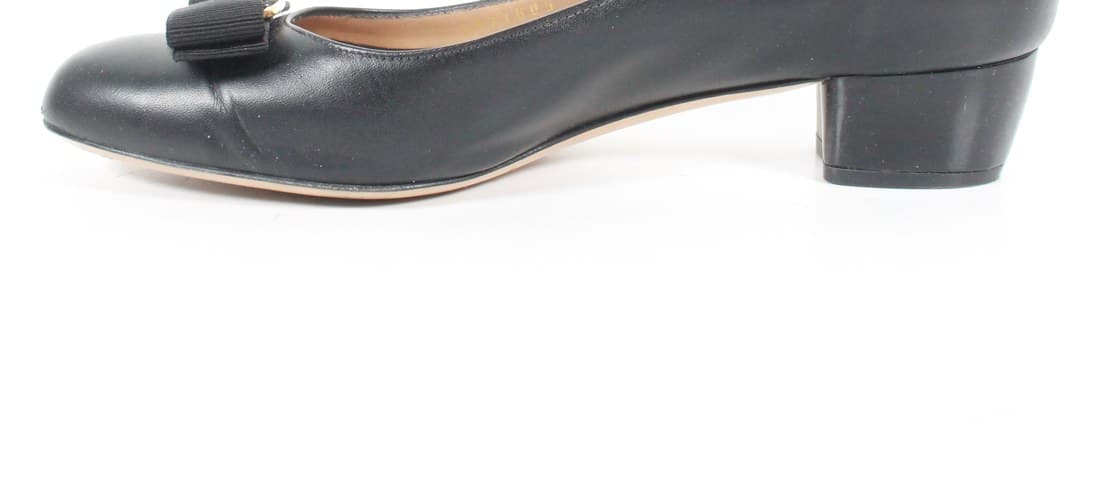
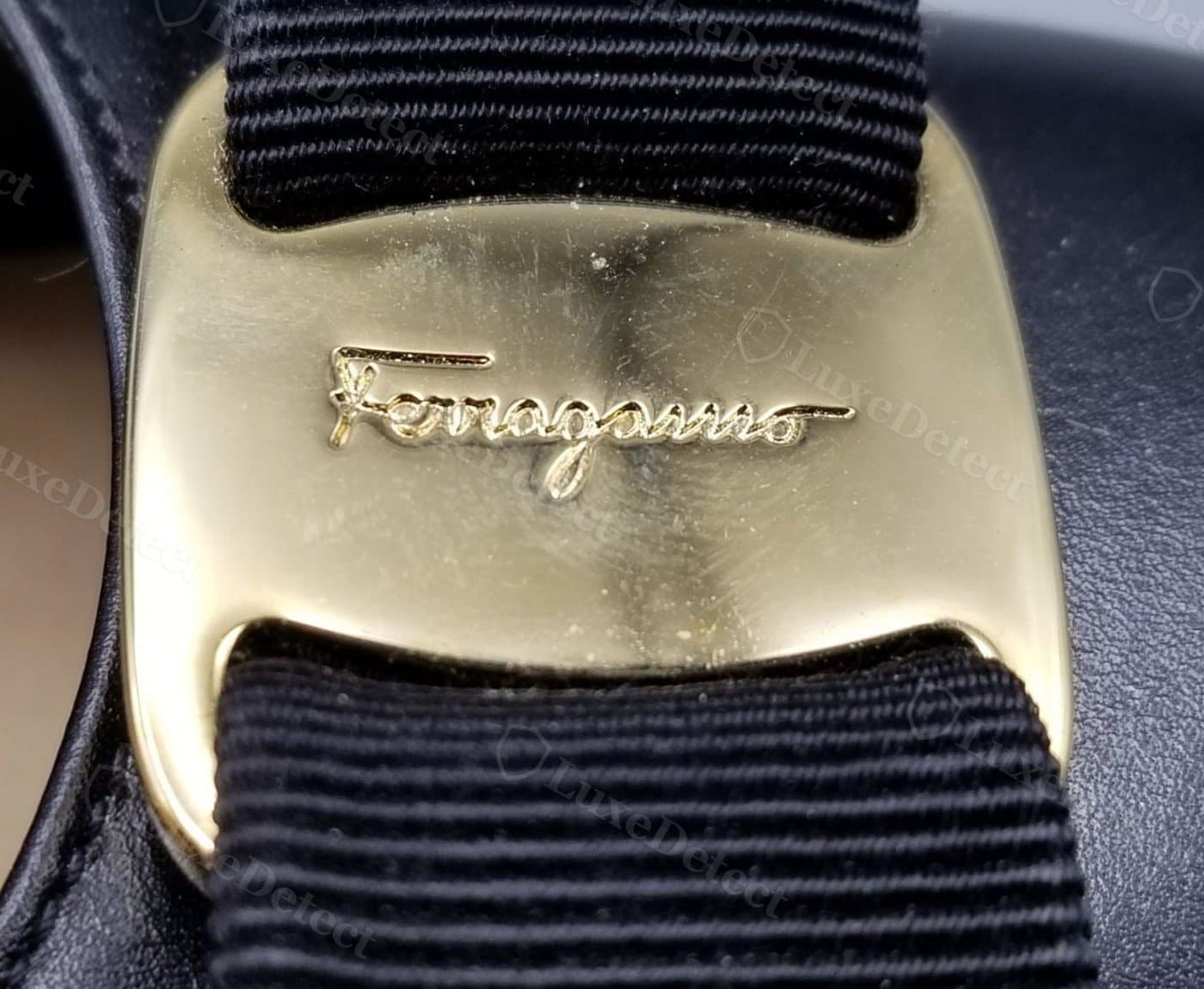
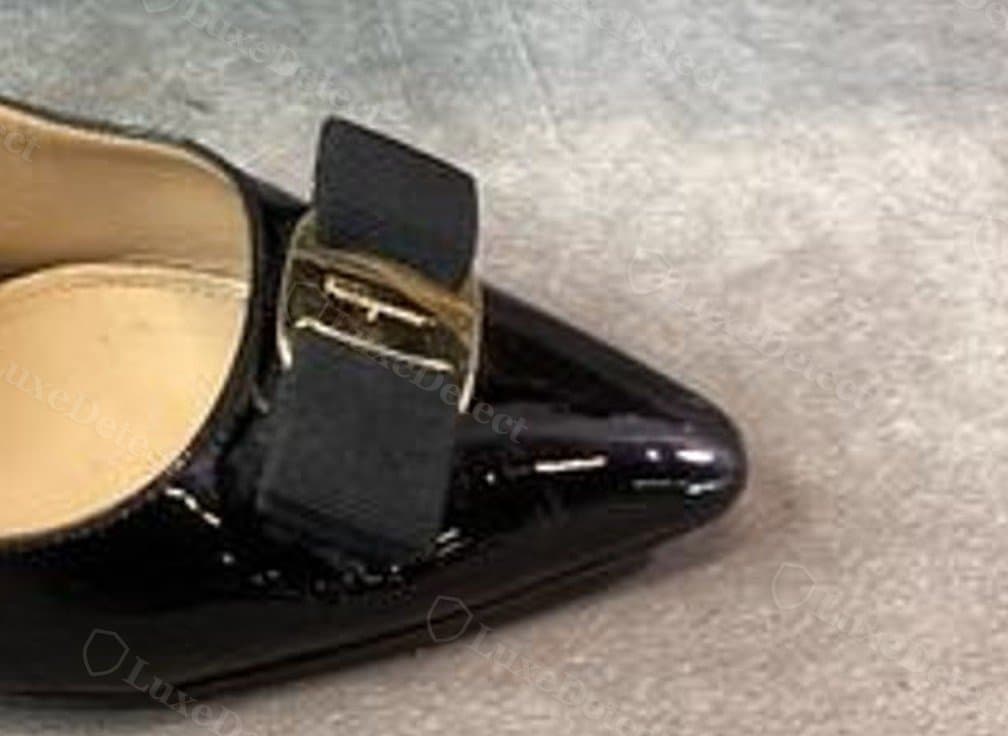
| Element | Authentic | Counterfeit |
|---|---|---|
| Ribbon | Tight structured weave, holds bow shape | Thin, floppy, sags or looks flattened |
| Centre clasp | Cast metal, "Ferragamo" script engraved with real depth | Flat stamped disc or plain buckle, no legible engraving |
Red flag
A Vara centre clasp with no visible "Ferragamo" script engraving at all, or one that's a flat, featureless gold rectangle. Genuine clasps are cast, not stamped sheet metal, and the script engraving is present and legible even on well-worn pairs.
Leather and General Construction
Away from the branded hardware, Ferragamo's shoes are still a quality-construction story.
Check the upper leather for an even colour and grain with no obvious plastic sheen, stitching for consistent, tight seams (particularly around the vamp and welt on loafers), the lining for a soft leather rather than a synthetic that bunches, and the shoe's balance — a well-made pair sits flat and doesn't rock or lean when placed on a hard surface. A driving-moccasin sole's hand-whipped edge stitching, where present, should be even and tight, not loose or gapped.
Fakes trend toward a stiffer, slightly plasticky upper leather, wandering or inconsistent stitching, a bunched or glued-looking synthetic lining, and a shoe that visibly rocks when set down — the same balance test is worth running on Christian Louboutin heels.
| Element | Authentic | Counterfeit |
|---|---|---|
| Upper leather | Even colour and grain, no plastic sheen | Stiff, plasticky sheen |
| Stitching | Tight, consistent, especially at vamp/welt | Wandering, inconsistent tension |
| Lining | Soft leather | Synthetic, bunched or glued |
| Balance | Sits flat, no rocking | Rocks or leans on a flat surface |
What the Box and Dust Bag Do and Do Not Prove
A Ferragamo box carries a printed label with the style, size, and colour, and shoes typically ship with a felt or cotton dust bag per shoe. Packaging is reproduced constantly and proves nothing on its own — its only real use is cross-referencing: the label's style, size, and colour should match the shoe, and its US size and width should be the same as the lining print (for example 8 B on both). A label that disagrees with the shoe itself is a bigger warning sign than a slightly cheap-feeling box.
| Element | Authentic | Counterfeit |
|---|---|---|
| Box label | Same US size and width as the lining, matching style and colour | Disagrees with the shoe, or is missing entirely |
| Dust bag | Cotton or felt, clean logo | Thin, generic, or absent |
Worth knowing
Packaging is context, not evidence. The lining print, the sole stamp execution, the hardware casting and the overall construction carry the verdict.
Quick Authentication Checklist
- Read the lining print: a letter code, a US size and a width letter (such as 7½ B or 10 D). An EU size or a hyphenated number is a strong warning sign.
- On any Gancini or Vara hardware, confirm the "Ferragamo" script has real depth and the casting is solid and rounded (the finish itself varies on genuine pairs)
- Read the sole stamp — "Salvatore Ferragamo" / "MADE IN ITALY," pressed cleanly, with wear consistent with the rest of the sole
- On bow styles, check the grosgrain holds a crisp shape and the centre clasp is genuinely cast, not a flat disc
- Check the upper leather, stitching, lining, and overall balance
- Cross-reference the box label against the lining print's US size and width
Two or more failures means walk away. A lining print with an EU size or a hyphenated code is a strong reason to walk away.
When to Get a Professional Opinion
The clearest fakes fail on the lining print, which a seller can photograph in seconds. The harder cases are well-made copies that get the lining print, the silhouette, the stamp wording, and even a passable hardware shape close — separating those from genuine pairs comes down to casting quality, stamp execution, and construction details that reward having handled real pairs.
If it's a marketplace purchase and the lining print or sole stamp gives you pause, get a second opinion before the money moves. LuxeDetect authenticates Salvatore Ferragamo shoes from $15 with a verdict and Certificate of Authenticity within 24 hours. Send close-up photos of the lining print, any metal hardware, the full sole, the insole, and the interior lining.
FAQ
How can I tell if Salvatore Ferragamo shoes are real?
Start with the lining print inside the shoe. Genuine pairs show a letter-prefix code, a US size and a width letter (for example DS 58304 B69 7½ B). Then check the sole stamp is pressed cleanly in the right lettering, and that any Gancini or Vara plate has a deep, clean "Ferragamo" script. Hardware finish varies on genuine pairs and is not a test.
Where is the Gancini on Ferragamo shoes?
It appears as the metal bit on Gancini loafers and pumps, and on the buckles of Ferragamo belts. Not every Ferragamo shoe carries Gancini hardware — the Vara pump uses a grosgrain bow with a smaller Gancini-style clasp at its centre instead.
What does the Ferragamo sole stamp say?
A genuine leather sole reads "Salvatore Ferragamo" in script over "MADE IN ITALY", often with the US size and width. Some older pairs also carry a generic "VERO CUOIO" shield, a standard Italian leather mark that fakes copy too, so it proves nothing. The insole carries the name in gold or silver foil, as a script or as the "SALVATORE FERRAGAMO / FLORENCE / MADE IN ITALY" block logo. The wording alone doesn't prove authenticity since it's public information; stamp execution and wear consistency matter more.
Are Salvatore Ferragamo shoes made in Italy?
Yes. Ferragamo's shoe production is centred in Florence, and the sole and insole say "Made in Italy." The country is no tell either way, because fakes print it too. Judge how the stamp is pressed, its lettering and its wear instead.
Is the Vara bow a reliable way to check authenticity?
It's a useful secondary check but not decisive on its own. A genuine Vara bow uses a tightly woven grosgrain ribbon that holds a crisp shape, with a cast metal clasp at its centre carrying a deeply engraved "Ferragamo" script. A thin, floppy ribbon or a flat stamped clasp supports a fake finding, but should be read alongside the sole stamp and hardware checks, not alone.
Does the box or dust bag prove a pair is authentic?
No. Boxes and dust bags are reproduced easily and prove nothing by themselves. Their only real value is cross-referencing: the box label's style, size, and colour should match what's stamped on the shoe's own sole and insole. A mismatch there is more telling than a cheap-feeling box.
Why doesn't this guide focus on one Ferragamo model?
Because the fakes submitted for authentication aren't concentrated on one style the way some brands are — they span pumps, loafers, and driving shoes fairly evenly. The lining print, sole stamp, hardware and construction checks in this guide apply across that whole range rather than to a single named model.