Luxury Accessories Authenticator
Luxury accessories authenticator. Covers small leather goods, belts, and eyewear.
Published September 2026 · Contact
Why Gucci Eyewear Is Faked at Volume
Gucci sunglasses sit at the cheapest entry point into the brand — roughly $300 to $500 against $2,000+ for a bag — which puts them in front of far more buyers, and makes them worth copying at every quality tier. Gucci eyewear is manufactured under licence by Kering Eyewear, to fixed optical-industry standards, and that turns out to be good news for authentication: the hinge construction, the inner-temple marking string, and the lens etch are all built to a spec that cheap factories can't match without spending real money.
The tells are mechanical rather than aesthetic. A fake can copy the frame shape and the web stripe convincingly; what it can't cheaply reproduce is a properly machined hinge seated without adhesive, and a clean laser etch.
What to check, ranked by reliability
| Checkpoint | Reliability | What it tells you |
|---|---|---|
| The Hinge | ★★★★★ | Visible adhesive at the hinge-to-acetate join, or a pressed pin where a slotted screw belongs, is the fastest fail on the frame. |
| The Inner-Temple Markings | ★★★★★ | A blurred or malformed model and size string, a wrong-format size, or a missing CE mark is decisive. |
| The Lens Etch | ★★★★★ | A scratchy, broken etch is a reliable fail — but a missing one is not, since placement varies by era and model. |
| Frame Material and Finish | ★★★★★ | Moulded plastic with a seam, flat colour and low weight flags a fake, but material quality is a spectrum, and weight and feel are checks done with the frame in hand. |
Model Reference Before You Start
Gucci eyewear model numbers follow a GG####S pattern (the S denotes sunglasses; optical frames drop it), followed by a three-digit colour code — for example "GG0447S 002". That string should appear on the inner temple and on the box label, and the two must agree.
- Acetate frames — square, oversized, cat-eye, round. Hinge is set into the acetate.
- Metal frames — aviator, pilot, rimless. Hinge is soldered or screwed to the temple arm.
- Web-stripe and GG-logo models — the green/red/green stripe or interlocking GG applied at the temple or hinge.
Gucci eyewear is made in Italy; the inner temple says so alongside a CE mark. Confirm the model number against gucci.com or an optical retailer before going further.
The Hinge
This is the decisive check on Gucci eyewear and the one fakes fail most consistently.
A genuine hinge is a machined metal component — typically multi-barrel — with cleanly slotted screws you can see a screwdriver would actually turn. On acetate frames it is deeply and squarely seated into the acetate (usually heat-sunk), sitting flush with no gap, no filler, and no visible adhesive anywhere. The metal edges are crisp, the finish even. Opened and closed, the temple moves with smooth, consistent resistance and stays where you put it.
Fakes cut cost exactly here. The most common tell is visible glue or dark adhesive residue smeared at the join where the hinge meets the acetate — a giveaway that the part was stuck on rather than properly set. Instead of slotted screws you often find a crude pressed rivet or pin, the hinge plate is thin stamped metal rather than machined, and the temple either flops loose or binds.
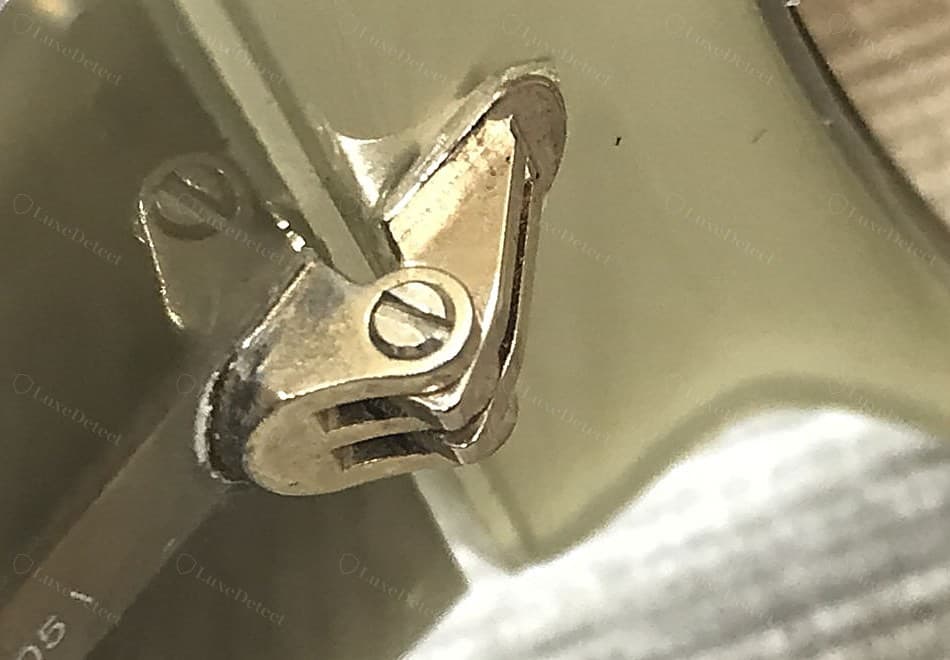
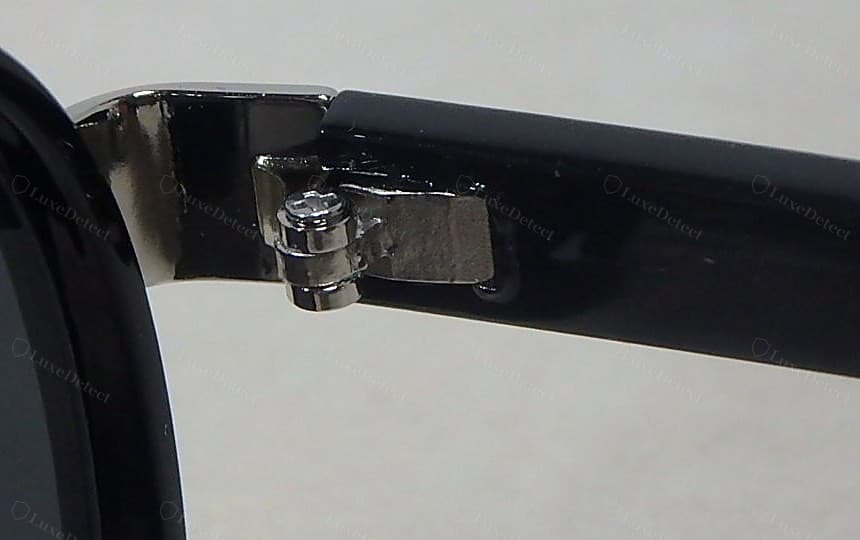
| Element | Authentic | Counterfeit |
|---|---|---|
| Hinge body | Machined metal, multi-barrel, substantial | Thin stamped plate, lightweight |
| Fasteners | Cleanly slotted screws | Pressed rivets or pins, or no visible screw |
| Seating | Flush, square, heat-sunk into acetate | Glue or filler visible at the join |
| Action | Smooth even resistance, holds position | Loose and floppy, or binding |
Red flag
Visible adhesive at the hinge-to-acetate join, or a pressed pin where a slotted screw belongs. Gucci eyewear hinges are set mechanically, not glued; a stuck-on hinge is the fastest fail on the frame.
The Inner-Temple Markings
Open the temple and read the printing on the inside. A genuine frame carries a specific string of information, cleanly applied.
Expect: the model number (GG####S), the colour code, and a size string in the standard optical format — lens width ▫ bridge width, then temple length, for example "65 ▫ 15 105". Alongside these you should find "MADE IN ITALY" and a CE mark. The printing or laser marking is sharp, evenly spaced, and correctly aligned along the temple, with consistent character height; the small square between the first two numbers is the standard optical separator and should be a clean shape.
Fakes get the content roughly right but the execution wrong: blurred or double-struck characters, uneven spacing, a size string in the wrong format or with implausible numbers, a missing CE mark, or a model number that doesn't resolve to a real Gucci frame. Some fakes print the string too large or place it in the wrong position on the temple.
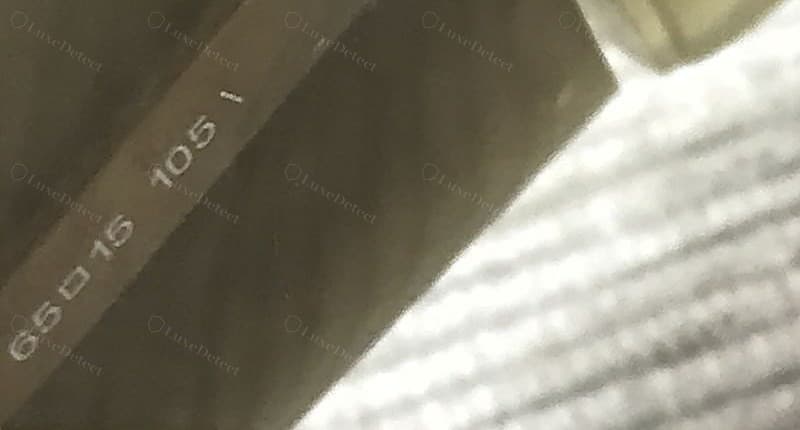
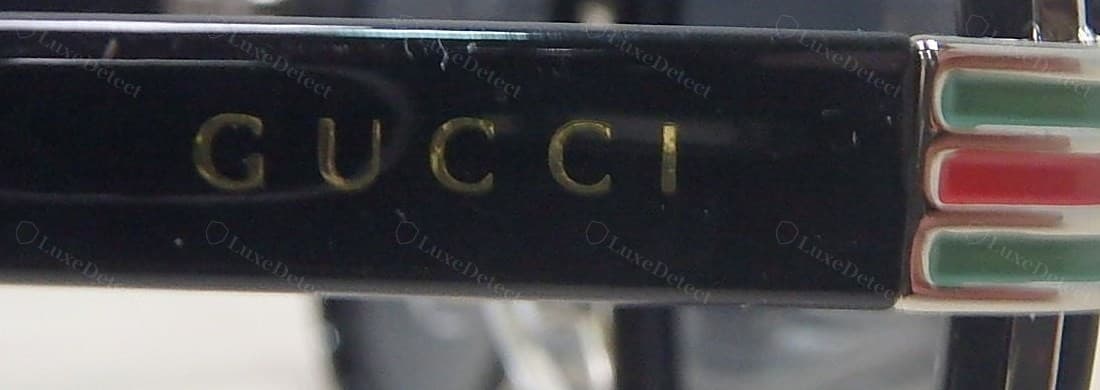
| Element | Authentic | Counterfeit |
|---|---|---|
| Model number | GG####S + colour code, resolves to a real frame | Missing, malformed, or doesn't resolve |
| Size string | Lens ▫ bridge, temple — clean optical format | Wrong format, implausible numbers, blurred |
| Origin / CE | "MADE IN ITALY" plus a CE mark | Missing, misspelled, or wrong country |
| Print quality | Sharp, even spacing and character height | Blurred, double-struck, uneven |
Worth knowing
Cross-check the model and colour code on the temple against the box label and, where present, the lens etch. Counterfeiters frequently reuse one label across frames, so a mismatch between the three is a strong signal even when each looks plausible alone.
The Lens Etch
Most current Gucci sunglasses carry a small "GUCCI" laser etch in a corner of one lens. It is easy to miss and easy to get wrong.
A genuine etch is precise and evenly cut: the letters have consistent stroke weight, clean edges, correct spacing, and sit at a consistent depth. You need to angle the lens to light to see it clearly — it should not be obvious head-on, and it should not catch your fingernail.
Fake etches are faint, scratchy, and uneven — letter strokes break up, character weight varies across the word, and the surrounding lens surface often shows stray scratches from a poorly controlled tool. Some fakes skip the etch entirely; others cut it far too deep and too visibly.
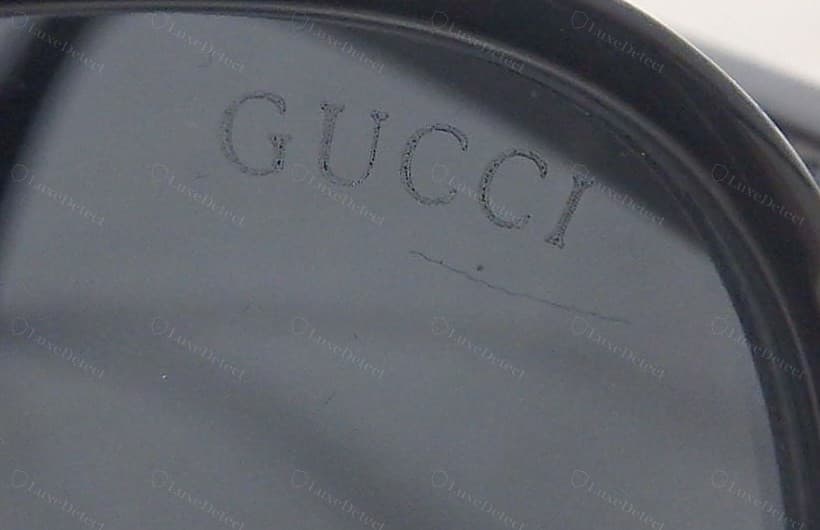
| Element | Authentic | Counterfeit |
|---|---|---|
| Cut quality | Precise, even stroke weight, clean edges | Scratchy, broken strokes, varying weight |
| Visibility | Subtle — needs angled light | Obvious head-on, or absent entirely |
| Surrounding lens | Clean | Stray tool scratches nearby |
Worth knowing
A missing lens etch is not decisive on its own — etch placement has varied across eras and some genuine models don't carry one. A badly executed etch, though, is a reliable fail: Gucci's laser marking is a controlled process, and a scratchy, broken mark is not it.
Frame Material and Finish
Genuine acetate frames are cut from solid acetate sheet: the material has depth and subtle variation in the colour when held to light, the surface is polished smooth with no mould seams, and the frame has real weight in the hand. Metal frames are evenly plated with no bare patches, and any enamel inlay (the green/red/green web) sits flush and level in its channel with crisp colour boundaries.
Fakes are typically injection-moulded plastic rather than cut acetate — flat, uniform colour with no depth, often with a faint mould seam along the temple or rim, and noticeably light. Enamel inlays sit proud or sunken, with bleeding or uneven colour bars.
| Element | Authentic | Counterfeit |
|---|---|---|
| Acetate | Cut sheet, depth and variation in colour, weighty | Moulded plastic, flat colour, light, mould seam |
| Plating (metal) | Even, no bare patches | Thin, patchy, base metal showing |
| Enamel inlay | Flush and level, crisp colour boundaries | Proud or sunken, bleeding colour |
Worth knowing
Material quality is a spectrum, and weight and feel are checks done with the frame in hand. Use it to build the picture around the hinge and the temple markings rather than as a standalone verdict.
What the Case and Papers Do and Do Not Prove
Gucci eyewear ships in a hard case with a microfibre cloth, a booklet, and a box label carrying the model, colour code, and size. Cases, cloths and labels are reproduced at scale and sold loose, so a complete set around a frame that fails the hinge check is still a fake.
The useful move is cross-referencing: the model and colour code on the box label against the inner temple, and both against the lens etch where present. A set that disagrees with itself is a flag; a set that agrees proves only that someone assembled it carefully.
Quick Authentication Checklist
- Open the temple and look at the hinge: machined metal, slotted screws, seated flush with no adhesive
- Work the temple: smooth even resistance, holds position, no flop or bind
- Read the inner temple: model number, colour code, size string in lens ▫ bridge / temple format, "MADE IN ITALY", CE mark — all sharply printed
- Angle the lens to light: if there's an etch, it should be precise and even, not scratchy
- Cross-check the model and colour code across temple, box label and etch — they must agree
- Check the acetate for depth and weight, or the plating for even coverage; enamel inlay flush and crisp
Two or more failures means walk away. Adhesive at the hinge (check 1), or a blurred, malformed inner-temple string (check 3), is on its own sufficient.
When to Get a Professional Opinion
The cheap fakes fail on the hinge alone — glue at the join, a pin instead of a screw, a temple that flops. The harder cases use a decent hinge and print a plausible temple string, and the decision moves to the etch quality under angled light, the exact character spacing of the markings, and whether the model number resolves to a frame Gucci actually made in that colourway.
If you're buying online and anything about the hinge, the markings, or the etch looks soft, get a second opinion before the money moves. LuxeDetect authenticates eyewear from $15 with a verdict and Certificate of Authenticity within 24 hours. Send the hinge open and close up, the full inner-temple string straight on, the lens etch in angled light, and the box label.
FAQ
What is the fastest way to spot fake Gucci sunglasses?
The hinge. Open a temple and look at where the hinge meets the frame. A genuine Gucci hinge is a machined metal part with cleanly slotted screws, seated flush into the acetate with no adhesive anywhere. Visible glue at the join, or a pressed pin where a screw should be, is the fastest and most reliable fail.
What should be written on the inside of the temple?
The model number in Gucci's GG####S format, a three-digit colour code, a size string in the optical lens ▫ bridge / temple format (for example "65 ▫ 15 105"), "MADE IN ITALY", and a CE mark. All of it should be sharply and evenly applied. Blurred or double-struck characters, a wrong-format size string, or a missing CE mark are fake indicators.
Do all real Gucci sunglasses have a logo etched on the lens?
No. Lens-etch placement has varied across eras and not every genuine model carries one, so a missing etch is not decisive by itself. What is decisive is a badly made one — Gucci's laser etching is a controlled process, so a faint, scratchy mark with broken letter strokes indicates a fake even though the mark is present.
Who actually manufactures Gucci eyewear?
Kering Eyewear, Gucci's parent group's in-house eyewear company, produces Gucci frames to optical-industry standards. That is why the mechanical details — hinge construction, marking format, CE compliance — are consistent and checkable, and why cheap counterfeits diverge from them so reliably.
Does the box and case prove the sunglasses are real?
No. Hard cases, cloths, booklets and box labels are all reproduced and sold separately. Their value is in cross-referencing: the model number and colour code on the label should match the inner temple exactly. A mismatch is a strong signal; a match only shows the seller assembled a consistent set.