Luxury Clothing Authentication Specialist
French luxury house specialist. Covers Chanel, Celine, and Saint Laurent construction and date coding.
Published November 2026 · Contact
Why True Religion Is Hard to Check With One Mark
True Religion is the American denim label with the horseshoe stitched on the back pockets, thick contrast thread and a Buddha playing a guitar on the back patch. Searching "True Religion real vs fake" turns up a lot of single-detail advice: look at the horseshoe, look at the button, look at the tag. The trouble is that every one of those marks is easy to copy, and in our records the counterfeits copy them.
That shapes this guide. We went through genuine pairs and through pairs whose verdict was counterfeit, side by side, looking for a mark that is on one and not the other. For the obvious ones (the Buddha patch, the engraved buttons, the horseshoe zipper pull, the size and care labels, the QR style tag) we did not find one. A counterfeit pair can carry all of them. So we are not publishing a red-flag list we cannot back with photos. We describe what genuine pairs look like, say what the brand itself points to, and are clear about what a matching mark does and does not prove.
Worth knowing
This guide is built from verified authentic True Religion clothing, mostly jeans, plus a comparison with pairs whose verdict was counterfeit. The verdict on an order does not tell us which detail gave it away, so we do not present any detail on those pairs as the reason. Use the guide to learn what genuine construction and labels look like, and to see why a single matching mark settles nothing.
The Back Pockets: Flap, Horseshoe Stitching and Button
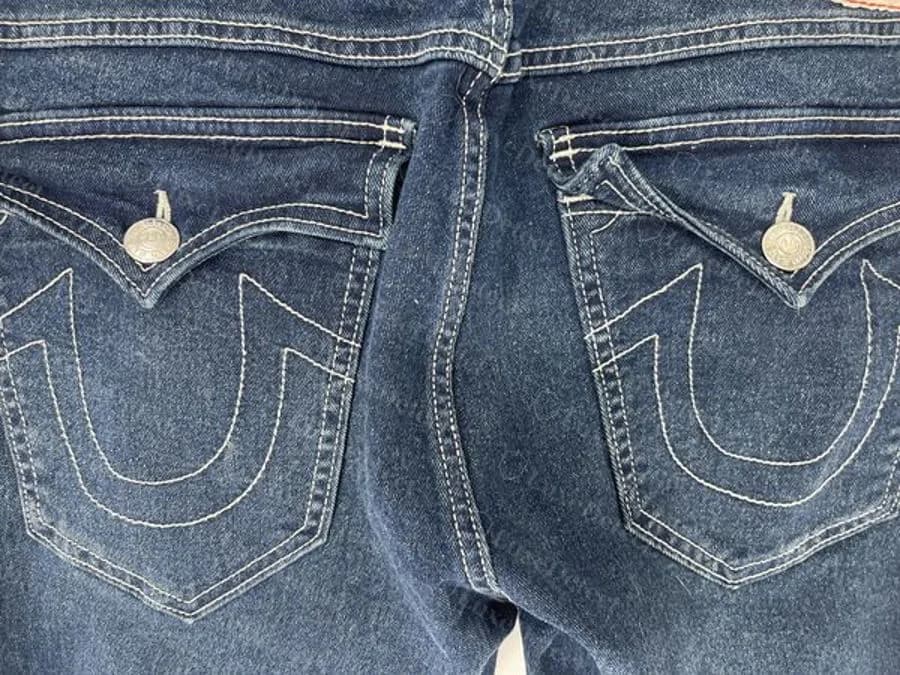
The horseshoe is the brand's signature, stitched in heavy contrast thread on the back pockets. Many styles have a flap with a small button above it, and the horseshoe sits below the flap point. On genuine pairs the two pockets are a matched pair: the horseshoe is the same size on each side and sits in the same place relative to the pocket edges and the flap.
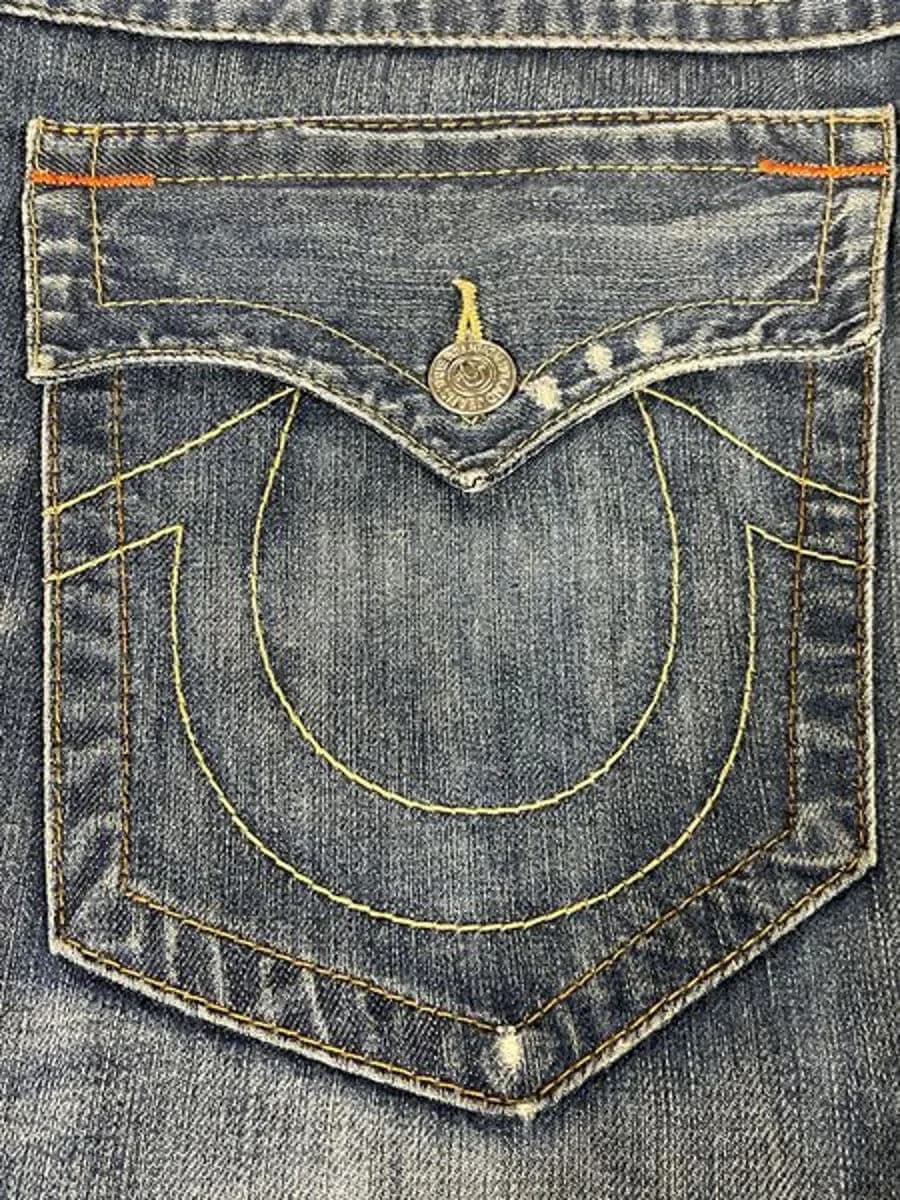
Thread colour is not a test. Genuine pairs in our records have white, cream, yellow, gold and orange stitching depending on the style and wash, and some styles have no flap at all, with the horseshoe stitched directly on a plain pocket. The older pair above has a bright orange bartack at each flap corner; newer pairs use plain stitched corners. Decide what the style should look like first, then compare.
Buttons and the Zipper Pull
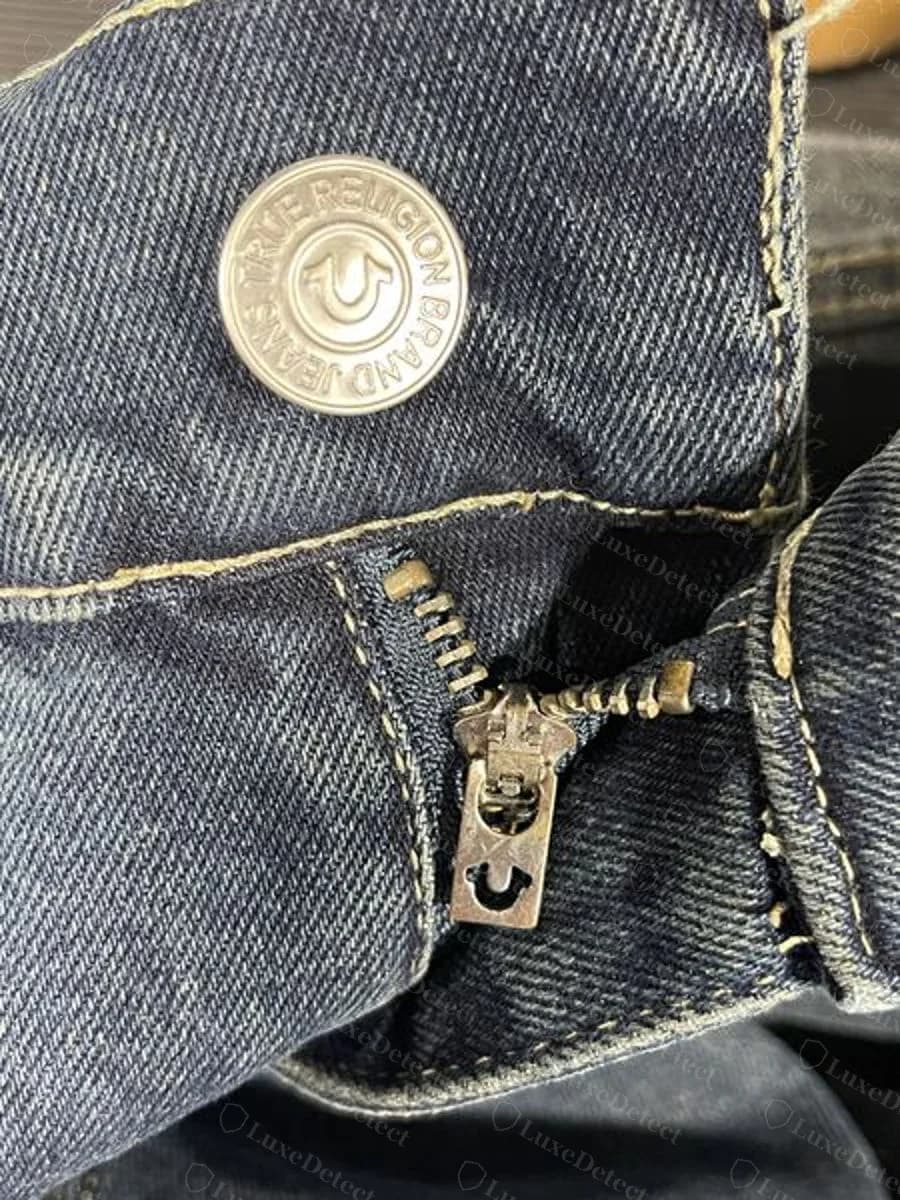
On the genuine pair above, the waist button is engraved with "TRUE RELIGION BRAND JEANS" running around a horseshoe, and the zipper pull has a horseshoe cut out of it. True Religion's own page on telling real from fake jeans points to the same detail: it says the zipper pull should carry the horseshoe, and that the back of the zipper should carry an engraving. We have not tested the engraving ourselves, so treat it as the brand's statement, not a result of ours.
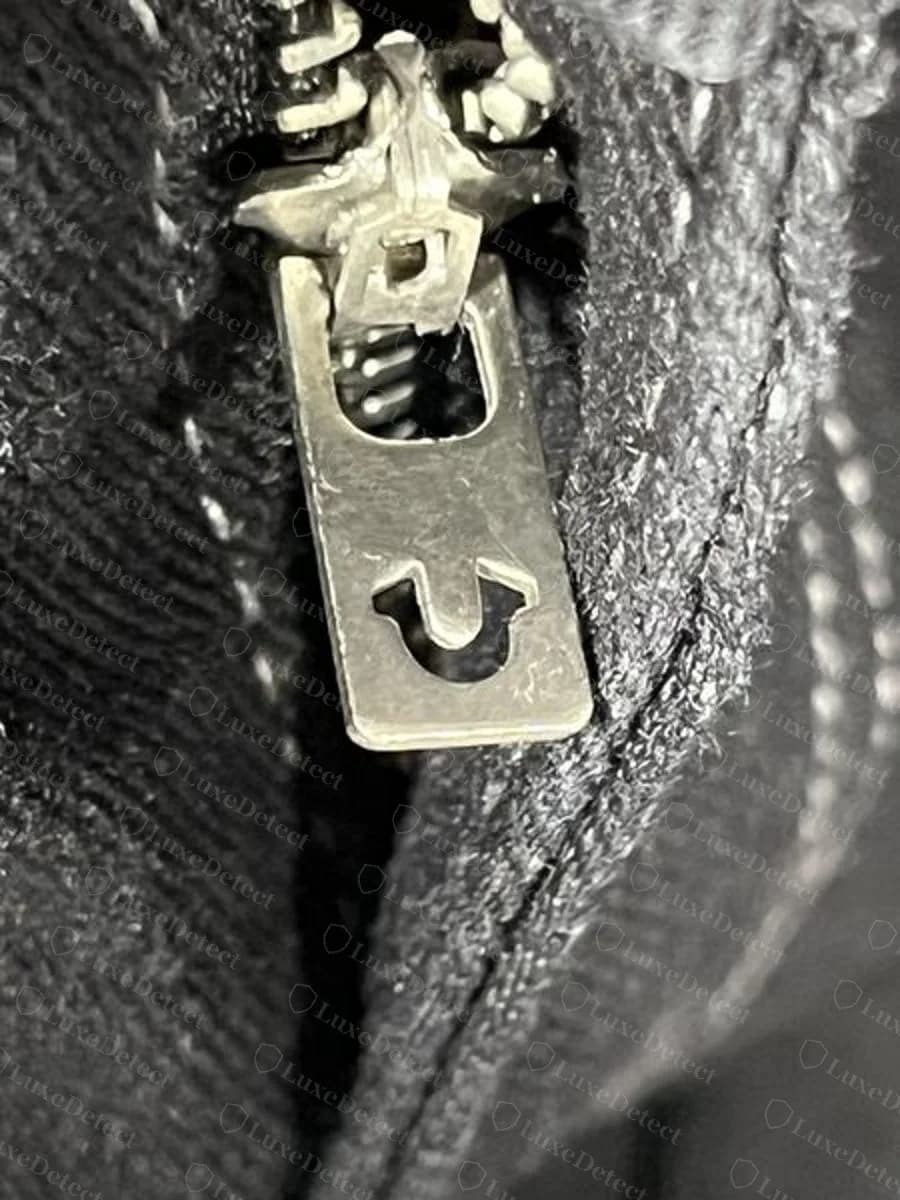
Here is the catch. This pair came from an order whose verdict was counterfeit, and its zipper pull also has a clean horseshoe cut-out. A horseshoe on the pull is what you should expect, but it does not tell you the pair is genuine.
The Buddha Back Patch
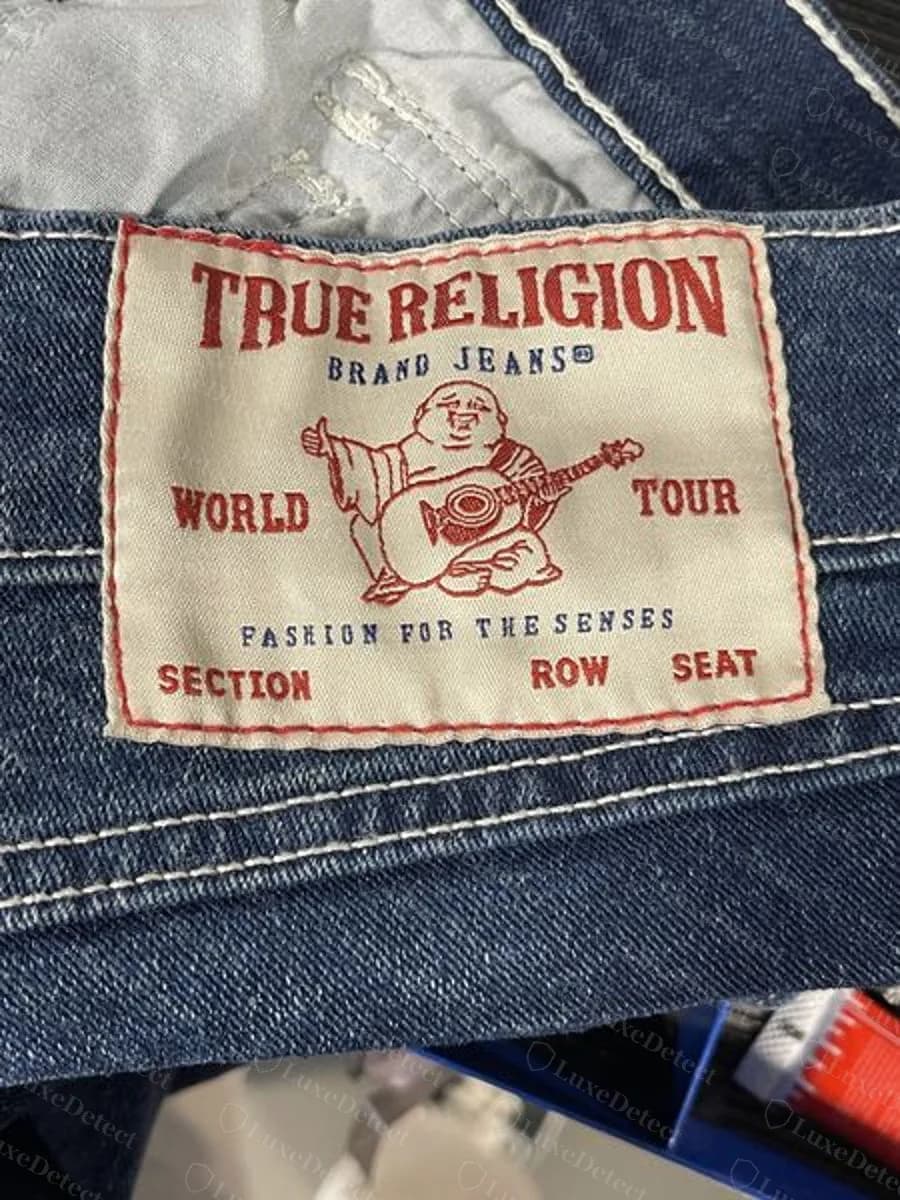
The patch on the back waistband reads "TRUE RELIGION BRAND JEANS", with the seated Buddha and guitar in the middle, "WORLD" and "TOUR" either side and "FASHION FOR THE SENSES" beneath, then "SECTION", "ROW" and "SEAT" along the bottom. On the genuine pair it is cleanly woven with a stitched border. Older pairs carry a slightly different patch, and some older styles print a style name where "ROW" sits (a "BOOT CUT" patch is one example in our records).
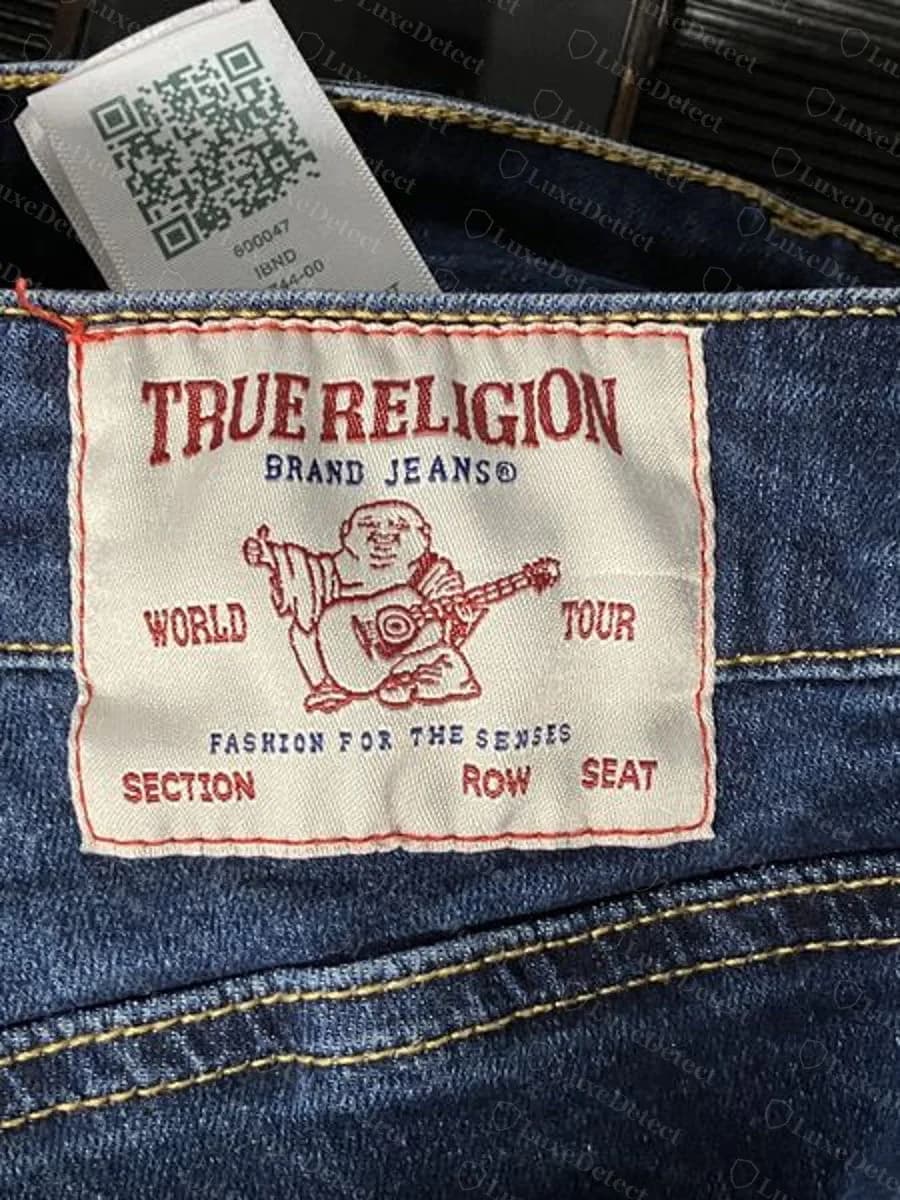
The patch above comes from a pair that was judged counterfeit, and the wording, layout and border look the same as the genuine one. We would not use the patch on its own to clear or condemn a pair. The advice you will see online about the Buddha's hands or ears is aimed at sellers' photos; we could not confirm it from verified pairs, so we do not repeat it as a test.
The Inside Labels: Size Tag, Care Label and QR Tag
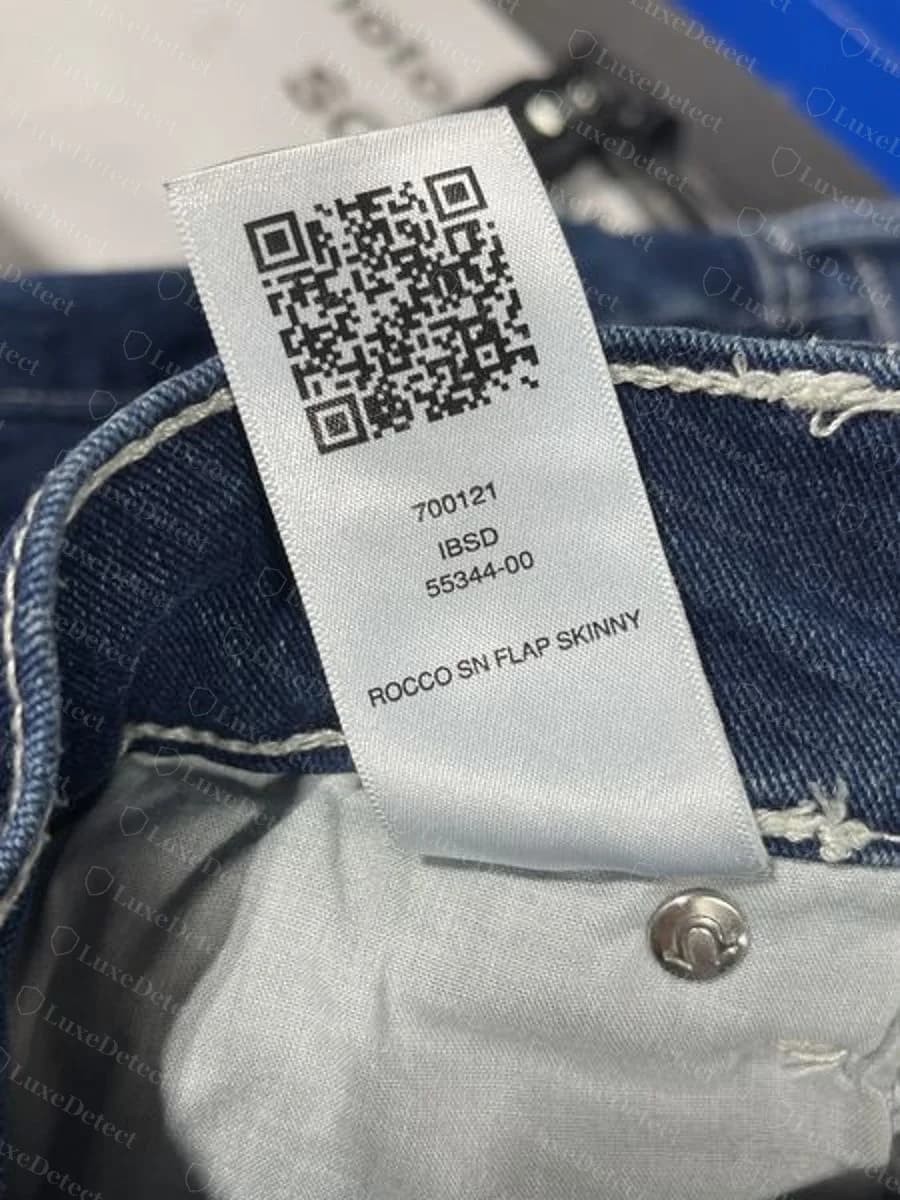
Current genuine pairs in our records carry a stack of labels inside the waistband: a black woven label with the model name (for example "ROCCO Relaxed Skinny" or "GENO Relaxed Slim"), a small black size tag with a horseshoe and a "Made in" line, a printed care label with an RN number and a CA number, and a satin tag with a QR code, a style number and the model name. The tag above is the last of these.
Where the pair was made varies. Genuine pairs in our records are marked made in Bangladesh, China and Mexico, and older pairs carry labels from other eras. A country of origin is not a tell, so do not reject or accept a pair on the "Made in" line. The same goes for the RN and CA numbers: they appear on genuine pairs, and they also appear on pairs that were judged counterfeit, so a matching number proves nothing by itself.
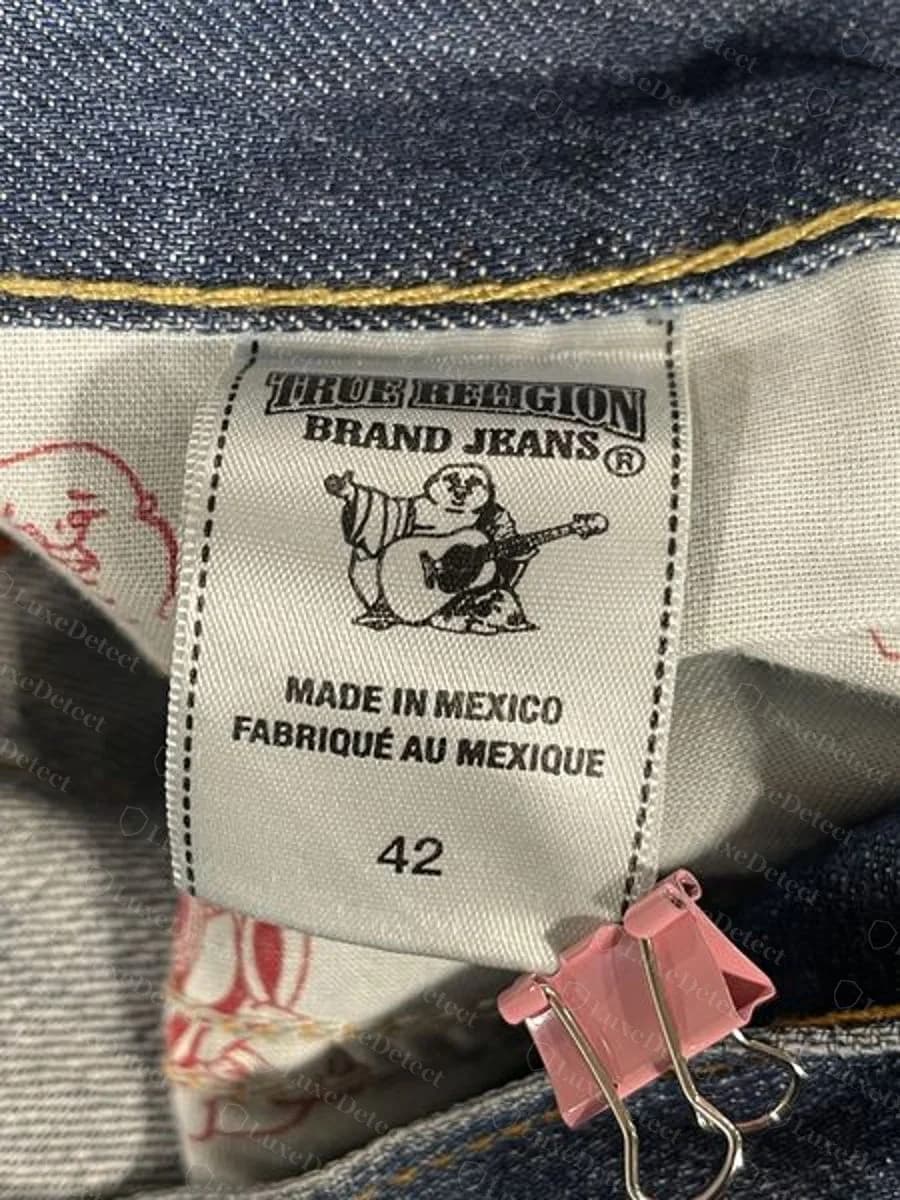
Older genuine pairs use different labels from today's, such as the woven inside label above in English and French. If a pair claims to be from one period but carries labels from another, that is a reason to look harder, but we have not verified it as a rule, so use it as a prompt to ask questions, not as a verdict.
What the Counterfeits in Our Archive Show
Counterfeit-verdict pairs in our archive are not crude. Across the pairs we compared, they carried a Buddha patch, an engraved horseshoe button, a horseshoe zipper pull, a size tag, a care label with RN and CA numbers and a QR tag. A Rocco in the counterfeit pile has the same model label and the same "Made in Bangladesh" size tag as a genuine Rocco. Their marks look right, so the marks alone do not separate them from genuine pairs.
We say this without claiming to know what gave each pair away. A verdict can come from the way several details fit together, or from something we did not photograph, and the label on an order does not tell us which. That is why the most useful things on this page are the reference photos above and the habit of comparing a pair against a verified pair of the same style and wash.
What a Matching Mark Does and Does Not Prove
A matching mark means the pair has not failed that one check. It does not mean the pair is genuine, because fakes copy the Buddha patch, the horseshoe button and zipper pull, the labels and the RN and CA numbers. Weight, hand feel and how the denim washes and wears are checks you make with the pair in your hands, and they matter more than any single label.
What does the work is how everything fits together: whether the labels belong to the same era, whether the stitching density and horseshoe shape match a genuine pair of the same style, whether the hardware, flap and pocket construction are consistent, and whether the price and the seller make sense. True Religion is sold in many places, including outlets and resale, so a low price is not a verdict either way, but a very low price on a current style is a reason to slow down.
When you ask a seller for photos, ask for the back patch, both back pockets straight on, the waist button and the zipper pull, and every inside label, including the care label and the QR tag, in daylight.
When to Get a Professional Opinion
If the pair matches this guide and the money matters, a second opinion costs less than a wrong pair. LuxeDetect authenticates clothing with a 24-hour turnaround starting at $15, a verdict from a specialist and a Certificate of Authenticity. Send clear photos of the back patch, both pockets, the button and zipper, and all the inside labels. If you are comparing other denim brands too, our guides to 7 For All Mankind jeans, Amiri MX1 jeans and DSQUARED2 jeans cover how those labels work.
A code that checks out doesn't prove the item is real. Counterfeiters copy genuine codes.
Our authenticators check the labels, stitching and fabric of your True Religion against verified references, from $15. You get a verdict within 24 hours, and a Certificate of Authenticity if the item passes.
Authenticate My True Religion →FAQ
How can I tell if my True Religion jeans are real?
Start with the style: identify the model and wash, then compare the back patch, horseshoe stitching, button, zipper pull and inside labels with genuine pairs of that style. No single mark settles it, because counterfeits copy them. If the pair is valuable, a specialist review of clear photos is the safer route.
Is there a True Religion serial number or authenticity code?
Not in the way a handbag has one. Current pairs carry a QR tag with a style number and a care label with RN and CA numbers, and counterfeit-verdict pairs in our archive carry the same kinds of tags. Treat those numbers as a way to check a listing against the model, not as proof.
Does Made in China or Made in Bangladesh mean fake?
No. Genuine pairs in our records are marked made in Bangladesh, China and Mexico, and older pairs carry labels from other eras. The country alone is never a reason to reject a pair.
Should the zipper pull have a horseshoe?
True Religion's own page says so, and the genuine pair in this guide has it. But a pair judged counterfeit also had a clean horseshoe pull, so it is an expected feature, not a test that clears a pair.
Do real True Religion jeans always have the same stitching colour?
No. Genuine pairs show white, cream, yellow, gold and orange thread depending on the style and wash, and some styles have no flap. Judge the shape and spacing of the stitching against the same style, not the colour.
Can I authenticate True Religion jeans from photos alone?
Yes. What decides it is how the back patch, hardware, labels, stitching and construction fit together, compared with verified pairs of the same style. Send clear photos of the back patch, both pockets, the button, the zipper pull and every inside label. For a pair that cost real money, a specialist review is the safer route.
Is a low price a sign of a fake True Religion?
Not on its own. The brand sells at outlets and in sales, and genuine pairs resell for far less than new, but a very low price on a current style from an unknown seller deserves a closer look at every label and photo.
Sources
True Religion, "Real vs fake True Religion jeans" (truereligion.com brand page, opened November 2026), for the horseshoe zipper pull and the zipper-back engraving. Genuine and counterfeit-verdict reference photos are from LuxeDetect's own order records.