Luxury Fashion Authentication Specialist
Handbag authentication specialist. Has reviewed submissions across Hermès, Chanel, Louis Vuitton, and Dior since 2019.
Last updated September 2026 · Published May 2026 · Contact
Why Moncler Is One of the Most Faked Jackets in the World
A genuine Moncler Maya retails around £975 in the UK; a Moncler Grenoble technical jacket reaches £1,800–£3,000. The combination of recognizable aesthetic, premium price, and enormous global demand has made Moncler one of the top five most counterfeited outerwear brands in the world. Production quality on fakes has improved substantially since 2020, with some "super fakes" now replicating the arm badge accurately enough to fool casual inspection. Stone Island faces a similar counterfeiting problem in technical outerwear; see our Stone Island real vs fake guide for that brand's own badge and label checks.
The authentic Moncler is built around genuine down fill, premium technical construction, and consistent quality across dozens of small details. This guide covers every check professionals run, from the arm badge to the sewn-in authenticity code label.
What to check, ranked by reliability
| Checkpoint | Reliability | What it tells you |
|---|---|---|
| 1. The Arm Badge — The Single Most Important Check | ★★★★★ | Cockerel orientation, feather separation, and embroidery pile are the hardest details to replicate and, if any one fails, decisive on their own. |
| 2. The Interior Labels — Multiple Checks | ★★★★★ | A chip label that disagrees with the care label is a strong tell; a code that scans proves little, since real codes are cloned onto fakes. |
| 3. Zipper Authentication | ★★★★★ | An unbranded or poorly struck slider mark is a useful tell, but Moncler uses several legitimate suppliers so brand alone is not enough. |
| 4. Construction Quality | ★★★★★ | Uneven channel spacing and unfinished seams are real tells but are hard to judge from photos and reward in-hand inspection. |
| 5. The Moncler Genius and Collaboration Lines | ★★★★★ | Only relevant to collaboration pieces, and a strong collaborating-brand execution alongside weak Moncler branding is the pattern to catch. |
The Arm Badge — The Single Most Important Check
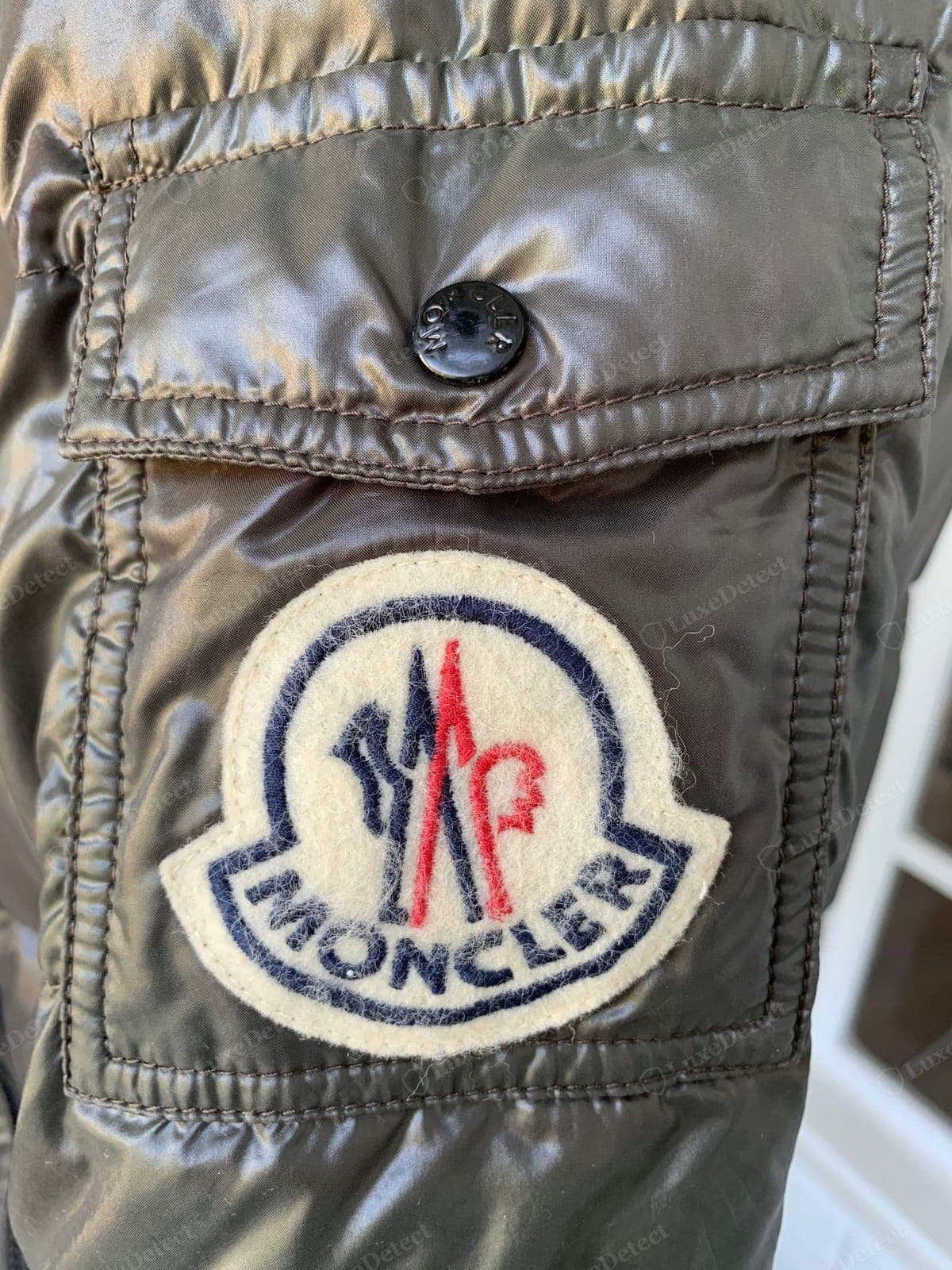
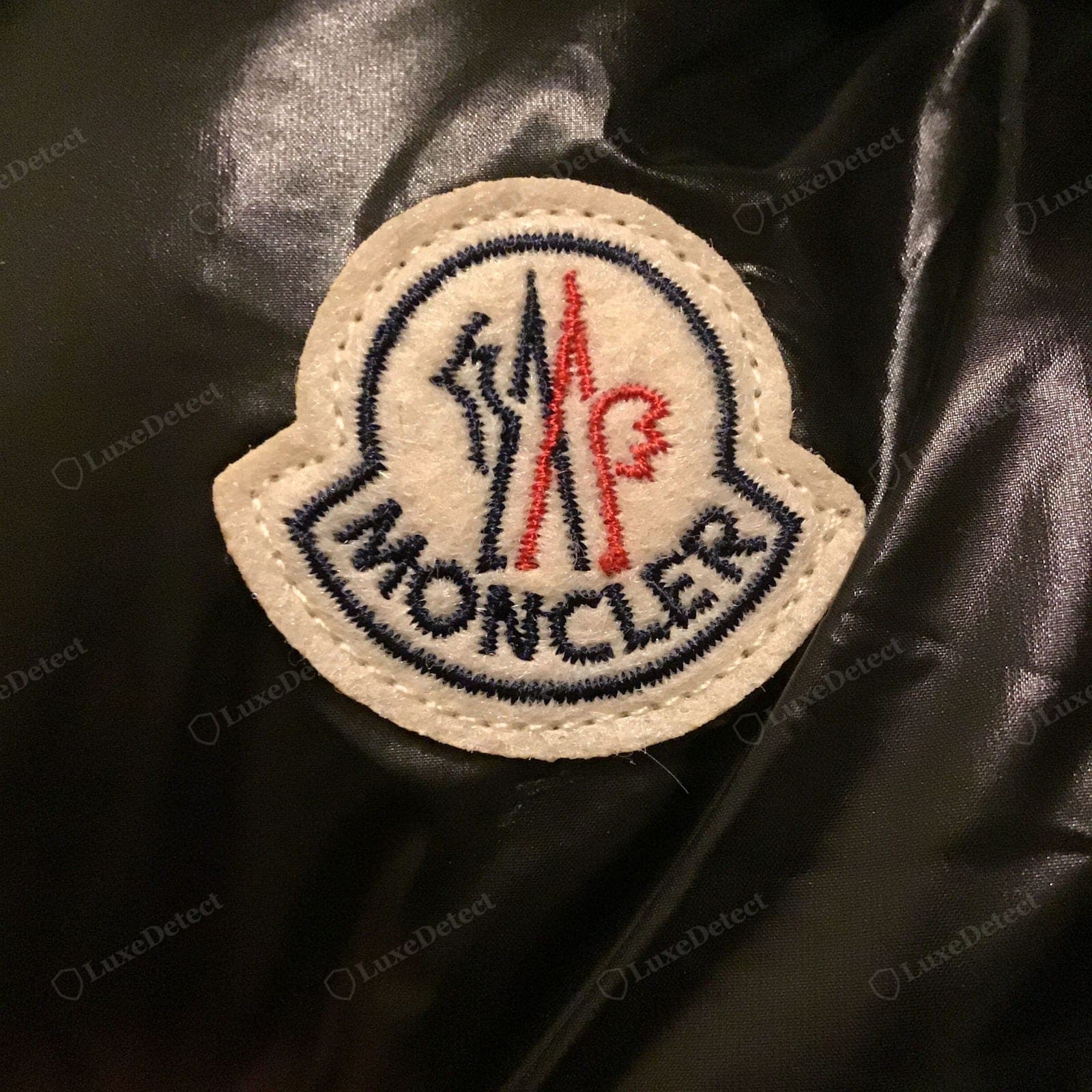
The embroidered arm badge on the left sleeve is Moncler's most recognizable brand element and the primary focus of counterfeiters. It needs to pass every sub-check.
The Cockerel (Rooster) Logo
The Moncler badge features a stylized cockerel — the Grenoble town cockerel that has been part of the brand identity since its 1952 founding. This specific graphic is the hardest detail to replicate correctly:
- Stance: The cockerel stands with its chest prominent and head slightly raised. It faces right (viewer's left) consistently on all genuine badges. Any badge where the cockerel faces left is a fake.
- Tail feathers: The tail feathers on a genuine badge form a specific fan shape with clearly defined individual feathers. Fakes frequently run the feathers together into an undifferentiated mass.
- Legs: The legs are clearly defined and proportionate — not too thin, not stubby. Fakes often have legs that look slightly malformed.
- Comb and wattles: The comb (the red crest on the head) has a defined scalloped edge. Many fakes render it as a smooth shape.
On the badge itself, the embroidery should have clean, tight stitching with a slight raised pile that you can feel. Run your thumb across the cockerel — individual embroidered elements should feel distinct.
Badge Text
The text "MONCLER" curves below the cockerel on the badge in a specific arc. Check:
- Font: The typeface used is a wide-tracked, slightly condensed sans-serif. All seven letters should be the same height and weight.
- Kerning: The spacing between letters is even. On fakes, the spacing often varies letter-by-letter, most visibly around the "M" and "C."
- Arc: The text follows a smooth upward curve. On fakes, the arc is often too steep or too flat, and individual letters sometimes tilt rather than following the curve cleanly.
Badge Background Color
The standard Moncler arm badge has a navy blue background. Some seasonal and collaboration pieces use different colors — but the navy badge is the standard and the one most commonly faked incorrectly:
- The navy should be a deep, cool blue — not black, not purple-navy, not bright royal blue.
- The background should be completely flat with no texture variation across the surface.
- Thread color on the cockerel and lettering should be bright white, clean and consistent.
Badge Border and Attachment
The badge has a border — usually white or yellow depending on season — that runs around its full circumference. On genuine badges:
- The border is stitched with a consistent 2mm width all the way around, with no widening at corners.
- The badge is attached to the sleeve with a topstitch running immediately inside the border — you should see the attachment stitching as a clean line inside the border thread.
- No fraying at the edges. The badge should look finished, not raw.
Red flag
A cockerel facing the wrong direction, tail feathers merged into a blob instead of distinct fanned strokes, or embroidery so flat you can't feel individual stitches under a thumb are the three sub-checks that most reliably separate a genuine badge from a replica — a badge that fails any one of them is enough on its own to reject the piece.
The Interior Labels — Multiple Checks
Genuine Moncler garments have several interior labels. Check each one.
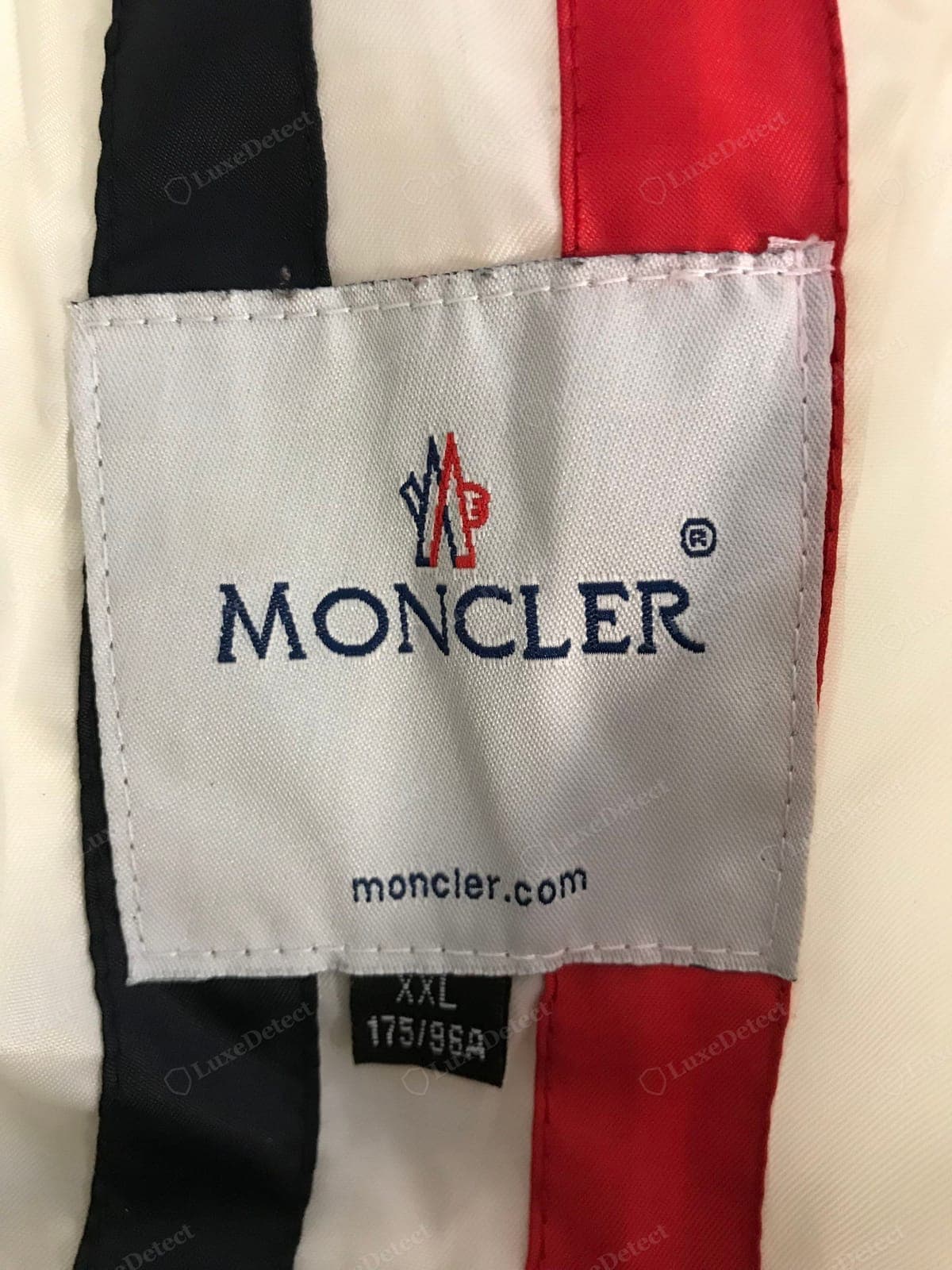
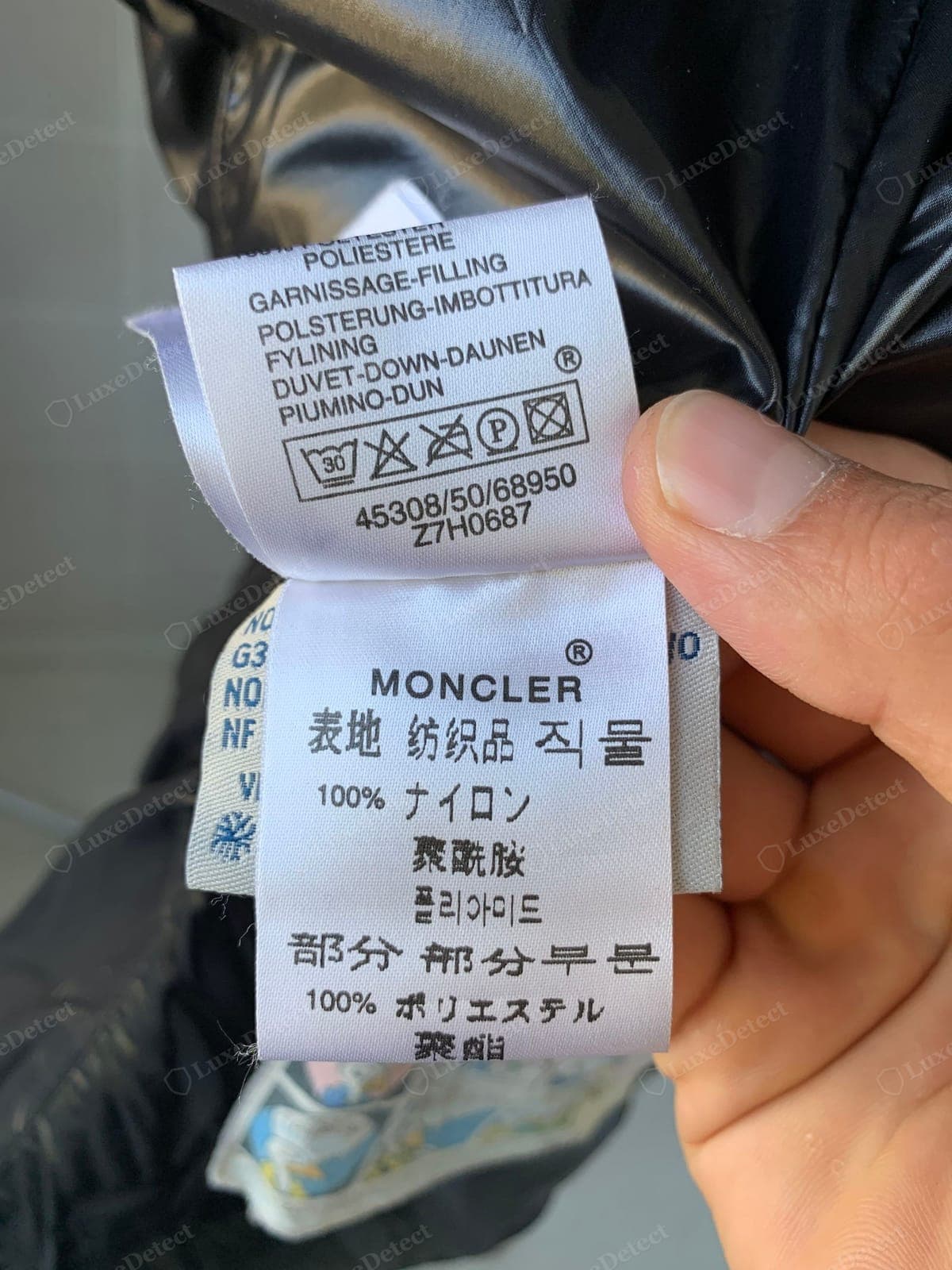
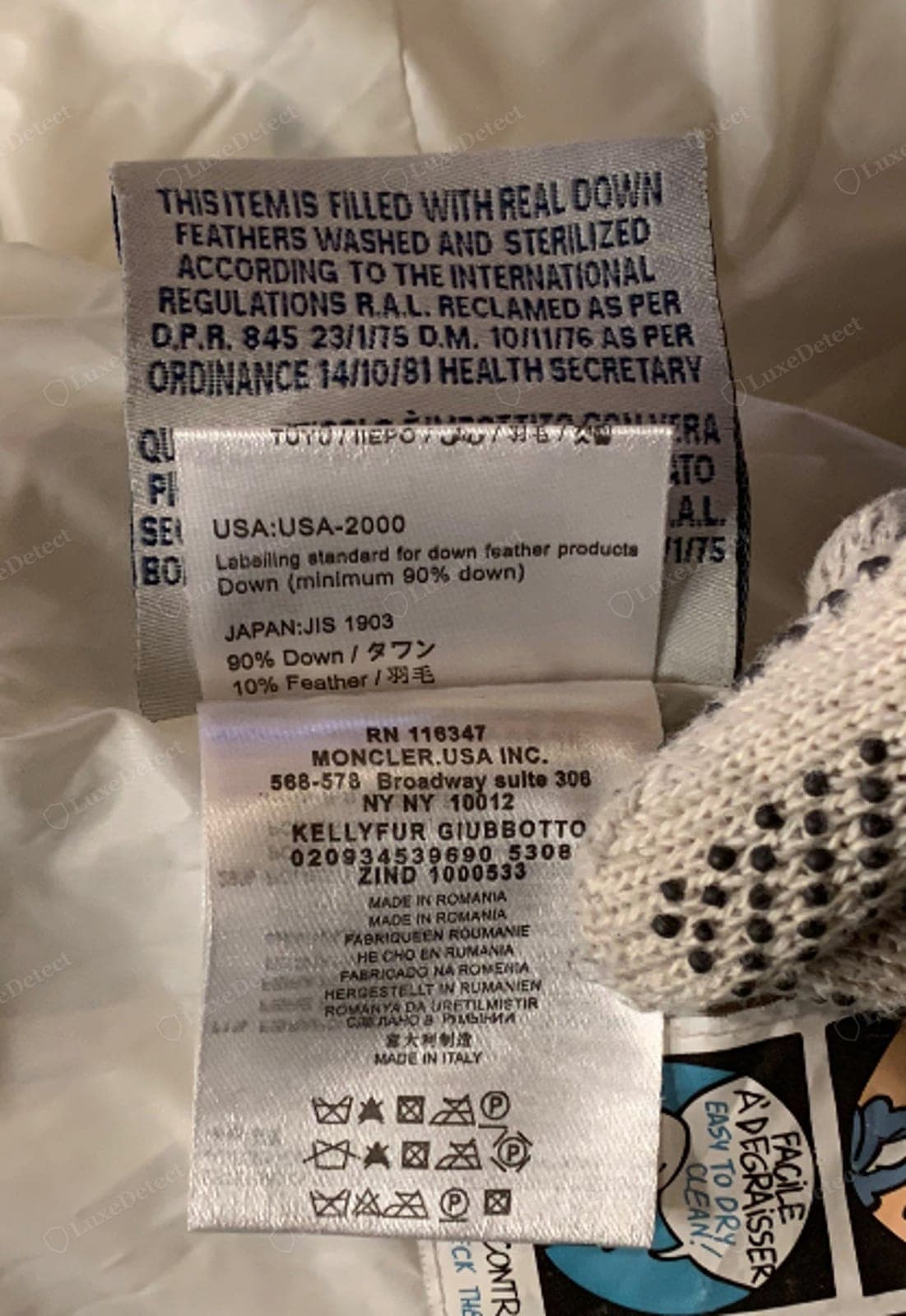
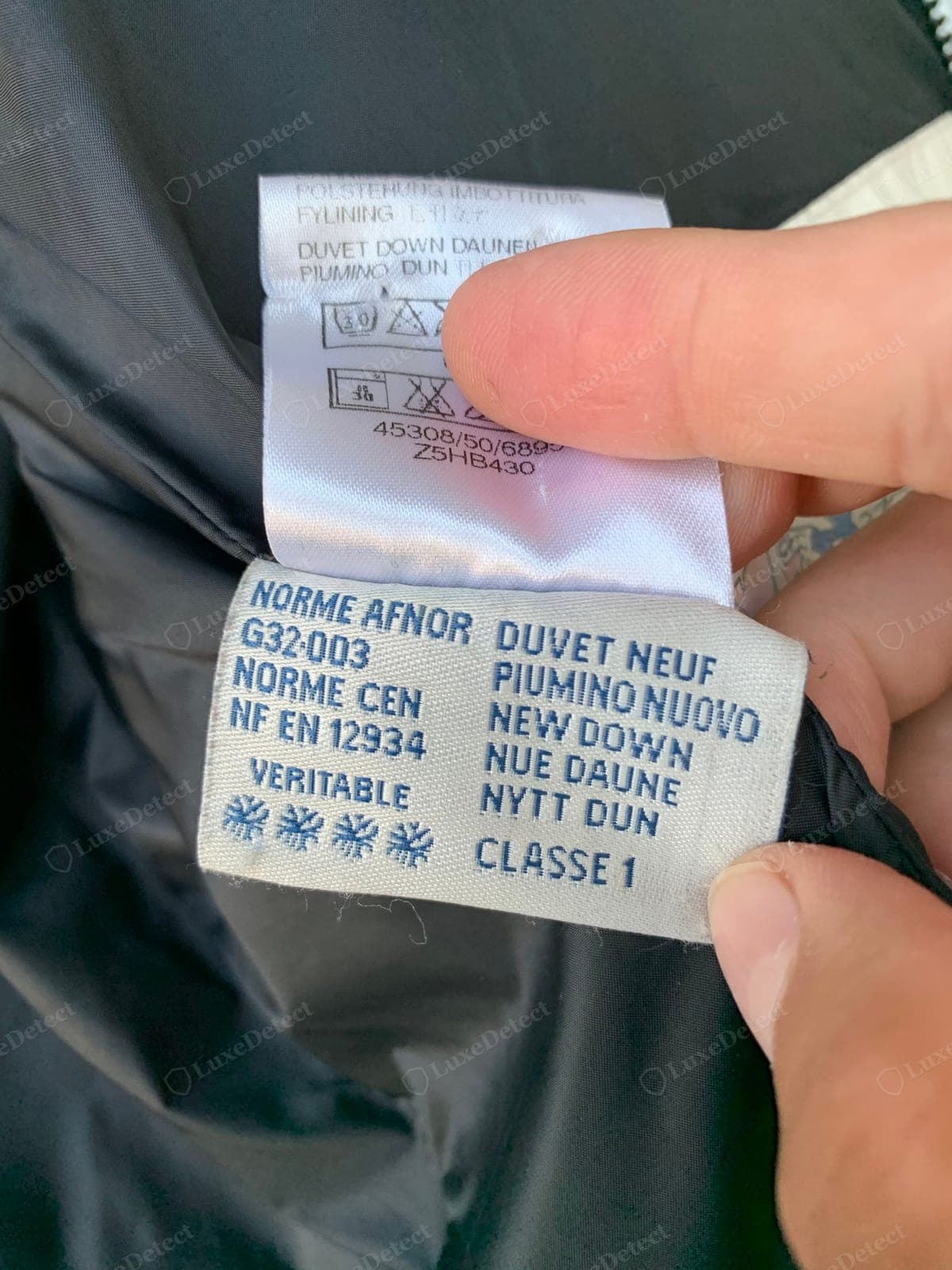
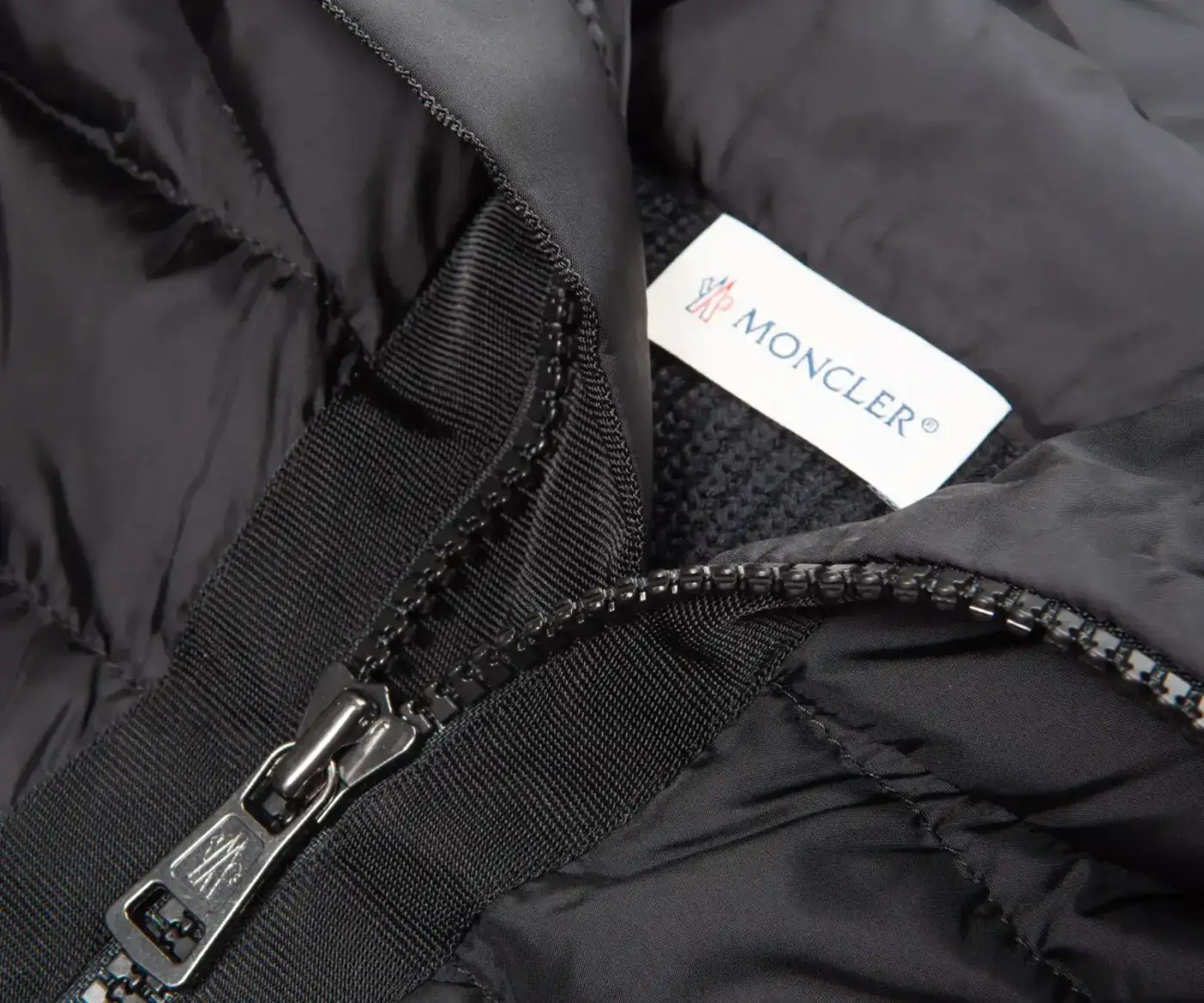
Main Brand Label
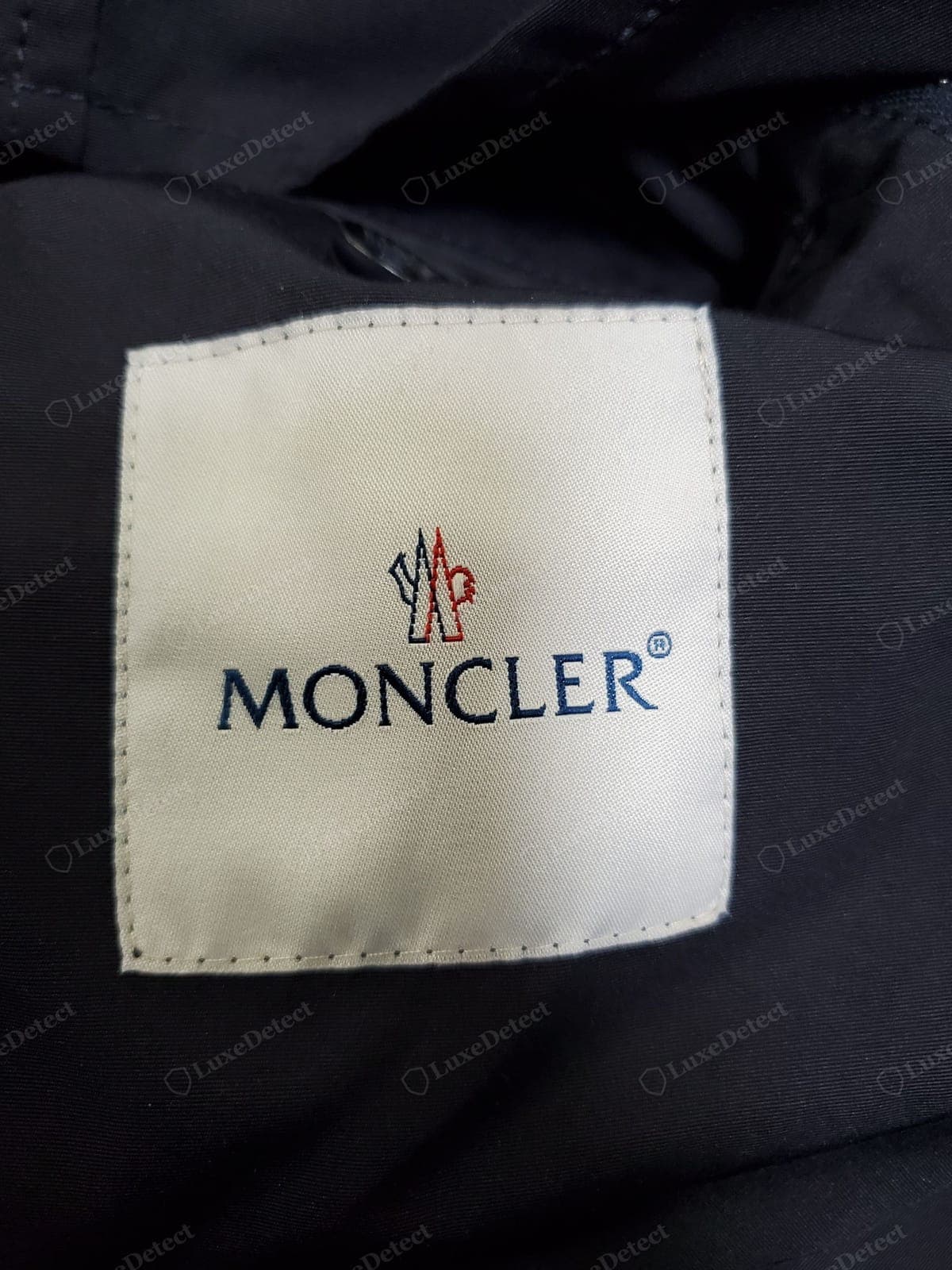
Sewn at the back of the neck, this label carries the "MONCLER" brand name. The country of manufacture is on the care label, not here.
- Country of manufacture: Romania is common, but genuine Moncler in our archive is also made in Italy, Hungary, Turkey, Georgia, Bulgaria and Armenia. Country on its own is not a tell.
- Label font: The Moncler logotype on all labels uses the same typeface as the badge. Weave quality should be tight — text is embedded in the fabric, not printed.
- Stitching: The label should be attached with stitching that runs completely around the label perimeter with a consistent seam allowance.
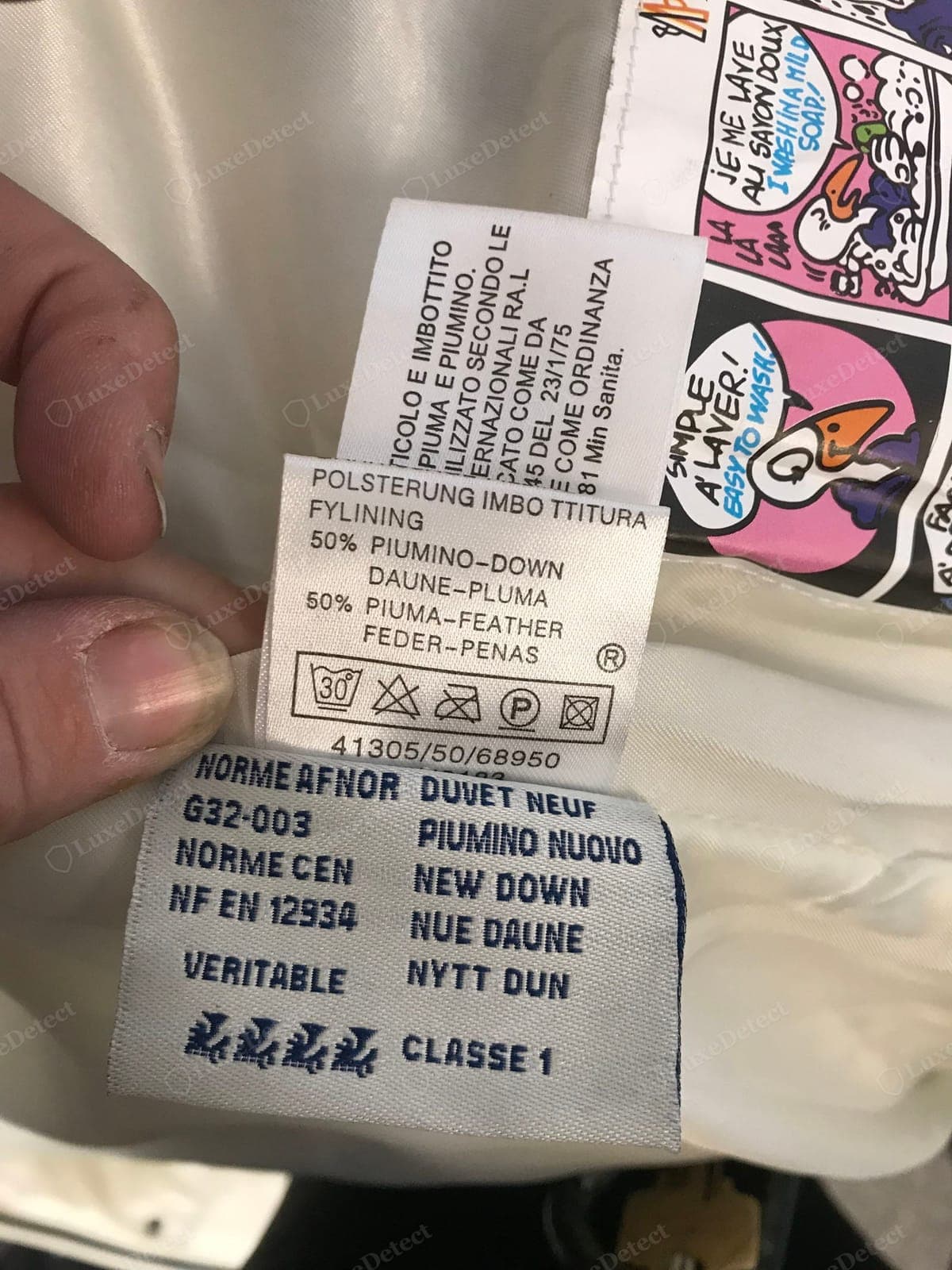
Size and Composition Label
This label gives size (numeric sizing from 00 to 7 on outerwear; letter sizes on some knit and jersey), fabric and fill composition, and the style code. Genuine labels:
- List both the outer fabric composition (typically 100% nylon or specific technical fabrics) and the fill composition (typically "Piuma d'oca 90%... Piuma 10%" — Italian for "goose down 90%, feather 10%").
- Use standard ISO care symbols in the correct sequence: washing, bleaching, tumble drying, ironing, dry cleaning. Any non-standard symbols or an unusual order is a flag.
- Have clean, legible text at a consistent print/weave quality.
| Element | Authentic | Counterfeit |
|---|---|---|
| Fill composition wording | Lists both fabric and fill composition (e.g. "Piuma d'oca 90%... Piuma 10%") | Missing, incomplete, or implausible composition |
| Care symbols | Standard ISO sequence: washing, bleaching, tumble drying, ironing, dry cleaning | Non-standard symbols or unusual order |
| Text/weave quality | Clean, legible, consistent print or weave | Blurry print, uneven weave density |
The Authenticity Code Label
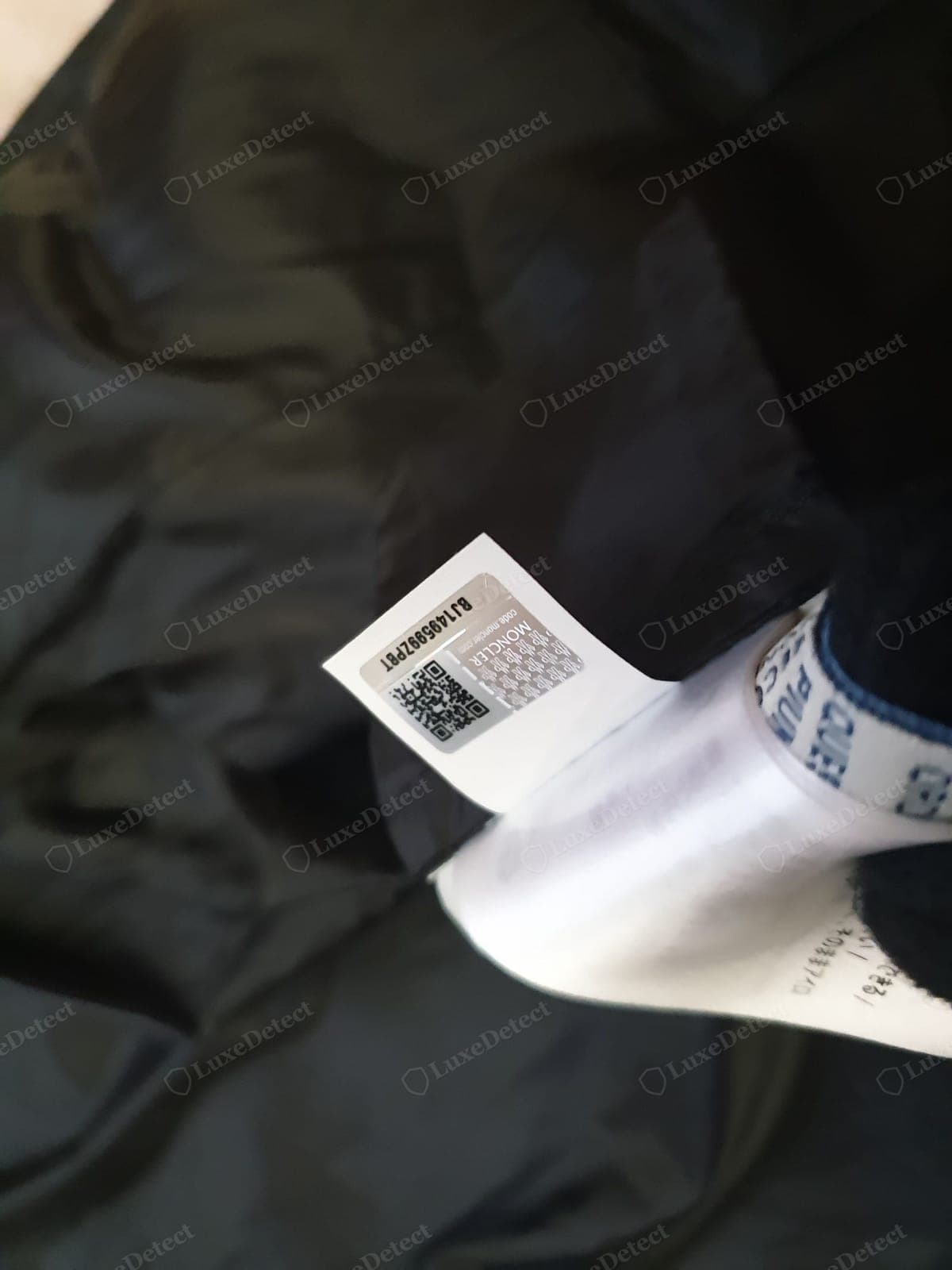
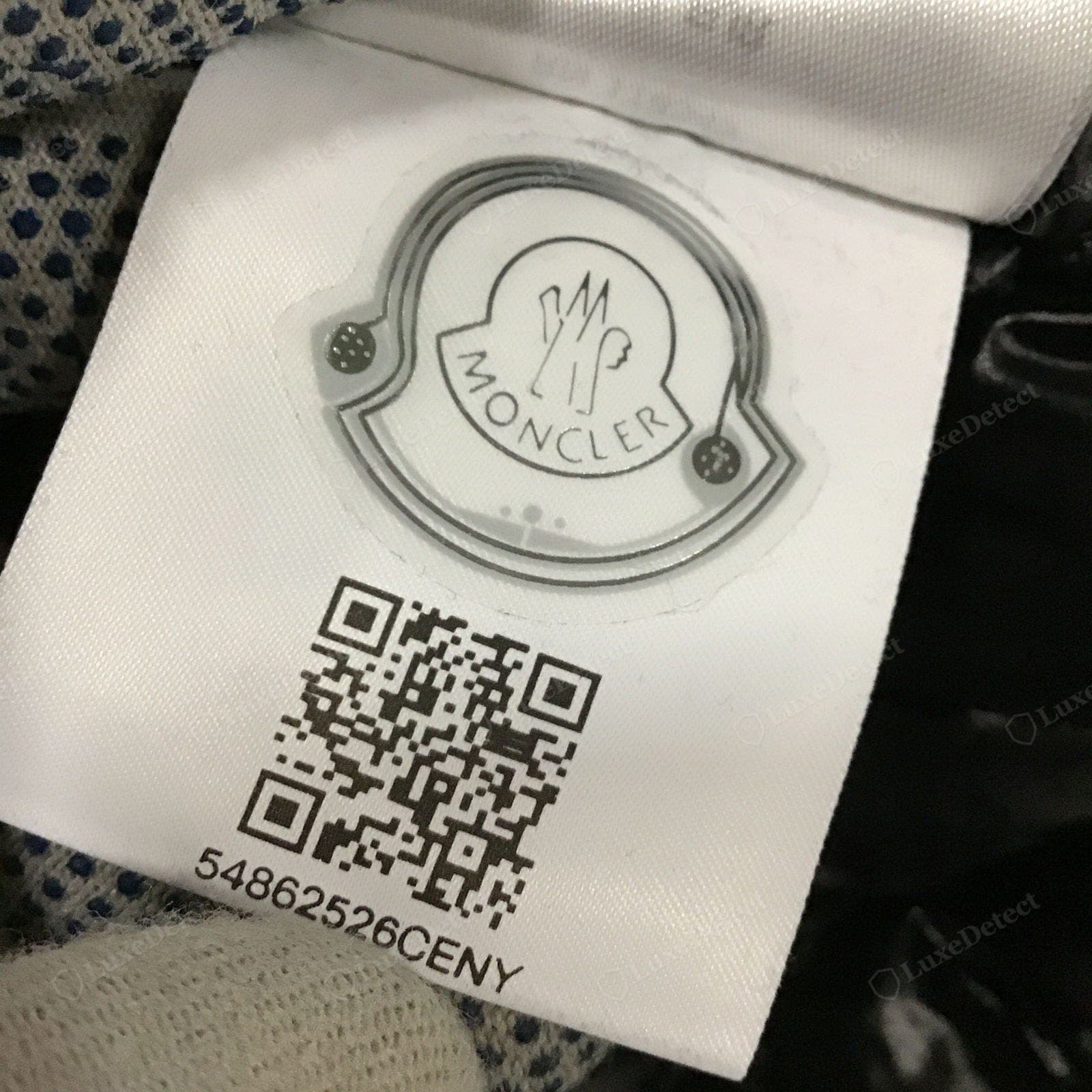
Moncler's authenticity code is on a label sewn inside the garment, not on a card. Its form depends on the era:
| Era | Label | Code format |
|---|---|---|
| 2008–2012 | Certilogo woven tag ("CHECK NOW / certilogo.com") | 12 digits in groups of three |
| About 2013–2015 | Holographic sticker label with a QR code and "code.moncler.com" | "B" + a letter + 6 digits + 4 letters |
| 2016 onward | Moncler logo tag with an RFID/NFC chip and QR code, plus a reverse label | 8 digits + 4 letters |
What to check:
- A garment from 2008 or later should have one of these labels. A missing sewn-in code label is a warning sign.
- On 2016+ pieces, the reverse of the chip label repeats the code and lists the style code ("Modello"), colour and size, plus a production line such as "SCOM 2018 2643". These should match the care label: the same style code, and the same category and year as the care label's production code (for example C-SCOM-18-2643). In our archive, about 4 in 10 counterfeits failed this cross-check, and no genuine piece did.
- The style code on the care label also dates the garment: in codes like G20931A00109, the first letter is the season year (F = 2020, G = 2021, H = 2022, I = 2023, J = 2024, K = 2025), and the production year on the care label should be that year or the year before.
- The only card in the jacket is a hang tag explaining how to check the code by NFC, QR or manual entry.
The Down Fill Label
Moncler uses certified, traceable goose down. Canada Goose relies on comparably strict down certification, covered in our Canada Goose Expedition Parka guide. The down composition label (separate from the main care label) should specify:
- Fill composition: percentage of down vs. feather (genuine is typically 90/10 down/feather)
- Moncler's own DIST down-traceability mark (dist.moncler.com), which appears on genuine labels
Fakes frequently use polyester fill or low-grade duck down. If you compress a genuine Moncler jacket sleeve firmly and release, the down should spring back within 2–3 seconds due to loft. Polyester fill springs back faster but with less volume; low-grade down springs back slowly.
Worth knowing
A code that checks out on code.moncler.com proves only that the code exists, not that it belongs to the garment in front of you. Counterfeiters clone real codes and program NFC chips: in our archive, one code (16468873IIKN) appears on several different fakes, and none of the fake codes we read failed a format check. Matching the chip label to the care label is more useful than the code itself. Always pair it with the physical checks above.
Zipper Authentication
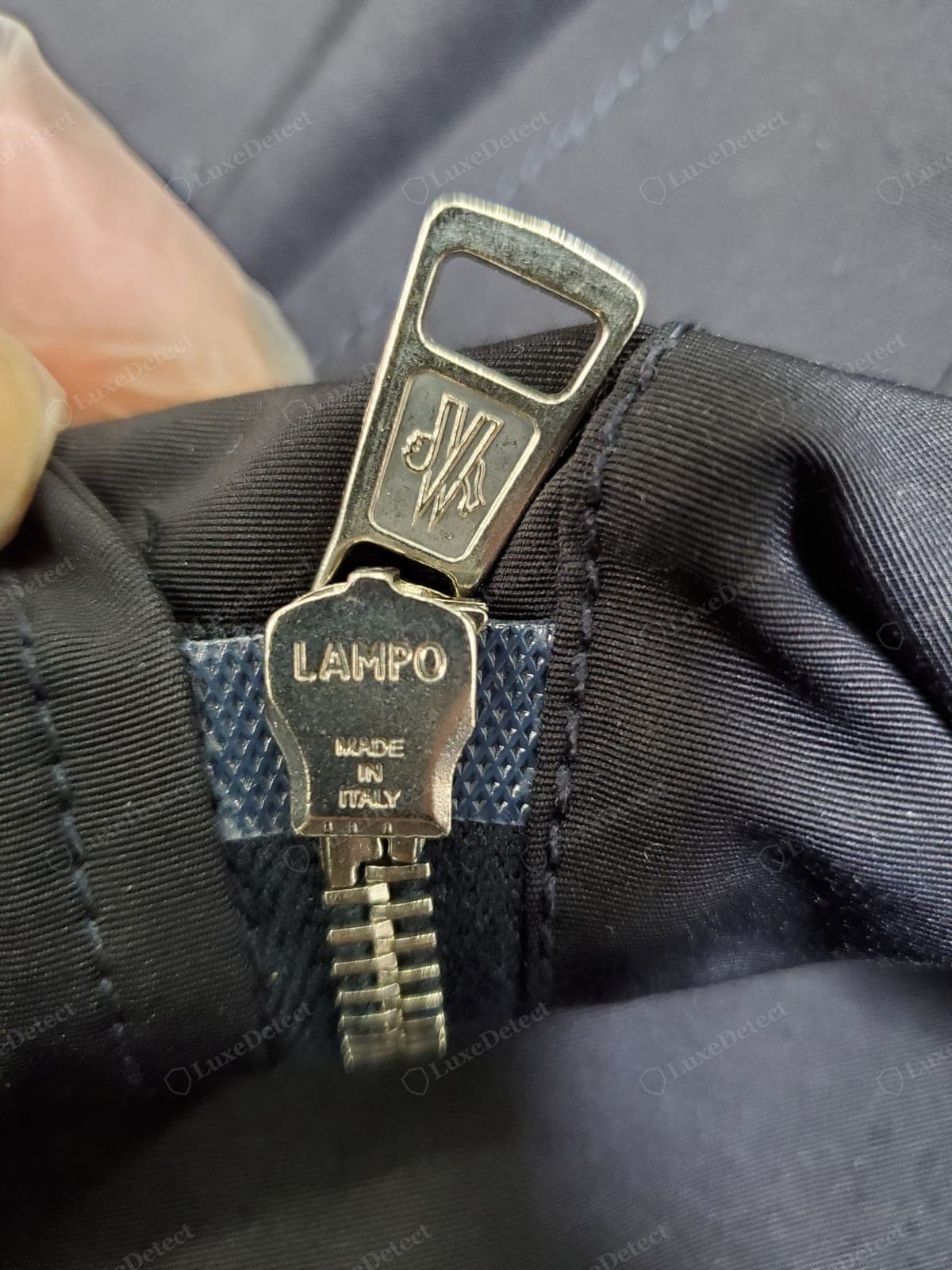
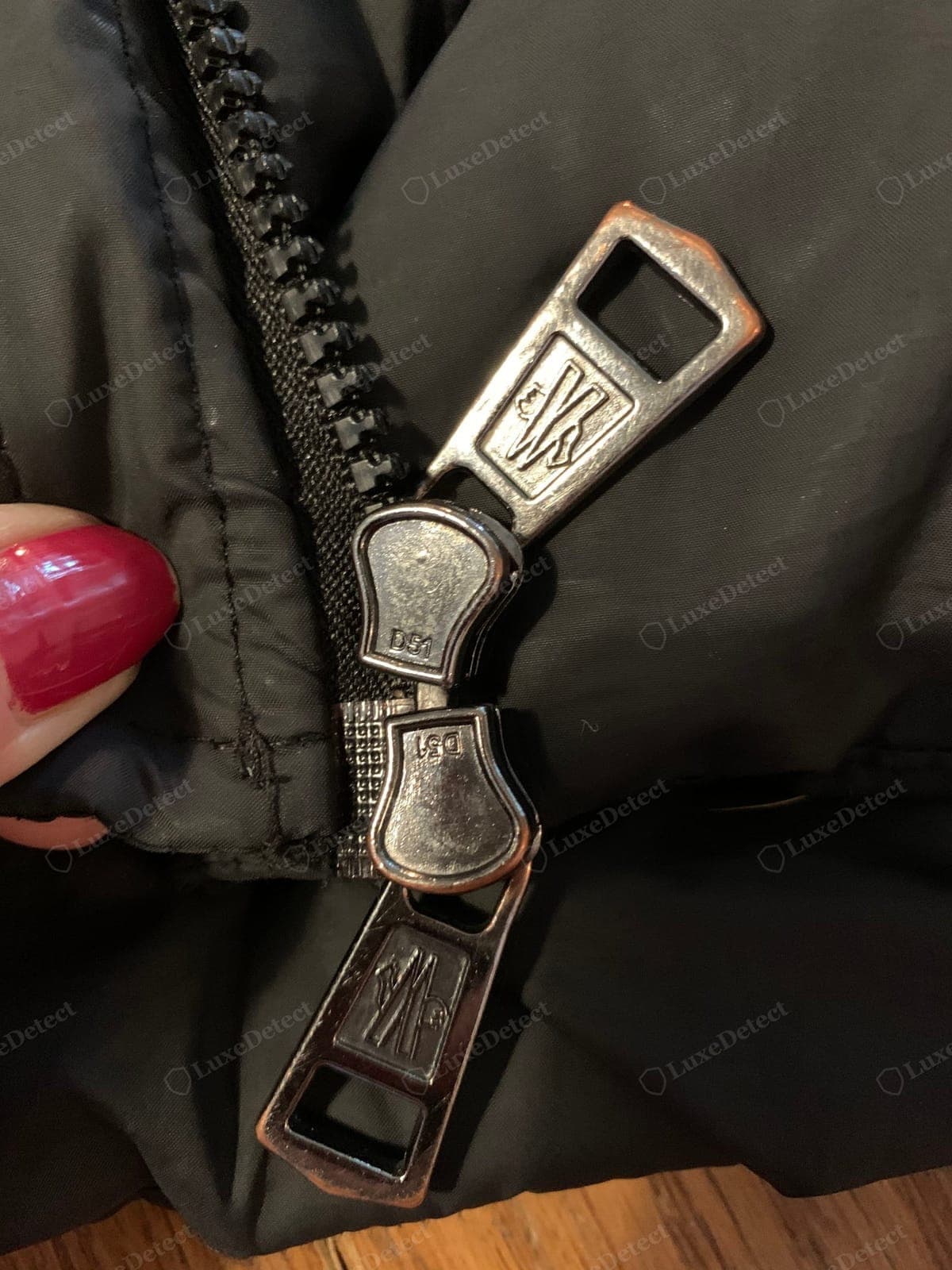
Moncler uses YKK zippers on the vast majority of pieces, with custom Moncler-branded zippers on premium models. Arc'teryx takes a comparably zipper-and-tape-focused approach to authentication on its technical shells; see our Arc'teryx guide for the parallel checks there.
Main Front Zipper
- YKK branding: The puller and zipper tape should bear YKK branding. Fakes use unbranded zippers that look similar but lack the YKK stamp.
- Pull mechanism: The main zip puller on genuine Moncler is a triangular ring with the Moncler cord or rubberized pull. The metal is heavy gauge — grip the puller firmly and it should not flex. Fakes use lighter-gauge metal that flexes.
- Zipper operation: Should be smooth with consistent resistance throughout its travel. A zipper that catches, jumps, or requires force is a factory-quality indicator.
Pocket Zippers
All zippers on the garment — hand pockets, internal pockets, sleeve vents — should be the same quality as the main zip. Fakes often spend effort on the main zipper but use lower-grade hardware on secondary openings.
Worth knowing
Genuine Moncler pieces use several legitimate zipper suppliers, not YKK exclusively — Lampo and riri both appear on authentic garments, so any one of those marks is fine. What's decisive is an unbranded slider or an indistinct, poorly struck mark where a genuine one is always crisp.
Construction Quality
Down Channel Stitching
Moncler down jackets use quilted channels to keep the down fill evenly distributed. Check:
- Channel uniformity: All channels should be parallel, evenly spaced, and consistent in width. On genuine pieces, channel spacing is precise — a ruler placed across the jacket would show channels hitting at regular intervals.
- Stitch density: Approximately 7–9 stitches per centimeter along the quilting seams. Fakes run lighter, producing channels that are more easily damaged.
- Channel fullness: Each channel should be uniformly full — no flattened sections. Squeeze each channel across its width. It should offer consistent resistance.
Seam Finishing
Turn the jacket inside out or look into the interior through a pocket:
- Main seams are finished with a specific bound seam or taped seam technique depending on the model. The seam allowance should be even and consistent.
- Moncler uses heat-taped internal seams on many models to prevent cold spots and moisture ingress — look for a thin polyurethane tape line running along the seam interior.
- Fake seams are often straight-stitched with unfinished edges — the fabric will begin to fray at the raw edge over time.
Hood and Collar Construction
On models with a down-filled hood:
- The hood channels should match the body channels exactly in width and stitch density.
- The fur trim (on models that have it) on genuine Moncler uses raccoon or coyote fur with consistent density. Fakes use synthetic fur that lacks the directional grain of genuine fur.
- The drawcord should run through a channel, not be attached with exposed loops.
Worth knowing
Uneven channel spacing or flattened sections are consistent with a fake, but stitch density and channel fullness are hard to judge from listing photos alone — this check earns the most confidence in hand, less so from a screen.
The Moncler Genius and Collaboration Lines
Moncler's Genius and collaboration pieces (with designers like Rick Owens, Valentino, Fragment) have their own additional authentication markers:
- Genius label: In addition to the standard Moncler labels, Genius pieces have a secondary label identifying the Genius number (1 Moncler JW Anderson, 2 Moncler 1952, etc.) in the same font and quality standard as the main label.
- Collaboration branding: On genuine collaborations, the collaborating brand's elements (logos, labels, hardware) should be at the same quality level as the Moncler elements. Fakes typically execute the Moncler branding well but drop quality on the collaborating brand's elements.
- Certification documentation: High-end Genius pieces include specific documentation — a booklet or card — identifying the piece as part of the Genius program. Its absence on a high-value Genius piece is suspicious.
FAQ
What direction does the Moncler cockerel face?
Always facing right (when you're looking at the badge face-on, the cockerel looks to your left). Any badge with the cockerel facing the other direction is a fake — there is no model where this varies.
Where is the authenticity code in a Moncler jacket?
On a label sewn inside the jacket, not on a card. From 2016 it is a Moncler logo tag with an NFC chip and a QR code, with the code printed underneath and repeated on the reverse label. Between about 2013 and 2015 it is a holographic sticker label; between 2008 and 2012, a Certilogo woven tag. The hang tag only explains how to check it.
Can I verify a Moncler jacket online?
Partly. On code.moncler.com you sign in, choose your tag type and enter the code, or scan the QR code or NFC chip. The site returns the model name, which should match the style on your care label; a code that returns nothing, a different model, or a "checked too many times" warning is a problem. A matching result does not prove the jacket is genuine, because counterfeiters clone real codes.
Does all genuine Moncler say "Made in Romania"?
No. Romania is common, but genuine pieces in our archive are also made in Italy, Hungary, Turkey, Georgia, Bulgaria and Armenia. The country is printed on the care label; on its own it is not a sign of a fake.
Why does my genuine Moncler jacket have uneven channels?
It shouldn't. If the channels are visibly uneven, parallel channels diverging, or some channels looking deflated, it's either a fake or a very unusual manufacturing defect. On genuine pieces, channel stitching is done by a machine set to precise measurements — unevenness is not a characteristic of authentic pieces.
How do I test whether a Moncler has real down fill?
Compress a sleeve or panel firmly in your fist, then release. Genuine high-loft goose down will spring back to full volume within about 2 seconds. Polyester fill springs back faster but to lower loft. Low-grade duck down springs back slowly. You can also hold the jacket up to a strong light in a darkened room — goose down has a characteristic shadow pattern as individual clusters catch the light through the fabric; synthetic fill looks more uniformly lit.
Is a code that scans enough to verify a Moncler?
No. The code check supports authentication but doesn't replace physical inspection. Real codes are cloned onto fakes, and NFC chips can be reprogrammed; one code in our archive appears on several counterfeit jackets. A code that checks out, labels that agree with each other, and a jacket that passes the physical checks together give you high confidence. A code alone is not sufficient.