Contemporary Fashion Authentication Specialist
Streetwear authentication specialist. Focuses on print quality, tagging, and seasonal production codes.
Published September 2026 · Contact
Why the MX1 Is Expensive to Fake Well
The Amiri MX1 is the brand's signature jean: a slim distressed denim with leather panel inserts at the knees and thighs, extensive hand distressing, and Amiri-stamped hardware. Retail is roughly $1,000–$1,300, similar territory to what drives buyers to authenticate Balmain pieces. Doing it properly means cutting and stitching leather panels into the denim, hand-sanding the distressing so it looks natural, and using quality metal trims — all labour. Fakes use synthetic "leather", machine distressing that repeats, and light stamped hardware.
The tells are the leather inserts, the hardware, the waist-tag embroidery, and the distressing pattern. This guide ranks them by what each proves.
What to check, ranked by reliability
| Checkpoint | Reliability | What it tells you |
|---|---|---|
| The Leather Panel Inserts | ★★★★★ | Stiff, plasticky synthetic inserts with an embossed uniform grain and a chemical smell are decisive. |
| The Hardware and Stamps | ★★★★★ | A shallow, blurry or wrongly sized Amiri stamp, or a generic non-YKK/RiRi zip, is a fake tell. |
| The Waist Tag and Interior Labels | ★★★★★ | Thick, bulky "AMIRI" or "SIZE" tag embroidery lacking sharpness is one of the most consistent tells. |
| The Distressing and Denim | ★★★★★ | Uniform, repeating machine distressing that ignores natural stress points corroborates a verdict. |
| Model Reference Before You Start | ★★★★★ | Separates the leather-insert MX1 from the MX2/MX3, whose insert checks differ. |
| What the Packaging Does and Does Not Prove | ★★★★★ | Hangtags and dust bags are reproduced — cross-check the style/lot code against the interior label only. |
Model Reference Before You Start
Confirm the model, because Amiri makes several similar jeans.
- MX1 — leather panel inserts (knees/thighs), the classic version this guide covers.
- MX2 — bandana or broken-denim inserts instead of leather; different insert checks.
- MX3 — heavier destruction, different construction.
- Stack / Straight / Skinny cuts — the fit varies; the insert, hardware and tag checks are the same.
Amiri is made in the USA (Los Angeles) or Italy depending on the piece and era — both are legitimate, and the interior tag states which. Everything below is for the MX1.
The Leather Panel Inserts
This is the decisive check.
Genuine: the inserts are real leather — supple, with a natural grain and a leather smell, and they take on a slight patina. They are stitched into the denim with neat, uniform, tight stitching all around the panel, sitting flush with the denim with no gaping or puckering. The panel edges are clean. The leather is a consistent, correct colour for the wash.
Fake: the inserts are synthetic — stiff, plasticky, with a uniform embossed "grain", an artificial sheen, and a chemical smell; the stitching around the panel is loose, uneven, with hanging threads; the panel puckers, gapes, or is glued as much as sewn; the leather colour is off or already cracking.
| Element | Authentic | Counterfeit |
|---|---|---|
| Insert material | Real supple leather, natural grain, leather smell | Synthetic, stiff, embossed grain, chemical smell |
| Panel stitching | Neat, uniform, tight all round | Loose, uneven, hanging threads |
| Fit into denim | Flush, no puckering | Puckered, gaping, part-glued |
| Leather colour | Consistent, correct for the wash | Off-colour, cracking |
Red flag
Panel inserts that are stiff, plasticky synthetic with an embossed uniform grain and a chemical smell. The MX1's inserts are real leather with a natural grain; a synthetic panel is decisive on its own.
The Hardware and Stamps
Genuine: the shank button, rivets, and zipper are quality metal. The button and rivets carry a clear, correctly sized, cleanly stamped Amiri logo with real depth, the same stamp-depth test that matters when you spot fake Off-White hardware. The rivets do not discolour quickly. The zipper is a YKK or RiRi unit that runs smoothly, often with Amiri or the zip-maker's branding on the pull.
Fake: light, hollow-feeling button and rivets; the logo stamp is shallow, blurry, too small, or the wrong size/shape; rivets that tarnish or discolour; a generic zipper that catches, with an unbranded or crudely branded pull.
| Element | Authentic | Counterfeit |
|---|---|---|
| Button / rivets | Solid metal, weighty | Light, hollow |
| Logo stamp | Clear, correct size, real depth | Shallow, blurry, wrong size |
| Rivet finish | Stable, does not discolour | Tarnishes, discolours |
| Zipper | YKK / RiRi, smooth, branded pull | Generic, catchy, unbranded |
Red flag
A shank button or rivets with a shallow, blurry, or wrongly sized Amiri stamp, or a generic non-YKK/RiRi zipper. Amiri uses solid, cleanly stamped hardware and quality zips; light hardware with a smeared logo is a fake tell that pairs with the leather-insert check.
The Waist Tag and Interior Labels
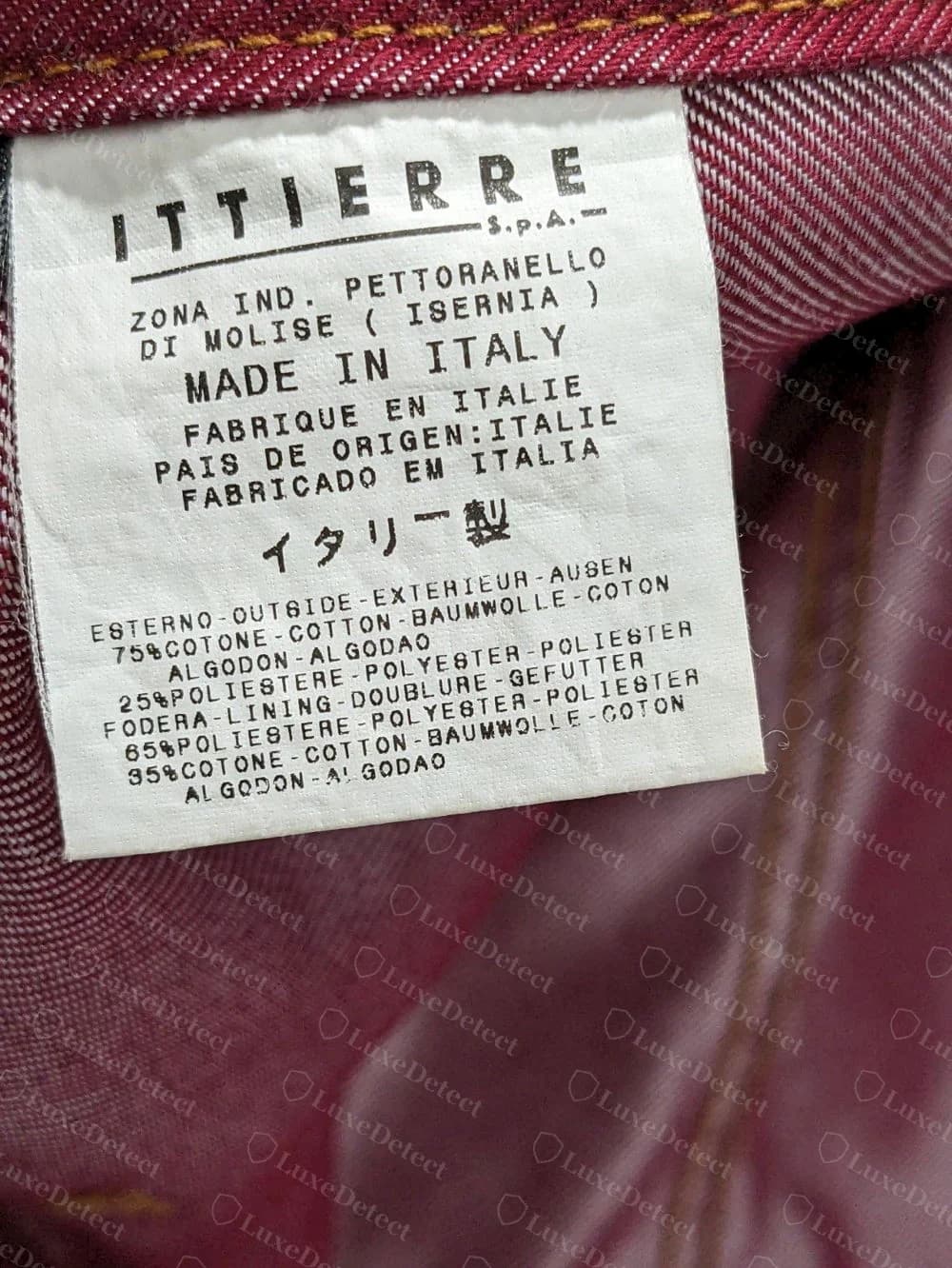
Genuine: the waistband tag (leather or jacron) carries "AMIRI" and often size/model text in sharp, balanced embroidery or a clean stamp — the "AMIRI" lettering is fine and correctly proportioned, not bulky. The interior labels give fibre content, country ("MADE IN USA" or "MADE IN ITALY"), care, and a style/lot code. Stitching is clean, text correctly spelled and spaced.
Fake: the waist-tag embroidery is bulky, with excessively thick "AMIRI" or "SIZE" lettering, lacking sharpness; the interior labels have wrong or vague content, wrong country, misspellings, or a missing/misformatted style code; crooked stitching.
| Element | Authentic | Counterfeit |
|---|---|---|
| Waist-tag "AMIRI" | Fine, sharp, balanced embroidery/stamp | Bulky, excessively thick, fuzzy |
| Interior content/care | Complete, correctly spelled | Vague, misspelled |
| Country | "MADE IN USA" or "MADE IN ITALY" | Wrong country |
| Style / lot code | Present, consistent format | Missing or misformatted |
Red flag
Waist-tag embroidery with thick, bulky "AMIRI" or "SIZE" lettering lacking sharpness. Genuine Amiri tag lettering is fine and balanced; heavy, fuzzy embroidery is one of the most consistent fake tells on these jeans.
The Distressing and Denim
Genuine: the rips, sanding, and whiskering are hand-applied and look natural — irregular placement, clean rip edges with intact cross-threads where intended, wear that follows where a body would actually wear denim, and no two pairs identical. The denim itself is a quality weight with a good hand and consistent wash.
Fake: machine distressing that looks uniform and repeats — identical rip shapes, symmetrical wear that does not match natural stress points, fuzzy or overly clean-cut holes; a thin or stiff denim; a blotchy or off-tone wash.
| Element | Authentic | Counterfeit |
|---|---|---|
| Distressing | Hand-applied, irregular, natural placement | Uniform, repeating, symmetrical |
| Rip edges | Clean, intended cross-threads intact | Fuzzy, or unnaturally clean-cut |
| Wear pattern | Follows real body stress points | Placed where a machine put it |
| Denim / wash | Quality weight, consistent wash | Thin/stiff, blotchy wash |
Worth knowing
Distressing is corroboration — a good fake factory can hand-finish reasonably well. Read it with the leather inserts, the hardware and the waist tag, which fail more reliably.
What the Packaging Does and Does Not Prove
Amiri jeans come with hangtags (often a branded card and a care card) and sometimes a dust bag. All are reproduced.
Packaging is context, not evidence. Cross-reference any style/lot code on the hangtags against the interior label. Hangtag card stock and a dust bag settle nothing.
Quick Authentication Checklist
- Leather panel inserts are real supple leather with a natural grain and leather smell, stitched flush with neat tight stitching
- Button and rivets are solid metal with a clear, correctly sized, deep Amiri stamp
- Zipper is YKK or RiRi, smooth, with a branded pull
- Waist-tag "AMIRI" lettering is fine and sharp, not bulky or fuzzy
- Interior label states MADE IN USA or MADE IN ITALY with complete content and a style/lot code
- Distressing looks hand-applied and irregular, following natural wear points, with no repetition
- Style/lot code on hangtags matches the interior label
Two or more failures means walk away. A single failure on the leather inserts (synthetic, plasticky) is on its own sufficient. A failed hardware stamp (shallow/blurry/wrong size, generic zip) is a strong tell; read it together with the leather inserts.
When to Get a Professional Opinion
Cheap MX1 fakes fail the leather-insert and hardware checks immediately. The better ones use a nicer synthetic or even thin real leather and closer hardware, and the deciding evidence becomes the exact leather hand, the stamp geometry, the waist-tag embroidery weight and the distressing logic — details that read best in hand or detailed photos, much like the leather checks in our guide to authenticate Gucci Horsebit loafers.
Photo-based authentication suits denim. Our authenticators review submissions from $15 with fast turnaround and return a Certificate of Authenticity. Send close-ups of a leather insert and its stitching, the shank button and a rivet, the zipper pull, the waist tag, the interior content label, and the overall distressing on both legs.
FAQ
What is the fastest way to spot fake Amiri MX1 jeans?
Check the leather panel inserts. On a genuine pair they are real, supple leather with a natural grain and a leather smell, stitched flush into the denim with neat, tight stitching. Fakes use stiff, plasticky synthetic panels with a uniform embossed grain and a chemical smell, often with loose stitching around the panel.
Where are Amiri jeans made?
In the USA (Los Angeles) or in Italy, depending on the piece and the era — both are legitimate. The interior label states which. A label naming a different country is a strong fake signal.
What zippers does Amiri use?
YKK or RiRi, running smoothly, usually with branding on the pull. A generic zipper that catches, with an unbranded or crudely branded pull, is a counterfeit indicator on an MX1.
Why does the waist tag embroidery matter on Amiri?
Genuine Amiri waist-tag lettering ("AMIRI", "SIZE") is fine, sharp and correctly proportioned. Fakes render it bulky and excessively thick, without sharpness. Heavy, fuzzy tag embroidery is one of the more consistent tells on these jeans.
How can I tell if Amiri distressing is fake?
Genuine distressing is hand-applied: irregular, placed where a body actually wears denim, with clean rip edges, and no two pairs identical. Machine distressing on a fake looks uniform and repeats — identical rip shapes and symmetrical wear that does not follow natural stress points.
Is a cheap pair of Amiri MX1 jeans on a marketplace fake?
The MX1 is faked at scale, so a pair priced well below retail from an unknown seller should be checked carefully against the leather inserts, the hardware stamps and the waist tag. A low price plus any single failure above is enough to walk away.