Luxury Accessories Authentication Specialist
Luxury accessories authenticator. Covers small leather goods, belts, and eyewear.
Published November 2026 · Contact
Why Maui Jim Marks Prove Less Than You Expect
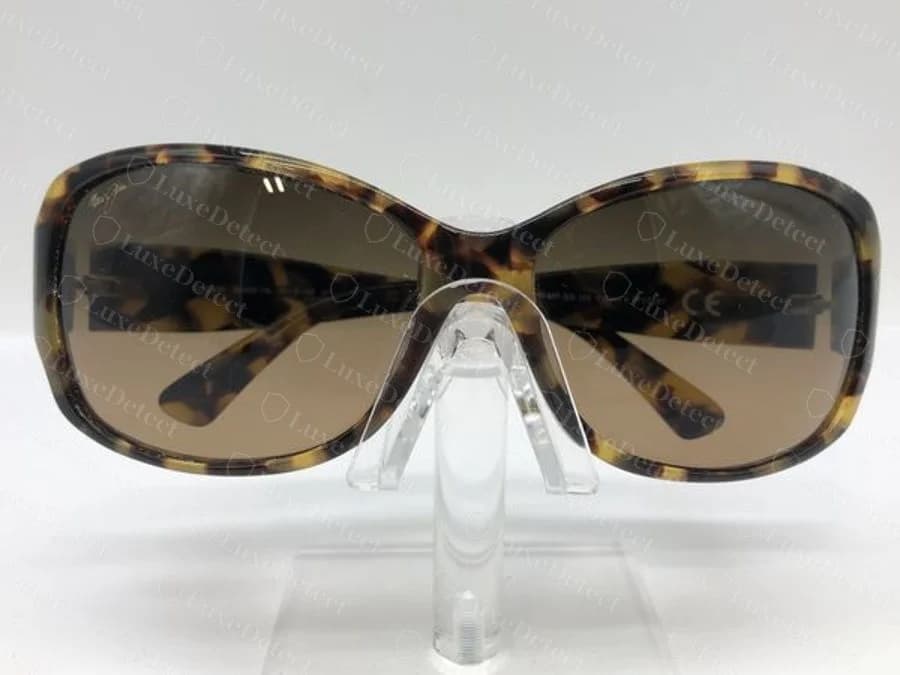
Maui Jim is a Hawaiian sunglasses brand founded in 1980, known for polarized lenses. A Maui Jim pair carries a lot of print: a model name and patent line on one temple, a model code and size line on the other, a gold script logo, a script etched into the lens and a branded case. That looks like plenty to check, and it is the reason buyers feel safe with a pair that has all of it.
The catch is that the marks are easy to reproduce. In our records, the fake-graded Maui Jim pairs we reviewed carry the same layout of temple text as genuine ones. For two models we could compare directly, the Punchbowl and the Peahi, the fake-graded pair's stamp followed the same format as the genuine pair's, and for the Peahi the code, size and wording were the same. So nothing below is a pass mark. It is a description of what genuine pairs in our records look like, so you know what you are comparing against.
Worth knowing
This guide is built from genuine Maui Jim sunglasses in our authentication records. We found no repeatable fake-only tell in the fake-graded pairs we reviewed, and we do not use "Made in Italy" or any single stamp as a verdict. A fake outcome in our records can also reflect a valuation outcome, so the label alone does not tell us why a pair failed. For other premium eyewear, see our [Persol guide](/blog/authenticate-persol-sunglasses-guide) and our [Ray-Ban guide](/blog/authenticate-ray-ban-sunglasses-guide).
The Two-Temple Stamp Layout
On the genuine acetate pairs we reviewed, the inside of each temple is printed in white. One temple carries the model name, then the lens technology, then a US patent number. The other carries "Maui", the model code, the size and the origin, with a CE mark.
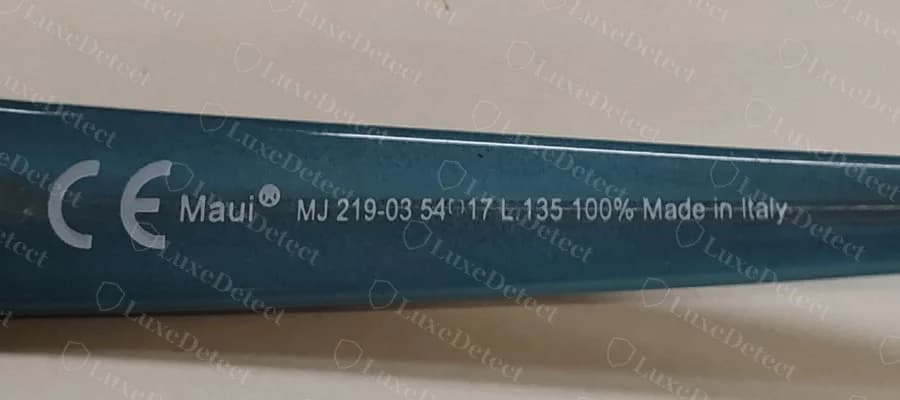
Read it left to right: MJ 219-03 is the model and colour, 54 is the lens width and 17 the bridge width in millimetres, and L.135 is the temple length. That is the usual way eyewear is sized, but we have not found Maui Jim's own published key, so treat our reading as a reasonable one rather than the brand's definition. The code is shared by every pair of that model and colour, so it is not a serial number.
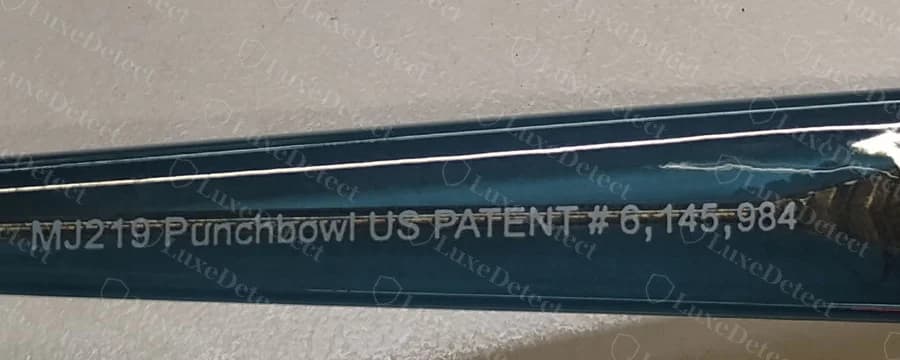
The other temple names the model and a patent number. A genuine Peahi in our records follows the same pattern with its own name and the same patent number, and a newer genuine Byron Bay pair shows two patent numbers after its name and lens code. So the patent line changes by model, and a pair with a different number from the one you expect is a question to ask, not a verdict.
The Fake-Graded Pairs Copy This Layout
We compared a fake-graded Punchbowl with the genuine one above.
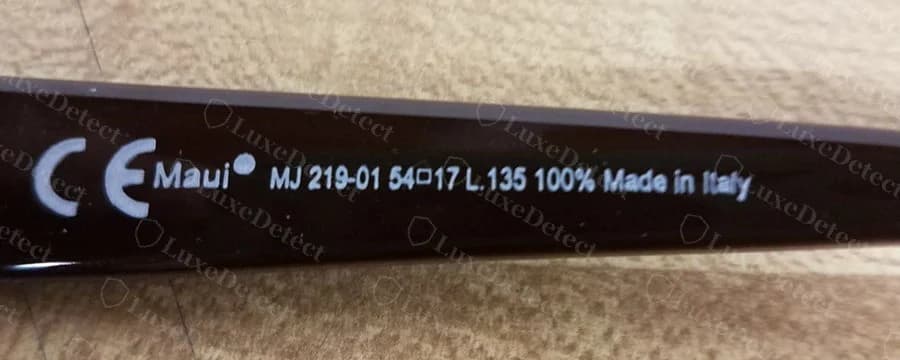
The format, spacing and wording match. The colour code differs (-01 here, -03 above), which is expected, because those are different colours of the same model. On the fake-graded Peahi we reviewed, the stamp read exactly as the genuine Peahi's: MJ 202-02, 65 and 19, L.120, 100% Made in Italy. We cannot point to anything in the stamp that separates the two, so a clean, correctly spaced stamp only means a pair has not failed this check.
"Made in Italy" Is Not the Whole Story
Many genuine pairs in our records say Italy, but not all. A genuine Nalani in our records is stamped "Made in Japan" with a different layout, and other genuine pairs in our records also say Japan.
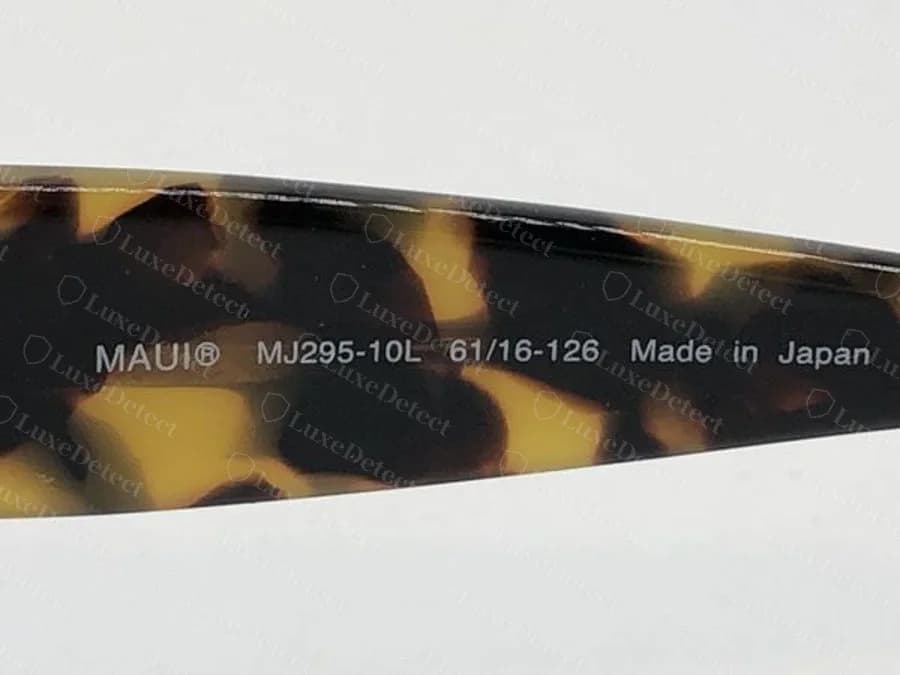
So a stamp that says Japan is not a warning sign on its own, and one that says Italy is not a pass. Judge the layout against a genuine pair of the same model, because it changes between models and eras.
Older Metal Frames Look Different
Older genuine metal pairs in our records use a thinner printed line in a serif face. On an older MJ-145-19 it reads "MAUI", the model code, "Made in Italy" and a CE mark, and the other temple carries a US patent number.
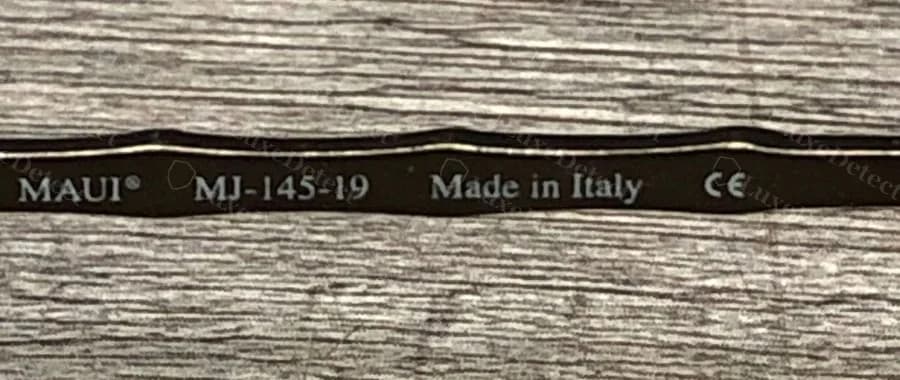
A fake-graded metal pair in our records uses the same style of line, so the same rule applies. Compare an older pair with pairs of the same model and era, not with a current one.
The Gold Script on the Temple and the Lens Etch
Most genuine acetate pairs carry the Maui Jim script in gold on the outside of a temple, set in a small raised, glossy dome.
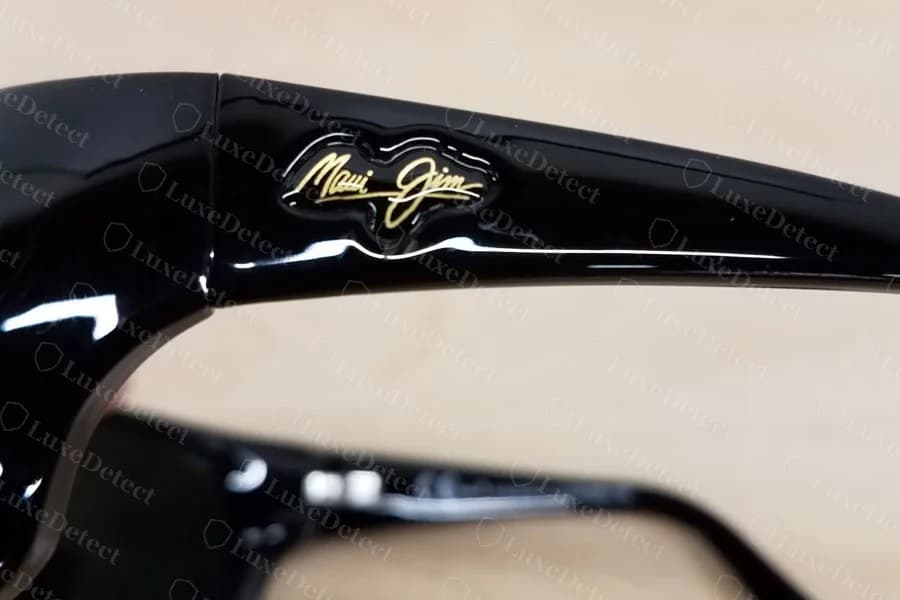
The same script is etched faintly into a corner of the lens, visible at an angle.
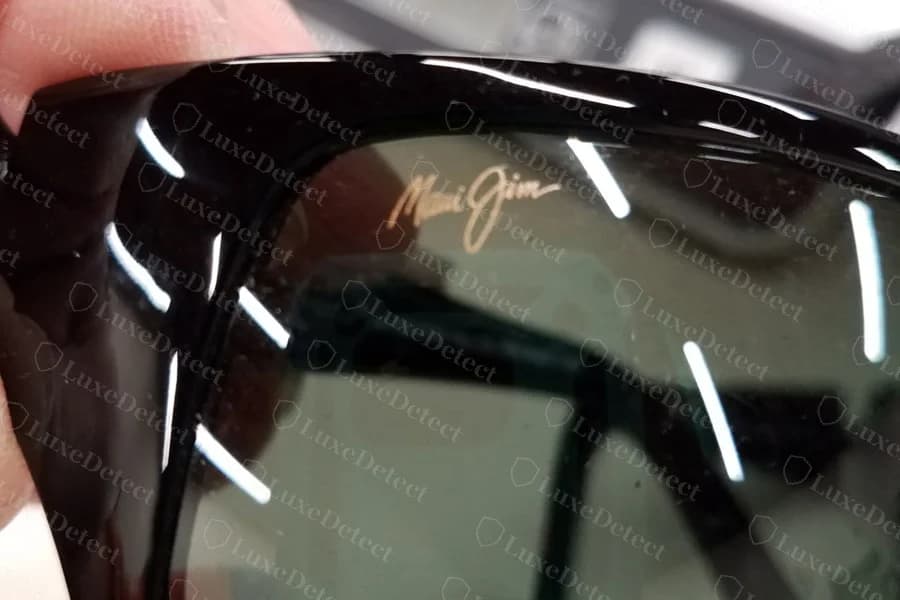
Both are copied. Fake-graded pairs in our records carry a temple logo and a lens etch too, so a crisp script tells you the pair has not failed this check, nothing more. Check that the logo sits flat and fully inside its dome, and that the etch is in the glass and not ink that wipes off.
The Case and Cloth
A genuine Nalani in our records came with a brown zippered case with a blue Maui Jim patch and a bright floral microfibre pouch.
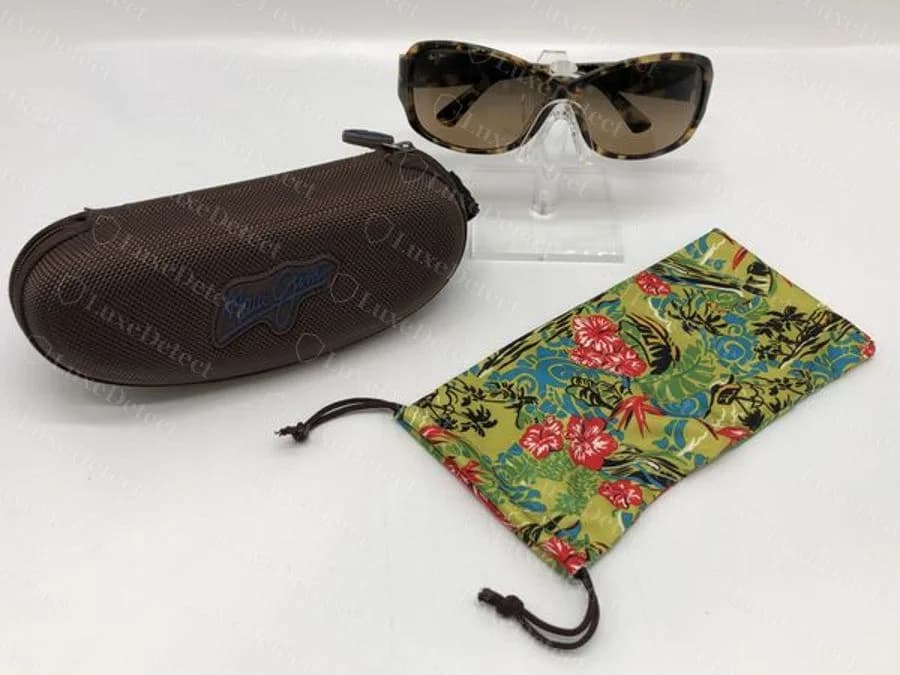
Cases vary: a genuine Byron Bay in our records came in a black folding case with the gold script. Packaging travels separately from frames and is easy to buy on its own, so it is context, not evidence.
What a Matching Mark Does and Does Not Prove
A temple stamp, a patent line, a gold logo and a lens etch can each be copied, and in our records they were, on pairs that failed authentication. A matching mark proves nothing on its own: matching every detail above does not prove a pair is genuine, and a different layout does not prove it is fake, because genuine layouts change between models, factories and years. Checks made with the pair in hand, such as the feel of the hinge, the polarization of the lens and the finish of the nose pads, add more than print does. Compare against a verified genuine pair of the same model and colour, and have a specialist look at the whole pair together.
When to Get a Professional Opinion
If you are buying a Maui Jim at a price that matters, or a listing shows only one temple, get a second opinion before you pay. LuxeDetect authenticates eyewear from photos, with a verdict from a specialist and a Certificate of Authenticity. Send clear photos of the front, both temples with every line of print, the temple logos, the hinges, the nose pads, the lens corners and the case.
A code that checks out doesn't prove the item is real. Counterfeiters copy genuine codes.
Our authenticators check the temple markings, lens etching and hinges of your Maui Jim against verified references, from $15. You get a verdict within 24 hours, and a Certificate of Authenticity if the item passes.
Authenticate My Maui Jim →FAQ
How can I tell if my Maui Jim sunglasses are real?
No single detail proves it. Genuine pairs in our records show a model name and patent line on one temple, a Maui, model code, size and origin line on the other, a gold script logo and a faint script etched in the lens. Check that these agree with each other and with the listing for that model, then get the pair checked if the purchase matters, because fakes copy the marks.
Where is the serial number on Maui Jim sunglasses?
We did not find one on the genuine pairs we reviewed. The code on the temple, such as MJ 219-03, names the model and colour and is shared by every pair of that kind, so it does not identify your pair.
What does MJ 219-03 54 17 L.135 mean on a Maui Jim?
MJ 219 is the model, the number after the dash looks like a colour code, 54 is the lens width and 17 the bridge width in millimetres, and L.135 is the temple length. We have not found Maui Jim's own published key, so this is our reading of a standard eyewear size line.
Are Maui Jim sunglasses made in Italy?
Many genuine pairs in our records are marked Made in Italy, and some are marked Made in Japan. A counterfeit can copy either wording, so the origin line is not a verdict in either direction.
Can a fake Maui Jim have a perfect stamp?
Yes. In our records, fake-graded pairs of the same models carried a temple stamp in the same format as genuine ones, and for one model the same code, size and wording. A perfect stamp is a baseline, not a pass.
Does the patent number prove a Maui Jim is real?
No. The number is printed in the same way on fake-graded pairs in our records, and it differs between models. It is useful as a consistency check against the model, not as proof.
Can I authenticate Maui Jim sunglasses from photos?
Yes. What decides it is how the stamps, logos, lens etch and frame construction fit together against verified genuine pairs of the same model. Because marks are copied, an expert review of the whole pair is the safer route on an expensive pair.
Where can I get my Maui Jim sunglasses authenticated?
LuxeDetect authenticates Maui Jim sunglasses from photos. Start an order and include clear photos of the front, both temples with every line of print, the temple logos, the hinges, the nose pads and the lens corners. If you also own an Oakley, our Oakley guide covers that brand.