Eyewear Authentication Specialist
Published September 2026 · Contact
Fendi doesn't run one eyewear line the way some houses do. Across the listings we reviewed, the FF-logo hardware, the shape, and even the case design change by decade and by collection, which means there's no single "the fakes always get X wrong" shape check the way there might be for a single handbag model. What's consistent, and what we can actually verify from a real sample of authenticated orders, is that fit and finish at the hinge is where Fendi's own construction quality shows up most reliably, and where the counterfeits we reviewed were most likely to cut a visible corner.
This guide is built from a direct sample pull of LuxeDetect's own authentication archive: photographs from 25 confirmed counterfeit Fendi sunglasses and eyeglasses orders and 15 confirmed authentic orders, spanning roughly three decades of Fendi eyewear design (mesh-temple 1990s metal frames, pequin-stripe cased vintage acetate, and current FF-logo hardware). We looked for a tell that repeats across that spread rather than one specific to a single model.
What to check, ranked by reliability
| Checkpoint | Reliability | What it tells you |
|---|---|---|
| 1. Hinge and Temple-Join Finish | ★★★★★ | Visible dried adhesive or residue haze at the temple-hinge seam was found only on counterfeit pairs in our sample and is disqualifying on its own. |
| 2. FF Logo Hardware and Printed Wordmark | ★★★★★ | Supporting only; several counterfeits in our sample had well-executed FF hardware, so a clean logo does not clear a pair. |
| 3. Temple Engraving: Model Code, Size, and Origin Text | ★★★★★ | Useful for catching a mislabelled listing, not for a real-vs-fake verdict; legible codes appeared on both sides of our sample. |
| 4. Case and Packaging | ★★★★★ | Context only, both sides of our sample had materially similar case quality for their apparent era. |
Model Reference Before You Start
Fendi eyewear in the secondhand market spans at least three distinct eras, and mixing them up is the most common cause of a false negative:
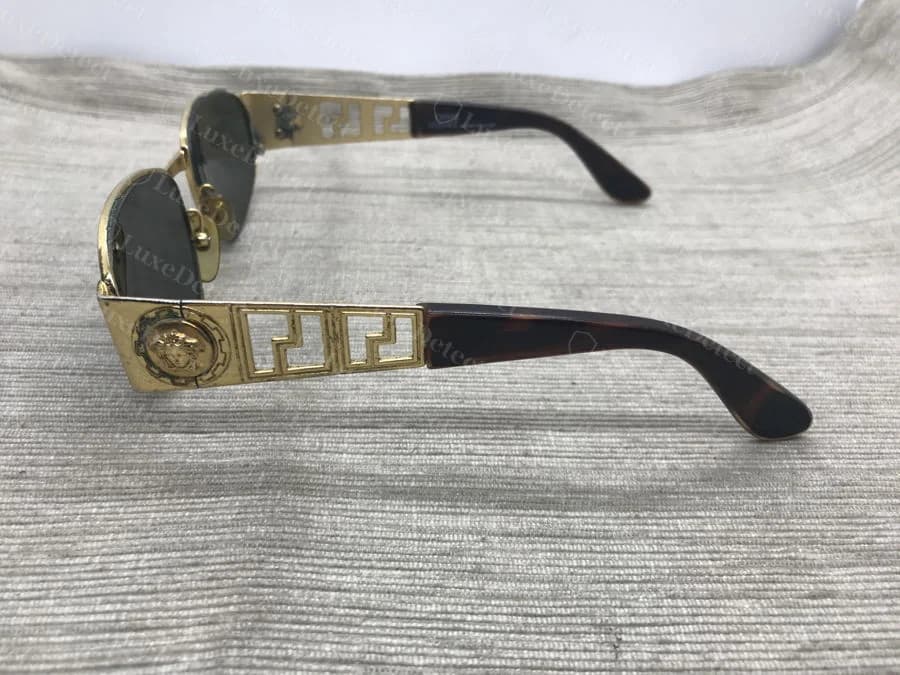
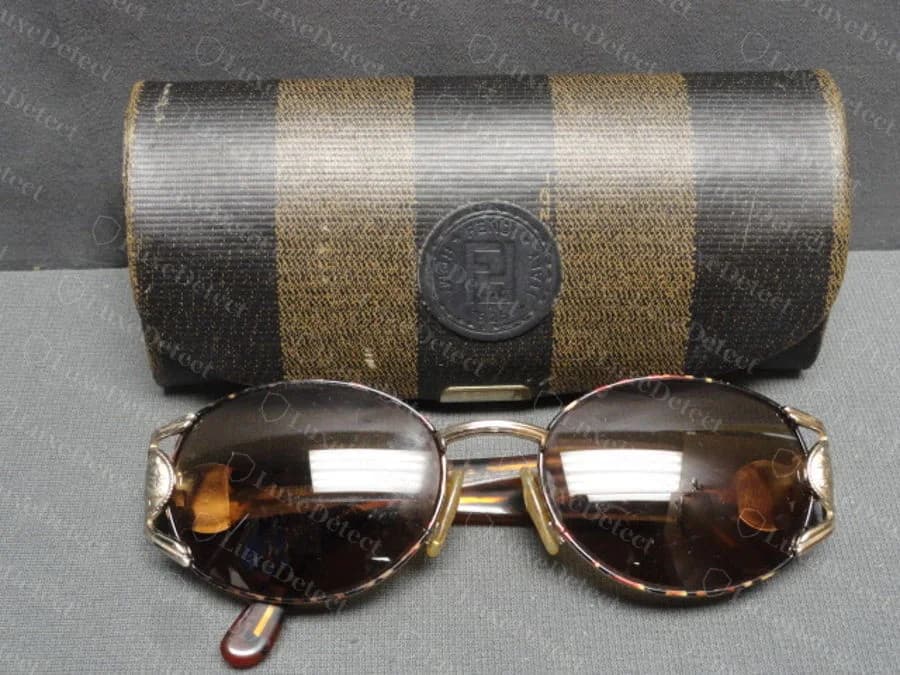
- 1990s–2000s metal frames with a perforated ("mesh") metal temple panel and a separate FF logo hardware plaque riveted or soldered onto the temple. Often paired with a pequin-stripe (brown and black striped canvas) hard case stamped with a round "FENDI ROMA ITALY 1925" medallion.
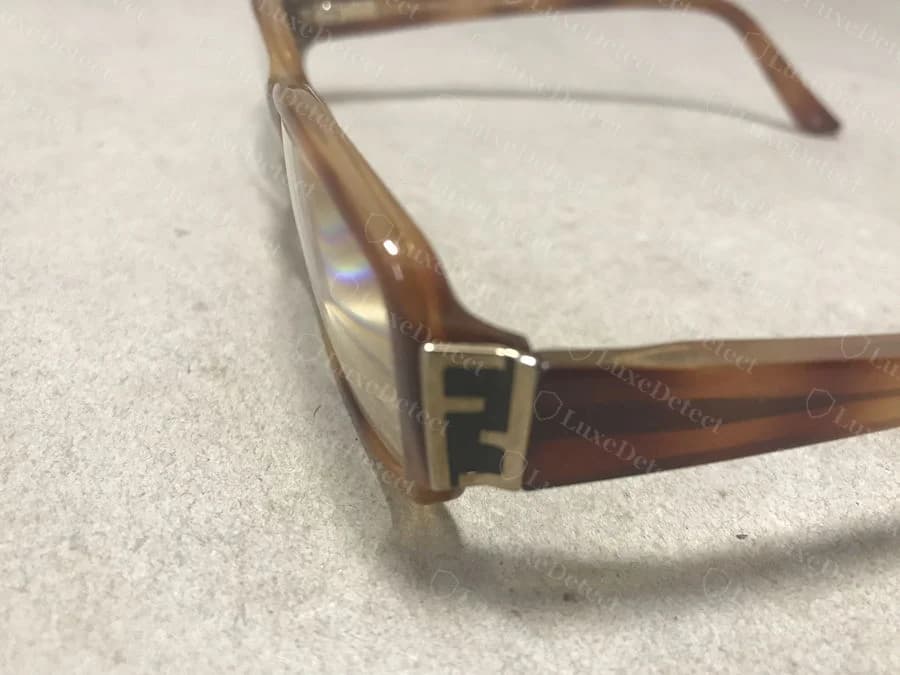
- 2000s–2010s acetate frames, often with the FF logo printed or laser-etched directly onto the inside of the temple in a repeating zucca (FF monogram) pattern, plus a separate small enamel-filled FF hardware tab near the hinge.
- Current-collection frames (roughly 2018 onward) with a bold, oversized FF logo worked into the temple as a design element, "FENDI" printed in block letters along the temple arm, and a plain embossed leather or leatherette case with a tonal "FENDI" wordmark, no medallion.
Don't assume a pequin-stripe case or a mesh temple means "obviously vintage and therefore suspect," and don't assume the absence of a case means anything either; sellers routinely separate frames from their original packaging. Match the era of the frame design to the era of the hardware and printing style before you evaluate anything else.
Use our free Fendi Serial Checker to check the serial format, the authenticity-card match, and the tag feature your bag's era should carry.
Check My Serial →Hinge and Temple-Join Finish
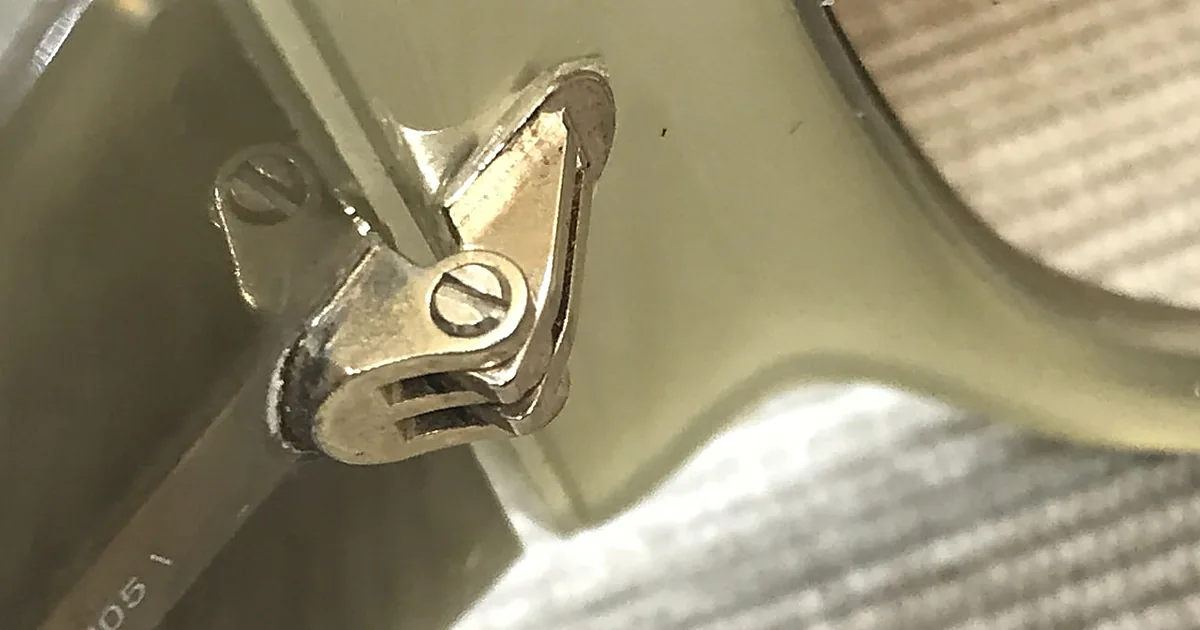
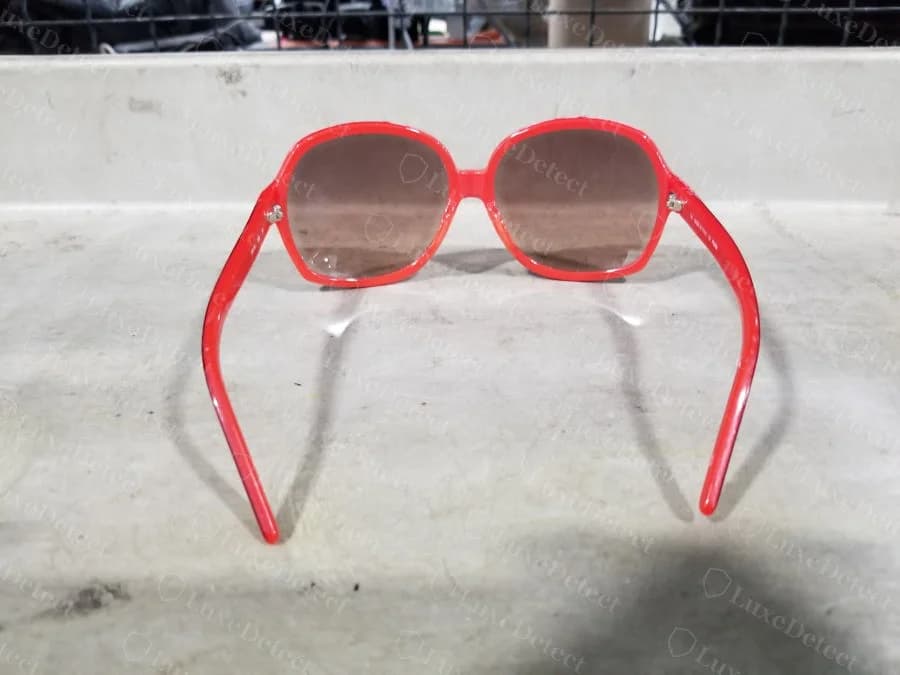
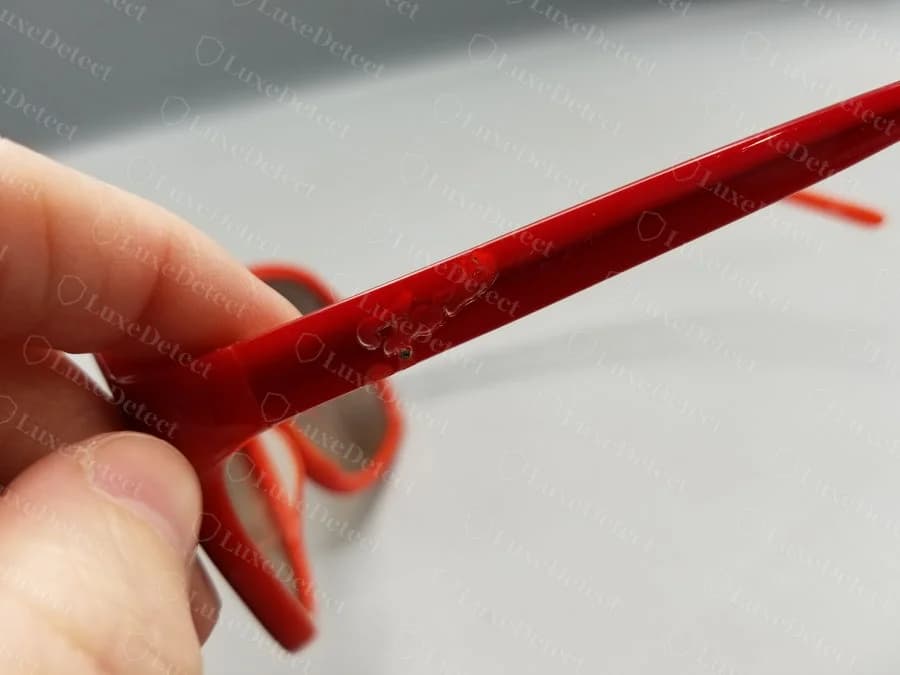
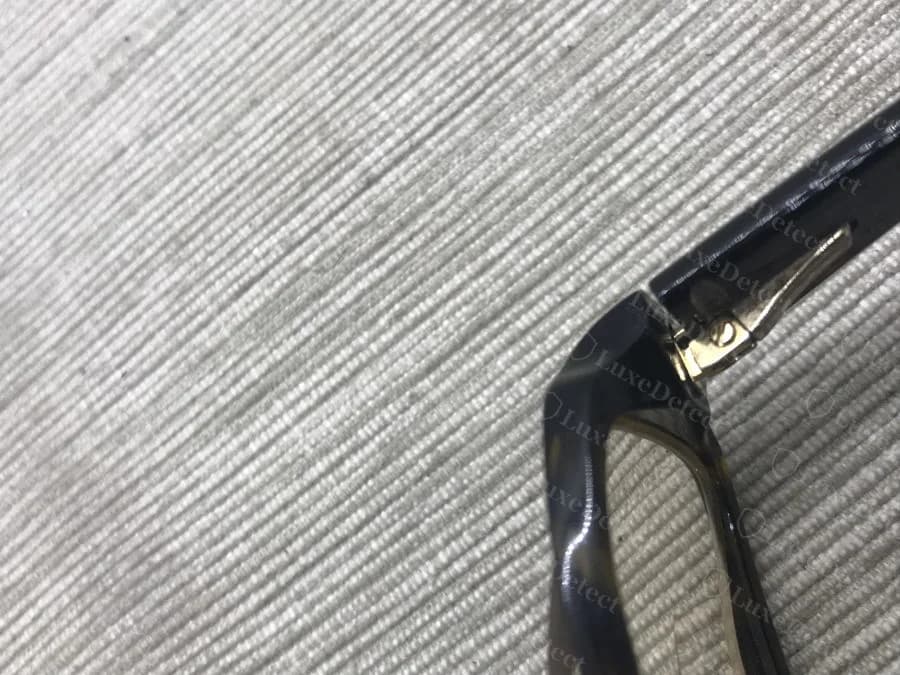
This is the strongest, most repeatable difference we found in our sample. At the point where the temple arm meets the hinge, or where a separate FF hardware piece is mounted onto the temple, genuine Fendi construction is either a clean mechanical seam (visible screw and barrel, but no visible adhesive) or a flush-mounted, precisely fitted enamel tab. In our counterfeit sample, two separate photographed pairs (a red acetate frame, photographed from two angles) showed a visible glob of hardened adhesive squeezed out at the temple-to-hinge seam, with debris embedded in it. A third counterfeit pair showed a similar haze of white residue at the base of its FF hardware plaque, exactly where the plaque meets the frame.
| Element | Authentic | Counterfeit |
|---|---|---|
| Temple-to-hinge seam | Clean mechanical joint; screw and barrel visible but no visible glue | Visible adhesive squeeze-out or dried residue at the seam, sometimes with debris trapped in it |
| FF hardware plaque mounting | Flush, no visible gap or haze around the base | Haze, film, or residue ring around the base of the plaque |
Red flag
A visible bead or smear of dried adhesive at the temple-hinge join, or a haze of residue around the base of an FF hardware plaque, is not something we found on any of the 15 authenticated pairs we pulled for this guide. On its own this is enough to reject a pair.
Worth knowing
We want to be honest about the limits of this check: the hinge *mechanism* itself (the visible screw, barrel, and folding assembly) looks mechanically similar across both authentic and counterfeit pairs in our sample, including some visibly worn authentic hinges that looked rough from age. Don't reject a pair just because the raw hinge hardware looks utilitarian rather than jewel-like; look specifically for glue residue, not general "roughness."
FF Logo Hardware and Printed Wordmark
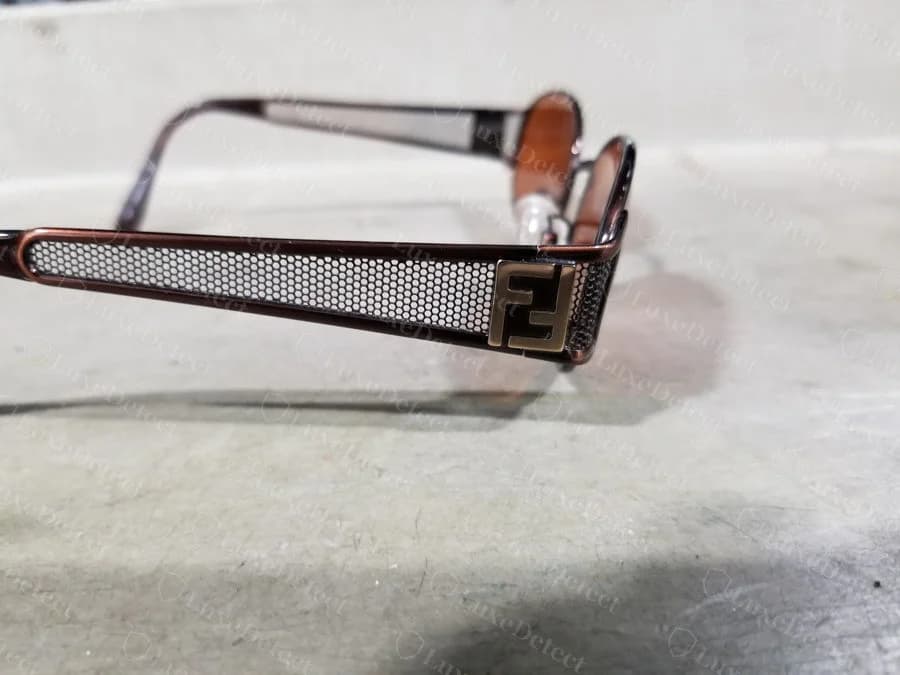
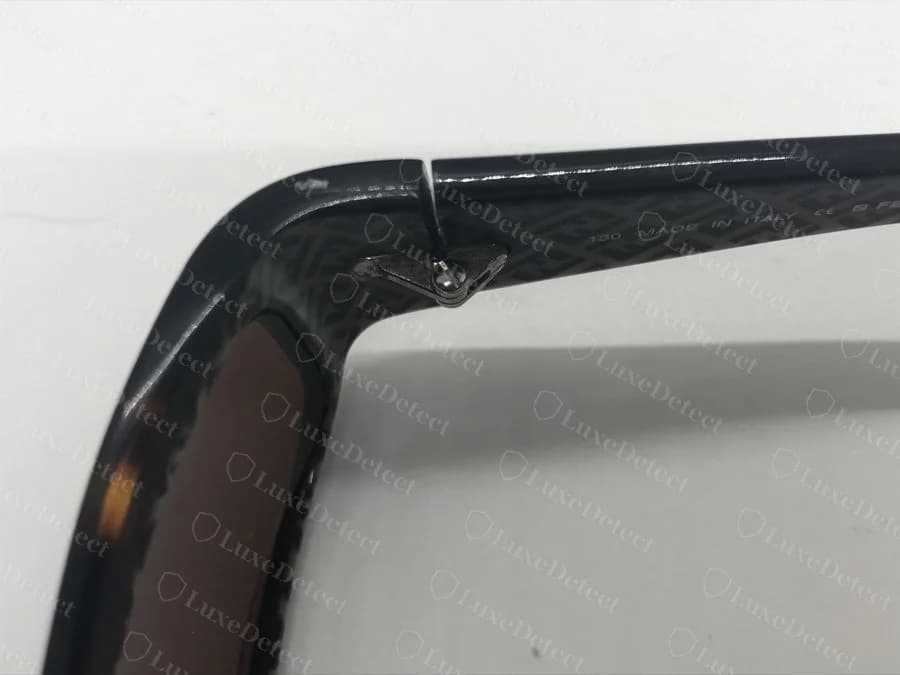
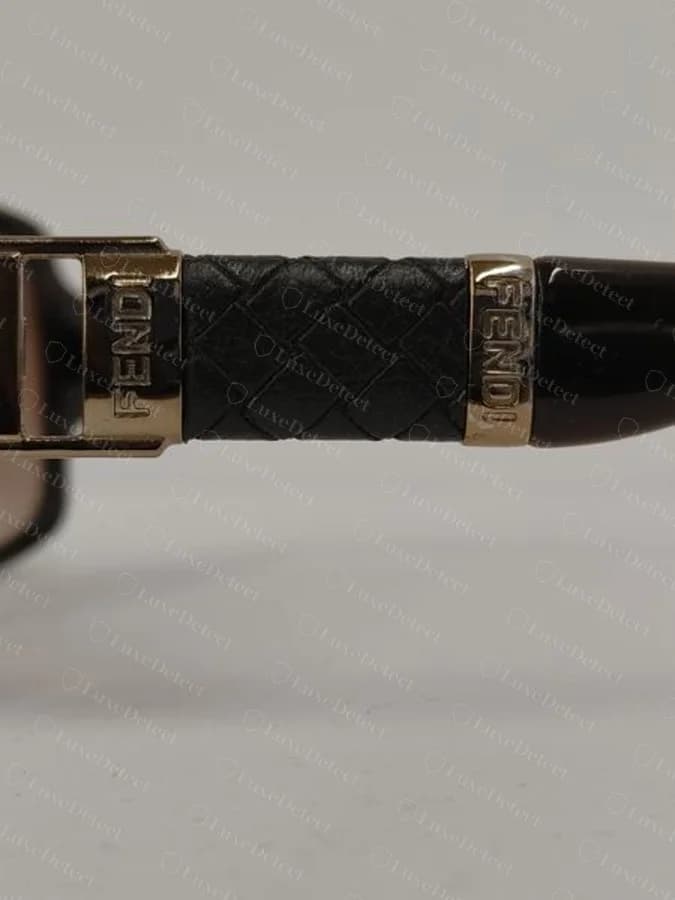
Fendi eyewear across every era we reviewed carries the brand name or FF monogram somewhere on the temple, either as a separate metal hardware plaque with enamel fill, as a printed zucca pattern on acetate, or as raised block lettering. We found this check useful for ruling out an obviously bad reproduction, but it is not as reliable a pass/fail test as the hinge seam: several counterfeit pairs in our sample had genuinely well-executed FF hardware, crisp block lettering, and correctly proportioned mesh-temple FF plaques that would not fail on this point alone.
| Element | Authentic | Counterfeit |
|---|---|---|
| Enamel-filled FF plaque | Enamel sits flush and level with the surrounding metal edge | Usually comparable; not a reliable differentiator on its own in our sample |
| Printed "FENDI" wordmark | Even stroke width, consistent letter spacing | Mostly comparable in our sample; a small number showed uneven letter spacing but most were well executed |
Worth knowing
Treat logo and wordmark quality as a supporting check, not a decisive one. Counterfeiters reproducing current Fendi eyewear have gotten the branded hardware right often enough in our sample that a clean logo does not clear a pair, and we did not find enough of a consistent quality gap here to publish it as a red flag.
Temple Engraving: Model Code, Size, and Origin Text
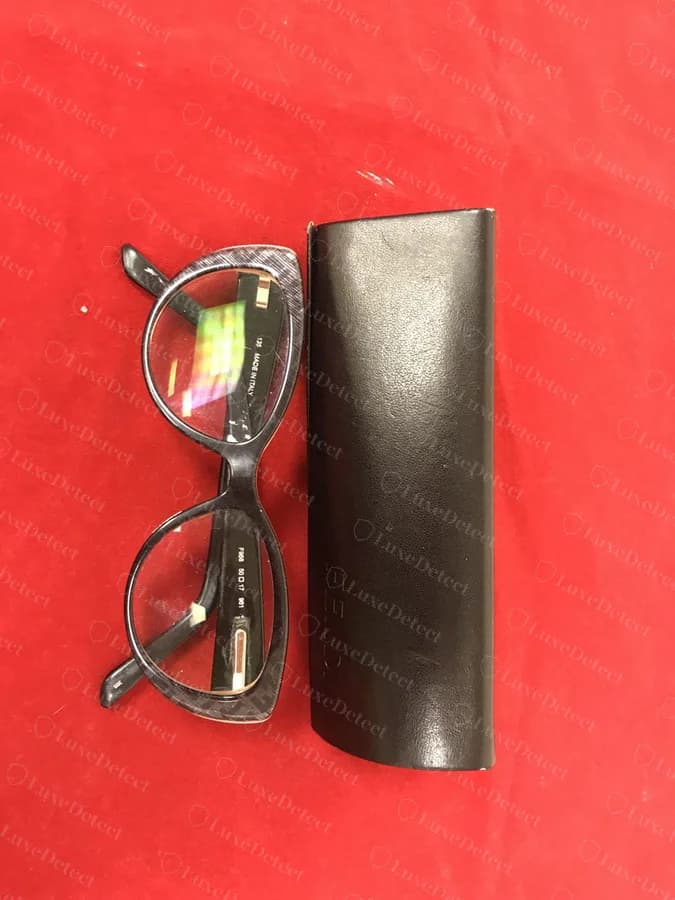
Genuine Fendi temples carry a printed or engraved model code (for example "FS5281 55□15 318 135") plus "MADE IN ITALY" (or the relevant country) and a CE mark on eyewear intended for the EU/UK market. In our sample, this text was legible and correctly formatted on the large majority of both authentic and counterfeit pairs, including several counterfeits with genuinely crisp, well-printed codes. This makes the engraving useful for cross-referencing a listing's stated model against the physical item, but it is a weak standalone authenticity check; a plausible, correctly formatted code does not by itself confirm a pair is genuine, and we could not find a repeatable formatting or placement error across our counterfeit sample.
Worth knowing
Use the temple code to catch a mislabelled pair (a seller listing one model but shipping another, or a size code that doesn't match the stated frame), not as a real-vs-fake test on its own.
Case and Packaging
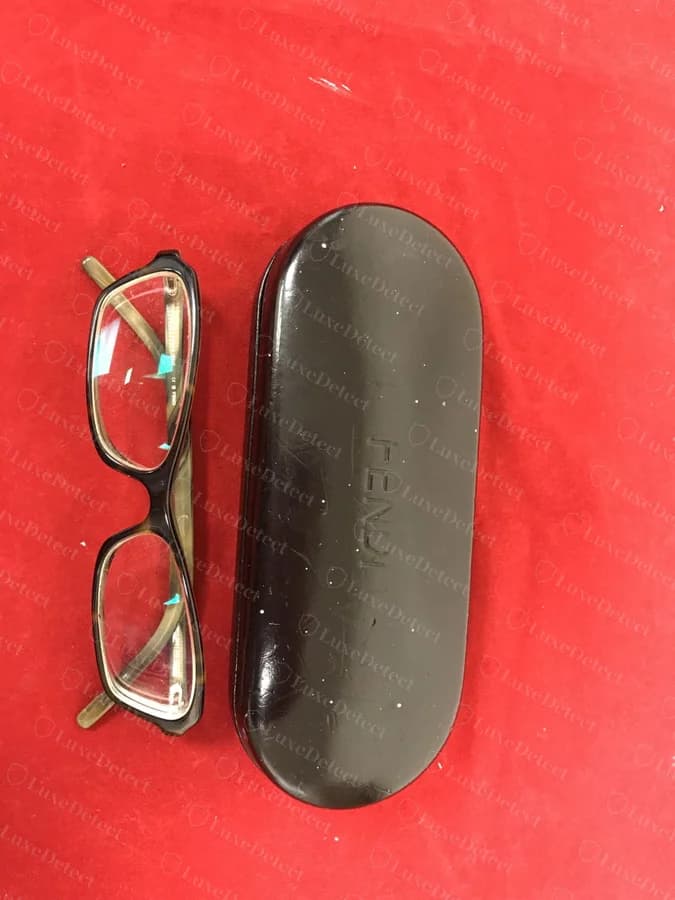
Fendi eyewear cases vary by era in the same way the frames do: pequin-stripe hard cases with a "FENDI ROMA ITALY 1925" medallion for older frames, embossed black leather cases with a tonal "FENDI" wordmark for more recent frames, and simple felt-lined boxes or soft pouches for others. In our sample, both authentic and counterfeit pairs came packaged in materially similar case types for their apparent era, and we did not find a repeatable case-quality gap worth publishing as a checkpoint.
Worth knowing
A case, even a correct-looking one, is packaging, not proof. Counterfeit sellers regularly source period-appropriate cases separately or reuse genuine cases with substituted frames. Treat the case only as a way to sanity-check the claimed era against the frame's actual design.
Quick Authentication Checklist
- Identify which design era the frame belongs to (mesh-temple metal, printed-acetate, or current oversized-FF) and confirm the hardware style, printing, and case (if present) are consistent with that era.
- Examine the temple-to-hinge join and the base of any FF hardware plaque under strong light or macro photography. Any visible adhesive residue or haze is disqualifying on its own.
- Cross-reference the printed temple model code against the listing's stated model and size.
- Treat the case and box as context only, never as standalone proof.
Two or more inconsistencies across these checks, or a clear adhesive residue finding in check 2 alone, is reason enough to walk away.
When to Get a Professional Opinion
Fendi's eyewear catalogue is large enough, and changes design language often enough, that DIY authentication is genuinely harder here than for a single well-known handbag model. If you can't confidently place a pair in one of the three design eras above, or the hinge and hardware photos you have aren't sharp enough to judge finish quality, that's the point to stop guessing. LuxeDetect's accessories authentication starts at $15 for a 24-hour turnaround and includes a written explanation of the verdict, not just a pass/fail.
FAQ
Does "Made in China" on a Fendi temple always mean it's fake?
No. Fendi, like most large luxury houses, manufactures across multiple countries depending on the product line and era. Country of origin alone is not a valid authenticity test for this brand; cross-reference it against the model code and construction quality instead.
What's the single most useful thing to check on Fendi sunglasses?
Based on our sample, the temple-to-hinge join and the base of any FF hardware plaque. Visible dried adhesive or a haze of residue at that seam was the one repeatable, photographable difference we found between our authentic and counterfeit samples.
Is a Fendi logo that looks well-made proof the sunglasses are real?
No. Several counterfeit pairs in our review sample had genuinely well-executed FF hardware and printed wordmarks. A good-looking logo rules out only the crudest fakes, not a well-made one.
Does the case or box prove authenticity?
No. Cases and boxes are reproduced and separated from their original items constantly in resale. Use the case only to sanity-check that its apparent era matches the frame's design, not as evidence on its own.
My Fendi sunglasses have a slightly rough-looking hinge mechanism. Is that a red flag?
Not by itself. We found visibly utilitarian, even slightly worn-looking hinge mechanisms on authenticated pairs in our sample. Look specifically for adhesive residue or haze at the seam, not general mechanical roughness, which can also appear on genuine, well-used pairs.
How many Fendi sunglasses did you actually look at for this guide?
25 confirmed counterfeit orders and 15 confirmed authentic orders from LuxeDetect's own authentication archive, spanning roughly three decades of Fendi eyewear design. We call out in the guide itself where the sample did and didn't support a strong claim.