Eyewear Authentication Specialist
Published September 2026 · Contact
Why Prada Sunglasses Are Different to Authenticate
Prada eyewear doesn't concentrate around one or two iconic silhouettes the way its handbags do around the Galleria or the Re-Edition 2005. Across our own authentication archive, the model codes on fake and authentic submissions alike are scattered across dozens of different references (SPR, VPR, SPS series) with no single shape dominant enough to build a model-specific guide around. That means this guide covers construction and stamping quality that holds across Prada's sunglasses range generally, rather than one frame's specific proportions.
The practical upshot is that surface impressions are unreliable here. In reviewing a working sample of authenticated and confirmed-counterfeit Prada sunglasses, several fakes looked entirely plausible at a glance: correct case, correct box, a temple stamp that read "PRADA Made in Italy CE" in a reasonable font. The checks below are the ones that actually separated real from fake in that sample, not the ones that merely looked convincing in a listing photo.
What to check, ranked by reliability
| Checkpoint | Reliability | What it tells you |
|---|---|---|
| 1. Logo Orientation and Placement | ★★★★★ | A "PRADA" logo that is mirror-reversed on one temple or on the case is decisive on its own; genuine frames never show this. |
| 2. Hinge Machining | ★★★★★ | Rough, sawtooth striations on the hinge barrel are a real tell where present, but hinge quality varied across our fake sample so absence does not clear a pair. |
| 3. Temple Stamp Execution | ★★★★★ | A genuinely sloppy stamp is worth noting, but several confirmed fakes in our sample had clean, evenly spaced stamping, so a clean stamp alone proves nothing. |
| 4. The Lens Etch | ★★★★★ | Presence is mildly reassuring; our sample lacked enough clear fake-lens photos to confirm how reliably counterfeits omit it. |
| 5. The Case | ★★★★★ | Context only, except when it repeats the reversed-logo error, which is disqualifying the same way it is on the frame. |
| Model Reference Before You Start | ★★★★★ | Confirms the stamp format and rules out a wrong country of origin; will not catch a good counterfeit on its own. |
Use our free Prada Serial Number Checker to decode the serial inside your Prada bag and check it against the era.
Check My Serial →Model Reference Before You Start
- Prada eyewear model codes follow the pattern SPR/VPR/SPS/VPS + two digits + one letter (e.g. SPR 52F, VPR 06S, SPS 50HS), stamped on the inside of one temple along with the size code, color code, and temple length in millimeters (e.g. "54⬜20 1AB-5S0 145").
- SPR/SPS prefixes are sunglasses; VPR/VPS are optical (prescription) frames.
- Prada Linea Rossa (the red-stripe sport sub-line) uses the same numbering convention but adds a red rubberized brand strip near the hinge instead of the plain engraved logo.
- All current-production Prada eyewear is legitimately made in Italy. There is no legitimate current line manufactured outside Italy, so "Made in China" or any origin other than Italy on the temple is disqualifying on its own.
- Don't expect the model code alone to confirm anything: it is trivial to copy accurately, and it does not appear in isolation on genuine frames — it is always accompanied by the size and length codes in the same stamped block.
Logo Orientation and Placement
This is the single most useful check we found in the sample, and the one buyers are least likely to think to make. On every authentic frame in the sample, the "PRADA" wordmark on each temple reads correctly left-to-right when the temple arm is viewed from the outside, in the same orientation on both the left and right sides.
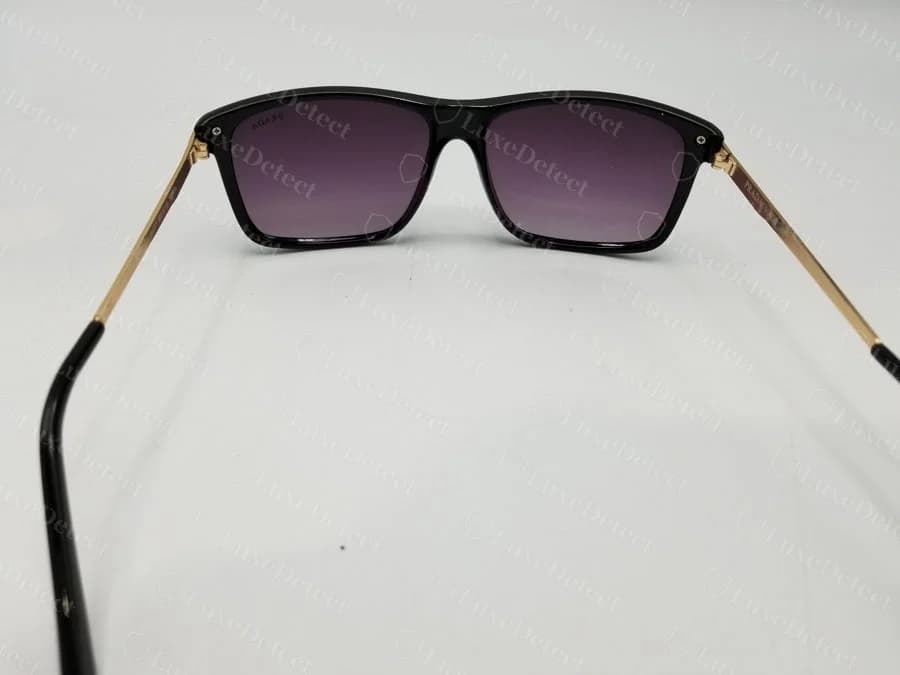
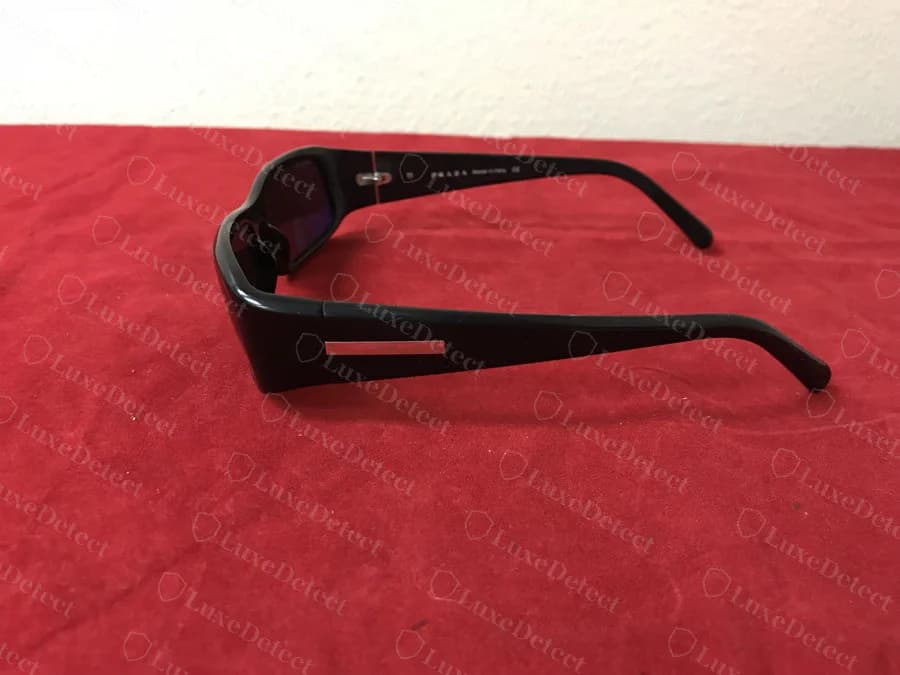
In one fake from our sample, the logo on one temple was stamped as a mirror image of itself, legible only in reverse. The same error showed up independently on a counterfeit Prada case, where the debossed lid logo was similarly reversed. This is not a subtle judgment call: hold the frame with both temples folded outward and compare the two sides directly against each other and against a reference photo. A correctly oriented logo does not confirm a pair is genuine, but a reversed or backward logo is unambiguous.
Red flag
A "PRADA" logo that reads correctly on one temple but is mirror-reversed on the other, or reversed on the case, is decisive on its own. This is not a font or spacing quibble; the letters are physically flipped and impossible to misread as a manufacturing quirk.
Hinge Machining
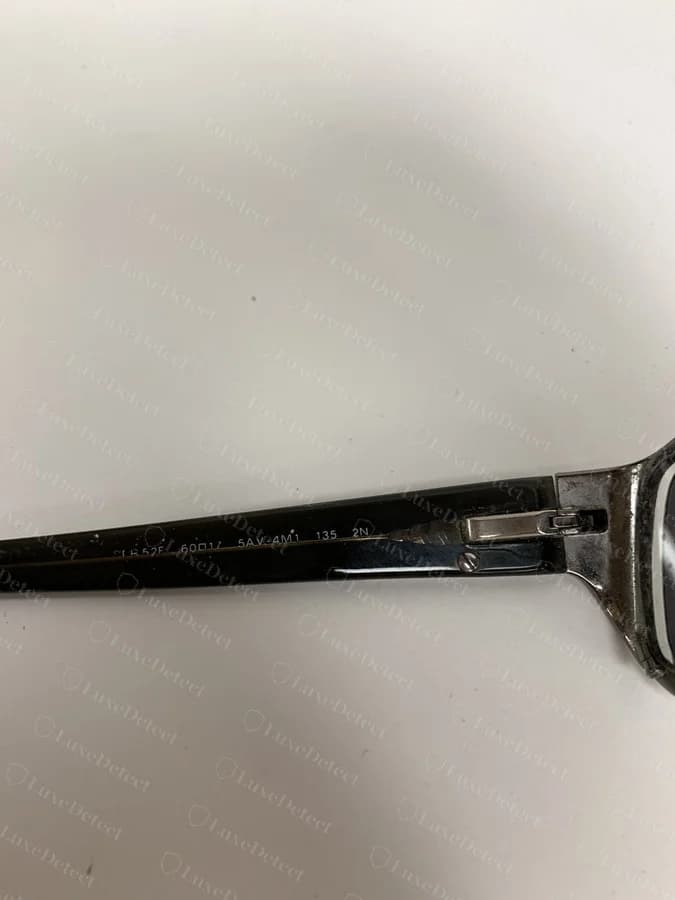
The hinge barrel and the small folding joint at the temple are cut from metal and are expensive to machine precisely, which makes this a harder detail for a counterfeiter to shortcut invisibly.
| Element | Authentic | Counterfeit |
|---|---|---|
| Hinge barrel edge | Clean, straight-cut edges with no visible tool marks | Rough, sawtooth-like striations visible along the cut edge under close inspection |
| Hinge action | Smooth, even resistance through the full fold | Gritty or uneven in some examples, though not always |
| Fit to frame | Hinge sits flush with no gap or casting flash | Visible flash or a slightly proud edge where the hinge meets the temple |
Worth knowing
We only observed this rough-hinge tell clearly on one record in our sample, and it was on the more elaborate rimless model in the fake set. Other fakes we reviewed had hinges that looked acceptable in photos. Treat this as a genuine, real tell when you see it, not as a check you can rely on producing a verdict every time — hinge quality was inconsistent across the counterfeit sample.
Temple Stamp Execution
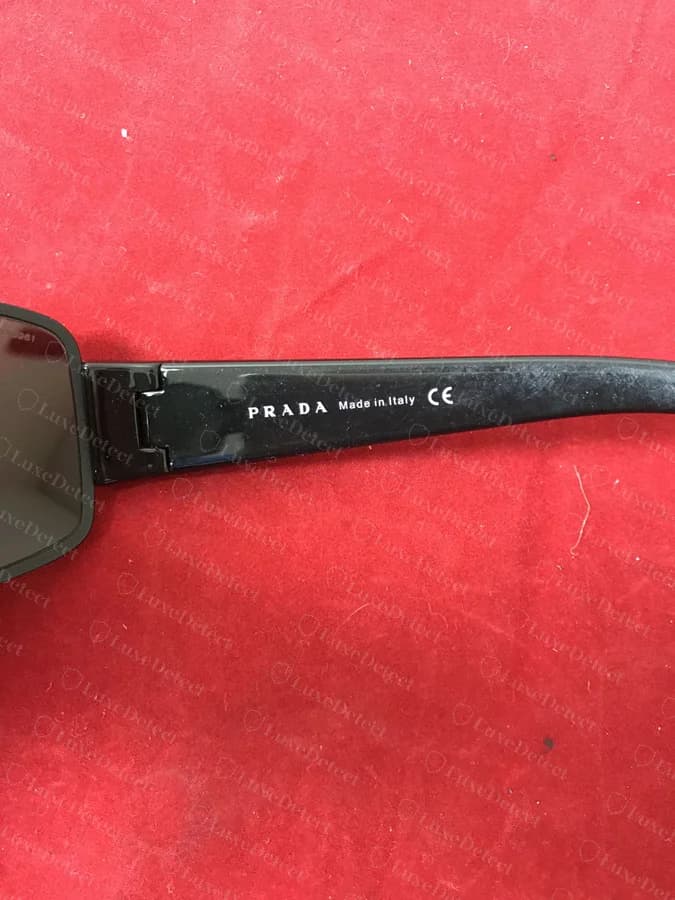
The stamped block on the inside temple (brand name, "Made in Italy," the CE mark, and the model/size code) varied more than we expected across the fake sample.
Authentic: Every authentic frame we reviewed showed evenly spaced, uniform-depth lettering in a consistent sans-serif or the house's stamped serif style, with no character misalignment.
Fake tells, inconsistent: One fake showed genuinely sloppy stamping — mismatched letterforms, uneven spacing, and a partially illegible final character. But others in the same sample had stamping that was clean, evenly spaced, and difficult to fault on close inspection. We can't responsibly claim stamp quality is decisive on its own; some fakes have simply gotten good at this specific detail.
Worth knowing
Stamp legibility is worth checking and a genuinely botched stamp (uneven letter depth, an illegible character, obviously mismatched fonts within the same line) is a real red flag when you see it. But a clean-looking stamp does not clear a pair — we found clean stamping on confirmed counterfeits in this same sample, so weight this below the logo-orientation and hinge checks.
The Lens Etch
Genuine Prada lenses commonly carry a laser-etched alphanumeric code (for example, a string beginning with a letter prefix like "AP" followed by digits) in one corner of the lens, visible only at an angle under light.
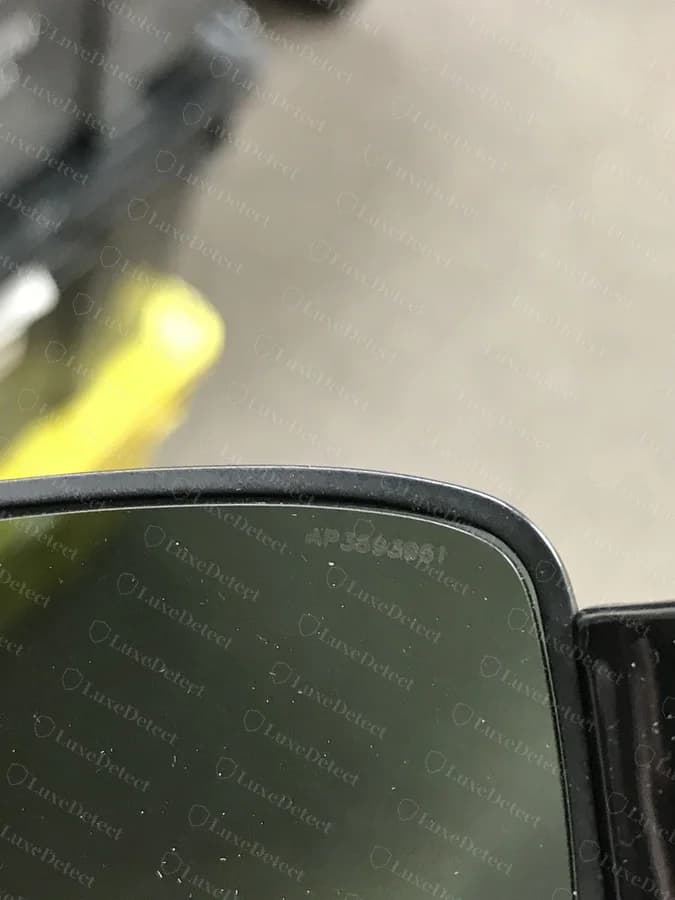
This etch is a lens-manufacturing detail, not a full serial number, and we did not have enough clearly-photographed fake lenses in our sample to say definitively how often counterfeits omit or fake it. Treat its presence as a mildly reassuring sign, not a pass/fail test on its own.
Worth knowing
We're being explicit about the limitation here: this check is based on what we consistently saw on authentic frames, not on a confirmed pattern of absence on fakes, because our fake-side sample didn't include enough clear lens close-ups to verify that side of the comparison.
The Case
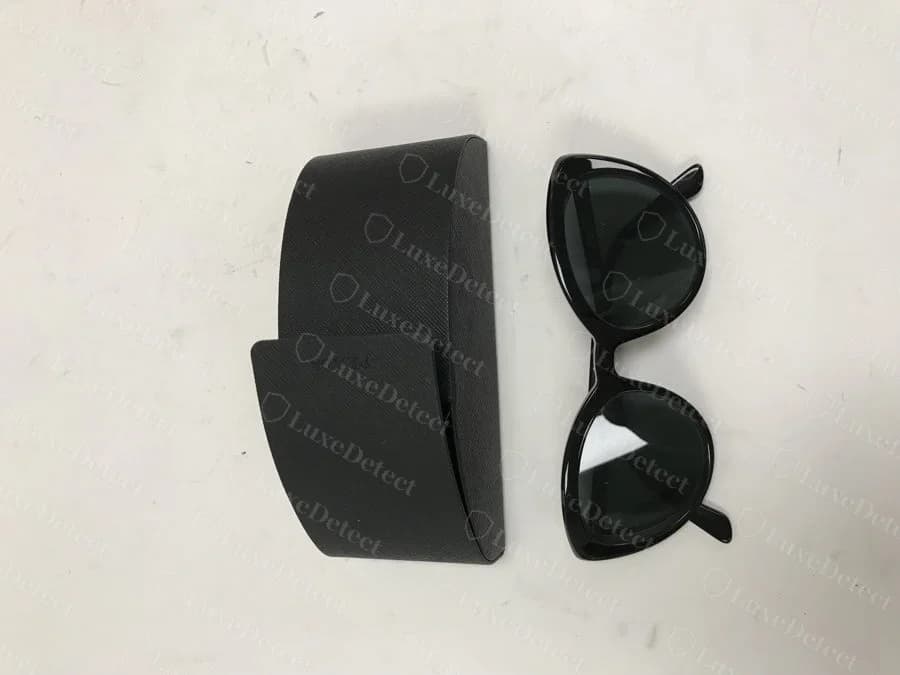
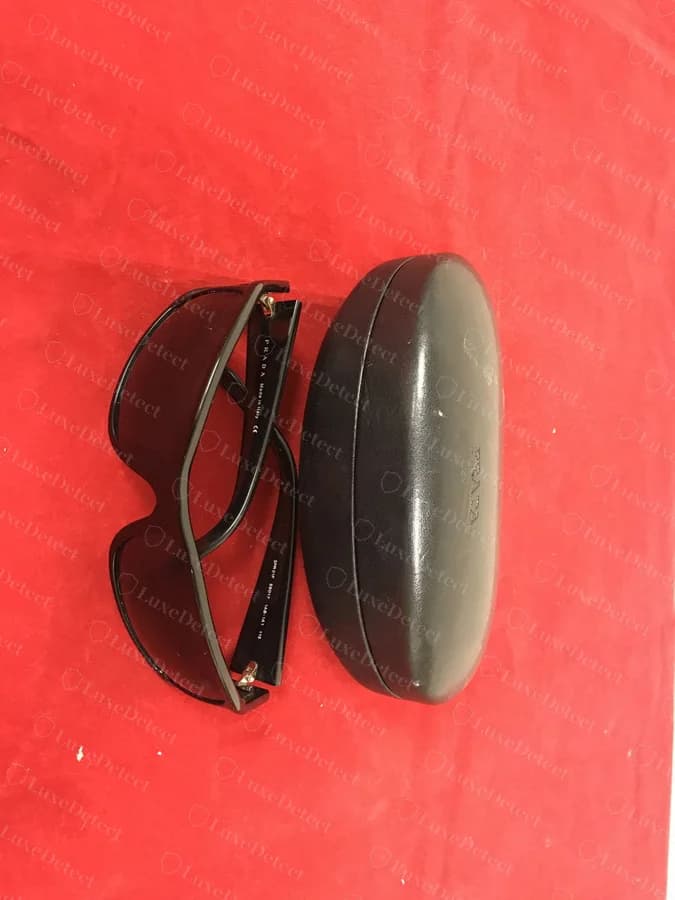
Authentic: A saffiano cross-hatch textured leatherette (or smooth leather on older styles) with a crisply debossed "PRADA" logo on the lid, evenly applied stitching, and a consistent black or brand-color interior lining.
Fake tells: The mirror-reversed logo described in Checkpoint 1 appeared on a case in our sample, which is the clearest disqualifying sign. Beyond that, weigh the case the way you would any other packaging: it corroborates, it doesn't decide.
Worth knowing
The case, cloth, and any paperwork are the cheapest parts of the package to reproduce and are frequently sold separately from the frame itself. A correct case never confirms a pair is genuine on its own; only a clearly wrong one (like the reversed logo we found) counts as decisive.
Quick Authentication Checklist
- Fold both temples outward and compare the "PRADA" logo on each side, and on the case if present, for correct left-to-right orientation
- Check the hinge barrel edge for rough, sawtooth machining marks under close light
- Read the full temple stamp block (brand, Made in Italy, CE mark, model/size code) for spacing and letterform consistency, but don't treat a clean stamp alone as confirmation
- Tilt the lens under light to look for a faint laser-etched alphanumeric code
- Confirm "Made in Italy" specifically; any other stated origin is disqualifying
A reversed logo on either the frame or the case is sufficient on its own to reject a pair. Short of that, treat rough hinge machining as a strong supporting signal and everything else (stamp quality, case, lens etch) as corroborating context rather than a standalone verdict.
When to Get a Professional Opinion
The checks above catch the mirror-reversed logo error and obvious hinge machining problems reliably, but our own sample also showed fakes with clean stamping, a correct case, and a plausible hinge in photos. Photo-based authentication is a fast, low-cost screening step precisely because it can check hinge and logo details a phone photo often can't resolve clearly enough on its own. LuxeDetect's accessories authentication runs $15 with a 24-hour turnaround (faster tiers available), which is proportionate against Prada eyewear's $300–$600+ retail range.
FAQ
Is there one Prada sunglasses model that's counterfeited more than others?
Not based on what we see in our own authentication volume. Fake submissions span dozens of different model codes across the SPR, VPR, and SPS lines with no single shape standing out, which is different from Prada's handbags, where a small number of lines (Galleria, Re-Edition 2005) account for most fakes.
Where is the model code on Prada sunglasses?
On the inside of one temple arm, stamped alongside the lens size, bridge width, and temple length in millimeters (for example "54⬜20 1AB-5S0 145"). It's always accompanied by "PRADA" and "Made in Italy."
Does a correct case and box mean the sunglasses are genuine?
No. Cases and boxes are sold separately and are the easiest component to fake. Only treat the case as informative if it shows something clearly wrong, like a reversed logo; a correct-looking case doesn't confirm anything on its own.
I can't find the laser-etched code on the lens — does that mean it's fake?
Not necessarily. The etch is faint and only visible at certain angles under direct light, so it's easy to miss on a genuine pair, and we don't have a confirmed pattern for how consistently counterfeits omit it. Don't treat its absence in a quick check as conclusive either way.
Are all current Prada sunglasses made in Italy?
Yes. Unlike some other categories where multiple legitimate manufacturing countries exist, current Prada eyewear production is Italy-only, so any other stated country of origin on the temple is a reliable red flag.
How much does professional Prada eyewear authentication cost?
$15 with a 24-hour turnaround for accessories, with faster tiers available. Against Prada eyewear's typical $300-$600+ retail price, that's a small fraction of the item's value for a documented verdict.