Eyewear Authentication Specialist
Luxury leather goods specialist. Works on Italian house construction, hardware, and interior stamping.
Published September 2026 · Contact
Why Versace Eyewear Doesn't Have One "Tell"
Versace has sold sunglasses and optical frames continuously since the 1980s, across acetate, metal, and mixed builds, in shield, aviator, cat-eye, oval, and rectangular shapes. Unlike a bag or a single sneaker silhouette, there's no one model dominating the counterfeit market: fakes turn up copying whatever shape is currently trending, old vintage Gianni-era frames, and everything between. That means a guide built around one specific frame's proportions would miss most of what's actually out there.
What does hold up across the range is how the brand executes its own signatures. Every genuine pair, regardless of era or shape, carries the Medusa head in metal hardware somewhere on the frame, and "VERSACE" printed or etched on the interior temple alongside a model code string. Counterfeiters reproduce both elements on almost every fake, so their presence proves nothing on its own — but the quality of the execution is where the gap between real and fake actually shows up, and it shows up consistently, on frames built ten years apart in completely different styles.
What to check, ranked by reliability
| Checkpoint | Reliability | What it tells you |
|---|---|---|
| 2. Logo Typography: Temple Print and Lens Etch | ★★★★★ | A visibly bolder, larger, or differently-shaped "VERSACE" wordmark, or a wavy lens etch baseline, is decisive against a genuine thin, precise reference. |
| 3. The Interior Temple Code String | ★★★★★ | A missing full model code string is a meaningful gap versus every genuine pair reviewed, but a plausible-looking code was not cross-checked against the real catalogue. |
| 1. The Medusa Hardware: Die Sharpness, Not Just Presence | ★★★★★ | Mushy, undefined hardware is a strong fail, but sharp hardware appeared on some fakes too and is inconclusive on its own. |
| Model Reference Before You Start | ★★★★★ | Confirms Italian production and the expected code format; will not catch a well-made fake on its own. |
| 4. The Case | ★★★★★ | No verified fake case was in the sample to compare, so treat the case as cross-reference context only. |
Model Reference Before You Start
- Versace eyewear uses two main numbering families: VE2xxx for metal-heavy optical and lighter sunglasses builds, and VE4xxx for acetate sunglasses (shield, cat-eye, oversized styles). Vintage Gianni Versace-era pieces (pre-2000s) use older reference formats like "MOD. H83" or "MOD. 4213-B" instead.
- The interior temple should carry the full code string: model number, colour code, lens size, bridge width, and temple length (for example "MOD. 4213-B 879/13 56□17 135"), plus "VERSACE MADE IN ITALY" and a CE mark.
- Versace frames are made in Italy. A frame claiming production anywhere else is not a genuine Versace frame.
- This guide covers sunglasses and optical frames broadly rather than one model, because the archive of confirmed fakes we reviewed didn't cluster around a single popular shape — it was spread across shield sunglasses, aviators, cat-eye acetates, and vintage ovals in roughly even numbers.
The Medusa Hardware: Die Sharpness, Not Just Presence
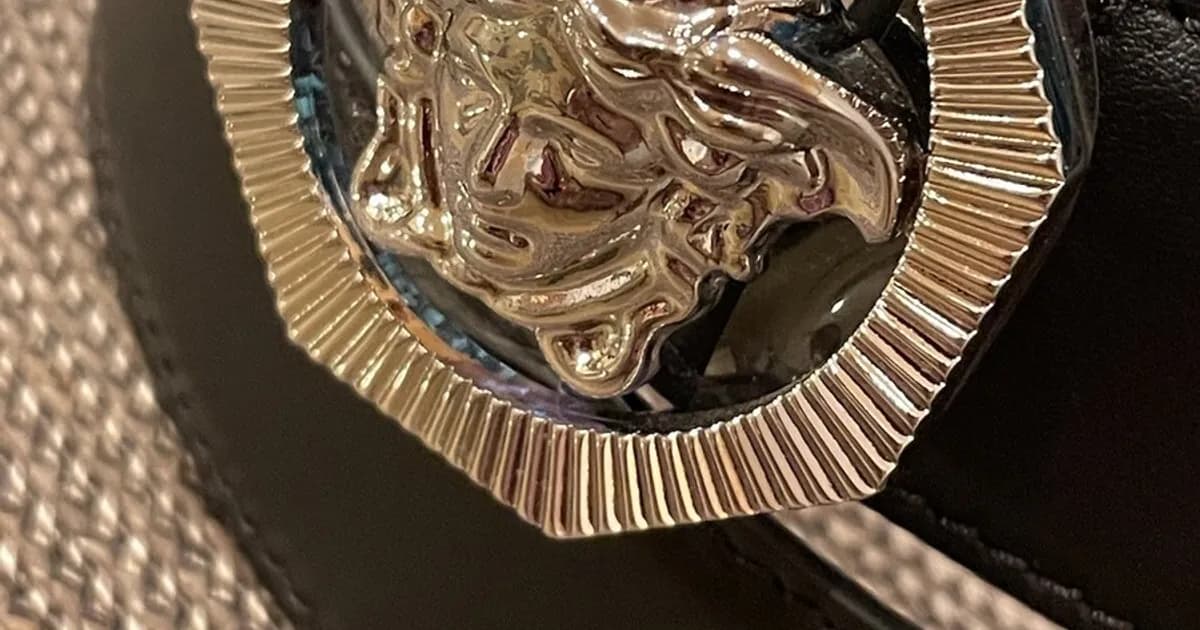
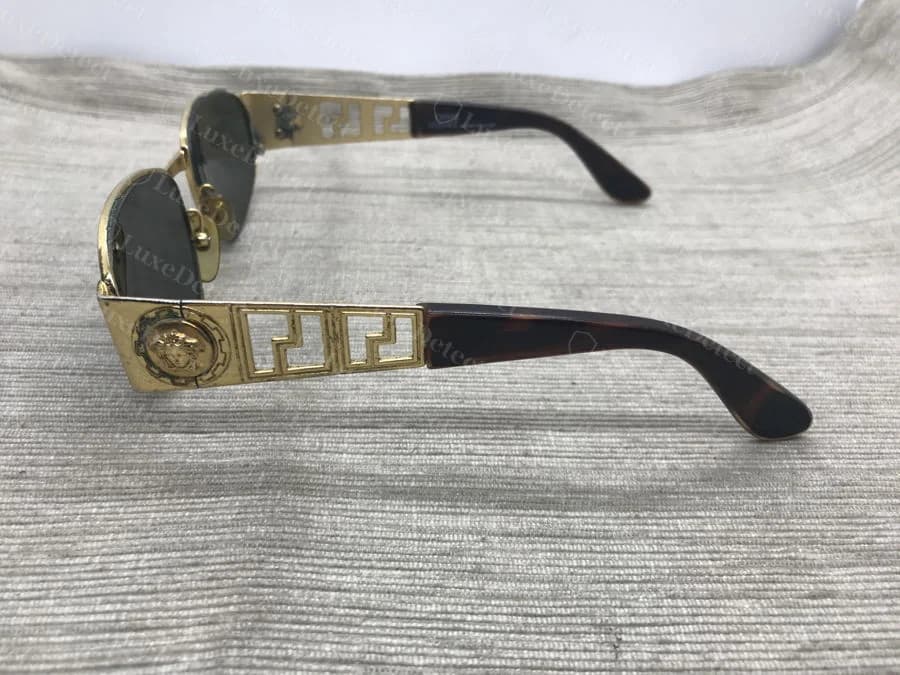
Every authentic pair we reviewed carried a Medusa head in solid metal, either as a round medallion set into a Greek-key temple plaque, a standalone applique on the bridge or temple, or a smaller face motif screwed to a lens edge on rimless styles. The detail was consistently sharp: individually defined hair coils, a distinct facial structure, and, where a surrounding ring is part of the design, a crisp Greek-key border with even, undistorted repeats.
Counterfeit quality on this specific point varied more than expected across the fakes we looked at. Some fakes had genuinely well-executed Medusa hardware, close enough that this check alone didn't separate them. But on the weaker fakes, the medallion was a shallow, mushy die-strike: the face reduced to a blob with no defined features, and the Greek-key border (where present) uneven or missing sharpness, sitting slightly recessed as if glued into a separate disc rather than struck flush with the surrounding metal.
| Element | Authentic | Counterfeit |
|---|---|---|
| Medusa facial detail | Distinct features, individually defined hair coils | Ranges from crisp to a mushy, undefined blob depending on fake quality |
| Greek-key border (where present) | Sharp, even repeats, flush with the medallion | Shallow or uneven repeats on lower-quality fakes |
| Setting | Struck or cast flush with the metal plaque | Sometimes visibly recessed into a separate disc on weaker fakes |
Worth knowing
Medusa hardware quality is not a reliable pass/fail test on its own. Several fakes in our sample had well-defined, sharp medallions indistinguishable from genuine at this resolution. Treat mushy, undefined hardware as a strong fail, but treat sharp hardware only as inconclusive, not as confirmation.
Logo Typography: Temple Print and Lens Etch
This was the most consistent gap we found across the sample, regardless of frame style or fake quality tier. Genuine Versace temple text ("VERSACE MADE IN ITALY CE") is thin, evenly kerned, and printed in a consistent light sans-serif weight, laid flat and straight along the temple arm. Lens-etched "VERSACE" on rimless styles follows the same weight and precision, sitting level along the lens edge.
On multiple fakes in our sample, the "VERSACE" wordmark was printed noticeably heavier and larger than any authentic example we found, in a bolder, slightly different letterform, often overlaid on a printed Greek-key pattern rather than alongside genuine cut or etched hardware. On a rimless shield fake, the lens-etched "VERSACE" had a visibly wavy, uneven baseline instead of sitting level, and the applied Medusa piece was screwed on slightly askew relative to the etch line beside it.
| Element | Authentic | Counterfeit |
|---|---|---|
| Temple wordmark weight | Thin, light sans-serif, evenly kerned | Some fakes print it noticeably bolder or larger, in a mismatched font |
| Lens etch baseline | Straight, level along the lens edge | Wavy or crooked baseline seen on at least one fake in our sample |
| Code string on temple | Full string: model, colour code, lens/bridge/temple sizes | Often abbreviated to just "VERSACE MADE IN ITALY" with no model code, or absent entirely |
Red flag
A "VERSACE" wordmark that's noticeably bolder, larger, or in a different letterform than the thin, precise etching on a verified genuine pair is a real tell we could point to directly in more than one fake in our sample. It's not universal, since some fakes get the typography close, but a font that reads visibly "off" is decisive against it — no genuine Versace temple print looks hand-drawn or oversized.
The Interior Temple Code String
Every authentic pair we reviewed, across eras from vintage Gianni-era opticals to current-production sunglasses, carried a full code string on the interior temple: model number, colour code, and the lens/bridge/temple measurements (e.g. "MOD. 4213-B 879/13 56□17 135 3N" or "MOD. H83 COL. 03X 55 17"), stamped or printed in the same thin, precise lettering as the wordmark.
Several fakes in our sample carried only "VERSACE MADE IN ITALY CE" with no accompanying model code string at all, which is a meaningfully different information footprint than every genuine pair we found. Where a fake did include a code-like string, we could not verify it against a real model database for every example, so we're not claiming a specific wrong code as a tell here, only the presence or absence of the string itself, and the print quality it's rendered in.
Worth knowing
We could not cross-check every fake's printed code against Versace's actual model catalogue, so a plausible-looking code number is not proof of authenticity on its own. Its complete absence, on a pair that should carry one for its era and construction, is the more reliable half of this check.
The Case
The authentic cases we reviewed (both a black leatherette hard case and a lighter hard case) carried a debossed or foil-stamped Medusa face or "VERSACE" wordmark rendered with the same clean, precise line quality as the frame's own branding, not a printed sticker or a shallow, blurry emboss. We did not have a confirmed-fake case in our sample to compare directly, so we can't point to a specific case tell from a counterfeit example.
Worth knowing
We don't have a verified fake case in this sample to compare, so treat the case as supporting context, not as an independent check. A convincing case proves nothing about the glasses inside it, and a missing or generic case doesn't prove a fake either, since cases are frequently lost or swapped independent of the frame's own authenticity.
What a Case or Box Alone Does Not Prove
A branded case is easy to source separately from the frame, whether reused, purchased loose, or bundled by a reseller. Use it only to cross-reference details, such as whether a model number printed inside a case matches the one etched into the temple, never as standalone evidence of authenticity.
Quick Authentication Checklist
- Check the Medusa hardware for sharp, individually defined features. A mushy, undefined medallion is a fail; a sharp one is inconclusive on its own.
- Read the temple wordmark. Compare its weight and letterform against a known genuine reference. A visibly bolder, larger, or differently-shaped "VERSACE" is a strong fail.
- Look for the full model code string on the interior temple (model number, colour code, lens/bridge/temple sizes), not just "VERSACE MADE IN ITALY."
- If the frame is rimless with a lens etch, check that the etched text sits level and straight, not wavy or crooked.
- Treat the case as context only, useful for cross-referencing a model number, never as evidence on its own.
A clearly wrong wordmark (check 2) or an absent code string paired with mushy hardware is enough on its own to reject a pair. A single ambiguous result, like sharp hardware with no code string, is worth a closer professional look rather than a snap verdict either way.
When to Get a Professional Opinion
Versace's frame catalogue is too broad, and counterfeit quality too inconsistent within it, for a confident DIY call on every pair. The checks in this guide catch a meaningful share of fakes, particularly the typography and code-string gaps, but we found genuine-quality Medusa hardware on some fakes in our own sample, which means a pair that clears every check here still isn't a guarantee. If you're buying a specific model secondhand, a photo-based check against the model's actual production reference is worth the cost of being wrong.
Photo-based authentication for eyewear starts at $15 with a 24-hour turnaround, faster tiers available. A professional check can cross-reference the model number against the real production catalogue for that reference, something this guide's sample size didn't let us do exhaustively ourselves.
FAQ
Where is the model number on Versace sunglasses?
On the inside of one temple arm, printed or etched alongside "VERSACE MADE IN ITALY" and a CE mark. It should read as a full string: model number, colour code, and lens/bridge/temple measurements, for example "MOD. 4213-B 879/13 56□17 135."
Does every Versace frame have a Medusa head?
Every genuine pair we reviewed did, in some form: a round medallion on the temple, a standalone applique on the bridge, or a smaller motif on a lens edge for rimless styles. But the Medusa's presence alone doesn't confirm authenticity, since counterfeits copy it too, sometimes convincingly.
Can a fake Versace have sharp, well-made hardware?
Yes. In our sample, some counterfeits had Medusa hardware sharp enough that hardware quality alone didn't separate them from genuine. Don't rely on hardware sharpness as a standalone pass; use it alongside the temple typography and code string checks.
Is "Made in Italy" enough to prove a Versace frame is real?
No. It's a necessary detail (a frame claiming another country of origin isn't genuine), but the text itself is easy to copy. Its value is in combination with the print quality and the full code string, not as a check on its own.
Why doesn't this guide focus on one Versace sunglasses model?
Because the counterfeit examples we reviewed weren't concentrated on one popular shape. They spanned shield sunglasses, aviators, cat-eye acetates, and vintage oval opticals in comparable numbers, so a single-model guide would have left most of the real-world fakes uncovered.
How much does it cost to authenticate Versace sunglasses?
Photo-based authentication starts at $15 for eyewear with a 24-hour turnaround. It's worth it on any pair where the typography and code-string checks in this guide don't give a clean answer either way.
Does a Versace case prove the glasses are authentic?
No. We didn't have a verified counterfeit case to compare in our sample, so we can't point to a specific case tell, but as a rule, cases are swapped and reused separately from the frame, so treat a case as supporting context only.