Watch Authentication Specialist
Watch authentication specialist covering Swiss manufacture references and bracelet construction.
Last updated October 2026 · Published September 2026 · Contact
Why the Navitimer Is Hard for Fakes to Get Right
The Navitimer is the most complicated dial Breitling makes for the money: a circular slide rule around the edge, a busy chronograph layout, and dense, fine printing everywhere. A steel Navitimer B01 Chronograph 43 retails around $9,000–$9,500, in the same range where you'd authenticate a TAG Heuer Carrera. That complexity is a gift to an authenticator, because a slide-rule bezel is roughly a hundred small printed numbers and index marks that all have to be the right size, the right font, and in exactly the right place. Fakes almost always slip somewhere on that bezel.
The dial and bezel are still where you start, but the checks that settle it are mechanical and physical: how the chronograph resets, what the serial engraving looks like, and what movement sits behind the caseback. This guide ranks them accordingly.
What to check, ranked by reliability
| Checkpoint | Reliability | What it tells you |
|---|---|---|
| The Movement Through the Caseback (B01 References) | ★★★★★ | A B01 reference with no column wheel behind the caseback is running a dressed-up clone — decisive. |
| The Chronograph Reset and Pusher Feel | ★★★★★ | A chronograph hand clearly off 12 or creeping back points to a cheap movement; a hair off can be wear or service. |
| The Slide-Rule Bezel Printing | ★★★★★ | Numerals that drift in spacing or misalign with the scale graduations are a fake tell visible first. |
| The Caseback Serial and Engraving | ★★★★★ | Fuzzy or wrong-font serials and papers that disagree with the caseback support a verdict; reused serials and digit counts do not. |
| Model Reference Before You Start | ★★★★★ | A reference whose movement, caseback or chronometer status contradicts the watch is a fast fail. |
| What the Box and Papers Do and Do Not Prove | ★★★★★ | Boxes, COSC certificates and cards are reproduced — cross-check the serial against the caseback only. |
Model Reference Before You Start
The Navitimer has run for decades in many forms. Pin down the reference so you know what movement and caseback it should have.
- Navitimer B01 Chronograph (41 / 43 / 46) — in-house Breitling Calibre 01, column wheel, ~70-hour reserve, display caseback, COSC chronometer.
- Navitimer Chronograph, Calibre 13 — ETA/Valjoux 7750 base, found on older Navitimer references (Breitling has since moved the line to its in-house calibres), usually solid caseback.
- Navitimer Automatic 35 / 41 — three-hand, no chronograph, no slide rule on some.
- Older references (e.g. 806, 1806 Chrono-Matic, A23322) — vintage, with different serial formats and casebacks. Movements range from manually wound chronographs to the automatic Chrono-Matic, so check what the specific reference should contain.
The reference is on the caseback and the papers, in a format like `AB0138241`. A letter-prefixed reference has been Breitling's convention for decades. Confirm the movement, caseback type and chronometer status for that exact reference on breitling.com before checking anything else.
The Slide-Rule Bezel Printing
This is the Navitimer's signature and the fakes' most consistent weak point.
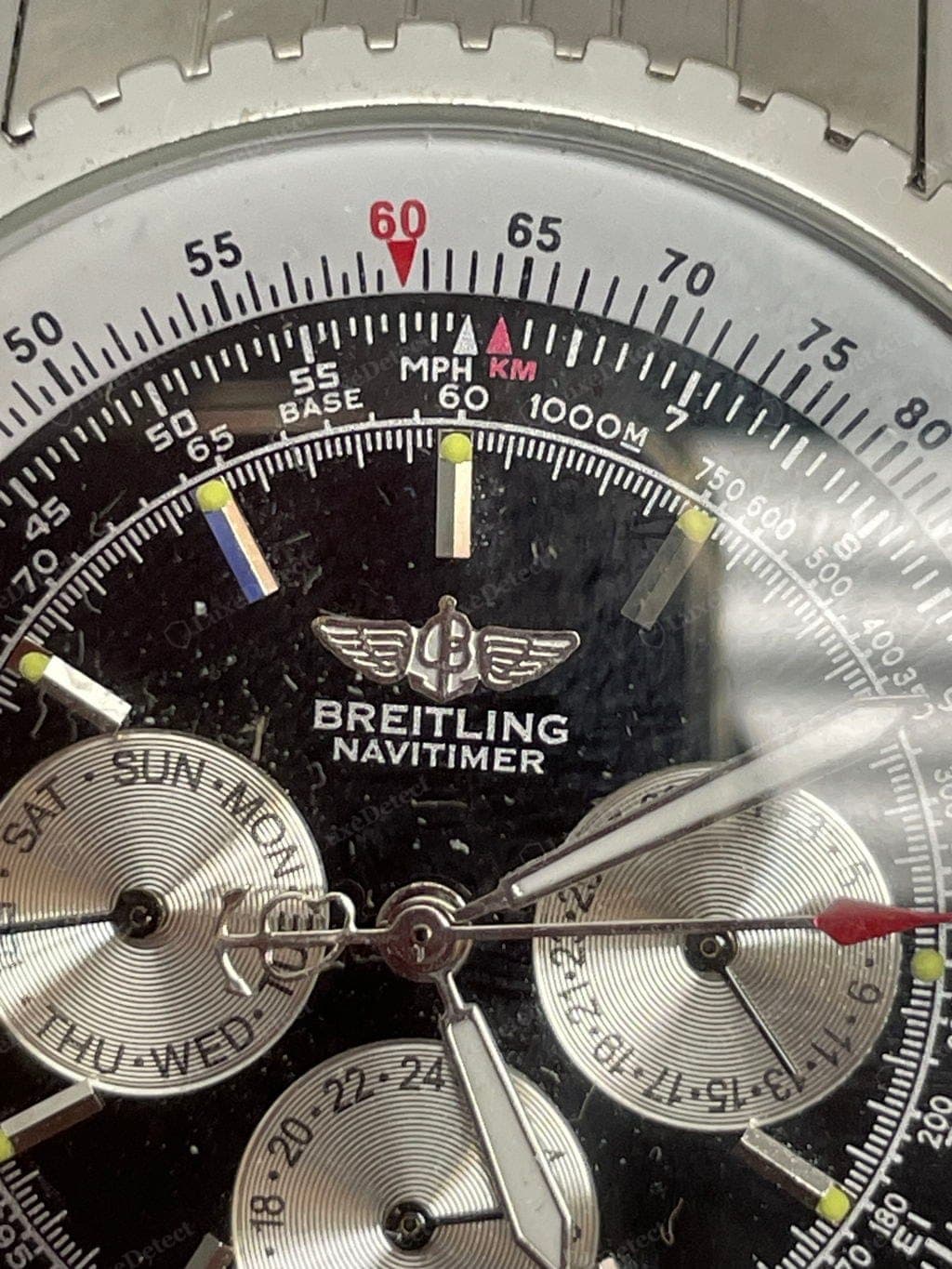
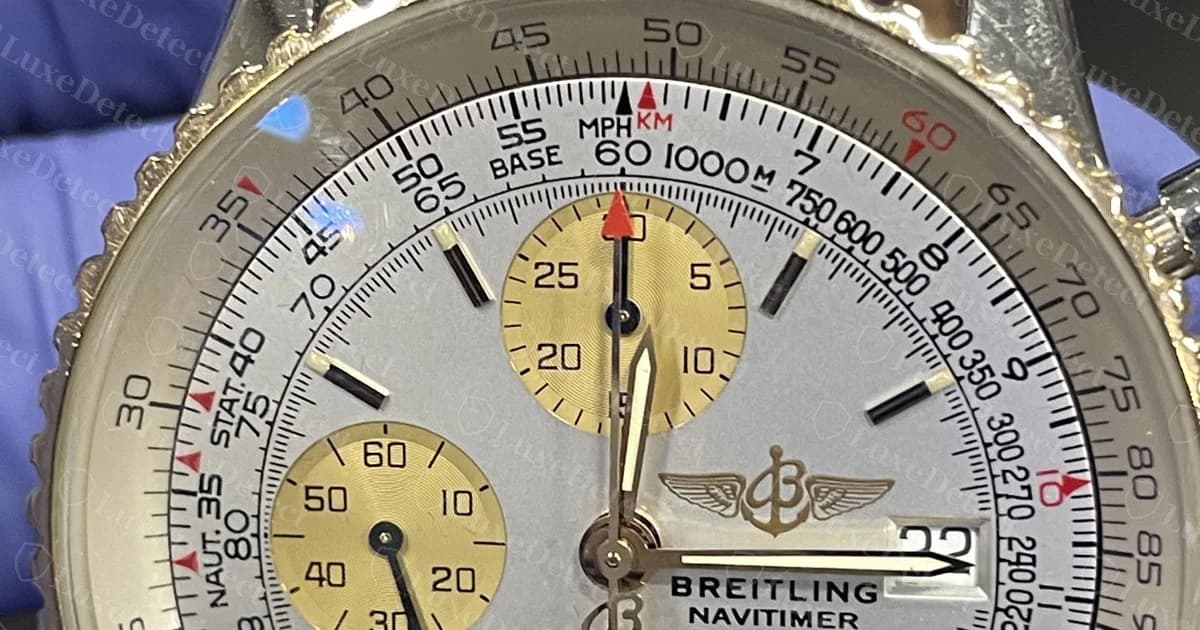
On a genuine Navitimer the bezel scales (the outer rotating slide rule and the fixed inner scale) are printed razor-sharp, in Breitling's specific condensed numerals, evenly spaced all the way around. Every tiny number is fully formed with consistent stroke weight. The alignment marks line up precisely with the scale graduations. The dense printed look is crisp, not smudged.
Fakes get this wrong in small, cumulative ways: numerals slightly too fat or too tall, uneven spacing that drifts as it goes round the dial, printing that looks soft or slightly doubled under a loupe, and index marks that do not quite line up with their numbers. The rotating bezel on a genuine watch turns with even, defined clicks (bidirectional on modern references); a fake often turns gritty or loose.
| Element | Authentic | Counterfeit |
|---|---|---|
| Slide-rule numerals | Sharp, condensed, consistent stroke weight | Fat, tall, or soft/doubled under a loupe |
| Spacing around the dial | Even all the way round | Drifts, crowds up in places |
| Scale-to-index alignment | Marks line up exactly with graduations | Slight misalignment, marks between numbers |
| Bezel rotation | Even defined clicks, no slop | Gritty, loose, or uneven |
Red flag
Slide-rule printing that is uneven or drifts in spacing as it travels around the bezel. Breitling prints this scale to a fixed geometry; numerals that crowd or stretch in places are a fake tell that is visible before you pick anything else apart.
The Chronograph Reset and Pusher Feel
Like any chronograph, the Navitimer's movement gives itself away at the reset.
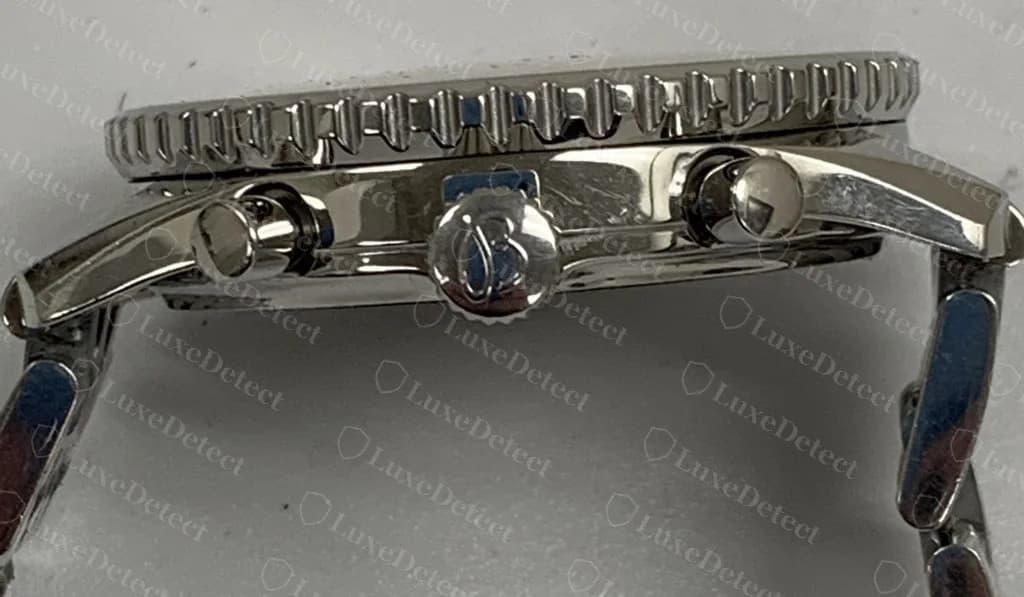
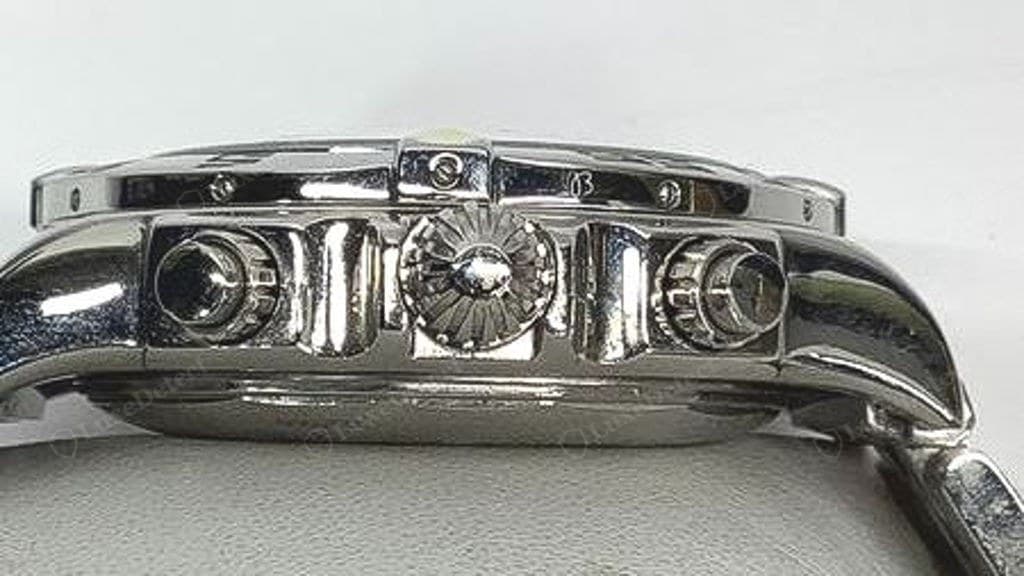
Run the chronograph, then press reset. On a genuine Navitimer the central chronograph seconds hand normally flies straight back to 12 instantly, and any active sub-dial hands return to their zero marks. The pushers give firm resistance and a clean single click. On a B01 reference the action is especially crisp because of the column wheel.
Fakes either reset slowly or land the hand clearly off 12, or they reset acceptably but with vague, spongy pushers and long travel before the mechanism engages. Be fair to the watch, though: a genuine chronograph that has been knocked or is overdue for service can rest a hair to one side of 12 (the hand is adjusted by the watchmaker), so judge the whole behaviour, not a single needle-width.
| Element | Authentic | Counterfeit |
|---|---|---|
| Chrono seconds reset | Instant, at or very near 12 | Lands clearly off 12, or creeps back |
| Sub-dial hands at reset | Return to zero (a hair off can come from wear or service) | One or more park clearly off zero |
| Pusher action | Firm, single positive click | Spongy, long travel, gritty |
| Running seconds sub-dial | Even, regular advance on an automatic (quartz Navitimers tick once a second) | Irregular, lazy or stuttering tick on a watch sold as automatic |
Red flag
A chronograph hand that lands well off 12 after a reset, creeps back slowly, or leaves the sub-dial hands off zero. Breitling sets the reset to the marker at the factory. A hand a needle-width out can simply be a genuine watch that needs adjusting, so weigh it with the pusher feel and the movement, but a hand that is clearly off the marker is a strong sign of a cheap movement.
The Caseback Serial and Engraving
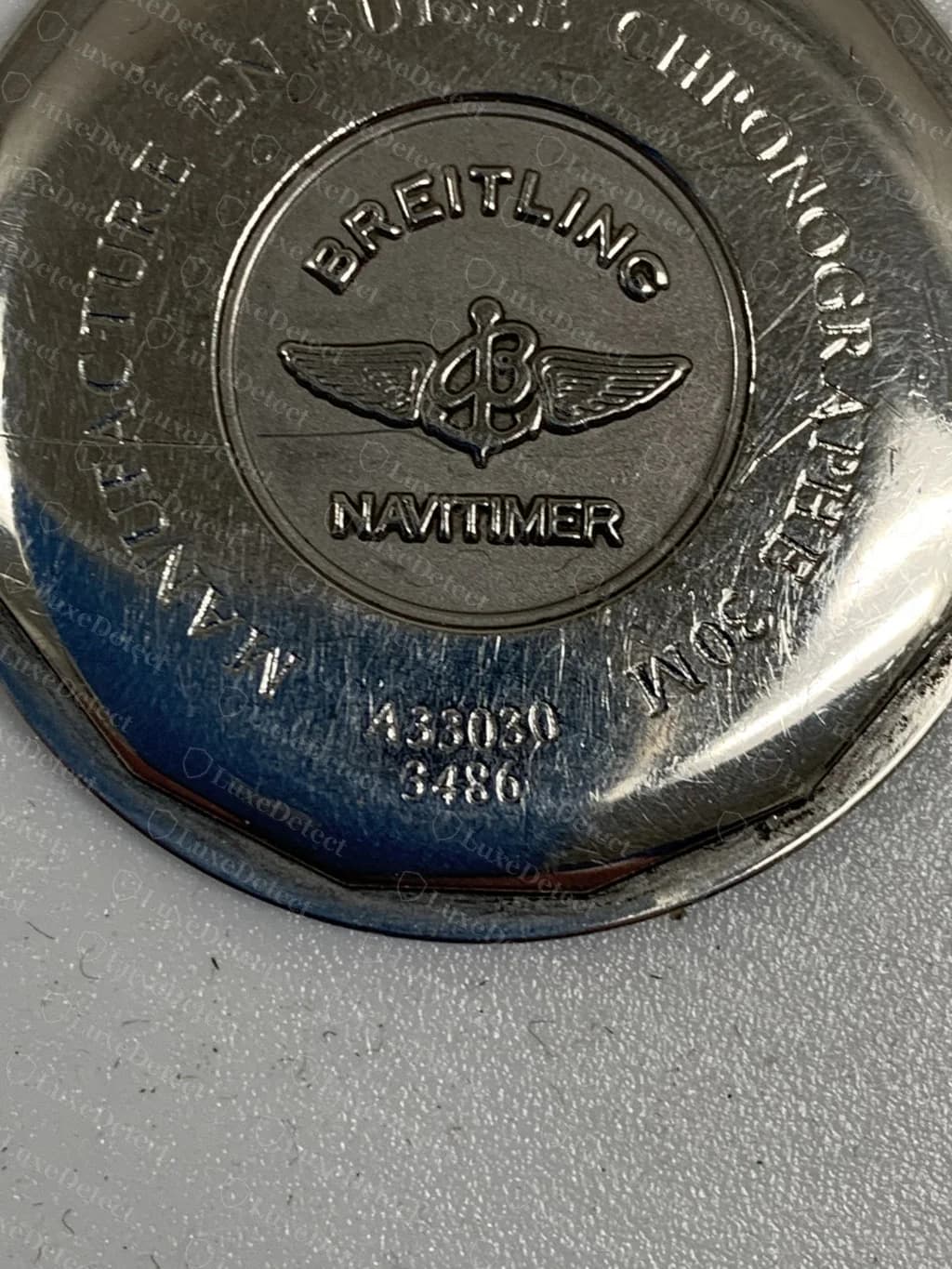
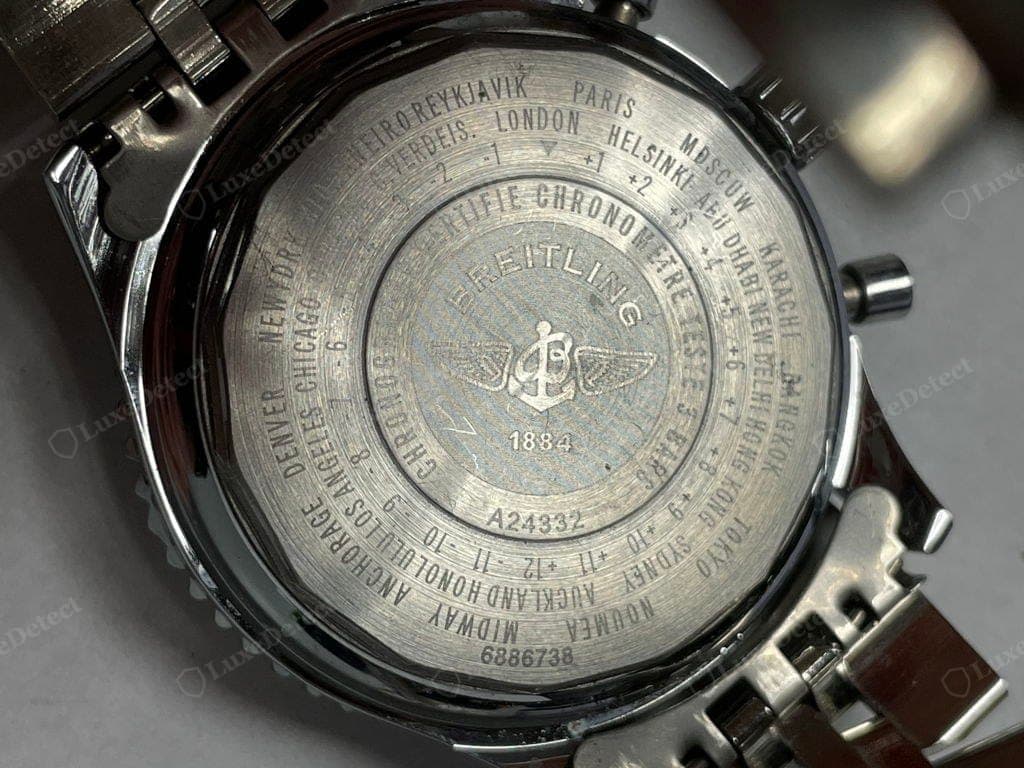
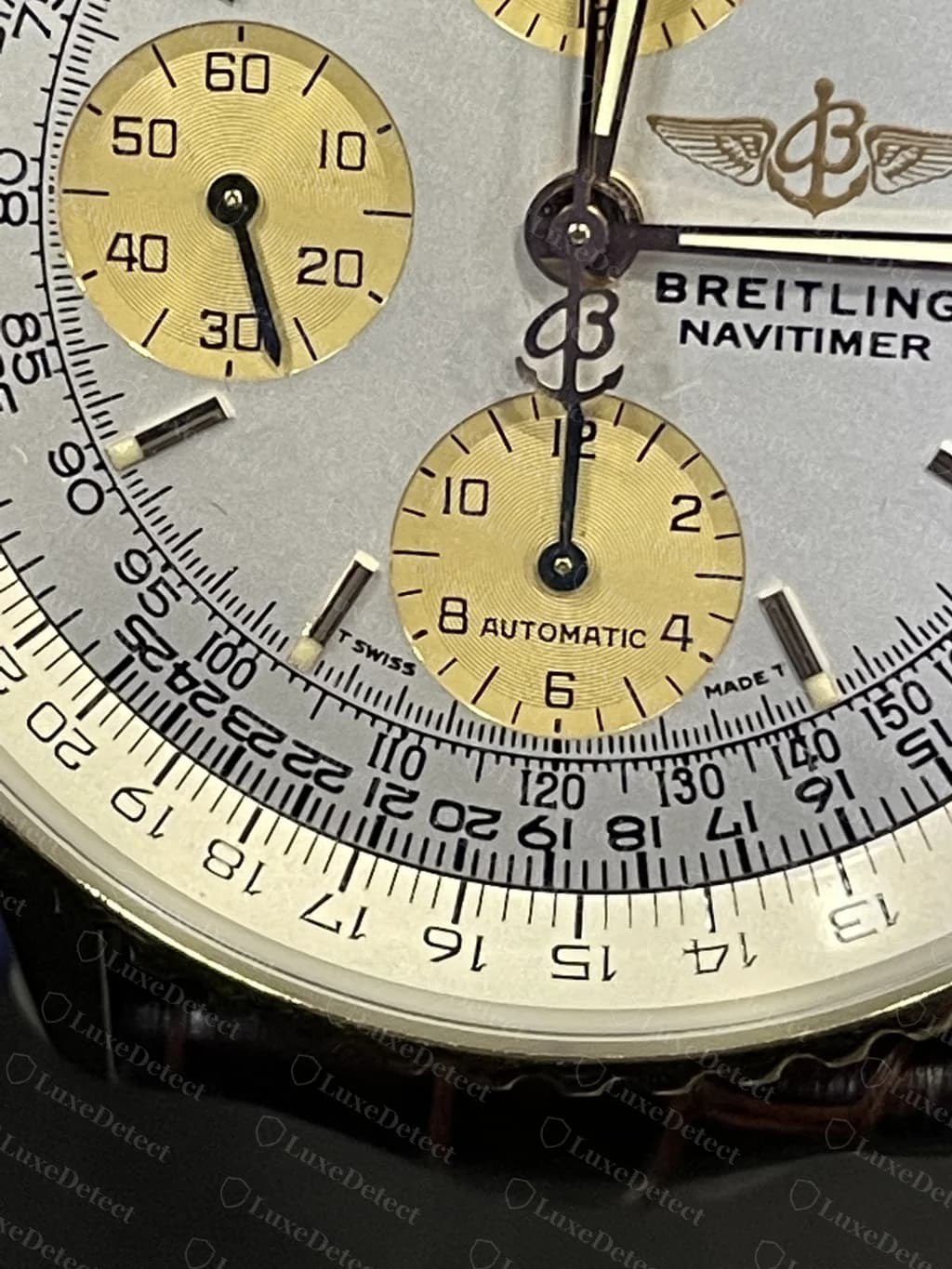
On a genuine Navitimer the serial number is usually engraved on the caseback (sometimes elsewhere on the case on older references). Breitling serial formats vary widely by era and reference: the genuine caseback pictured above carries just a four-digit number under the reference, while later watches carry longer ones, so do not fail a watch on digit count alone. Look for clean, sharp edges in Breitling's typeface.
Under a loupe, genuine engraving is precise with even depth. Weaker fakes show serials that are fuzzy, shallow, unevenly spaced, or in a slightly wrong font — but better fakes can cut a comparably clean caseback, so don't treat crisp engraving alone as a pass. On many Breitling chronometers the same number is also on the movement and the COSC certificate, but that is not true of every reference or era, and a replaced movement or a service caseback can legitimately differ. Treat a case/movement difference as a question to ask, not as a verdict. A serial that returns a different model when checked with Breitling is a stronger concern.
| Element | Authentic | Counterfeit |
|---|---|---|
| Serial engraving | Laser, sharp edges, even depth | Often fuzzy, shallow, or stamped — though a clean-looking engraving does not rule this out |
| Serial length / format | Varies by era and reference, Breitling font | Wrong font, uneven spacing, or a format that does not fit the reference's era |
| Serial ↔ papers and COSC certificate | Match the caseback and the reference | Differ from the caseback, or name another reference |
| Caseback fit | Flush, evenly machined, crisp knurling | Gaps, soft edges, rough knurling |
Worth knowing
Breitling can verify a serial against its records, but a "matching" serial you find quoted online proves nothing on its own — counterfeiters reuse known-good serials, and a crisp engraving is not proof either, as the sample pictured shows. Treat the serial and its finish as one input, checked alongside the movement and reset rather than decisive alone.
The Movement Through the Caseback (B01 References)
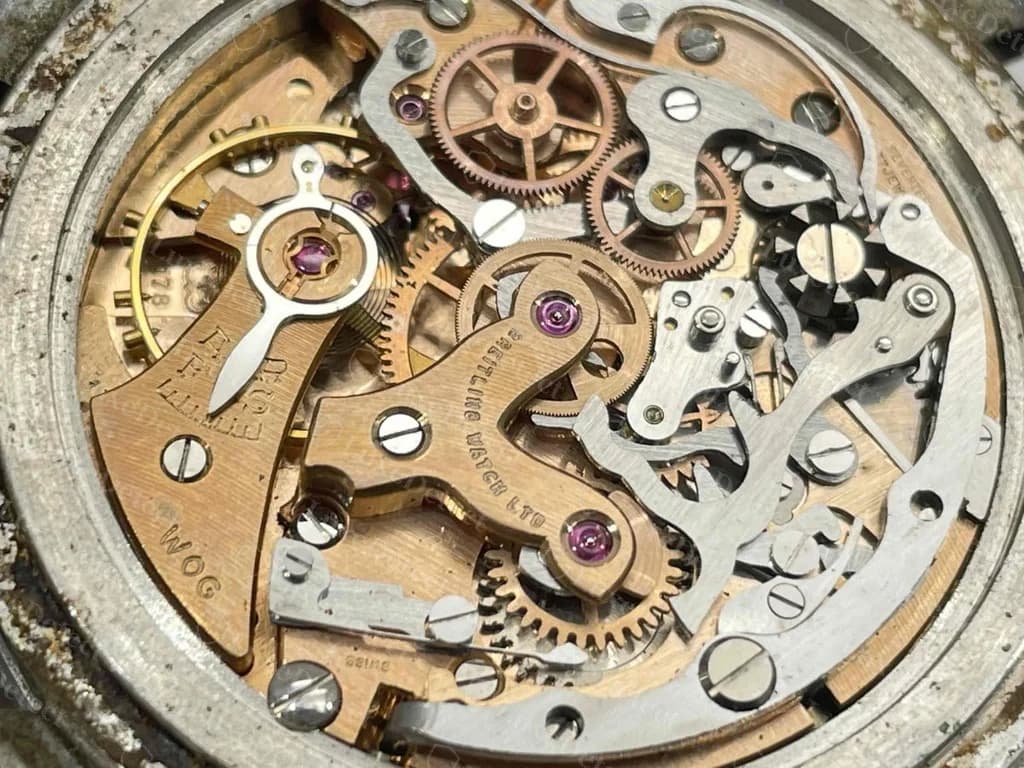
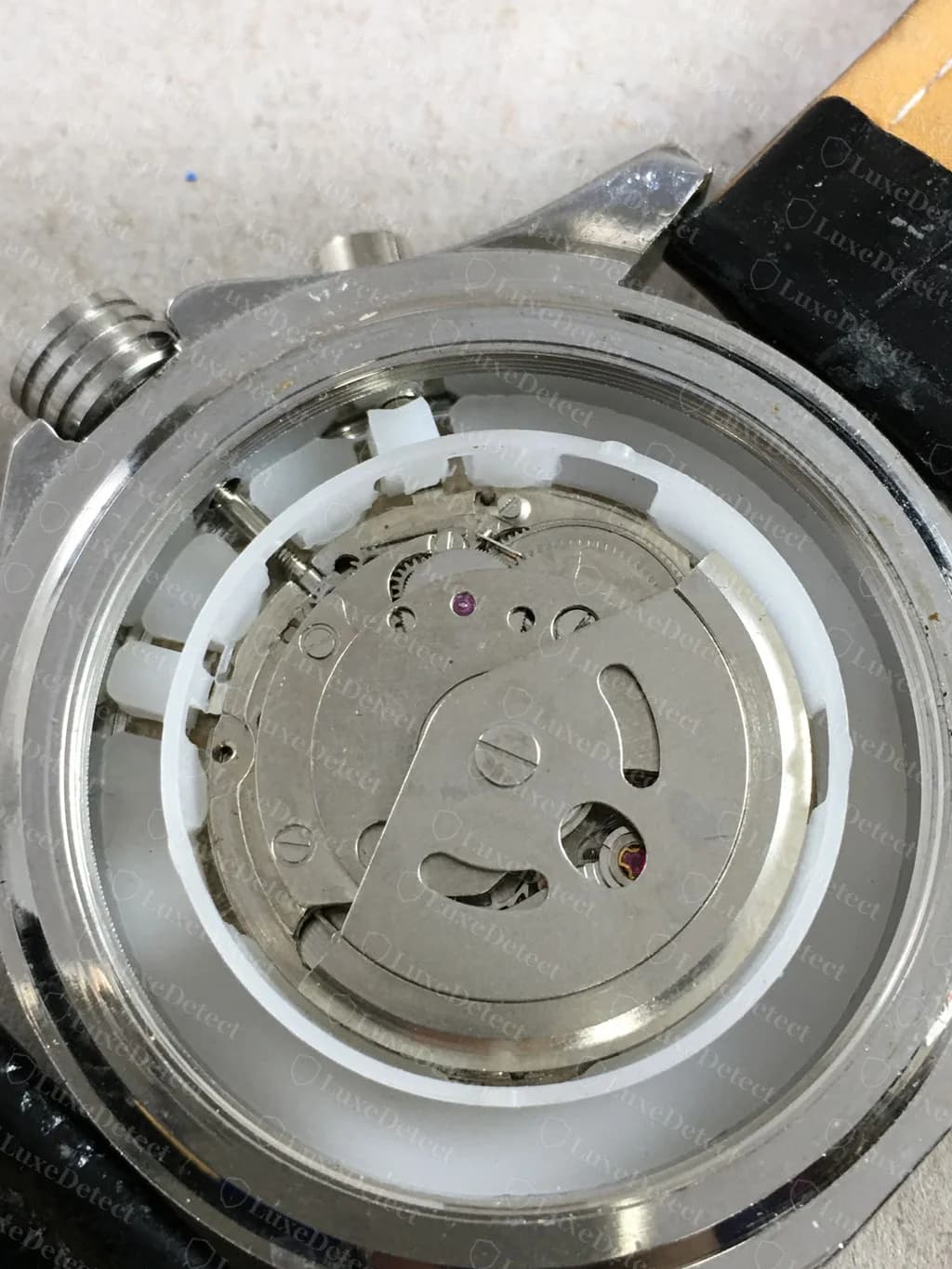
If the reference has a display back, the movement is your best evidence. The Breitling Calibre 01 is an in-house column-wheel, vertical-clutch automatic, COSC-certified. Behind the sapphire you should see:
- A column wheel coordinating the chronograph.
- A rotor engraved "BREITLING" and often "MANUFACTURE", with consistent finishing and a correctly seated bearing.
- Bridges with clean bevelling, "SWISS MADE", the jewel count, and "CHRONOMETER" wording on COSC references, and a balance oscillating smoothly at 28,800 bph.
Fakes of B01 references often use a dressed-up Asian automatic, such as a 7750 clone or a Seagull base. Tells: cam switching instead of a column wheel, a rotor that is unsigned or wrongly worded, coarse machining, a movement sitting in a plastic spacer ring, and a stuttering balance. Do not over-read a signed rotor on its own: a genuine movement wears a signed rotor, but so can a good fake, so look at the whole layout, and remember that a Breitling with a three-hand or older movement is not expected to show a column wheel at all.
| Element | Authentic (Calibre 01) | Counterfeit |
|---|---|---|
| Column wheel | Present, visible | Absent, cam-switched layout |
| Rotor engraving | "BREITLING" / "MANUFACTURE", crisp | Unsigned, wrong wording, shallow |
| Bridge finishing | Even, clean bevels, correct text | Coarse grain, no bevelling |
| Balance | Smooth 4 Hz oscillation | Visible stutter, slow beat |
Red flag
A B01 reference with no column wheel behind the caseback. The Calibre 01 is a column-wheel movement; a cam-switched 7750-style layout in its place is decisive. Apply this only to references that should carry the Calibre 01.
Fantasy Models and Bentley-Style Fakes
Many of the Breitlings that reach us as counterfeits are not copies of a real reference at all. They are fantasy pieces: a Breitling-signed case with a slide-rule scale, a moonphase window, a visible gold tourbillon-style balance and the words "Automatic Multifunction" on the dial, on a heavily knurled bezel.
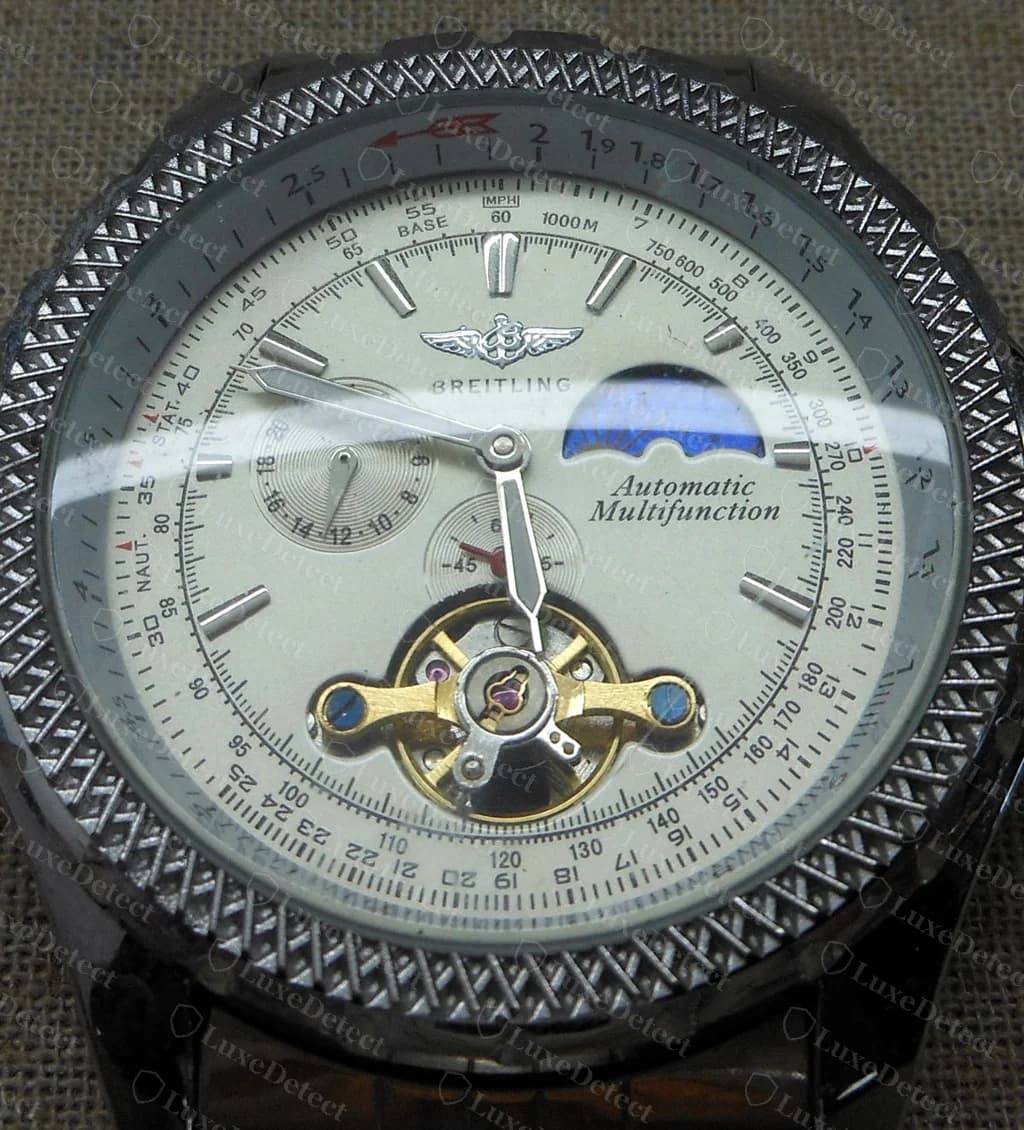
Breitling does make some moonphase, perpetual calendar and tourbillon watches, so a complication is not proof of a fake by itself. The check is whether that exact combination exists for that exact reference: look up the model on breitling.com, or compare it with the brand's own catalogue photos. A mix of features that no single Breitling reference offers (and a cheap-feeling movement behind it) is a clear fantasy fake. The same applies to casebacks that carry Bentley wording or special-edition engravings; compare the wording against the real model's caseback rather than assuming it is right.
What the Box and Papers Do and Do Not Prove
A full set adds resale value and nothing else to authentication. Breitling boxes, COSC certificates and warranty cards are reproduced, and genuine papers are routinely sold with fake watches — the same holds true when you authenticate an IWC Portugieser.
Packaging is context, not evidence. Cross-reference: the reference and serial on the warranty card and COSC certificate must match the caseback exactly, and the card should name a real retailer and a plausible date. A mismatch between the papers and the caseback serial is a red flag. A clean matching set around a watch that fails the reset or movement check is still a fake.
Quick Authentication Checklist
- Reference on the caseback matches a real Breitling spec (movement, caseback type, chronometer status)
- Slide-rule bezel printing is sharp, evenly spaced all the way round, marks aligned to graduations
- Bezel rotates with even, defined clicks
- Chronograph seconds hand snaps to 12 on reset (a hair off can be wear or service); pushers click firmly
- Caseback serial is cleanly engraved in the right font for the era, and matches the warranty card and COSC certificate
- B01 references: column wheel visible through the caseback, rotor correctly engraved
- Warranty card and COSC certificate reference/serial match the caseback
Two or more failures means walk away. A single clear failure on the chronograph reset, the movement (wrong calibre behind a B01 back), or grossly uneven bezel printing is on its own sufficient.
When to Get a Professional Opinion
The Navitimer's dial complexity makes crude fakes easy to reject, but the better replicas now reproduce the bezel and dial closely enough that a matching dial proves nothing on its own, and the deciding checks are the reset, the serial engraving and the movement. Replica 7750-based movements dressed as the Calibre 01 have improved, and separating one from the genuine in-house calibre is a job for someone who has opened both.
Our watch specialists review Breitling submissions from $45 with 24-hour turnaround and return a Certificate of Authenticity. Send straight-on dial and bezel photos sharp enough to read the slide-rule numerals, the caseback serial, the movement through the display back, and the warranty card next to the caseback.
FAQ
Where is the serial number on a Breitling Navitimer?
Engraved on the caseback, usually on the rim or between the lugs, and on many chronometer references the number is also found on the movement. Older references may carry it elsewhere on the case. It should match the serial on the warranty card and COSC certificate. Breitling can verify a serial against its records through a boutique or service centre.
What is the fastest way to spot a fake Navitimer?
Look hard at the slide-rule bezel. Genuine printing is razor-sharp and evenly spaced all the way around, with index marks aligned exactly to the scale graduations. Fakes drift in spacing, use slightly fat or tall numerals, and misalign the marks. It is the quickest single tell because there is so much of it to get wrong.
How do I check the movement in a Navitimer B01?
Look through the display caseback for the column wheel — a small toothed wheel that operates the chronograph. The in-house Calibre 01 is built around it. A cam-switching layout with no column wheel, or a rotor that is unsigned or wrongly worded, means the movement is not a genuine B01.
Do all Breitling Navitimers have a see-through caseback?
No. The B01 chronograph references have a sapphire display back; many Calibre 13 (7750-based) and older references have a solid caseback with engraving only. Confirm the caseback type for the exact reference before treating a solid back as suspicious.
Can Breitling tell me if my Navitimer is real?
Breitling can check a serial number against its production records and, at a service centre, open the watch and inspect the movement. That is the definitive route, much like the manufacturer checks available when you spot a fake Omega. A serial you find quoted as "genuine" online is not proof, because counterfeiters reuse real serials.
Are old Navitimers (references like 806) checked the same way?
Partly. Vintage Navitimers have different serial formats, different casebacks and different movements (some manually wound, some automatic such as the Chrono-Matic), so the reference-spec step matters even more. The chronograph reset and the movement are still decisive, but vintage authentication also involves period-correct parts, and is best handled by a specialist in older Breitling.