Senior Watch Authenticator
Last updated October 2026 · Published January 2026 · Contact
The Scale of the Problem
More counterfeit Rolex watches exist than genuine ones, and the fakes have got dramatically better — a "super clone" Submariner will fool most people on casual inspection. But most still fail on several technical points. This guide covers the checks in the order professionals run them, and says where genuine Rolex watches differ by era so you do not condemn a real vintage piece or a genuine quartz model.
What to check, ranked by reliability
| Checkpoint | Reliability | What it tells you |
|---|---|---|
| Serial and Model Numbers — Laser Engraving | ★★★★★ | On a modern watch, a serial your fingernail catches on and that looks stamped or etched under a loupe is a strong warning; vintage cut engraving can feel different. |
| The Bracelet — Clasp and Finishing | ★★★★★ | A gap where the end links meet the case fails a tolerance fakes frequently miss, and it needs no tools. |
| The Cyclops Lens — 2.5x Magnification | ★★★★★ | Magnification below 2.5x is among the most common Cyclops failures and shows at arm’s length. |
| The Crown Logo — Dial and Winding Crown | ★★★★★ | Crown markings that contradict the reference, such as a bare crown on a modern steel Submariner, are a strong prompt for the other checks. |
| The Dial — Printing, Indices, and Lume | ★★★★★ | Tilted applied indices, adhesive traces and patchy or wrong-era lume give away dials that pass at arm’s length. |
| The Movement — Second Hand Sweep | ★★★★★ | Clears cheap fakes quickly, but genuine quartz and slower vintage calibres exist, and super clones run cloned movements with a genuine sweep. |
| Model-Specific Checks | ★★★★★ | Decisive once you know the reference, worthless applied to the wrong one. |
| Box, Papers, and Service History | ★★★★★ | Context only — papers can be stolen or fabricated, and a genuine watch often outlives them. |
The Movement — Second Hand Sweep
Flip the watch over. If it has an exhibition case back, look at the movement. If it doesn't, watch the second hand.
The sweep test: most modern mechanical Rolex movements beat at 28,800 vibrations per hour, advancing the second hand 8 times per second, which reads as a continuous sweep. Many vintage mechanical calibres beat more slowly (commonly 19,800 or 18,000 vibrations per hour, roughly 5 steps per second), so an older Rolex looks slightly less smooth but still sweeps rather than ticks. A badly cloned mechanical movement ticks at 3–4 beats per second, a visible stutter.
Genuine exceptions: Rolex also made real quartz watches. The Oysterquartz (Datejust and Day-Date, produced from the late 1970s until 2001) uses Rolex's own quartz calibres and ticks once per second by design, so a ticking second hand on one of those is correct. The check is therefore "does the movement match the reference?", not "is the hand ticking?". A once-per-second tick on a modern Submariner, Datejust 126300 or Daytona is a serious warning; on an Oysterquartz it is expected.
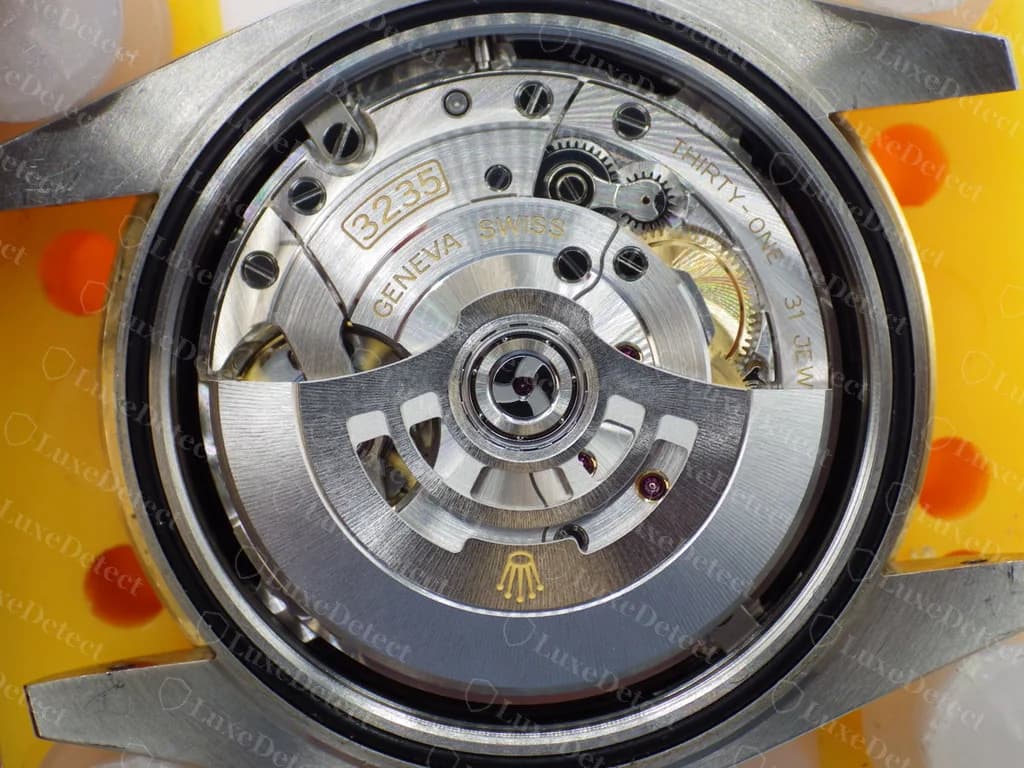
Inside the movement, if you can see it: the Rolex crown on the rotor, the calibre number (for example 3235) and "Geneva Swiss" markings on the plates or bridges, and the high level of finishing Rolex applies to modern calibres. Finishing differs by calibre and era, so do not hold a vintage movement to a modern calibre's decoration. If you see a blue component in a modern calibre, it is usually the blue Parachrom hairspring. The movement carries its own calibre number; it does not carry the case serial, so a claim that a mainplate "serial should match the case" is not a valid test.
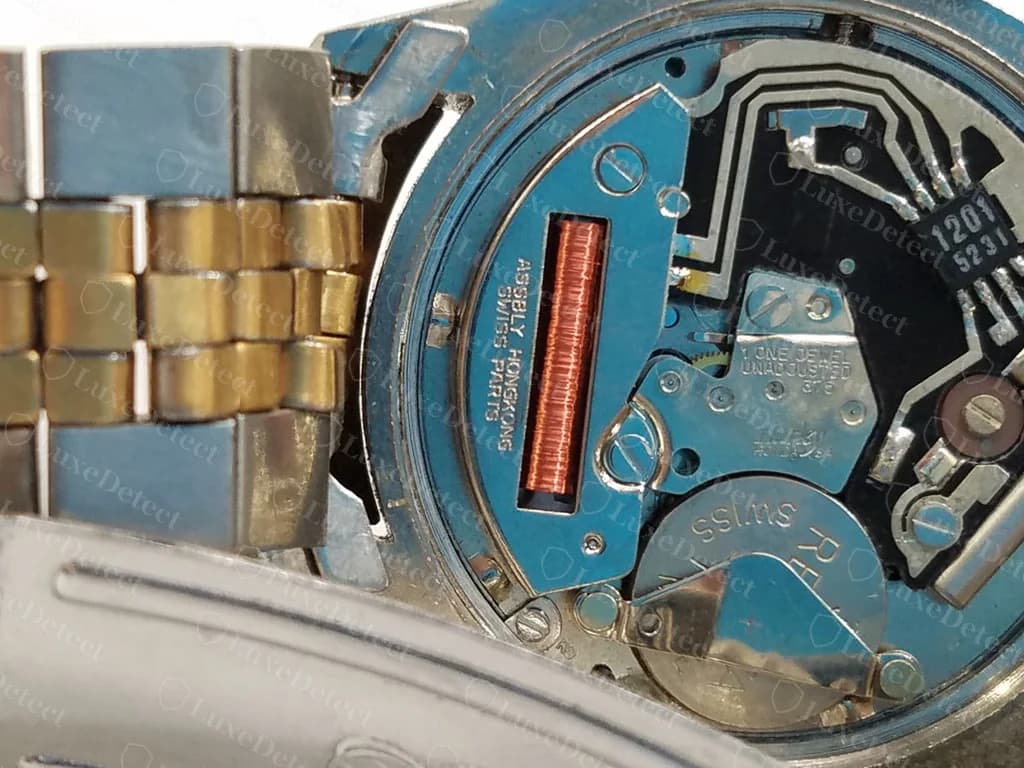
| Element | Authentic | Counterfeit |
|---|---|---|
| Second hand motion | Modern mechanical: 8 steps per second, a continuous sweep. Vintage mechanical: a slightly slower sweep. Oysterquartz: one step per second by design | A tick or stutter you can count on a reference that should be mechanical, or a movement that does not match the reference |
| Rotor | Rolex crown on the rotor, cleanly executed | Blank, generic, or a badly printed crown |
| Plates and bridges | Calibre number and "Geneva Swiss" engraved, high finishing for the era | Bare plates, a printed imitation of the finishing, or another maker's name |
| Movement markings | Calibre number matching the model family (the case serial is not on the movement) | Generic markings such as "unadjusted", a jewel count, or a third-party maker |
Red flag
A quartz module, a battery or a generic third-party movement inside a watch that should be a mechanical Rolex. A ticking second hand alone is not enough (Oysterquartz and slower vintage calibres are genuine), but a movement that does not match the reference ends the discussion.
Worth knowing
This check clears the cheap fakes and nothing more. Super clones run cloned cal. 3135 and 3235 mechanisms with a genuine sweep, so a correct sweep moves you to the next check rather than settling anything.
The Cyclops Lens — 2.5x Magnification
Most Rolex models with a date window have a Cyclops lens — a bubble of sapphire over the date, providing 2.5x magnification (Rolex's own figure). Hold the watch at arm's length: on a genuine Rolex the date fills the window and reads easily; on many fakes the magnification is weaker, so the date looks small and is hard to read at distance.
Know the exceptions before you judge: some genuine date models have no Cyclops. Older Sea-Dwellers (refs. 16600 and 116600) and the Deepsea carry a date window with a flat crystal, and the Sea-Dweller only gained a Cyclops with the 126600 in 2017. Pre-1950s Rolex had no date at all. Establish the reference first.
Check the numerals too. Genuine Rolex date text is a clean, consistent typeface, precisely spaced, sitting centred. Fakes show slightly off-centre numerals, a bold or condensed variant of the typeface, or a dome that doesn't align with the window centre.
| Element | Authentic | Counterfeit |
|---|---|---|
| Magnification | 2.5x, the date fills the window and reads at arm's length (on models that have a Cyclops) | Often weaker, the date looks small and is hard to read at distance |
| Presence | Cyclops on most date models; none on some Sea-Dweller and Deepsea references | A Cyclops added to a reference that never had one, or missing from one that should have it |
| Date centring | Numeral sits centred under the dome | Slightly off-centre, or the dome misaligned with the window |
| Numeral typeface | Clean, consistent, precisely spaced | A bold or condensed variant, uneven spacing |
Red flag
A date you have to squint at from arm's length on a reference that should have a Cyclops. The 2.5x lens is one of the harder parts to source correctly, and weak magnification is among the most common Cyclops failures. Confirm the model has one first.
Serial and Model Numbers — Laser Engraving
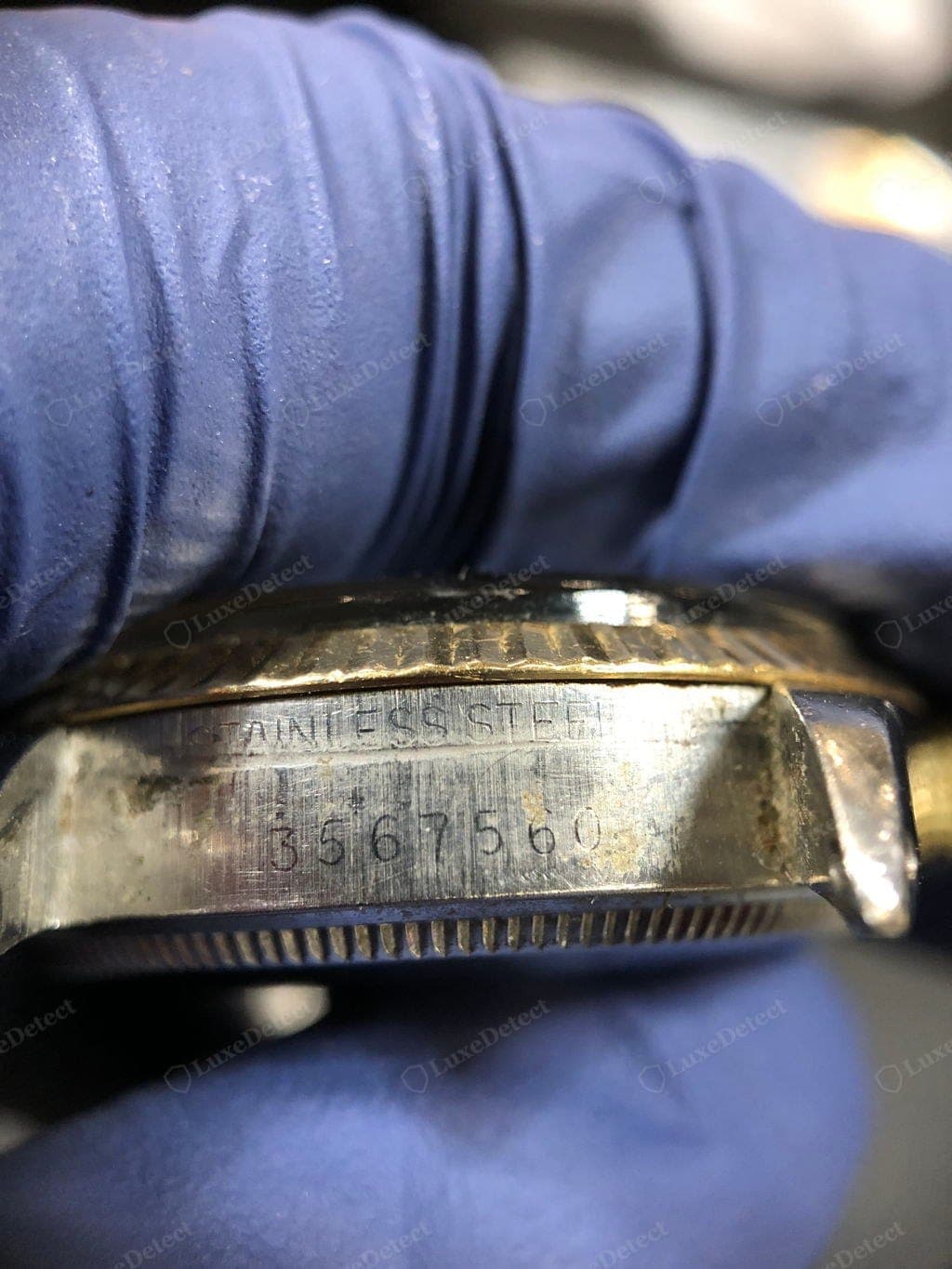
On older watches the serial number sits between the lugs at 6 o'clock and the model/reference number at 12 o'clock. Modern watches also carry the serial on the rehaut (the sloped ring between crystal and dial): Rolex began engraving "ROLEX" around the rehaut in the early 2000s (first examples around 2002–2004, widespread by about 2005), added the serial on the rehaut from about 2005, and phased out the lug serial around 2008–2010. The serial appears once on the rehaut, at 6 o'clock, while "ROLEX" repeats around the ring.
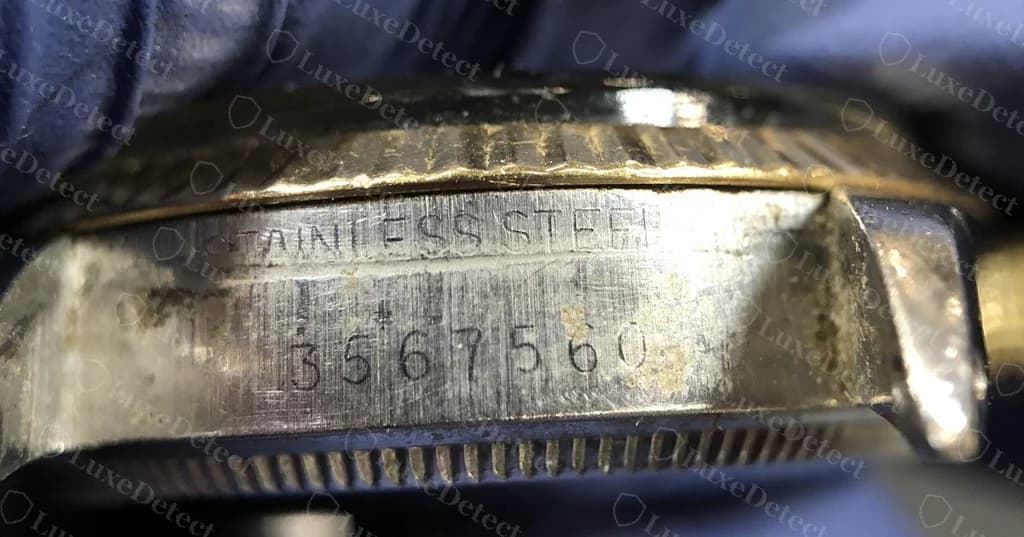
Modern Rolex serials and rehaut engraving are laser-engraved: very fine characters, sharp at the edges with no bleeding, evenly spaced, consistent in depth. Older cases (like the one above) were engraved by tool, so the characters look different and age and cleaning change them. Fakes are acid-etched (a slightly eaten look) or stamped (deeper, less refined) — visible under a 10x loupe. As a rough touch test on a modern watch, a fingernail across laser engraving usually feels a very smooth surface; stamped or etched numbers often catch. On a vintage or serviced watch a slight edge can be normal, so use the loupe rather than the nail.
Rolex's serial format changed three times: numbers only until about 1987, then a letter plus six digits until about 2010, then random 8-character alphanumeric serials from about 2010 (the changeover fell somewhere in 2009–2011). A format that contradicts the stated year is wrong.
| Element | Authentic | Counterfeit |
|---|---|---|
| Engraving method | Modern: laser micro-engraving, almost microscopic. Older: tool-cut engraving that has aged | Acid-etched (rough, eaten edges) or stamped (deep, less refined) |
| Character edges | Sharp with no bleeding, consistent depth throughout | Fuzzy, uneven depth, visible tool marks |
| Feel under a fingernail | Modern: usually smooth. Vintage: may carry a slight edge | A distinct ridge on a watch that should be laser-engraved |
| Rehaut engraving (about 2005 on) | "ROLEX" repeated around the ring, the serial once at 6 o'clock, precisely aligned to the minute track | Missing, misaligned, or crudely cut |
Red flag
A serial on a modern watch that your fingernail catches on and that looks stamped or acid-etched under a loupe. Genuine modern laser engraving normally leaves no tactile edge, so a ridge you can feel is a strong warning, but vintage cut engraving and refinished cases can feel different, so confirm it under magnification.
Decode the serial's era before you go further — a format that contradicts the claimed production year is worth more than any single physical tell:
Worth knowing
The serial gives you the production era, not the verdict. Rolex keeps no public serial database, so a plausible number confirms nothing on its own; what it catches is a contradiction between the format and the year the seller claims. The [Rolex serial number checker](/rolex-serial-number) covers the format changes in full.
A separate, strong tell: what's actually inside the caseback
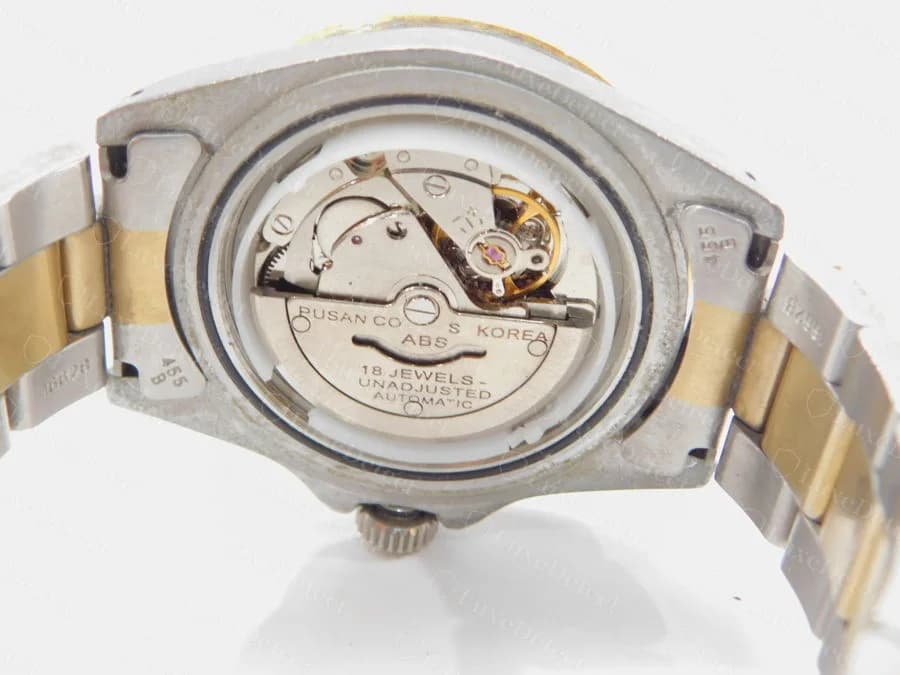
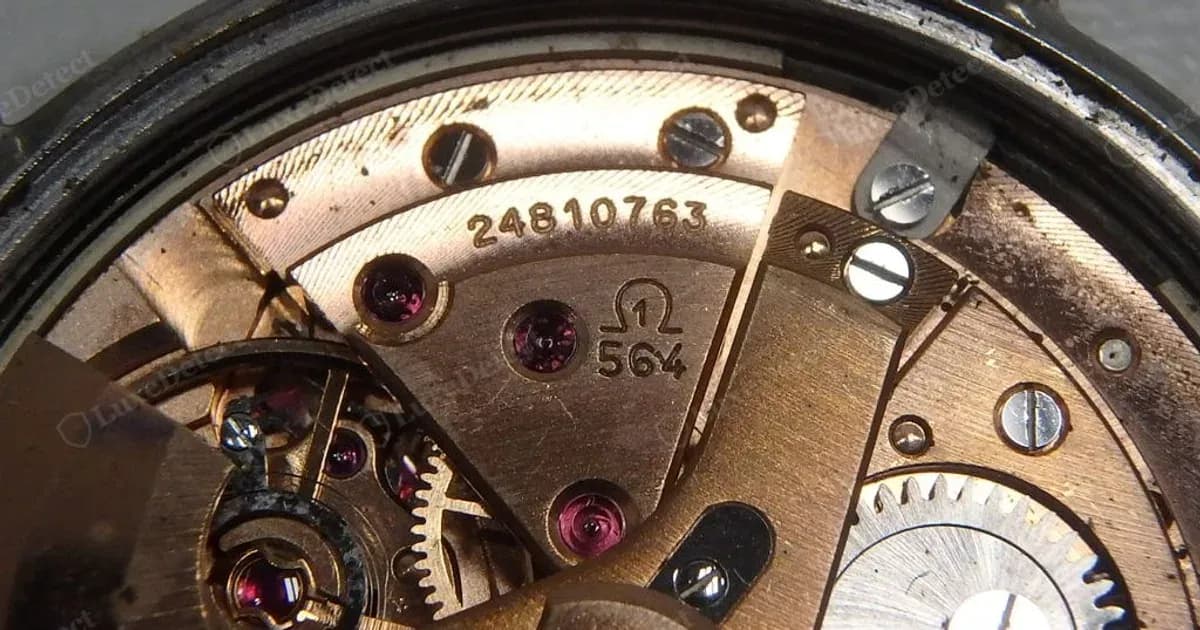
This is a different check from the lug engraving above: view through the caseback and read what the movement itself is stamped with. On this piece, the plate reads "Pusan Co S Korea — ABS — 18 Jewels — Unadjusted — Automatic." Rolex movements carry the Rolex crown and a Rolex calibre number; this is a generic mass-market movement dropped into a Rolex-branded case, not a clone of a Rolex calibre.
This is unrelated to the acid-etching/stamping quality question above — it's not a matter of degree. Where you can check it (an exhibition caseback, or a watchmaker willing to open a solid one), a movement stamped with an unrelated maker's name or generic "unadjusted" wording settles the question quickly.
The Crown Logo — Dial and Winding Crown
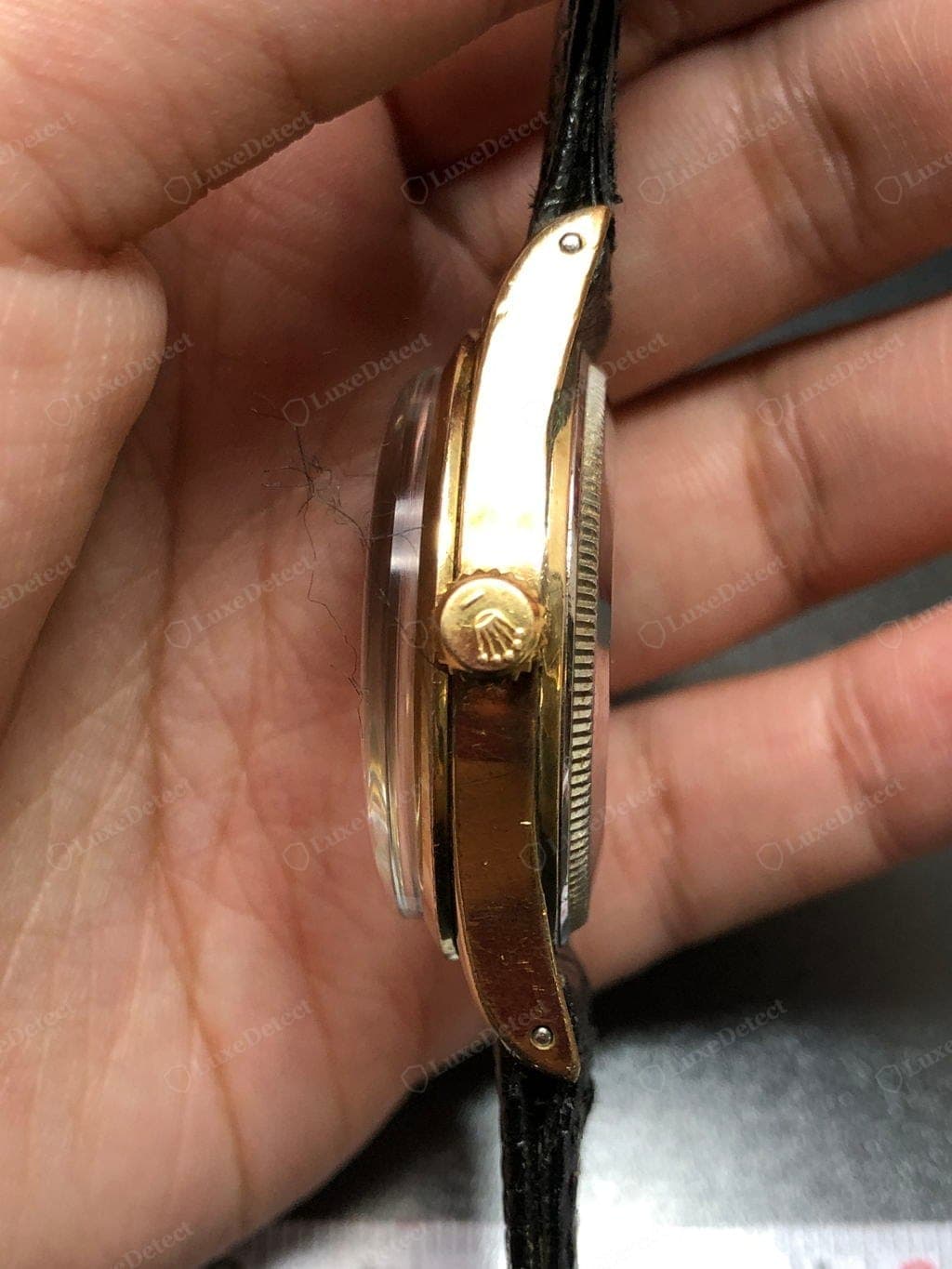
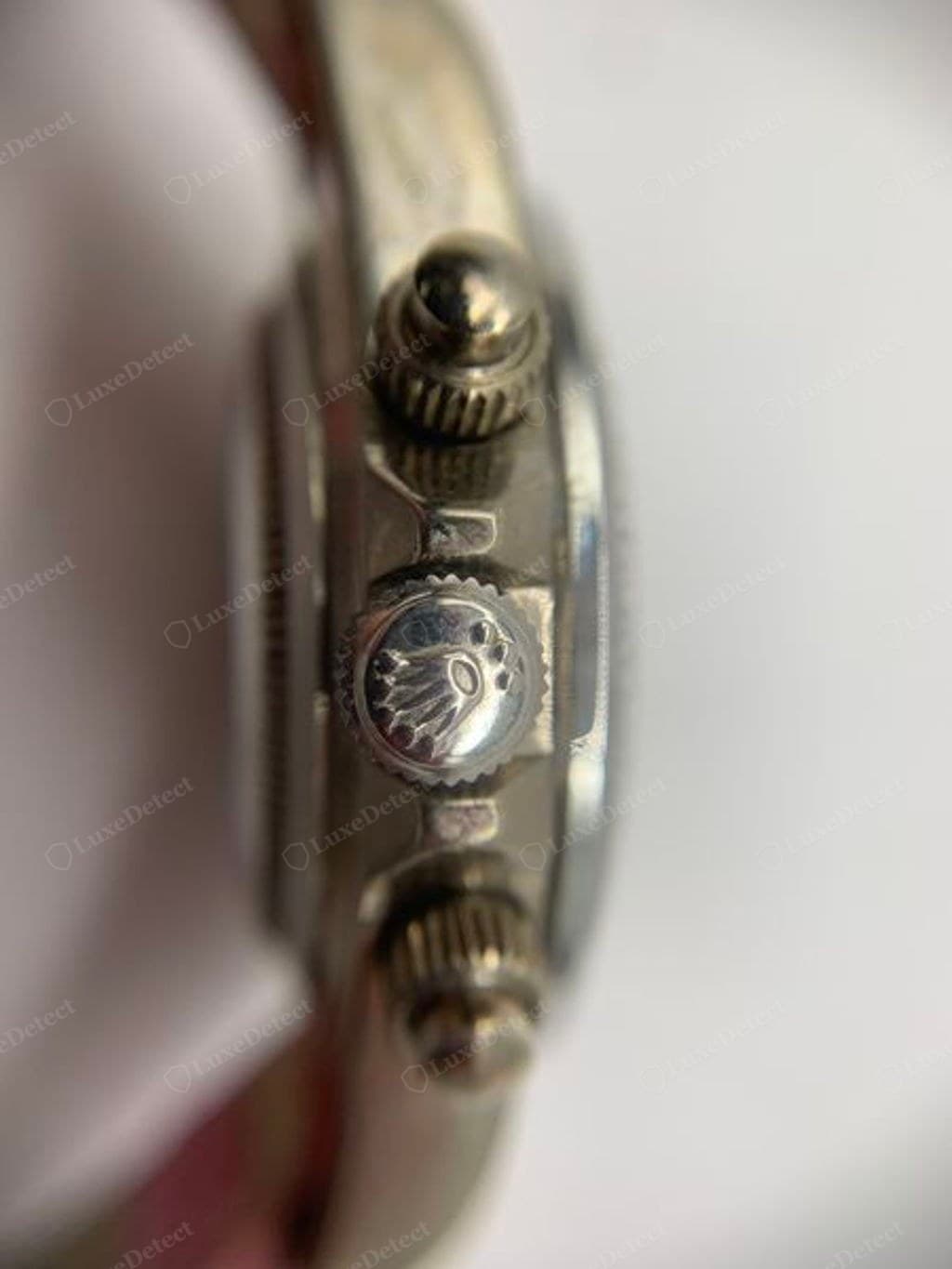
Rolex's five-point crown logo appears on the dial at 12 o'clock and on the winding crown at 3 o'clock.
On the dial: the crown is printed with a process that gives it slight three-dimensional relief — at a shallow angle authentic printing has texture and body, fake printing is flat. The five points should be identical in size and perfectly symmetrical.
On the winding crown: this is metalwork, not printing — the crown engraved into the outer face, clean and crisp with no tool marks. Fakes are often slightly misshapen, with one point taller or points rounded rather than sharp.
Markings under the coronet: on current-production watches the marks beneath the coronet show the crown system and the case metal, and they differ by model and era. On steel watches, three dots mean a Triplock crown (found on the Submariner, Sea-Dweller, Deepsea and Daytona and on many GMT-Master II references), while a solid line means a Twinlock crown (for example the Explorer II). Gold and platinum watches use different arrangements. Vintage crowns carry no dots at all, and a crown replaced at a service may differ from the original. Compare the marking to the reference in your hand, not to one fixed rule.
| Element | Authentic | Counterfeit |
|---|---|---|
| Dial crown printing | Slightly raised, three-dimensional at a shallow angle | Flat, no texture or body |
| Crown symmetry | Five points identical in size, perfectly symmetrical | One point taller, or points rounded rather than sharp |
| Winding crown logo | Engraved into the outer face, clean, no tool marks | Shallow, misshapen, or stamped |
| Markings under the coronet | Match the reference and metal, for example three dots on a steel Submariner or Sea-Dweller, none on a vintage crown | Dots or a line that contradict the reference, or irregular, uneven dots |
Red flag
A crown marking that contradicts the reference — for example a bare crown on a modern steel Submariner or Sea-Dweller. Those references ship with the Triplock crown and its three dots, but replacement crowns and vintage references exist, so treat this as a strong prompt for the other checks rather than a verdict alone.
The Bracelet — Clasp and Finishing
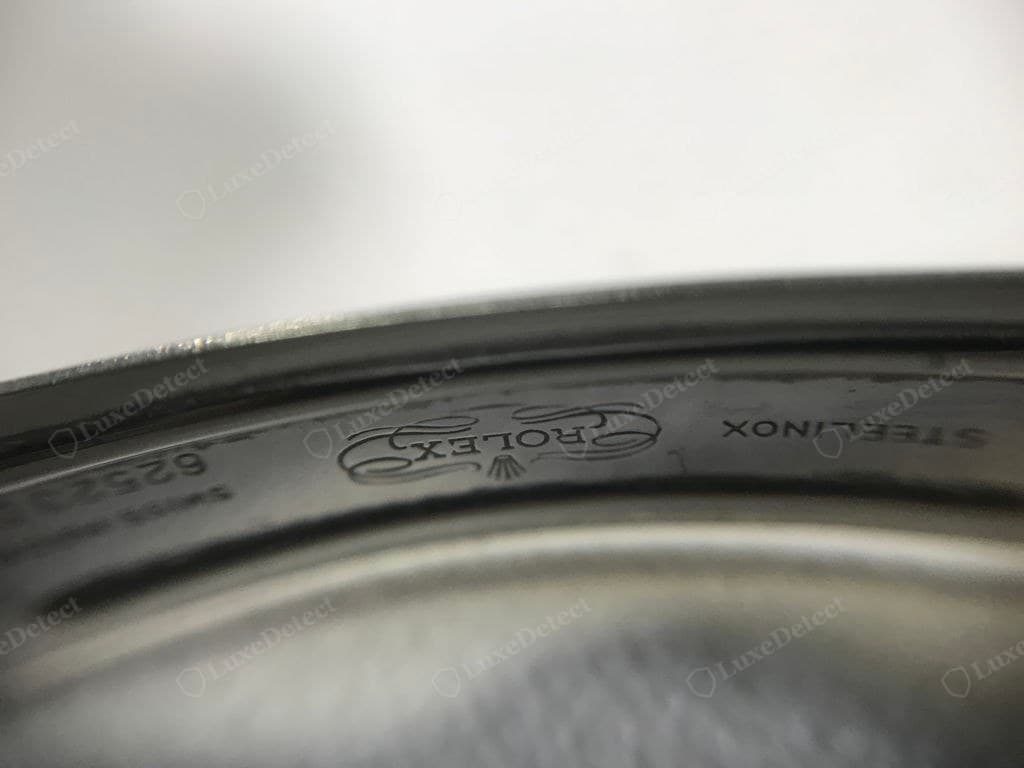
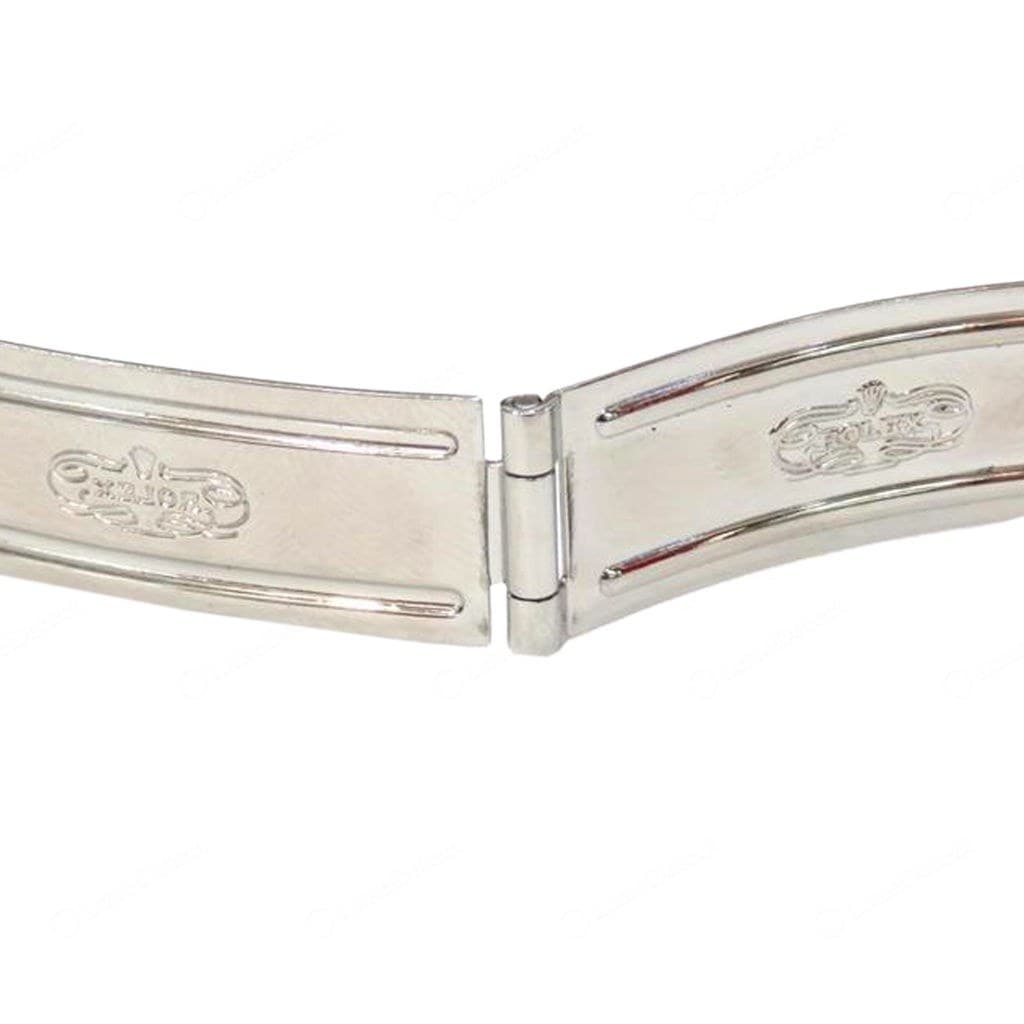
Modern Rolex steel is 904L (Oystersteel), harder and more corrosion-resistant than the 316L most watchmakers use. Rolex first used 904L on the Sea-Dweller in the late 1980s and moved all its steel models over by roughly the early 2000s, so older bracelets are 316L and vintage bracelets can have folded, hollow links. You can't identify the alloy by eye, but finishing quality is diagnostic:
- Alternating brushed and polished Oyster links with sharp transitions — mirror-bright polish, parallel brushed grain
- Crisp, not rounded, link edges
- A clasp that springs open and shuts with positive, firm resistance
- On modern Oysterlock and Easylink clasps, a micro-adjustment that operates smoothly both ways
The end links, where bracelet meets case, fit flush with essentially zero gap on a genuine modern Rolex (vintage bracelets stretch and may show a small gap; check that the end links match the case). Fakes often show a visible gap, or end links sitting proud. The clasp interior reads "ROLEX" or the model name in clean laser etching on modern clasps; older clasps are normally stamped, which can look softer.
| Element | Authentic | Counterfeit |
|---|---|---|
| End links | Fit flush to the case with essentially zero gap (modern) | A visible gap, or end links sitting proud of the case |
| Brushed and polished transitions | Sharp boundary, mirror-bright polish, parallel brushed grain | Soft or smeared transitions, cloudy polish |
| Link edges | Crisp | Rounded from cheaper finishing |
| Clasp action | Springs open and shuts with positive, firm resistance | Loose, rattling, or vague |
| Clasp engraving | Clean laser etching (modern) or crisp stamping (older) | Shallow, uneven, garbled or misspelled |
Red flag
A gap where the bracelet meets the case on a modern watch. Rolex holds tight end-link tolerances that fakes frequently miss, and it is visible without tools or magnification. On a vintage watch, a stretched bracelet or non-original end links can also leave a gap, so compare against the case.
Worth knowing
You cannot identify 904L steel by eye, so treat any seller who offers the alloy as proof as offering nothing. The finishing quality is the evidence, not the metallurgy.
The Dial — Printing, Indices, and Lume
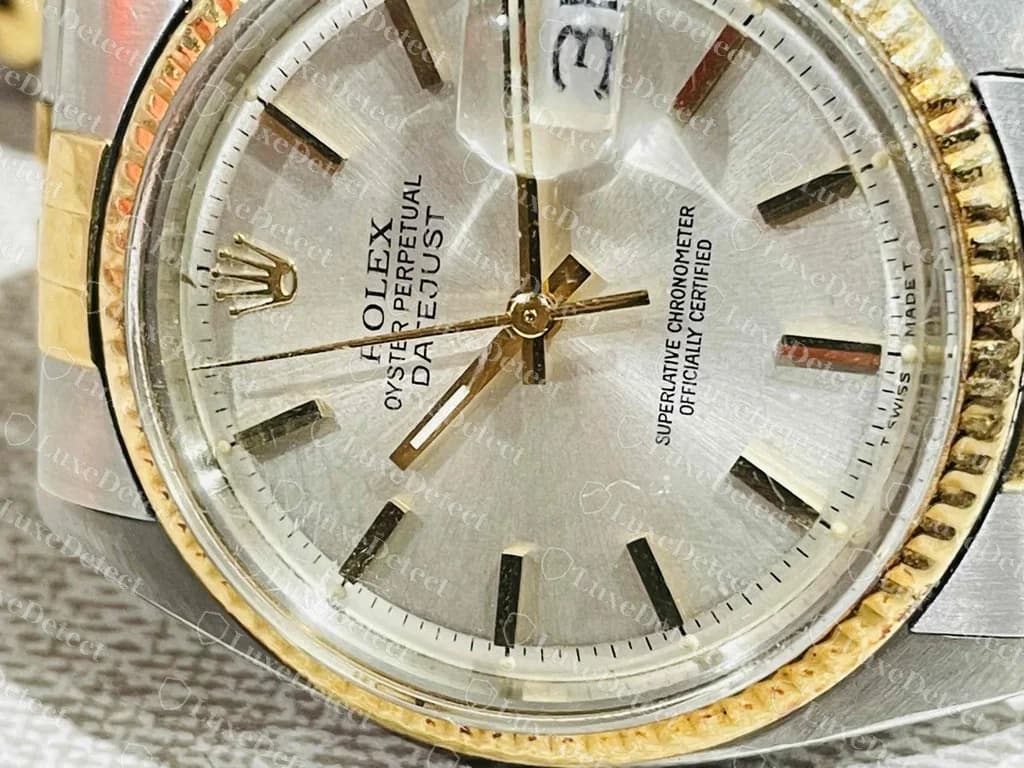
Text printing: genuine Rolex dial text is applied in extremely fine layers, giving it slight relief. Run a light parallel to the dial surface — genuine text casts a hairline shadow; fake dials are flat-printed.
Applied indices: hour markers on most Rolexes are physical metal pieces, sitting flush, level, at consistent height. Fakes are often slightly tilted or show adhesive lines at the edges.
Lume: the correct glow depends on the year. Rolex used tritium from the mid-1960s until about the late 1990s (now often aged to cream or brown and no longer glowing much), Luminova and Super-LumiNova from about the late 1990s, which glow green, and Chromalight, a blue glow, from about 2008 on current models. So a green glow is correct on many watches from the 2000s and earlier, and blue is correct on recent ones. Judge the colour against the reference and year; fakes more often show patchy, bubbled or uneven fill.
Date wheel: under magnification, genuine date numerals are a specific typeface with clean edges and no fuzz or ink bleed.
| Element | Authentic | Counterfeit |
|---|---|---|
| Text printing | Fine layered application, casts a hairline shadow under raking light | Flat-printed, no relief |
| Applied indices | Physical metal, flush, level, consistent height | Slightly tilted, visible adhesive lines at the edges |
| Lume under UV | Colour and brightness matching the era (tritium aged, green Super-LumiNova, blue Chromalight on recent models), even fill with no bubbles or voids | Patchy, bubbled or uneven fill, or a colour that contradicts the reference and year |
| Date wheel | Clean edges in Rolex's specific typeface | Fuzz or ink bleed at the numeral edges |
Confirms authentic
Applied indices that sit level with no adhesive trace, under magnification, alongside evenly filled lume of the right colour for the year. Setting indices to that tolerance is a production capability rather than a finishing trick, which is why it stays out of reach of many clones. A re-dialled or refinished watch can fail these checks while still being a genuine Rolex, so pair the dial with the movement and serial.
Model-Specific Checks
Different references have specific tells fakes frequently miss:
Submariner (Ref. 126610): perfectly aligned ceramic bezel minute markers, a tiny laser-etched coronet in the crystal at 6 o'clock (in the sapphire, not on the ceramic insert), and a firm 120-click bezel. Many fakes have fewer positions or a looser feel.
Daytona (Ref. 116500): chronograph pushers with specific resistance (too light often means a poor mechanism), a crisp tachymeter scale with even fill, and "Cosmograph Daytona" dial text in a specific weight and spacing.
Datejust (Ref. 126300): fake fluted bezels often have shallower grooves and less visual depth.
GMT-Master II (Ref. 126710BLRO, red and blue "Pepsi"; Ref. 126710BLNR, black and blue "Batman"): the two-colour ceramic bezels have a clean, sharp colour transition at the 3 and 9 o'clock positions. Fakes often show blurry transitions or off colour.
Worth knowing
Model-specific tells only work if you know which reference you are holding. Establish the reference first, from the model number between the lugs at 12 o'clock, then check it against the tells above — a genuine tell applied to the wrong reference proves nothing.
Box, Papers, and Service History
An authentic current Rolex comes in a green outer box with an inner pillow box, a warranty card, a manual, and a green tag hanging from the bracelet or clasp that carries the model number. Older watches shipped with a different box and a differently styled card, so knowing the correct paperwork for a reference and year helps.
Paper-only verification isn't enough. Papers can be stolen, lost, or fabricated — a watch with perfect papers can be a super clone, and one without papers can be genuine after decades of ownership.
Worth knowing
Packaging is context, not evidence. What the box and papers are good for is cross-referencing: the reference and serial on the card should match the watch in your hand.
Quick Authentication Checklist
- Check the movement against the reference. A modern watch that ticks once a second is a warning; an Oysterquartz does that legitimately and vintage calibres sweep a little slower.
- Confirm the model has a Cyclops, then read the date at arm's length.
- Look at the serial between the lugs (or on the rehaut) under a loupe. On a modern watch, a catchable, stamped-looking edge is a strong warning.
- Check the rehaut engraving on anything from the mid-2000s on, and its alignment to the minute track.
- Compare the markings under the winding crown with what the reference should carry.
- Look at the end links where the bracelet meets the case. A gap on a modern watch is a fail.
- Take a raking light across the dial. Genuine text casts a hairline shadow.
- Cross-reference the reference and serial on the papers against the watch.
Two or more failures means walk away. A single failure on the serial engraving or a wrong movement is on its own a serious warning, but confirm it with a second check before you decide.
When to Get a Professional Opinion
Where DIY hits its limit on Rolex is the super-clone tier: a $1,500 clone with a cloned 3135 movement, a 904L-grade case and a ceramic bezel passes the sweep test, the Cyclops test and a casual look at the bracelet. What separates it from a genuine watch is movement finishing, rehaut alignment measured rather than eyeballed, and dial printing under magnification — judgement calls built on having handled both.
If the watch is a private sale, a gift you cannot open in front of the seller, or anything above the entry tier, get a second opinion before the money moves. LuxeDetect authenticates watches from $45 with a Certificate of Authenticity back in your inbox within 24 hours.
FAQ
How can I tell a fake Rolex without opening it?
The three fastest no-tools checks: the second hand motion (matched to the reference: a sweep on most mechanical models), the Cyclops magnification (date fills the window and reads at arm's length, on models that have one), and the bracelet end links (flush to the case on modern watches, no gap). If all three pass, run the serial engraving check with a 10x loupe.
What is a "super clone" Rolex?
A fake using a high-grade movement (often a cloned cal. 3135 or 3235) with a 904L-grade steel case and a ceramic bezel — enough to pass basic physical inspection at $500–$1,500. They still fail on movement finishing, dial printing, rehaut engraving, and bracelet tolerances.
Does a Rolex tick?
Most do not. Modern mechanical Rolex movements advance the second hand 8 times per second, reading as a continuous sweep, and vintage mechanical calibres sweep slightly more slowly. The exception is genuine quartz: the Oysterquartz (produced until 2001) ticks once per second. A ticking second hand on a reference that should be mechanical is a warning sign.
Where is the serial number on a Rolex?
On older watches, between the lugs at 6 o'clock. From about 2005 it also appears on the rehaut (the ring between the dial and the crystal) at 6 o'clock, and from about 2008–2010 the rehaut is the only location. Never on the dial or the case back.
Can I verify a Rolex serial number online?
No. Rolex keeps no public serial database. Authorised dealers and service centres can verify a serial against production records; third-party databases give estimated date ranges, not official confirmation.
How much does a real Rolex weigh?
A steel Rolex sports watch on a full bracelet is a dense, heavy watch, but weight varies a lot by model and era, and vintage pieces with hollow links weigh much less. Counterfeits in lower-grade alloys are often noticeably lighter, though weight alone is not a reliable test.