Watch Authentication Specialist
Watch authentication specialist. Focuses on movement inspection, case finishing, and serial verification.
Last updated October 2026 · Published September 2026 · Contact
Why the Portugieser's Simplicity Works Against Fakes
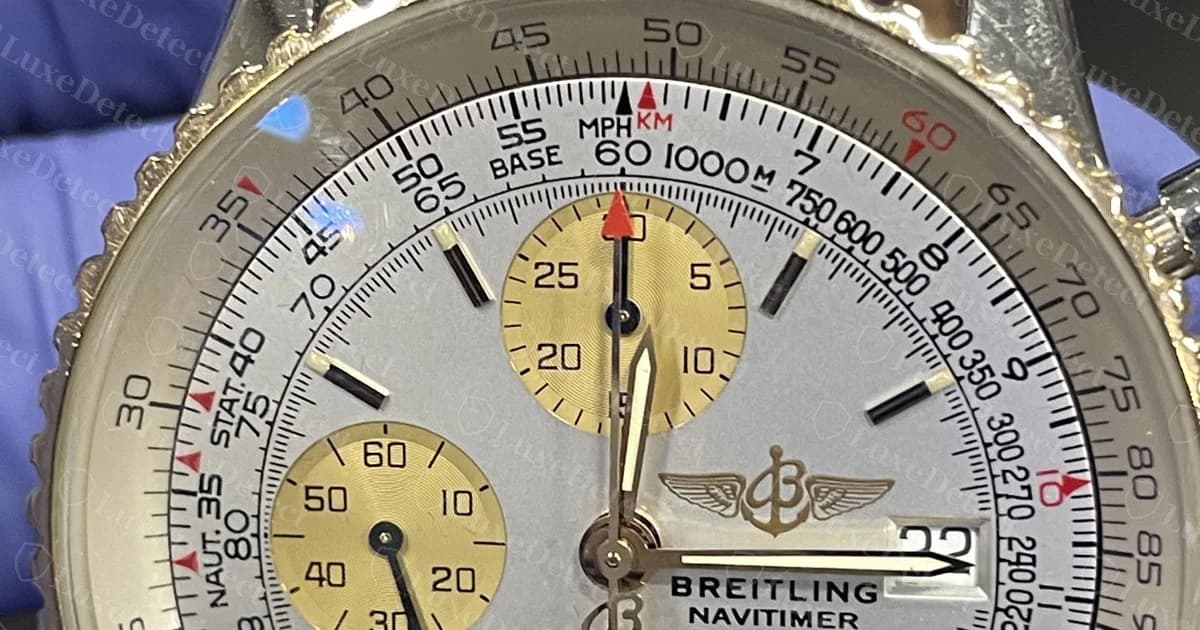
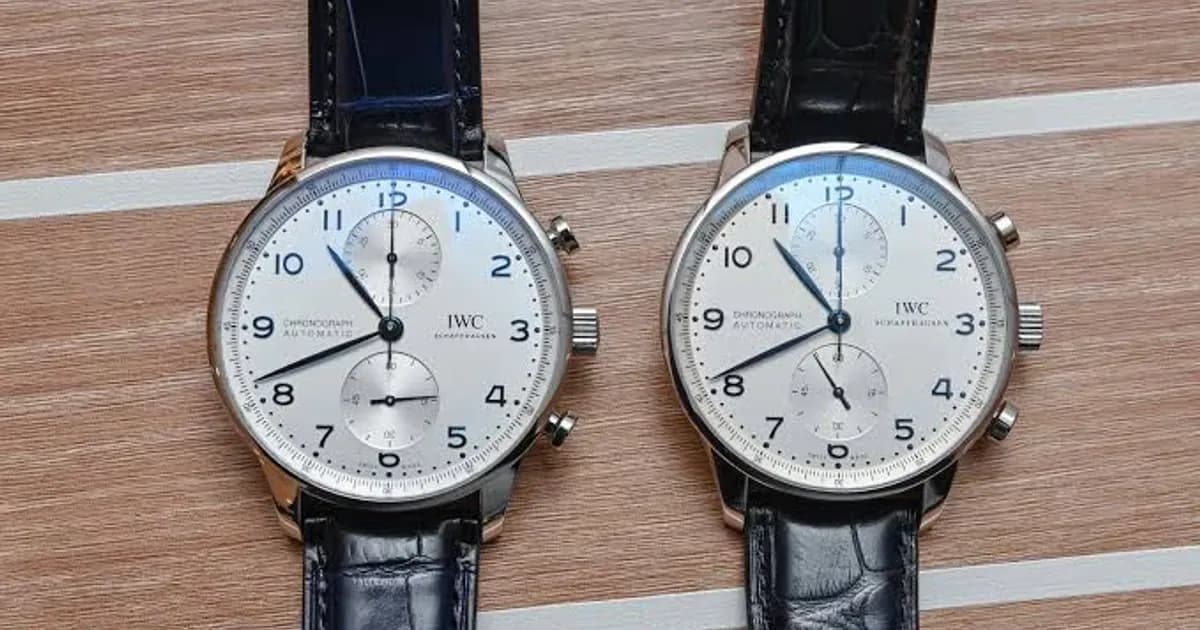
The Portugieser is IWC's most elegant line and, in the automatic and chronograph forms, its most faked. A Portugieser Automatic 40 retails around $8,000; the Chronograph sits a little above. The dial is deliberately spare: railway minute track, slim applied Arabic numerals, feuille (leaf) hands, and a small-seconds sub-dial (at 6 on the Automatic 40, at 9 on the 7-day 42). There is very little decoration to hide behind, which means a fake's font errors and layout mistakes are exposed rather than lost in a busy design, the same principle that makes a clean chronograph dial like the Breitling Navitimer easy to screen once you know the reference layout.
The dial is where you start, and on the Portugieser it is unusually informative. The checks that confirm a verdict are the movement behind the caseback, the caseback serial, and, as a supporting hint, how the small-seconds hand advances. This guide ranks them by what each proves.
What to check, ranked by reliability
| Checkpoint | Reliability | What it tells you |
|---|---|---|
| The Movement Through the Caseback | ★★★★★ | No Pellaton pawls on an automatic that should have them, or no column wheel on a 69355 chrono, is decisive. |
| The Dial Printing and Layout | ★★★★★ | Visibly uneven stroke weight on "IWC SCHAFFHAUSEN" disturbs the dial balance the genuine print holds. |
| The Caseback Serial and Engraving | ★★★★★ | Shallow or fuzzy engraving and a missing movement number support a verdict; a serial alone is weak. |
| The Small-Seconds Ticks (The IWC Movement Tell) | ★★★★★ | A far steppier seconds hand than the reference's beat rate allows hints at a slower movement; hand-wound and older 7-day references beat slower legitimately. |
| Model Reference Before You Start | ★★★★★ | A "7-day" reference with no power-reserve display, or small seconds in the wrong place for that reference, is a fast fail. |
| What the Box and Papers Do and Do Not Prove | ★★★★★ | Boxes and cards are reproduced — cross-check the reference and serial against the caseback only. |
Model Reference Before You Start
Identify the reference so you know the movement, the seconds layout and the caseback.
- Portugieser Automatic 40 — IWC in-house automatic (Cal. 82200 family, Pellaton winding, about 60 hours), display caseback, small seconds at 6.
- Portugieser Automatic 42 / 7-Day — Cal. 52010 Pellaton automatic with a 7-day reserve, display caseback, small seconds at 9 and the power-reserve indicator at 3 (so the 6 o'clock sub-dial remarks below do not apply to it).
- Portugieser Chronograph — in-house Cal. 69355 column-wheel on current references (older ones used a Valjoux 7750 base), sub-dials at 6 and 12, display caseback on current models.
- Portugieser Perpetual Calendar / Tourbillon — high complication, display caseback, rarely faked convincingly.
- Portugieser Hand-Wound — manual, small seconds. Versions include the 46-hour Cal. 98295 (which beats slower, at 18,000 vph) and the 8-day Cal. 59210.
The reference is on the caseback and papers. Confirm the movement, the reserve, whether there is a power-reserve indicator, and the caseback type for that exact reference on iwc.com before checking further. A "7-day" reference without a power-reserve display, or a chronograph with sub-dials in the wrong places, is wrong immediately.
The Small-Seconds Ticks (The IWC Movement Tell)
This is a supporting check that is specific to how IWC movements run, but it needs care, because it only means something if you know the beat rate the reference should have.
Watch the small-seconds sub-dial, ideally under a loupe. Most current Portugieser movements (Cal. 82200, 52010 and 69355 among them) beat at 28,800 vph, which is 8 steps per second. The seconds hand therefore advances in eighth-of-a-second jumps, and to the eye it reads as an almost smooth, fine sweep. A cheaper movement at 21,600 vph makes 6 steps per second, and at 18,000 vph just 5, so the hand looks progressively coarser and steppier: the slower the beat, the fewer steps per second and the more visible each one.
That is the useful part, and also the limit of it. If a reference that should be a 4 Hz movement shows a visibly stepped, countable advance, the movement is slower than it should be, which is a common sign of a cheap replacement. But not every genuine Portugieser runs at 28,800: the hand-wound Cal. 98295 and the older 7-day references with Cal. 5000 beat at 18,000 vph, so a steppier hand on one of those is correct. Match the beat to the exact reference first, and treat a smooth sweep as inconclusive, because fakes built on 28,800 movements (such as an ETA 2824 or 7750 type) look smooth too.
The 6 o'clock marker on the sub-dial is sometimes cited as a tell, with a slightly elongated oval on some genuine references versus a plain round dot on fakes. Treat that as a weak hint at most: IWC has changed the sub-dial design over the years, so compare against photographs of the exact reference rather than the shape alone.
| Element | Authentic | Counterfeit |
|---|---|---|
| Seconds-hand advance (28,800 vph references) | 8 fine steps per second, reads as a near-smooth sweep | Visibly coarser, countable steps, or uneven (a slower-beat movement) |
| Slower-beat genuine references | Hand-wound Cal. 98295 and older Cal. 5000 7-day watches (18,000 vph) look steppier by design | Same coarse look on a reference that should be 28,800 |
| 6 o'clock sub-dial marker | May be slightly oval on some references; varies by reference | Plain round dot where the reference shows another shape |
| Hand alignment | Passes cleanly over each marker | Rides high, or misses marks |
Red flag
A seconds hand that advances in coarse, countable steps on a reference that should beat at 28,800 vph. That points to a slower, cheaper movement. Confirm against the reference's spec and with the movement behind the caseback (or a timing machine) before drawing a conclusion, because slower-beat genuine references exist.
The Dial Printing and Layout
The Portugieser dial is spare, so the printing has to be perfect and any error stands out.
Font: the applied Arabic numerals are slim, upright, and evenly weighted. Every letter of "IWC SCHAFFHAUSEN" and "AUTOMATIC" has uniform stroke thickness, clean edges, and balanced spacing. On genuine dials the text is crisp at 10x. Fakes typically print the wording slightly too thick or with uneven stroke weight, which breaks the dial's symmetry.
Railway minute track: the track is finely printed with consistent tick length and spacing, and the numerals sit centred over their positions. Fakes show a track that is slightly irregular, or numerals that are not quite centred.
Hands: feuille (leaf) hands, correctly proportioned to reach the track. The finish is even. Fakes often get the hand length or the taper subtly wrong.
Date window (where fitted): the date disc colour matches the dial, and the number is centred in the aperture. A mismatched disc or an off-centre number is a tell.
| Element | Authentic | Counterfeit |
|---|---|---|
| "IWC SCHAFFHAUSEN" text | Uniform stroke weight, sharp, balanced | Too thick, uneven weight, fuzzy |
| Applied numerals | Slim, upright, evenly set | Fat, leaning, uneven gaps |
| Railway track | Even tick length and spacing | Irregular, numerals off-centre |
| Feuille hands | Correct length and taper, even finish | Wrong proportion, rough finish |
Red flag
Dial text with visibly uneven stroke weight on "IWC SCHAFFHAUSEN". The genuine dial is printed to a uniform line; thick-and-thin lettering that disturbs the dial's balance is a fake tell that shows before anything else.
The Caseback Serial and Engraving
The case serial is engraved on the caseback — on the outer ring of a display back, or on a lug's underside on some references. It is separate from the movement number, which sits on the movement itself and is visible on display-back models.
Genuine IWC engraving is clean, precise and well-defined: brand and model name (on closed backs), water resistance, case material, and the serial, all sharp under a loupe. Fakes show sloppy, shallow, or fuzzy engraving, uneven letter spacing, or a slightly wrong font. A common tell is a missing or crudely applied serial, or a case serial that IWC's records do not recognise.
| Element | Authentic | Counterfeit |
|---|---|---|
| Engraving quality | Sharp, even depth, well-defined | Shallow, fuzzy, uneven |
| Serial presence | Present, cleanly applied | Missing, crude, or stamped |
| Case ↔ movement number | Two separate numbers, both present on display backs | Movement number absent or identical to case |
| Font | IWC's typeface, even spacing | Wrong font, crowded or stretched |
Worth knowing
IWC can verify a serial against its records and issue an Extract from the Archives for older pieces. A serial alone is weak evidence — read it with the movement and the sub-dial behaviour.
The Movement Through the Caseback
If the reference has a display back, use it. What you should see depends on the calibre:
- Cal. 52010 (7-day, Portugieser 42): IWC's Pellaton automatic winding — twin pawls that wind in both rotor directions — visible near the centre, a large rotor often with a gold medallion, black-coated bridges on some execution, "IWC SCHAFFHAUSEN" engraving, and Côtes de Genève on the bridges.
- Cal. 69355 (Chronograph): in-house column-wheel chronograph, bidirectional pawl winding, column wheel visible, correct rotor engraving.
- Cal. 82200 family (Automatic 40): Pellaton winding with ceramic components, clean finishing.
Fakes use a modified 7750 or an Asian automatic dressed to imitate. Tells: no Pellaton pawls where there should be a Pellaton system, no column wheel on a "69355" chronograph, an unsigned or wrongly worded rotor, coarse machining, and a balance that visibly stutters.
| Element | Authentic | Counterfeit |
|---|---|---|
| Pellaton winding (52010 / 82200) | Twin pawls visible near centre | Standard reverser wheels, no pawls |
| Column wheel (69355 chrono) | Present, visible | Absent, cam switching |
| Rotor engraving | "IWC SCHAFFHAUSEN", crisp, correct medallion | Unsigned, wrong wording, shallow |
| Bridge finishing | Even Côtes de Genève, clean bevels | Coarse grain, no bevelling |
Red flag
A "7-day" automatic or Automatic 40 reference with no Pellaton winding pawls visible through the caseback, or a "69355" chronograph with no column wheel. The movement is not what the reference claims, which is decisive. (Hand-wound references have no rotor and no Pellaton system, so apply this only to the automatics.)
What the Box and Papers Do and Do Not Prove
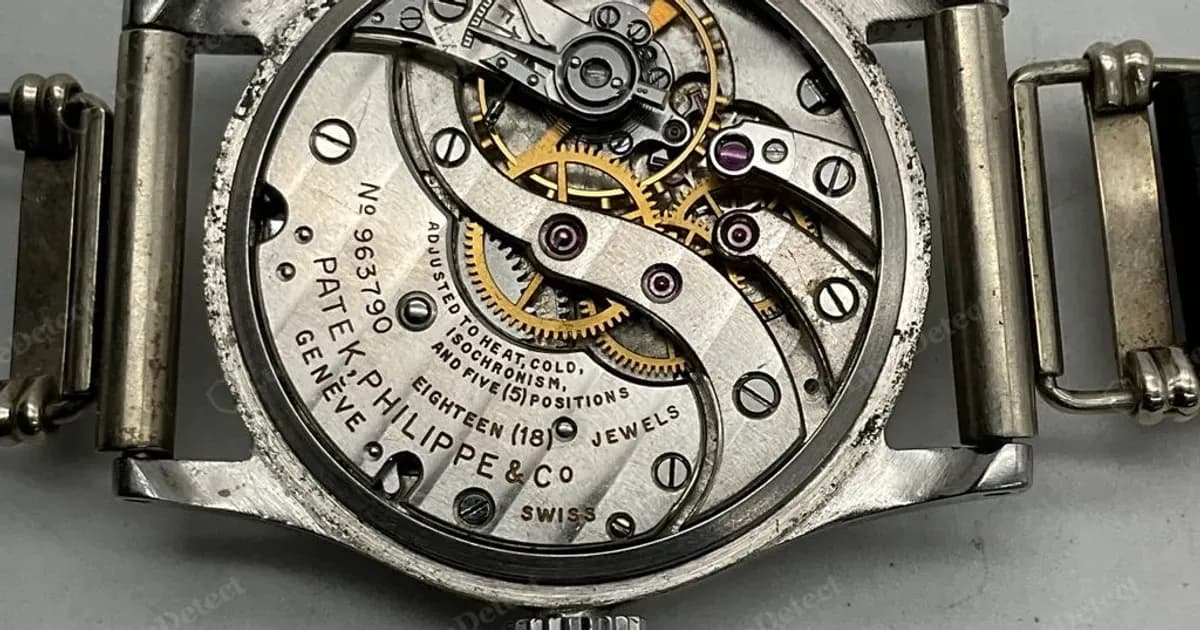
A full set (presentation box, warranty card, booklets) helps resale and does not authenticate. IWC boxes and cards are reproduced, and genuine papers are sold with fakes, the same trap that catches buyers of a fake Patek Philippe sold with a convincing paper trail.
Packaging is context, not evidence. Cross-reference the reference and serial on the warranty card against the caseback, check the card names a real retailer and a plausible date, and confirm the movement number where the papers record it. A mismatch is a red flag; a matching set around a watch that fails the sub-dial or movement check is still a fake.
Quick Authentication Checklist
- Reference on the caseback matches a real IWC spec (movement, reserve, power-reserve display, caseback type)
- Small-seconds hand advances evenly and at the beat the reference should have (a 28,800 vph reference reads as a near-smooth sweep; hand-wound and older 7-day references beat slower by design)
- Sub-dial layout (position of small seconds, power reserve) matches the exact reference; a 6 o'clock marker shape is a weak hint only
- "IWC SCHAFFHAUSEN" text has uniform stroke weight and sharp edges
- Railway minute track is even; applied numerals slim and upright
- Caseback serial is sharp and present; movement number separate on display backs
- Display back shows the correct winding system (Pellaton pawls / column wheel) for the calibre
- Warranty card reference and serial match the caseback
Two or more failures means walk away. A single clear failure on the movement (wrong winding system or missing column wheel), or a seconds hand that is far steppier than its reference should be, is on its own sufficient to send the watch for a professional opinion.
When to Get a Professional Opinion
The Portugieser's clean design makes many fakes easy to reject on the dial font alone, but the better replicas print the dial well and fit sapphire, and the deciding checks are the movement beat and the calibre behind the caseback. Those are checks made with the watch in hand, ideally by someone who has seen a genuine Pellaton system and column-wheel chronograph up close, much like verifying an Omega Seamaster comes down to the movement rather than the dial. IWC can verify the serial and, for older pieces, issue an Extract from the Archives.
The dial text, the caseback engraving and the movement behind the display back are what decide it. Our watch specialists review IWC submissions from $45 with 24-hour turnaround and return a Certificate of Authenticity. Send a straight-on dial photo sharp enough to read the text and the sub-dial, a close-up of the small seconds, the caseback serial, and the movement through the display back.
FAQ
Where is the serial number on an IWC Portugieser?
Engraved on the caseback — on the outer ring of a display back, or on the underside of a lug on some references. It is separate from the movement number, which is on the movement itself and visible through a display caseback. The case serial should match the warranty card, and IWC can verify it against its records.
What is the fastest way to spot a fake Portugieser?
Start with the dial text under a loupe: the clean dial exposes font errors quickly. Then watch the small-seconds hand. Most current Portugieser movements beat at 4 Hz, so the hand advances in fine eighth-of-a-second steps and looks nearly smooth; a slower, cheaper movement looks visibly steppier. Check the reference first, because the hand-wound Cal. 98295 and older 7-day references beat slower and look steppier legitimately.
How many steps does the seconds hand make on a real IWC?
On a movement running at 28,800 vibrations per hour (4 Hz), the seconds hand makes eight steps per second, so it advances in eighth-of-a-second jumps that are too fine to count by eye and read as a near-smooth sweep. A movement at 21,600 vph makes six steps per second and one at 18,000 vph makes five, so slower beats look progressively coarser. Some genuine Portugiesers (the hand-wound Cal. 98295 and the older 7-day Cal. 5000 references) run at 18,000 vph, so always compare with the beat rate of the exact reference.
Do all IWC Portugieser watches have a display caseback?
Most current in-house references do — the Automatic, the 7-day, the Chronograph and the complications. Some older or entry references had solid backs. Check the caseback type for the exact reference before treating a solid back as a problem.
Can IWC confirm my Portugieser is authentic?
IWC can check the serial against its production records, and for vintage pieces it issues an Extract from the Archives. A service centre can open the watch and inspect the movement. That is the definitive route. A serial quoted online as genuine is not proof.
Is the oval 6 o'clock marker on every Portugieser?
No, and we treat it as a weak hint rather than a rule. Some references are described as having a slightly elongated marker on the sub-dial, but IWC has varied the sub-dial design over the years and the 7-day 42 has its small seconds at 9 instead, so compare the exact reference with the brand's own photographs. A mismatch on this marker alone proves nothing.