Watch Authentication Specialist
Watch authentication specialist. Focuses on movement inspection, case finishing, and serial verification.
Last updated October 2026 · Published August 2026 · Contact
What a Rolex Serial Number Tells You — and What It Doesn't
Every Rolex carries a serial number, and where it sits tells you almost as much as what it says. On older watches the serial is engraved between the lugs at 6 o'clock, hidden under the bracelet. From about 2005 Rolex also engraved it on the rehaut — the inner flange between the dial and the crystal — where it is visible without removing anything, and by about 2008–2010 the rehaut was the only place.
There is a hard limit worth stating up front. Pre-2010 serials were issued in sequence, so the number or letter prefix maps to a production era. Serials from about 2010 onward are random, and Rolex made that change deliberately so the number could no longer be used to date a watch. If your Rolex has an 8-character alphanumeric serial, no lookup table on the internet can date it, and any site claiming otherwise is guessing.
What the serial does reliably is catch contradictions: a format that disagrees with the model's production history, a serial engraved in the wrong place for its claimed era, or engraving quality that fails on its own terms.
Prefer the full-screen version? The Rolex serial number checker covers every format from the numeric-only era onward and shows where the serial should be engraved. It is a format and era check, not authentication.
A code that checks out doesn't prove the item is real. Counterfeiters copy genuine codes.
Our authenticators check the movement, dial, case and bracelet of your Rolex against verified references, from $45. You get a verdict within 24 hours, and a Certificate of Authenticity if the item passes.
Authenticate My Rolex →Where to Find the Serial
Older watches (before about 2005): Engraved between the lugs at 6 o'clock. You need to remove the bracelet or turn the watch face down and look into the gap. This is deliberately awkward — Rolex never intended it to be casually visible.
About 2005 to about 2010: Many watches carry the serial in both places, between the lugs and on the rehaut.
About 2008–2010 to present: Engraved on the rehaut, the inner ring between the dial and the crystal, at the 6 o'clock position. The word "ROLEX" repeats around the ring (that engraving began in the mid-2000s, with the first examples around 2002–2004), and the serial appears once, at 6 o'clock. Rolex also laser-etches a tiny coronet into the crystal at 6 o'clock on modern references. The reference number stays between the lugs at 12 o'clock.
What the engraving should look like
Authentic modern engraving: Laser engraving on the rehaut and lugs: very fine characters with sharp, clean edges, consistent depth across every character, even spacing. On the rehaut the characters are precisely indexed to the minute track and hour markers.
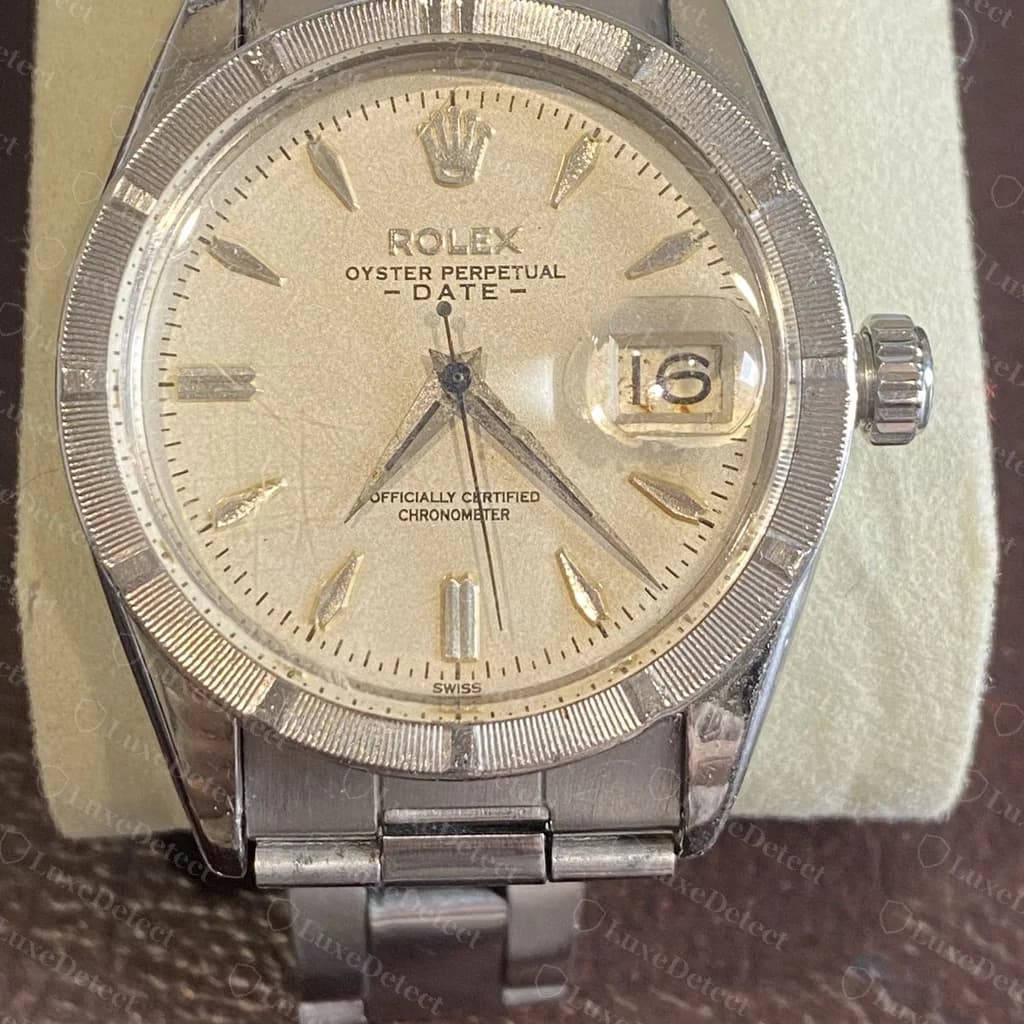
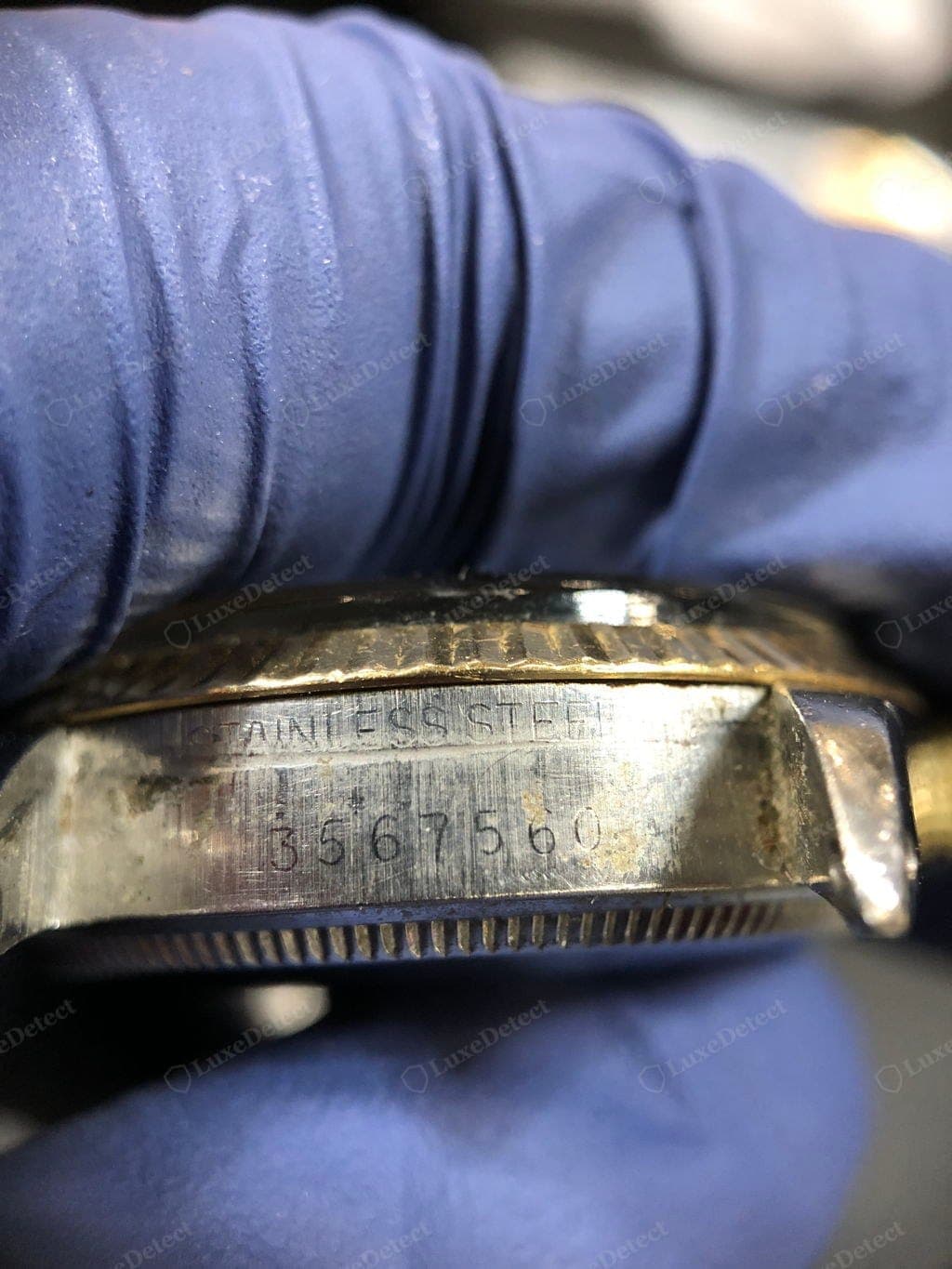
Authentic vintage engraving: Older cases, like the one above, were engraved by tool rather than laser. The characters can look deeper or softer, vary with the case finish, and wear with age and polishing. Do not hold a decades-old case to a modern laser standard.
Fake tells: Acid-etched or crudely stamped serials with rough or fuzzy edges, characters of uneven depth, a sandy or grainy texture within the engraving, and on rehaut engravings, characters that are misaligned relative to the dial's markers. A sharp-looking engraving is not proof, since counterfeiters copy real serials.
Rolex Serial Number Formats and Years
Rolex has used three formats. All year ranges below are approximate: published dealer and auction references differ by about a year at the edges, and Rolex does not publish its own table.
| Format | Approximate years |
|---|---|
| Numeric only (no letter) | Until about 1987 |
| One letter plus six digits | About 1987 to about 2010 |
| Random 8-character alphanumeric | About 2010 onward (not dateable) |
Letter-prefix serials (about 1987 to 2010)
Rolex used a letter prefix followed by six digits. The letters were not issued in alphabetical order, which is why a lookup table is more reliable than intuition. Each letter was used once.
| Prefix | Approximate years |
|---|---|
| R | 1987–1988 |
| L | 1988–1989 |
| E | 1990 |
| X | 1991 |
| N | 1991 |
| C | 1992 |
| S | 1993–1994 |
| W | 1994–1995 |
| T | 1995–1996 |
| U | 1997–1998 |
| A | 1998–1999 |
| P | 1999–2000 |
| K | 2000–2001 |
| Y | 2001–2002 |
| F | 2003–2005 |
| D | 2005–2006 |
| Z | 2006–2008 |
| M | 2007–2009 |
| V | 2008–2009 |
| G | 2010 |
| Random 8-character | About 2010 onward (not dateable) |
Numeric-only serials (before about 1987)
Before the letters, Rolex used numbers only. The published tables agree on broad bands, shown below, but numbers were not issued in strict date order and the tables disagree by a year or so, so treat these as an indication of the era and nothing more. The earliest numeric run restarted in the 1950s, so low numbers cannot be dated precisely.
| Serial range | Approximate era |
|---|---|
| Up to about 1,000,000 | 1950s to early 1960s |
| About 1,000,000 to 2,200,000 | 1960s to about 1970 |
| About 2,200,000 to 3,900,000 | About 1970–1975 |
| About 3,900,000 to 5,000,000 | About 1975–1977 |
| About 5,000,000 to 6,450,000 | About 1977–1980 |
| About 6,450,000 to 9,300,000 | About 1980–1986 |
| About 9,300,000 to 9,999,999 | About 1986–1987 |
A worked example: the serial 3567560 in the photo above falls in the 1970–1975 band; published tables place it at about 1973. A tool that dated it to the 1950s would be wrong, and the checker on this site reads it as early 1970s.
An important nuance: because serials were issued from stock, a watch can carry a serial from slightly before its actual sale date, and service replacement cases can carry a different serial from the original. A year range indicates when a number was in use, not a guaranteed manufacture date. Treat a one-year discrepancy as normal and a five-year discrepancy as a problem.
The Model Consistency Check
This is where the serial earns its keep. Cross-reference the decoded era against the model's production history:
- A Submariner ref. 116610 with a serial decoding to 1995 is wrong — that reference launched in 2010
- A Daytona (introduced 1963) with a serial that decodes to the 1950s is wrong
- Any watch with a rehaut-engraved serial but a claimed production year before roughly 2005 is wrong, since the serial was not engraved on the rehaut before then
- Any watch claimed to be from 2011 or later with a letter-prefix serial is wrong, since the random format was in place by then
- A numeric-only serial on a watch claimed to be from 1988 or later is worth questioning (a service replacement case is one possible explanation)
Counterfeiters working from mixed reference photographs routinely produce these contradictions. It costs nothing to check and catches a meaningful share of fakes.
Beyond the Serial
The serial is a tripwire. These checks carry the real weight.
The movement
Authentic: Most modern mechanical Rolex movements beat at 28,800 vibrations per hour, producing a second hand that advances eight times per second — too fast to count individually, appearing as a smooth sweep. Vintage mechanical calibres often beat more slowly (for example 19,800 or 18,000 vibrations per hour), and the genuine Oysterquartz (produced until 2001) ticks once per second. Rolex calibres carry the Rolex crown on the rotor and a calibre number on the plates, finished to the standard of their era.
Fake tells: A tick or stutter on a reference that should be a modern mechanical movement, a quartz module or battery inside a mechanical model, or a movement marked with another maker's name. On watches with a display back — which Rolex almost never uses on modern sports models — a generic movement. Check the movement against the reference rather than relying on the tick alone.
The Cyclops lens
Authentic: 2.5x magnification over the date on models that have a Cyclops. The date fills the window and is easily readable at arm's length. A few genuine date models have no Cyclops, such as older Sea-Dwellers (16600, 116600) and the Deepsea.
Fake tells: Magnification closer to 1.5x, leaving the date visibly smaller and harder to read, on a reference that should have a Cyclops. This is one of the more common failures across counterfeit tiers because the lens geometry is hard to replicate.
Case and bracelet
Authentic: Substantial weight on modern steel watches (Rolex has used 904L steel on all its steel models since about the early 2000s; older watches are 316L). Brushed and polished surfaces meet at crisp boundaries. The clasp closes with a definite, solid click.
Fake tells: Light weight for the size. Blurred finish transitions. A clasp that closes loosely or requires force. A bracelet that rattles is a softer signal: vintage bracelets with folded links can rattle and stretch while being genuine, so judge it against the era.
Quick Authentication Checklist
- Location: between the lugs on older watches, the rehaut on later ones (both on many watches from about 2005 to 2010) — matching the claimed era
- Engraving: modern laser engraving that is sharp, evenly deep and aligned with the dial markers; vintage cut engraving judged against its age
- Rehaut alignment: characters precisely indexed to the dial's markers
- Format: decoded era consistent with the reference's production history
- Movement: matches the reference (modern sweep, vintage slower sweep, or a genuine Oysterquartz), with Rolex marks on the rotor and plates
- Cyclops: 2.5x magnification where the model has one
- Case and bracelet: solid weight on modern steel, crisp finish boundaries, a definite clasp click
FAQ
Can I date a modern Rolex from its serial number?
No. Rolex randomised serials around 2010 precisely to prevent this. An 8-character alphanumeric serial carries no date information that can be publicly decoded. Only Rolex can confirm a production date, via the movement and original paperwork. Any website offering to date a random serial is fabricating the answer.
Where exactly is the serial on my watch?
On older watches, between the lugs at 6 o'clock — remove the bracelet or look into the gap with the watch face down. From about 2005 it also appears on the rehaut, the inner metal ring between the dial and the crystal, at 6 o'clock, and from about 2008–2010 the rehaut is the only place. Many watches from the changeover years carry both.
Does a valid serial number mean my Rolex is genuine?
No. Counterfeiters copy real serials from listing photographs and reuse them, so a well-formed, correctly decoding serial confirms only the format. How the serial is engraved — laser-sharp and evenly deep on a modern watch, consistent with its age on a vintage one — tells you considerably more than what it says.
My serial decodes to a year that doesn't match the seller's claim. Is it fake?
Not automatically. Rolex issued serials from stock, so a watch can carry a serial from slightly before its sale date, and published tables differ by about a year. A discrepancy of a year or so is normal. A discrepancy of several years, or a serial predating the reference's launch entirely, is a serious problem.
Can Rolex authenticate my watch?
A Rolex Service Centre will inspect a watch and can identify counterfeits, typically in the course of a service request. Rolex does not issue authentication certificates for the resale market. For resale, insurance, or dispute purposes you need documented third-party authentication.
How much does professional Rolex authentication cost?
Photo-based authentication typically runs $45 for watch authentication with a 24-hour turnaround and is a sensible first screening step. For a watch worth $8,000 to $50,000, treat it as a filter ahead of in-person inspection by a watchmaker, particularly given how capable current super-clones have become.