Watch Authentication Specialist
Watch authentication specialist. Focuses on movement inspection, case finishing, and serial verification.
Last updated October 2026 · Published September 2026 · Contact
The Scale of the Problem
Demand for Patek Philippe — especially the steel Nautilus 5711 (discontinued in 2021) and Aquanaut 5167 — runs far ahead of the roughly 70,000 watches a year the company makes, and the fakes range from crude $100 versions to $1,000–$3,000 "super clones" of the Nautilus with a decorated automatic movement and a blue embossed dial that looks convincing.
Patek differs from Rolex or Omega in one way: no serial-to-year lookup, but an official records service. The company has kept a ledger of every watch since 1839 and will issue an Archive Extract confirming a specific watch's details. This guide covers the brand-wide physical checks, and where the Extract fits.
What to check, ranked by reliability
| Checkpoint | Reliability | What it tells you |
|---|---|---|
| Movement Finishing — The Core Check | ★★★★★ | Rounded interior angles or dull anglage on the bridge bevelling settles most Patek fakes — clone-tier counterfeiting cannot reproduce hand-polished sharp internal angles. |
| The Archive Extract | ★★★★★ | An Extract that describes a different dial or metal than the watch is decisive against; a refused or non-Patek “Extract” is a serious warning. |
| The Patek Philippe Seal (and the Geneva Seal on older pieces) | ★★★★★ | A Geneva Seal on a clearly recent Nautilus or Aquanaut (well after 2011) often means the counterfeiter copied an old reference photo — but watches from around 2009–2011 can carry either seal. |
| The Dial and Applied Logo | ★★★★★ | A printed “PATEK PHILIPPE GENÈVE” where the reference’s official photos show an applied signature, or applied markers with visible adhesive, are flaws Patek dial work does not have — vintage and retailer-signed dials are the exception. |
| The Numbers — Reference, Movement, and Case | ★★★★★ | Identical movement and case numbers, or numbers the Archive Extract does not confirm, is a real red flag; a matching pair is only a mild positive. |
| The Case, Crown, and Bracelet | ★★★★★ | Strong corroboration — a clone can get the case profile close, but read it with the movement and dial rather than alone. |
| Model-Specific Checks | ★★★★★ | Decisive with the exact reference confirmed and misleading without it. |
| Box, Papers, and Provenance | ★★★★★ | Context only — Certificates of Origin are forged and sold separately. The chain that matters is watch → caseback numbers → Archive Extract. |
Movement Finishing — The Core Check
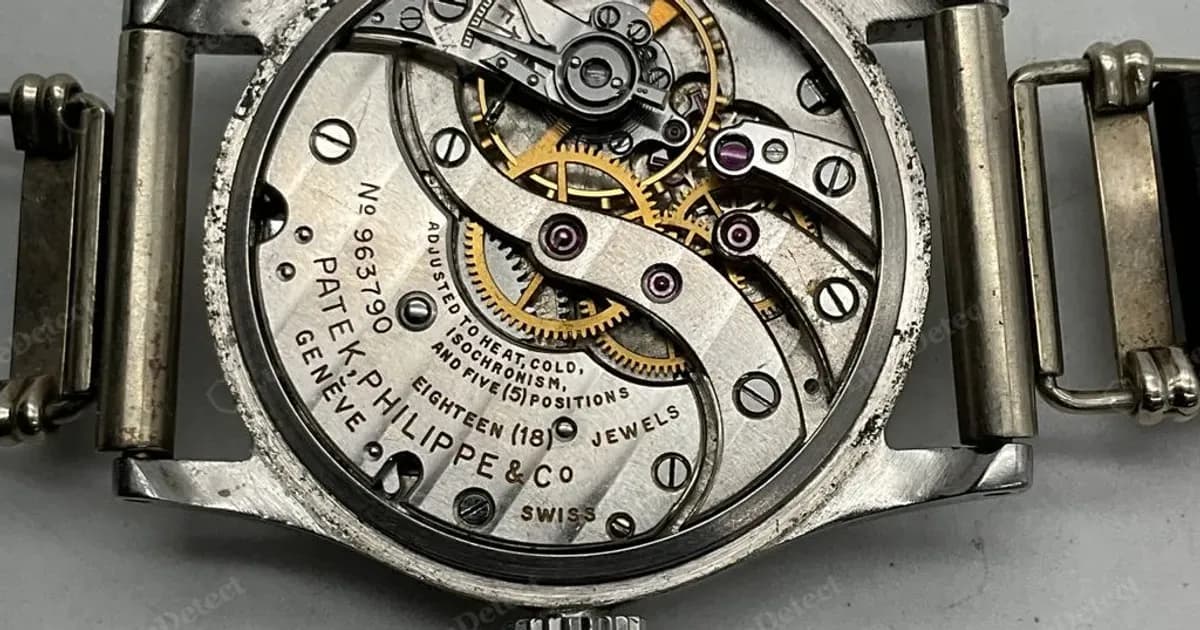
Open the caseback (most modern Pateks have a display back). This is where a Patek fake is caught: Patek movement finishing is at a level almost nothing else reaches, and counterfeiters cannot replicate it at clone prices.
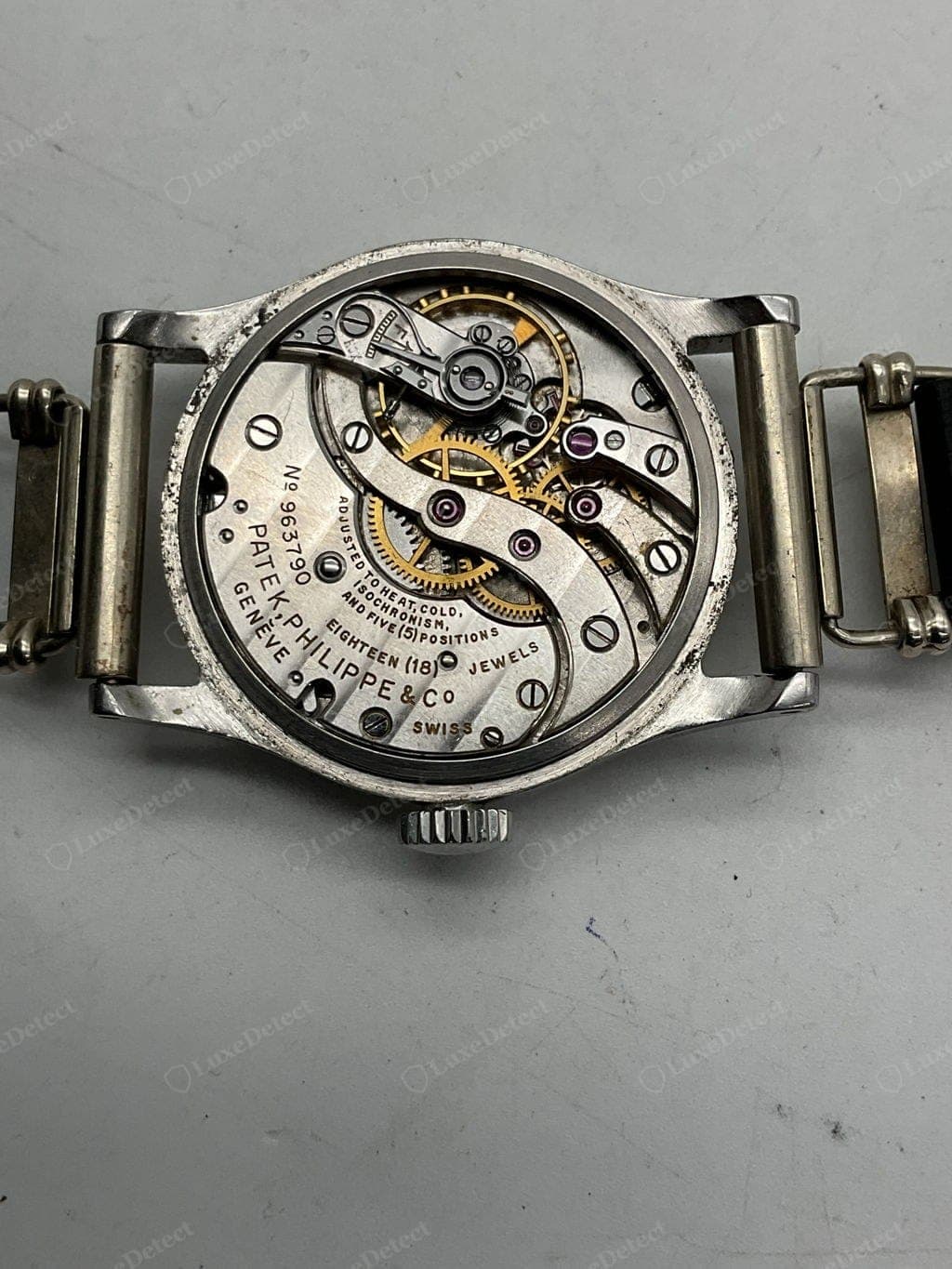
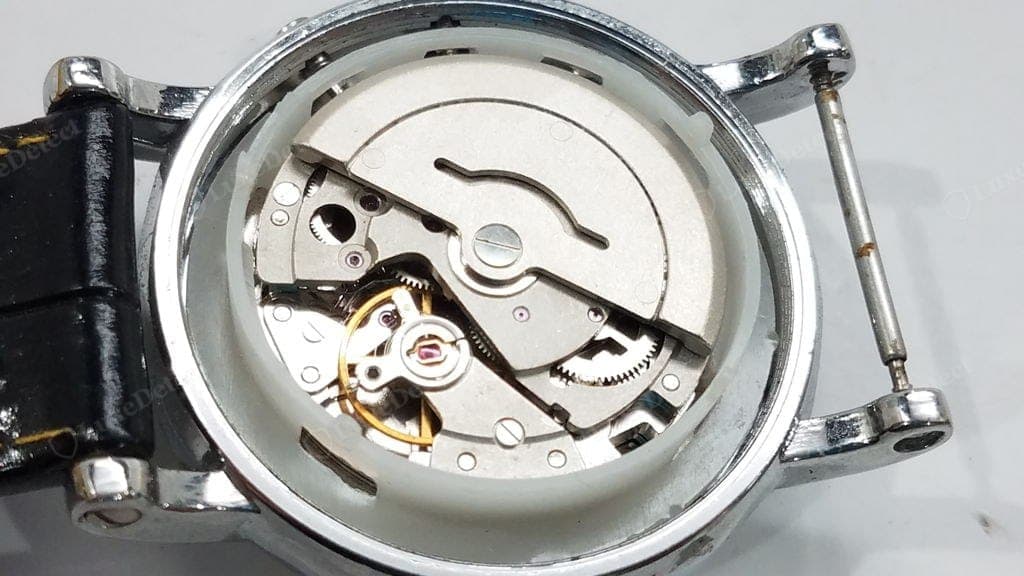
On a genuine Patek movement:
- Anglage (bevelling): every bridge edge is chamfered at 45 degrees and mirror-polished by hand, including the inside corners — sharp interior angles a machine cannot cut, even in width and flawlessly bright.
- Côtes de Genève striping is even, parallel, and cleanly terminated.
- Perlage on the mainplate is regular and complete, even under the bridges.
- Screws are cleanly made, with polished slots and neat, polished heads. Most modern Patek calibres use polished steel screws (some vintage and complicated calibres use blued ones), so a plain polished screw is not a fake tell on its own — burred, ragged slots are.
- Engraving — the calibre number, "PATEK PHILIPPE GENÈVE", the Seal on modern movements — is crisp and correctly placed.
On a fake the bevels are dull, uneven, or absent, interior angles are rounded (the machine tell), the striping is shallow, the screw slots are rough or burred, and the perlage is patchy under the bridges.
| Element | Authentic | Counterfeit |
|---|---|---|
| Anglage | 45° hand-polished bevels on every edge, sharp interior angles, even width | Dull, uneven, or absent bevels; rounded interior angles |
| Côtes de Genève | Even, parallel, cleanly terminated | Shallow, irregular, or a printed imitation |
| Perlage | Regular and complete, including hidden areas | Patchy, or missing under the bridges |
| Screws | Neat polished slots and heads (polished steel on most modern calibres; blued on some vintage and complicated ones) | Rough or burred slots, uneven finishing, a generic industrial look |
Red flag
Rounded interior angles on the bridge bevelling, or dull/absent anglage. Hand-finished sharp interior angles are a Patek signature that clone-tier counterfeiting cannot reproduce — this check alone settles most fakes.
The Patek Philippe Seal (and the Geneva Seal on older pieces)
From 2009, Patek has certified its watches with its own Patek Philippe Seal — a small "PP" in a shaped shield, engraved on a bridge, covering the whole watch. Before that, Geneva-made Pateks carried the Geneva Seal (Poinçon de Genève), an eagle-and-key hallmark applied by an independent body. The changeover was not a single day: watches sold around 2009–2011 can carry the Geneva Seal, and many older and vintage pieces carry no seal at all.
On a genuine modern watch the seal is a crisp, correctly shaped engraving in the right place for the era. A Nautilus or Aquanaut made well after about 2011 with a Geneva Seal instead of the Patek Seal is wrong; one from the 2009–2011 window can legitimately carry either, so check the reference's production years before judging. A fuzzy, wrongly shaped, or absent seal on a recent watch is a red flag.
| Element | Authentic | Counterfeit |
|---|---|---|
| Modern watch (roughly 2012 on) | Patek Philippe Seal ("PP" in a shield) engraved crisply on a bridge | Geneva Seal on a clearly modern reference, or a fuzzy/absent seal |
| Watch from around 2009–2011 | Either seal, depending on the exact production date | Fuzzy or badly shaped engraving of either |
| Pre-2009 Geneva watch | Geneva Seal (eagle and key) hallmark on most pieces; some vintage pieces carry none | Wrong hallmark on a reference that should carry one |
Red flag
A Geneva Seal on a Nautilus or Aquanaut that is clearly recent (well after 2011). Those carry the Patek Philippe Seal; the wrong seal for the era often means the counterfeiter copied an old reference photo.
The Numbers — Reference, Movement, and Case
A genuine Patek carries two numbers, and they are different:
The movement number is stamped on the movement — roughly 6 digits on vintage and neo-vintage, around 7 on modern. It is not a year-by-year series: different calibres were numbered in separate blocks, so a number cannot be turned into a date by comparing it with a single table. The case number is stamped inside the caseback. On an authentic watch both are present, both distinct, and both consistent with the reference and era. Identical numbers mean one was copied onto the other — a fake tell.
The reference number identifies the model — usually 4 digits before any suffix (a few vintage references are shorter: the caseback of a vintage steel Calatrava reads "REF. 96"), often followed by a metal-code letter, a /-variant and a catalogue suffix, e.g. `5711/1A-010`, `5167A-001`, `3970E`.
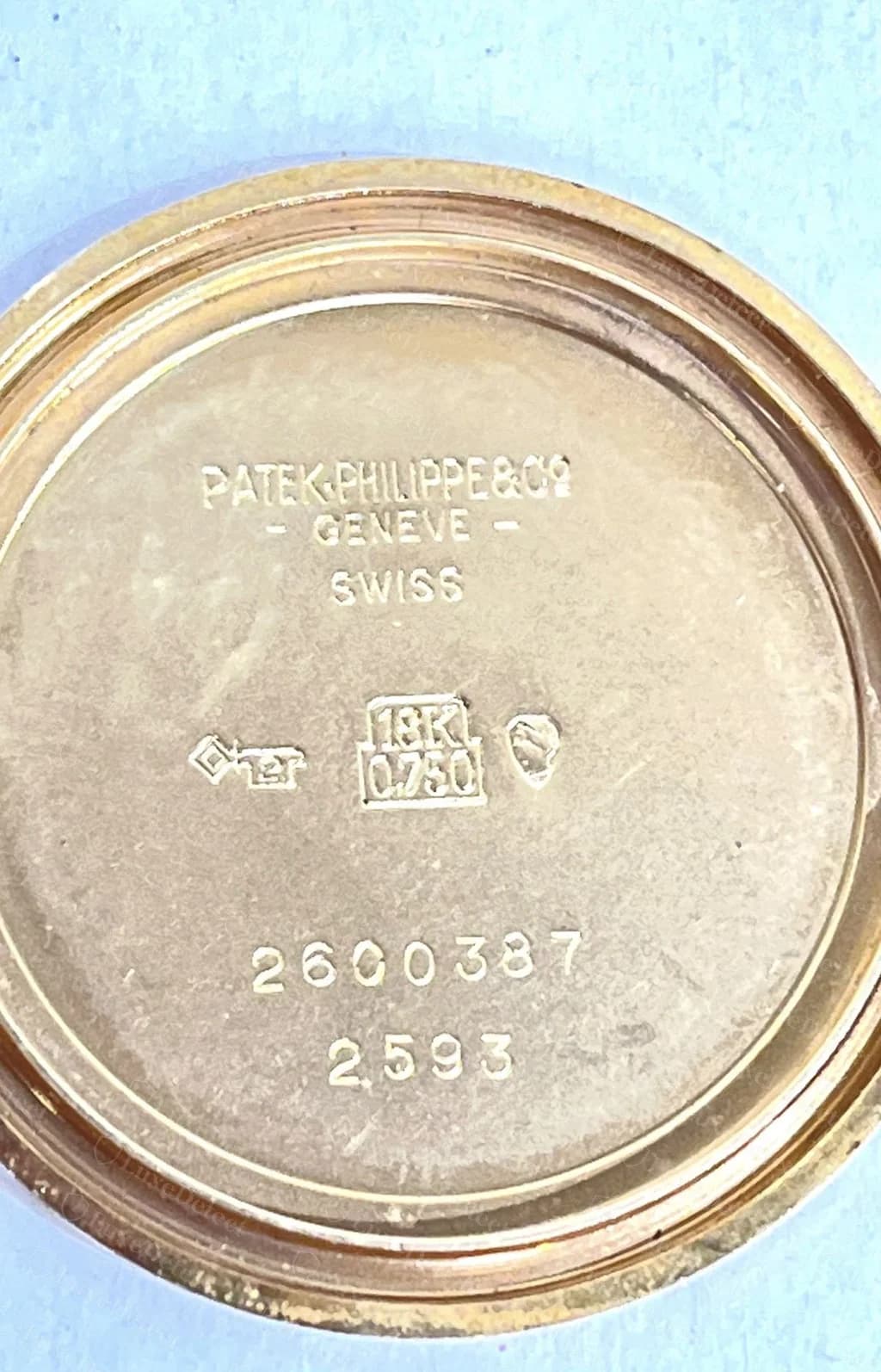
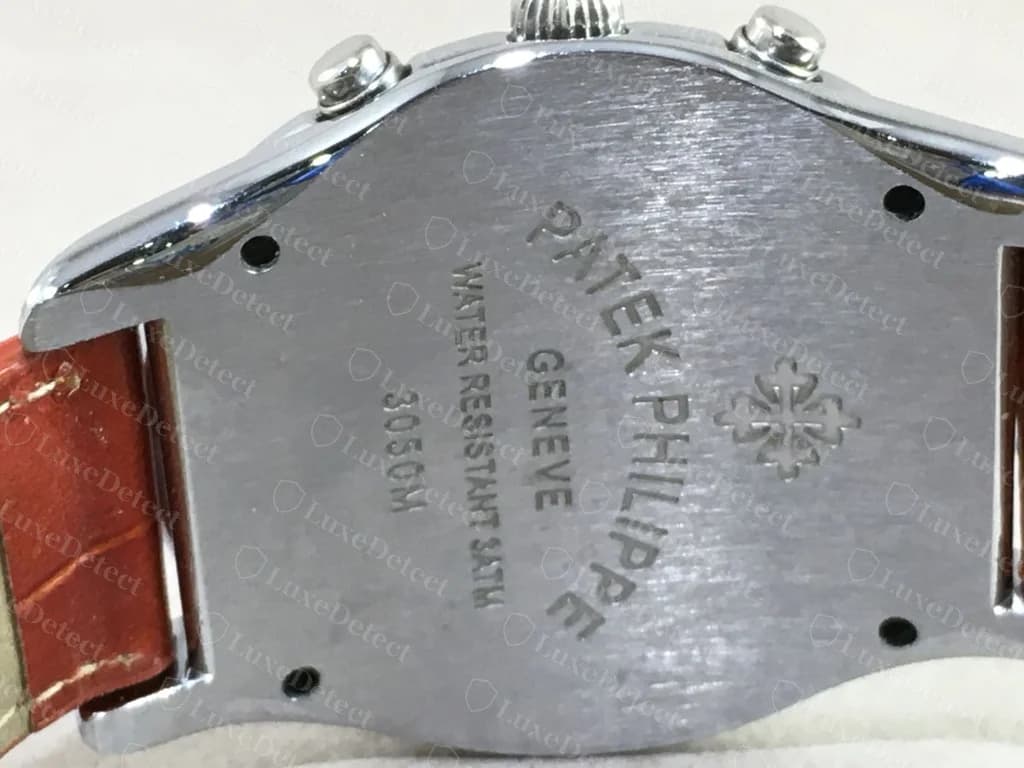
Check the format and the internal consistency:
Patek publishes no serial-to-year table, and movement numbers are not one neat year-by-year series, so the checker only tests the shape and consistency of the numbers and never guesses a decade. For a date, you need an Archive Extract (next section).
| Element | Authentic | Counterfeit |
|---|---|---|
| Movement number | ~6 digits vintage, ~7 modern, stamped on the movement | Missing, wrong length, or identical to the case number |
| Case number | Distinct from the movement number, inside the caseback | Absent, or copied from the movement number |
| Reference | Usually 4 digits (some vintage ones shorter) + optional metal code, variant and catalogue suffix, matching the model | A reference that does not correspond to the watch's configuration |
Worth knowing
The numbers are a format and consistency check, not a date. A matching, correctly-formatted pair is a mild positive; a contradiction (identical numbers, or numbers the Archive Extract does not confirm) is a real red flag. The [Patek Philippe number checker](/patek-philippe-serial-number) explains what it does and does not test.
The Archive Extract
The Archive Extract is the closest thing to an official authenticity and provenance document a Patek buyer can get. Patek issues it from its ledgers — every watch since 1839 — confirming the movement number, case number, reference, dial, case metal, and date of sale. You order it from patek.com (fee and a wait).
What it does: tells you a watch with those exact numbers, reference and dial left Patek on that date. What it does not do: certify that the watch in front of you is that watch — numbers can be transplanted, dials swapped. So it is powerful paired with a comparison against the watch: an Extract that matches the watch is strong; one describing a different dial or metal is decisive against. A seller who refuses, stalls, or produces an "Extract" not from Patek is a serious warning sign.
| Element | Authentic | Counterfeit |
|---|---|---|
| Archive Extract | Issued by Patek, matches the watch's numbers, reference, dial and metal | Absent and refused, or a document not from Patek, or details that do not match the watch |
Worth knowing
The Extract dates and describes a watch from Patek's records; it does not by itself prove the physical watch is genuine. Its power is in the match between what it describes and what you are holding.
The Dial and Applied Logo
Under a loupe, a genuine Patek dial is close to flawless.
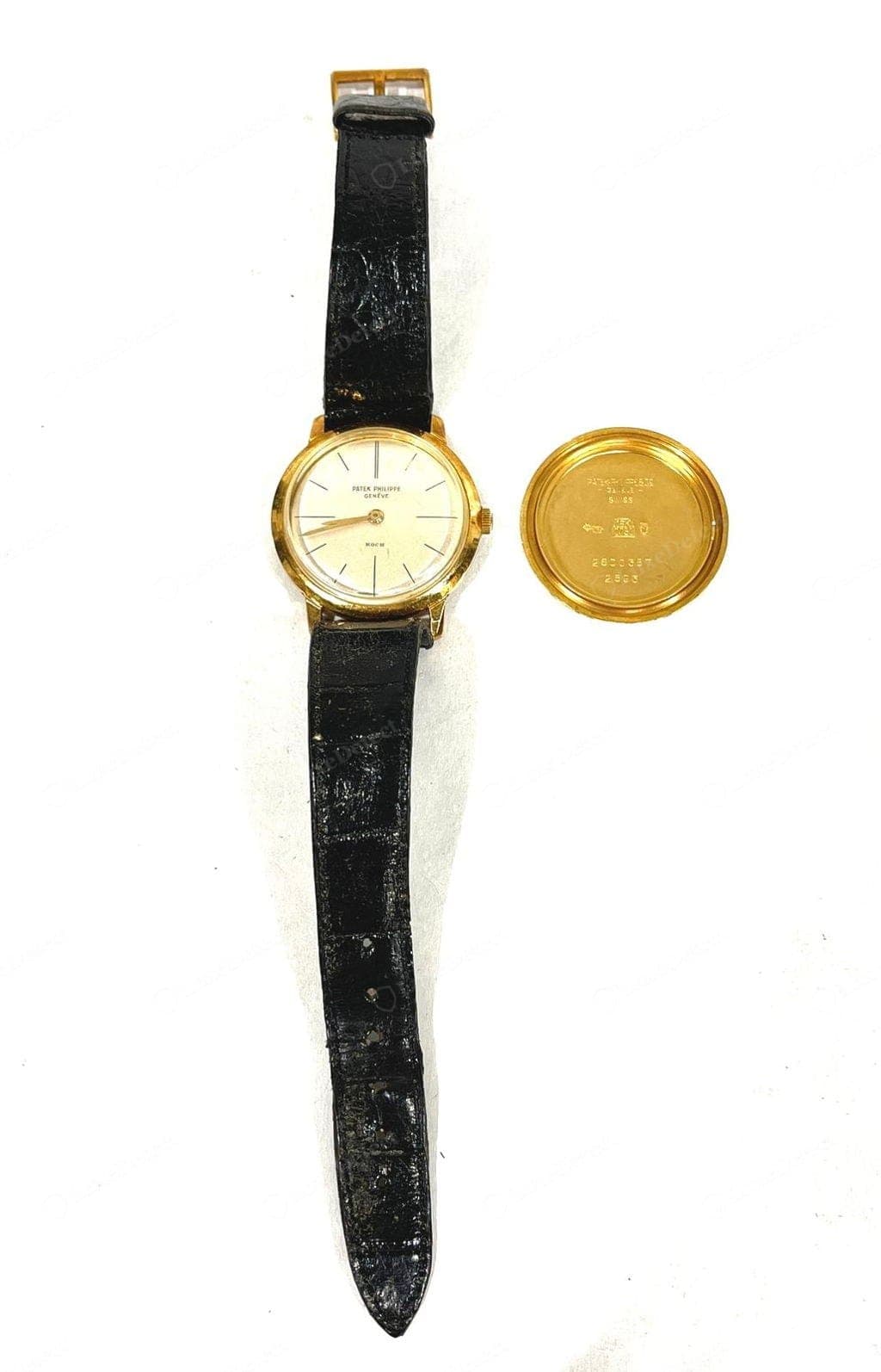
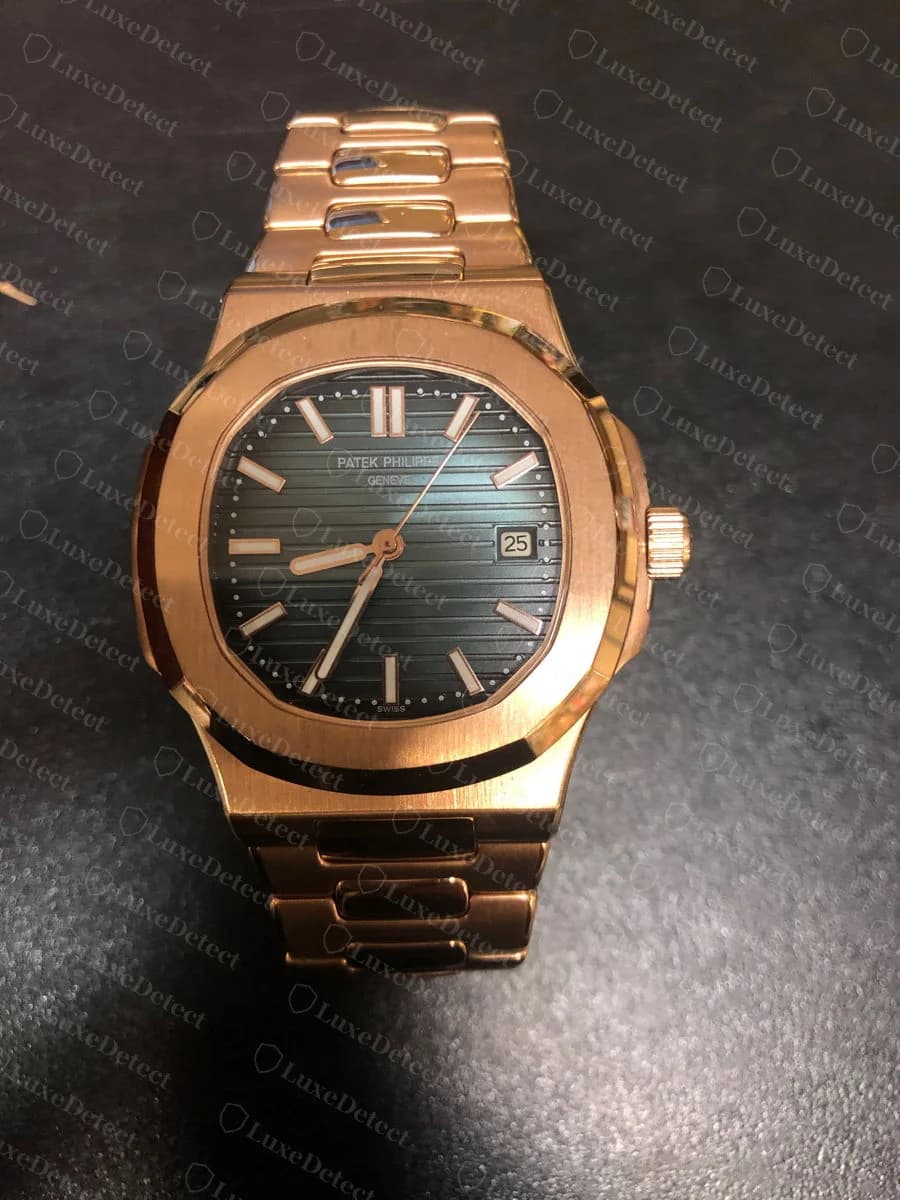
The "PATEK PHILIPPE GENÈVE" signature is applied (separate polished-metal lettering, perfectly level, no adhesive visible) on some models and printed on others — and many vintage dials, such as the retailer-signed Calatrava above, are printed. So first find out which method Patek's own images show for your exact reference and era. Printed where that reference should be applied, uneven letter heights, or a wordmark a fraction too wide are fake tells. Check the spacing and spelling against those images too: dials and casebacks read GENEVE or GENÈVE depending on era and model, so do not treat the accent alone as proof either way.
The applied hour markers are solid faceted gold, dead straight, evenly spaced, no glue showing, with luminous fill applied cleanly inside the outline on the Nautilus and Aquanaut.
Printing — minute track, text, date numerals — is razor sharp with even density. The date window (Nautilus 5711/5712) is cleanly cut, the disc colour-matched with aligned, correctly proportioned numerals.
The guilloché — the Nautilus embossing, the Aquanaut grid — is crisp, even, and consistent in depth. Fakes show a shallow, soft, or irregular pattern.
| Element | Authentic | Counterfeit |
|---|---|---|
| Signature | Applied or printed exactly as Patek's images show for that reference and era; level, correct width and spacing | Printed where that reference should be applied, uneven height, wrong proportions |
| Applied markers | Solid faceted gold, straight, even, no glue | Tilted, uneven height, adhesive visible |
| Guilloché / embossing | Crisp, even, consistent depth | Shallow, soft, or irregular |
| Date disc | Colour-matched, numerals aligned and correctly proportioned | Off-colour, misaligned, wrong font |
Red flag
A printed "PATEK PHILIPPE GENÈVE" on a reference whose official photos show an applied signature, or applied markers with visible adhesive. Patek dial work does not have these flaws. Vintage and retailer-signed dials are the exception: judge them against genuine examples of the same period.
The Case, Crown, and Bracelet
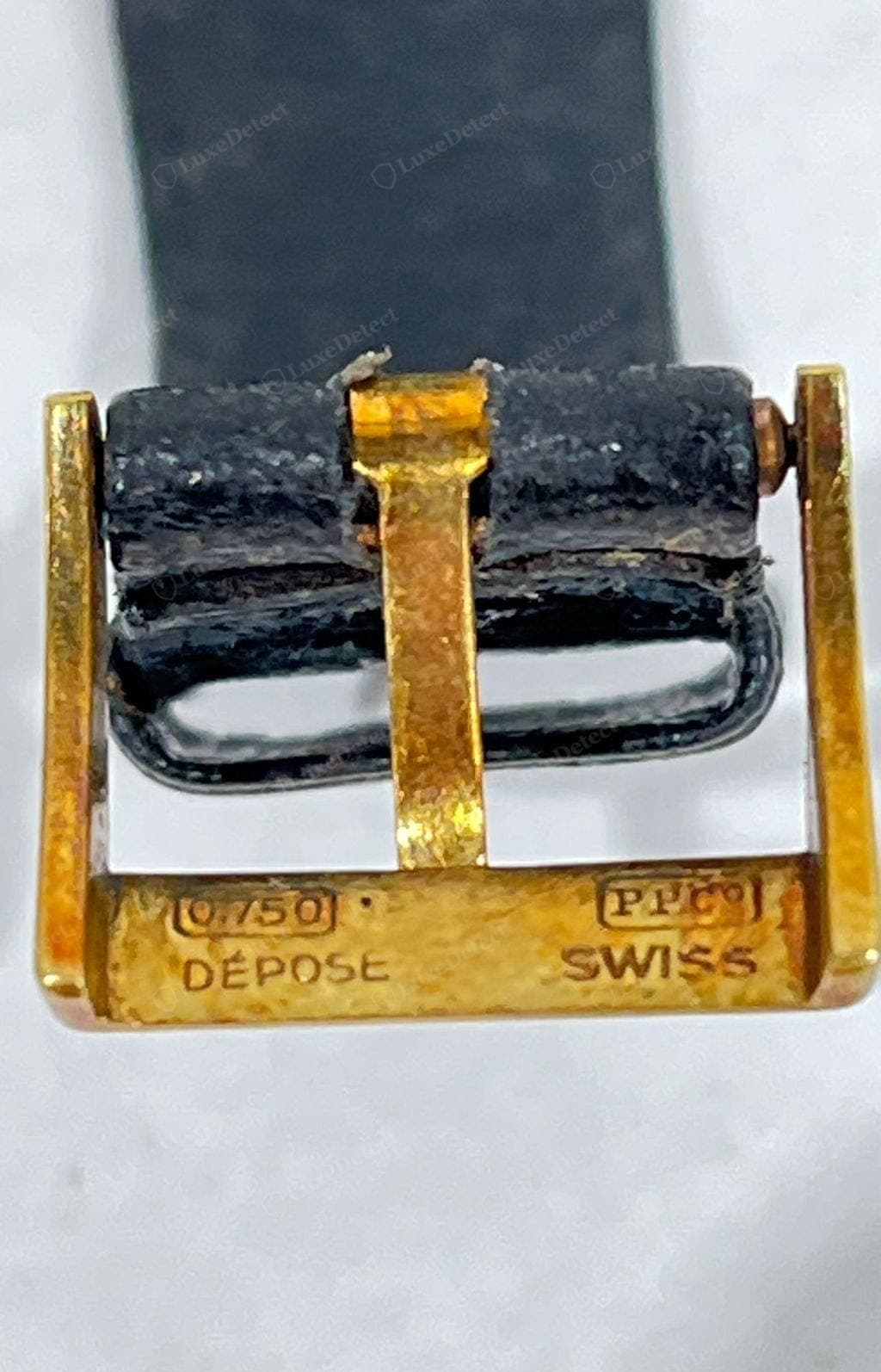
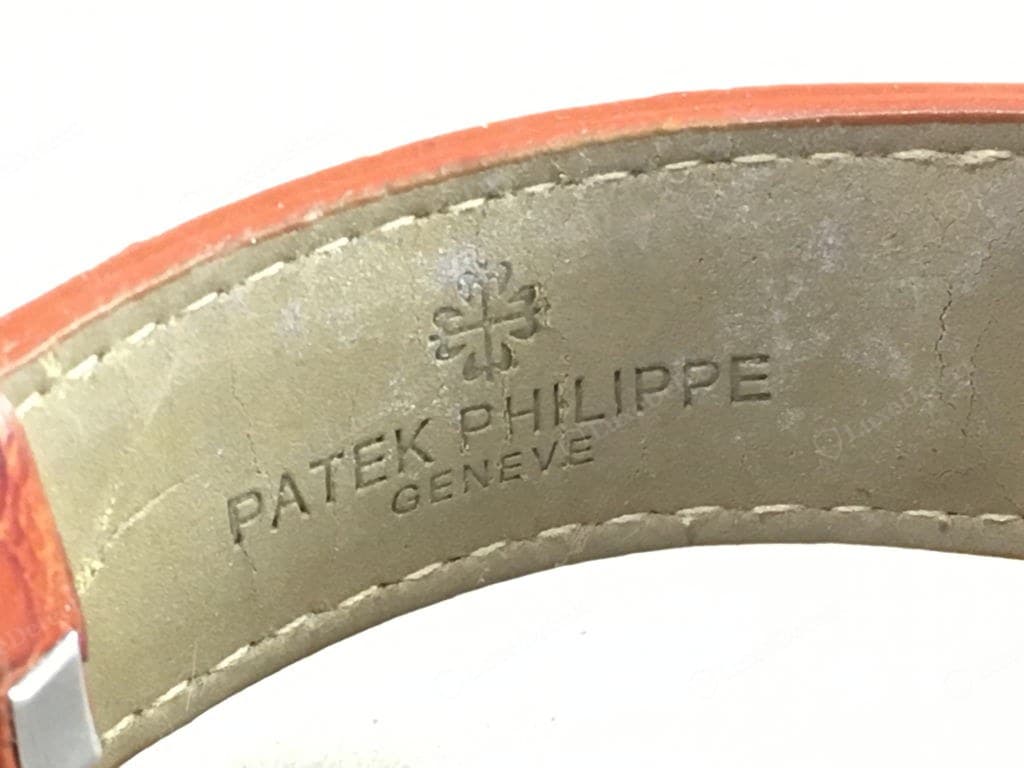
Case finishing: mirror polish and fine brushing with crisp, sharp transitions. The Nautilus's rounded-octagon bezel has a specific profile — polished top, brushed flanks — with cleanly integrated "ears" at 3 and 9. Over-polished or mushy transitions are fake tells.
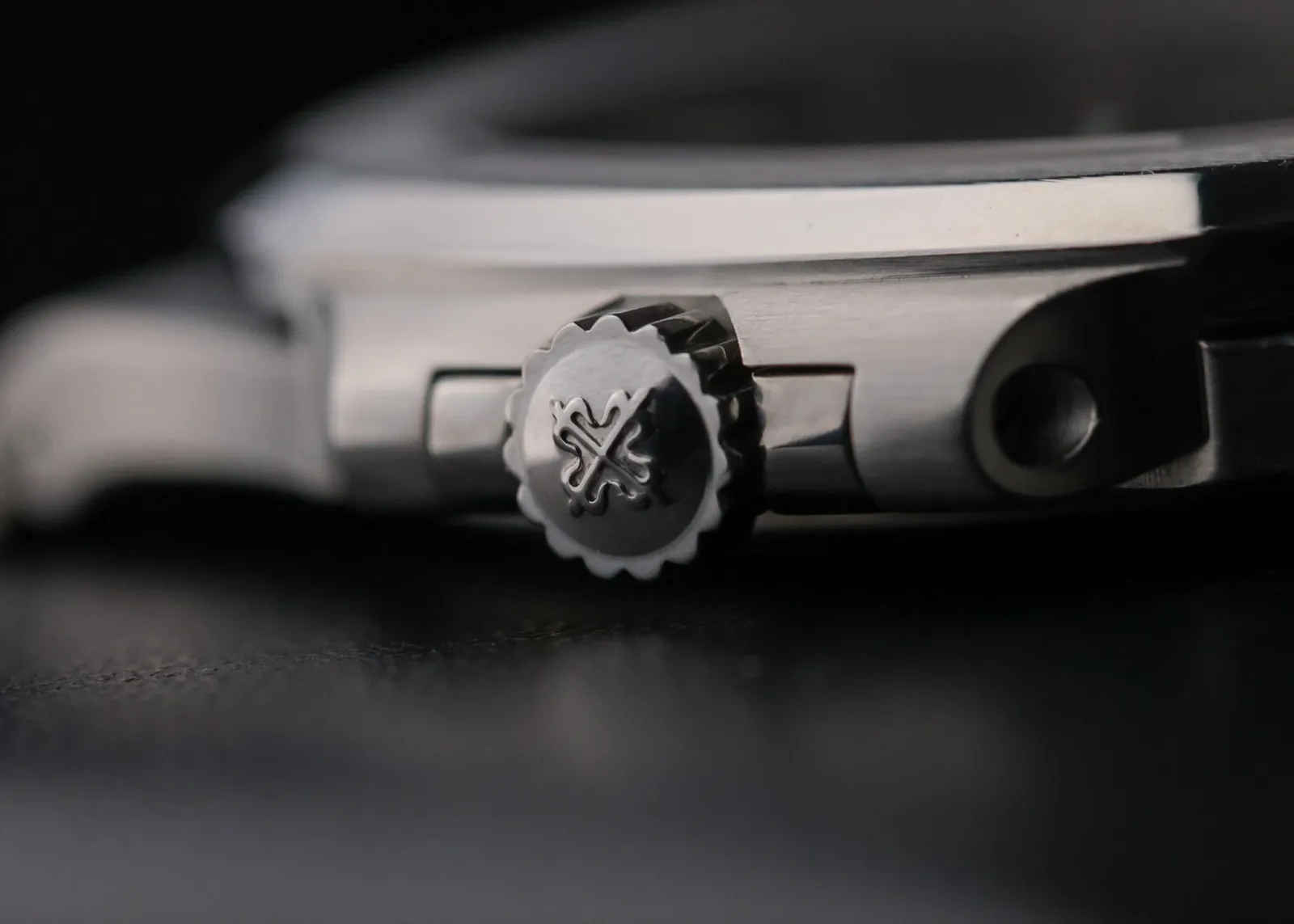
The crown carries a cleanly formed Calatrava cross and a precise action. A soft or misshapen cross, or a gritty crown, is wrong.
The bracelet or strap clasp should carry clean machining, sharp and correctly proportioned lettering, and a Calatrava cross where the reference calls for one — vintage pin buckles are stamped differently from modern deployant clasps, so match the buckle style to the era before judging it.
Weight: a genuine steel Nautilus 5711 is roughly 120–125 g on its bracelet (it shifts with bracelet length). A good clone in correct-grade steel can hit the number — use weight to catch the cheap fakes.
| Element | Authentic | Counterfeit |
|---|---|---|
| Case finishing | Sharp mirror-to-brushed transitions, correct bezel profile | Over-polished, soft edges, wrong bezel shape |
| Crown | Cleanly formed Calatrava cross, precise action | Soft or misshapen cross, gritty action |
| Bracelet / clasp | Clean machining, brushing follows link shape, lettering and cross correctly proportioned for the era | Uneven finishing, soft or misshapen lettering, wrong cross proportions |
| Weight | Full for the size (roughly 120–125 g for a steel Nautilus 5711 on its bracelet) | Noticeably light |
Worth knowing
Case and bracelet finishing is strong corroboration, not the decisive check on its own — the strap-lining stamp pictured above looks plausible at a glance, which is exactly why this check is read together with the movement and dial rather than alone. A clone can get the clasp and case profile close; it cannot get the movement right.
Model-Specific Checks
Once the brand-level checks are clear:
- Nautilus (5711, 5712, 5990): the rounded-octagon bezel and its "ears", the embossed dial, the correct calibre (324 S C on most 5711s made from 2006, 26-330 S C on the later ones), the two-part case.
- Aquanaut (5167, 5164, 5168): the rounded-octagon-with-rounded-corners case, the embossed grid dial, the "Tropical" composite strap with its texture and moulded clasp.
- Calatrava (5196, 5227, 6119): dressier and thinner; the check is almost entirely movement finishing, the applied signature, and flawless case polishing. The 5227's hinged dust cover is a hard-to-fake detail.
- Complications and Grand Complications: any such claim needs specialist verification against an Archive Extract, no exceptions.
The Nautilus has its own authentication guide; for the other families, use the brand-level checks above together with the exact reference's official photos. Run the brand checks first — a watch that fails movement finishing is finished before the model tells matter.
| Element | Authentic | Counterfeit |
|---|---|---|
| Nautilus calibre | Correct in-house movement for the reference and year (e.g. 324 S C or 26-330 S C in the 5711) | A generic decorated automatic |
| Aquanaut strap | "Tropical" composite with the correct texture and moulded clasp | Plain rubber, soft moulded detail |
| Calatrava finishing | Flawless case polishing, applied signature, movement anglage | Soft edges, printed signature, machine-finished movement |
Worth knowing
Model checks are decisive with the exact reference confirmed and misleading without it. Confirm the reference and, for anything complicated or high-value, order the Archive Extract.
Box, Papers, and Provenance
A Patek comes with a Certificate of Origin (a folding card stamped by the retailer), booklets, and a wooden box. None of it authenticates the watch — Certificates of Origin are forged, and genuine ones are sold separated from their watches.
Check that the Certificate's reference, movement number and case number match the watch exactly, that the retailer and date are plausible, and — the real step — that they match the Archive Extract. A Certificate that disagrees with the caseback numbers or the Extract is decisive against; a full matching set is a positive that the physical checks and the Extract still carry.
| Element | Authentic | Counterfeit |
|---|---|---|
| Certificate of Origin | Reference, movement and case numbers match the watch and the Archive Extract | Blank, mismatched, or disagreeing with the Extract |
| Retailer + date | Plausible for the reference, consistent with the Extract | Predates the reference, or contradicts Patek's records |
Worth knowing
Papers are context. The chain that matters is watch → caseback numbers → Archive Extract; the box and card only support it.
Quick Authentication Checklist
- Open the caseback and loupe the movement bevelling — sharp hand-polished interior angles, or it is finished.
- Find the seal: Patek Philippe Seal on modern watches (from about 2012; pieces from 2009–2011 can carry either), Geneva Seal on older Geneva pieces.
- Read the movement number and the case number — both present, both distinct, formats right.
- Order (or demand) an Archive Extract and match its dial, metal and numbers to the watch.
- Loupe the signature — applied or printed as Patek shows for that reference, level, correct width and spacing.
- Check the applied markers for adhesive and uneven height.
- Check the guilloché/embossing depth and evenness.
- Check the case finishing transitions and the bezel profile for the model.
- Confirm the correct in-house calibre for the exact reference.
- Match the Certificate of Origin to the caseback numbers and the Extract.
Any failure on movement finishing, the seal, or a contradiction with the Archive Extract is on its own sufficient. Given the sums involved, one unresolved concern is a reason to stop.
When to Get a Professional Opinion
Patek is the one brand where DIY authentication should always be backed by an expert and an Archive Extract. A $1,000–$3,000 "super clone" Nautilus gets the dial, the case profile and even the weight close. What it does not get right is movement finishing under magnification, the seal, and a match to Patek's records — judgement calls that need someone who has handled genuine Pateks, plus the Extract.
If you are buying a Patek Philippe on the secondary market, get a professional authentication and an Archive Extract before the money moves. LuxeDetect authenticates Patek Philippe watches from $45 with a Certificate of Authenticity back in your inbox within 24 hours, and can advise on obtaining an Archive Extract.
FAQ
What is the single best check on a Patek Philippe?
Movement finishing under a loupe. Genuine Patek bridges have 45-degree bevels mirror-polished by hand, including sharp interior angles a machine cannot cut. Clone-tier counterfeiters cannot reproduce this — dull, uneven, or rounded bevelling settles most fakes on its own.
What is a Patek Philippe Archive Extract?
A document Patek issues from its archives, which record every watch since 1839. It confirms the movement number, case number, reference, dial, case metal, and date of sale. Order it from patek.com. When it matches the watch, it is the strongest evidence a buyer can have.
What is the Patek Philippe Seal?
From 2009, Patek certifies its watches with its own seal — a "PP" in a shaped shield, engraved on a bridge — covering the movement, case, dial, and timekeeping. Before that, Geneva-made Pateks carried the Geneva Seal, and watches from around 2009–2011 can carry either. A clearly recent Nautilus or Aquanaut with a Geneva Seal instead is a red flag.
Are fake Patek Nautilus watches convincing?
The best "super clones" of the 5711 look convincing and get the case profile, weight, and blue embossed dial close. They fail on movement finishing under magnification, the Patek Philippe Seal, applied-signature geometry, and a match to Patek's archives. At Nautilus values, always get an expert opinion and an Archive Extract.