Why the Datejust Is Checked From the Back
The Datejust is the Rolex most people picture: a round Oyster case, a fluted bezel, a date window under a magnifying lens at 3 o'clock, often on a five-piece Jubilee bracelet. Rolex introduced it in 1945 as the first self-winding chronometer wristwatch to show the date in a window on the dial, and it has been made in steel, in gold and in Rolesor (steel and gold together) ever since. That long, varied production run is exactly why it is copied so often: there are dozens of genuine dial, bezel and bracelet combinations, so a buyer cannot rule a watch out just because the front looks unfamiliar.
The front is also where counterfeiters spend their effort. Among the fake Datejusts in our order records, many have dials, fluted bezels and two-tone bracelets that look right in a listing photo. Far fewer get the back of the watch right. The caseback and what sits behind it are where most fake Datejusts we have reviewed fail, and those checks need nothing more than a clear photo of the back or, at most, a watchmaker opening the case.
This guide is about the Datejust specifically. The general Rolex checks (the sweep of the seconds hand, Cyclops magnification, serial engraving, crown markings and bracelet finishing) are in our complete guide to spotting a fake Rolex, and serial formats by year are in the Rolex serial number guide. Here we go deeper on the checks that decide a Datejust.
What to check, ranked by reliability
| Checkpoint | Reliability | What it tells you |
|---|---|---|
| 1. The Caseback: Solid Steel, Never a Window | ★★★★★ | Rolex has never made a Datejust with a see-through back, so a window rules the watch out. |
| 2. The Movement: A Rolex Calibre, Not a Generic Automatic | ★★★★★ | A movement with no ROLEX engraving or calibre number is decisive; a Rolex-looking one only moves you on. |
| 4. The Outside of the Caseback | ★★★★★ | An engraved crown and ROLEX branding in the middle of the back is a counterfeit pattern; dedications are not. |
| 3. Inside the Caseback Lid | ★★★★★ | A blank or garbled lid rules a watch out; correct wording is copied by some fakes and proves nothing. |
| 5. Dial, Date and Cyclops | ★★★★★ | Catches misprints and impossible dial wording, but good fakes look best from the front. |
| Model Reference Before You Start | ★★★★★ | Catches a Day-Date dial on a two-tone case or a quartz round Datejust; will not catch a good fake. |
| What the Box and Papers Do and Do Not Prove | ★★★★★ | Packaging is context only; papers help only when their numbers match the case engravings. |
Use our free Rolex Serial Number Checker to decode the serial between the lugs and confirm the production era.
Check My Serial →Model Reference Before You Start
- Datejust (men's and mid sizes). Current models come in 36 mm and 41 mm, earlier ones mainly in 36 mm, with mid sizes in between. Fluted, smooth or gem-set bezels; Oyster, Jubilee or President bracelets depending on the reference.
- Lady-Datejust. The smaller ladies' version (28 mm on recent models, 26 mm on older ones), built the same way with a smaller movement.
- Day-Date (not a Datejust). It adds the day of the week spelled out in a window at 12 o'clock and has only ever been made in gold or platinum. A "Day-Date" or "Oysterquartz Day-Date" dial on a steel or two-tone Datejust-style watch is a contradiction we see regularly on fakes; the main Rolex guide covers it.
- Oysterquartz Datejust. A genuine quartz Datejust made from the late 1970s until 2001, with its own angular integrated case and bracelet. It ticks once a second by design. A round, Jubilee-bracelet Datejust that holds a battery is a different story (section 2).
- Metals. Steel, Rolesor (steel with a yellow, white or Everose gold bezel, crown and centre links) and solid gold all exist. Two-tone is genuine on a Datejust.
The reference number (for example 16013, 16233 or 126233) is engraved on the case between the lugs at 12 o'clock and, on many older watches, inside the caseback lid. Write it down before going further: every check below is easier when you know what the watch claims to be.
The Caseback: Solid Steel, Never a Window
Rolex builds the Datejust on its Oyster case, sealed with a solid, screw-down caseback with fine flutes around the edge. Rolex has never sold a Datejust with a see-through caseback. Whatever the era, size or metal, the back of a genuine Datejust is metal you cannot see through.
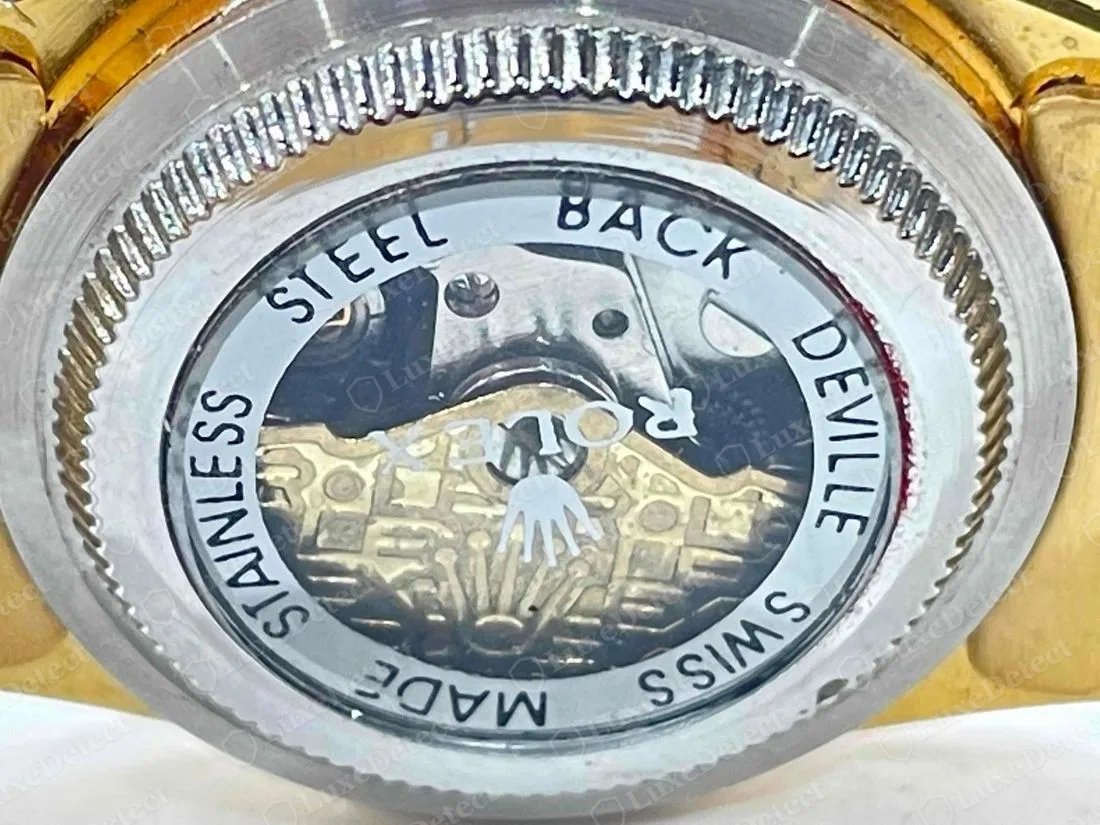
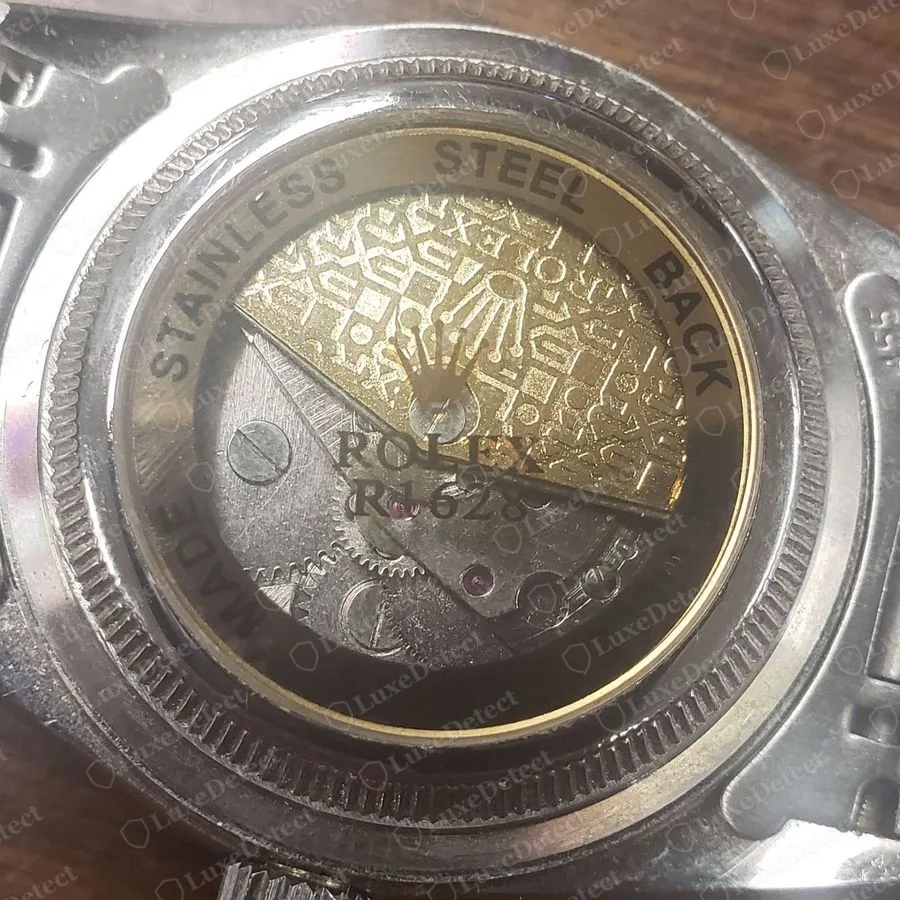
Fake Datejusts very often have exactly that: a display window showing the movement, usually ringed with printed text. Several fakes in our records carry the same printed ring, reading "STAINLESS STEEL BACK", "SWISS MADE" and the word "DEVILLE" (a word that has nothing to do with Rolex), around a window with a crown printed on the glass and a gold-coloured rotor stamped with a repeating crown pattern.
| Element | Authentic | Counterfeit |
|---|---|---|
| Caseback type | Solid screw-down metal back, fluted edge, nothing visible through it | A glass window showing the movement |
| Text around the back | None printed; the outside is plain on the genuine Datejusts we have reviewed | Printed rings such as "STAINLESS STEEL BACK", "DEVILLE", "SWISS MADE" |
| Rotor seen through the back | Not visible without opening the case | Gold-coloured rotor with a stamped crown pattern, or a printed ROLEX on the glass |
Red flag
A see-through caseback on a Datejust. Rolex has never made a Datejust with a display back, so a window on the back ends the inspection whatever the dial looks like. An aftermarket display back fitted to a genuine watch is possible but rare, and it would still show a Rolex movement (section 2).
The Movement: A Rolex Calibre, Not a Generic Automatic
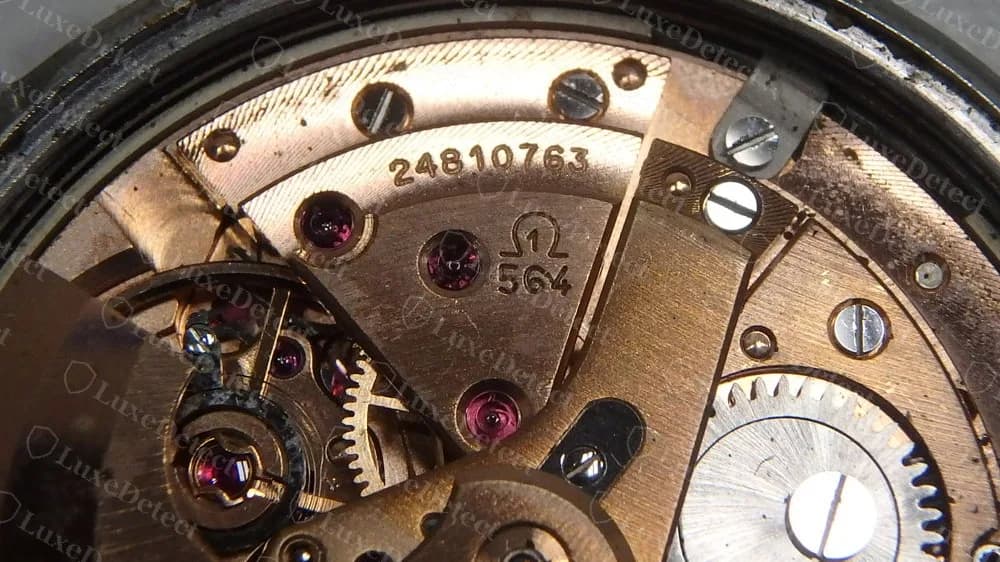
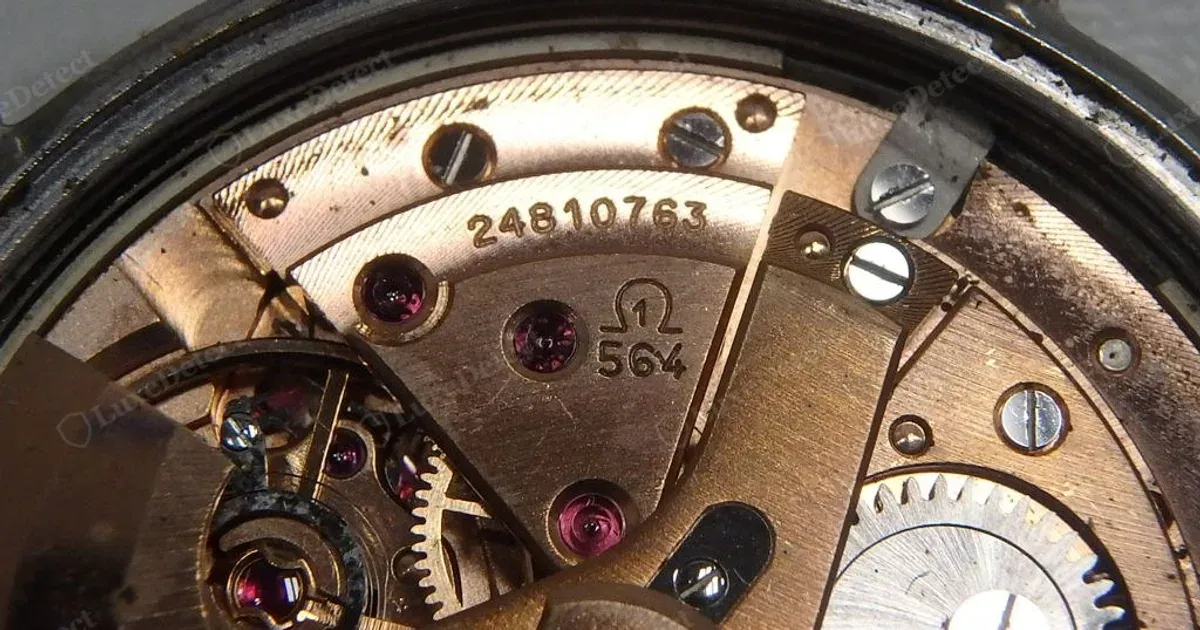
A genuine Datejust runs on a Rolex automatic calibre. The movement is engraved "ROLEX" and "GENEVA" or "GENEVE" with "SWISS", the calibre number, and on many calibres red reversing wheels show beside the rotor. The genuine 16013 below (1980s) runs on calibre 3035; later men's Datejusts moved to the 3135 and today's to the 3235, while Lady-Datejusts use their own smaller calibres.
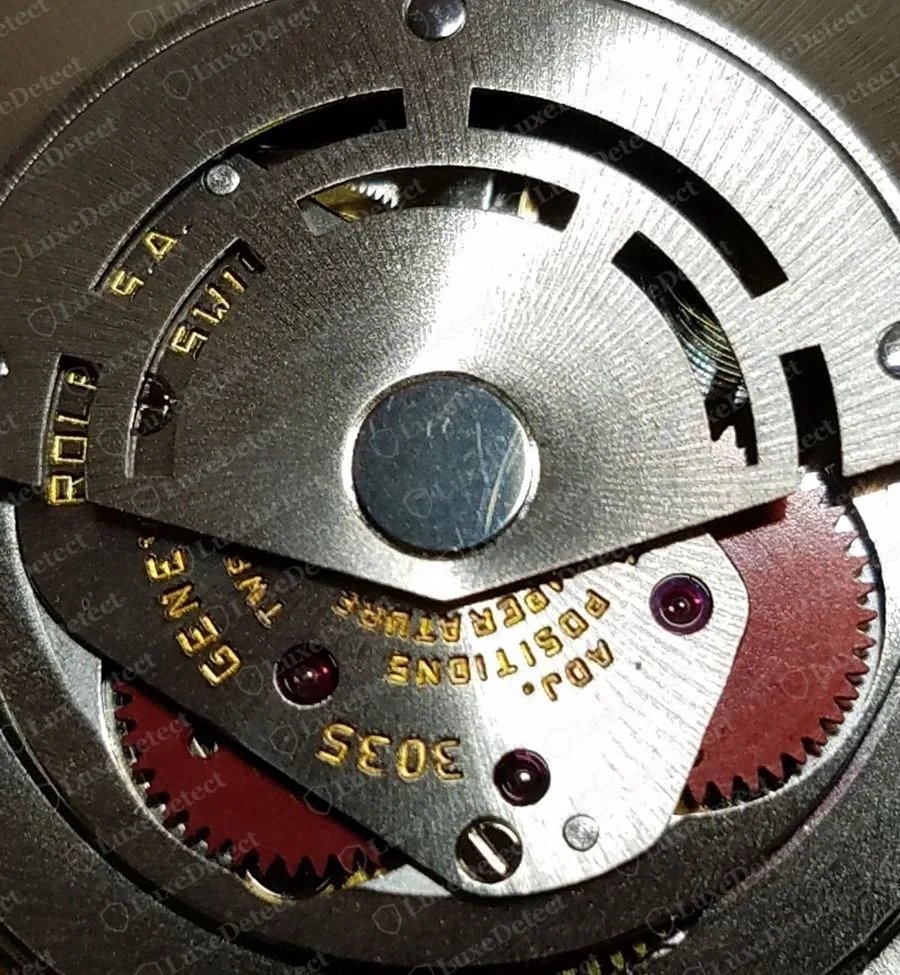
The fakes we see either show a movement through a display back (section 1) or, once opened, a generic automatic with no Rolex marking at all: plain plates, a half-moon rotor with no engraving, sometimes a single visible jewel set off-centre. The same unmarked movements turn up across fake Datejusts of different sizes and colours.
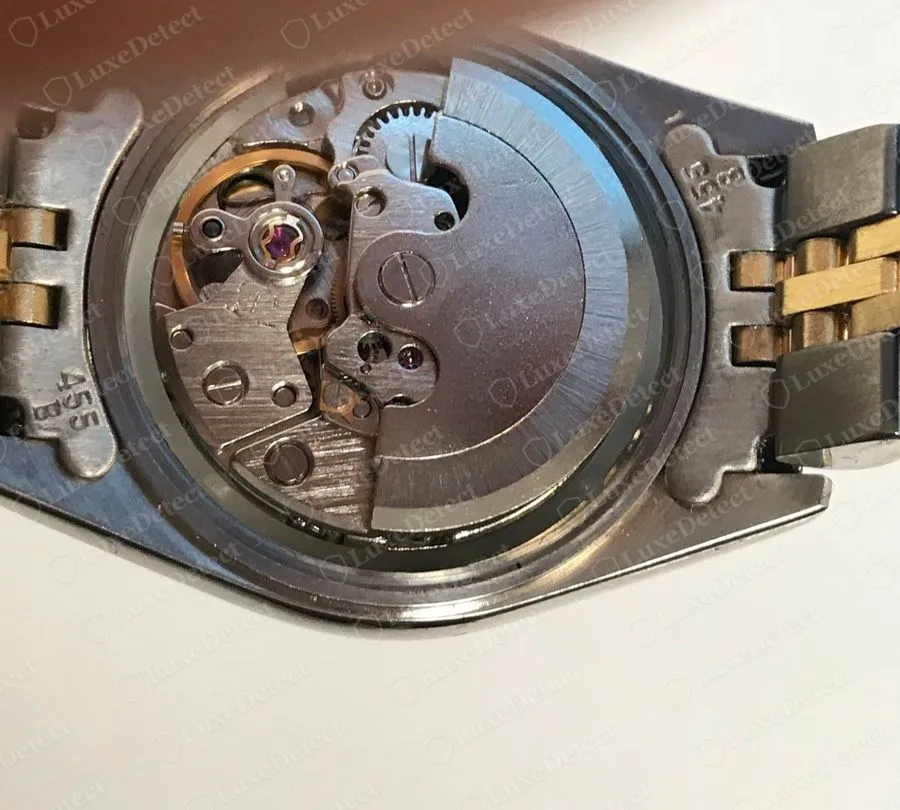
| Element | Authentic | Counterfeit |
|---|---|---|
| Markings | ROLEX, GENEVA or GENEVE, SWISS and a calibre number engraved on the bridges | Blank plates, or another maker's markings |
| Rotor | Rolex rotor, engraved on modern calibres | Plain half-moon rotor, or a gold-coloured decorative rotor |
| Reversing wheels | Red reversing wheels visible on many Rolex automatic calibres | Absent |
| Power source | Automatic (except the separate Oysterquartz model) | Sometimes a battery quartz module in a "Datejust" |
Red flag
A movement with no ROLEX marking and no calibre number. A genuine Datejust movement is engraved by Rolex, so a blank movement or a quartz module in a round Jubilee-bracelet Datejust settles it. Have a watchmaker open a solid back if the seller allows it; the [main Rolex guide](/blog/how-to-spot-fake-rolex-2026-guide) has more on reading movements.
Worth knowing
The better clones use mechanical movements built to look like a Rolex calibre. A Rolex-looking movement moves you on to the other checks; it does not prove the watch on its own.
Inside the Caseback Lid
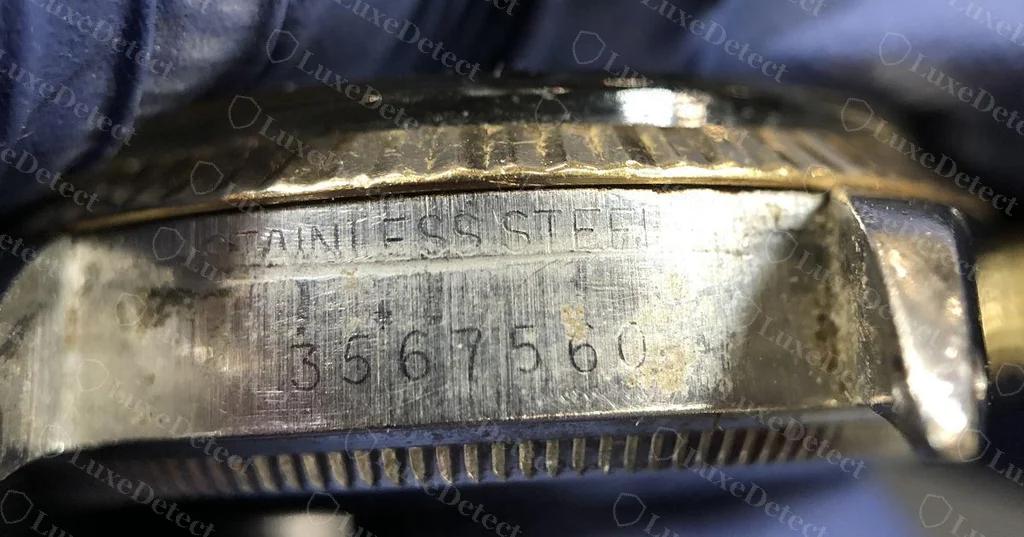
When a genuine Datejust is opened, the inside of the solid caseback is engraved with the maker's details: "MONTRES ROLEX S.A. GENEVA SWITZERLAND", the metal ("STAINLESS STEEL" on steel backs) and a caseback reference number. Older backs may add "PATENTED" or a date code. The lettering is even and evenly spaced.
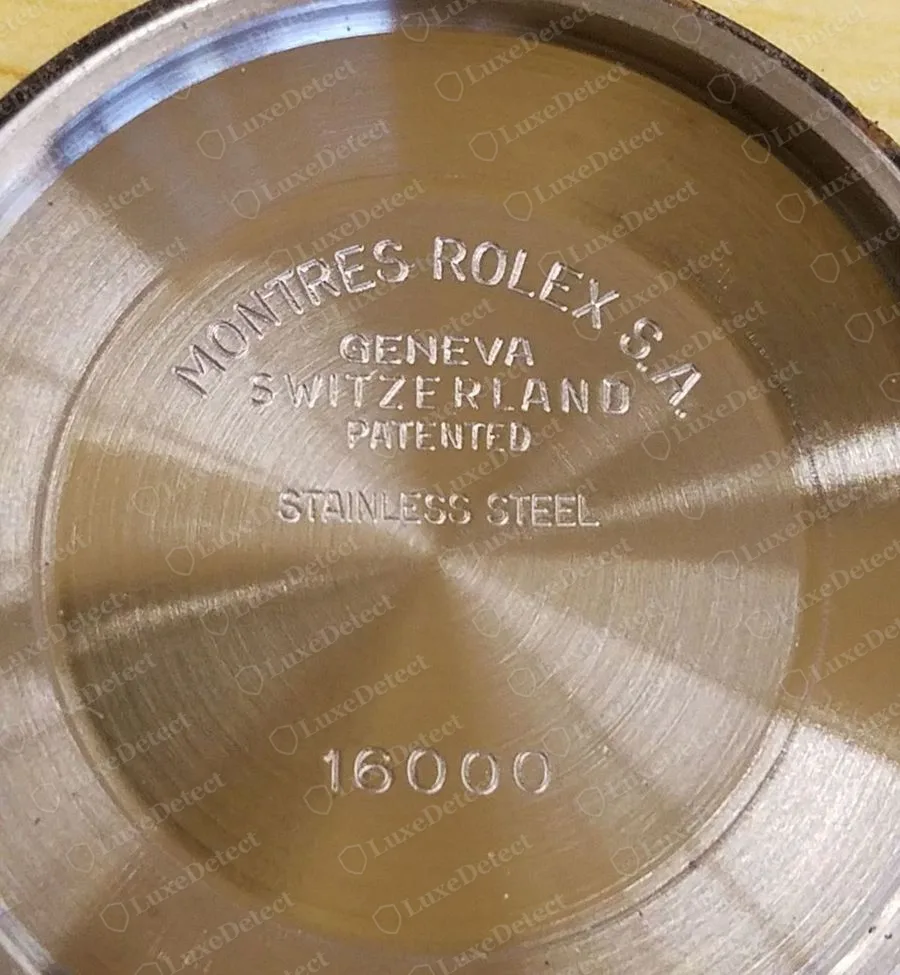
Fake Datejust lids in our records are either blank, with only machining rings, or engraved with text that only imitates the layout. One reads "MONARCHPOLFY S.A. GELENA SHITINERAND STAINLESS STEEL" in the same arc-and-lines arrangement as the genuine wording, which is close enough to pass a glance and wrong on every word.
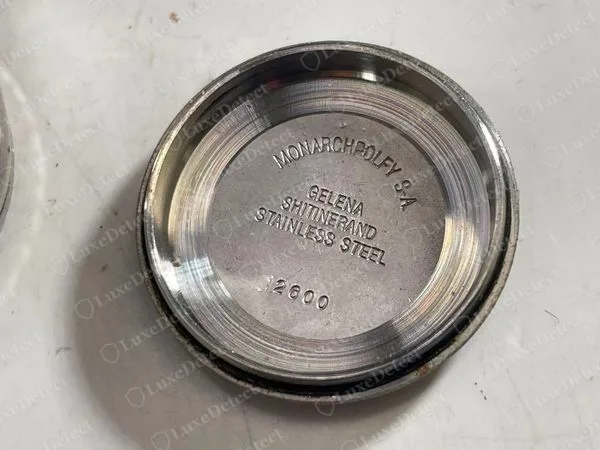
| Element | Authentic | Counterfeit |
|---|---|---|
| Maker's line | "MONTRES ROLEX S.A." arched across the top | Missing, or garbled lettering in the same arc |
| City and country | "GENEVA SWITZERLAND" | Missing or misspelled |
| Metal | "STAINLESS STEEL" on steel backs | Missing, or present while the rest is wrong |
| Number | A caseback reference number | Missing, or a number that matches nothing |
Worth knowing
A blank or garbled lid is a strong sign of a fake, but a correct lid is not proof: some counterfeits copy the genuine wording accurately (we have seen it on a fake Submariner). Use this check to rule watches out, not in.
The Outside of the Caseback
On the genuine Datejusts in our records the outside of the caseback is plain brushed or polished metal with a fluted edge. Rolex marks the case between the lugs and inside the lid, not in the middle of the back.
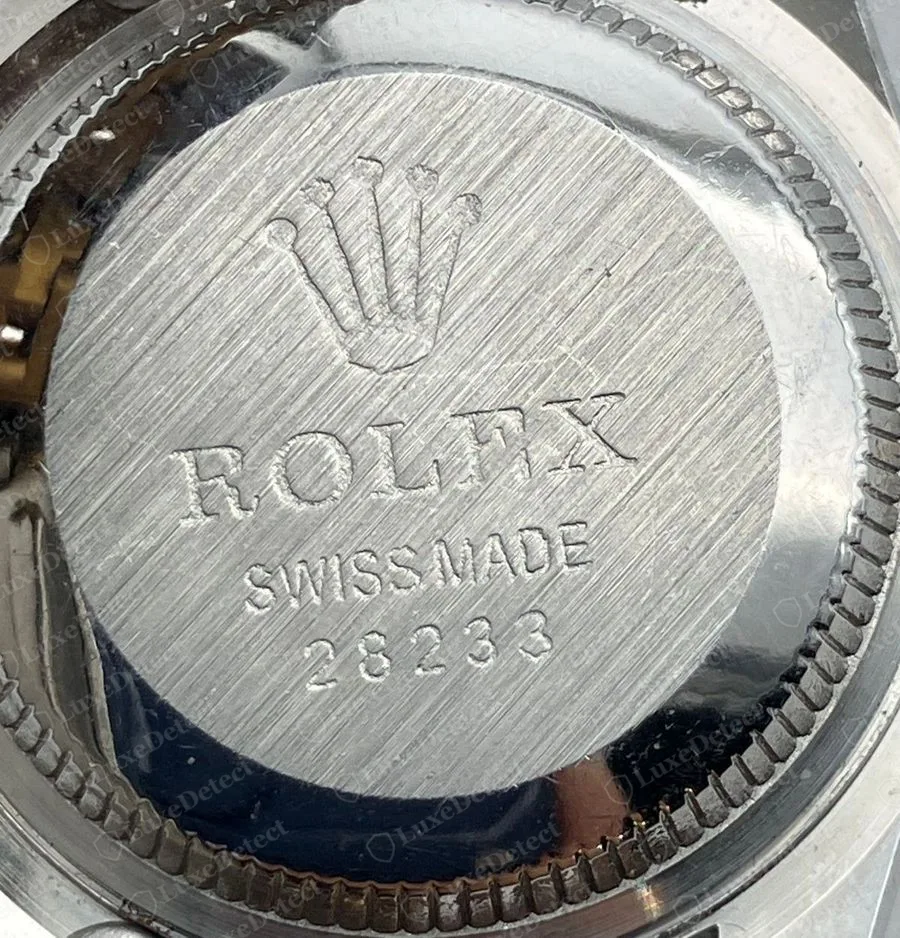
Fakes often decorate it: a large engraved crown with "ROLEX", "SWISS MADE" and a number in the centre, wording such as "SWISS MADE AUTOMATIC MOVEMENT" around a crown, or a green hologram sticker printed with a reference number. The example above even misspells the name: look closely and the engraving reads "ROLFX".
| Element | Authentic | Counterfeit |
|---|---|---|
| Centre of the back | Plain metal | Engraved crown, ROLEX, SWISS MADE and a number |
| Wording | None | "SWISS MADE AUTOMATIC MOVEMENT" and similar |
| Stickers | A green hologram sticker on watches sold until about 2007, usually removed by owners | Hologram stickers on watches of any era, often printed with a reference number |
Red flag
A Rolex crown and ROLEX lettering engraved in the middle of the outside caseback. Rolex does not brand the outside of a Datejust back, so factory-style branding there is a counterfeit pattern. A personal dedication engraved later by an owner is a different thing and can appear on a genuine watch.
Dial, Date and Cyclops
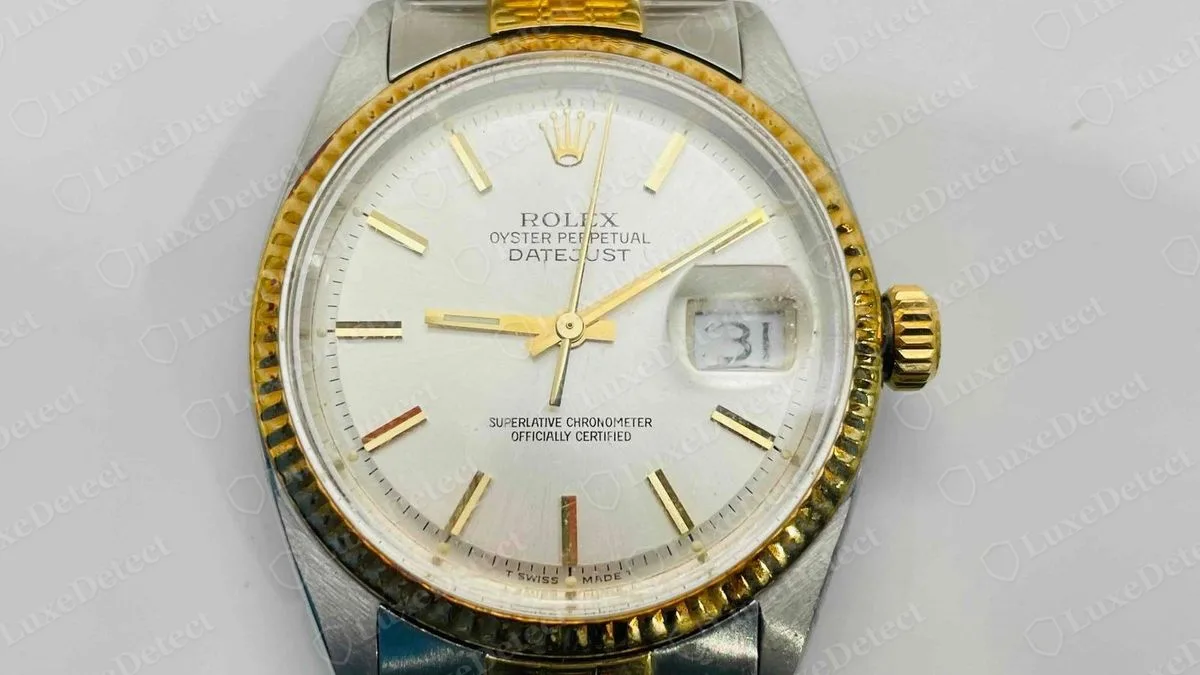
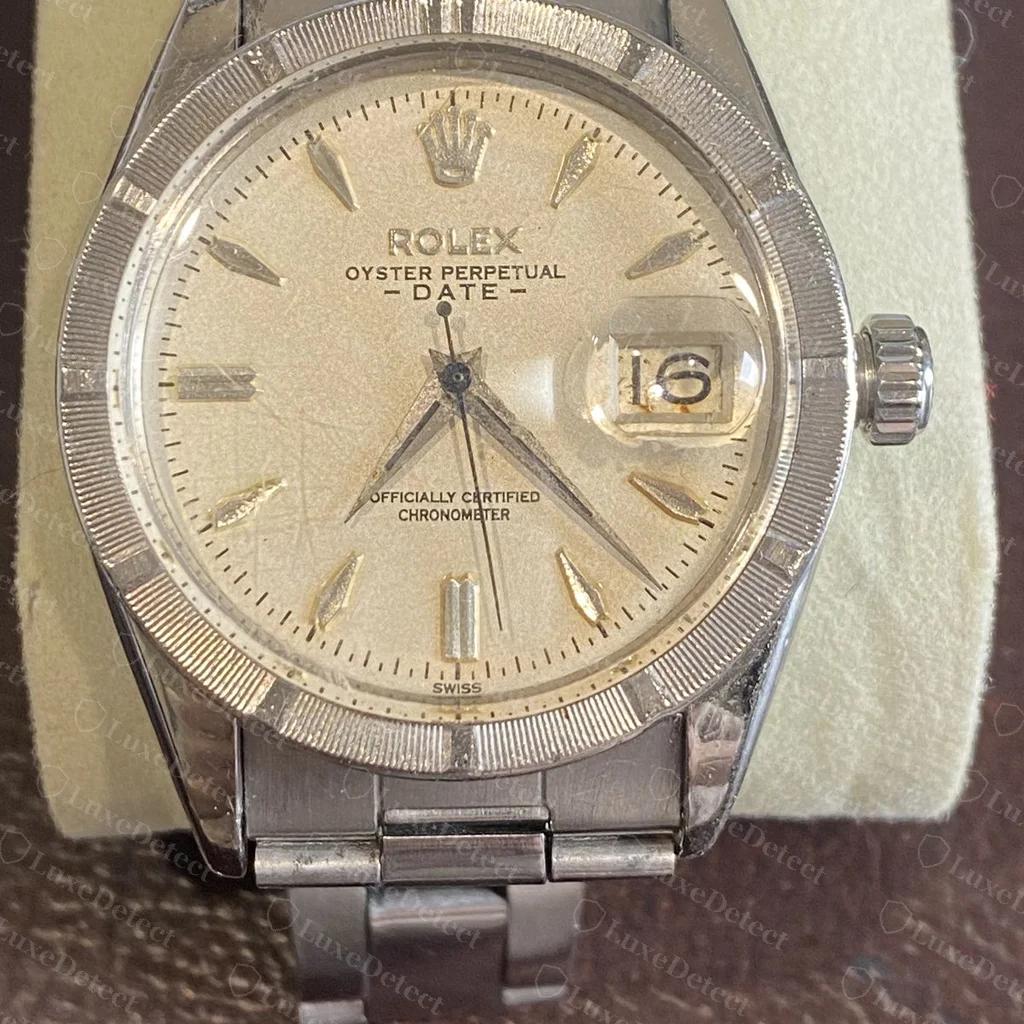
The dial is where good fakes look best, so we rank it below the caseback. On a genuine Datejust the text reads "ROLEX", "OYSTER PERPETUAL DATEJUST" and "SUPERLATIVE CHRONOMETER OFFICIALLY CERTIFIED" in crisp, evenly weighted letters, with the coronet sharp and symmetrical and applied indices sitting level. The date sits centred in its window under the Cyclops, which Rolex added in 1953 and which magnifies the date 2.5 times, so the numeral fills the window.
On a fake, look for letters that are thicker, thinner or unevenly spaced, a coronet with uneven points, a date numeral that floats small or off-centre under the lens, and dial wording that names a function the watch lacks, such as "DAY-DATE" with no day window. The main Rolex guide explains the Cyclops test and dial printing in detail.
Worth knowing
Genuine Datejust dials vary a lot by era (tritium-era dials marked "T SWISS T", diamond and gem-set dials, linen and pie-pan finishes), and aftermarket dials and diamond bezels are fitted to genuine watches. Judge the dial against the reference and era, and never on its own.
What the Box and Papers Do and Do Not Prove
Several fake Datejusts in our records came in a green Rolex-style box, some with a booklet and a hologram-style tag. Boxes and cards are sold separately and are easy to copy, so they are context, not evidence. What papers are good for is cross-checking: the reference and serial on a genuine warranty card should match the engraving on the case. A mismatch is a warning; a match proves nothing on its own.
Quick Authentication Checklist
- Look at the back. A see-through caseback rules the watch out.
- If the case can be opened, read the movement: ROLEX, GENEVA or GENEVE, SWISS and a calibre number.
- Read the inside of the lid: "MONTRES ROLEX S.A. GENEVA SWITZERLAND", the metal and a number.
- Check the outside of the back: plain metal, no engraved crown or "SWISS MADE" branding in the middle.
- Confirm the reference between the lugs at 12 o'clock and the serial at 6 o'clock or on the rehaut; decode the serial era with the Rolex serial number checker.
- Check the dial text, the date under the Cyclops and that the dial names only functions the watch has.
- Cross-check papers against the case engravings.
A failure on check 1 or 2 is enough on its own. Two failures among the others means walk away.
When to Get a Professional Opinion
The checks above clear the large majority of the fake Datejusts we see, because most fail at the back. The harder cases are clones with a solid back, a correct-looking lid and a mechanical movement shaped like a Rolex calibre, and genuine watches that have been altered with aftermarket dials, bezels or bracelets. Telling those apart means comparing finishing and engraving against verified watches, which is a judgement built on having handled many of both.
If the watch is a private sale, a marketplace listing or anything you cannot open in front of the seller, get a second opinion before paying. LuxeDetect authenticates watches from $45, with a Certificate of Authenticity back in your inbox within 24 hours.
FAQ
Does a real Rolex Datejust have a clear caseback?
No. Every Datejust Rolex has made has a solid, screw-down metal caseback. A Datejust with a glass back that shows the movement is a fake, or at the very least a watch fitted with a non-Rolex back, which should then be opened and checked.
Can I authenticate a Rolex Datejust from photos?
Yes. What decides it is how the caseback, movement, lid engraving, case engravings and dial fit together against verified Datejusts of the same reference and era. Clear photos of the back, the lid and the movement settle most cases; on an expensive watch, a professional review is the safer route.
What movement is inside a genuine Datejust?
A Rolex automatic calibre engraved with ROLEX, GENEVA or GENEVE, SWISS and the calibre number. Men's Datejusts have used calibres such as the 3035, 3135 and the current 3235; Lady-Datejusts use smaller Rolex calibres. The genuine quartz exception is the Oysterquartz Datejust, which has its own angular case and integrated bracelet.
Are two-tone Datejusts real?
Yes. Rolex calls steel and gold together Rolesor, and two-tone Datejusts with a gold bezel, crown and centre bracelet links are a long-running genuine line. Two-tone is not a warning sign on a Datejust; it is on a Day-Date, which Rolex has only made in gold or platinum.
What is written inside a Datejust caseback?
On a genuine back: "MONTRES ROLEX S.A. GENEVA SWITZERLAND", the metal (for example "STAINLESS STEEL") and a caseback reference number, sometimes with "PATENTED" or a date code on older backs. A blank lid or garbled lettering is a strong sign of a fake, but some fakes copy the correct wording.
Where is the serial number on a Datejust?
Between the lugs at 6 o'clock on older watches, and on the rehaut (the inner ring between dial and crystal) at 6 o'clock on newer ones. The Rolex serial number guide explains where to look by era and what the format tells you.
Sources
Photos are from LuxeDetect's own order records: genuine Datejusts and counterfeits reviewed by our authenticators. Model facts (the Datejust's 1945 introduction, the 1953 Cyclops lens and its 2.5x magnification, the Oyster case with a screw-down caseback, Rolesor, current case sizes and the calibre 3235) are from Rolex's own Datejust pages and newsroom at rolex.com. Earlier calibre numbers and the Oysterquartz production period are from published dealer and auction references.