Luxury Watch Authentication Specialist
Watch authentication specialist covering Swiss manufacture references and bracelet construction.
Last updated October 2026 · Published June 2026 · Contact
Why the Royal Oak Is Faked at Scale
The Audemars Piguet Royal Oak Selfwinding 41mm (ref. 15400, then 15500, and since 2022 the 15510) retails for well over $20,000 and often trades above retail on the secondary market. The "jumbo" ref. 16202 commands over $100,000. This pricing makes the Royal Oak a frequent target for counterfeiters, like the Submariner and the Nautilus.
The Royal Oak has one characteristic that sets its counterfeit market apart: Gerald Genta's 1972 design is defined almost entirely by finishing rather than complication. There is no chronograph to reproduce, no perpetual calendar, no tourbillon. What makes a Royal Oak a Royal Oak is the bezel geometry, the tapisserie dial, and the hand-finished bracelet — all surface qualities. Counterfeiters have therefore concentrated on exactly those surfaces, and the best current fakes reproduce them well enough that the traditional quick checks no longer carry the weight they did five years ago.
The screw-slot check below remains genuinely useful and costs nothing. But treat it as a first filter rather than a verdict: it catches volume fakes and misses good ones.
The Eight-Screw Bezel — Slot Direction
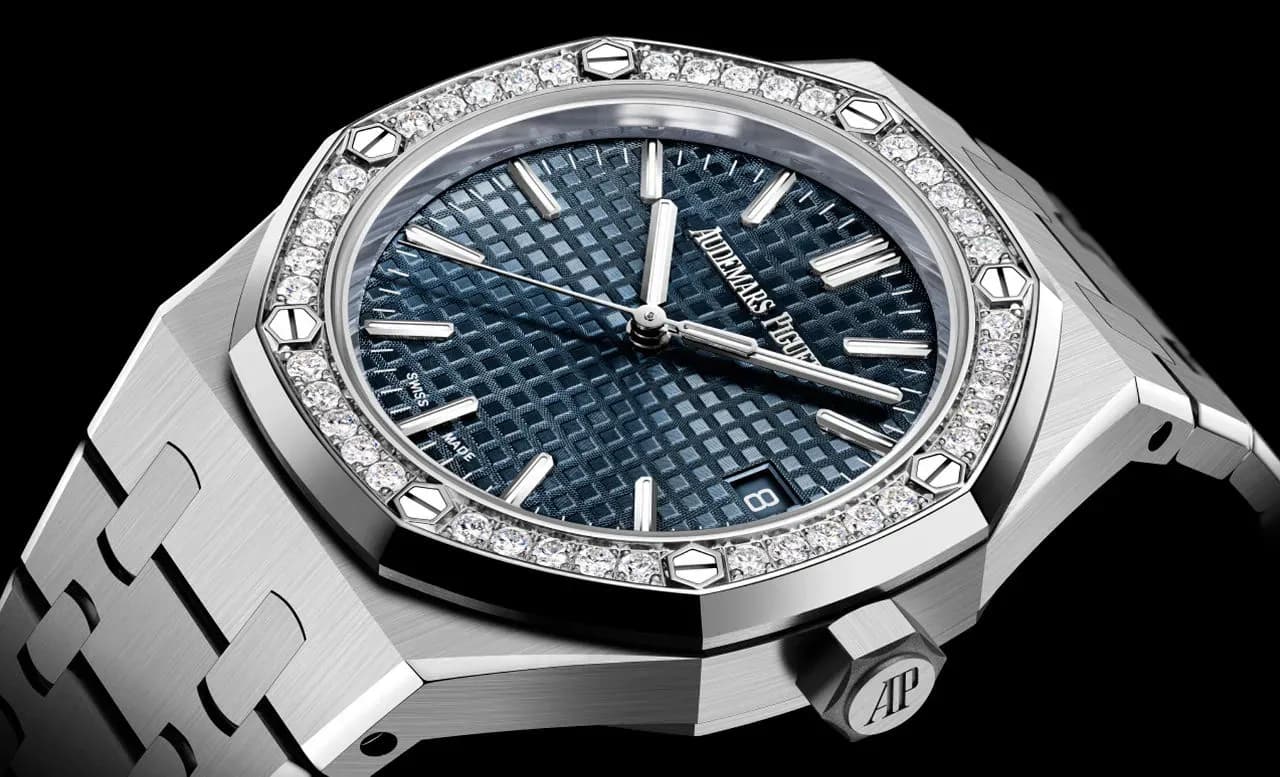
The design centres on an octagonal bezel secured by eight hexagonal screws, and these screws are the most-checked detail on the watch.
Authentic: Each hexagonal head is mirror-polished with a slot cut precisely across its centre, and the slots are aligned deliberately and consistently around the octagon: they follow the bezel, so on a genuine watch the screws at 12 and 6 carry horizontal slots, the ones at 3 and 9 carry vertical slots, and the four corner screws follow the same pattern at their angles. They are not all horizontal — a rule like that would fail every genuine watch. All eight screws are identical in size and sit flush with the bezel surface.
Fake tells: Slots that break the pattern of their neighbours on the same watch (a screw turned out of line with the others in its position), which is a common failure because counterfeiters skip the alignment step. Compare against official photos of the exact reference. Screws of slightly differing sizes. Heads recessed below the bezel surface or standing proud of it. Slot cuts that are off-centre on the hexagonal head.
Its limitation: better fakes now align the slots correctly. Passing this check means the watch clears the lowest tier, nothing more.
Bezel geometry
Authentic: The octagon's facets are even and symmetrical, with sharp defined edges where the brushed top surface meets the polished chamfer. The chamfer itself is a true mirror.
Fake tells: Uneven facet widths. Rounded or softened edges where genuine ones are crisp. A chamfer that is bright but not mirror-polished, showing fine directional marks under a loupe.
The Grande Tapisserie Dial
The dial carries a precise square hobnail texture — raised squares in a uniform grid across the entire surface.
Authentic: Under magnification each hobnail square has crisp corners and consistent height, and the grid remains perfectly regular across the full dial including at the edges and around the date aperture. The pattern is precisely machined, giving it genuine relief that shifts visibly as the watch tilts under directional light. The "AUDEMARS PIGUET" signature (applied on many references, printed on others, often with an applied AP logo at 6 — check the official photos for your exact reference and year) shows precise character spacing, and it is the part fakes most often get wrong. A standard Royal Oak dial does not carry the words "ROYAL OAK"; they appear on casebacks and on some special editions. Applied gold indices have clean polished faces and sit perfectly upright.
Fake tells: Printed or stamped tapisserie that reads flat under raking light with no depth as the watch moves. Grid regularity breaking down near the dial edge or around the date window. Inconsistent letter spacing in "AUDEMARS PIGUET," typically with the S and the following P too close, or a "ROYAL OAK" line printed on a dial that should not have one. Indices sitting at a slight angle.
Lume and hands
Authentic: Lume fills the index and hand channels flush, evenly, with no overflow. The hands carry polished bevels that catch light as a clean bright line.
Fake tells: Lume proud of or dished below its channel. Colour mismatch between hands and indices. Hand bevels absent or rough, breaking the light reflection.
The Integrated Bracelet
Each link is individually machined and finished — a brushed centre strip with polished edges, and a razor-sharp transition between the two.
Authentic: The brushed-to-polished contrast is a clean line with no blurring at any point along the bracelet. The bracelet lies flat and articulates smoothly, draping evenly when held by one end. "AP" is engraved on the folding clasp in the correct typeface and depth.
Fake tells: Blurred transitions between finishes, the most reliable bracelet tell. Rattle or uneven articulation. A bracelet that hangs stiffly rather than draping. Clasp engraving in an incorrect typeface or at inconsistent depth.
Link tolerances
Authentic: Gaps between links are uniform along the full length, with no lateral play when a link is twisted gently. The taper from case to clasp is smooth and symmetrical.
Fake tells: Variable gaps. Side-to-side movement between adjacent links. An asymmetric taper, visible by laying the bracelet flat and comparing both sides.
Movement — Calibre 4302
The refs. 15500 and 15510 use AP Calibre 4302 (the earlier 15400 uses Calibre 3120), visible through the display case back on most modern models. Vintage Royal Oaks and many dress-sized or quartz models have solid case backs, so a missing display back is not by itself a fake tell.
Authentic: The movement carries AP's distinctive Côtes de Genève-style striping, running in a consistent direction, with mirror-polished bevels at the bridge edges. The gold oscillating weight carries AP's engraving and AP's specific shape. The bridge layout is unmistakably AP's — immediately distinguishable from any ETA architecture.
Fake tells: An ETA 2892 clone, identifiable at a glance by wrong bridge layout and wrong rotor shape. Absent or machine-stamped striping, which appears uniform but lacks the depth of true striping. Bevels that are bright but not mirrored.
On movement inspection: the display case back makes this the most accessible high-value check on the watch. Photograph the movement through the crystal at an angle that catches the bevels, and compare against reference images of the calibre for that specific reference.
Sapphire Crystal
Authentic: Modern Royal Oaks use sapphire with anti-reflective coating on both surfaces. Tilted under light the crystal shows a subtle blue-green cast applied evenly to the full surface including the extreme edges. (A fingernail test proves nothing — neither sapphire nor mineral glass reliably marks under a nail — so rely on the coating and a loupe.)
Fake tells: Patchy or blotchy AR coating, most visible near the crystal perimeter. Coating stopping short of the edge. No AR cast at all.
Case Back and Engravings
Authentic: The case back carries the reference number, serial number, and AP markings, laser-engraved to a consistent sharp depth with crisp character walls under a loupe.
Fake tells: Shallow or uneven engraving. Ragged character edges. Serial formats inconsistent with the claimed production period. AP or an authorised retailer may be able to check a serial against AP's records — as with any registry check, a match confirms the serial exists, not that this watch is the one recorded.
Quick Authentication Checklist
- Eight screws: slots aligned consistently around the octagon as on official photos of that reference (12/6 horizontal, 3/9 vertical), identical size, mirror-polished, flush with the bezel
- Bezel: even, symmetrical facets, sharp edges, true mirror chamfer
- Tapisserie dial: genuine raised hobnail grid with depth under raking light, regular to the dial edge, correctly spaced "AUDEMARS PIGUET" and no stray "ROYAL OAK" text
- Lume: flush and even, colour matched between hands and indices
- Bracelet: razor-sharp brushed/polished transitions, smooth articulation, uniform link gaps, correct AP clasp engraving
- Movement: AP Calibre 4302 (15500/15510) or 3120 (15400) architecture with striping and mirror bevels — not an ETA layout
- Crystal: even blue-green AR cast to the edge on both surfaces
FAQ
Why do screw slot directions matter?
AP aligns the eight slots deliberately, so a genuine watch shows a consistent pattern that follows the bezel (horizontal at 12 and 6, vertical at 3 and 9). Counterfeiters frequently skip this step or are unaware of it, making it a free check visible in any clear photograph. Note that better fakes now get it right, so alignment alone does not authenticate a watch.
What is the difference between ref. 15400, 15500 and 15510?
All are 41mm. The 15510 (2022) succeeded the 15500 and keeps the Calibre 4302. The 15500 introduced the newer Calibre 4302 in place of the 3120 and revised the dial layout, including a repositioned minute track and a slightly different date window treatment. Authentication principles are identical; only the movement reference and dial details change.
Is the Royal Oak Offshore authenticated differently?
The same principles apply with different proportions. Most Offshores run 42–44mm (37mm and other sizes also exist) with a thicker case and its own tapisserie scale — the Méga Tapisserie pattern uses noticeably larger squares. The eight-screw check, dial relief test, bracelet finishing, and movement architecture checks all carry over unchanged.
Can I authenticate a Royal Oak from photographs?
Yes, and the Royal Oak suits it better than most watches, because the display case back exposes the movement. Screw alignment, dial relief under raking light, bracelet finish transitions, and movement layout can all be compared against a verified reference. Case dimensions, bracelet articulation, and crystal hardness are further points to compare against a verified watch.
Are box and papers enough?
No. Counterfeit boxes and papers circulate widely, and genuine papers are routinely separated from their watches and sold alongside fakes. Papers support a conclusion the physical checks have already reached; they never substitute for it.
How much does professional Royal Oak authentication cost?
Photo-based authentication runs $45 for watch authentication with a 24-hour turnaround, and the Royal Oak is unusually well suited to it given how much the display case back reveals. For a transaction above $35,000, it is a sensible step before you pay.