Watch Authentication Specialist
Watch authentication specialist. Focuses on movement inspection, case finishing, and serial verification.
Last updated September 2026 · Published June 2026 · Contact
Why Richard Mille Is Faked
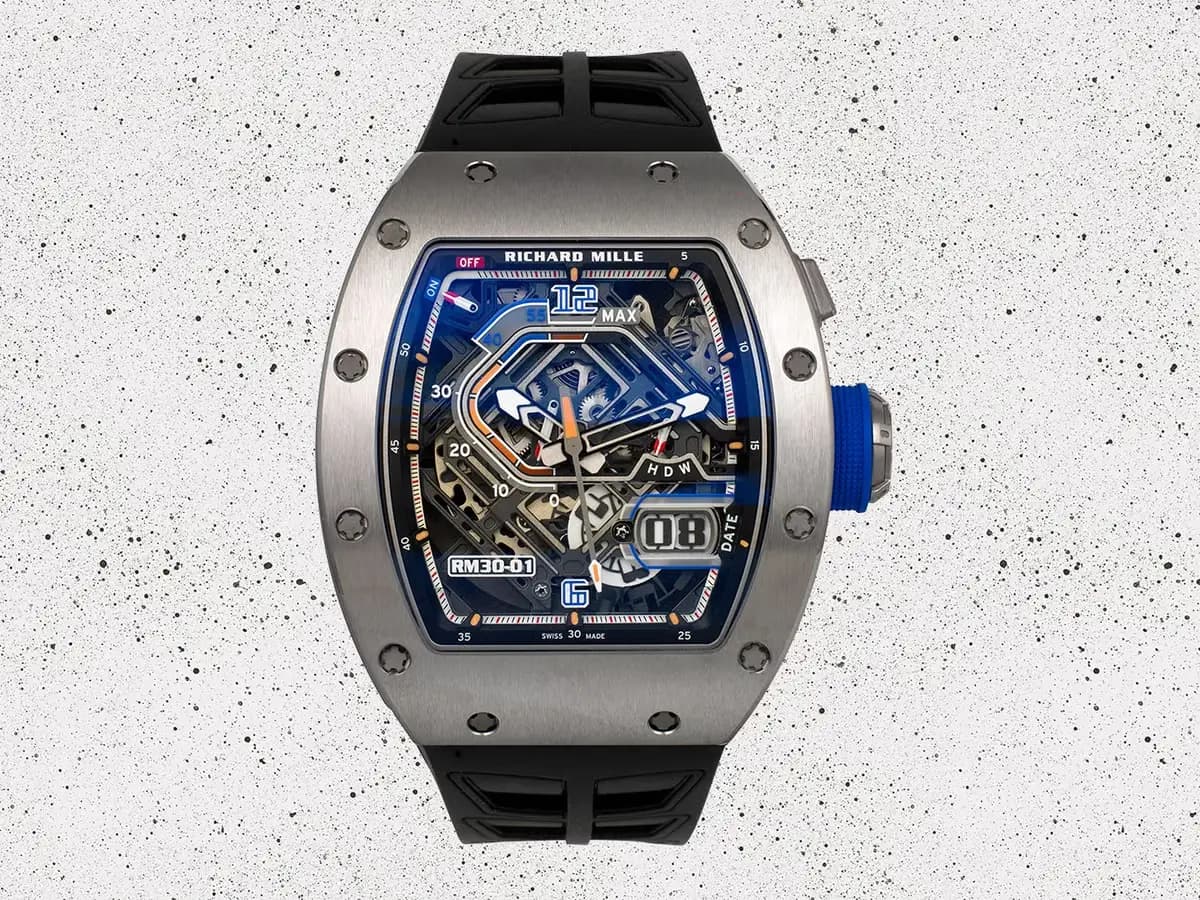
Richard Mille produces approximately 5,000 watches per year. A base model RM 11-03 retails around $200,000. The RM 50-03 — the world's lightest mechanical chronograph — retails at $1,000,000+. Secondary market prices for sought-after references can be 2–5× retail. This combination of extreme price, extreme scarcity, and high cultural profile makes Richard Mille the single most profitable fake target in watchmaking.
Super-clone Richard Milles have reached a level of sophistication where photos alone are insufficient for authentication. This guide covers physical examination points that fakes consistently fail.
The single fact that decides most Richard Mille authentications is mass. The genuine watches are built from grade 5 titanium and TPT carbon to be almost weightless; fakes are steel dressed to look the same. A real RM feels impossibly light for its size, and no current fake closes that gap — so the checks below are ranked with weight and case material first, everything else after.
What to check, ranked by reliability
| Checkpoint | Reliability | What it tells you |
|---|---|---|
| Case Weight — The First and Fastest Tell | ★★★★★ | A watch 3x its published mass is a steel case; no current fake gets the weight right. |
| Case Materials — Carbon TPT and NTPT | ★★★★★ | Carbon that reads flat under raking light is a PVD coating, not layered TPT. |
| The Skeletonised Movement Through the Case | ★★★★★ | CNC-perfect bridge edges with no hand anglage mean a machine-decorated fake movement. |
| The Crown and Crown Tube | ★★★★★ | A push-pull or two-position crown is wrong, but the tri-lobe feel needs the watch in hand. |
| The Sapphire Crystal | ★★★★★ | Corroboration only — a good clone may fit real sapphire. |
Case Weight — The First and Fastest Tell
Richard Mille watches are famous for their use of ultra-lightweight materials: grade 5 titanium, carbon TPT (Thin Ply Technology), NTPT carbon, quartz TPT, and various exotic alloys. An RM 11-03 in titanium weighs approximately 38–42 grams without strap. An RM 67-02 in carbon and titanium weighs around 32 grams.
Fakes cannot replicate these weights. Most fake Richard Milles use stainless steel cases — identical in appearance to the genuine exotic materials but dramatically heavier. A fake RM 11 will typically weigh 120–160 grams. The difference is immediately apparent: a genuine Richard Mille feels almost impossibly light for its size.
If you do not have a scale, the weight difference is felt when the watch is lifted. Genuine Richard Mille wears like almost nothing is on the wrist.
| Element | Authentic | Counterfeit |
|---|---|---|
| RM 11-03, titanium, no strap | ~38–42 g | 120–160 g (stainless steel case) |
| RM 67-02, carbon and titanium | ~32 g | 3–5× that mass |
| On the wrist | Wears like almost nothing is there | Immediately feels like a heavy sports watch |
| Magnet on the case | No pull (titanium is non-magnetic) | Weak pull from a steel case |
Red flag
A Richard Mille that weighs three or more times its published mass. Grade 5 titanium and TPT carbon at the correct weight would cost near genuine production; every current fake is steel and far too heavy, and that alone ends it.
Case Materials — Carbon TPT and NTPT
Carbon TPT and NTPT carbon are proprietary materials exclusive to specific suppliers working with Richard Mille. Their characteristics are highly specific:
Carbon TPT appearance: The material has a visible fibre pattern — layers of parallel carbon fibres visible as fine striations across the case surface. The pattern is consistent in fibre direction but has natural variation in the layering, meaning no two Carbon TPT cases look exactly the same. Fakes use a carbon-look PVD coating or carbon fibre sheet with a regular, repeating pattern.
The striation test: Look at the case from a shallow angle under strong, directional light. Genuine Carbon TPT shows depth — the striations appear to recede into the material. Fake carbon PVD is flat — the pattern is on the surface only.
Titanium colour and texture: Grade 5 titanium has a specific grey tone — slightly warmer and lighter than stainless steel. The brushed finish on genuine titanium cases is fine and parallel, with no circular or cross-hatch marks. Fakes use 316L stainless with a titanium PVD coating — the colour may match initially but chips or wears at edges over time.
| Element | Authentic | Counterfeit |
|---|---|---|
| Carbon TPT pattern | Fine parallel striations, natural layer variation, no two cases alike | Regular repeating weave, or a printed carbon-look coating |
| Striation under raking light | Shows depth, the layers appear to recede into the material | Flat; the pattern sits on the surface only |
| Titanium tone | Warm-grey, lighter than steel | Steel-grey, or a PVD coat that chips at the edges |
| Brushed finish | Fine, parallel, no circular or cross-hatch marks | Uneven grain, swirl marks, cross-hatching |
Red flag
Carbon that reads flat under angled light. Genuine Carbon TPT has visible depth — the fibre layers recede into the case; a pattern that stays on the surface is a PVD coating and is decisive.
The Skeletonised Movement Through the Case
Most Richard Mille watches have full sapphire crystal case backs (and some have sapphire side panels) allowing the movement to be viewed completely.
Movement finishing: Richard Mille movements are finished to a specific standard — bridges and plates show anglage (bevelled edges), fine circular-graining (Côtes de Genève) on appropriate surfaces, and blackened screws. Under a 5× loupe, each component should show hand-finishing marks. Fake movements use CNC-machined surfaces with no hand finishing — the surface texture is too regular and lacks the slight irregularity of human-applied decoration.
Tourbillon (RM 08, RM 27, etc.): Models with flying tourbillons should show the cage rotating once per minute. On genuine watches, the rotation is smooth and even. Fake tourbillons (when present) often have inconsistent rotation speed or visible mechanical drag.
Movement baseplate material: Richard Mille uses SSAM (Skeletonised Space Age Material) or grade 5 titanium baseplates on many movements. These materials have a specific colour and texture. Fake baseplates use standard brass with grey PVD — the colour is slightly off and the surface shows more uniform machining.
| Element | Authentic | Counterfeit |
|---|---|---|
| Bridge edges | Hand-applied anglage, bevelled, polished, slight irregularity | CNC-cut edges, too regular, no hand-finishing marks |
| Screws | Blackened, evenly seated | Bright, uneven, or the wrong head type |
| Tourbillon (where fitted) | Smooth even one-per-minute rotation | Inconsistent speed, visible drag or stutter |
| Baseplate | SSAM or titanium tone and texture | Brass under grey PVD, colour slightly off, machining uniform |
Red flag
Movement bridges with CNC-perfect edges and no anglage. Richard Mille hand-bevels its bridge edges, so a movement whose finishing is flawlessly regular under a loupe was machine-decorated and is a fake.
The Crown and Crown Tube
The crown on Richard Mille watches is secured by a specific locking mechanism — a tri-lobe crown tube locking system that requires a quarter-turn to release and re-engage. This system:
- Requires a specific, deliberate motion to operate (it is not a standard push-pull crown)
- Has three detent positions on the tube locking mechanism
- Produces a specific tactile click when the crown is locked
Fake crown tubes either use a standard push-pull mechanism (completely wrong feel) or a simplified two-position lock that lacks the precision of the genuine tri-lobe system.
| Element | Authentic | Counterfeit |
|---|---|---|
| Mechanism | Tri-lobe locking tube, quarter-turn to release and re-engage | Standard push-pull, or a two-position lock |
| Detents | Three defined positions on the tube | One or two vague positions |
| Feel | Deliberate motion, a specific tactile click when locked | Loose, mushy, or a simple pull-out stem |
The Sapphire Crystal
Richard Mille uses sapphire crystals of extreme thickness — 4–6mm in some cases — to provide structural rigidity for the tonneau case form. The crystal wraps around the dial and, in some models, forms part of the case structure.
Crystal edges: Genuine sapphire crystals have ground edges — the perimeter of the crystal is bevelled and polished to a clean, sharp edge. Fake mineral glass or standard sapphire have a slightly softer edge.
Scratch test: Sapphire (hardness 9 on Mohs scale) cannot be scratched by anything other than diamond or corundum. Drag a steel knife blade across an inconspicuous area of the crystal. Sapphire shows no mark; mineral glass scratches. (Perform this test only on your own watch or with owner permission.)
| Element | Authentic | Counterfeit |
|---|---|---|
| Thickness | 4–6 mm, wraps the dial, part of the case structure on some models | Thinner, flat, sits on top of the case |
| Edge | Ground, bevelled, polished to a clean sharp edge | Softer edge, mineral glass or thin sapphire |
| Scratch test | Steel leaves no mark | Mineral glass scratches |
Worth knowing
The crystal checks are corroboration, not the verdict. A convincing clone may fit real sapphire. Weigh the crystal alongside the mass and case-material checks, which is where a fake actually falls apart.
Quick Authentication Checklist
- Weight: genuine RM 11-03 in titanium is ~38–42 g; a fake runs 120–160 g
- Carbon TPT: fine irregular striations with visible depth, not a flat coating
- Titanium: warm-grey, fine parallel brushing, no PVD chipping at edges
- Movement: hand-applied anglage on the bridges, blackened screws, smooth tourbillon
- Crown: tri-lobe locking tube with three detents and a defined click
- Sapphire: 4–6 mm, ground bevelled edges, unscratched by steel
Two or more failures means walk away. A single failure on case weight or the carbon/titanium material check is on its own sufficient.
When to Get a Professional Opinion
Richard Mille is the highest-stakes authentication in watchmaking. Super-clones now reproduce the case shape, dial layout and visible movement convincingly enough that photographs cannot settle it, and the price of being wrong runs from six figures upward. Weight and case material still catch every current fake, but confirming those means having the watch in hand.
For any Richard Mille purchase, an in-person authentication or a manufacturer verification through Richard Mille itself is the standard of care, not an optional extra. Where a first pass from photos is useful — screening a listing before travelling to see it — our watch specialists review Richard Mille submissions from $45 for 24-hour turnaround and will tell you whether the visible evidence justifies an in-person inspection, which for this brand is always the final step.
FAQ
Are there fake Richard Milles that weigh the correct amount?
Currently, no. Fake production using grade 5 titanium or NTPT carbon at the correct weight tolerances would be prohibitively expensive — approaching genuine production cost. Any fake Richard Mille will be significantly heavier than the genuine article. This remains the single fastest check.
Can photos alone identify a fake Richard Mille?
No. High-quality photos can identify some obvious fakes, but super-clone production has reached a level where the case shape, dial layout, and visible movement elements are reproduced convincingly in photographs. Physical examination — particularly weight and case material — is required for conclusive authentication.
What is the most-faked Richard Mille model?
The RM 11-03 (flyback chronograph) and RM 035 (ultra-lightweight manual wind) are the most commonly counterfeited. Both have high recognition and are frequently shown in celebrity media, driving demand for fakes.