Luxury Watch Authentication Specialist
Watch authentication specialist covering Swiss manufacture references and bracelet construction.
Published June 2026 · Contact
The Most Expensive Fake Target in Watches
The Patek Philippe Nautilus ref. 5711/1A-010 in stainless steel has traded at auction for over $400,000 and holds a secondary market floor above $150,000 for unworn examples. At these prices, even a $5,000 super-clone represents enormous profit for counterfeiters.
That economics point deserves emphasis, because it explains why Nautilus authentication is harder than almost any other category. A counterfeiter working on a $500 handbag cannot justify custom tooling. A counterfeiter working on a watch that sells for $150,000 can justify a purpose-built movement, a correctly machined case, and a dial made on equipment approaching Patek's own. The top tier of Nautilus fakes — sold openly as "super clones" at $3,000–$8,000 — are built by workshops with genuine horological capability.
What this means practically: no single check settles a Nautilus. The screws-and-stamps approach that works on entry-luxury goods fails here. Authentication rests on the accumulation of small proportional and finishing details, and for any transaction at this value, on movement inspection by someone qualified to open the watch.
Use our free Patek Philippe Number Checker to check the reference, movement number and case number for format and consistency.
Check My Numbers →The Porthole Case — Shape and Proportion
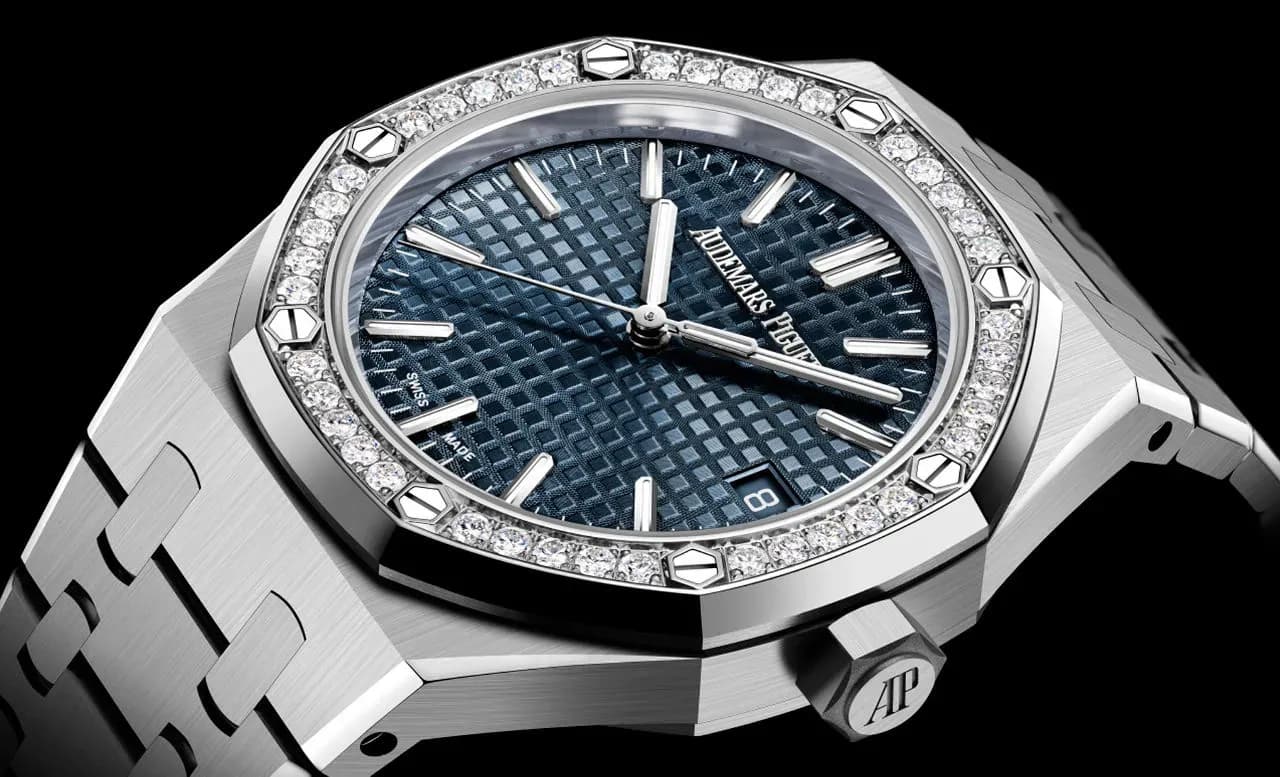
The Nautilus's defining design is an octagonal bezel with rounded horizontal extensions, integrated bracelet, and precise left-right symmetry.
Dimensions
Authentic: The 5711 case measures 40mm in diameter and 8.3mm thick — notably thin for a sports watch, and one of the hardest specifications for counterfeiters to hit because a thicker movement forces a thicker case. Measure thickness with calipers at the case flank, not over the crystal.
Fake tells: Thickness reading 8.6mm or more is common, because most clone movements are taller than the calibre 26-330 S C. Diameter is usually correct; thickness is where fakes give themselves away.
Bezel geometry
Authentic: Each of the eight bezel facets is equal in width. The transition from the flat top surface to the polished flank is a crisp edge, not a rounded one. The horizontal "ears" flanking the case are precisely proportioned and perfectly symmetrical left to right.
Fake tells: Unequal facet widths, most often with one or two facets narrower than the rest. Ears slightly too wide or too narrow relative to the case body. Softened or rounded transitions where genuine edges are sharp, which results from polishing that removes rather than defines the geometry.
Finishing
Authentic: The case alternates brushed and polished surfaces with a razor-sharp boundary between them. Brushed grain runs in a consistent direction across each surface. Under a loupe the brushing is fine and even.
Fake tells: Blurred boundaries where brushed meets polished. Brushing that varies in coarseness across a single surface. Polishing that has slightly rounded what should be a defined edge.
The Horizontal Embossed Dial
The Nautilus dial carries alternating matte and reflective horizontal bands across its surface.
Authentic: The bands are embossed — physically raised and recessed — so that under directional light they produce a strong alternating pattern with clean transitions. Tilt the watch slowly and the pattern shifts in a way flat printing cannot reproduce. Applied gold hour indices align precisely with the stripe grid, each sitting at the same relative position within its band. Hand bevels catch light as a crisp bright line at specific angles.
Fake tells: Printed stripes that appear flat under raking light with no depth as the watch tilts. Indices slightly crooked or unevenly spaced relative to the grid. Hand beveling absent, or present but rough so the reflection breaks up rather than running as a clean line.
Lume
Authentic: Lume is applied flush within the index channels with a clean, even surface and no overflow onto the surrounding metal. Colour is consistent across all indices and both hands.
Fake tells: Lume sitting proud of the index or dished below it. Overflow at the index edges. Colour mismatch between the hands and the indices, which indicates separately sourced components.
Date window
Authentic: On the 5711, the date aperture at 3 o'clock has a cleanly cut edge, and the printed date numerals are centred in the window both horizontally and vertically. The date disc colour matches the dial closely.
Fake tells: Numerals sitting high, low, or off-centre in the aperture. A ragged aperture edge. A date disc whose background differs noticeably in tone from the dial.
The Integrated Bracelet
Each bracelet link is individually finished with brushed centres and polished edges, flowing from the case with no visual step.
Authentic: The brushed-to-polished contrast on each link is a precise clean border. Articulation between links is smooth with no binding, and the bracelet drapes evenly when held by one end. The folding clasp is engraved "PATEK PHILIPPE GENÈVE" in the brand's specific typeface, with even depth throughout.
Fake tells: Blurry finish transitions. Links that bind or click during articulation. A bracelet that hangs stiffly rather than draping. Clasp engraving absent, shallow, or in an incorrect typeface — the È with its grave accent is frequently rendered wrong.
Link fit
Authentic: Gaps between links are uniform along the bracelet's full length, and there is no lateral play when a link is twisted gently.
Fake tells: Variable gaps, or perceptible side-to-side movement between adjacent links. Both indicate looser machining tolerances than Patek's.
Movement — Calibre 26-330 S C
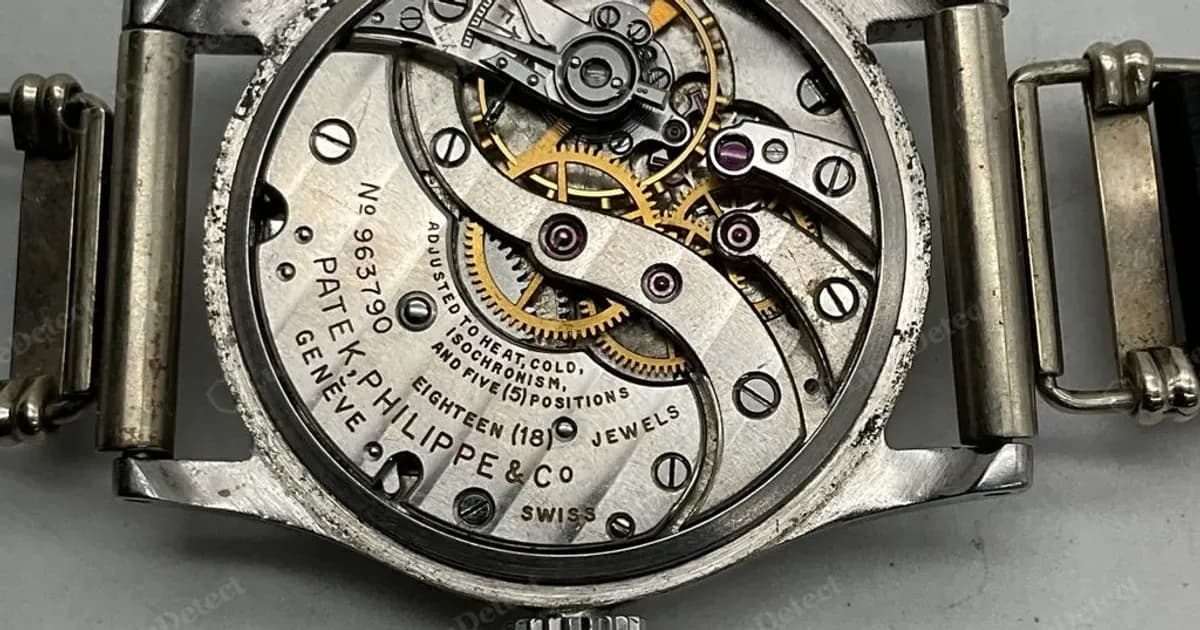
The current 5711 uses the Geneva Seal certified Patek Philippe Calibre 26-330 S C.
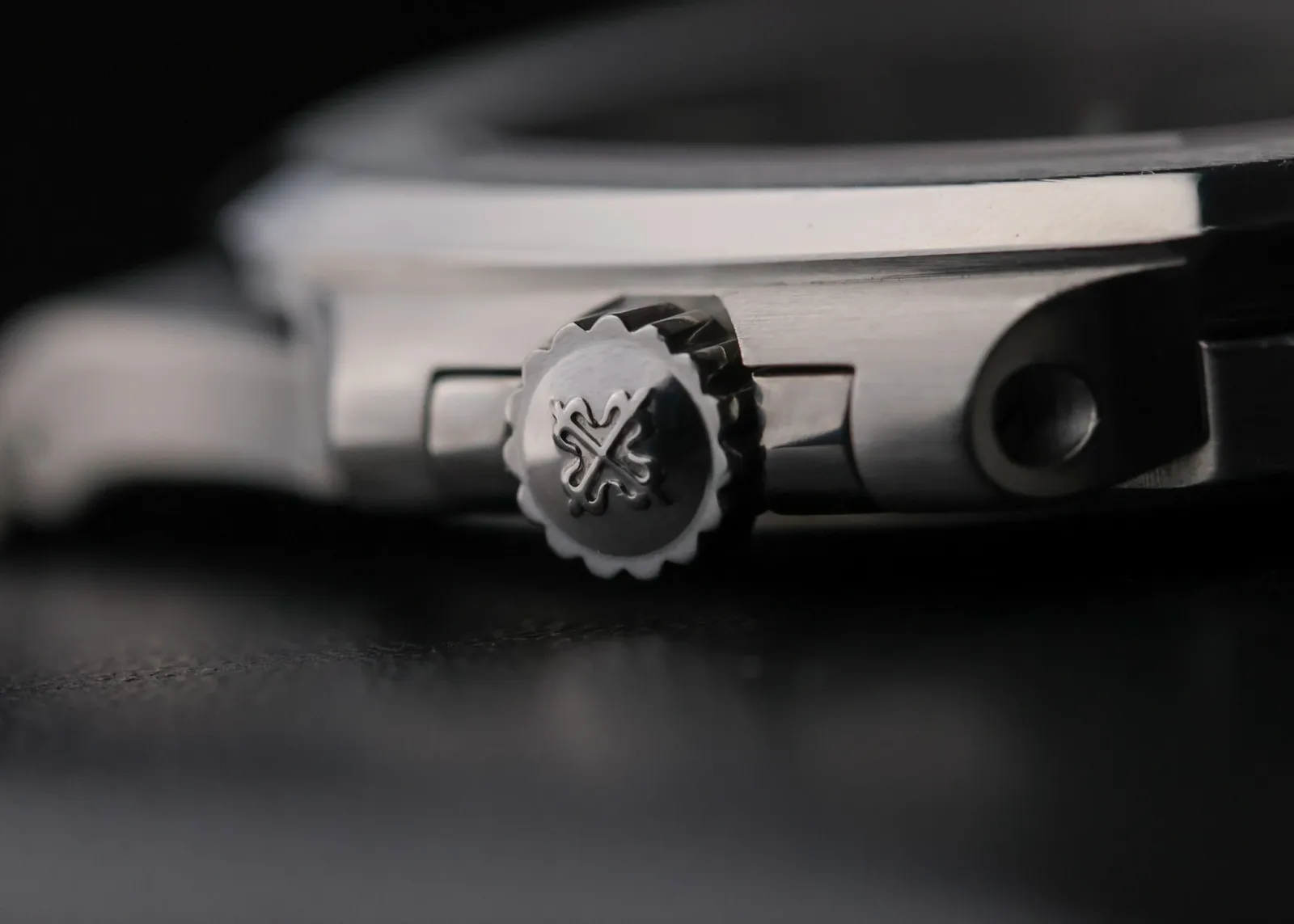
Authentic: The rotor bears the Calatrava Cross — a specific cross pattée with four arms that widen toward their tips. Bridges carry Geneva Seal finishing: mirror-polished bevels at every edge, Côtes de Genève striping running in a consistent direction, and heat-blued screws with polished heads. Under magnification the bevels show a true mirror, not a bright brushed finish.
Fake tells: An ETA 2824 or 2892 clone, identifiable by bridge layout entirely different from Patek's architecture. Absent Geneva Seal finishing, or decoration applied by machine stamping rather than hand-bevelling — stamped bevels look uniform but lack the mirror. A Calatrava Cross rendered as a simple equal-armed cross rather than a pattée.
On inspecting the movement: this requires opening the case, which should be done by a qualified watchmaker. At Nautilus values, it is a necessary step. A seller unwilling to permit movement inspection before a six-figure transaction is telling you something.
Hallmarks and Engravings
The case back carries "PATEK PHILIPPE GENÈVE," the reference number, the serial number, and the Calatrava Cross.
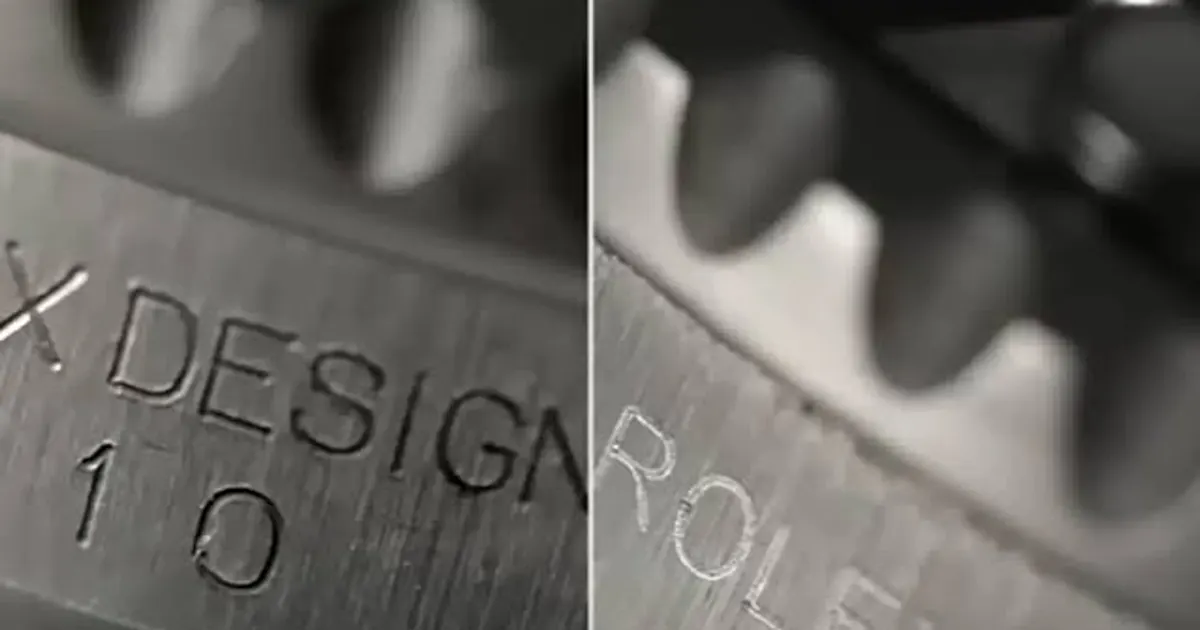
Authentic: All laser-engraved to a consistent sharp depth, with crisp character walls visible under a loupe. The Calatrava Cross is correctly formed as a cross pattée. Reference and serial numbers use Patek's specific numeral forms.
Fake tells: Shallow or uneven engraving depth. Characters with ragged edges from imprecise tooling. A simplified cross. Serial numbers in a format inconsistent with the claimed production period.
Serial verification
Patek Philippe authorised retailers can run serial lookups, and the Patek Certificate of Origin — the red extract — lists reference and serial for pieces sold after roughly 2009. Verify that the serial on the case matches the papers, and that the papers themselves are consistent. A harvested serial will exist in Patek's records while the watch in your hand does not.
Quick Authentication Checklist
- Case: 40mm diameter, 8.3mm thickness measured at the flank, equal octagonal facets, sharp brushed-to-polished boundaries
- Dial: genuinely embossed horizontal bands with visible depth under raking light, indices aligned to the grid, flush even lume
- Date: numerals centred in the aperture, disc colour matching the dial
- Bracelet: crisp finish transitions, smooth articulation, even link gaps, correct clasp engraving including the È
- Movement: Calatrava Cross rotor as a cross pattée, true mirror bevels, Côtes de Genève, blued screws
- Case back: laser-sharp engraving at consistent depth, serial verified against papers and registry
FAQ
Can Patek verify a serial number?
Patek Philippe authorised retailers can run serial lookups, and the Certificate of Origin lists reference and serial for pieces sold after roughly 2009. Bring the physical watch — the registry confirms that a serial exists in Patek's records, not that the watch presenting it is the one recorded.
Why is the 5711 so much more valuable than other references?
Patek discontinued the stainless steel 5711 in 2021 at the height of demand, creating a supply shock that sent secondary prices vertical. The scarcity is structural rather than speculative, which is why prices have held.
Are box and papers enough to authenticate?
No, and relying on them is a common and expensive error. Counterfeit boxes and papers are widely available, and genuine papers are routinely separated from their watches and paired with fakes. Papers add confidence only when the serial matches the case and the physical checks pass independently.
What is a "super clone" and can I spot one visually?
A super clone is a high-end counterfeit built with a purpose-made movement rather than a repurposed ETA, sold openly at $3,000–$8,000. Many pass casual visual inspection and some pass photographic authentication. Case thickness, dial embossing depth under raking light, and movement finishing are where they still fail — but confirming the last requires opening the watch.
Should I buy a Nautilus without movement inspection?
Not at these values. Ask for inspection by a watchmaker of your choosing, or buy from a dealer who has already performed it and will stand behind it. The cost of inspection is trivial against a six-figure purchase, and it is the single check super clones are least able to survive.
How much does professional Nautilus authentication cost?
Photo-based authentication runs $45 for watch authentication and is a reasonable first filter that catches the lower tiers of counterfeit. For a transaction at Nautilus values, treat it as a screening step before an in-person movement inspection rather than as a substitute for one.