Luxury Accessories Authentication Specialist
Luxury accessories authenticator. Covers small leather goods, belts, and eyewear.
Published November 2026 · Contact
Why a YSL Belt Is Checked Along the Strap, Not at the Buckle
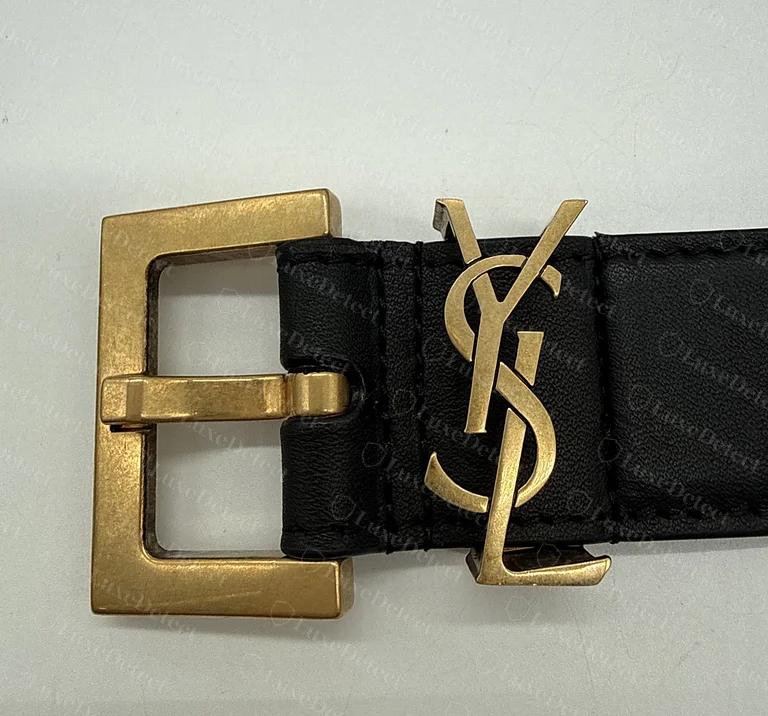
The Saint Laurent belt most buyers mean is the Cassandre belt: a plain leather strap, a square buckle frame and a separate YSL monogram fixed to the strap beside it. It comes in black, tan and white leather, croc-embossed and grained calfskin and suede, with gold, bronze or silver hardware, and it is one of the most searched designer belts there is. That also makes it one of the most copied.
We went through the Saint Laurent belt orders in our archive, the ones that came back fake and the genuine belts in the same archive, and compared them photo by photo. The front of the belt told us very little. The fakes had the square frame, the interlocking Y, S and L, and the antique gold finish, and from the front most of them looked like the genuine belts beside them. So did the "SAINT LAURENT PARIS" heat stamp on the underside.
What separated them was further along the strap. That is the angle of this guide: a Saint Laurent belt is read from the underside, and a counterfeit gives itself away in the stamps it adds, not the ones it copies. Ask for a photo of the whole underside, including the tip, before you look at anything else.
What to check, ranked by reliability
| Checkpoint | Reliability | What it tells you |
|---|---|---|
| 1. A Size Stamp at the Strap Tip | ★★★★★ | A stacked inch-over-centimetre size at the tip of a modern Saint Laurent Paris belt is a strong sign of a fake. |
| 2. The Code Line: What It Says and What It Cannot Prove | ★★★★★ | A size that contradicts the belt or a second stamp is a fault; a correct code proves nothing. |
| 3. The Cassandre Monogram and the Buckle Frame | ★★★★★ | A loose monogram or rough frame lowers confidence; a neat buckle is copied too. |
| 4. The SAINT LAURENT PARIS Heat Stamp and the Strap | ★★★★★ | The stamp is copied on almost every fake; edge paint and stitching are checks for the belt in hand. |
| 5. Vintage Yves Saint Laurent Belts | ★★★★★ | Size pairs and licensed-country printing are normal here and copied; judge era consistency. |
| Model Reference Before You Start | ★★★★★ | Tells a modern Cassandre belt from a vintage one, which changes the rules. |
| What the Box, Dust Bag and Tags Do and Do Not Prove | ★★★★★ | Context only: packaging is sold separately; use tags only to cross-check the size. |
Model Reference Before You Start
- Cassandre belt (Saint Laurent Paris, 2012 onward): square buckle frame, YSL monogram on the strap, widths from slim women's straps to wide men's belts. This is the belt the checks in sections 1 to 4 are about.
- Monogram plaque belts: the YSL monogram on a flat plate or a wide strap without a separate frame. The underside checks still apply.
- Vintage Yves Saint Laurent belts: belts from before the 2012 rename, including belts made under licence in other countries. They follow different rules, covered in section 5.
- Country of manufacture: the modern genuine belts we compared were all marked made in Italy, and so were the modern fakes. The country line does not decide anything.
If a listing is not clear about which of these it is, the stamps will tell you: a modern belt says "SAINT LAURENT PARIS", a vintage one says "Yves Saint Laurent".
A Size Stamp at the Strap Tip
Turn the belt over and look at the last few centimetres of the strap, the end that goes through the buckle. On the modern genuine Saint Laurent belts we compared, that end carries no marking. The size is stamped only once, inside the code line near the buckle (see section 2).
Several of the fake Cassandre belts in our archive had an extra stamp there: a stacked size pair, inches over centimetres with a short rule between them, such as 38 over 95, 40 over 100 or 44 over 110. It appeared in the same place and the same style on black and tan fakes submitted months apart, which suggests the same source.
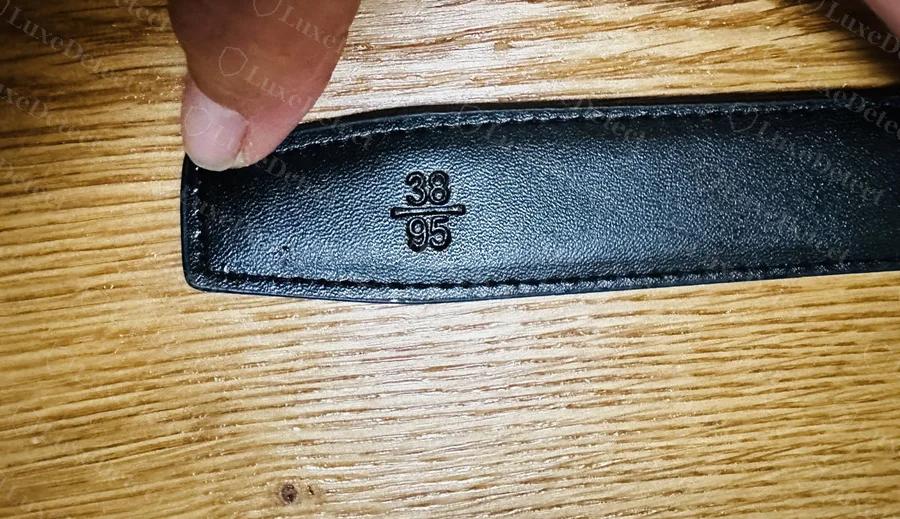
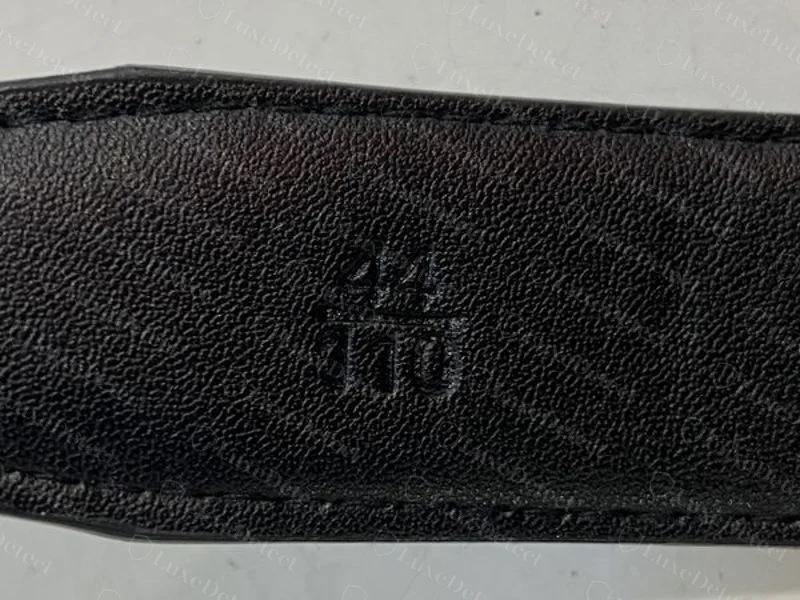
The second fake above makes the point twice: its tip says 44 over 110, while its own code line says 85. A belt can only be one size.
| Element | Authentic | Counterfeit |
|---|---|---|
| Strap tip (underside) | No stamp | Stacked inch and cm pair, e.g. 38 over 95 |
| Where the size appears | Once, inside the code line | In the code line and again at the tip |
| Size consistency | Code size matches the belt | Tip size and code size can disagree |
Red flag
A stacked inch-over-centimetre size stamp at the tip of a modern "SAINT LAURENT PARIS" belt. We did not find it on any of the modern genuine belts we compared, and it repeated across our fakes.
Worth knowing
This applies to modern Saint Laurent Paris belts only. Genuine vintage Yves Saint Laurent belts do carry size pairs such as 38/95 or 44/110, so on a pre-2012 belt the same mark is normal (section 5). A clean tip does not clear a belt either: many fakes had no tip stamp at all.
The Code Line: What It Says and What It Cannot Prove
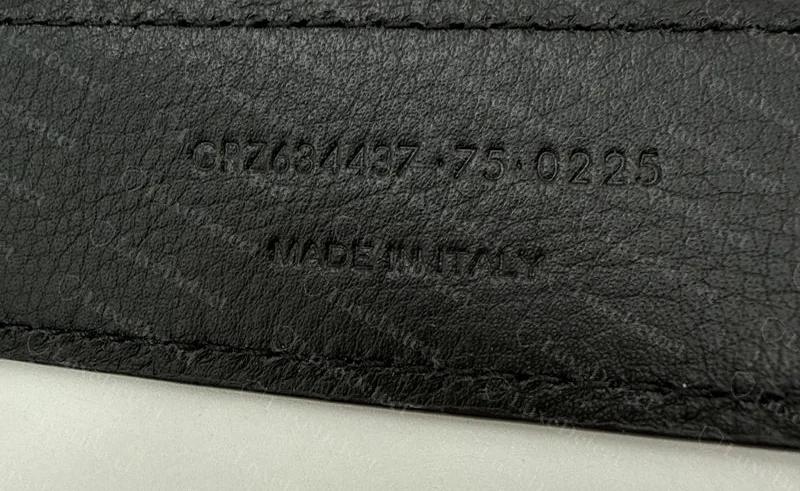
Near the buckle end, the underside of a modern Saint Laurent belt carries a heat-stamped line with "MADE IN ITALY" beneath it (on some belts beside it). On the genuine belts in our archive it reads as three letters and a six-digit style number, then the belt size in centimetres, then four digits that appear to be the month and year, separated by small raised dots: for example GRZ634437·75·0225 on a 75 cm black Cassandre belt. The six digits stayed the same across the genuine classic Cassandre belts we compared; the letters, the size and the last group changed.
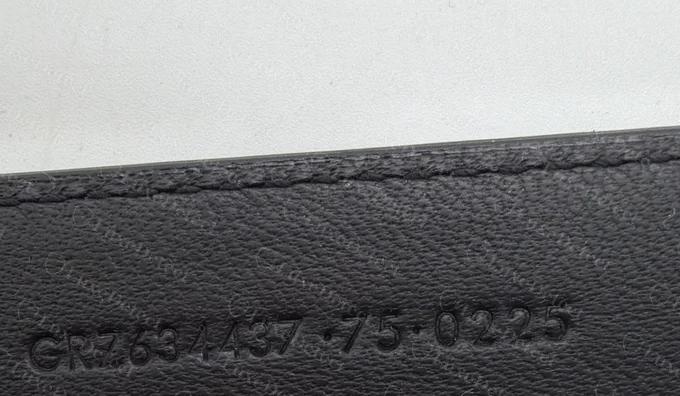
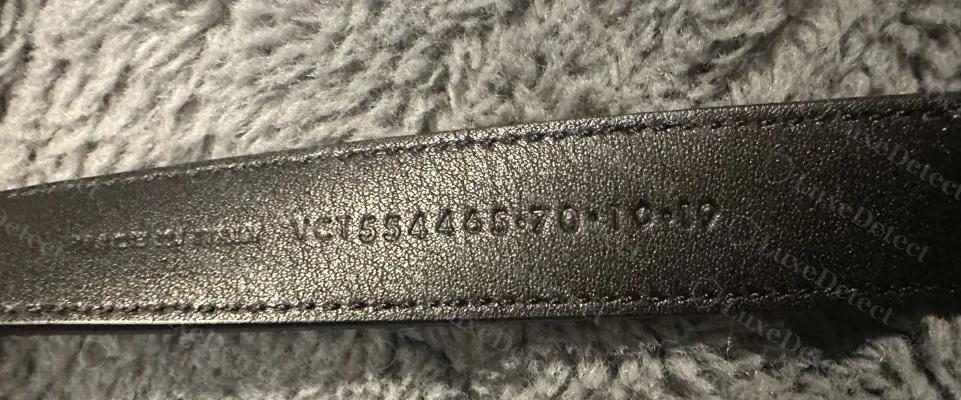
The layout is not fixed across years. A genuine suede belt from 2019 in our archive writes the last group as two pairs ("10·19") and puts "MADE IN ITALY" on the same line, so a code with two date pairs is not a fault on its own.
Here is the problem: the fakes copy all of this. Every modern fake that showed its code in our set used the same letters, digits and dots, in clean, evenly pressed characters. One went further and carried exactly the code of a genuine belt we had authenticated, GRZ634437·75·0225, character for character.
Repetition does not help much either. Fakes in our set shared codes (GRZ558080 with the same last group appeared on fakes of several different sizes), but genuine belts repeat too: genuine Cassandre belts of different sizes carried the same style number and the same last group. The code seems to identify a production batch, not a single belt.
What the code can do is catch inconsistency:
- The size in the code should match the size in the listing and the belt's actual length, and there should be no second, different size elsewhere on the strap (section 1).
- The size should be a real belt size, in five-centimetre steps.
- On a modern belt sold as new, the last group should fit the season the seller claims.
| Element | Authentic | Counterfeit |
|---|---|---|
| Layout | Letters and style number, size, date, MADE IN ITALY | Same layout copied |
| Characters | Even, clean, evenly spaced | Usually just as clean |
| Repeated codes | Same style and date on different sizes is normal | Shared codes too, so not decisive |
| Size in the code | Matches the belt | Can contradict a second size stamp |
Worth knowing
A correct code proves nothing. It is the easiest thing on the belt to copy, and we have seen a genuine belt's code on a fake. Use the code to check that the belt agrees with itself and with the listing, never to approve it. The [Saint Laurent serial number guide](/blog/saint-laurent-serial-number-guide) explains the related codes inside Saint Laurent bags.
A code that checks out doesn't prove the item is real. Counterfeiters copy genuine codes.
Our authenticators check the stamps, hardware and construction of your Saint Laurent against verified references, from $15. You get a verdict within 24 hours, and a Certificate of Authenticity if the item passes.
Authenticate My Saint Laurent →The Cassandre Monogram and the Buckle Frame
The genuine Cassandre belt uses two metal parts: a square frame with a pin, and a separate YSL monogram fixed through the strap. On the genuine belts we compared, the frame carries a small "SAINT LAURENT PARIS" engraving on the inner face of one bar, the antique finish is even across the frame and the monogram, and the monogram sits flat and straight on the strap, with the strap's stitched loop holding it tight.
The fakes copied this well. Their frames carried the same engraving, some on the top bar and some on the side bar, and genuine frames show it in both places too, so its position does not decide anything. Plating colour varies with lighting and with the finish (gold, bronze, silver), and a brassy look in a phone photo is not evidence on its own.
What to check with the belt in hand:
- The monogram should be firmly fixed and not twist on the strap.
- The frame and pin should be solid and finished on the back as well as the front.
- The engraving on the frame should be fine and even, not shallow or blurred.
| Element | Authentic | Counterfeit |
|---|---|---|
| Frame engraving | Fine "SAINT LAURENT PARIS" on a bar | Same text, also present |
| Monogram fit | Flat, straight, firmly fixed | Usually right; sometimes loose or tilted |
| Finish | Even across frame and monogram | Often close; can differ between the two parts |
Worth knowing
We did not find a buckle detail that separated the fakes from the genuine belts on its own. Treat the buckle as a check that can lower your confidence, not raise it.
The SAINT LAURENT PARIS Heat Stamp and the Strap
The underside of a modern belt carries "SAINT LAURENT" over a smaller, widely spaced "PARIS", heat-pressed into the leather without colour. Almost every modern fake in our set had this stamp, in a convincing font and position, so it is not a useful test. A stamp that is crooked, or spelled "YVES SAINT LAURENT" on a belt sold as current-season is worth questioning; a correct one proves nothing.
The strap itself is a better check in hand: even edge paint with no bubbles or cracking on a new belt, stitching at a constant distance from the edge, and leather of the same thickness from the buckle to the tip.
Vintage Yves Saint Laurent Belts
Many belts listed as YSL are vintage Yves Saint Laurent pieces from before 2012, and they look nothing like the Cassandre belt. Some were made in Italy with a YSL plaque or an engraved frame. Others were made under licence: genuine belts in our archive are printed along the lining with "YvesSaintLaurent", a seven-digit style number, a size pair such as 42/105 and the leather type, with "TAIWAN R.O.C." or "Handcrafted in America" on the strap.
The fakes sold as vintage copy that layout too: a style number, a size pair and "LEATHER TAIWAN R.O.C." printed in the same order. More than one of our vintage-style fakes even shared the same style number. With these belts the printed lining tells you the format, not the verdict. What helps is whether the buckle, the printing and the wear all belong to the same era.
Worth knowing
On a vintage belt, a size pair like 38/95 is normal, and the country printed on the lining is not evidence either way.
What the Box, Dust Bag and Tags Do and Do Not Prove
Some of the fakes in our archive arrived in plastic sleeves with resale tags, and genuine belts arrived with and without dust bags. Packaging is context, not evidence. Its only use is cross-referencing: a size on a tag or receipt should match the size in the code line. A matching box and dust bag prove nothing, because both are sold separately.
Quick Authentication Checklist
- Decide whether the belt is a modern Saint Laurent Paris belt or a vintage Yves Saint Laurent belt; the rules differ.
- On a modern belt, look at the underside of the tip. A stacked inch-over-centimetre size stamp there is a red flag.
- Read the code line. The size in it should match the belt and the listing, and there should be no second, different size on the strap.
- Do not treat a correct-looking code as approval; fakes copy real ones.
- Check that the monogram is firmly fixed and the frame is finished front and back.
- Treat the "SAINT LAURENT PARIS" heat stamp as context only.
- Inspect edge paint, stitching and strap thickness end to end.
A size stamp at the tip of a modern belt, or a tip size that disagrees with the code, is enough on its own. Two weaker failures elsewhere mean walk away.
When to Get a Professional Opinion
This guide is built from the Saint Laurent belt orders in our archive, the fakes and the genuine belts side by side. It is strongest on the black and tan Cassandre belts that make up most of them and thinner on suede, white and wide plaque belts, where we had fewer genuine examples to compare. Fakes that skip the tip stamp and copy a real code leave very little on the underside, and for those the decision rests on materials, construction and how every mark fits together.
LuxeDetect authenticates Saint Laurent belts from photos, starting at $15 for a 24-hour accessories check, with a Certificate of Authenticity for belts that pass. Send clear photos of the front of the buckle and monogram, the back of the buckle, the whole underside of the strap including the tip, and the code line. For other Saint Laurent pieces see our Cassandre wallet guide and Saint Laurent shoes guide; for other belts, the Gucci belt and Louis Vuitton belt guides.
FAQ
How can you tell if a YSL belt is real?
Turn it over. A modern genuine Saint Laurent belt carries "SAINT LAURENT PARIS" and one code line with the size in it, and nothing at the tip. A stacked size stamp at the tip, or a second size that disagrees with the code, points to a fake. The buckle and the heat stamp are copied well, so they cannot confirm a belt on their own.
Where is the code on a Saint Laurent belt?
On the underside of the strap, usually near the buckle end, with "MADE IN ITALY" under it or beside it. It reads as three letters and a six-digit style number, the size in centimetres and a date group, for example GRZ634437·75·0225.
Does a real code mean my YSL belt is genuine?
No. Fakes copy the format and sometimes the exact code of a genuine belt; we have seen one carry a genuine belt's code character for character. Use the code to check that the size and the listing agree, not as proof.
Do real YSL belts have the size stamped at the end?
Modern Saint Laurent Paris belts do not: the size appears only inside the code line. Vintage Yves Saint Laurent belts made before 2012, including licensed belts, often do carry a size pair such as 38/95, so the answer depends on the era.
Can I authenticate a Saint Laurent belt from photos?
Yes. What decides it is how the buckle, the underside stamps, the code and the construction fit together compared with verified genuine belts. Photograph the whole underside, including the tip, and the back of the buckle; for an expensive belt a professional review is the safer route.
What size is a Saint Laurent belt?
Saint Laurent sizes belts in centimetres, in five-centimetre steps (75, 80, 85 and so on), and the size is part of the code on the underside. It should match the belt's length and the size in the listing.