Fine Jewelry Authentication Specialist
Fine jewelry authentication specialist. Focuses on hallmarks, stone setting, and metal finishing.
Last updated September 2026 · Published June 2026 · Contact
Why the Alhambra Is One of the Most Faked Jewelry Pieces
The VCA Vintage Alhambra necklace in yellow gold with malachite retails at $2,950 for a single motif; the 10-motif long necklace runs to $16,500. The four-leaf clover silhouette is instantly recognizable — and replicated at every quality tier.
The Alhambra presents counterfeiters with an unusually favourable target. Its silhouette is simple enough to reproduce by casting, it carries no complex mechanism, and its value sits high enough to justify real gold plating on the better fakes. What separates genuine from counterfeit is almost entirely execution quality at small scale: the milgrain beading, the inlay fit, and the hallmark engraving. These are precisely the details that photograph poorly, which is why the Alhambra fake market thrives on online resale.
Buyers should also know that the counterfeit tier has shifted. Five years ago most fakes were gold-plated brass, detectable by weight alone. Today a meaningful share are solid 18k gold with genuine stone inlay, produced by workshops that sell them openly as "reproductions." These pass the weight test, the magnet test, and the acid test. Only the finishing gives them away.
What to check, ranked by reliability
| Checkpoint | Reliability | What it tells you |
|---|---|---|
| 1. The Clover Motif — Shape and Symmetry | ★★★★★ | Irregular milgrain bead size or gaps at the lobe junctions are decisive even on solid-gold reproductions. |
| 2. Hallmarks — Location and Content | ★★★★★ | Wrong VCA letter proportions or an acid-etched rather than laser-cut engraving floor is a strong indicator, though a correct serial alone proves nothing. |
| 3. The Chain and Clasp | ★★★★★ | Missing clasp micro-engraving or a mismatched gold tone corroborates a finding but a careful fake can get the chain close. |
| 4. Gold Tone and Weight | ★★★★★ | Rules out cheap plated fakes only; solid 18k reproductions with genuine inlay pass weight, tone, and magnet tests entirely. |
The Clover Motif — Shape and Symmetry
Lobe geometry
Authentic: All four lobes are identical in size and curvature. Rotate the motif ninety degrees and it should present the same silhouette. The "pinch" where adjacent lobes meet is clean, sharply defined, and consistently sized across all four junctions — VCA's tooling produces the same intersection angle every time.
Fake tells: Lobes unequal in size, most often with one noticeably broader than its opposite. Pinch junctions that vary in depth around the motif, or that read soft and rounded rather than crisp. A motif that looks correct face-on but asymmetric when rotated.
The milgrain border
This is the single most diagnostic feature on an Alhambra, and the one that defeats most counterfeiters.
Authentic: A thin row of tiny gold beads runs the full perimeter of the clover. Every bead is identical in size and spacing, formed by a precision milgrain wheel. The beading follows the curve of each lobe without gaps at the junctions, and each bead is fully round — hemispherical, not flattened.
Fake tells: Beads of irregular size, the most common single failure. Gaps or crowding where the border turns a corner at a lobe junction. Squashed or elongated beads indicating a worn or hand-run wheel. Beading that stops short of a junction and resumes on the other side.
Inlay fit
Authentic: The stone or inlay — malachite, onyx, carnelian, mother-of-pearl — sits perfectly flush with the surrounding gold frame. Run a fingernail across the boundary: you should feel no step in either direction. The inlay edge follows the clover curve exactly with no visible adhesive.
Fake tells: Inlay sitting proud of or below the frame. A visible gap between stone and gold at any point around the perimeter. Adhesive residue at the boundary. On mother-of-pearl, an even, printed-looking iridescence rather than natural non-repeating grain.
Red flag
Irregular bead size along the milgrain border is the most common single failure and, combined with gaps at the lobe junctions, is decisive on its own — this is the detail counterfeiters consistently cannot match even on solid-gold reproductions.
Hallmarks — Location and Content
Inside the motif's gold frame on the reverse: the "VCA" monogram, the 750 purity mark with the French eagle-head assay mark, and a unique serial number.
Authentic: Laser-engraved with sharp, near-vertical walls to each character. Under magnification the engraving floor is smooth. The "VCA" uses specific proportions — the V is wider at its base than a standard typeface would render it, the C is an open arc of consistent stroke width, and the A carries its crossbar at a distinctly low position.
Fake tells: "VCA" rendered in wrong proportions, most often with a C drawn too closed toward a circle. A missing 750 mark or eagle head. No serial number at all. An acid-etched appearance, with soft shallow characters and a rough floor, rather than the clean walls of laser cutting. Hallmarks positioned inconsistently relative to the motif's orientation.
On serial numbers
A serial in correct format confirms format only. Counterfeiters harvest real serials from marketplace photographs and reuse them across many pieces. Van Cleef & Arpels boutiques can verify a serial against their registry, which is the only reliable use of the number — the engraving quality tells you more than the digits do.
Worth knowing
A correctly formatted serial proves format only, not this specific piece — bring the physical item to a boutique for a registry check rather than trusting a photographed number.
The Chain and Clasp
Authentic: Finely constructed round cable chain in gold matching the motif exactly in tone. Every link is uniform in size, shape, and finish, with solder joins invisible under normal viewing. The barrel clasp threads together smoothly along a fine machined thread and locks firmly, requiring deliberate unscrewing to open. The clasp carries "VCA" micro-engraving executed to the same standard as the motif hallmarks.
Fake tells: Links varying in size or finish along the chain's length, or solder joins visible as bright spots. A clasp that can be pulled open with a slight tug, indicating a coarse or incomplete thread. Missing or blurry clasp micro-engraving — counterfeiters frequently omit it entirely, assuming buyers will not look. A chain whose gold tone differs subtly from the motifs, revealing separately sourced components.
Motif spacing on multi-motif pieces
Authentic: On 5-, 10-, or 20-motif necklaces, spacing between motifs is identical throughout, and each motif hangs in the same orientation.
Fake tells: Variable gaps between motifs. Motifs that sit at slightly different rotational angles when the necklace is laid flat.
Worth knowing
Missing or blurry clasp micro-engraving is a strong supporting tell — counterfeiters frequently omit it entirely, assuming buyers won't check the clasp as closely as the motif.
Gold Tone and Weight
Authentic: 18k gold has a warm, fully saturated yellow tone with visible depth, consistent across every surface including the reverse and the inner edges of the frame. A genuine single-motif Vintage Alhambra necklace weighs approximately 10–12 grams. Gold is not magnetic.
Fake tells: A brassy, orange-tinted cast, or a pale washed-out yellow — both indicate plating over base metal. Tone shifting at edges and high-contact points where plating thins. A comparable piece weighing 5–7 grams. Any magnetic attraction indicates ferrous content and is conclusive.
The limitation of these tests: solid-gold reproductions pass every check in this section. Weight, tone, and magnetism rule out the cheaper tier only. If a piece passes here, the milgrain border and hallmark engraving remain the deciding evidence.
Worth knowing
Weight, tone, and the magnet test only rule out the cheaper counterfeit tier — solid 18k gold reproductions with genuine stone inlay pass every check here, so a pass at this section proves nothing on its own.
Quick Authentication Checklist
- Motif: four equal lobes, crisp consistent pinch junctions, symmetric when rotated
- Milgrain: uniform round beads, no gaps or crowding at junctions, continuous around the full perimeter
- Inlay: perfectly flush with the frame, no gap or adhesive, natural non-repeating grain on mother-of-pearl
- Hallmarks: "VCA" in correct proportions, 750 mark with eagle head, serial present, laser-sharp walls
- Chain and clasp: uniform links, matching gold tone, smooth-threading barrel clasp with VCA micro-engraving
- Gold: warm saturated yellow consistent to the edges, ~10–12g single motif, non-magnetic
FAQ
Can VCA verify authenticity from the serial number?
Yes. Any Van Cleef & Arpels boutique can look up a serial in their registry, and this is definitive for pieces sold after roughly 2000. Note that the boutique verifies the serial exists in their records — bring the physical piece, since a harvested serial will match records while the item in your hand does not.
Is the Alhambra ever made in white or rose gold?
Yes, across the collection. White gold carries a cool, faintly platinum-like tone; rose gold a specific warm pink that VCA holds consistent. The 750 purity mark and eagle-head assay apply to all three metals, and every check in this guide holds regardless of colour.
How do I distinguish the Vintage Alhambra from the Magic Alhambra?
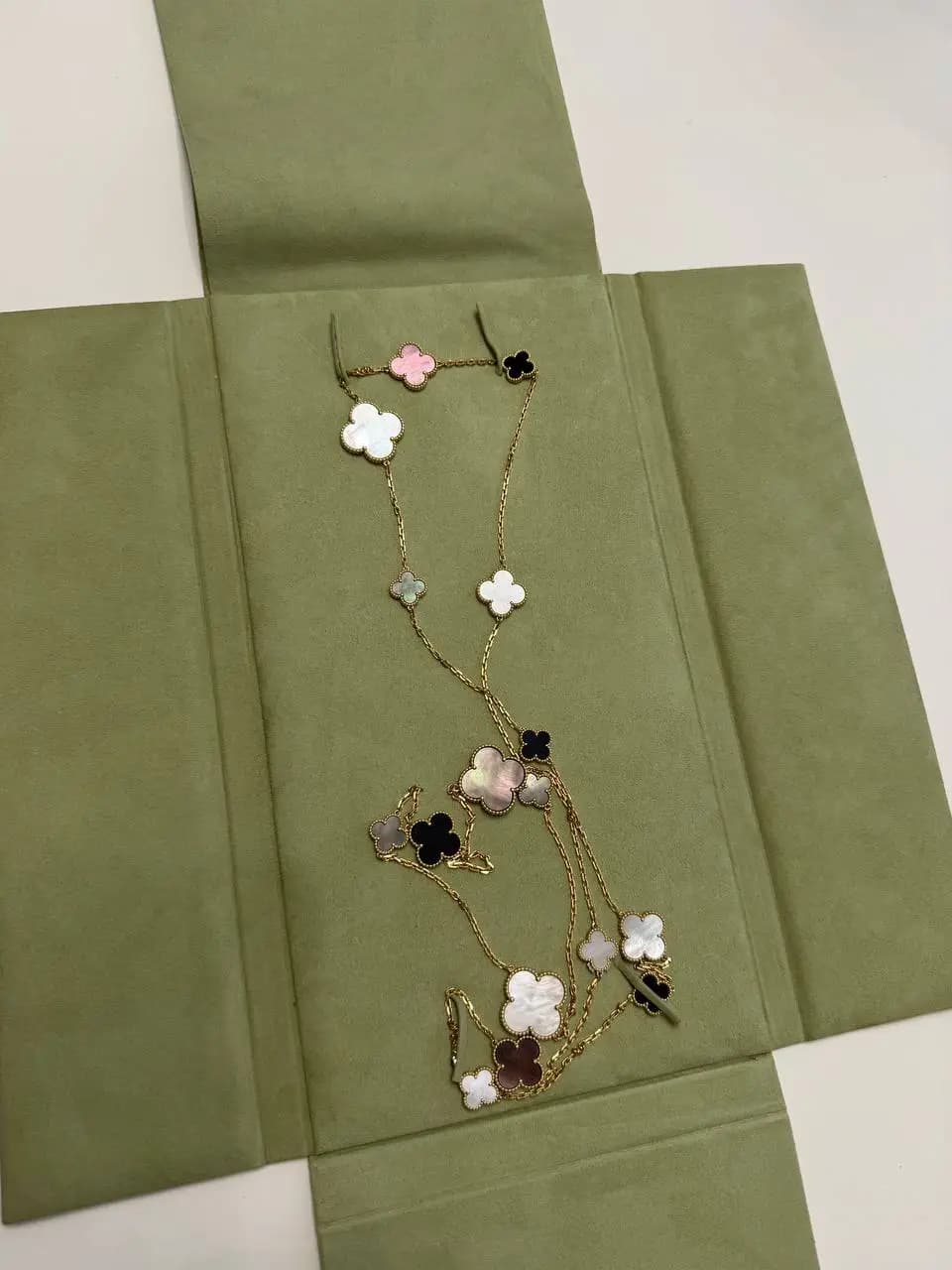
The Vintage Alhambra uses uniformly sized motifs of about 15mm. The Magic Alhambra uses motifs in several different sizes within a single piece, the largest around 25mm. The Sweet Alhambra is smaller, around 9mm. Authentication principles are identical across all three; only the reference dimensions change.
The piece is solid gold and non-magnetic. Does that make it genuine?
No. A significant share of current Alhambra counterfeits are solid 18k gold with genuine stone inlay, produced by workshops selling them as reproductions. They pass weight, magnet, and acid testing. The milgrain beading consistency and hallmark engraving quality are what separate them from genuine pieces.
Is mother-of-pearl harder to authenticate than malachite or onyx?
It is the most informative of the three. Genuine mother-of-pearl shows non-repeating natural iridescence that shifts as the piece moves under light. Counterfeits frequently use printed or resin substitutes with an even, uniform shimmer that looks identical from every angle. Tilt the piece slowly and watch whether the pattern moves.
How much does professional Alhambra authentication cost?
Photo-based authentication typically runs $30 for jewelry authentication with a 24-hour turnaround. Against a piece worth $2,950 to $16,500, that is negligible, and a certificate materially supports resale value in a category where informed buyers now expect documentation.