Handbag Authentication Specialist
Handbag authentication specialist. Has reviewed submissions across Hermès, Chanel, Louis Vuitton, and Dior since 2019.
Published October 2026 · Contact
What Makes Etro Distinctive
Etro began in Milan in 1968 as a textile house, and its paisley prints are the part most buyers know: the company says it introduced paisley furnishing textiles in 1981, and leather goods followed in 1984. The brand's emblem is Pegaso, a winged horse. That mix of loud prints and one recognisable emblem is why Etro turns up in resale as coated paisley handbags, silk and cotton shirts, scarves, jeans, coats and sunglasses.
Those categories do not share one label. A paisley tote, a cashmere scarf and a pair of jeans carry different tags, and the marks changed over the years. So there is no single "genuine Etro tag" to check against. This guide shows the formats that genuine pieces in our records carry, so you can compare your own item with them.
Worth knowing
This guide is built from genuine Etro pieces in our authentication records. We do not have enough confirmed counterfeit Etro pieces to offer a real-versus-fake comparison, so we are not claiming any fake tell. What follows is what genuine pieces show, not Etro's own published system. A match proves nothing on its own, because good fakes copy marks. Where we could not confirm what a mark means, we say so.
The Paisley Print Is Not a Test
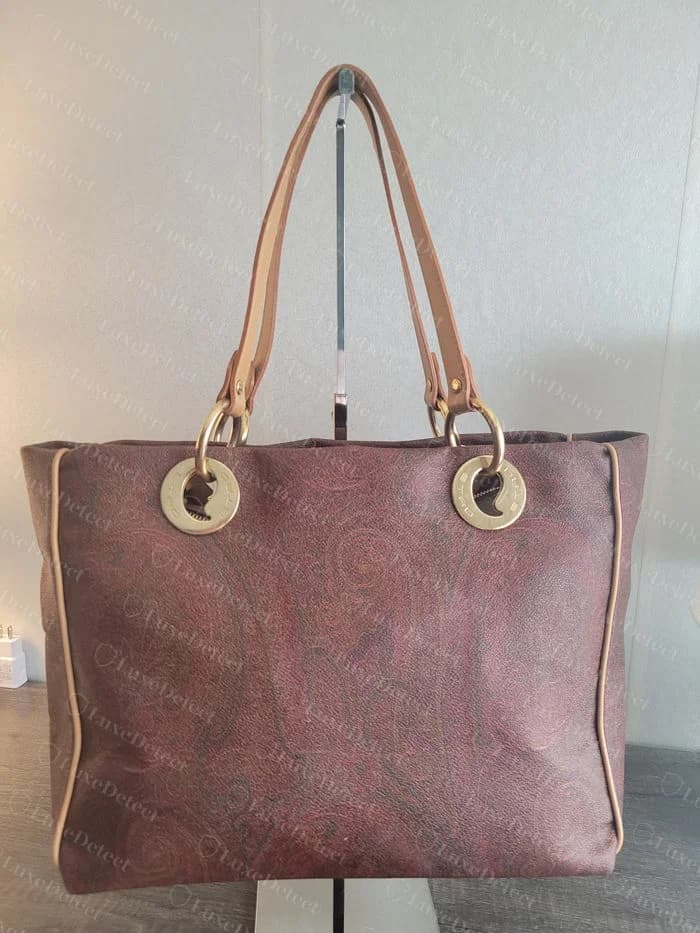
The paisley bags in our records are a coated, printed canvas in browns, reds and teals, trimmed with tan or natural leather and finished with contrast stitching and brass-tone hardware. The same family of print also appears as a black jacquard nylon tote with a green paisley lining, as silk and cotton shirt prints, and as the pattern on scarves and denim.
Colours and scale of the print vary a great deal from piece to piece, and the pattern can sit slightly differently on each panel. Print alone cannot tell you whether a piece is genuine, and a different print from another Etro bag you have seen is not suspicious for that reason. The marks below tell you more.
The Pegasus Hardware
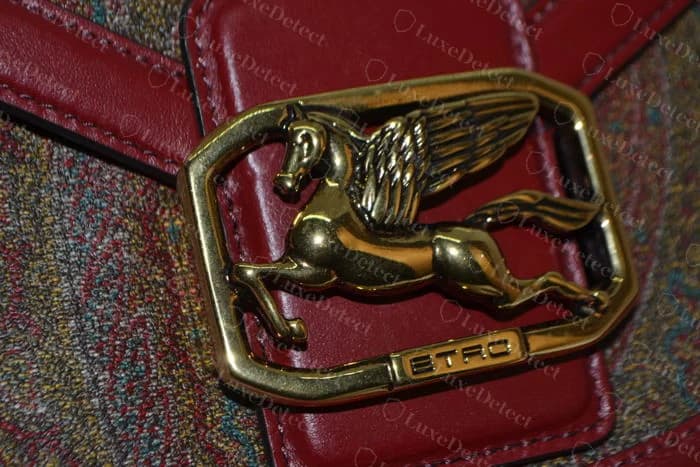
The winged horse shows up as hardware on many of the bags we reviewed. One example is a gold-tone pegasus set inside an octagonal frame, with a small ETRO plate beneath it, used as a flap buckle on a red leather and paisley shoulder bag. Others carry the horse engraved on teardrop zip pulls, and several bags use the ETRO name itself on round or oval metal: a ring eyelet with ETRO lettering around it, a round padlock with the horse above the name, or an oval plate on a nylon tote.
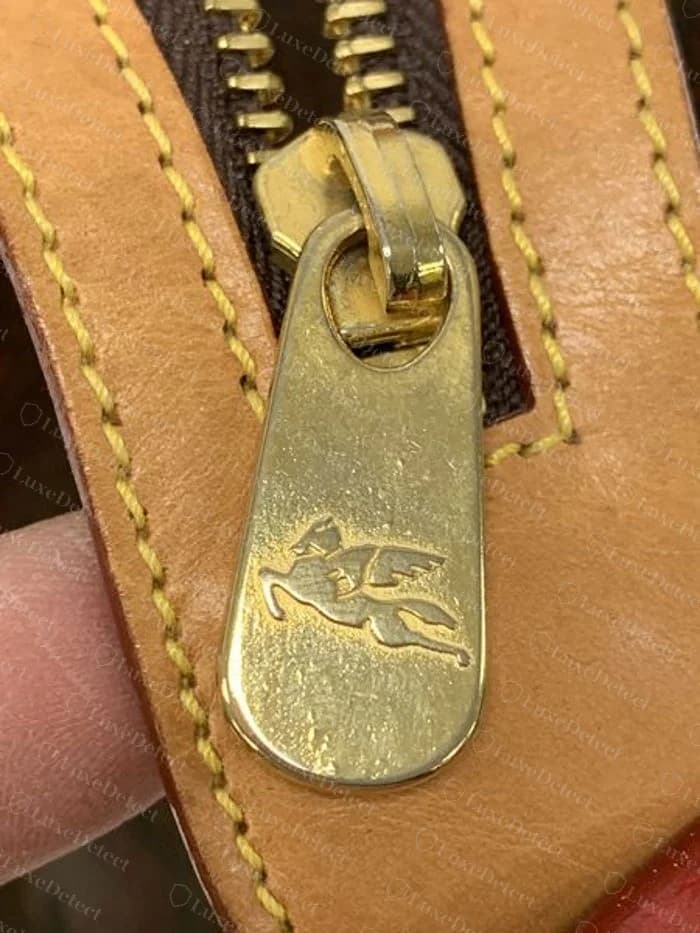
A different set of bags uses a plain rectangular plaque in the shape of a stylised letter E on the flap or wallet front. Across the pieces we viewed the hardware is brass or gold-tone, and zip pulls and eyelets match the rest of the metal on that bag. But the hardware changes by line and era, so a bag whose hardware differs from the pictures here is not necessarily wrong, and engraved hardware is also something fakes reproduce.
The Interior Leather Tag
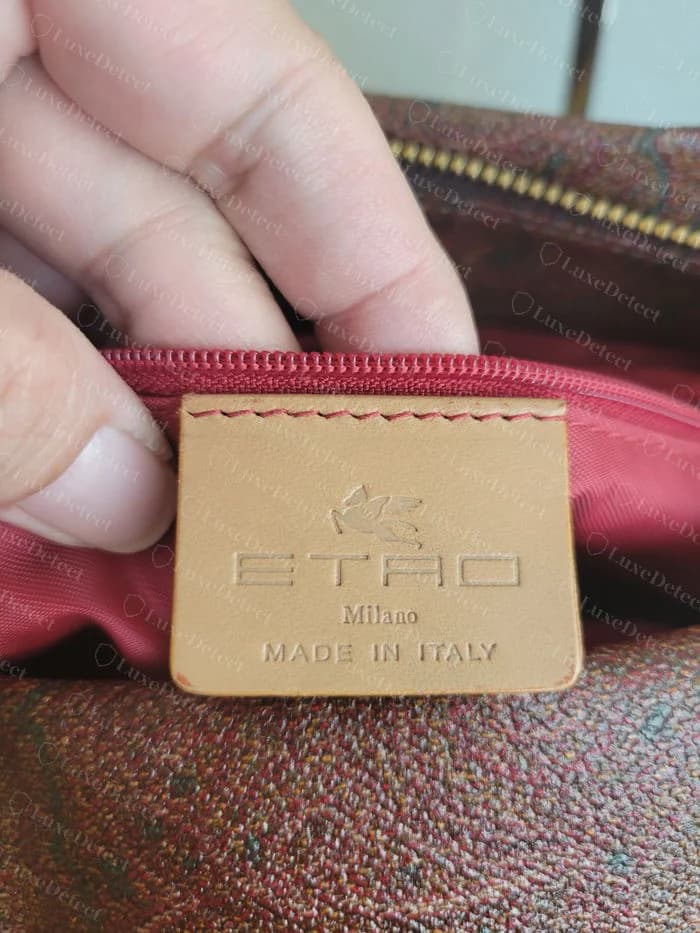
The most common interior mark on the handbags and wallets we viewed is a small rectangle of leather set into the lining or a pocket seam. It is embossed or debossed with the winged horse, "ETRO", a smaller "Milano" beneath, and "MADE IN ITALY". It comes in tan, natural, and on some bags red, and some are edged with a stitched border while others are plain. The lettering is wide-spaced capitals; on tan tags it is pressed in, not printed.
Some pieces also carry the horse and name printed in small repeating form directly on the lining fabric. We saw this on a red leather clutch-style bag, where it sat alongside the tag. A bag can have the tag, the printed lining, or both.
The Stamped Number and Date on the Back of the Tag
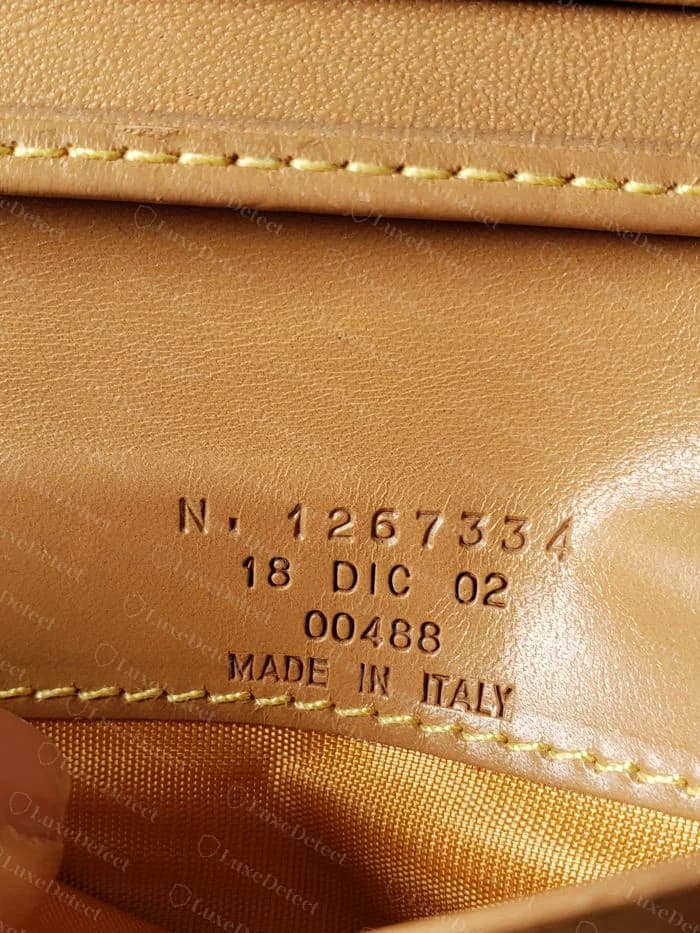
Turn the tag over, or look at a second small leather tab beside it, and several of the genuine pieces we viewed carry stamped numbers. On the older-looking bags and wallets the layout is an "N." followed by a seven-digit number, then a day, an abbreviated Italian month and a two-digit year, then a short four- or five-digit number, and sometimes "MADE IN ITALY". The months seen include MAR, SET, LUG and DIC, which are Italian abbreviations, and the years on the stamps we read include the 1990s and 2002.
On later-looking pieces the layout shifts to a short alphanumeric code with a numeric date, such as a pair of four-digit groups over a line like 18-04-05, or a code over a date written as day, month and four-digit year (the latest we read was 2018). On this face of the tag, the format changes across the pieces we viewed.
The lines read like dates, and the Italian month names are a strong hint, but we have not confirmed what the date records, what the long number identifies, or what the short suffix means. Treat these as details to compare, not as a decoder, and do not work out a bag's age from them. A tag that is missing, worn smooth or has been replaced is not a verdict either way.
Woven Labels on Clothing
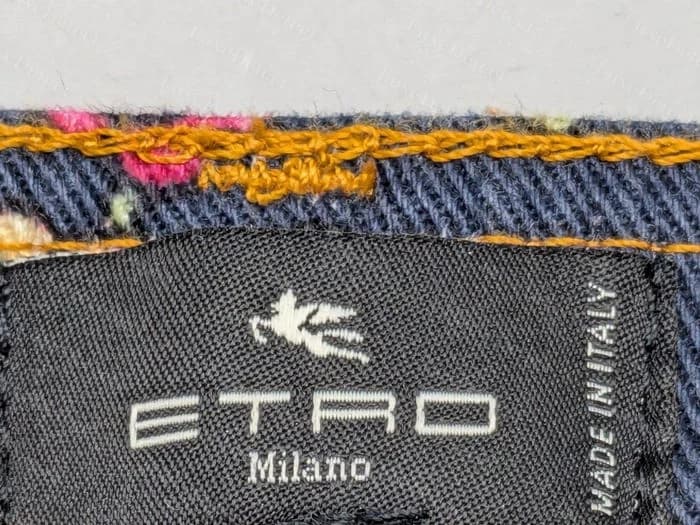
Clothing in our records mostly carries a woven neck or waistband label with the horse, "ETRO" and "Milano". The version on a pair of floral jeans is black with white lettering and "MADE IN ITALY" running vertically down one side, with a separate woven size tab. Other genuine pieces show a cream label reading "ETRO Milano / Made in Italy" or just "ETRO / MADE IN ITALY" with the size beside it, and a navy label with grey stitching on a textured jacket. The same jeans also carry a stamped leather patch above the back pocket and a metal button engraved with the horse and the name.
Labels differ by garment type and era, and the lettering and size placement are not uniform. We have not matched label styles to particular seasons. A label that doesn't look like the photo here is not a warning by itself.
Care Labels
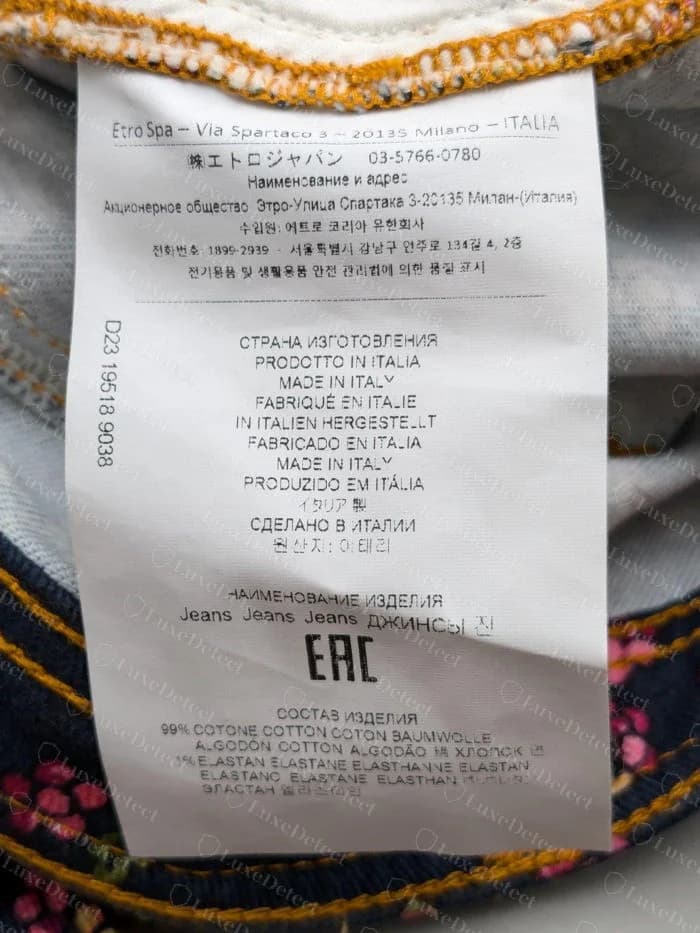
The white printed care labels on the clothing we viewed give the company name and a Milan street address (Etro Spa, Via Spartaco 3, 20135 Milano), then "Prodotto in Italia / Made in Italy" in several languages, composition, and laundry symbols. Several carry an item code, and the 2022 jeans show a production month and year.
The jeans label also repeats the address in Japanese and other scripts, so a label packed with languages is normal. The wording and layout change between garments, and fakes can copy care labels word for word, so this is a check on whether the details agree with the rest of the piece, not a pass.
Scarves and Hang Tags
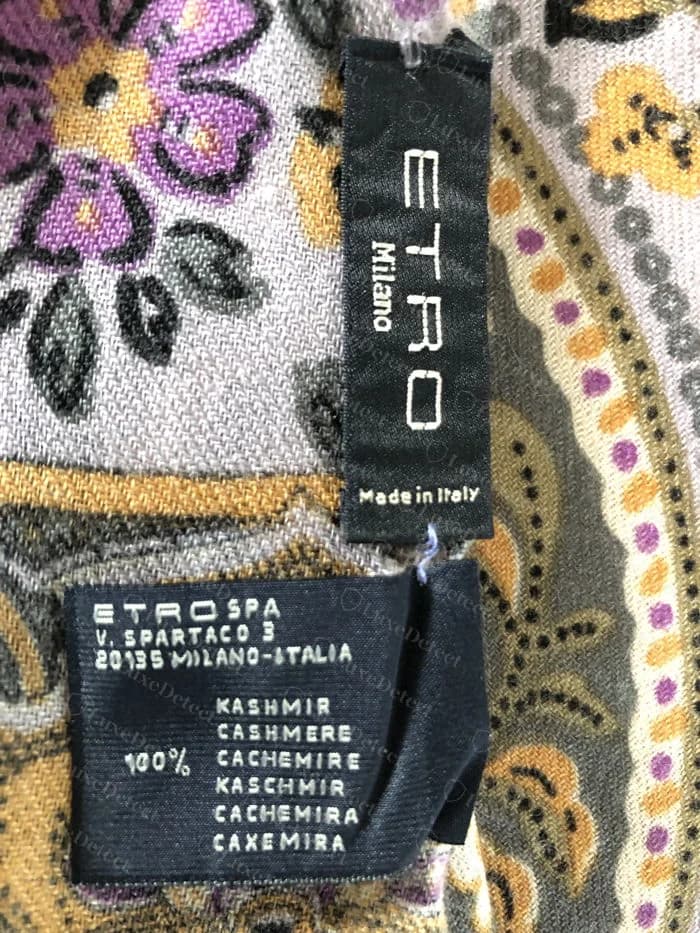
On the cashmere scarf we viewed, two separate black woven tags are sewn at the edge: one reading "ETRO Milano / Made in Italy", the other with the company address and fibre content in six languages. The brand name is also printed along the border of the print. For a scarf, compare both tags with the print itself, and keep in mind that a silk piece may instead carry only a printed name; one genuine silk jacket we viewed has a small cursive "Etro" signature with a copyright sign worked into the print.
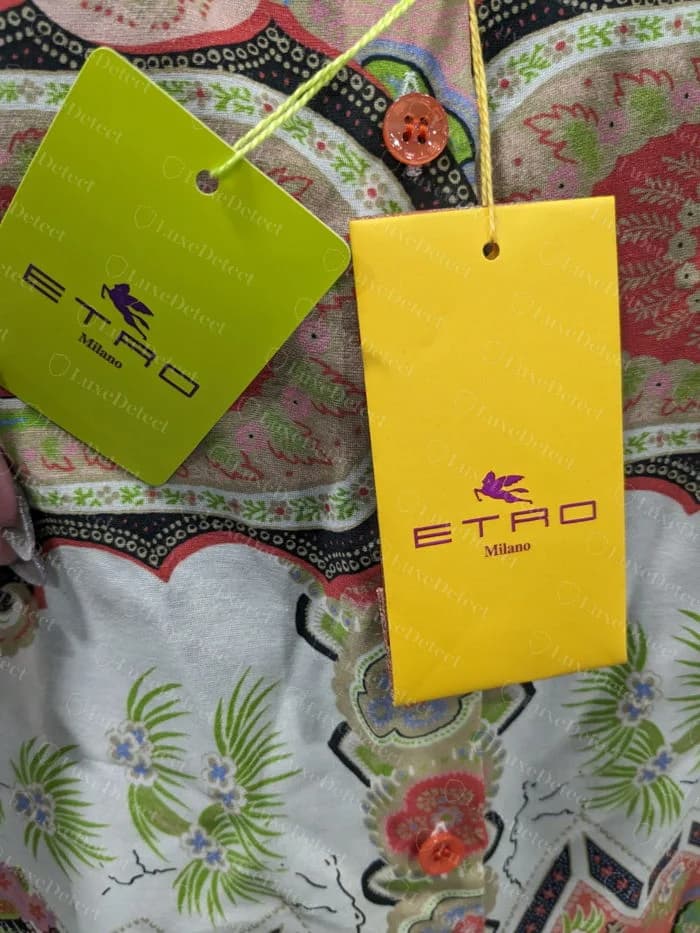
New pieces with tags in our records show a bright yellow tag with the horse and "ETRO Milano", a lime-green tag with care instructions in several languages, and a paisley-print card with a model number, size and barcode sticker. Hang tags are easy to move from one item to another, so treat them as supporting context, never proof.
Embroidered Patches
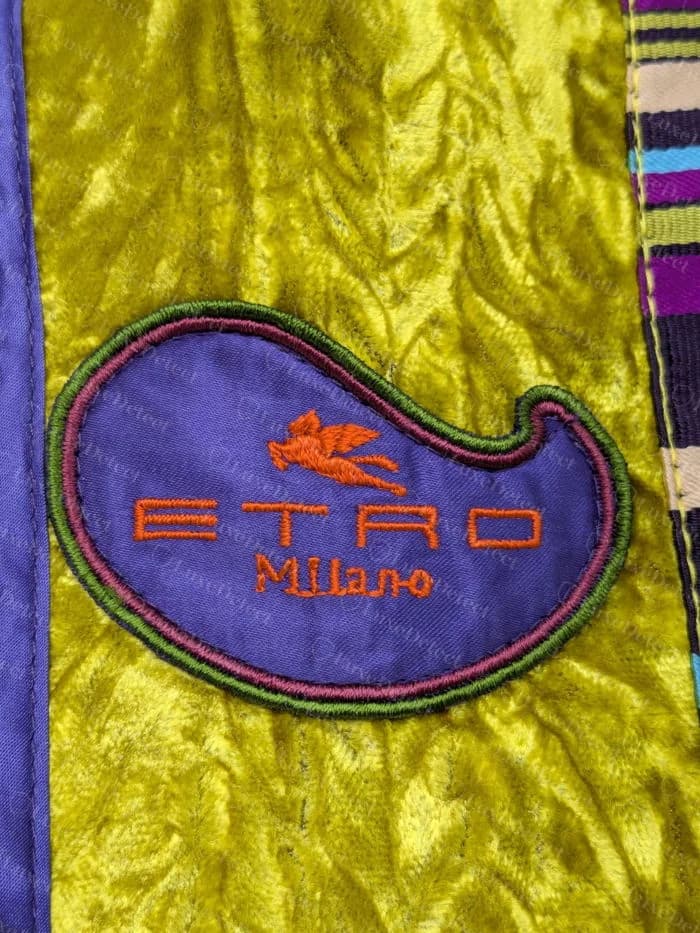
Some coats and jackets show an embroidered paisley-shaped patch on the lining in place of a woven neck label, with the horse and "ETRO Milano" stitched in contrasting thread. It is a different mark from the woven labels above, and one more reason not to expect a single tag format across the brand.
What a Matching Mark Does and Does Not Prove
Etro is made in Italy per the tags in our records, but not everything is: the genuine sunglasses we viewed are marked "MADE IN CHINA", so origin on its own is not a test. Reading the marks together, the leather tag, the stamp, the hardware, the label and the care label, tells you whether a piece is consistent with what we have seen. Fakes copy these marks, so a matching mark proves nothing on its own. For broader context on other Italian houses, see our guides to the Fendi Baguette and the Hermès scarf; for how labels read on a designer garment, see Issey Miyake.
When to Get a Professional Opinion
Because Etro's tags and hardware change by line and era, and counterfeiters copy marks, a matching mark proves nothing on its own. What matters is how the print, the tags, the hardware, the stitching and the materials fit together against confirmed genuine pieces. LuxeDetect authenticates Etro clothing, scarves and accessories from photos starting at $15, and handbags from $25, with a 24-hour turnaround and a Certificate of Authenticity for pieces that pass. Start an order with clear photos of the interior tag front and back, the hardware, every label and the care label, and the overall piece.
A code that checks out doesn't prove the item is real. Counterfeiters copy genuine codes.
Our authenticators check the stamps, hardware and construction of your Etro against verified references, from $25. You get a verdict within 24 hours, and a Certificate of Authenticity if the item passes.
Authenticate My Etro →FAQ
How can I tell if my Etro bag is real?
Compare the marks together rather than relying on one. Genuine paisley bags in our records show an embossed leather interior tag with the winged horse, ETRO, Milano and MADE IN ITALY, brass-tone hardware, and often a stamped number and date on the back of the tag. Fakes can copy all of these, so a professional check is the reliable answer.
What does the number stamped on the back of an Etro tag mean?
We have not confirmed it. Older-looking tags in our records read like an N. number, then a day, an Italian month abbreviation and a year, then a short number. Later ones show a code and a numeric date. We do not know what each part records, so don't use it to decode age.
Is the paisley print on my Etro piece a way to check authenticity?
Not by itself. Genuine pieces come in many paisley and floral prints and scales, on canvas, nylon, silk, cotton and denim. A print that differs from another Etro item you have seen is not a warning.
Where is Etro made?
The tags on the genuine clothing and bags in our records say made in Italy, and the company is based in Milan. The genuine sunglasses we viewed say made in China, so origin by itself is context, not a verdict.
Does every Etro item have the Pegasus logo?
No. The winged horse appears on much of the hardware, tags and labels we viewed, but other genuine pieces use the plain ETRO name, a stylised E plaque, or a paisley-shaped patch. Don't treat a missing horse as suspicious on its own.
What does a genuine Etro care label look like?
On the clothing in our records it is a white printed label giving Etro Spa and a Milan address, made-in-Italy wording in several languages, fibre composition and laundry symbols. Layouts differ between garments, and fakes can copy the wording, so it supports other checks rather than proving anything.
Can fake Etro have perfect labels and tags?
Yes, good counterfeits copy labels, tags and hardware closely. A matching mark is a baseline, not a pass, which is why we recommend checking the whole piece together.