Hermès Authentication Specialist
Handbag authentication specialist. Has reviewed submissions across Hermès, Chanel, Louis Vuitton, and Dior since 2019.
Last updated May 2026 · Published February 2026 · Contact
What Makes a Hermès Carré Worth Authenticating
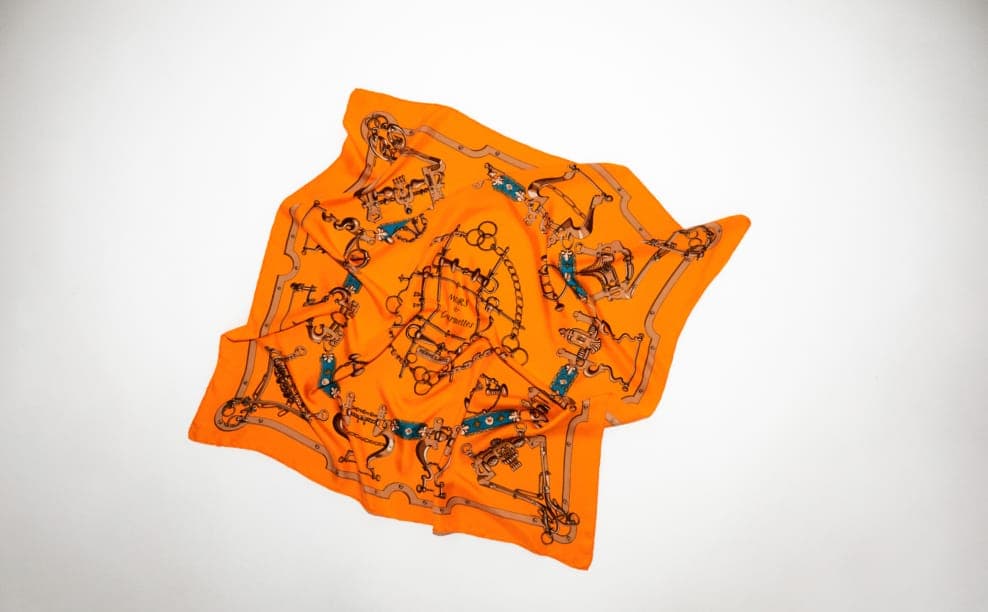
The first Hermès carré appeared in 1937. From the initial sketch to the finished scarf, production takes up to 18 months — and that timeline is not marketing. The design process involves commission artists, hand-drawn stencils, and a silk-screen printing process where colors are applied one at a time, building up in layers. A complex design can require 30+ individual color passes. Each pass uses a different screen that must be perfectly aligned with every previous layer.
That process produces something that cannot be cheaply replicated. But the secondary market for Hermès scarves is substantial — authentic vintage carrés in excellent condition regularly sell for €500–€2,000+ — which makes faking them worthwhile.
The authentication framework below focuses on the things that cannot be faked at scale: the silk itself, the edge finishing, and the print quality at close range.
Use our free Hermès Date Stamp Decoder to identify the production year of any Birkin, Kelly, or Constance — circle, square, or modern alphanumeric format.
Decode My Date Stamp →The Standard Hermès Carré: Specifications
The classic 90 cm × 90 cm carré is the standard format. There are also:
- Twilly: 5 cm × 86 cm — narrow elongated format
- Maxi Twilly: 7 cm × 100 cm
- 90 Carré: The reference format — most fakes target this size
- 140 cm Cashmere-Silk Shawls: Different material, different weight
Authentication points below apply primarily to the 90 cm silk carré, which is the most widely faked.
The Silk Itself
Hermès uses a specific grade of silk twill that is noticeably heavier and denser than standard silk fabric. This is the foundational authentication marker because it's immediately apparent to the touch.
Weight test: Hold the carré and feel its weight in your hands. Authentic Hermès silk is substantial — it hangs with weight and has a richness to it. Fakes use lighter, thinner silk that feels insubstantial.
The stretch test: Hold one corner and gently pull it diagonally (across the bias). Authentic silk twill has minimal stretch in this direction and returns immediately to its original shape when released. Cheap polyester or low-grade silk blends stretch more and may not fully recover.
Diagonal texture: Look at the fabric at an angle in good light. You should see a subtle diagonal rib — the characteristic twill weave. This texture is faint but consistent and regular. Polyester fakes appear smooth or show an irregular weave.
Color vibrancy: Hermès dyes are applied to the silk before weaving in some processes, and the resulting colors have a depth and richness. Colors should be vivid but not garish. They should look saturated even when the scarf is folded, not just on the surface.
The Hand-Rolled Edge
This is one of the most telling quality markers and the easiest to check with practice. Every authentic Hermès carré has its edges hand-folded and hand-stitched by a human worker. The stitching is done with a thread that matches the dominant border color, applied in a rolling stitch that wraps the edge of the silk.
What to look for: The folded-and-stitched roll goes toward the front of the scarf (the printed side). The stitching is visible on the back — you can see individual stitches. They're consistent in spacing but have the very slight natural variation that machine stitching rarely shows. A perfectly uniform, machine-sewn edge is incorrect.
Common fakes: Machine-overcast edges (where the thread loops around the cut edge without rolling it), heat-sealed edges (the edge is melted rather than rolled), or machine-sewn rolled edges that are perfectly uniform. Examining the edge with a loupe is helpful — the difference between machine and hand work is immediately clear.
Print Detailing and Color Registration
The multi-layer silk-screen printing process produces a level of detail that shortcuts cannot replicate. Look at the print in good light, ideally with a magnifier.
Outline clarity: Where one color meets another, the boundary should be crisp and clean. On genuine carrés, there is essentially no bleeding or smearing between colors. Fakes frequently show slight color bleeding at the edges of printed areas.
Background areas: Even solid-colored background areas in authentic scarves have subtle depth — they're not flat solid fills. You can see the silk weave structure through the printing. Fakes often have fully opaque backgrounds that look plasticized.
Detail density: Hermès designs are highly detailed — scenes with horses, riders, bridles, botanical elements. Look at the finest elements in the design: thin lines, small text, intricate decorative elements. On authentic scarves, these reproduce with full clarity. On fakes, fine detail becomes blurry or breaks down.
Artist Signature and Design Name
Almost every Hermès carré has the artist's signature integrated into the design, usually tucked into a corner or along a border element. It's there intentionally — artists who create designs for Hermès sign their work.
The design name also appears on the scarf, printed in a discrete location. "Hermès © Paris" appears in thin, clean text — small enough to be unobtrusive but present.
Fakes often omit one or both of these, or position them incorrectly. If the artist signature is absent on a design that should have one, that's a significant red flag.
The Silk Corner Label
Sewn into one corner on the reverse is a small silk label reading approximately: "100% Soie / Made in France / Hermès / Paris." The label is attached with stitching that matches the edge work — consistent and neat. The font is small, clean, and the text is in black on the cream/white label.
What's wrong on fakes: Incorrect text sequence, misspellings, labels in a different fabric (satin instead of silk, polyester instead of silk), or labels attached with different-colored thread. Some fakes remove the label to avoid scrutiny — a missing label is not automatically a red flag on very old vintage pieces, but on anything from the past 30 years, it should be there.
The Round Tag
New Hermès scarves come with a round price tag attached. On authentic scarves it's a matte, stiff card with the Hermès logo in a thin, elegant font. The lettering spacing is precise.
Note: many secondary market carrés have had their tags removed. The absence of a tag on a pre-owned scarf is normal and not a red flag.
Packaging
Authentic Hermès scarf packaging is an orange box in a specific shade of orange — not red, not yellow-orange, but the precise Hermès orange. The box is stiff cardboard with a matte finish and a slight sheen (not glossy). The Hermès logo is centered.
Critical: Hermès does not typically include authentication cards, holographic stickers, or certificates with their scarves. If packaging contains any such item, it is either a third-party add-on (irrelevant to authenticity) or the scarf is fake and the card is a counterfeit authenticity prop.
Authentication Checklist
- Silk weight — substantial and heavy, not thin
- Stretch test — minimal stretch across bias, returns immediately
- Diagonal twill texture — visible under angled light
- Edge — hand-rolled, hand-stitched, visible individual stitches
- Print — crisp color boundaries, no bleeding, fine detail intact
- Artist signature — present in design
- Design name — present
- Corner label — "100% Soie / Made in France" with correct stitching
- No authentication cards in packaging
- Hermès orange box — matte, not glossy
FAQ
How can I tell if a Hermès carré is silk or polyester?
A burn test on a tiny loose thread is sometimes used, but it is destructive, so we do not recommend it on a scarf you want to keep. A safer approach: hold the fabric and assess the weight and drape. Silk feels cool to the touch initially and warms quickly. Polyester feels neutral. Silk has a natural sheen that changes as you move the fabric; polyester has a more static, uniform shine. The diagonal twill weave structure visible under angled light is also characteristic of authentic silk twill — polyester weaves look different.
Does every Hermès carré have an artist signature?
Almost all, but not literally every one. A very small number of historical designs were produced without a visible artist credit. However, the presence of an artist signature is the norm. If a seller claims the scarf doesn't have one because "some don't," verify against the specific design's known documentation — most Hermès designs are catalogued online by collectors.
Are vintage Hermès carrés harder to authenticate?
In some ways yes, because the silk label style has evolved over decades, the packaging changes, and some very old scarves have had tags removed or labels damaged. But the fundamental silk quality and hand-rolled edge remain consistent markers across all eras. Very early carrés (1937–1970s) are significantly rarer and more specialized — for those, a dedicated Hermès specialist is worth consulting.
What makes a Hermès carré valuable?
Rarity of the design, condition (no fading, staining, pulls, or edge fraying), and desirability of the specific motif. Designs featuring horses, wildlife, or classic Hermès themes in exceptional colorways are most sought after. First-edition prints of well-known designs carry a premium. Condition grades matter significantly — a pristine rare carré can be worth 3–5x a similar design in fair condition.
Should I have a vintage Hermès carré professionally cleaned?
Only by a specialist who handles fine silk. Standard dry cleaning can damage the silk and fade the prints. Hand washing in cool water with silk-specific detergent is an option for very light refreshing, but for anything beyond surface dust, a professional specializing in vintage textiles is the safer choice.