Luxury Accessories Authentication Specialist
French luxury house specialist. Covers Chanel, Celine, and Saint Laurent construction and date coding.
Published September 2026 · Contact
Why Dior Belts Are Authenticated at the Buckle, Not the Stamp
A Dior belt carries less information than a Dior bag. There is no cannage to count, no lining to inspect, no charm to weigh. What you have is a buckle, a strap, a couple of heat stamps and, on newer belts, a production code. Counterfeiters know this, and on the belts we see they have concentrated their effort on exactly those stamps.
We went through every belt order in our Christian Dior archive: 51 orders mentioning a belt came back fake, 48 of them actual belts (the rest were belted dresses and a Saddle belt pouch). Almost every modern fake in that set carried a clean "MADE IN ITALY" stamp and a correctly shaped production code, and the gold "Christian Dior Paris" foil was often indistinguishable from the genuine one in photos. The stamps that buyers are told to check are the stamps the factories have learned to copy.
What they have not copied as well is the metalwork. The CD buckle is a separate cast part, and on a reversible 30 Montaigne belt it hides a hinge mechanism that costs real money to make well. That is where this guide puts its weight, with the stamps treated as a consistency check rather than proof.
Our archive's fake belts break down like this: 16 modern CD or D buckle belts (30 Montaigne oval CD, open CD and crystal CD styles), 16 vintage-style belts sold as pre-2000 pieces, 4 embroidered or Oblique canvas strap belts, 4 men's plaque-buckle belts, 2 Teddy-D belts, 2 DIOR letter-buckle belts and 4 plain or wide leather belts. The modern CD buckle belt is both the most copied and the easiest to check, so it gets most of the space here.
What to check, ranked by reliability
| Checkpoint | Reliability | What it tells you |
|---|---|---|
| 1. The CD Buckle: Casting, Edges and Engraving | ★★★★★ | A rough, unfinished buckle reverse with moulded numbers or pitted plating rejects the belt; domed faces and blunt serifs corroborate. |
| 2. The Reversible Hinge Block on the 30 Montaigne Belt | ★★★★★ | Play in the pivot, gaps around the block or a colour step between block and CD frame is a strong sign of a counterfeit. |
| 3. The Production Code Stamp | ★★★★★ | Fakes copy every code format, but a code reused across unrelated models or a size that does not match the belt is a real warning. |
| 4. Strap, Foil Stamp, Edges and Stitching | ★★★★★ | The gold foil is usually copied well; cracked or bubbled edge paint and wandering stitching on a new belt are the useful tells. |
| 5. Vintage and Licensed-Era Dior Belts | ★★★★★ | Country stamps prove nothing on licensed-era belts; only details that mix incompatible eras settle anything. |
| Model Reference Before You Start | ★★★★★ | Catches a modern CD buckle belt stamped outside Italy; will not catch a good fake on its own. |
| What the Box, Dust Bag and Tags Do and Do Not Prove | ★★★★★ | Packaging is context only; its value is matching the tag size and description to the belt. |
Model Reference Before You Start
Know which belt you are looking at before comparing details, because Dior has used very different hardware and stamping across its belt lines.
- 30 Montaigne belt: the oval CD buckle, where the C and D sit inside a continuous oval outline. Often sold as a reversible belt (for example black and white leather, or Oblique canvas on one side and leather on the other), with a hinged block behind the buckle so the strap can be turned.
- Open CD buckle belts: a free-standing C and D without the oval. Listings often call these "Saddle belts". The Saddle Belt Pouch is a different item (a small bag worn on a belt) and is covered in our Dior Saddle bag guide.
- Teddy-D and CD plaque belts: a flat oval or rounded plaque with the CD logo, usually on a narrow strap.
- DIOR letter buckles and J'Adior-style buckles: the house name spelled out as the buckle itself.
- Oblique and embroidered strap belts: canvas or jacquard straps, sometimes wide "Christian Dior" embroidered belts with a leather tab closure.
- Vintage and licensed-era belts: pre-2000 Christian Dior belts made under licence, with plaque or harness buckles and stamps naming Spain, Taiwan, France or Argentina. These follow different rules, covered in section 5.
If the belt in the listing is a 30 Montaigne or open CD buckle belt, it should be stamped "MADE IN ITALY". A modern CD buckle belt stamped with any other country is a problem; a vintage licensed belt stamped Spain or Taiwan is not.
The CD Buckle: Casting, Edges and Engraving
The buckle is a separate part with its own tooling, and it is the component where fakes show their cost savings most clearly.
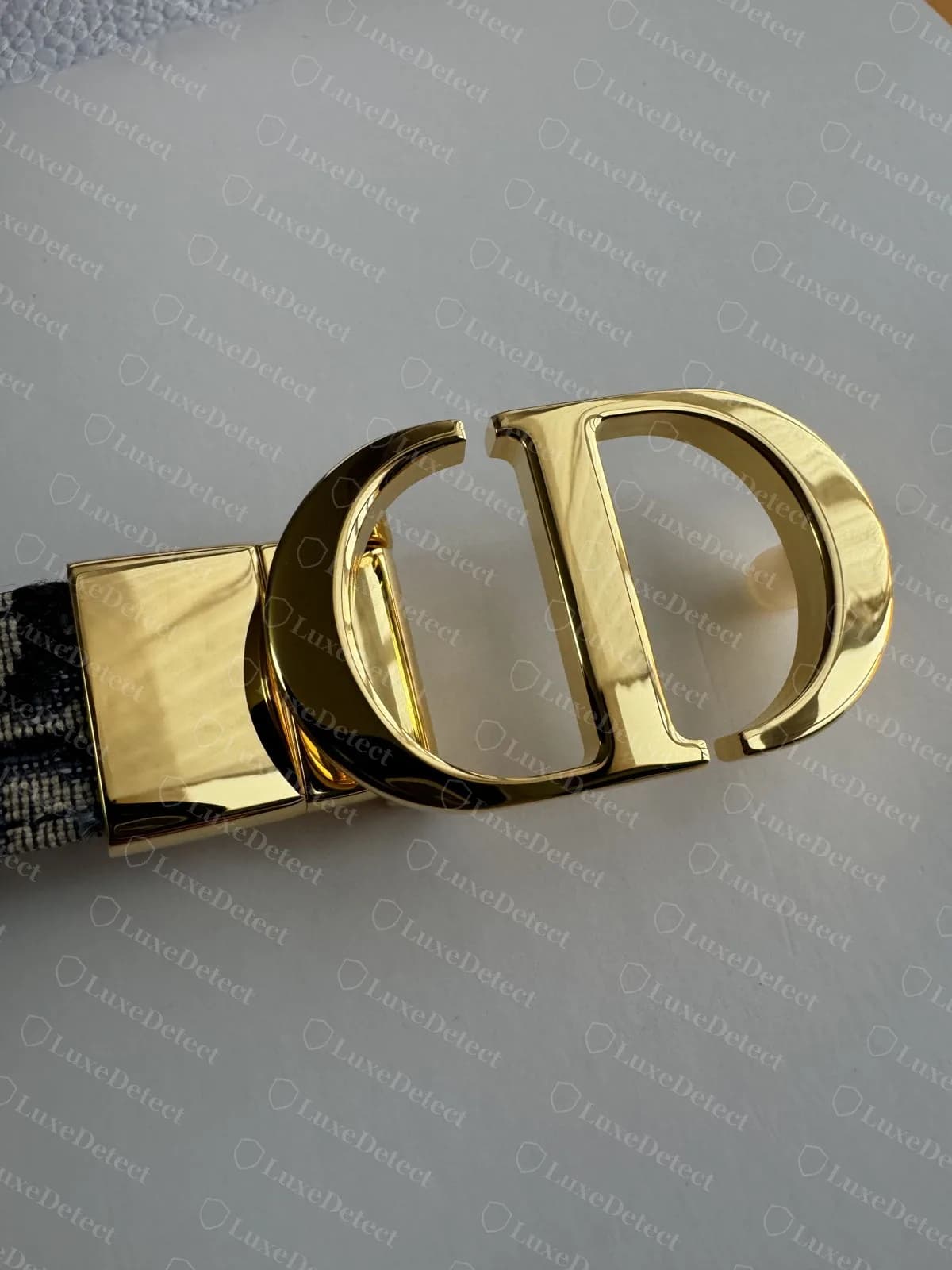
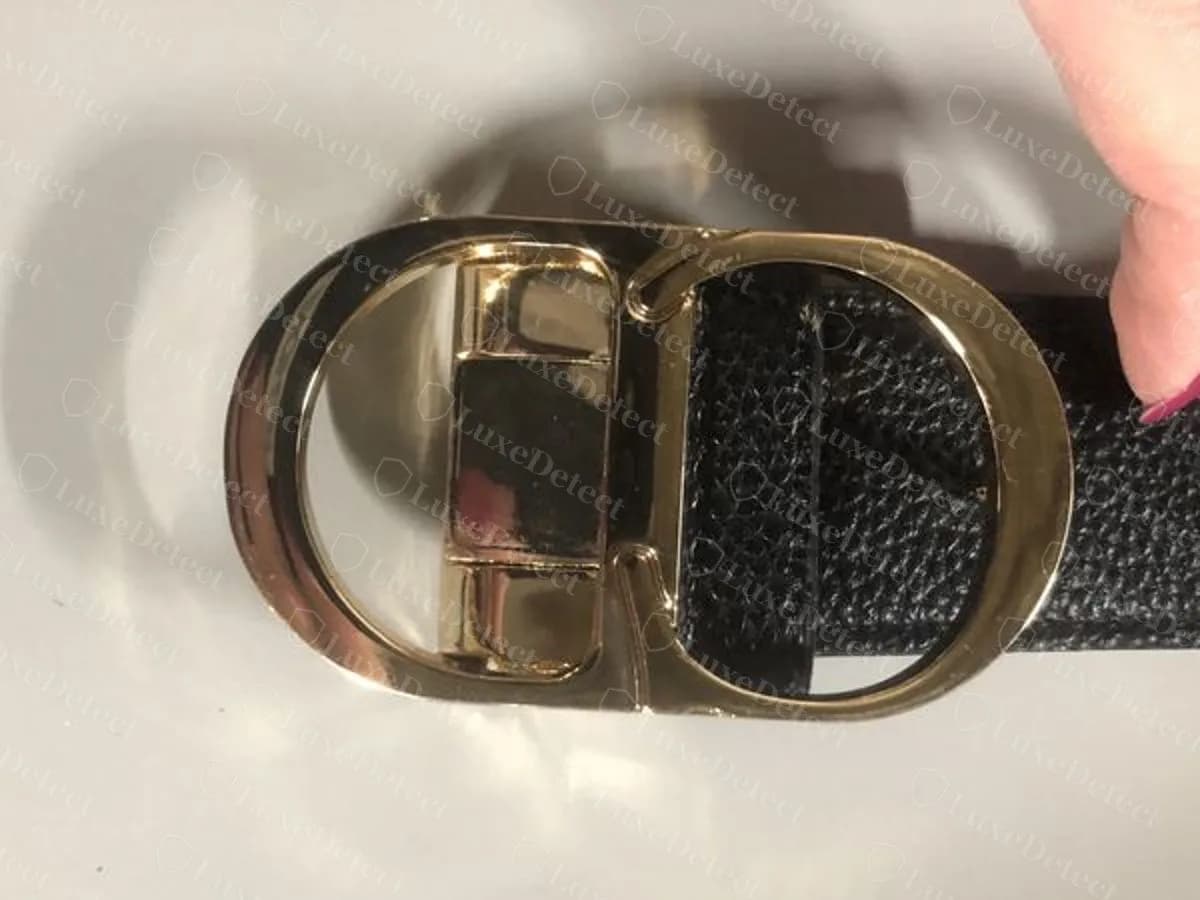
On a genuine buckle, the faces of the C and D are flat and evenly polished, and the edges where the face meets the side walls are crisp. The serif ends of the C are cut cleanly, and the gap between the C and the D is even from top to bottom. The plating has a deep, uniform colour that carries into the inside curves.
On the fakes we see, the faces tend to be slightly domed or wavy, so reflections bend across the letter instead of running straight. Inner corners are rounded off, the serifs are blunt, and the gold tone is often paler and more brassy than the genuine yellow gold. None of these is dramatic on its own in a photo, which is why the back of the buckle matters.
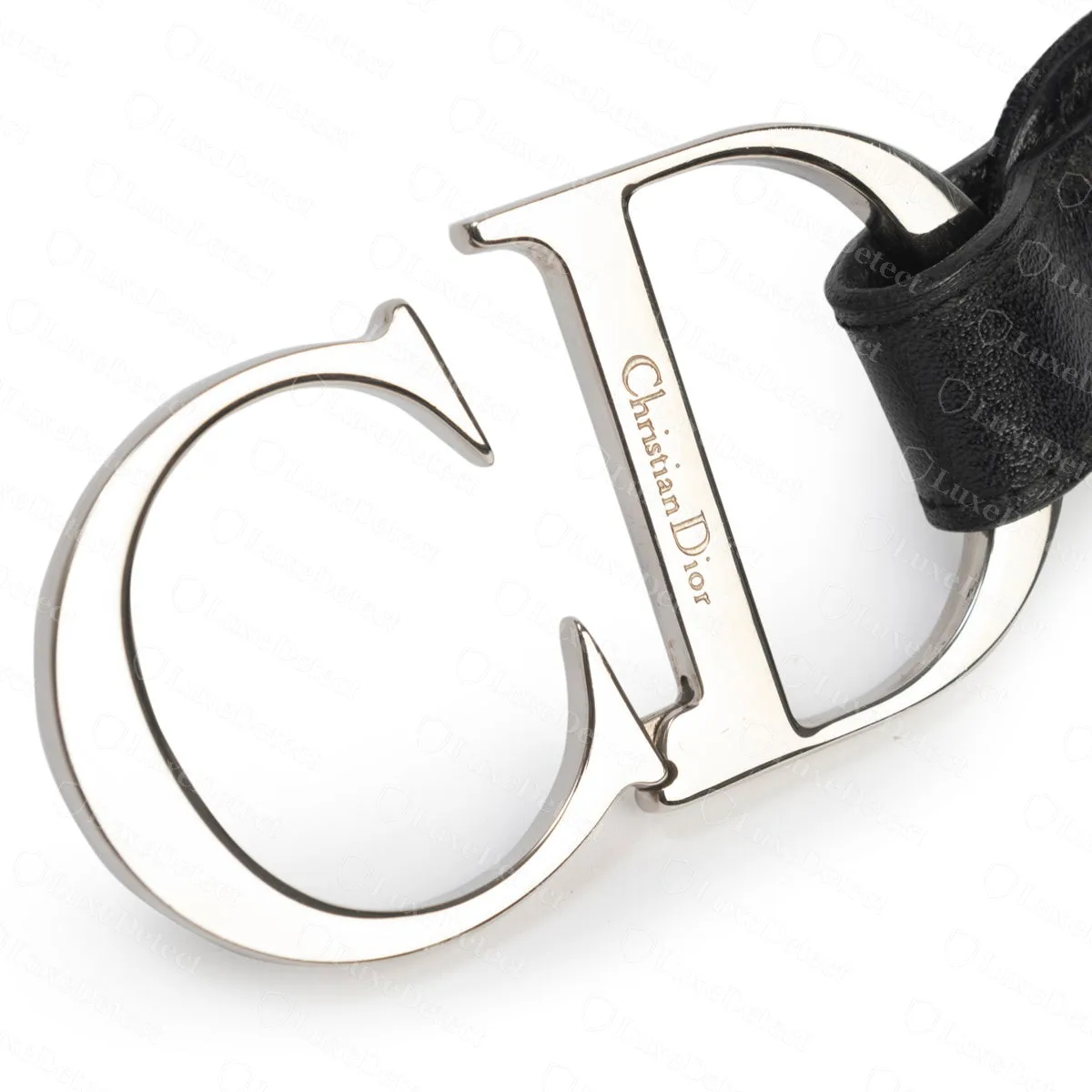
Where a buckle carries an engraved "Christian Dior" signature (common on 2000s CD buckles, like the one above), the lettering is fine, evenly deep and follows the upright of the D in a straight line. Engraving that wanders, varies in depth or looks etched rather than cut is a warning.
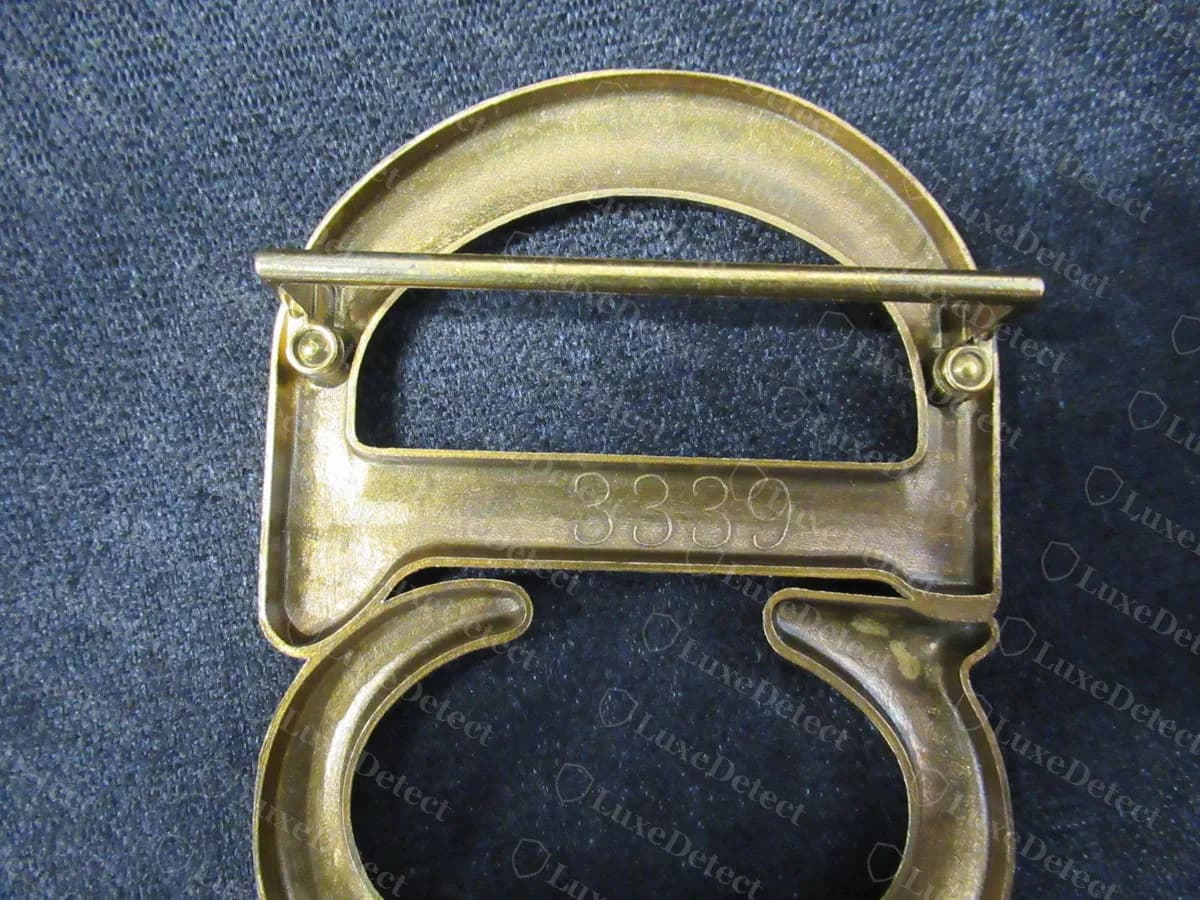
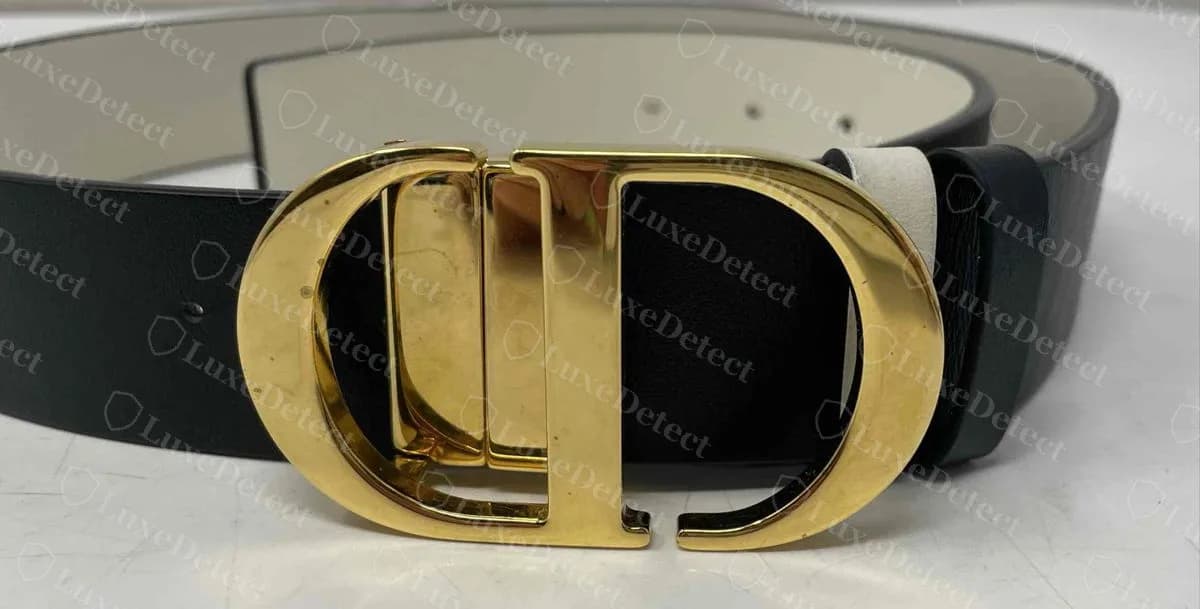
The reverse of the buckle is where cheap casting shows. The fake above has a moulded number on the back, uneven wall thickness, rough transitions where the frame meets the prong bar, and plating that has gone dull and patchy. Genuine Dior buckles are finished on the back as well as the front.
| Element | Authentic | Counterfeit |
|---|---|---|
| Letter faces | Flat, evenly polished, straight reflections | Slightly domed or wavy, reflections bend |
| Edges and serifs | Crisp inner corners, sharp serif ends | Rounded corners, blunt serifs |
| Plating colour | Deep, even tone including inside curves | Pale or brassy, thinner in recesses |
| Buckle reverse | Finished, smooth, clean transitions | Rough casting, moulded numbers, pitting |
| Engraving (where present) | Fine, even depth, straight line | Shallow, wandering or etched-looking |
| Feel in hand | Dense and solid for its size | Light, or rattles at the joints |
Red flag
A buckle whose reverse is a rough, unfinished casting with moulded numbers or pitted plating is not Dior workmanship. Genuine buckles are finished front and back, so a crude reverse on a belt sold as current-season is enough to reject it.
The Reversible Hinge Block on the 30 Montaigne Belt
Reversible 30 Montaigne belts have a hinged metal block behind the buckle. The strap is screwed into the block, and the block pivots so the belt can be worn either side out. It is a small mechanism, and it is expensive to copy well.
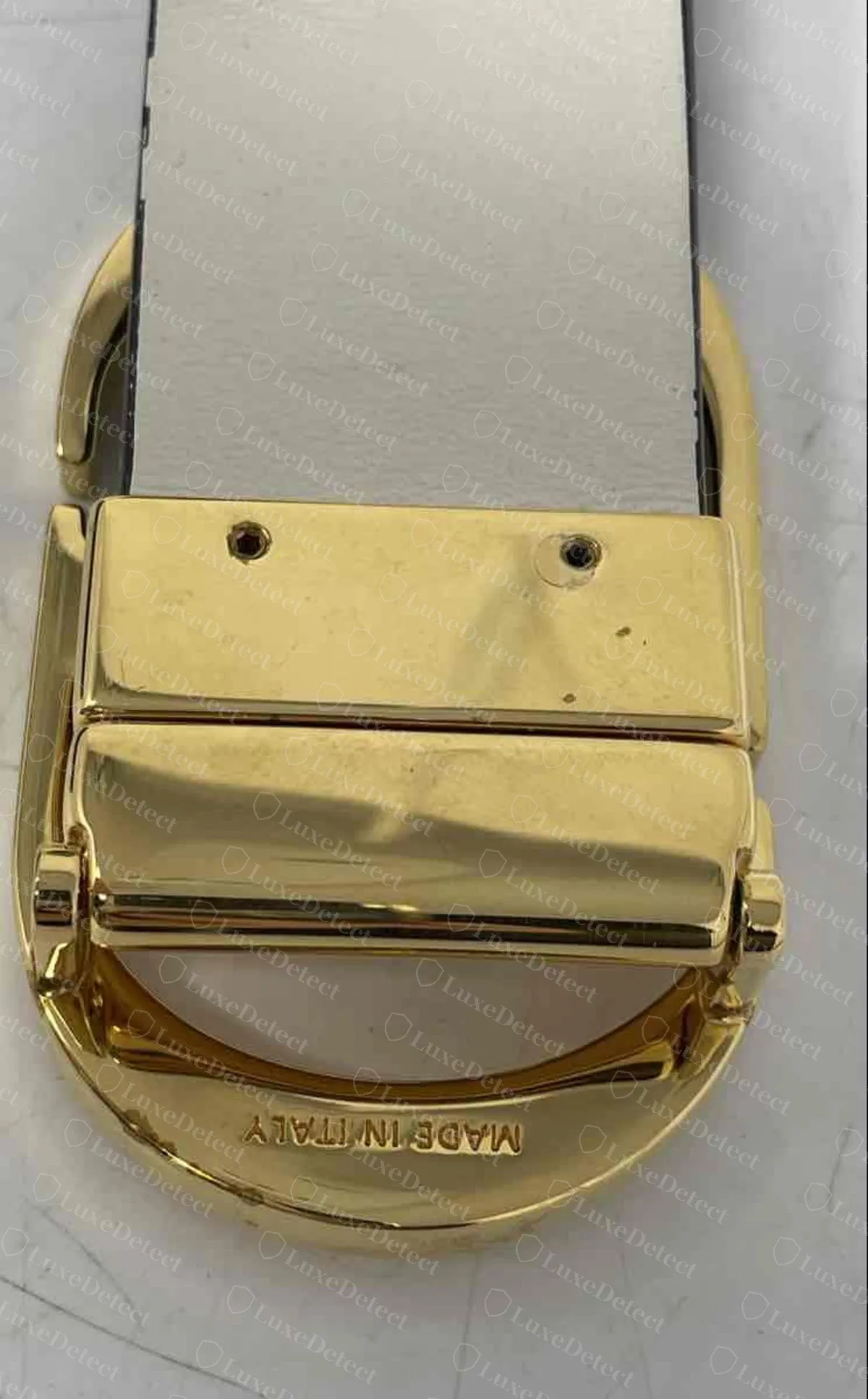
On the genuine belt the block is a solid, squared part with tight seams, the pivot runs cleanly through both sides, and the strap is fixed with two neat screws. "MADE IN ITALY" is engraved in small, even capitals on the inside face of the oval. The same engraving appears on the other genuine 30 Montaigne belts in our archive, in the same position.
Fakes copy the engraving too (one fake in our set has it in the same place), so its presence proves little. What to look for instead is the fit: gaps between the block and the buckle frame, a pivot that is loose or stiff, plating that does not match between the block and the buckle, and screws that sit proud or are replaced by a pressed rivet. Turn the buckle through its full movement. It should rotate smoothly and stop firmly, with no wobble.
| Element | Authentic | Counterfeit |
|---|---|---|
| Block construction | Solid, squared, tight seams | Visible gaps or thin folded metal |
| Strap fixing | Two neat screws, flush | Screws proud, mismatched, or a pressed rivet |
| Pivot action | Smooth, firm stop, no play | Loose, gritty, or wobbles when turned |
| Colour match | Block and buckle identical tone | Block and buckle slightly different shades |
| "MADE IN ITALY" on buckle | Present, small even capitals | Often also present, so not decisive |
Red flag
A reversible buckle that wobbles on its pivot or shows a colour step between the block and the CD frame has been assembled from mismatched parts. On a belt sold as new, that is a strong sign of a counterfeit.
The Production Code Stamp
Modern Dior belts carry a heat-debossed stamp with "MADE IN ITALY", a production code and the belt size. On the genuine belts in our archive the code follows a two-digits, two-letters, four-digits pattern (for example 23-MA-0252, 35-MA-1220, 60-MA-0291), followed by the European size in centimetres (75, 80, 90, 95 and so on). Some wide belts use a three-digit prefix (175-BM-...), and 2000s belts often carry a shorter two-letters, four-digits code such as RE0015 or RE-0066.
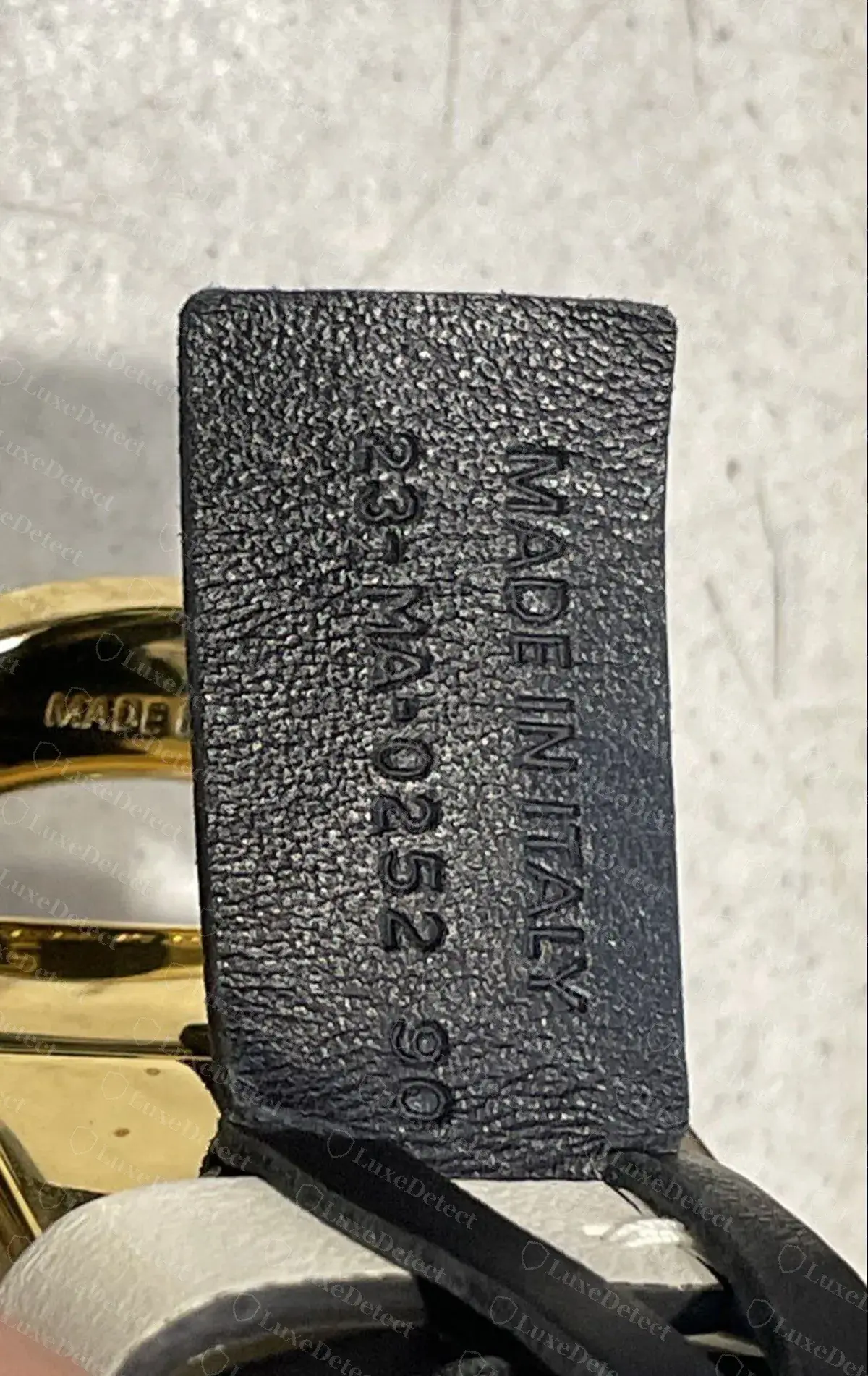
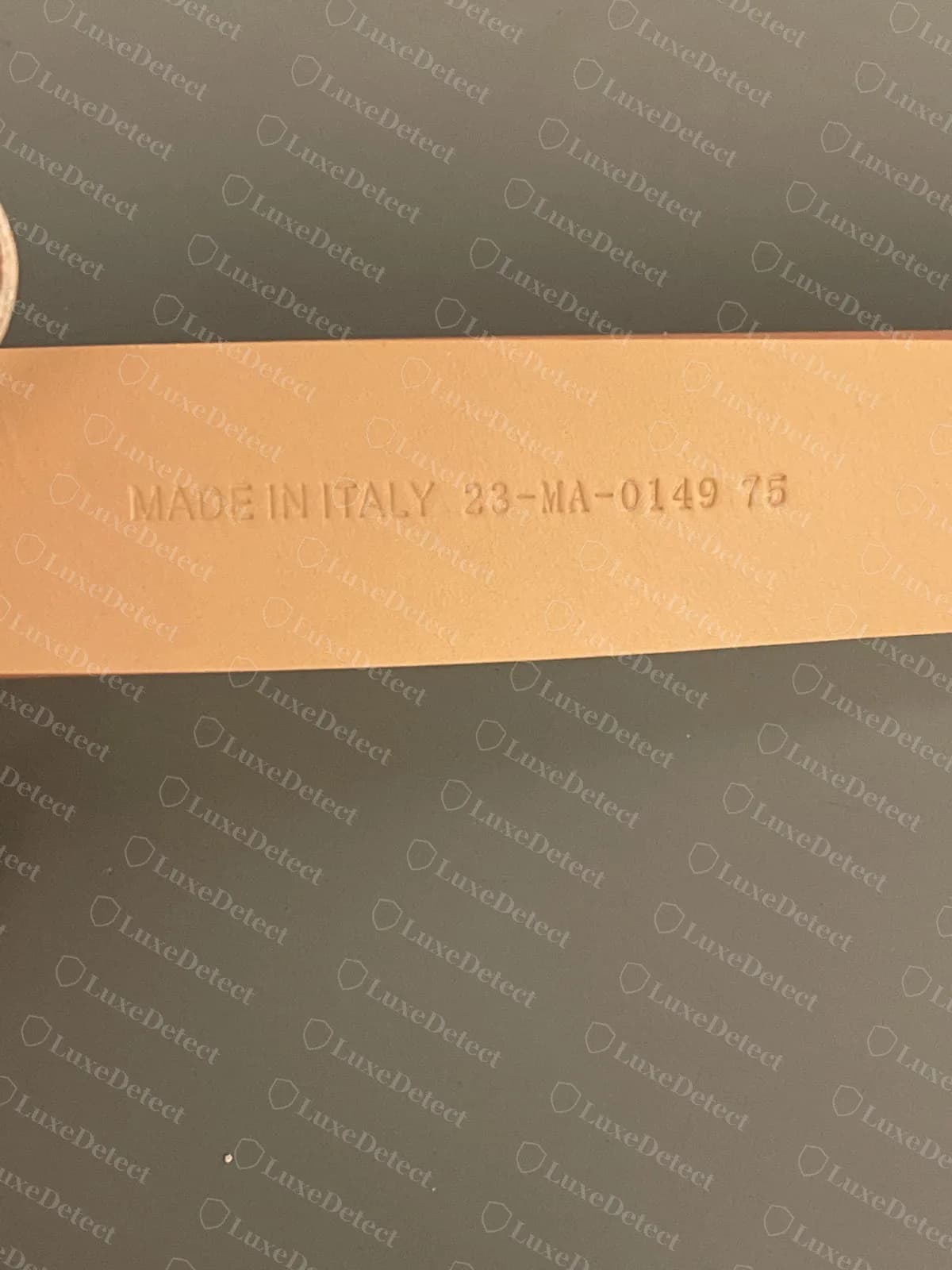
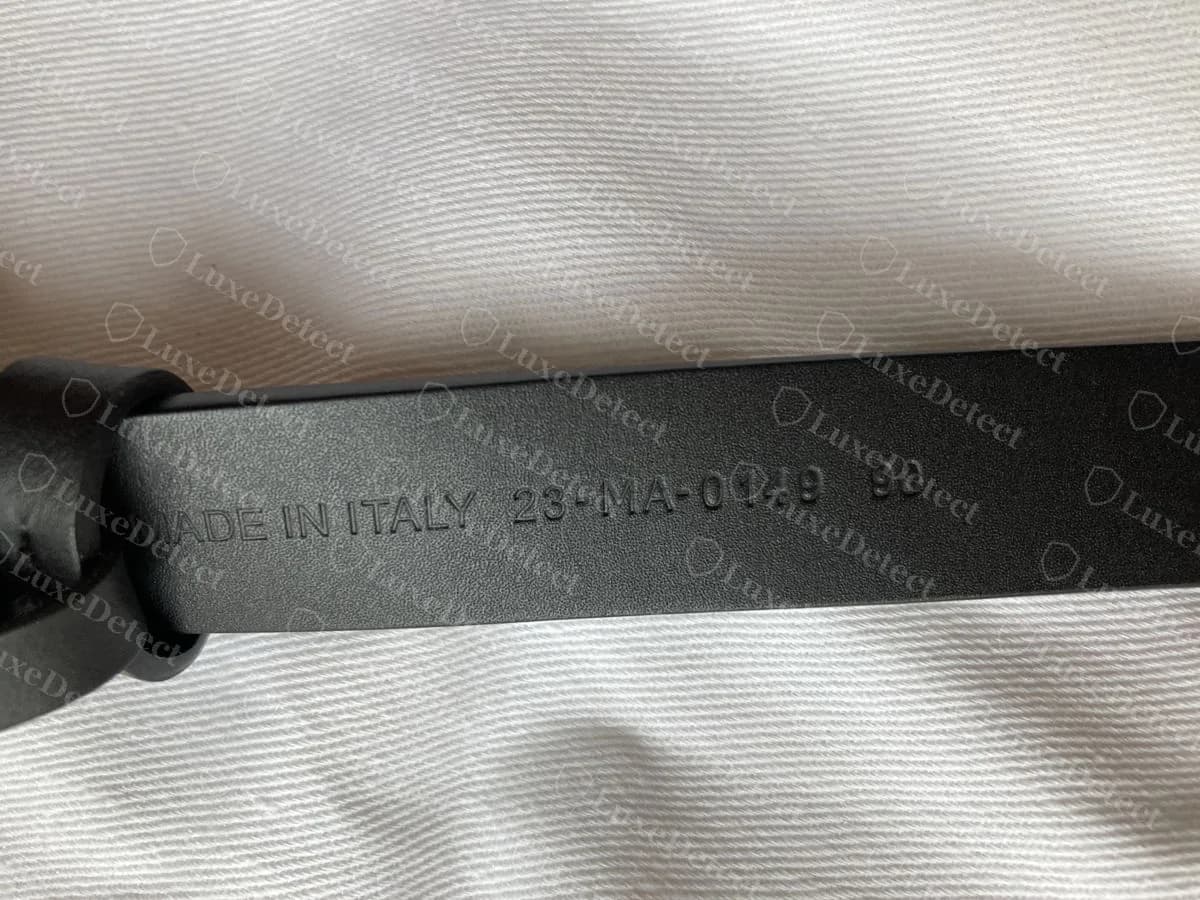
This is where our archive surprised us. The fake belts copy every format: the modern NN-MA-NNNN layout, the three-digit BM variant and the older RE codes all appear on fakes, well stamped and correctly spaced. What gave several of them away was repetition. The code 23-MA-0149 appears on a fake nude CD belt, on a fake grey CD belt of the same design, and on a fake Teddy-D belt, all submitted within a few weeks of each other. A counterfeiter found one plausible code and put it on everything.
Be careful with that finding, though. Genuine codes also repeat: two genuine Dior belts of the same double-ring design, submitted about eighteen months apart, both read 35-MA-1220 with the same size. The code appears to identify a production reference rather than a single belt. So a repeated code is only suspicious when it turns up on different models, or with a size that does not match the belt.
Two practical checks follow. First, the size at the end of the stamp should match the size on the listing and the belt's actual length. Second, if you can search the code, see whether it appears on listings for unrelated Dior belt designs.
Worth knowing
Our free [Dior date code checker](/dior-date-code) is built for the two-letter, four-digit codes inside Dior bags. Belt codes do not decode to a month and year in the same way, so use the belt stamp as a consistency check, not a dating tool. The [Dior date code guide](/blog/dior-date-code-guide) explains the bag format if you are comparing a matching bag.
| Element | Authentic | Counterfeit |
|---|---|---|
| Country line | "MADE IN ITALY" on modern CD buckle belts | Also "MADE IN ITALY", so not decisive |
| Code format | NN-MA-NNNN or similar, then size | Same formats copied accurately |
| Code vs model | Repeats only within the same model | Same code on unrelated models (23-MA-0149) |
| Size number | Matches the belt's real length | Sometimes does not match the listing or length |
| Stamp execution | Heat-debossed, even depth, straight | Usually good; occasionally uneven or crooked |
A code that checks out doesn't prove the item is real. Counterfeiters copy genuine codes.
Our authenticators check the stamps, hardware and construction of your Dior against verified references, from $15. You get a verdict within 24 hours, and a Certificate of Authenticity if the item passes.
Authenticate My Dior →Strap, Foil Stamp, Edges and Stitching
The inside of a modern Dior belt carries "Christian Dior" over "PARIS" in gold foil. On genuine belts the foil is bright, evenly filled and set into a clean debossed impression, with the Dior serif letterforms and the small, widely spaced "PARIS" underneath.
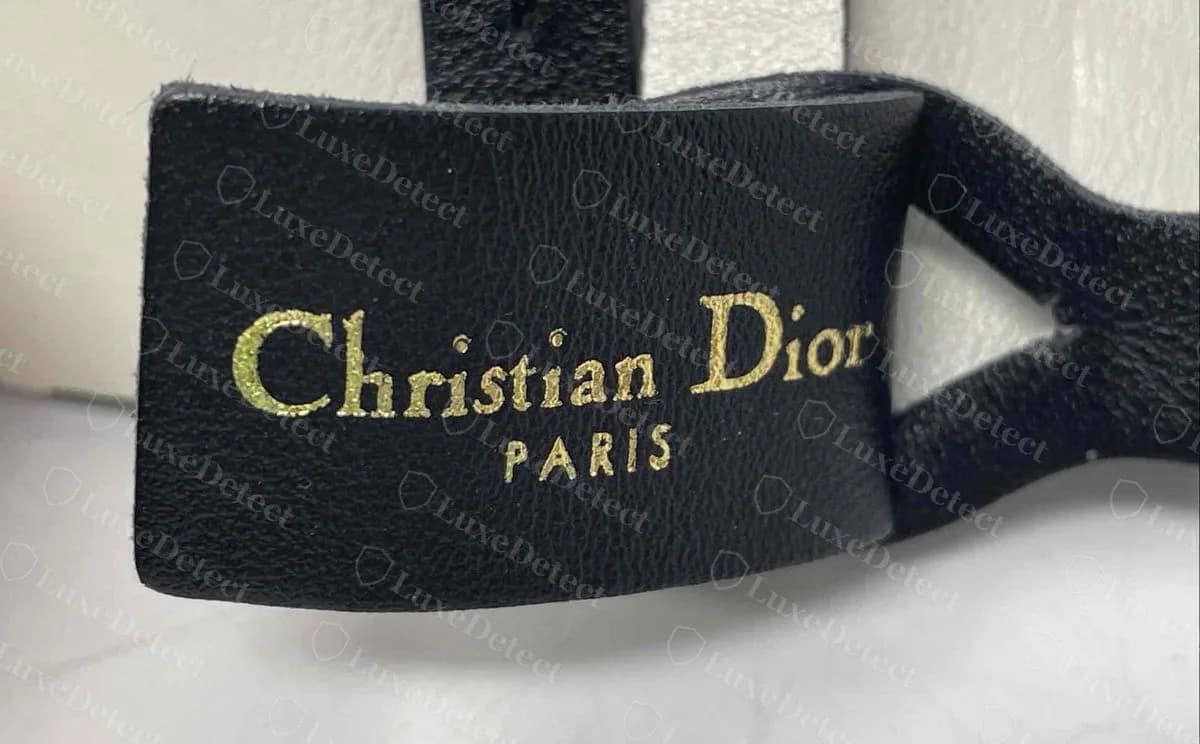
We have to be honest about this one: on most of the modern fakes in our archive, the gold foil looked right in photographs. Letter shapes, spacing and colour were close enough that we would not reject a belt on the foil alone. Where the foil does fail, it fails by bleeding past the letter edges, flaking on a belt described as new, or sitting on the surface without a debossed impression under it.
The strap construction is a better check in hand. On genuine belts the edge paint is smooth, even and slightly rounded, with no bubbles and no cracking on a new belt. Stitching, where the belt has it, runs at a consistent distance from the edge with even stitch length. The leather should be the same thickness from the buckle end to the tip.
| Element | Authentic | Counterfeit |
|---|---|---|
| "Christian Dior PARIS" foil | Bright, evenly filled, debossed | Often close; fails by bleeding or flaking |
| Edge paint | Smooth, rounded, intact on new belts | Bubbled, uneven, cracking when new |
| Stitching | Even length, constant distance from edge | Wandering line, uneven stitch length |
| Strap thickness | Consistent end to end | Thins toward the tip or at the holes |
| Smell | Leather | Chemical or strong glue odour |
Worth knowing
The foil stamp is one of the easiest details to copy, and most fakes we reviewed got it right. A correct foil stamp should not raise your confidence much; a bad one lowers it a lot.
Vintage and Licensed-Era Dior Belts
About a third of the fake belts in our archive were sold as vintage. This is the hardest group to authenticate, because for decades Christian Dior belts were made under licence by different manufacturers in different countries, and the genuine pieces look nothing like a modern Dior belt.
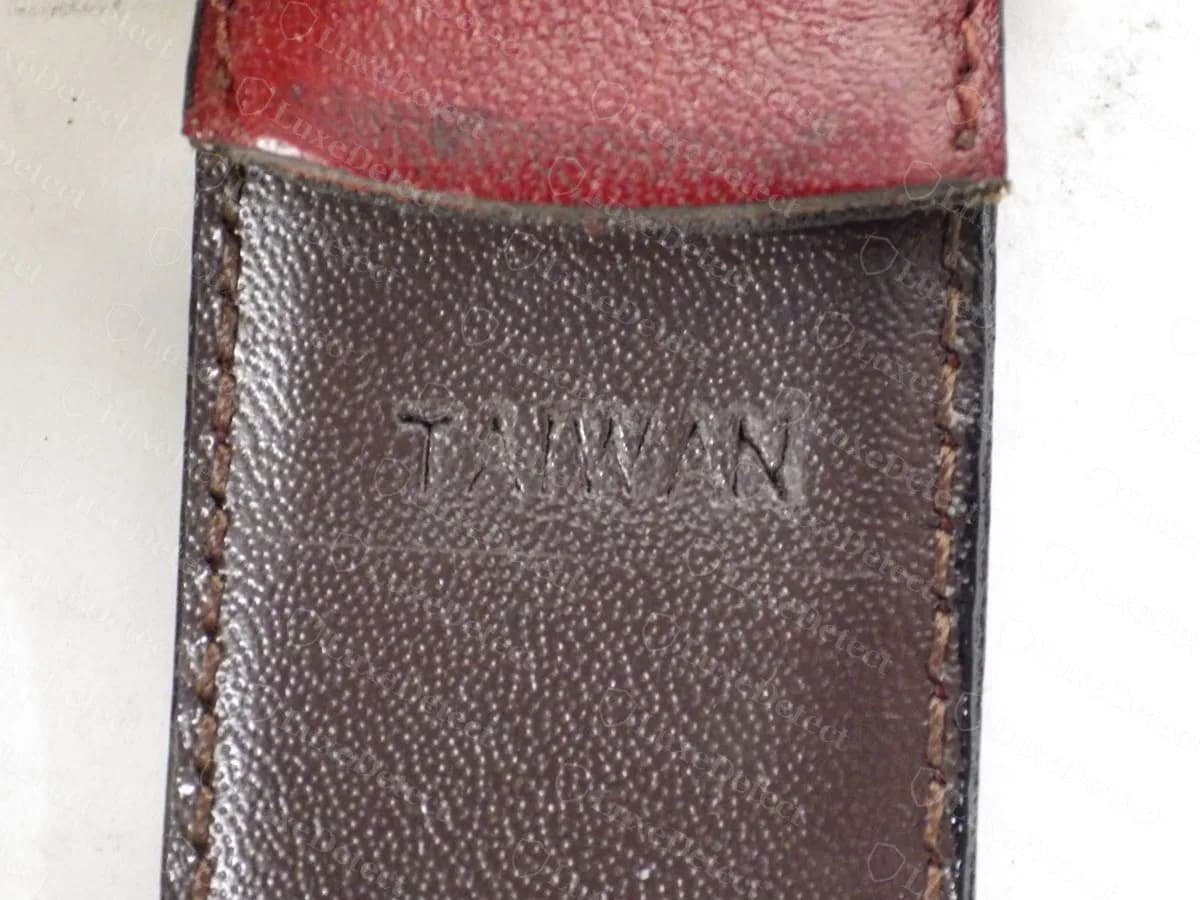
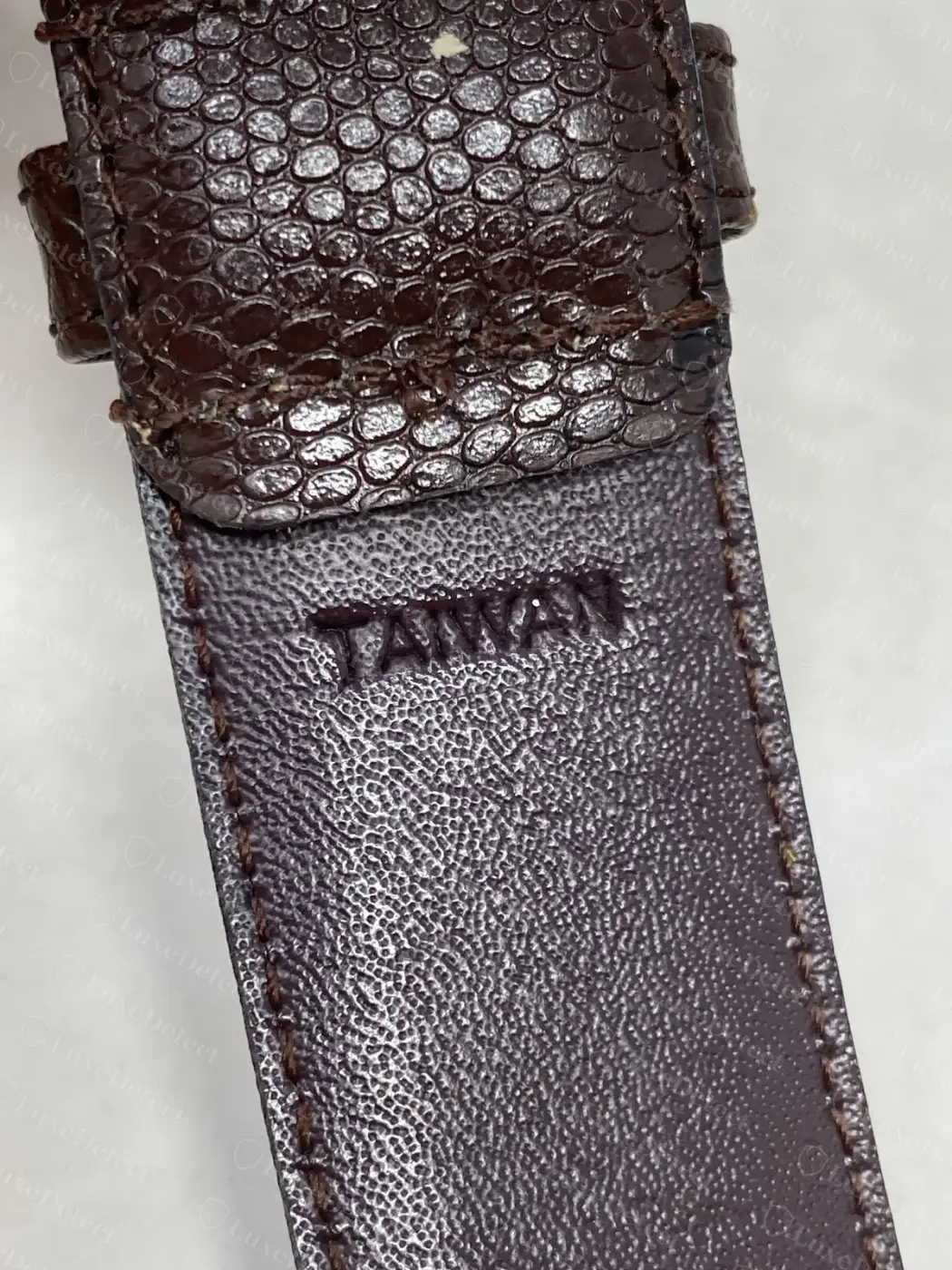
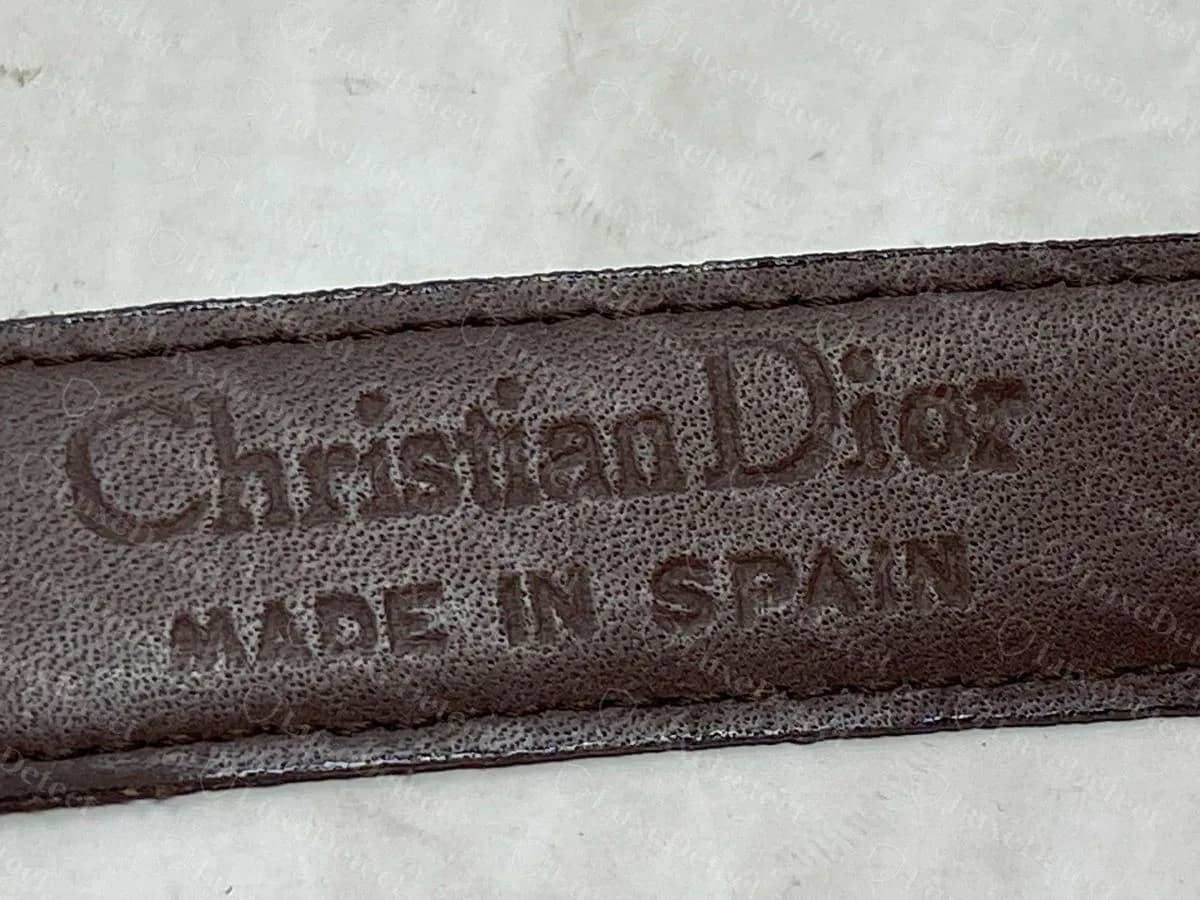
Genuine vintage Dior belts in our archive are stamped Made in Spain, Taiwan, France and Argentina, and a genuine beaded evening belt carries a "HAND MADE IN CHINA" label under the "Christian Dior Ceintures" woven tag. Fakes copy these origins as well: the fake above has the same "TAIWAN" stamp in the same place as a genuine licensed belt, and its lining uses the same printed layout (size, "Christian Dior" and a six-digit style number) as the genuine piece. A fake beaded belt in our set carried the same "HAND MADE IN CHINA" Ceintures label.
So the country stamp tells you almost nothing on a vintage belt. What helps is consistency with the era: the buckle style, the licensed-era stamp layout, the wear pattern (a 30-year-old belt with pristine edges and no creasing at the used hole is odd), and whether the buckle plating has aged the way the leather has.
Red flag
A belt sold as vintage that carries modern details, such as a 30 Montaigne style buckle with a licensed-era stamp, or a "MADE IN ITALY" NN-MA code on a supposedly 1980s strap, mixes eras that never existed together.
What the Box, Dust Bag and Tags Do and Do Not Prove
Several fakes in our archive arrived with a Dior box, a drawstring dust bag, a hang tag with a barcode and, in one case, a store receipt. Packaging is context, not evidence. Its only real use is cross-referencing: the size on the tag should match the size stamped on the belt, and the product description should match the belt in the box. A mismatch there is useful. A matching set proves nothing, because boxes, dust bags and tags are sold separately.
Quick Authentication Checklist
- Identify the model first; a modern CD buckle belt should say "MADE IN ITALY".
- Turn the buckle over. The reverse should be finished, not a rough casting with moulded numbers.
- Check the letter faces and edges for flat polish, crisp corners and sharp serifs.
- On a reversible belt, rotate the hinge block through its full travel and look for play, gaps or a colour step.
- Read the code stamp. Confirm the size matches, and search the code for use on unrelated models.
- Treat the gold foil as a weak check; reject for bleeding or flaking, never accept for looking right.
- Inspect edge paint, stitching and strap thickness end to end.
- For vintage belts, ignore the country stamp and check that the buckle, stamp layout and wear all belong to the same era.
A failure on the buckle reverse or the hinge block is enough on its own. Two failures elsewhere, especially a code repeated across models plus weak edge finishing, mean walk away.
When to Get a Professional Opinion
This guide is built from 48 fake belt orders and the genuine belts in the same archive, so it reflects what we actually see rather than a theoretical list. It is thinner on some lines: we had only two genuine 30 Montaigne reversible belts to compare, and very few genuine Teddy-D or DIOR letter-buckle belts, so our comparisons for those styles rely more on construction than on model-specific detail. If your belt is one of those, or a vintage licensed piece, a photo check is worth it.
LuxeDetect authenticates Dior belts from photos, starting at $15 for a 24-hour accessories check, with a Certificate of Authenticity for belts that pass. Send clear photos of the buckle front and back, the hinge block if it has one, every stamp inside the strap, and the tip.
FAQ
Where is the serial number on a Dior belt?
On modern Dior belts the code is heat-stamped inside the strap, usually near the buckle end, next to "MADE IN ITALY" and the size. On reversible 30 Montaigne belts it is often on a small leather tab by the buckle. Vintage licensed belts may show a style number and size printed along the lining instead.
Can I check a Dior belt code with the Dior date code checker?
Only partly. The Dior date code checker decodes the two-letter, four-digit codes found inside Dior bags. Belt codes use different formats that do not decode cleanly to a month and year, so use them to check consistency (size, model, repetition) rather than to date the belt.
Do fake Dior belts say Made in Italy?
Yes. Almost every modern fake belt in our archive was stamped "MADE IN ITALY" with a correctly formatted code. The stamp needs to be there on a modern CD buckle belt, but its presence does not prove the belt is genuine.
Is a Christian Dior belt made in Spain or Taiwan fake?
Not necessarily. Genuine vintage Christian Dior belts were produced under licence in several countries, and our archive holds genuine examples stamped Spain, Taiwan, France and Argentina. The origin is only a problem on a modern CD buckle belt, which should be made in Italy.
Why does my Dior belt have the same code as another one online?
Genuine Dior belt codes can repeat within the same model and size, so a match with an identical belt is not a red flag on its own. A match with a different design is: in our archive the code 23-MA-0149 appeared on fake belts of two different models.
How can I tell a fake 30 Montaigne belt quickly?
Turn the buckle over and rotate it. A genuine reversible 30 Montaigne buckle has a solid hinge block, two neat screws holding the strap and a smooth pivot with no play. Loose hinges, rough casting on the reverse, or a colour difference between the block and the CD frame are the fastest tells.
How much does it cost to authenticate a Dior belt?
LuxeDetect checks Dior belts from photos starting at $15 for a 24-hour accessories review, with faster turnaround available. Belts that pass receive a Certificate of Authenticity, which helps when reselling on marketplaces that ask for proof.