Luxury Fashion Authentication Specialist
French luxury house specialist. Covers Chanel, Celine, and Saint Laurent construction and date coding.
Published October 2026 · Contact
Why a Correct Dior Label Proves Almost Nothing
Every Dior clothing guide tells you to check the care label. Counterfeiters read the same guides. On the T-shirts, sweatshirts and hoodies we see, most of the fakes carry a label that matches the genuine format line for line: the five-digit number, the style code, the size, the trilingual composition, the CNPJ line and "Made in Italy". Several of the fakes we have reviewed also had an engraved metal DIOR cord end, a correct woven neck label and clean stitching. A hoodie can pass every one of those checks and still be counterfeit.
So this guide is deliberately narrow, and deliberately honest. It does two things. First, it shows you what the genuine label set looks like, so you can spot a label that is missing pieces. Second, it describes two cloned label templates that we keep finding on fake garments, one on a Portugal label and one on a short care label. Neither is on every fake; most fakes use neither. But when one of them is on a garment, the verdict is not in doubt, because the same label text turns up on completely unrelated garments, with fabric claims that cannot be true for the item it is sewn into.
If the labels on your piece are correct, you have ruled out the laziest fakes and nothing more. This guide will not tell you otherwise.
What to check, ranked by reliability
| Checkpoint | Reliability | What it tells you |
|---|---|---|
| 2. Tell One: The "Made in Portugal" Second-Fabric Template | ★★★★★ | A Made in Portugal label with a viscose and silk second fabric on a cotton garment is a cloned label and rejects the piece; it is on a minority of fakes. |
| 3. Tell Two: The Stub Care Label | ★★★★★ | A short label with no style code or number, a "100% cotton" claim that cannot fit the fabric and an origin that contradicts the Japanese label is a clone. |
| 1. The Genuine Label Set: What to Compare Against | ★★★★★ | Catches incomplete or inconsistent labels; a complete set is a baseline, since many fakes copy it exactly. |
| 4. Neck Labels, Cords and Hardware | ★★★★★ | A sloppy neck tag is a warning, but fakes carry engraved cord ends and correct tags, so a good one proves little. |
| Why a Correct Label Proves Nothing | ★★★★★ | A matching label rules out only the laziest fakes; it never clears a garment. |
What This Guide Covers and Where It Is Limited
The photos behind this guide come from our own order archive: hundreds of Dior clothing orders, with the fakes concentrated in T-shirts (including Oblique and KAWS prints), sweatshirts, hoodies and the occasional knit or denim jacket. Dresses, jackets and tailoring are copied far less often, and a coat or a suit jacket is mostly judged on cut and lining, which this guide does not teach.
- Covered: care label and importer label anatomy, the two cloned templates, neck labels and hood cord ends, and what the packaging and hangtags can and cannot tell you.
- Not covered: decoding the style code. The photos support no reading of the digits for season or colour, so we do not offer one. Dior's date code checkers are built for bags and do not apply to clothing.
- Also worth knowing: our archive includes a lot of vintage and consigned genuine pieces, and old labels do not always follow the modern layout. Older Boutique-era pieces and Baby Dior can legitimately carry a "Made in Portugal" or "Made in France" label. Origin alone never settles anything.
The Genuine Label Set: What to Compare Against
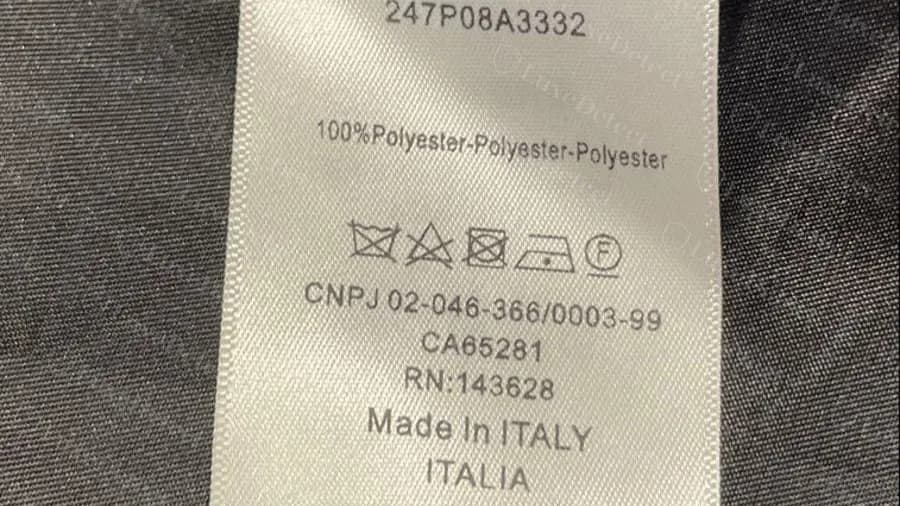
A modern genuine Dior garment usually carries a small family of labels, not one. The main care label reads, from the top: a five-digit number (sometimes seven digits), a style code such as 043J646A0531, the size, the composition in French, English and Portuguese with real percentages, the care instructions and icons, the CNPJ line, and "Made in ITALY / ITALIA".
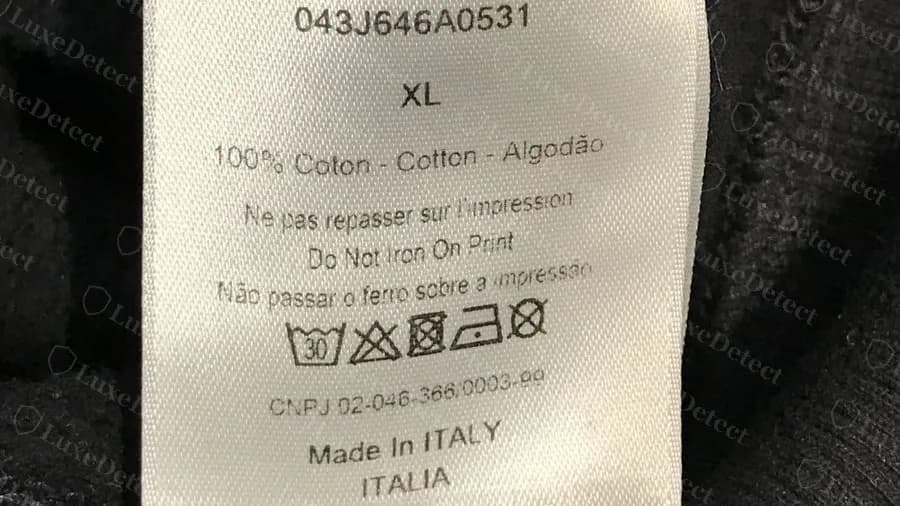
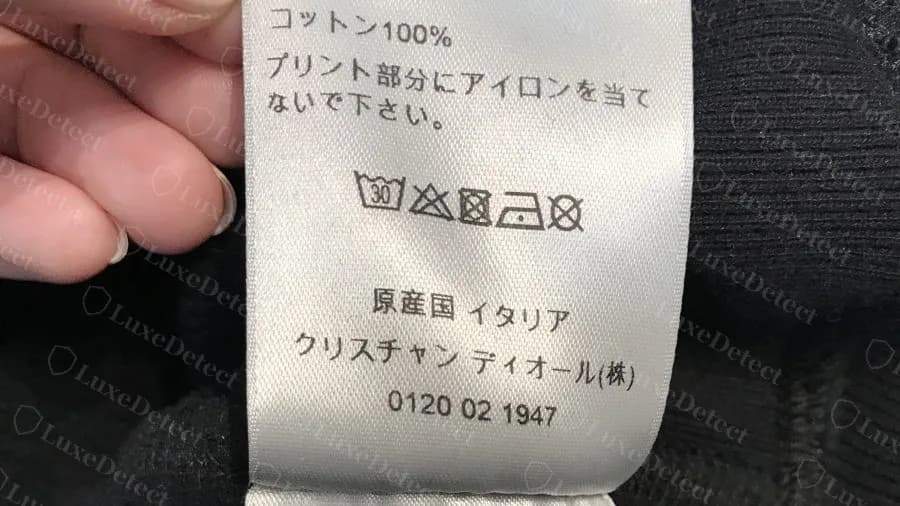
Pieces imported into the United States add a CA number and an RN number between the CNPJ line and the origin, and a separate Japanese label (origin Italy, Christian Dior KK, a phone number), a Chinese label and a Korean importer label often sit alongside.
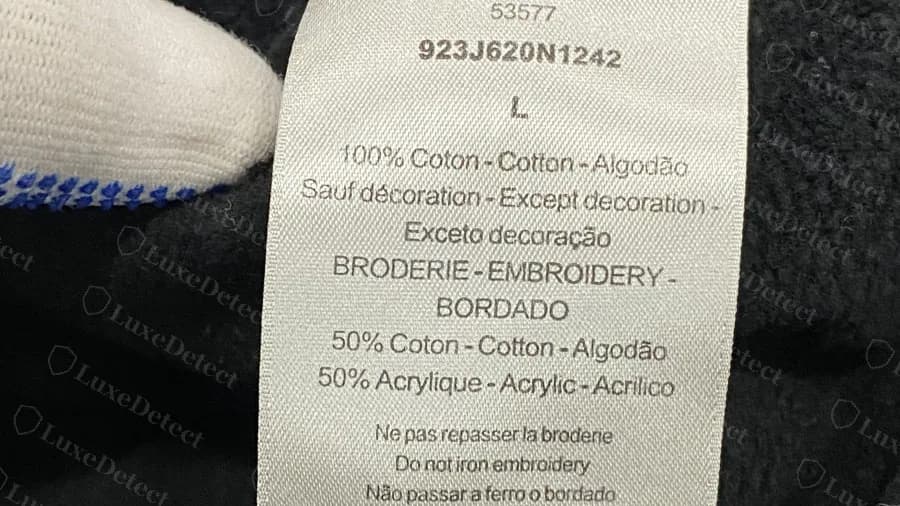
When the composition is complicated, the label says so in full. A sweater with embroidery lists the body fabric and the decoration fabric separately, with percentages that add up and match the garment you are holding.
| Element | Authentic | Counterfeit |
|---|---|---|
| Label contents | Number, style code, size, composition, care, CNPJ and origin all present | Often reduced to a short stub with fewer lines, or a block that does not belong to the garment |
| Composition | Matches the fabric of the garment | Claims that cannot be true for the item, or the same text on different garments |
| Origin | Italy on the main label, repeated as Italy on the Japanese label | Contradictions between labels, or an origin that does not fit the house |
| Importer labels | Japanese, Chinese and Korean labels with Italy as origin | Missing, or origin that disagrees with the English label |
Worth knowing
A complete, correct-looking label set is the baseline, not the verdict. We see fakes with every one of these lines right. Use this section to catch the label that is incomplete or internally inconsistent, and do not treat a good match as proof.
Tell One: The "Made in Portugal" Second-Fabric Template
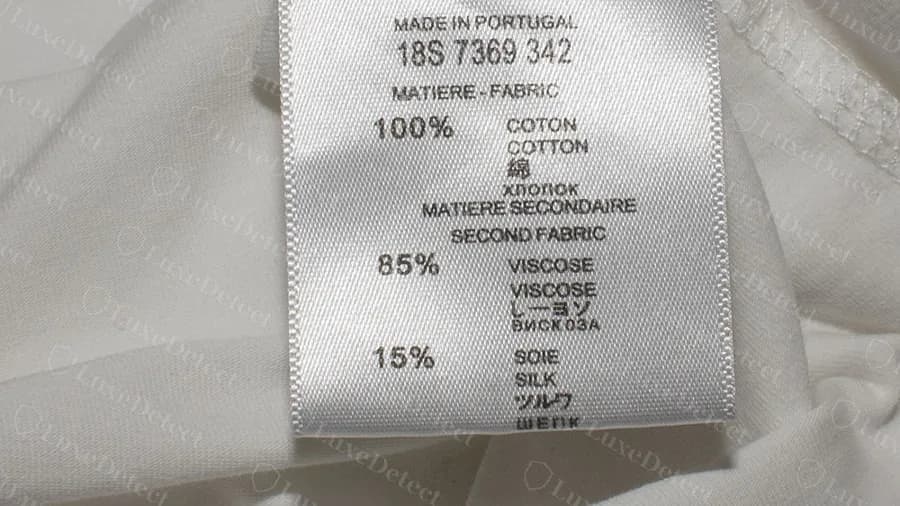
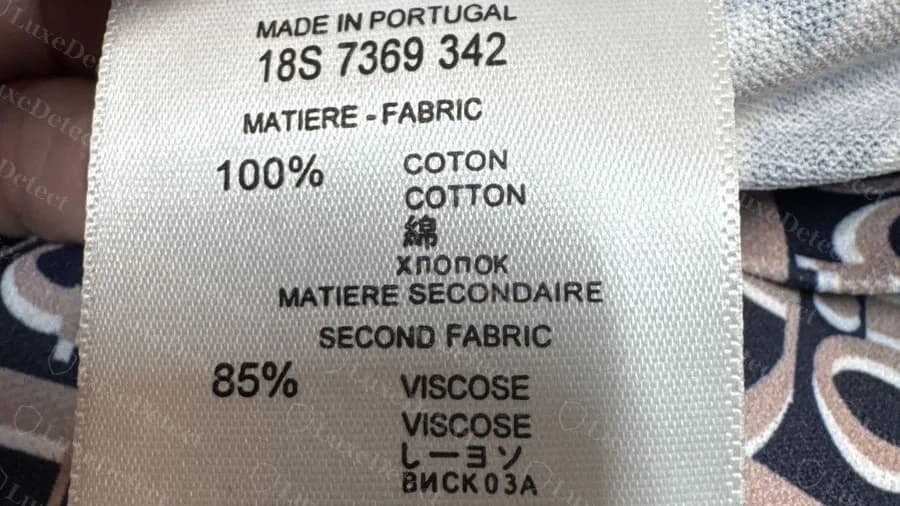
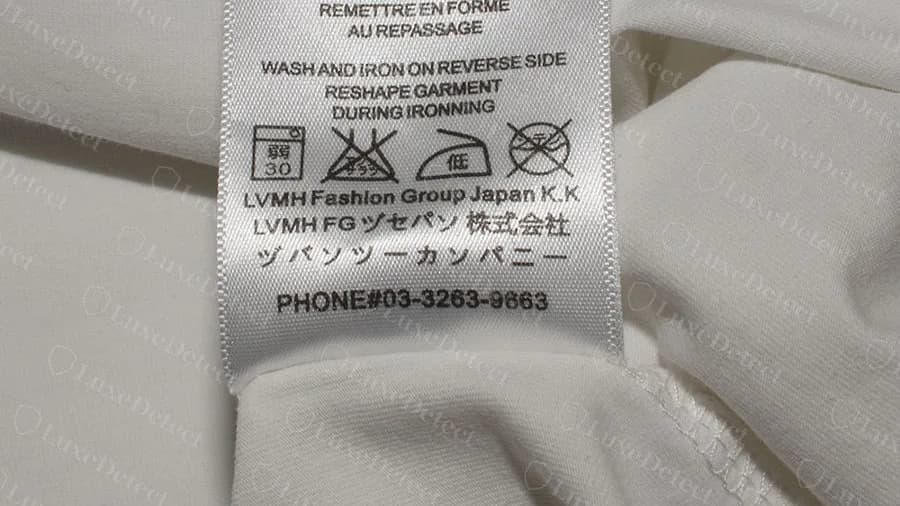
The first cloned template is a single label that we keep finding on fakes. It reads "MADE IN PORTUGAL", a short code in the form 18S 7369 342, "100% coton / cotton" as the main fabric, and then a second block: "MATIERE SECONDAIRE / SECOND FABRIC, 85% viscose, 15% silk", with Russian and Japanese lines under each fibre. It is paired with a Japanese-language wash label naming "LVMH Fashion Group Japan K.K" with a phone number.
The giveaway is not the wording. It is that the same label is sewn into garments that have nothing in common: a plain white T-shirt, a white cotton sweatshirt with ribbed cuffs, a black T-shirt, an Oblique-print T-shirt and an Oblique-print polo. A plain cotton sweatshirt does not have a second fabric made of viscose and silk, and a genuine house does not issue one care label for a whole range of unrelated garments.
| Element | Authentic | Counterfeit |
|---|---|---|
| Origin line | Italy on modern main-line pieces | "MADE IN PORTUGAL" with the code 18S 7369 342 |
| Fabric block | One composition that matches the garment | "100% cotton" plus a second fabric of 85% viscose and 15% silk |
| Same label across garments | Each style has its own label and style code | One label on tees, sweatshirts and polos alike |
| Wash label | Care icons on the main label, separate Japanese label for Japan | Separate wash label naming LVMH Fashion Group Japan K.K with a phone number |
Red flag
A label that reads "Made in Portugal", 18S 7369 342, with a viscose and silk second fabric on a cotton T-shirt or sweatshirt. We have found this exact label on several different fake garments, and in the genuine pieces we have reviewed it has not appeared once. If you see it, the inspection is over.
Worth knowing
Do not turn this into a rule that Portugal labels are fake. Genuine Boutique-era pieces and Baby Dior can carry "Made in Portugal", and old Japanese labels naming LVMH Fashion Group Japan exist too. It is the whole combination, the code, the second-fabric block and the garment it is sewn into, that is the tell.
Tell Two: The Stub Care Label
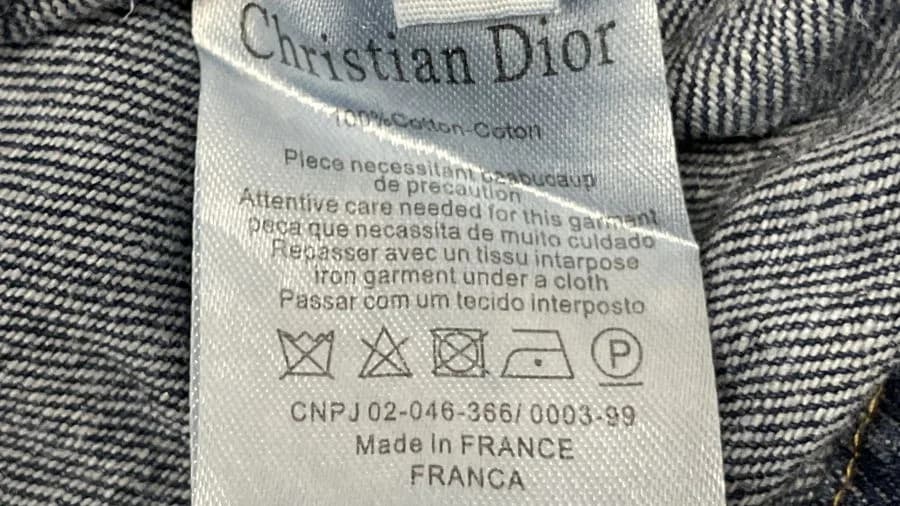
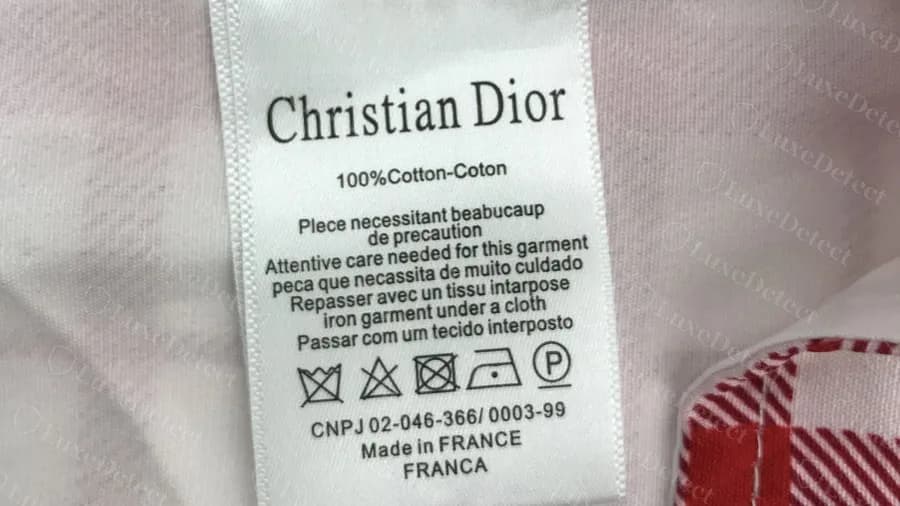
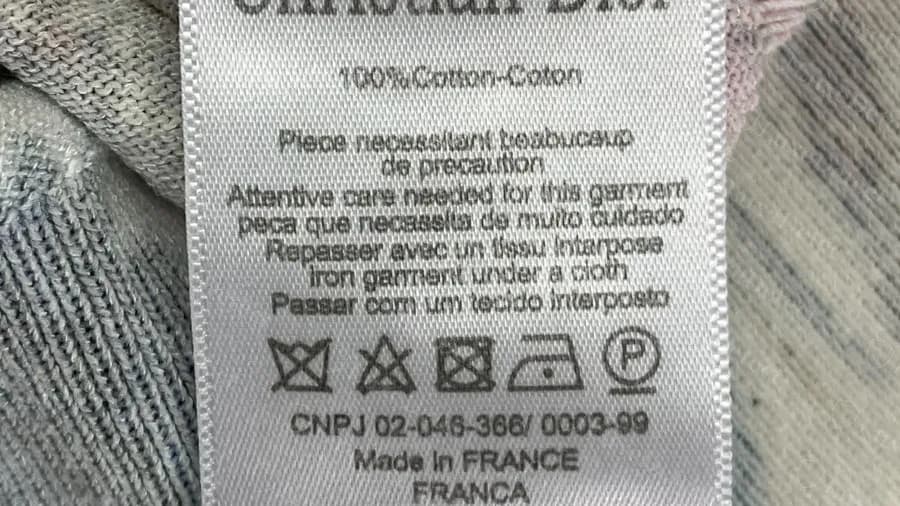
The second template is a short label that looks right at a glance and is wrong in what it leaves out. It reads "Christian Dior" in a serif face, "100%Cotton-Coton", the French, English and Portuguese "piece necessitant beaucoup de precaution / attentive care needed for this garment" lines, five care icons, a CNPJ line and "Made in FRANCE / FRANCA". There is no style code, no five-digit number and no composition block beyond that one line.
The wording is not the problem. Genuine labels use the "piece necessitant beaucoup de precaution" text too, on silk and knit pieces. What is missing is everything that should sit beside it: the number, the style code and the size, which the genuine labels we reviewed all carry. And the stub claims "100% cotton" on whatever it is sewn into. We have seen it on a plaid top, an Oblique robe, a cropped hoodie, a denim jacket, a knit T-shirt and a leopard-print blazer. Fabric that is never 100% cotton, on garments that have no business sharing one label.
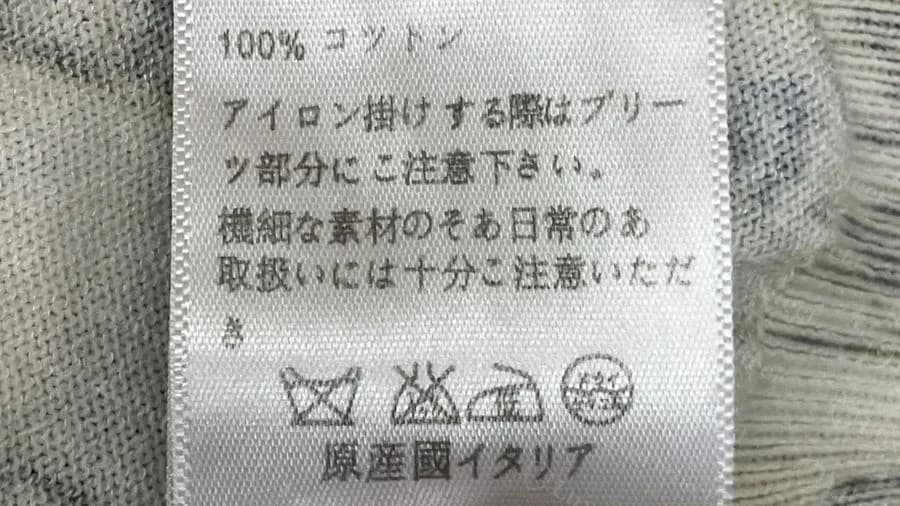
The same garments often betray the template a second way. The Japanese label attached to the piece says the origin is Italy, while the English label beside it says France.
| Element | Authentic | Counterfeit |
|---|---|---|
| Label length | Number, style code and size above the composition | Short stub that starts at the logo and has none of the three |
| Composition | Real fibre list that matches the garment, in three languages | "100%Cotton-Coton" on denim, knits, tops and blazers alike |
| Origin | Italy, and the Japanese label agrees | "Made in FRANCE / FRANCA" with a Japanese label saying Italy |
| Logo line | Label fonts match the genuine family | Serif "Christian Dior" heading above the stub text |
Red flag
A care label with no style code or number, a "100%Cotton-Coton" line that cannot be true for the fabric, and an English origin that disagrees with the attached Japanese label. We found the same stub on unrelated garments, and none on the genuine pieces we reviewed. Treat the label as counterfeit.
Neck Labels, Cords and Hardware
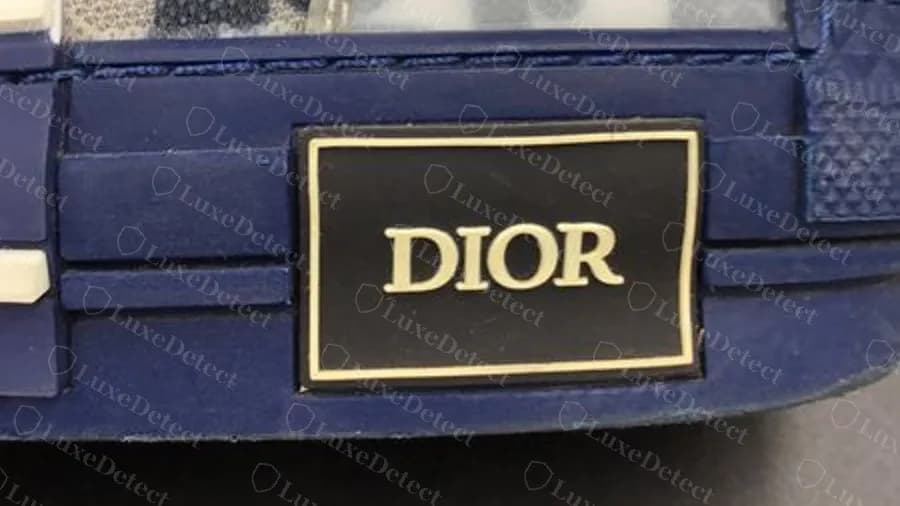
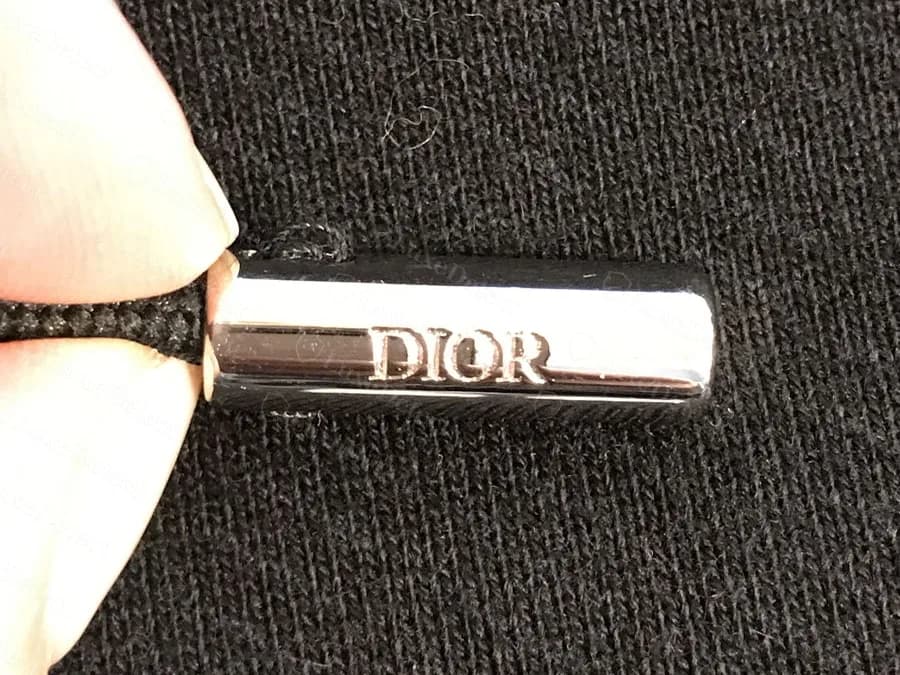
Most buyers are told to check these first, and counterfeiters have noticed. A genuine Dior Homme neck label is a grey woven "DIOR". Womenswear carries a white "Christian Dior PARIS" label. Hood and waist cords on genuine pieces end in an engraved metal "DIOR" tube.
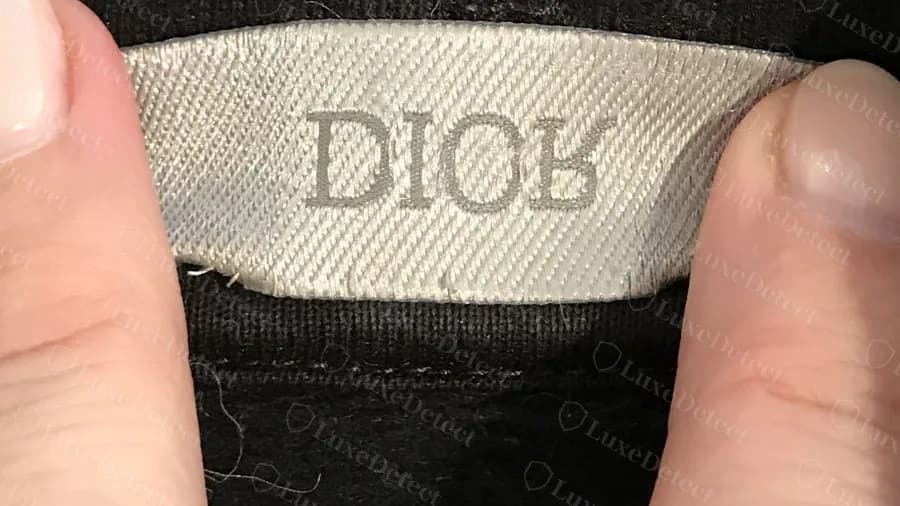
These details are worth a look, and a sloppy one is a useful warning. On a fake KAWS T-shirt we reviewed, the neck tag used a crude serif "Dior" and a garbled "D!oI" in place of the woven letters, and a fake hoodie carried an English-only "kindly product care / cold machine wash" label. Both are worth flagging, but each is a single garment, so treat them as a prompt to look harder rather than a rule.
The reverse also holds, and it matters more. We reviewed fake hoodies with an engraved DIOR cord end, fake sweatshirts with a full CNPJ and "Made in Italy" label, and a fake sweatshirt with a flawless neck tag. A good cord end proves the supplier bought a good cord end.
Worth knowing
Hardware and neck labels are copyable. They can lower your confidence when they are wrong; they cannot raise it when they are right.
Why a Correct Label Proves Nothing
Think of the two tells as a net with large holes. They catch the counterfeits made from a handful of cloned label rolls. They do not catch the better ones, and most of the fakes we see do not carry either template. A fake with a perfect label, a correct cord end and a convincing neck tag looks, in photos, exactly like a genuine piece.
This is why a label match is the start of the inspection and not the end. When the label is the only thing you can check, the honest answer is that the label tells you whether the item fails, not whether it passes. Fabric weight and hand, print and embroidery quality, seam finishing and the cut of the garment are all things a trained eye compares side by side with confirmed genuine pieces, and none of them can be settled from one photo of a tag.
What Hangtags and Packaging Do and Do Not Prove
Dior hangtags, garment bags and receipts are context. A seller who has the original tags and a receipt for the right season is a better risk than one who has nothing, but fakes ship with tags, and genuine consigned pieces often have none. Cross-check what the tag says against the label inside the garment (style code, size, colour) and treat a mismatch as a red flag. A tag that matches does not make the garment genuine.
Quick Authentication Checklist
- Find every label on the garment and photograph them flat, in focus.
- Read the main care label for the number, style code, size and a composition that fits the garment.
- Check the origin on the English label against the Japanese label.
- Look for the "Made in Portugal" label with code 18S 7369 342 and a viscose and silk second fabric.
- Look for the stub label with no style code or number and a "100%Cotton-Coton" line.
- Compare the neck label and cord ends with a confirmed genuine piece.
- If everything passes, remember that it proves nothing on its own, and compare the garment itself against a genuine example.
Either cloned template is enough to reject the garment. Passing both only means this particular shortcut was not used.
When to Get a Professional Opinion
Most Dior clothing questions come from resale listings where you see a few photos of a label and nothing else, and the fakes that survive that are exactly the ones with copied labels. If you are about to pay mainline money for a piece, or something feels off, get a second opinion from someone who compares the garment and its labels against confirmed genuine pieces every day. For bags, scarves and belts from the same house, see our guides to the Dior belt and the Dior Saddle bag.
LuxeDetect clothing authentication has a 24-hour option and returns a verdict with a Certificate of Authenticity. Submit your Dior piece for authentication.
A code that checks out doesn't prove the item is real. Counterfeiters copy genuine codes.
Our authenticators check the labels, stitching and fabric of your Dior against verified references, from $15. You get a verdict within 24 hours, and a Certificate of Authenticity if the item passes.
Authenticate My Dior →FAQ
How can I tell if a Dior T-shirt is real?
Start with the labels, but do not stop there. A genuine Dior T-shirt has a main care label with a five-digit number, a style code, the size, a trilingual composition, the CNPJ line and "Made in Italy", plus importer labels on pieces sold in some markets. A label that is complete is a baseline, since many fakes copy it exactly. The decisive failures are the two cloned templates in this guide.
What does a genuine Dior care label look like?
It runs from the top: a five-digit number, a style code (for example 043J646A0531), the size, the composition in French, English and Portuguese with real percentages, care instructions and icons, the CNPJ line, and "Made in ITALY / ITALIA". Pieces imported into the US add a CA number and an RN number.
Is a Dior label that says "Made in Portugal" fake?
Not by itself. Older Boutique-era pieces and Baby Dior can genuinely carry Portugal or France labels. The tell in this guide is one specific label: "Made in Portugal" with the code 18S 7369 342 and a second fabric of 85% viscose and 15% silk, sewn into a cotton T-shirt or sweatshirt.
Why does my Dior label say 100% cotton and Made in France?
If it is a short label with "Christian Dior" in a serif face, "100%Cotton-Coton", care text and "Made in FRANCE / FRANCA", and it has no style code or number, it matches the second cloned template we see on fake garments. Check whether the attached Japanese label says Italy instead, which contradicts it.
Can a fake Dior hoodie have the right engraved cord end?
Yes. We have reviewed fake hoodies with an engraved metal DIOR cord end, a full CNPJ and origin label, and a correct neck tag. These details are copied well, so a good result raises your confidence only slightly.
Does the style code tell me whether a Dior garment is genuine?
No. The style code on a Dior care label is useful for matching the piece to a listing, but we do not decode it, and we do not treat repeated style codes across garments as a tell either. Dior's date code tools are built for bags and do not apply to clothing.
Where can I get a Dior jacket or hoodie authenticated?
LuxeDetect authenticates Dior clothing from photos of the garment, the care labels and the neck label. Start an order and include clear photos of every label and the cord ends.