Luxury Handbag Authentication Specialist
French luxury house specialist. Covers Chanel, Celine, and Saint Laurent construction and date coding.
Published August 2026 · Contact
Why the Dior Date Code Matters — and Why It Isn't Proof
Christian Dior bags made from the early 1990s onward carry a date code stamped into the interior leather. Unlike Prada's serial, the Dior code genuinely decodes: it tells you the atelier that made the bag and the exact month and year it was produced.
That makes it more useful than most brand codes, and also more dangerous to over-trust. A code that decodes cleanly proves the format is right, not that the bag is genuine — counterfeiters copy valid codes from listing photographs. What the code does well is catch contradictions. A bag advertised as a 2015 Lady Dior whose code decodes to 1997, or a code stamped in a format that did not exist in its claimed year, fails before you examine the stitching.
Prefer the full-screen version? The Dior date code checker decodes the atelier, month, and year from any code.
A code that checks out doesn't prove the item is real. Counterfeiters copy genuine codes.
Our authenticators check the stamps, hardware and construction of your Dior against verified references, from $25. You get a verdict within 24 hours, and a Certificate of Authenticity if the item passes.
Authenticate My Dior →The Two Format Eras
| Era | Format | Example | Note |
|---|---|---|---|
| Pre-1990 (vintage) | No date code | , | Early Christian Dior pieces were not coded. Authentication relies entirely on hardware, lining, and label details. |
| Early 1990s–present | 2 letters + 4 digits | MA0694 | Two-letter atelier code, then two-digit month and two-digit year. MA0694 = atelier MA, June 1994. |
The absence of a code on a genuinely vintage piece is normal and expected. The absence of a code on a bag claimed to be from 1995 onward is a serious red flag.
How to Decode
| Segment | Meaning | Example |
|---|---|---|
| First 2 characters | Atelier / factory code (MA, DO, DI and others) | MA |
| Digits 3–4 | Month of production (01 = January … 12 = December) | 06 |
| Digits 5–6 | Last two digits of the production year | 24 |
So MA0624 decodes to atelier MA, June 2024.
The checks the format gives you for free
Month must be 01–12. A code whose third and fourth digits read 13 or higher is invalid. This is the single most common error on low-tier fakes, because counterfeiters treat all four digits as a sequence rather than as month and year.
Year must be plausible for the model. A Lady Dior code decoding to 1993 is possible — the model launched in 1994 under the name Chouchou and was renamed in 1995, so an early code needs scrutiny rather than automatic rejection. A Book Tote code decoding to anything before 2018 is not possible, since the model did not exist.
Atelier code must be two letters. Digits or symbols in the first two positions indicate a fabricated code.
Where to Find the Code
The code is heat-stamped into the leather, most often on a tab or directly into the interior lining. Common locations are the interior back wall, inside a zip pocket, or on a small leather tab sewn into a seam. On Lady Dior bags it typically sits inside the interior pocket; on Saddle bags, on the interior lining near the seam.
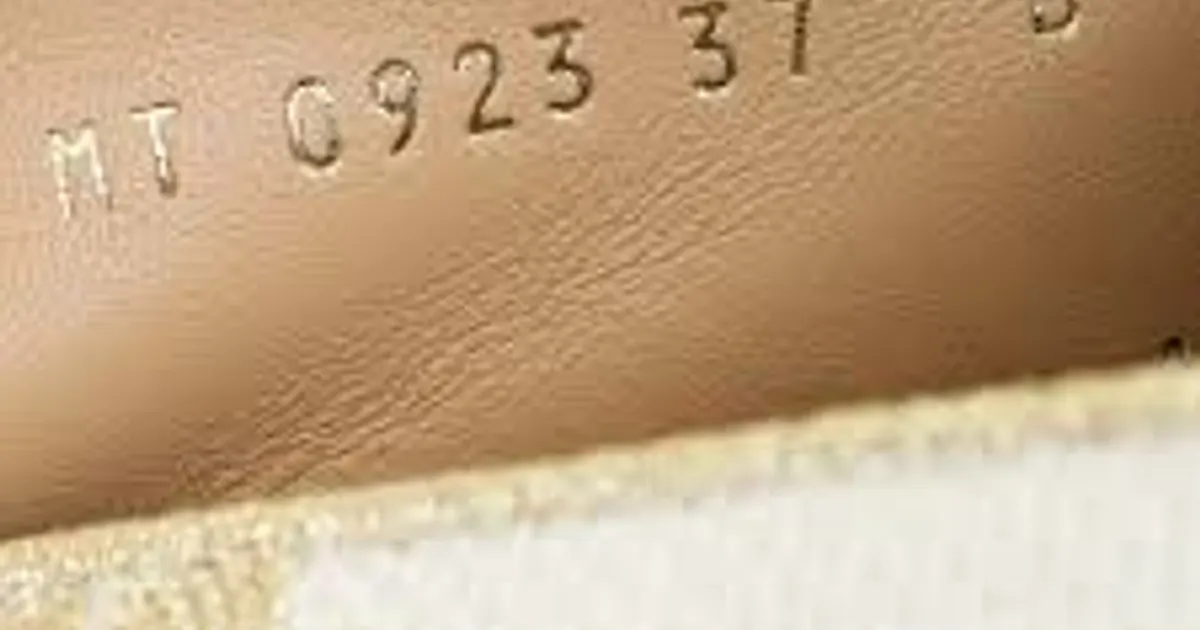
Authentic stamping: Heat-debossed without ink, so the characters sit below the leather surface. Run a fingernail across the code and you feel a clean depression. Depth is consistent across every character, and the typeface is a fine, precise sans-serif with even spacing.
Fake tells: Printed or inked codes sitting flush with the surface — the fastest tell in the set. Characters of varying depth, indicating hand-pressing rather than a calibrated press. Fuzzy character edges from rubber tooling rather than a metal punch. Codes stamped crookedly relative to the leather edge.
The Authenticity Card
Modern Dior bags ship with an authenticity card. Recent production has moved toward NFC-enabled cards and microchips embedded in the bag.
Authentic: Card stock is substantial with clean, evenly weighted printing. Where a card carries a code, it matches the stamped code in the bag exactly.
Fake tells: Thin or glossy card stock. Blurred printing or incorrect letter spacing. A card code that does not match the bag's stamp — a common failure, since cards and bags are frequently produced in separate counterfeit batches.
A caution: cards are among the cheapest components to reproduce and circulate independently of the bags they came with. A missing card on a secondhand piece is unremarkable. A present card is weak positive evidence at best.
Beyond the Code — What Actually Decides It
The date code is a tripwire. These are the checks that carry the weight.
Cannage stitching
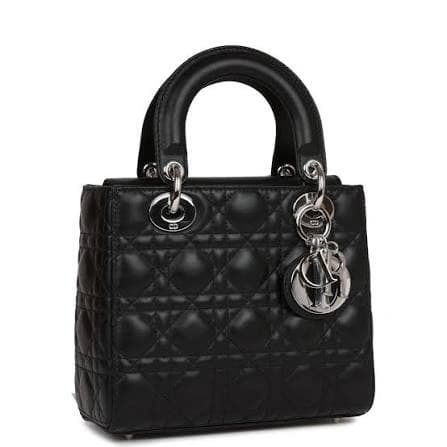
Authentic: The quilted cannage pattern is symmetrical across the bag's face, with each diamond identical in size. Stitch tension is even so no diamond puckers or sits flatter than its neighbours. The pattern aligns where panels meet at a seam.
Fake tells: Diamonds varying in size across the panel. Puckering at stitch intersections. Pattern that fails to align at the seams — the most reliable single construction tell on a Lady Dior.
The D.I.O.R. charms
Authentic: Each letter charm is solid metal with even plating, hanging from its own ring. The letters are correctly ordered and oriented, and the engraving on each is crisp with consistent depth. Charms have real weight and swing freely.
Fake tells: Lightweight or hollow charms. Uneven plating, or plating already worn on a bag described as new. Letters that hang backwards or in the wrong order. Shallow or blurred engraving.
Hardware and interior
Authentic: Hardware is substantial with even plating including the reverse faces. Zips run smoothly through their full travel. Interior lining is evenly applied with no glue bleed at the seams, and the "CHRISTIAN DIOR" interior stamp is heat-debossed with correct typeface proportions.
Fake tells: Light hardware, rough zip action, visible adhesive at lining seams, or an interior stamp that is printed rather than debossed.
Quick Authentication Checklist
- Code format: two letters plus four digits, with month in the 01–12 range
- Decoded year: plausible for the specific model's production history
- Stamping: heat-debossed with consistent depth, fine typeface, straight relative to the leather edge
- Card: substantial stock, clean printing, code matching the bag exactly
- Cannage: symmetrical diamonds, even stitch tension, pattern aligned at seams
- Charms: solid weight, even plating, correct order and orientation, crisp engraving
- Interior: no glue bleed, heat-debossed brand stamp, smooth zip action
FAQ
Can Dior verify a date code for me?
Dior boutiques can sometimes look up production records, but the house does not issue written authentication statements for items not bought through its own channels. What staff will confirm informally varies by location. For resale, insurance, or dispute purposes you need documented third-party authentication.
My vintage Dior bag has no date code. Is it fake?
Not necessarily. Christian Dior pieces made before the early 1990s were not coded at all, so an absent code on a genuinely vintage bag is expected. Authenticate those on hardware construction, lining material, and label typography for the claimed era instead. On any bag claiming to be from the mid-1990s onward, a missing code is a serious concern.
What do the atelier letters mean?
They identify the workshop that produced the bag. Codes such as MA, DO, and DI appear commonly. Dior does not publish a complete key, so the letters are best used as a consistency check — two letters, correctly stamped — rather than as information you can independently verify.
Does a valid date code mean my bag is authentic?
No. This is the most common and most costly misunderstanding. Counterfeiters copy real codes from marketplace listing photographs, so the same valid code now appears on many fakes. A correct code clears the first hurdle. The cannage symmetry, charm quality, and stamping execution are what actually decide it.
Are Dior bags with NFC chips easier to authenticate?
Somewhat. Recent production embeds a chip that can be read with a phone, which raises the bar for counterfeiters. It does not eliminate the problem — chips can be transplanted from damaged genuine bags — and it only applies to recent pieces. Physical checks remain necessary.
How much does professional Dior authentication cost?
Photo-based authentication typically runs $25 for handbag authentication with a 24-hour turnaround. Against a Lady Dior or Saddle trading between $2,000 and $6,000 secondhand, that is proportionate, and a certificate materially supports resale value.