Luxury Footwear Authentication Specialist
French luxury house specialist. Covers Chanel, Celine, and Saint Laurent construction and date coding.
Published November 2026 · Contact
Why Chanel Sneakers Are Judged on the Inside
Chanel sneakers, above all the CC trainer (the low runner with a large interlocking CC on each side, in suede, mesh, tweed, leather or knit), are among the most copied Chanel items we see. They sell new for around a thousand dollars or more, they come in many colourways every season, and buyers rarely know which colourway was real. That gives counterfeiters plenty of room.
The outside is not where most fakes go wrong. The side CC, the CHANEL wordmark on the heel, the CC roundel on the outsole and the CC tab on the laces are all copied closely enough to pass a glance. What fakes get wrong more often is a small, dull mark: the code printed inside the shoe, on the tongue or the heel lining. Genuine pairs follow one format every time. Some counterfeits break it.
So this guide does two things. It shows the code format genuine Chanel sneakers carry and the broken versions we have found on counterfeit pairs, and it shows the genuine tongue label, insole and outsole as reference, with an honest word on how much each one is worth. Unlike a Chanel bag, a sneaker has no serial sticker, no hologram and no chip, so the Chanel serial number system does not apply here.
What to check, ranked by reliability
| Checkpoint | Reliability | What it tells you |
|---|---|---|
| 1. The Code Inside the Shoe: Letter, Reference, Size | ★★★★★ | A code without the opening letter or the G-reference rejects the pair; a well-formed code is copied and proves nothing. |
| 2. The Tongue Label and the Insole | ★★★★★ | Copied closely by most fakes; useful only for uneven spacing or a mismatch between the two shoes. |
| 3. The Side CC and the Outsole | ★★★★★ | Catches only crude fakes; the CC, roundel and moulded origin line are reproduced well. |
| What Fakes Copy Correctly | ★★★★★ | The CC, the wordmarks, the outsole roundel and a correct code are copied, so passing them clears nothing. |
| Model Reference Before You Start | ★★★★★ | Tells you which guide applies; espadrilles and ballet flats use a different system. |
| What the Box and Dust Bag Do and Do Not Prove | ★★★★★ | Packaging is context only; its value is matching the box reference and size to the code inside. |
Use our free Chanel Serial Number Checker to decode your bag's production era and see exactly what the sticker should look like.
Check My Serial →Model Reference Before You Start
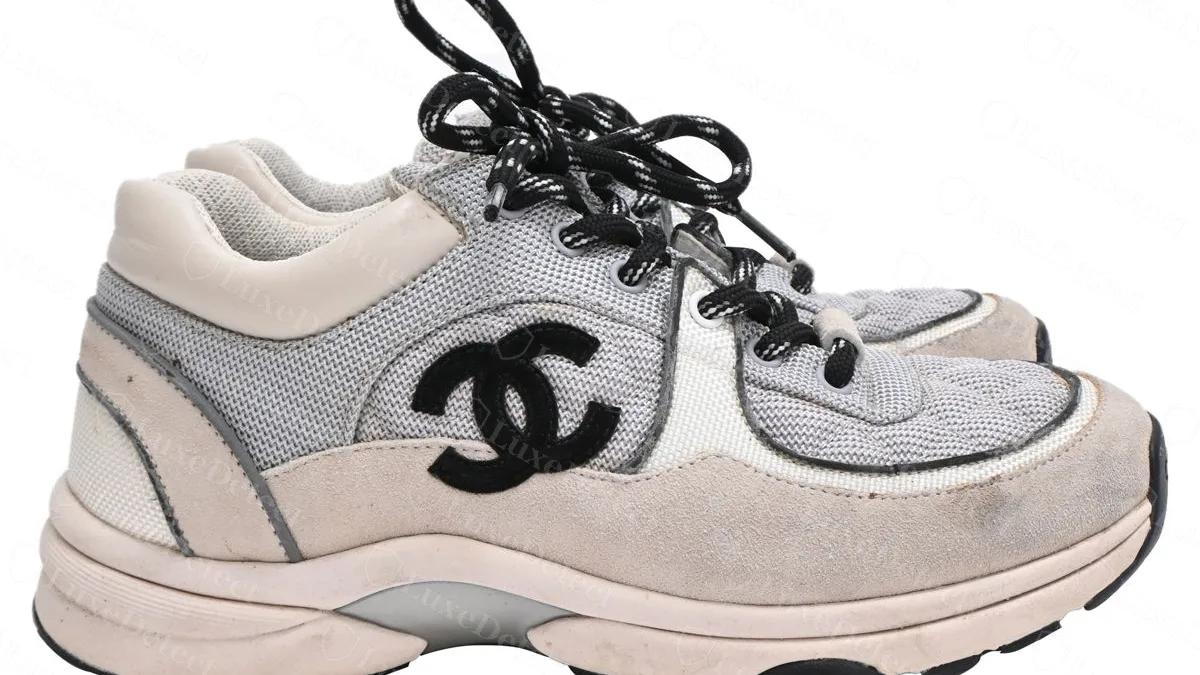
- The CC trainer (runner). The model most people mean by "Chanel sneakers": a low runner with a stitched-on CC on each side, a chunky ridged sole and a CC roundel under the forefoot. Made in many fabrics and colours, including tweed, velvet, knit and metallic versions.
- Low-top court sneakers. A flatter shape with a cupsole, often with CHANEL in large letters on the side or the heel, or a cap toe in a contrast colour.
- High-tops and sock sneakers. Laced high-tops, knit sock-style trainers and seasonal designs. The checks below apply to them too, because they use the same inside code.
- Rope-soled espadrilles and ballet flats are a different system. Use our Chanel shoes guide for espadrilles and the Chanel ballet flats guide for the cap-toe flat.
The genuine sneakers we reviewed were made in Italy. "Made in Italy" printed inside a pair is expected, and fakes print it too, so it says nothing either way.
The Code Inside the Shoe: Letter, Reference, Size
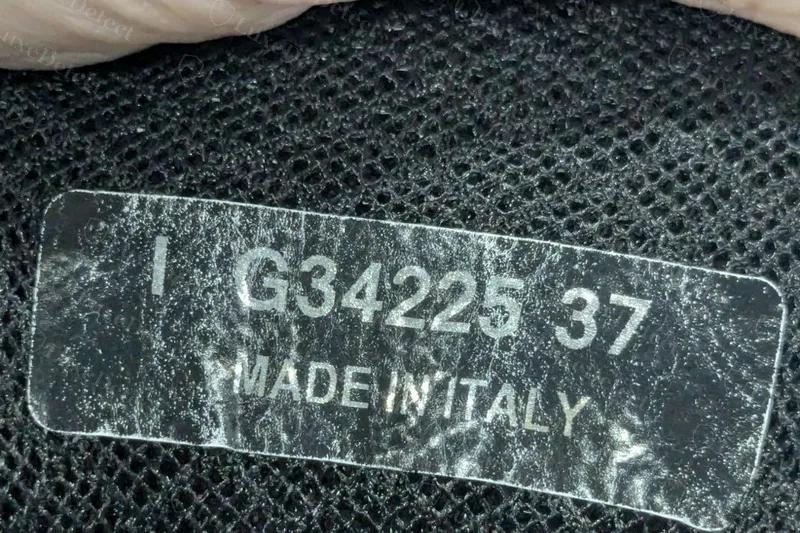
Look inside the tongue, or at the top of the heel lining, and you will find a short printed code. On every genuine Chanel sneaker we checked, it followed the same pattern: one letter, a space, a model reference that starts with G and has five digits, then the size. "MADE IN ITALY" often sits on a second line. Examples from genuine pairs: "I G38299 37", "I G34225 37", "L G35934 40", "W G34086 40½", "R G31711 40".
The code can be printed straight onto the lining fabric, onto a clear heat-transfer patch or onto a small sewn label with dashed stitching, depending on the model and season. The way it is applied changes; the format does not. The letter at the start is not the size, and the G-reference identifies the style, not the individual pair.
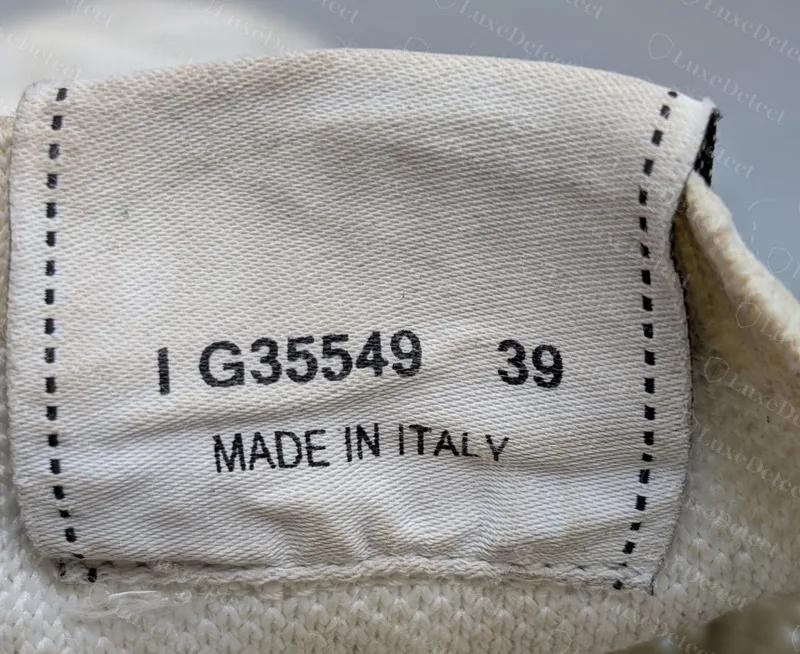
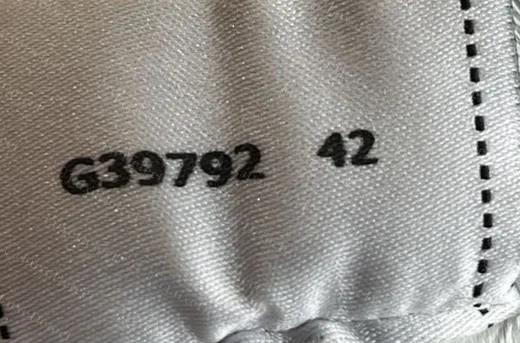
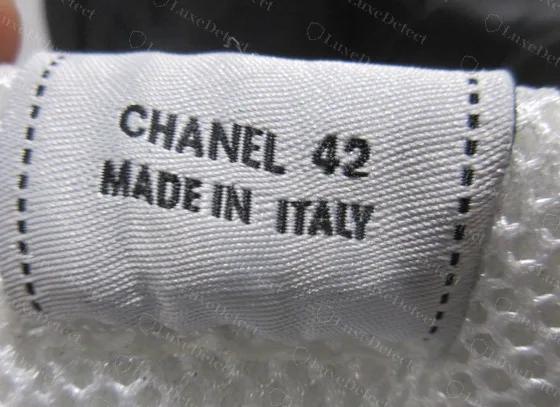
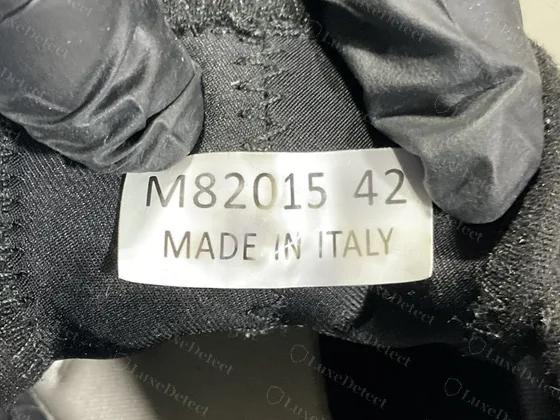
Several counterfeit pairs broke the pattern, each in a different way: a G-reference with no letter in front of it, a label reading only "CHANEL" and the size with no model reference at all, and a code that started with M instead of a letter and a G-reference. We did not find any of these on a genuine pair.
| Element | Authentic | Counterfeit |
|---|---|---|
| Opening letter | One letter, then a space (I, L, W, R and others) | Sometimes missing, so the code starts with the G |
| Model reference | G followed by five digits | Sometimes missing, or replaced by "CHANEL" or another prefix such as M |
| Size | After the reference, halves written as ½ | Present, so the size alone tells you nothing |
| Second line | Often "MADE IN ITALY" | Also "MADE IN ITALY", so the origin line is not a tell |
Red flag
A code that does not read letter, space, G plus five digits, size: no opening letter, no G-reference, or "CHANEL" where the reference should be. We found each of these on counterfeit pairs and never on a genuine one, so treat it as a strong reason to walk away.
Worth knowing
Most fakes pass this check. Counterfeit pairs in our reviews also carried well-formed codes such as "W G37494 39 MADE IN ITALY", so a correct code is what you expect to see, not proof. A genuine-looking reference can be copied from any listing.
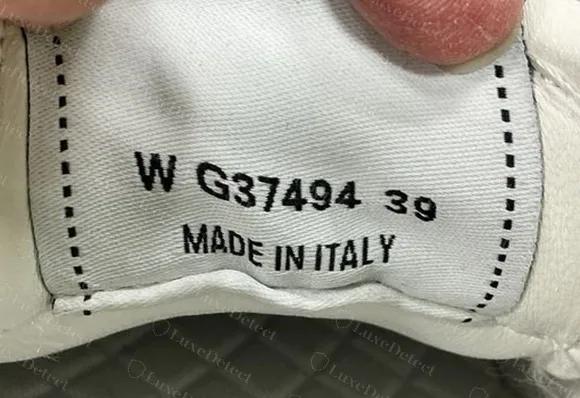
If the pair comes with a box, the box label carries the same G-reference and size. Matching them is a quick consistency check: a mismatch is worth asking about, a match proves little, because boxes are sold separately.
The Tongue Label and the Insole
Genuine Chanel sneakers carry a woven label on the tongue with CHANEL in capitals over a small CC in a circle, sewn on with a visible line of stitching at each side. The removable insole usually has a printed label at the heel with the same CHANEL and circled CC, either as a dark patch or printed straight onto the insole lining.
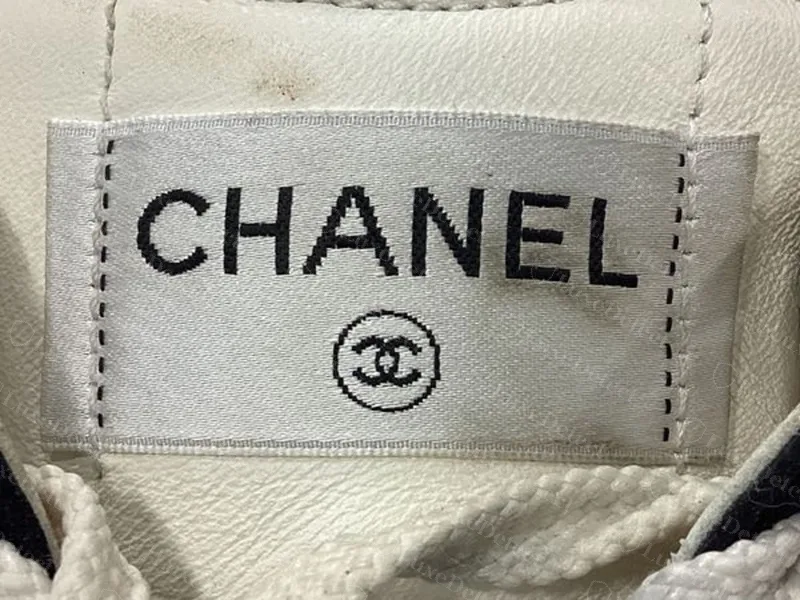
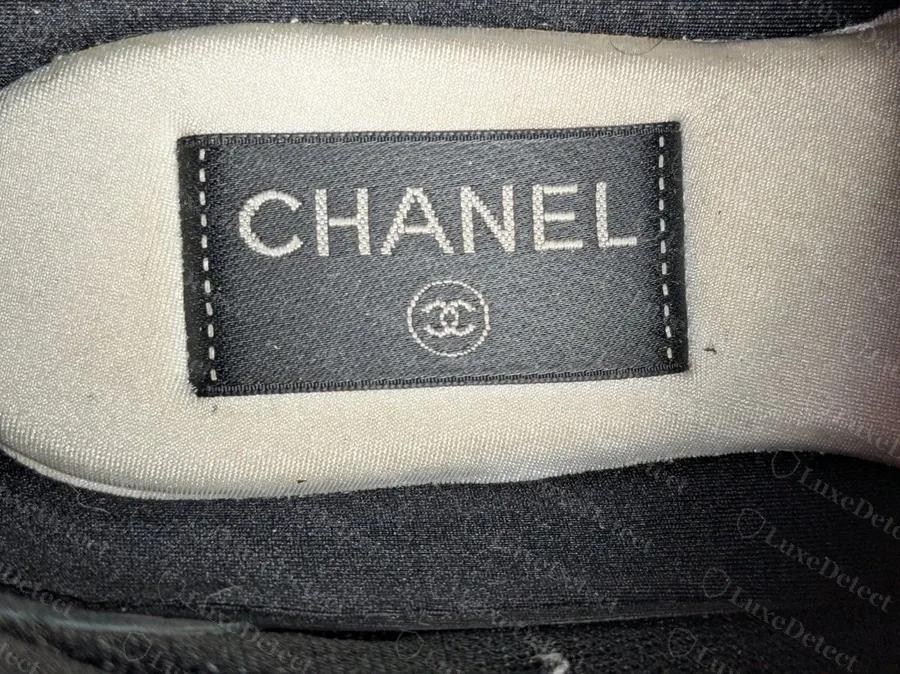
These are reference marks, not tells. The counterfeits we reviewed reproduced the tongue label and the insole label closely, including the dashed side stitching and the circled CC. Use them to check spacing and evenness: the letters should be evenly spaced and level, the CC should be round and centred under the wordmark, and the left and right shoes should match each other.
| Element | Authentic | Counterfeit |
|---|---|---|
| Tongue label | CHANEL over a circled CC, woven, sewn at the sides | Usually copied closely, stitching included |
| Insole label | CHANEL and circled CC at the heel | Usually copied closely |
| Left against right | Same label, same position on both shoes | Usually the same, so compare spacing instead |
Worth knowing
A sewn label with dashed stitching around it is normal on genuine pairs, on the tongue and sometimes for the code as well. Do not count the stitching against a pair.
We also saw a narrow tab reading "IDENTIFICATION" with a small CC, sewn inside the tongue of more than one counterfeit black leather pair. We did not find it on the genuine pairs we checked, but we have not seen it often enough to call it a rule, so take it as a reason to look harder at the code rather than as a verdict.
The Side CC and the Outsole
The side CC on the CC trainer is a separate piece of suede, leather or fabric stitched onto the upper, with the two Cs interlocking cleanly and the stitching running close to the edge. Underneath, the outsole carries a CC in a roundel under the forefoot, set into ridged tread panels, and many models have "MADE IN ITALY" moulded into the rubber at the heel.
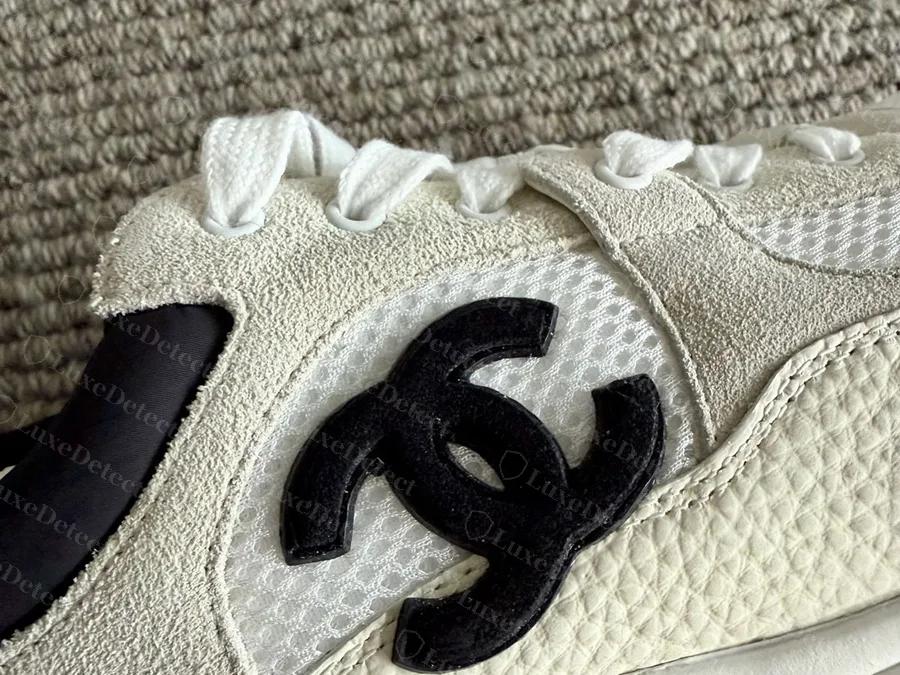
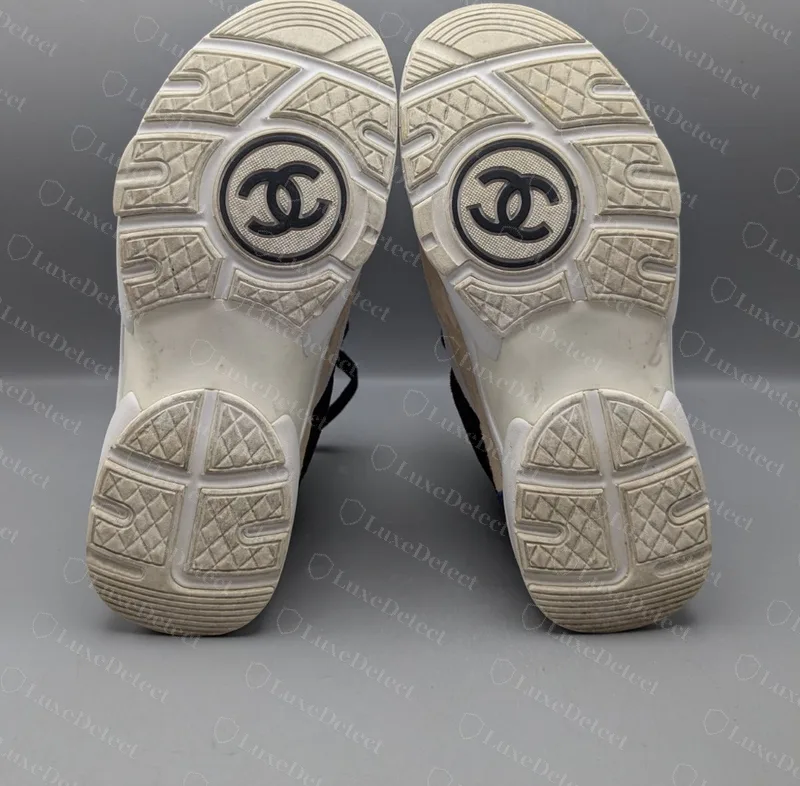
These are the first things a buyer looks at and the last things that settle a pair. In our reviews counterfeits copied the side CC, the outsole roundel and the moulded origin line well. They are useful only for the obvious: a CC whose Cs do not interlock, a roundel off-centre on one shoe, or stitching that wanders off the edge of the CC.
| Element | Authentic | Counterfeit |
|---|---|---|
| Side CC | Separate stitched piece, Cs interlock evenly | Usually copied well |
| Outsole | CC roundel under the forefoot, ridged panels | Usually copied well |
| Moulded origin | "MADE IN ITALY" on many models | Also present, so not a tell |
What Fakes Copy Correctly
Most of what a listing photo shows is not evidence. In our reviews counterfeit Chanel sneakers got these right, so a correct one tells you nothing:
- The side CC, in suede, leather, tweed or embroidery.
- The CHANEL wordmark on the heel, the tongue and the insole.
- The CC lace tab and the CC roundel on the outsole.
- A well-formed inside code, letter, G-reference and size, with "MADE IN ITALY".
- A box and dust bag, sometimes with a label matching the code inside.
Worth knowing
A pair can pass every check here and still be counterfeit, because each check catches only the fakes that got that one detail wrong. The inside code catches more fakes than any other single mark we found, and it still misses most of them.
What the Box and Dust Bag Do and Do Not Prove
Packaging is context, not evidence. A genuine Chanel shoe box has a label with the style reference, material, colour and size, and the reference and size should match the code inside the shoe. That cross-check is the box's only real value. Boxes and dust bags are sold separately, and many genuine pairs are resold without them, so a missing box is not a warning and a convincing one is not a reassurance.
Quick Authentication Checklist
- Find the code inside the tongue or heel lining and read it: one letter, a space, G plus five digits, then the size. Anything else, stop.
- If there is a box, match its reference and size to the code inside the shoe.
- Compare the tongue labels and insole labels on both shoes for even spacing and the same position.
- Look at the side CC and the outsole roundel for the obvious faults: Cs that do not interlock, an off-centre roundel, wandering stitching.
- Do not count a correct code, a "MADE IN ITALY" line, a clean CC or a box in the pair's favour.
A broken code format is on its own a strong reason to walk away. Everything else on this list is a prompt to look harder, not a verdict, and a pair that passes all of it is not proven genuine.
When to Get a Professional Opinion
This guide rests on a large set of authenticated and counterfeit Chanel sneaker orders in our own archive. The inside code is the one mark where fakes in our reviews repeatedly slipped, and the better counterfeits get it right. If a pair is a meaningful purchase, get a second opinion before you pay. LuxeDetect authenticates Chanel sneakers from $15, with a verdict and Certificate of Authenticity within 24 hours. Start an authentication with clear photos of both shoes from the side, the soles, the tongue label, the insoles and the code inside the tongue or heel.
FAQ
How can I tell if Chanel sneakers are real?
Start with the code printed inside the tongue or heel lining. Genuine pairs read one letter, a space, a G-reference with five digits and the size, for example "I G38299 37". A code without the letter, without the G-reference or with "CHANEL" in its place is a strong warning. A correct code is not proof, because counterfeits copy it.
Where is the code on Chanel sneakers?
Inside the shoe, usually on the back of the tongue or at the top of the heel lining. It can be printed on the fabric, on a clear patch or on a small sewn label. It is a model code, not a serial number.
What does the code inside Chanel sneakers mean?
The G-reference identifies the style and the number after it is the size. The letter in front is part of Chanel's code and is not the size. It cannot be looked up to confirm a pair, and counterfeits copy real references, so it only helps when its format is wrong.
Are Chanel sneakers made in Italy?
The genuine Chanel sneakers we reviewed were made in Italy, and the inside code and outsole often say so. Counterfeits print "MADE IN ITALY" too, so the origin line does not help either way.
Do Chanel sneakers have a serial number or a chip?
No. Chanel bags use a serial sticker or, more recently, a chip plate, but sneakers carry only the printed model code and size inside the shoe.
Can I authenticate Chanel sneakers from photos?
Yes. What decides it is how the code inside, the labels, the materials and the construction fit together against verified pairs of the same model. Send clear photos of the code, both tongue labels, the insoles, the soles and both sides of each shoe. On an expensive pair, a professional review is the safer route.