Chanel Authentication Specialist
Handbag authentication specialist. Has reviewed submissions across Hermès, Chanel, Louis Vuitton, and Dior since 2019.
Published September 2026 · Contact
Why the Deauville Is Different to Authenticate
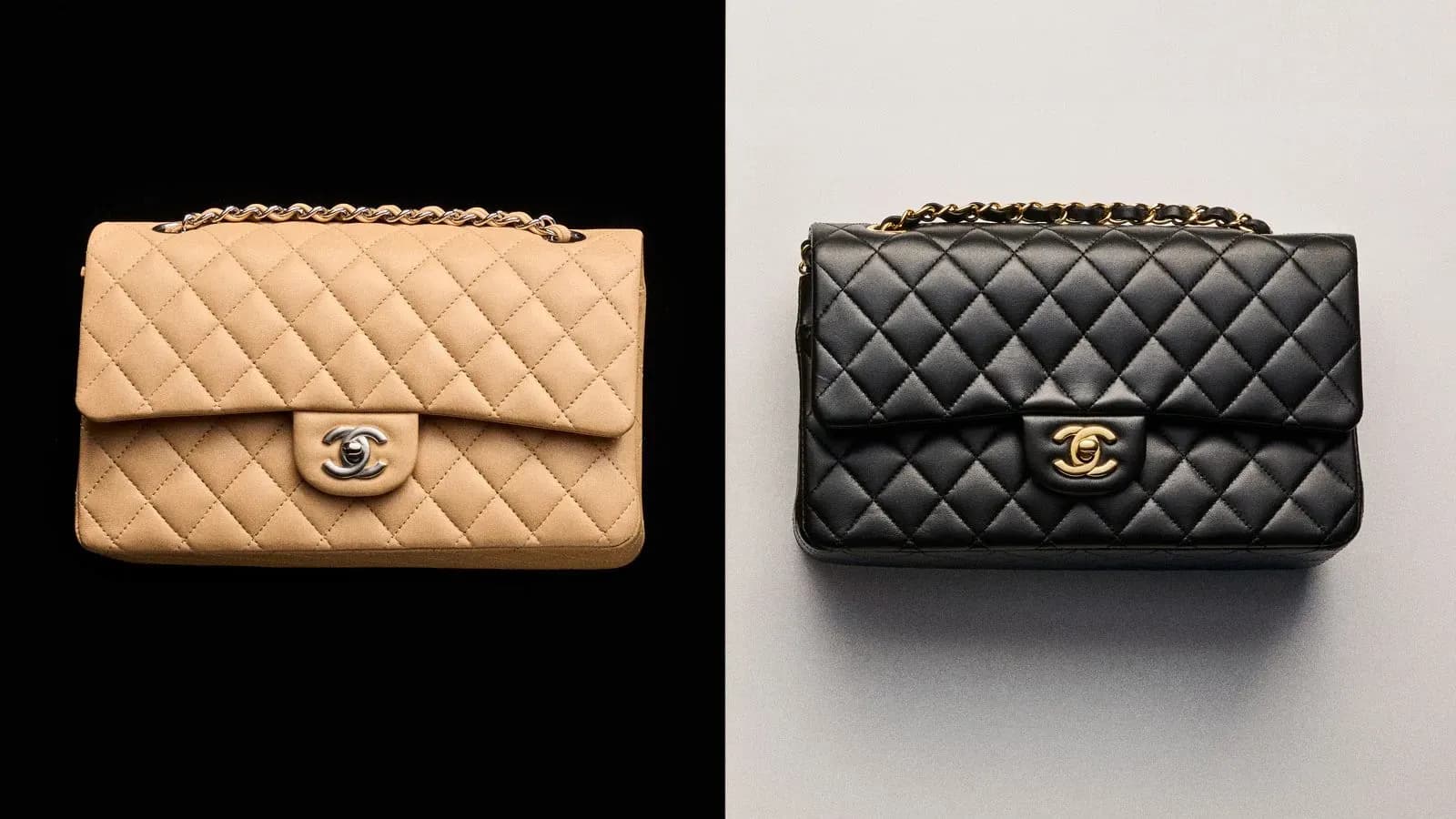
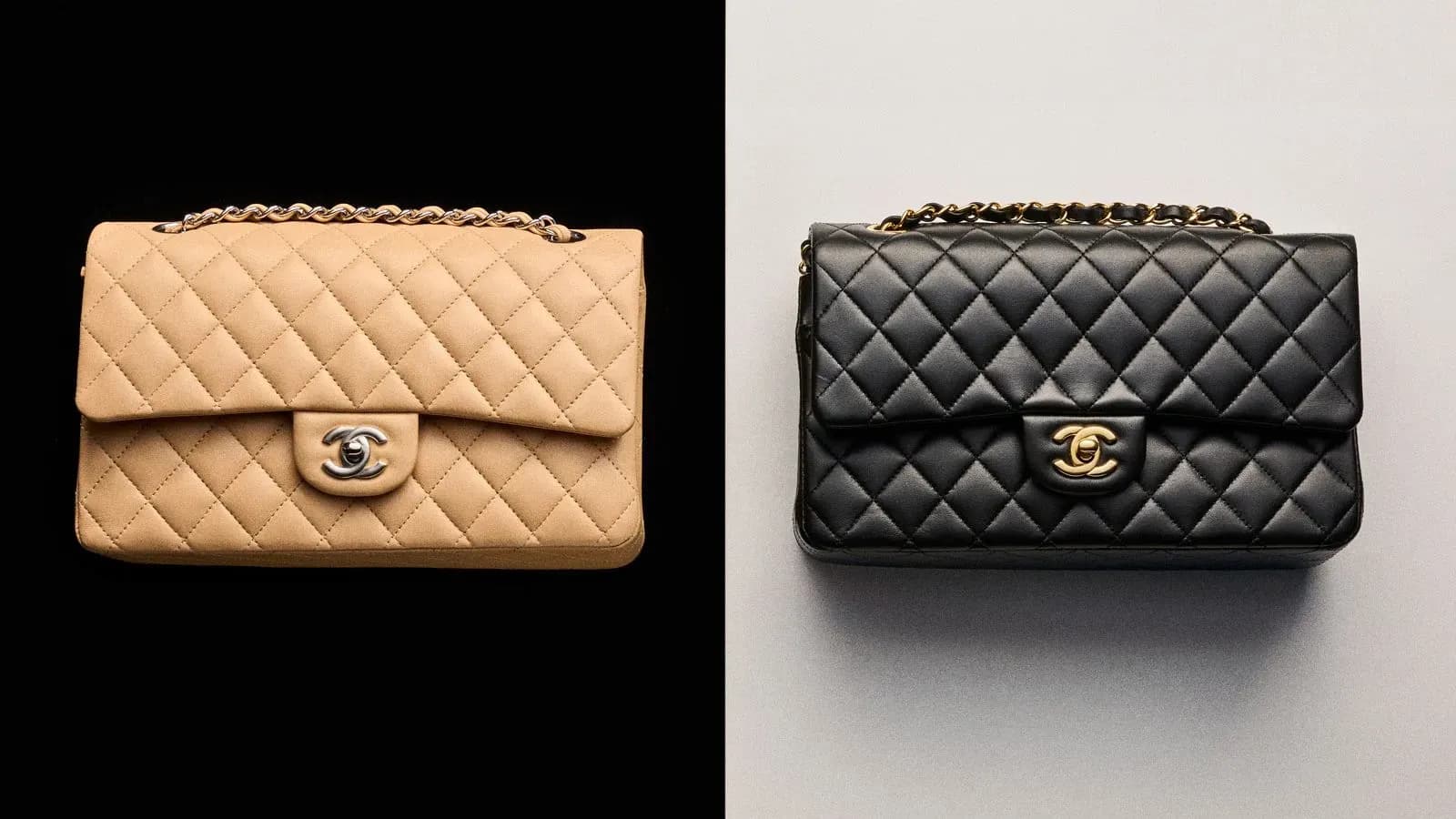
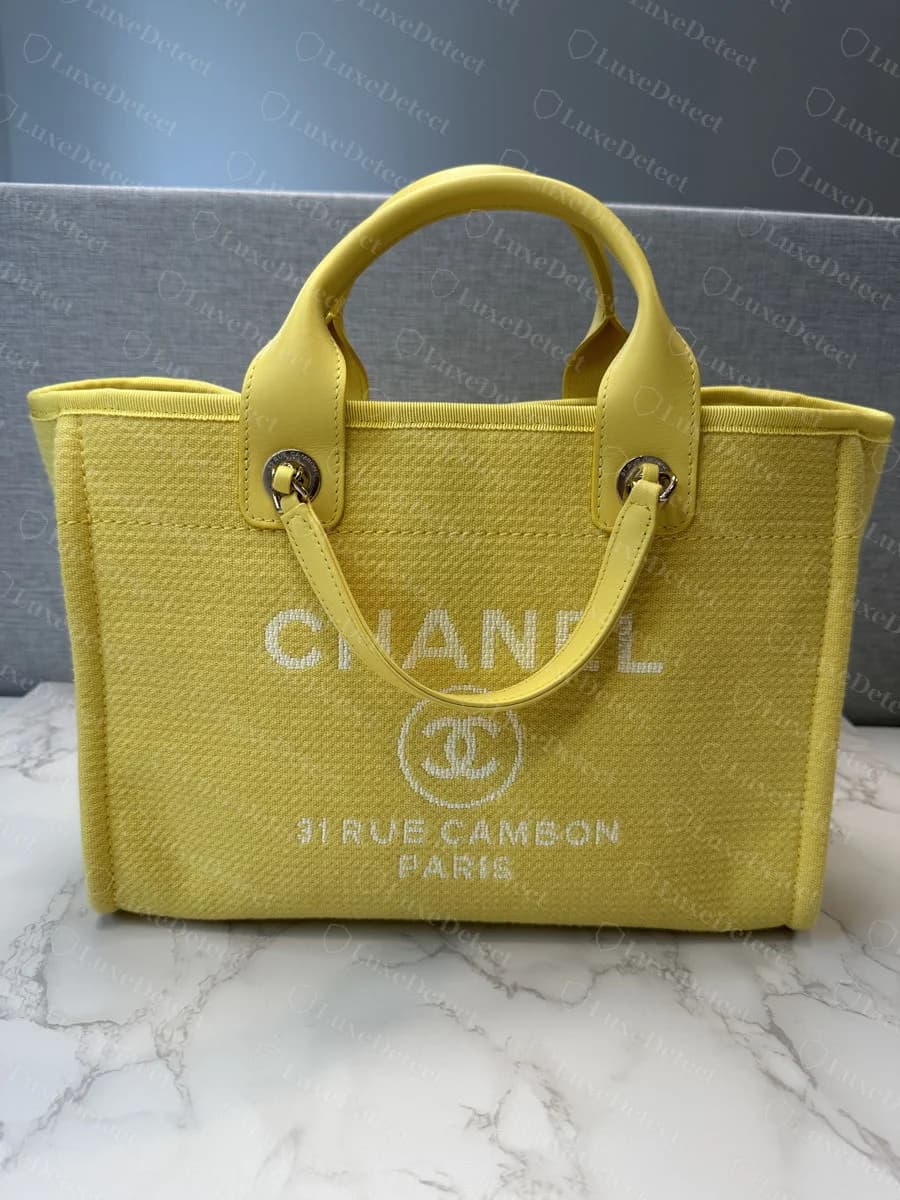
The Chanel Deauville is a canvas tote, not a quilted lambskin flap bag, and that changes what counterfeiting actually has to get right. There's no diamond quilting to misalign, no hologram sticker with a holographic shift to fake convincingly, no heavy leather-threaded chain to feel light in the hand. The bag is jacquard-woven canvas, two leather rope handles, a CC turn-lock, and a "CHANEL / 31 RUE CAMBON PARIS" logo across the front. Counterfeiters can get all of that close. What we found sampling confirmed real and confirmed fake Deauville orders is that the printed logo, the canvas weave, and even the grommet wording around the rope handles are frequently replicated well enough that they aren't reliable tells on their own.
What is reliable is smaller and easier to miss: how the bag's authentication is physically implemented, and what's stamped on hardware a buyer doesn't usually think to check. We pulled records from LuxeDetect's own authentication archive across both the no-microchip and RFID-microchip eras of Chanel production and looked at what repeatably separated confirmed-genuine bags from confirmed-fake ones. Two tells held up. A few things we expected to be tells didn't, and we're saying so rather than padding the list.
What to check, ranked by reliability
| Checkpoint | Reliability | What it tells you |
|---|---|---|
| 1. Where the QR / Digital Authentication Code Actually Lives | ★★★★★ | A QR or authentication tag sewn permanently into an interior seam is not how Chanel implements digital authentication and is decisive on its own. |
| 2. Snap Closure and Hardware Stamps | ★★★★★ | A third-party hardware manufacturer's stamp on any snap or fastener is decisive when found, but was not present on every fake sampled. |
| 3. Interior Tag Execution | ★★★★★ | A smudged tag is a caution sign, but a crisp one does not confirm authenticity — both appeared on confirmed fakes in this sample. |
| 4. Canvas Weave, Logo, and Rope Handle Construction | ★★★★★ | Closely replicated on most fakes sampled; treat as context only, not a check to rely on. |
| Model Reference Before You Start | ★★★★★ | Confirms the authentication system matches the claimed era; will not catch a well-made fake on its own. |
| What the Box and Dust Bag Do and Do Not Prove | ★★★★★ | Packaging is context only — useful for cross-referencing the retail tag, never as evidence by itself. |
Use our free Chanel Serial Number Checker to decode your bag's production era and see exactly what the sticker should look like.
Check My Serial →Model Reference Before You Start
- Deauville Tote / Shopping Tote: canvas construction with leather rope handles, gold or silver-tone hardware, available in Small, Medium, Mini, and (older seasons) Oversized sizing. Sold in solid canvas, striped canvas, denim, tweed/boucle, and metallic leather variants across different seasons.
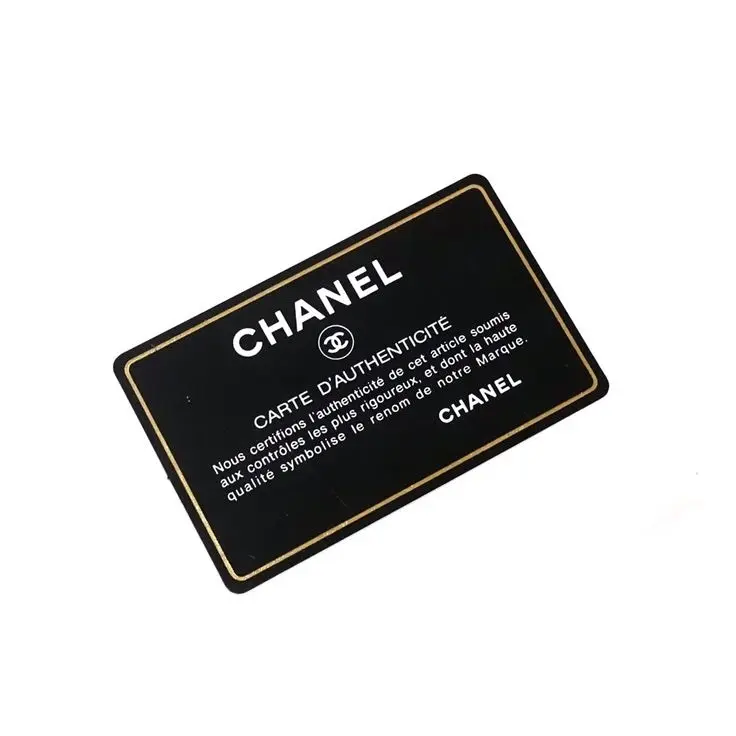
- Era matters for which authentication system applies. Pre-roughly-2021 Deauville totes carry Chanel's holographic serial sticker and matching authenticity card (see our Chanel serial number guide). Bags from around 2021 onward carry an RFID microchip built into a printed retail swing tag, not a sticker — see our Chanel NFC chip guide for how to read that system. Don't fault a genuine older bag for lacking a chip, and don't fault a genuine newer bag for lacking a hologram sticker; check for the system that matches the bag's claimed production year.
- "31 Rue Cambon Paris" appears on both real and fake Deauville bags — on the front canvas logo and stamped into the rope-handle grommets. Wording alone proves nothing; it's copied accurately on most fakes we looked at.
- Country of manufacture on genuine Deauville totes is France or Italy. Either is legitimate; any other country ends the inspection.
Where the QR / Digital Authentication Code Actually Lives
This was the single most repeatable difference in our sample. Genuine Chanel's digital authentication — whether it's the older serial hologram or the newer RFID system — lives on a detachable cardstock retail swing tag: printed "CHANEL" branding, a small QR/datamatrix code, an RFID icon with an EPC number, a barcode, and the style reference numbers, attached by a string to the hardware and meant to be removed at purchase. It is never sewn permanently into the bag's interior lining as fabric.
On multiple confirmed-fake Deauville totes in our sample, we found a black-and-white fabric tag stitched into an interior seam — usually near the base of a handle or a side seam — showing a printed "CHANEL" wordmark with the CC logo on one panel and a printed QR code on an adjacent panel, permanently sewn in rather than a detachable card. This appears to be an attempt to visually reference Chanel's real digital-authentication rollout, done in a format Chanel doesn't actually use. We found this exact configuration on close to a third of the confirmed-fake records we sampled, and never on a confirmed-authentic one.
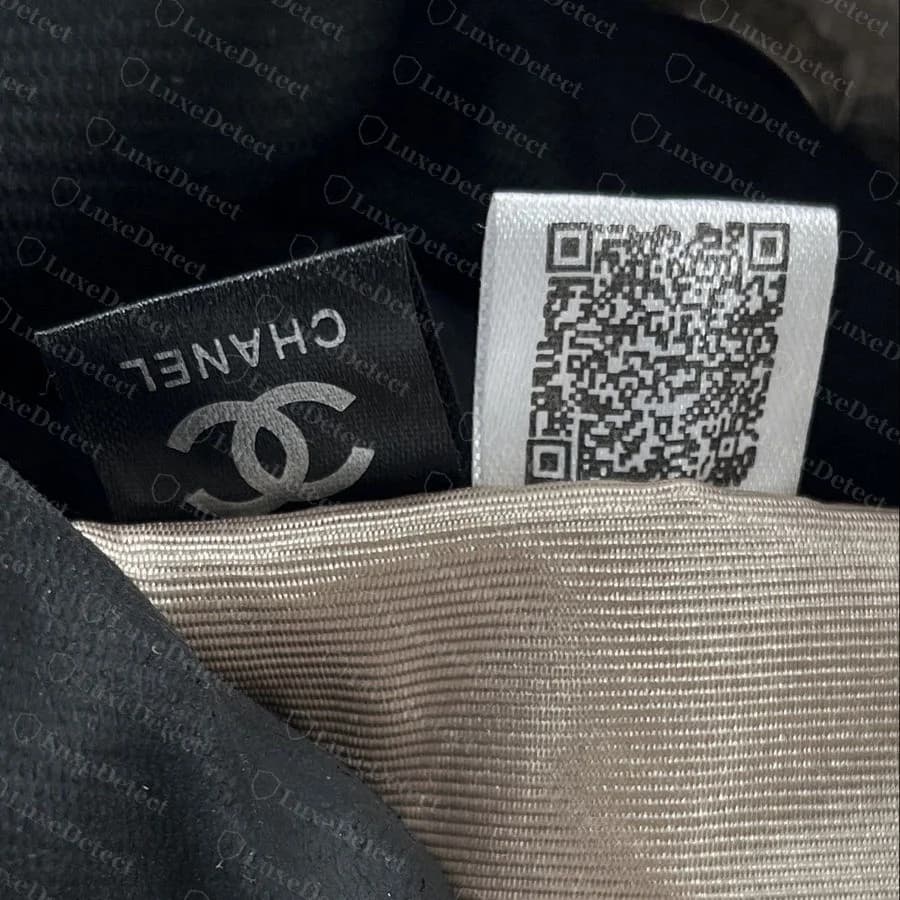
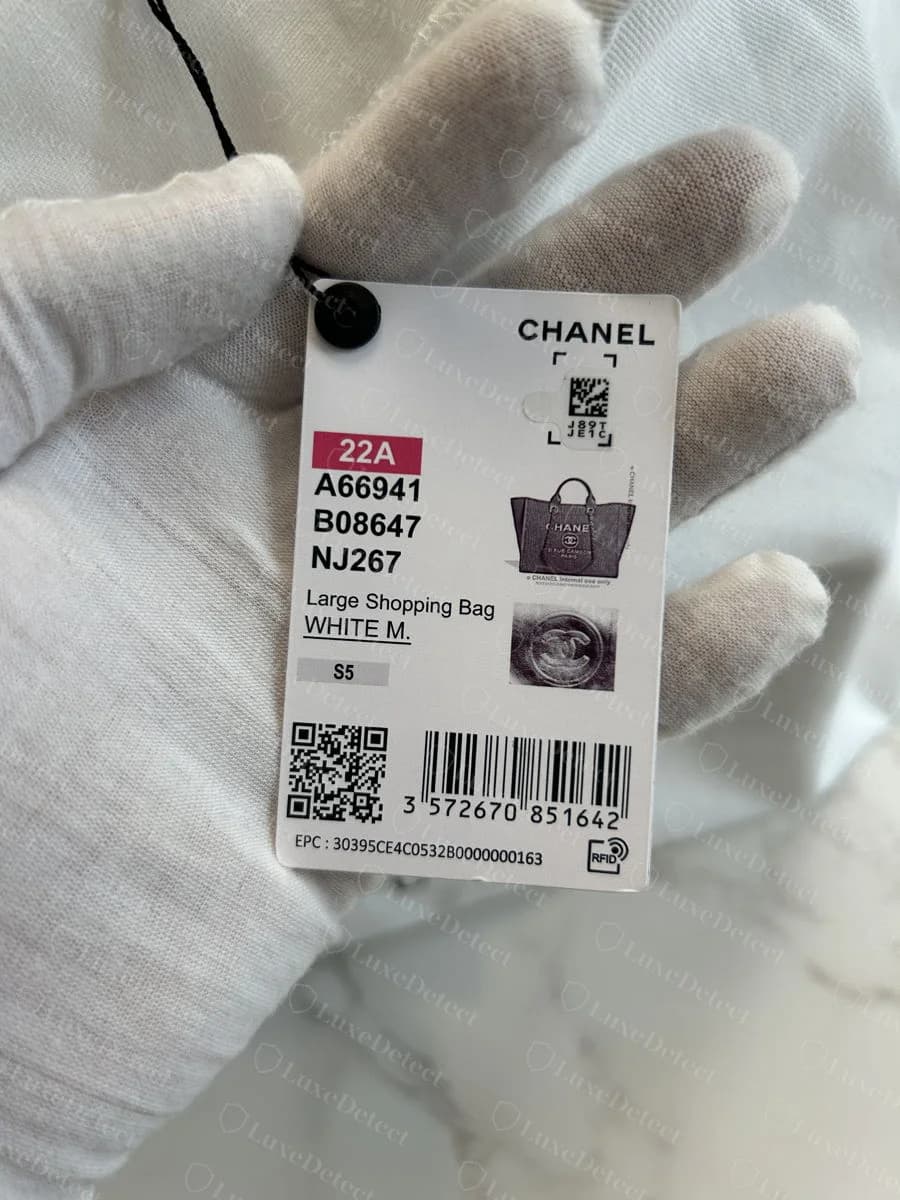
| Element | Authentic | Counterfeit |
|---|---|---|
| Where the code lives | Detachable cardstock swing tag, removed at purchase | Sewn permanently into an interior seam as fabric |
| Format | Printed QR/datamatrix + RFID EPC number + barcode + style refs, on card | A black-and-white fabric "CHANEL + CC" tag paired with a separate printed QR fabric swatch |
| Present after purchase | No — tag is meant to be removed | Yes — sewn in, can't be removed without unpicking a seam |
Red flag
A QR-code or "authentication" tag stitched into the interior lining rather than living on a detachable retail card. Chanel's actual digital authentication, old or new, is never implemented as a permanent fabric label sewn into a seam; a bag with one is not using Chanel's real system.
Snap Closure and Hardware Stamps
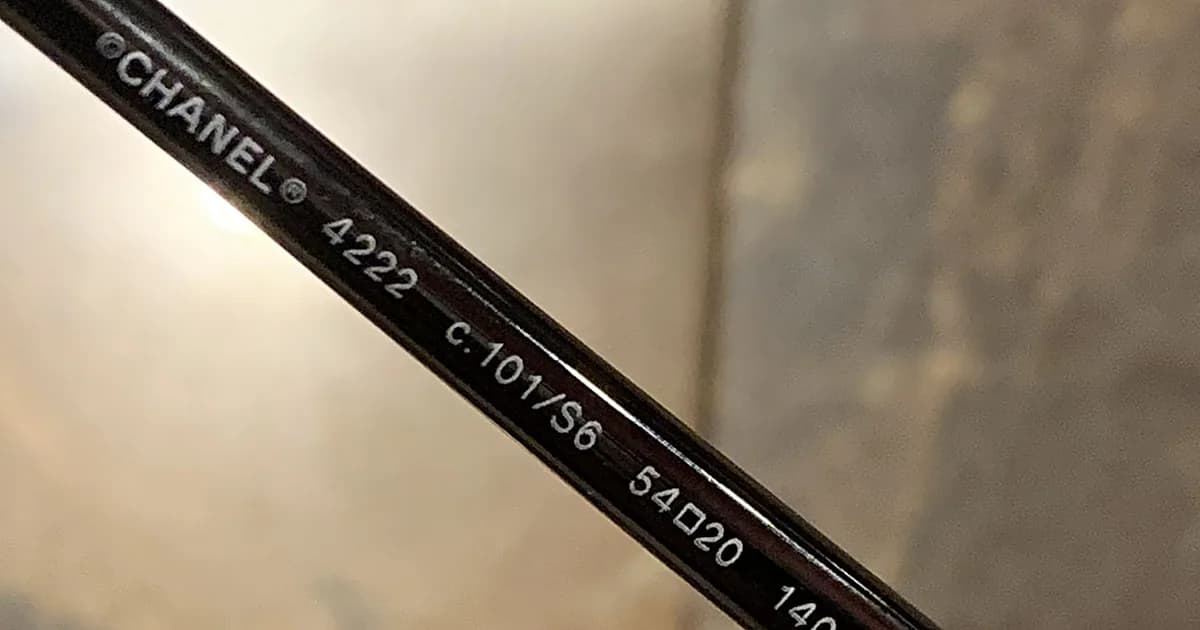
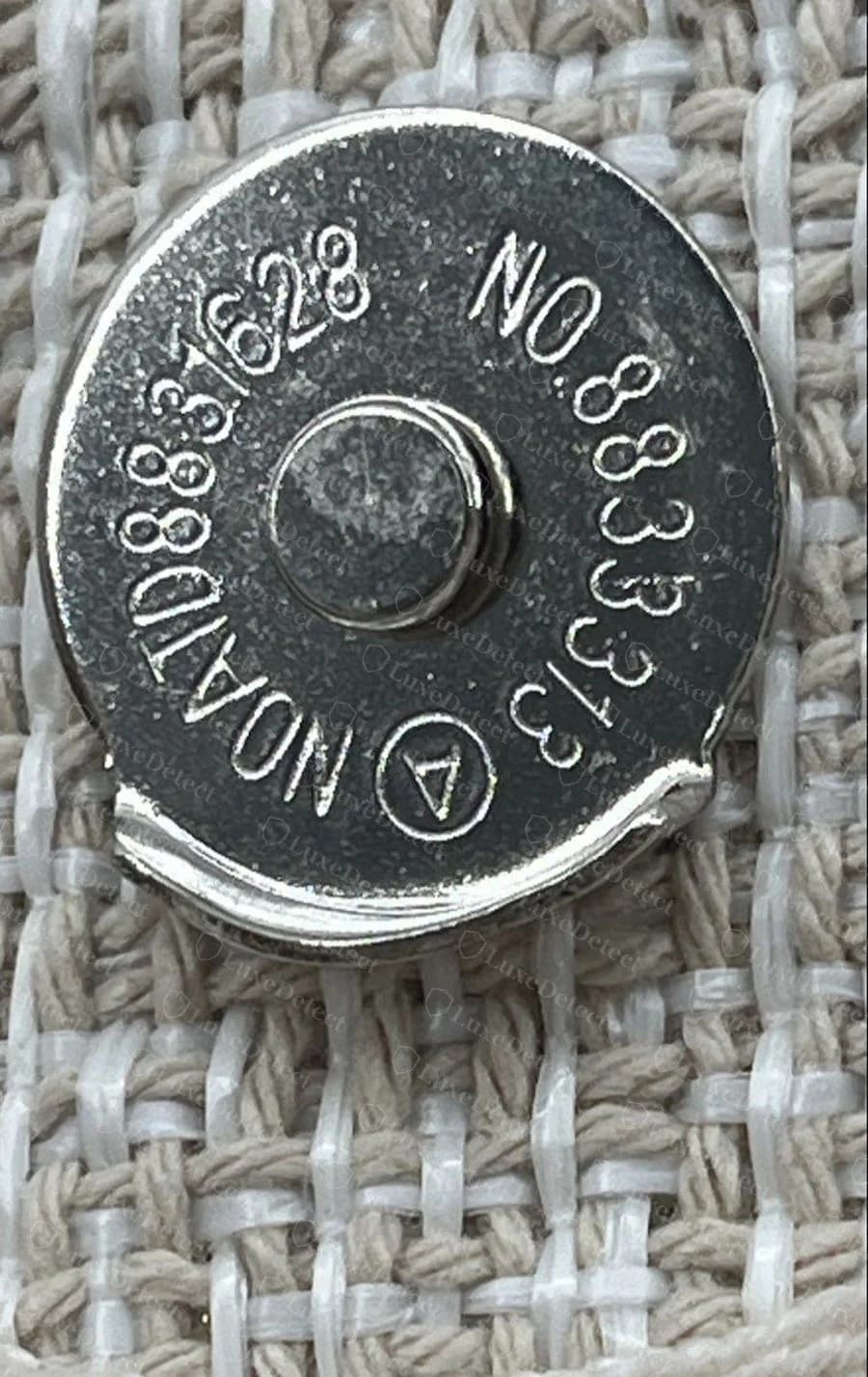
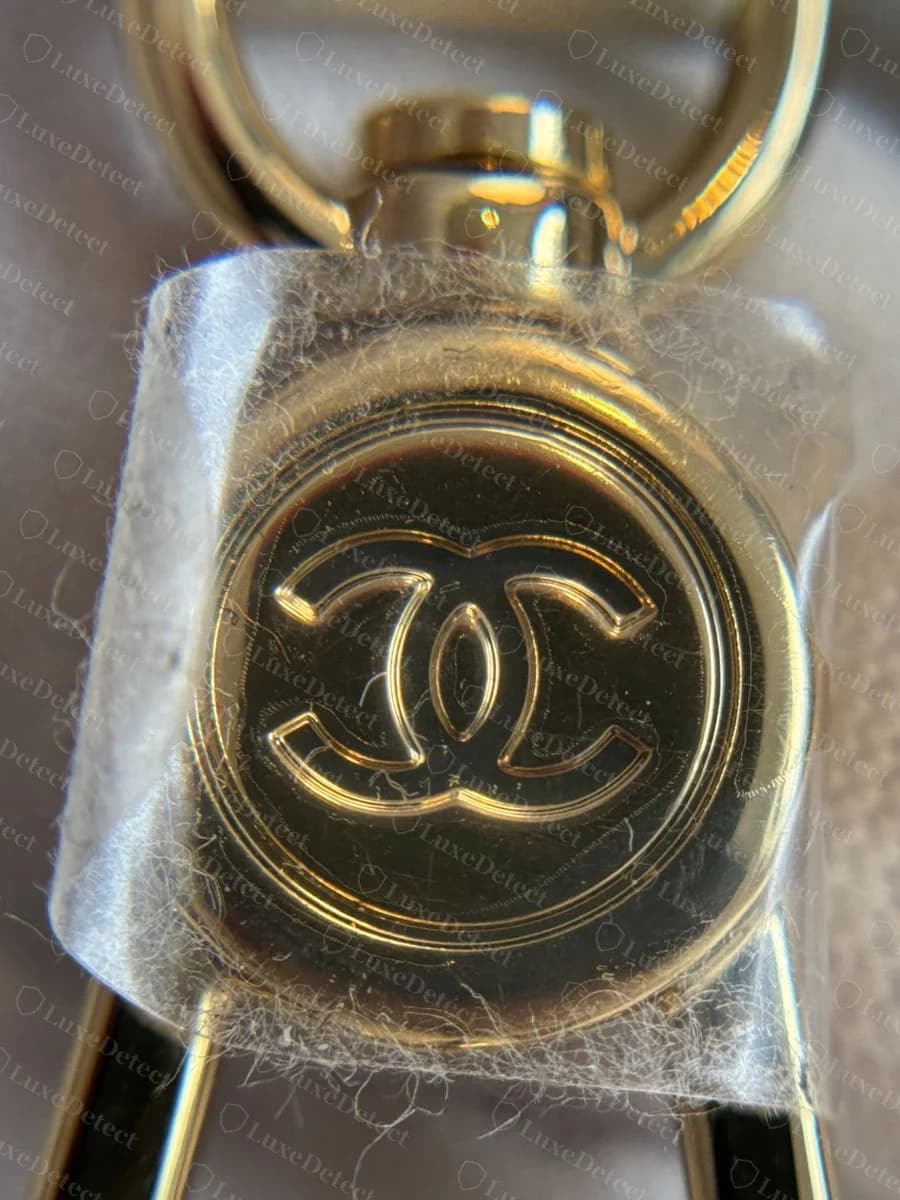
Look closely at any magnetic snap closures, not just the CC turn-lock. On one confirmed-fake bag in our sample, the interior magnetic snap was stamped with a generic hardware-supplier's own part-number and brand text (visible even though partly obscured), not "CHANEL" and not blank. Genuine Chanel hardware is either stamped "CHANEL" in the brand's own lettering or left unmarked — it never carries a third-party fastener manufacturer's name.
| Element | Authentic | Counterfeit |
|---|---|---|
| Snap/hardware stamp | "CHANEL" or unmarked | A generic third-party fastener brand and part number |
| Casting quality | Clean, even depth, no bleed | Present but not disqualifying on its own — see note below |
Worth knowing
We only found this on one of the nine confirmed-fake records we sampled, so it's not universal — a fake can ship with correctly blank or "CHANEL"-stamped hardware. When you do see a third-party hardware brand stamped anywhere on the metal, though, it's decisive on its own: Chanel does not outsource-brand its fasteners visibly.
Interior Tag Execution
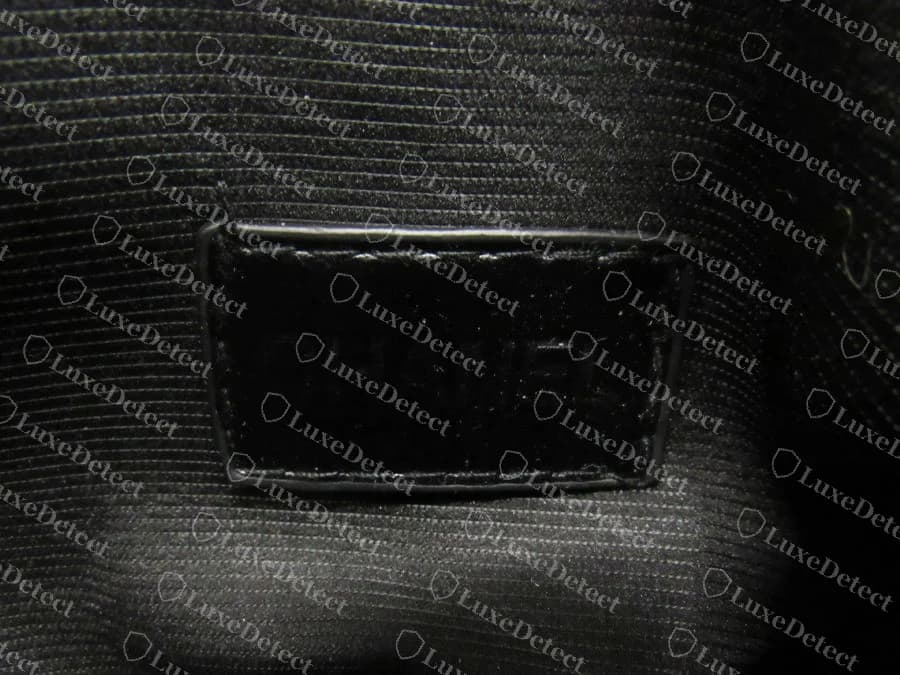
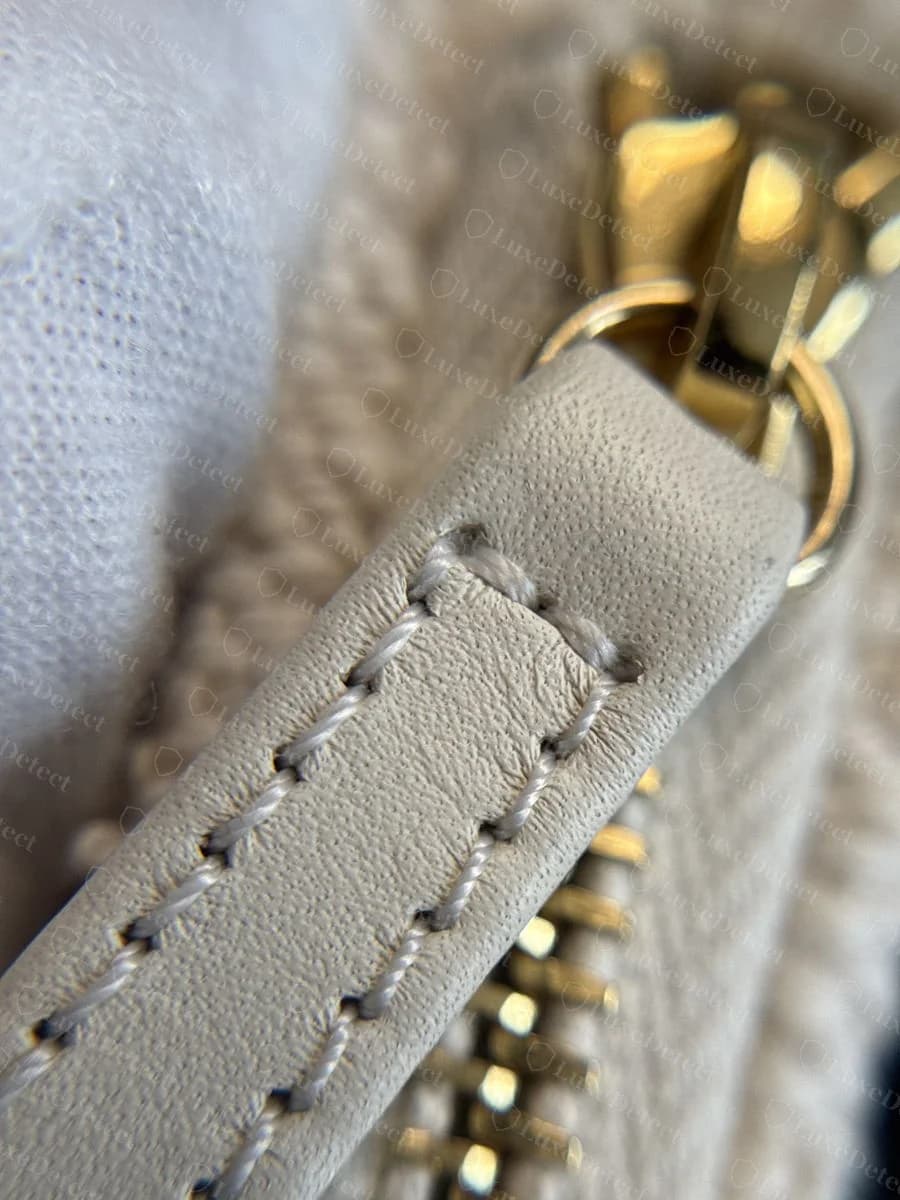
The interior fabric tag reading "CHANEL / MADE IN FRANCE" or "MADE IN ITALY" is worth checking, but be honest about what it proves. On genuine bags in our sample it was consistently crisp: foil-stamped or debossed lettering with clean edges, evenly seated on the leather patch. Some confirmed-fake bags matched this closely — sharp, legible, correctly worded. Others in the same fake sample had smudged, bled, or nearly illegible lettering where the letterforms ran together into a dark blob.
Worth knowing
A crisp, legible interior tag does not confirm authenticity on its own — we found convincingly sharp tags on confirmed fakes in the same sample. A smudged or illegible tag is worth treating as a caution sign, but the reverse isn't true, so weight it below the QR-tag placement and hardware-stamp checks.
Canvas Weave, Logo, and Rope Handle Construction
We looked closely at the jacquard-woven "CHANEL / CC / 31 RUE CAMBON PARIS" front logo, the canvas weave density, and the rope handle stitching and grommet wording across both sides of our sample. None of these held up as a reliable tell. The logo weave, the grommet text, and the handle construction were closely matched on most confirmed-fake bags we examined — good enough that we can't responsibly publish a specific construction defect as decisive here. This is worth knowing precisely because it means you shouldn't rely on "the logo looks right" or "the handles feel sturdy" as reassurance; those are exactly the areas current fakes have caught up on.
Worth knowing
If a listing or seller's main pitch for authenticity is "look how good the canvas and logo are," treat that as neutral information, not reassurance. Move to the interior seams and hardware stamps instead.
What the Box and Dust Bag Do and Do Not Prove
Packaging is context, not evidence. Several bags in our authentic sample still had the original retail tag attached with the QR/RFID card intact, which is a good sign when present but proves nothing on its own — a counterfeiter can source or reproduce a dust bag and box. What the box and card can do is let you cross-reference: does the style number on the tag match the bag's actual size and material? Does the claimed season line up with whether the bag should have a hologram sticker or an RFID tag at all? Use packaging to catch contradictions, not as a substitute for checking the bag itself.
Quick Authentication Checklist
- Check the interior seams (handle bases, side seams) for any sewn-in fabric tag with a QR code or "CHANEL" branding — this should not exist on a genuine bag.
- Check every snap closure and hardware piece for a third-party manufacturer's stamp instead of "CHANEL" or a blank finish.
- Read the interior tag closely, but don't treat a crisp one as confirmation on its own.
- Confirm the country of manufacture is France or Italy.
- Match the authentication system (hologram sticker vs. RFID tag) to the bag's claimed production era.
- Cross-reference the retail tag's style number and material against the physical bag, if the tag is present.
A sewn-in QR/authentication fabric tag is sufficient on its own to reject a bag. A third-party hardware stamp is sufficient on its own when you find one. Everything else on this list is corroborating, not decisive.
When to Get a Professional Opinion
The Deauville's canvas construction genuinely narrows the gap between a good fake and the real thing more than a quilted leather bag does — there's less tactile and material complexity for a factory to get wrong. That raises the stakes on the checks that are left. If you can't get eyes on the interior seams and hardware stamps in person, or if the bag is being sold without its retail tag and you can't confirm which authentication era it should carry, a professional check is worth the cost relative to a $1,000–$3,000+ bag. Photo-based authentication typically runs $25 with a 24-hour turnaround, and you receive a Certificate of Authenticity you can use in a resale listing or dispute.
FAQ
Does every genuine Chanel Deauville have a QR code inside?
No, and that's the point. Genuine Chanel bags carry their digital authentication — a hologram sticker with a matching card (older bags) or an RFID chip in a printed retail swing tag (roughly 2021 onward) — but never as a fabric tag sewn permanently into the interior lining. If you find a black-and-white "CHANEL" and QR-code fabric tag stitched into a seam, that's not how Chanel implements this system.
What's the difference between the no-microchip and with-microchip Deauville?
It's a production-era distinction, not a model distinction. Chanel bags made before roughly 2021 use a holographic serial sticker inside the bag with a matching paper authenticity card. Bags from around 2021 onward use an RFID microchip embedded in the retail tag instead, with an EPC number, QR code, and barcode printed on a detachable cardstock swing tag. Neither system is more "authentic" than the other — check that the bag's claimed year matches which system it should have.
Is the Deauville's canvas logo printed or woven?
On genuine bags, the "CHANEL / CC / 31 RUE CAMBON PARIS" front logo is jacquard-woven into the canvas itself, not printed on top. That said, we found this closely replicated on confirmed-fake bags in our sample, so weave quality alone isn't a reliable way to call a Deauville authentic or fake — use it as context, not a decisive check.
Where is the serial number or hologram sticker on a Deauville tote?
On pre-2021 bags, it's typically on the interior lining, often inside a slip pocket or on the interior back wall, paired with a matching authenticity card. On newer bags, there's no interior sticker at all — the RFID chip and its associated codes are on the retail swing tag instead. See our Chanel serial number guide for the full prefix-to-year reference.
Can I authenticate a Chanel Deauville from photos alone?
Partially. The interior seam check for a sewn-in QR tag and the hardware-stamp check both photograph reasonably well if the photos are close and well-lit. What's harder from photos: canvas weight and hand-feel, and confirming a retail tag's RFID chip actually reads correctly. For a bag at real resale prices, a photo-based professional check is inexpensive insurance.
Are all Chanel Deauville totes made of canvas?
No. While canvas is the most common and recognizable material, Chanel has also produced the Deauville in denim, tweed/boucle, and metallic or crumpled calfskin leather across different seasons, particularly in the RFID-chip era. The authentication checks in this guide — the seam check for sewn-in tags and the hardware stamp check — apply regardless of exterior material.