Fine Jewelry Authentication Specialist
Fine jewelry authentication specialist. Focuses on hallmarks, stone setting, and metal finishing.
Published October 2026 · Contact
How to Tell if Gold Is Real: The Short Answer
Look for a purity stamp and a maker's mark, then confirm it with a test that measures the metal itself. No single home test is conclusive, and a stamp on its own proves nothing, because a stamp can be put on a piece made of any metal. The same steps work for silver.
In order of how much each one tells you:
- Read the marks. Purity numbers such as 925, 750, 585 and 375 say what the maker claims the metal is. A full hallmark, with a maker's mark and an assay office mark, says much more than a lone number.
- Check the weight and the density. Gold is very dense. A piece that feels light for its size is a warning, and a water displacement test can put a number on it.
- Use a magnet only to rule things out. A pull means there is iron, nickel or cobalt in the piece. No pull proves nothing.
- Treat an acid kit as a last resort. It scratches the piece, it samples only the surface, and it is hazardous to handle.
- Ask a jeweler or assay office for a measurement if the piece is valuable. They can measure the metal; you cannot read it from the stamp.
Worth knowing
This guide covers plain gold and silver jewelry. Branded fine jewelry (Tiffany, Cartier, Pandora and others) adds brand-specific marks that fakes copy, so it is covered brand by brand in our other guides, linked below.
What Do the Numbers on Gold and Silver Jewelry Mean?
A purity stamp is a number out of 1,000. It says how many parts in 1,000 of the piece are the precious metal. Gold is also described in carats (called karats in the US), out of 24.
| Stamp | Metal | Carat or karat | What it says |
|---|---|---|---|
| 999 | Gold, silver or platinum | 24 | Fine, almost pure |
| 916 | Gold | 22 | 91.6% gold |
| 750 | Gold | 18 | 75% gold |
| 585 | Gold | 14 | 58.5% gold |
| 375 | Gold | 9 | 37.5% gold |
| 925 | Silver | None | Sterling silver, 92.5% silver |
| 800, 830 | Silver | None | Lower silver standards used in some countries |
| 950 | Platinum | None | 95% platinum |
The list of numbers comes from the UK order that sets which fineness numbers an international Convention hallmark can carry: gold 999, 916, 750, 585 and 375; silver 999, 925, 830 and 800; platinum 999, 950, 900 and 850; palladium 999, 950 and 500 (UK Hallmarking (International Convention) Order 2002). The carat column is simple arithmetic on those numbers.
On the silver side, the US Jewelry Guides say a product can be called sterling silver only if it is at least 925/1,000 pure silver, and "coin silver" only if it is at least 900/1,000 (US FTC Jewelry Guides, 16 CFR 23.5). A US piece may also carry words, such as "14K", "18K" or "STERLING", instead of a number.
A stamp tells you the claim. It does not tell you whether the claim is true. The next sections show what supports it.
Gold Hallmark Check: What a Full Hallmark Looks Like
A hallmark is a set of marks, not a single number. The rules depend on the country, so read the rule for where the piece was sold.
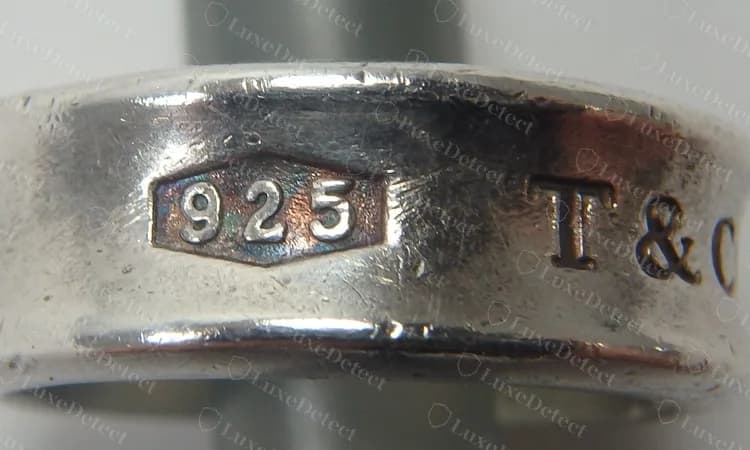
United Kingdom. A complete UK hallmark has three compulsory marks: a sponsor's (maker's) mark, a metal and fineness mark, and an Assay Office mark. A date letter is optional. Pieces below a minimum weight are exempt: 1 gram for gold, 7.78 grams for silver, 0.5 gram for platinum and 1 gram for palladium. Above those weights, selling an unhallmarked item as precious metal is illegal, in a shop or online (UK Government, Hallmarking is the law). So on a UK piece above those weights, a lone "925" with no maker's mark and no assay office mark is incomplete.
United States. The US Jewelry Guides do not set up an assay office hallmark like the UK system. They deal with how a quality mark may be used. Under the National Stamping Act, as cited in the Guides, a maker or dealer who applies a quality mark also applies its trademark or name to the article (16 CFR 23.10, Note 2). So a US piece stamped "14K" should also show who stands behind that stamp. A "14K" with no maker's name or trademark is a reason to look closer.
Other European countries. Many have their own national marks and rules, and we have not verified them one by one for this guide. If your piece is from another country, check that country's assay office or trade standards body for the marks it uses.
Where a mark can be read, look at how it was made. Genuine marks are normally clean and evenly struck, with the letters and numbers sized in proportion to each other. Blurred, uneven or oversized marks are worth a closer look, but a worn old piece can also have faint marks, so use this as a prompt to ask more questions, not as a verdict.
The tool above is our free jewelry hallmark checker. It covers two brands, Bvlgari and Tiffany & Co. You choose the brand, type the signature and purity mark as engraved, and say whether a serial is present. It then tells you whether those marks are consistent with what that brand is documented to use. It does not check any other brand, and it does not verify that a piece is genuine.
What a Stamp Does and Does Not Prove
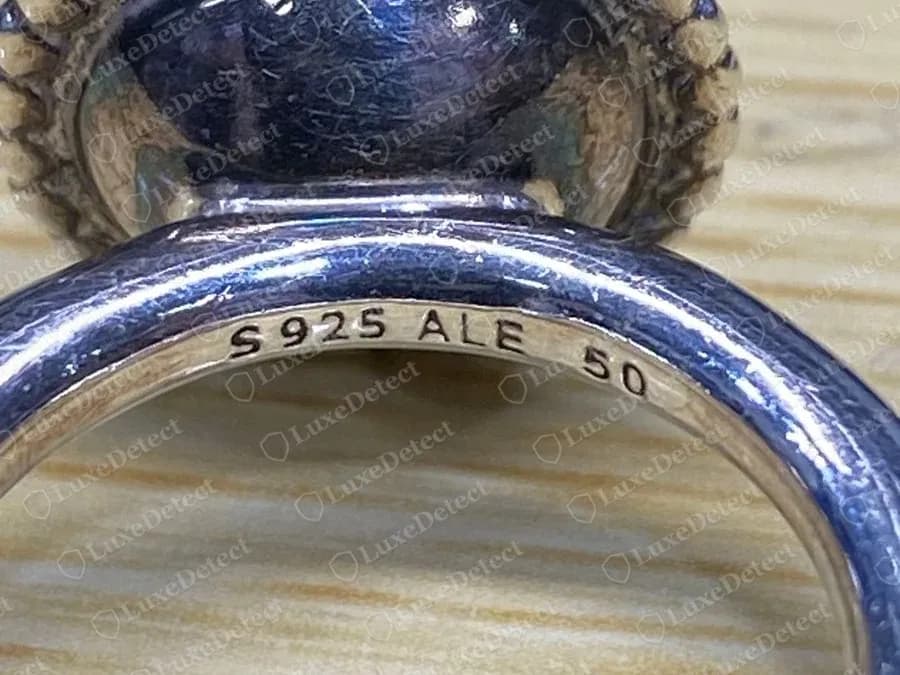
A stamp proves what someone claims. It is a mark cut or pressed into metal, and nothing in the stamp stops it appearing on another metal. Counterfeit makers copy stamps along with everything else. In our own records of Pandora jewelry, pieces graded as counterfeit often carry the same S925 and ALE stamps as genuine ones, so a matching stamp proves little by itself (see our Pandora real vs fake guide).
What a stamp can do is rule things out and give you something to check:
- No stamp at all on a piece sold as solid gold or sterling silver is a reason to stop. In the UK, above the exempt weights, it can also be unlawful to sell it as precious metal.
- A stamp that does not fit the piece is a reason to stop. A "925" on a piece sold as gold, or a "750" on a piece sold as silver, does not add up.
- A stamp that fits but nothing else does. If the stamp is right but the weight, the finish and the construction are wrong, trust the weight, the finish and the construction.
Worth knowing
A full set of marks is stronger evidence than a number alone, because it is harder to copy a whole set convincingly. It is still not a measurement of the metal. Only a test on the metal can do that.
Plated, Filled, Vermeil or Solid: Know What the Piece Is
Many pieces that look like gold are real, but not solid gold. The US Jewelry Guides define the terms, and these definitions are what a seller has to meet to use each word (16 CFR 23.3 and 23.4):
| Term | What it means in the US Jewelry Guides |
|---|---|
| Solid gold | The whole piece is a gold alloy of the marked purity |
| Gold filled | A layer of karat gold bonded to a base metal, the gold making up at least 1/20th of the weight of the whole article |
| Gold electroplate | A thin layer of gold, with a minimum thickness equivalent to 0.175 microns of fine gold |
| Vermeil | A sterling silver base, coated with gold on all significant surfaces, to a minimum thickness equivalent to 2.5 microns |
Words and abbreviations for these terms count: the Guides apply to "Gold Filled" or "Gold Electroplate" and to any abbreviation of them. So a stamp that reads as, or abbreviates, "gold filled" or "gold plated" tells you the piece is not solid gold. That is not a fake. It is a different, cheaper product, and it should be priced as one.
The problem comes when plating is sold as solid. Plating wears. Look at the edges, the high points and the inside of a ring for a different colour of metal showing through. Rub marks that show a silver, brass or reddish layer underneath tell you the surface is a coating.
The Magnet Test: Useful, but Not Conclusive
Gold, silver and platinum are not magnetic. So if a strong magnet pulls on a piece, there is iron, nickel or cobalt in it, and it is not solid precious metal (Apex Magnets, how to test gold and silver with magnets).
That is as far as it goes. The same source says plainly that a magnet can expose some fakes but cannot prove a piece is real, because not all counterfeit items use magnetic materials. Brass, copper alloys and many plated base metals are not magnetic either, so they pass the test.
How to use it:
- Use a strong magnet, not a fridge magnet.
- Test the body of the piece, and test the clasp separately, because a clasp can be a different metal from the rest.
- Treat a pull as a red flag. Treat no pull as "no information".
Red flag
A clear pull toward a magnet on the body of a piece sold as solid gold or sterling silver means it is not solid precious metal. No pull proves nothing.
The Density Test: Gold Is Heavy
Pure gold has a density of 19.32 g/cm3, almost double that of silver. Alloying lowers it: 18 carat gold made with equal parts silver and copper has a density of about 15.4, and UK 9 carat gold is around 11 (LBMA, Density of gold). Because density depends on the alloy, the Archimedes principle can be used to detect counterfeit or under-title gold (LBMA, same page).
A simple version at home needs a scale that reads to 0.01 gram:
- Weigh the piece dry. Call this the weight in air.
- Put a cup of water on the scale and set it to zero.
- Hang the piece on a thread so it is fully under the water and does not touch the cup. The scale now shows the extra grams, which equals the volume of the piece in cm3.
- Divide the weight in air by that number to get the density.
For example, a 15.4 gram piece of 18 carat gold would read about 1.0 gram in step 3. A piece that gives a much lower density than the marked purity should have is not what the stamp says.
This test works only on a piece with a single metal and no stones. Stones, hollow parts, solder and mixed metals all change the result. It also does not separate every fake: a base metal piece with a gold-coloured layer is easy to rule out, but a heavy metal core under a thick layer of gold can give a misleading figure.
The Acid Test: Read This Before You Try It
An acid kit works by scratching a small streak of the metal onto a black stone, then putting a drop of acid on it and watching how fast the streak reacts. Gold resists the weak acids, and a base metal fizzes and turns green. Kits come with several strengths of acid, one for each carat level.
Know what it cannot do:
- It tests the surface. The streak samples only the outer layer. Gold plated and gold filled pieces can pass a surface test, and a heavy metal core under the gold would not be detected.
- It damages the piece. A scratch on a ring, a necklace or a watch case lowers its value. Do not do it on a branded or antique piece.
- For silver, home kits are a poor guide. A drop of nitric acid has no published standard for reading silver purity, and one trade source advises against the dichromate-based silver test acid for home use.
Worth knowing
Safe handling comes first. Nitric acid and the acids in test kits can burn skin, damage eyes permanently and harm your lungs if you breathe the fumes. Wear splash goggles and chemical-resistant gloves, work in a well-ventilated area, keep water and sodium bicarbonate (baking soda) at hand, and never mix the acid with alcohol, acetone or other organic liquids. If acid gets on your skin or in your eyes, flush with water immediately and get medical help (CDC NIOSH Pocket Guide to Chemical Hazards, nitric acid; Alliance Chemical, how to test gold and silver with nitric acid). Keep the kit away from children. If you are not comfortable with this, do not use an acid kit: a jeweler or assay office can test the piece for you.
Checks Ranked by What They Prove
| Check | What it tells you | What it cannot tell you |
|---|---|---|
| Full hallmark (maker, fineness, assay office) | The piece went through the national marking system in that country | That a copied mark is not on a different piece |
| A purity stamp alone | The claimed purity | That the claim is true |
| Weight and density | Whether the piece is as heavy as the marked metal should be | The exact purity; results with stones or mixed metals |
| Magnet | Rules out iron, nickel and cobalt | That the metal is gold or silver |
| Acid kit | Surface reaction, base metal or not | The core, plating thickness, or silver purity |
| Measurement by a jeweler or assay office | The actual metal content | Whether a branded piece is a genuine item of that brand |
The last row matters for branded pieces. A piece can be real silver and still be a fake Tiffany. That is a different question from "is it real silver", and it is answered by the brand's marks, clasp, chain construction and finish. For that, use our brand guides: Tiffany & Co. jewelry, Pandora, Van Cleef & Arpels Alhambra or the Cartier Love bracelet.
Quick Checklist: Is My Gold Real? Is My Silver Real?
- Find the stamp. Write down the number, any words and any maker's mark.
- Check that the stamp fits the metal and the item. Silver is 925 or 800, gold is 375 to 916.
- Check the rules for the country: three marks in the UK; a maker's name or trademark with the quality mark in the US.
- Look for wear that shows a different colour of metal underneath.
- Weigh it and compare it with what the metal should weigh. Run the water displacement test if there are no stones.
- Test with a magnet. A pull means stop.
- Skip the acid kit unless you can handle it safely and accept the scratch.
- For a piece that matters, get it measured by a jeweler or assay office, and for a branded piece, have the brand marks checked.
Two or more checks that fail means walk away. One clear failure, such as a magnet pull on a piece sold as solid gold, is enough on its own.
When to Get a Professional Opinion
If you are buying or selling a piece where the price matters, a stamp and a home test are a good start but not enough. LuxeDetect authenticates branded jewelry from $30 with a 24-hour turnaround, a verdict from a specialist and a Certificate of Authenticity. Send clear photos of every stamp, the clasp, the inside of any ring or bangle, and the whole piece. Our review covers the marks, the construction and the finish against verified pieces from the same brand.
For an unbranded piece where you only need to know the exact purity, a jeweler with an XRF analyser or an assay office measures the metal itself.
A code that checks out doesn't prove the item is real. Counterfeiters copy genuine codes.
Our authenticators check the hallmarks, engravings, clasp and settings against verified references, from $30. You get a verdict within 24 hours, and a Certificate of Authenticity if the item passes.
Authenticate My Item →FAQ
How can I tell if gold is real?
Check for a purity stamp (375, 585, 750, 916 or 999) and a maker's mark, check the weight against what the metal should weigh, and rule out iron, nickel and cobalt with a magnet. None of these is conclusive alone. A jeweler or assay office can measure the metal to be sure.
Is my gold real if it has a stamp?
Not necessarily. A stamp is the maker's claim, and it can be put on a piece made of another metal. A full hallmark with a maker's mark and an assay office mark is stronger evidence than a number alone, and a stamp that does not fit the piece is a reason to stop. Weigh the piece and test it as well.
How do I do a gold hallmark check?
Find the marks, then read each one. In the UK, a full hallmark has a sponsor's mark, a fineness mark and an Assay Office mark, and a date letter is optional. In the US, a quality mark such as 14K should come with the maker's trademark or name. For Bvlgari and Tiffany & Co. pieces, our jewelry hallmark checker tests whether the signature and purity mark you read off the piece are consistent with that brand.
How can I tell if silver is real?
Look for a 925 stamp (sterling) or a similar silver standard, and check that the piece is not pulled by a magnet. Compare the weight with a verified piece of the same design if you can. For a firm answer on a valuable piece, have it measured by a jeweler or an assay office, because home acid kits are a poor guide for silver.
What does the 925 stamp mean?
925 means 925 parts in 1,000 are silver, or 92.5%. This is sterling silver. In the US, a product can be called sterling silver only if it is at least 925/1,000 pure silver. The stamp is a claim by the maker, and fakes copy it, so check the weight and the other marks too.
What do 750, 585 and 375 mean on jewelry?
They are gold purity marks out of 1,000. 750 is 18 carat (75% gold), 585 is 14 carat (58.5% gold) and 375 is 9 carat (37.5% gold). A 916 mark means 22 carat.
Does a magnet test prove gold is real?
No. Gold is not magnetic, but neither are brass, copper alloys and many plated base metals, so a fake can pass. A pull toward the magnet shows the piece contains iron, nickel or cobalt and is not solid precious metal.
What is the difference between gold plated, gold filled and solid gold?
Solid gold is a gold alloy all the way through. Gold filled is a layer of karat gold bonded to a base metal, with the gold at least 1/20th of the total weight. Gold electroplate is a thin layer at least 0.175 microns thick, so it wears away much sooner. Vermeil is gold over a sterling silver base, at least 2.5 microns thick.
Can you tell if jewelry is real from photos?
Yes. What decides it is how the stamps, the clasp, the chain construction and the finish fit together on the piece, compared with verified pieces from the same brand. Send clear photos of every stamp and the whole piece. For an expensive piece, a professional review is the safer route, and an assay measurement is the way to confirm the exact purity of the metal.