Fine Jewelry Authentication Specialist
Fine jewelry authentication specialist. Focuses on hallmarks, stone setting, and metal finishing.
Last updated September 2026 · Published June 2026 · Contact
Why Tiffany Gets Faked More Than Most Jewelry Brands
Tiffany's brand recognition is so strong that its pieces are sold in nearly every flea market, Amazon seller storefront, and grey-market jewelry site, often without the buyer realizing they're buying a replica. The Return to Tiffany heart tag, the oval tag necklace, and T-bar pieces are among the most commonly counterfeited entry-level luxury jewelry in any category.
The fakes range from obvious (thin plating, wrong font, missing hallmark) to genuinely convincing. Having worked through both authentic and counterfeit Return to Tiffany pieces side by side, the honest finding is that engraving font alone is not the reliable tell it's often described as: some of the better fakes get the serif typeface and spacing close enough that font alone won't settle it. Chain and clasp construction, which are more expensive to fake well, hold up better as evidence.
What to check, ranked by reliability
| Checkpoint | Reliability | What it tells you |
|---|---|---|
| 1. Chain and Clasp Construction | ★★★★★ | A generic belcher chain or mismatched clasp on a piece Tiffany builds with a fine cable chain is a construction mismatch, not a style choice. |
| 4. The 925 / Ag925 Sterling Stamp | ★★★★★ | A present, evenly struck stamp is necessary but not sufficient; a missing or shallow one is a fail. |
| 3. The Return to Tiffany Heart or Oval Tag Engraving | ★★★★★ | Font alone does not reliably separate real from fake on better counterfeits; weigh baseline evenness and proportion, not font shape alone. |
| 2. The "©TIFFANY & CO." Engraving and Chain Tag | ★★★★★ | Stamp depth and placement help, but font quality alone is not decisive on well-made fakes. |
| 6. Weight and Density | ★★★★★ | Directional only; ring size and design both affect weight, so use it alongside hallmark and construction checks. |
| 5. Tiffany Blue Packaging | ★★★★★ | Packaging never authenticates the piece itself — useful only for cross-referencing a listing, never as evidence. |
Use our free Tiffany Hallmark Checker to check the signature and purity mark against what Tiffany actually engraves.
Check My Hallmarks →Model Reference Before You Start
- This guide covers Tiffany's most-faked sterling and gold pieces: the Return to Tiffany heart tag and oval tag (necklaces and bracelets), the "Tiffany & Co." chain-tag engraving used across many pendant styles, and general hallmark/weight checks that apply broadly.
- It does not cover stone-set pieces (Tiffany Setting engagement rings, diamond jewelry) or the Elsa Peretti and Paloma Picasso designer lines in depth, each of which has its own construction details worth a dedicated look.
- Sterling silver pieces are stamped 925; gold pieces carry 750 (18k), 585 (14k), or 375 (9k).
Chain and Clasp Construction
This is the check that held up best across the authentic and counterfeit examples we compared directly.
| Element | Authentic | Counterfeit |
|---|---|---|
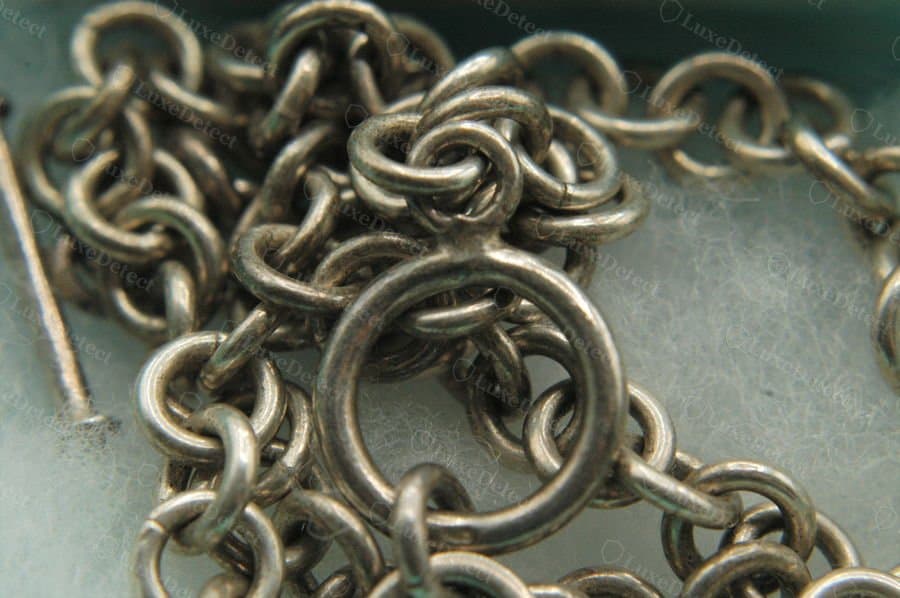
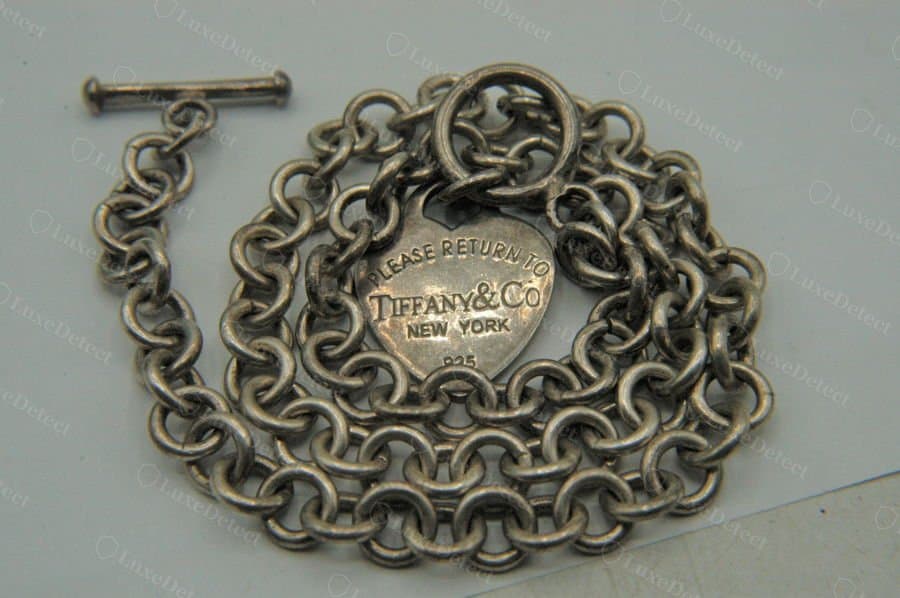
| Clasp type | Classic Return to Tiffany necklaces use a fine spring-ring (lobster-style) clasp on a light cable chain | We've seen fakes substitute a heavier belcher/rolo chain with a spring-ring or toggle clasp that doesn't match the piece's original design |
| Chain weight | Proportional to the piece; a fine necklace chain stays fine end to end | Chain can be noticeably heavier or thicker than the authentic version of that specific piece |
| Jump rings | Fully closed, no visible gap | Gaps or visible solder blobs at the rings |
| Spring-ring action | Smooth, positive lock | Stiff, loose, or grinding action |
Red flag
A belcher or rolo chain with a toggle clasp on a piece that Tiffany sells as a fine cable-chain, spring-ring design is a construction mismatch, not just a style choice — it means the counterfeiter built a generic base chain instead of copying the actual piece.
The "©TIFFANY & CO." Engraving and Chain Tag
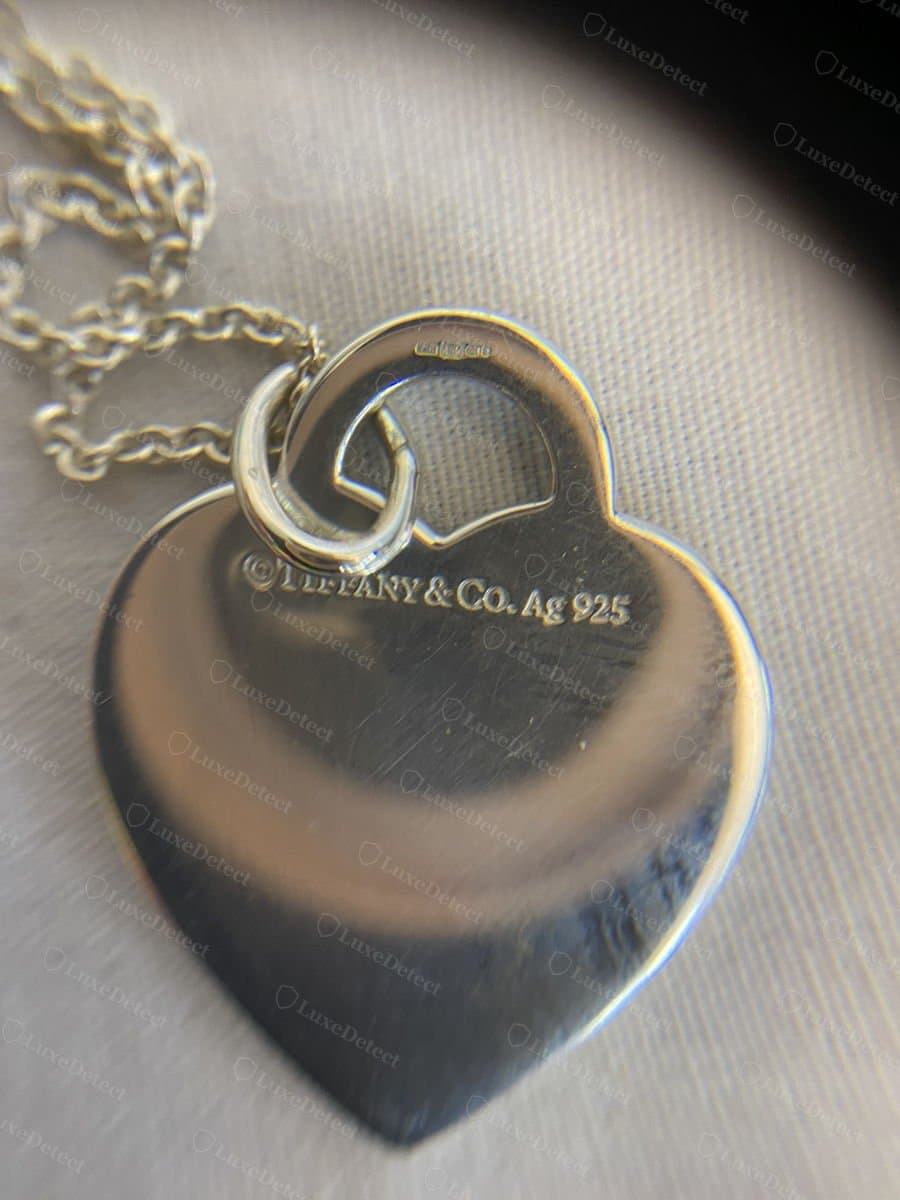
Most Tiffany pieces carry a small oblong tag stamped "©TIFFANY & CO." integrated into the chain itself, separate from any pendant.
| Element | Authentic | Counterfeit |
|---|---|---|
| Tag stamp | Crisp, evenly depthed serif engraving, copyright symbol present | Font can be close on better fakes; watch for shallow or uneven letter depth instead |
| Tag placement | Set into the chain near the clasp, matching link size | Sometimes oversized relative to the chain gauge |
| Copyright mark | Small © symbol precedes "TIFFANY & CO." | Frequently omitted on lower-tier fakes |
Worth knowing
We don't have a clean counterfeit example of this specific chain-tag style to show side by side, so treat font quality here as a supporting check, not a standalone one. Weigh it together with the chain and clasp construction above.
The Return to Tiffany Heart or Oval Tag Engraving
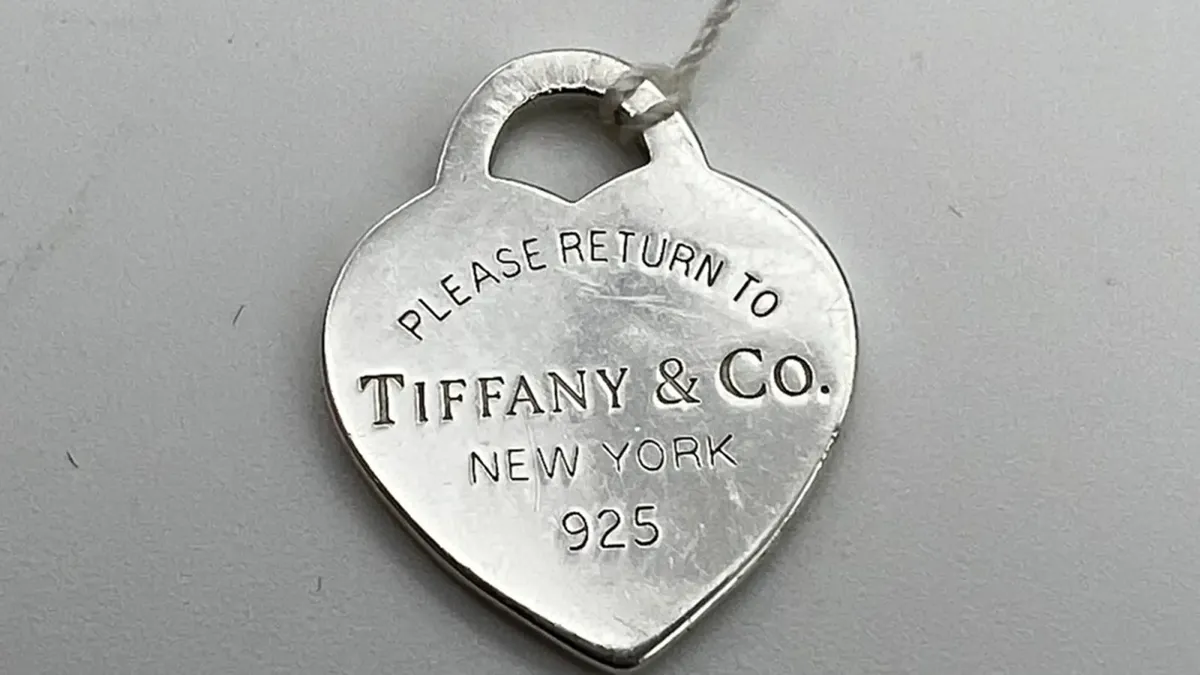
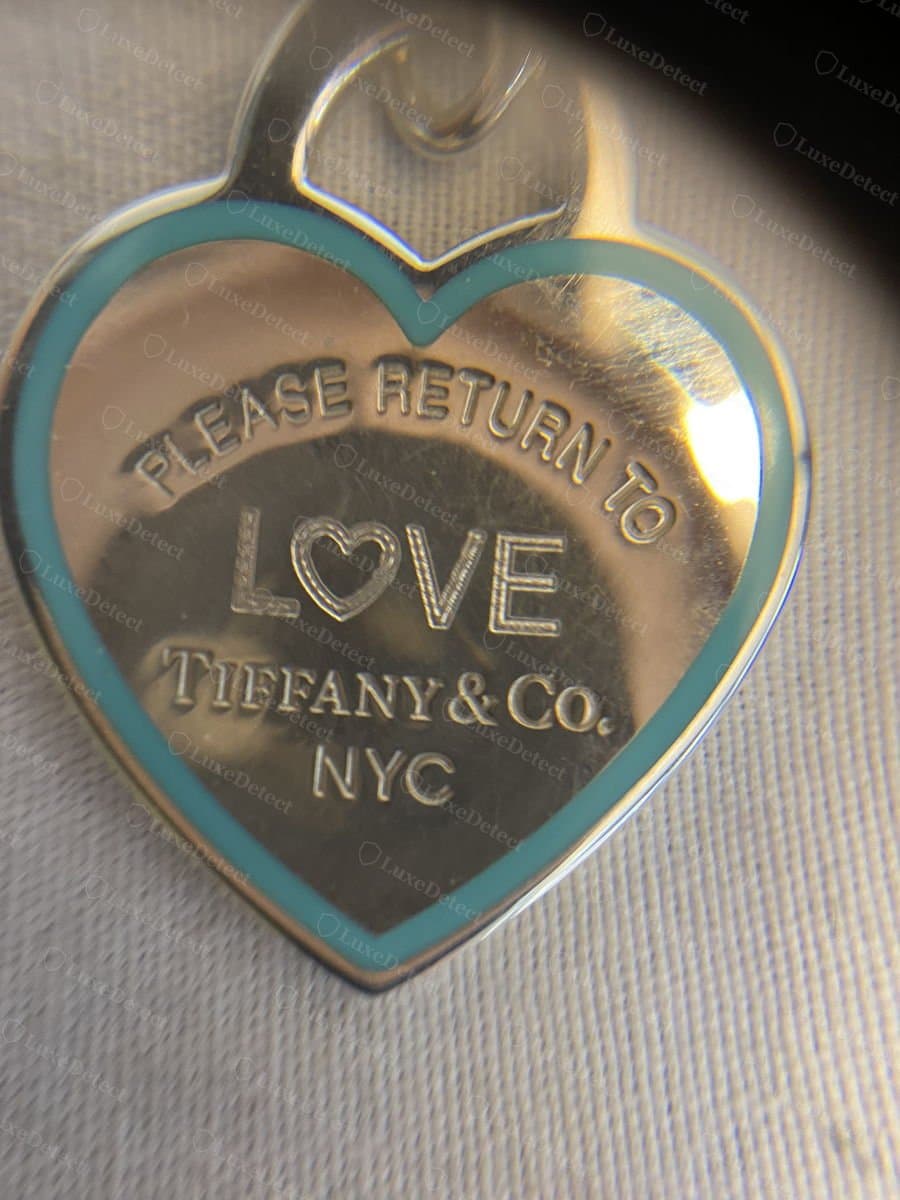
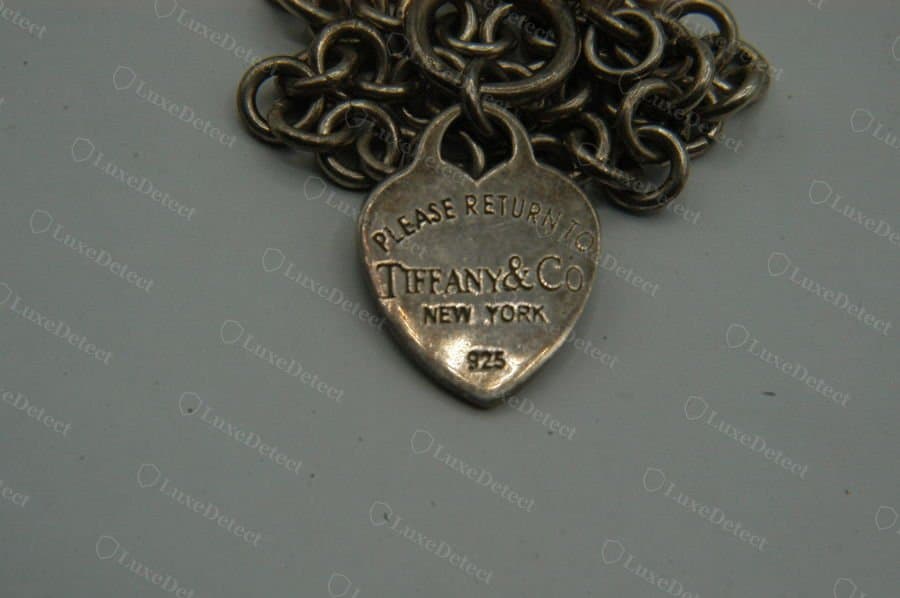
The heart tag reads "PLEASE RETURN TO / TIFFANY & CO. / NEW YORK / 925" in an arc; some limited editions add a small motif (a heart outline, "LOVE") above the brand line.
| Element | Authentic | Counterfeit |
|---|---|---|
| Font | Distinct serif face, consistent stroke weight, letters centered on the tag's vertical axis | Can be very close on well-made fakes; look for uneven baseline curvature instead of font shape alone |
| "925" placement | Small, centered below "NEW YORK" | Usually present and correctly placed even on decent fakes |
| Tag proportion | Heart shape is a specific width-to-height ratio Tiffany has used consistently | Slightly too wide, too narrow, or too pointed at the bottom lobe |
Worth knowing
We want to correct a claim that circulates in a lot of authentication guides, including an earlier version of this one: that font alone reliably separates real from fake Return to Tiffany tags. It does not, on the evidence we've reviewed directly. Use the font as one input, and weigh chain and clasp construction more heavily.
The 925 / Ag925 Sterling Stamp
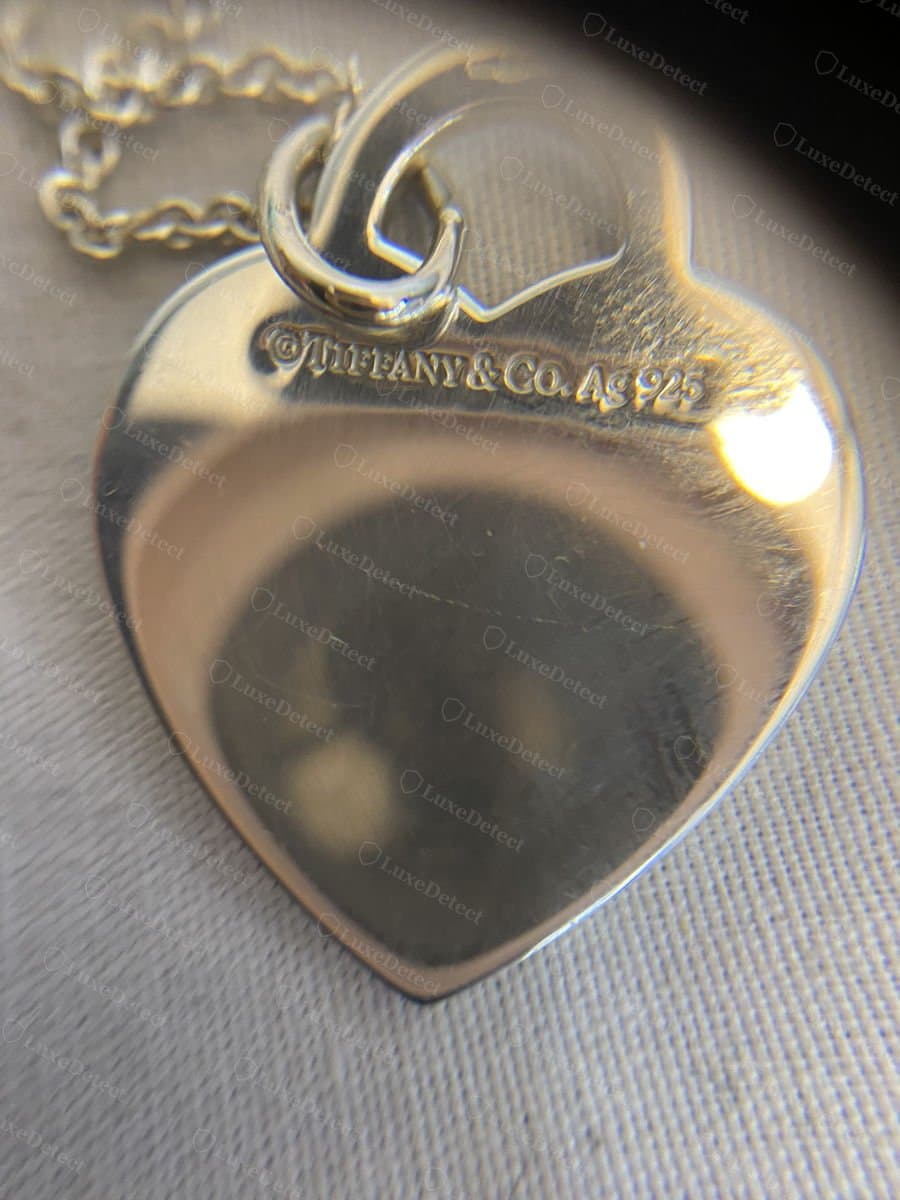
Authentic Tiffany sterling pieces are stamped "925," "Ag925," or "STERLING" somewhere discreet: on the heart tag itself below the main engraving, on the jump ring near the clasp, or inside a ring band.
| Element | Authentic | Counterfeit |
|---|---|---|
| Stamp depth | Consistent depth across every character | Shallow or uneven depth, sometimes only partially struck |
| Format | "925," "Ag925," or "STERLING," matching the piece's documented convention | "S925" or other non-standard formatting suggests non-Tiffany production, though this varies by piece |
| Location | Discreet, consistent placement for that piece type | Occasionally missing entirely on very cheap fakes |
Worth knowing
A present, correctly formatted 925 stamp is necessary but not sufficient. A missing stamp is a fail; a present one only rules out the crudest fakes.
Tiffany Blue Packaging
Packaging alone never authenticates a piece; most pre-owned pieces don't retain original packaging, and a fake can absolutely arrive in a convincing box. Where packaging is present, the registered Tiffany Blue (Pantone 1837) should read as a soft, medium-light robin's-egg tone rather than turquoise or teal, the ribbon should be a fine white satin, and the lid logo should be debossed rather than printed flat.
Worth knowing
Treat packaging as context for cross-referencing a listing's other claims, never as evidence for the piece itself.
Weight and Density
Solid sterling silver and gold are dense, noticeably heavier than plated base metal at the same size. This is directional, not definitive: ring size and piece design both affect weight, so use it alongside the hallmark and construction checks rather than on its own.
Quick Authentication Checklist
- Check the chain and clasp construction against the specific piece's documented design, not just "does it look like a chain."
- Inspect the 925/Ag925 stamp for consistent depth and correct format.
- Examine the heart or oval tag engraving for baseline evenness and correct proportions, as a supporting check, not a standalone one.
- Confirm the chain tag's "©TIFFANY & CO." stamp depth and placement.
- Weigh the piece in hand; solid sterling or gold should feel dense for its size.
- Treat packaging as context only.
Two or more failures means walk away. A construction mismatch on the chain or clasp (check 1) is close to sufficient on its own, since it's the most expensive detail for a counterfeiter to get exactly right.
When to Get a Professional Opinion
Font and hallmark checks from photos have a real ceiling, and we've now seen well-made fakes clear both. For anything beyond a low-value costume piece, get a second opinion before paying, especially private-sale listings without a return window. A $30 jewelry authentication with a same-day turnaround, or $55 with a 2-hour turnaround, is inexpensive relative to what a five-figure Tiffany estate piece can run, and comes with a Certificate of Authenticity.
FAQ
Can I tell from a photo if Tiffany jewelry is real?
Chain and clasp construction, and stamp depth and consistency, are visible in good photos and are stronger indicators than engraving font alone. We've compared authentic and counterfeit Return to Tiffany tags directly and found the engraving font can be close enough on better fakes that it won't settle the question by itself. For pieces over a few hundred dollars, request video under magnification or have the piece tested in person.
Is the engraving font a reliable way to spot fake Tiffany jewelry?
Not on its own, despite how often this claim appears. We've examined a counterfeit Return to Tiffany heart tag with font and layout close enough to genuine pieces that font alone didn't resolve it. Weigh it together with chain and clasp construction and the stamp depth, not in isolation.
Does authentic Tiffany ever tarnish?
Yes. Sterling silver (92.5% silver, 7.5% copper) tarnishes naturally with exposure to air and skin, and heavily tarnished pieces we've examined were genuine. Rapid, uneven tarnishing, where some areas darken quickly and others stay bright, can suggest silver-plated base metal where the plating has worn through, but tarnish alone doesn't indicate a fake.
What's the difference between authenticating Tiffany sterling and gold pieces?
Gold pieces carry a different hallmark (750 for 18k, 585 for 14k, 375 for 9k) and weigh more than an equivalent silver piece. The construction and stamp-depth checks are the same. Gold-plated fakes feel light and the plating wears through quickly at edges and high-contact points.
Is it possible to authenticate Tiffany using a magnet?
Partially. Sterling silver and gold are not magnetic; strong attraction to a magnet means the piece contains ferrous metal and isn't solid silver or gold. Some fake alloys are also non-magnetic, though, so passing a magnet test doesn't confirm authenticity on its own.
Where is the 925 stamp usually located on Return to Tiffany pieces?
Most commonly on the heart or oval tag itself, below the main "TIFFANY & CO." engraving, or on a small tag integrated into the chain near the clasp. Exact placement varies by piece and era, so treat an unusual location as one data point, not a verdict.