Fine Jewelry Authentication Specialist
Fine jewelry authentication specialist. Focuses on hallmarks, stone setting, and metal finishing.
Last updated September 2026 · Published June 2026 · Contact
Why Bvlgari Gets Faked
Bvlgari (officially spelled Bulgari, stylized BVLGARI) is one of the big three Italian jewelers alongside Cartier and Van Cleef & Arpels. The B.zero1 ring starts at $1,150 in yellow gold; the Serpenti Viper bracelet retails above $4,000; the Bulgari Bulgari necklace runs from $2,000 upward. All three are widely replicated, with convincing fakes reaching $200–400 on grey-market platforms.
What makes Bvlgari different to authenticate is that the house's signature is a typeface, not a construction trick. BVLGARI in Roman lapidary capitals appears on almost every piece, and cutting those letterforms cleanly into curved gold is a machining problem counterfeiters consistently lose. Get the engraving check right and most fakes are settled before you reach the hallmarks.
What to check, ranked by reliability
| Checkpoint | Reliability | What it tells you |
|---|---|---|
| The BVLGARI Logo Engraving — The Primary Check | ★★★★★ | Acid-etched, pitted letter walls are decisive; Bvlgari cuts its lettering cleanly. |
| Weight and Gold Tone | ★★★★★ | Any magnetic response proves ferrous content and settles it with no expertise needed. |
| B.zero1 Ring — Spiral Construction | ★★★★★ | A solder seam at a terminal, or an oval tube, exposes assembled rather than formed stock. |
| Serpenti — Hardware and Scales | ★★★★★ | Scales that stay flat under raking light were printed, not stamped into the metal. |
| Hallmarks — Metal Purity and Brand Mark | ★★★★★ | Catches missing assay marks and wrong origin, but punches are easily bought. |
Use our free Bvlgari Hallmark Checker to check the signature, purity mark and serial against what Bvlgari actually engraves.
Check My Hallmarks →The BVLGARI Logo Engraving — The Primary Check
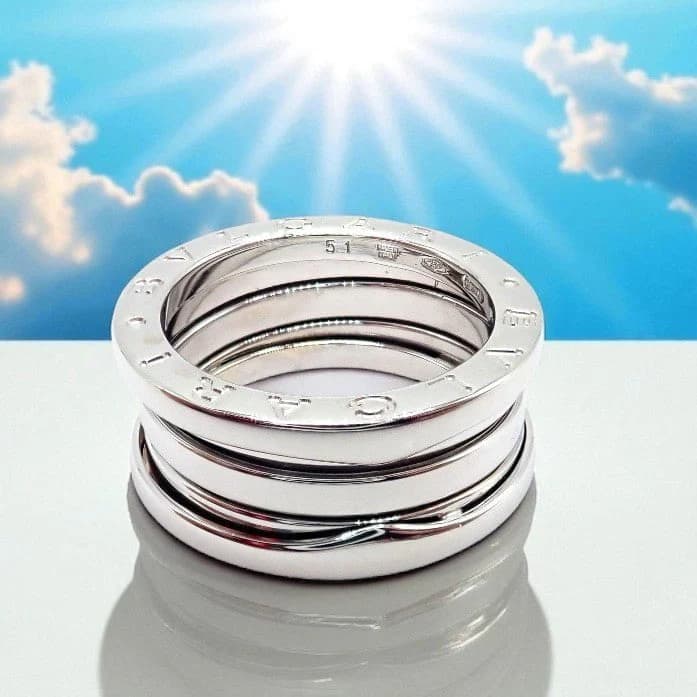
On every authentic Bvlgari jewelry piece, the brand name is engraved in Roman capitals: BVLGARI. This appears on the band of B.zero1 rings, the clasp of Serpenti bracelets, and the front motif of Bulgari Bulgari pieces. The typography is the single most diagnostic check.
Authentic engraving:
- The font is based on Roman lapidary inscription — the same letterforms used on ancient Roman monuments. The V is used in place of the U (hence BVLGARI not BULGARI). This is intentional and correct.
- Letter height and weight are consistent across all seven characters
- The engraving depth is moderate and consistent — no letter shallower or deeper than another
- On rings and bangles, the text wraps cleanly around the curvature with consistent spacing throughout the circumference
- On the B.zero1, "BVLGARI" is engraved repeatedly around the central spiral — each instance is identical in size and depth
Fake tells:
- Letters with inconsistent weight — some thicker strokes, some thinner
- "BULGARI" spelled with a U instead of V (some fakes copy the wrong version)
- Engraving that's too shallow (appears as a surface scratch rather than a clean cut)
- On B.zero1 rings, inconsistent spacing between repeated "BVLGARI" instances around the spiral
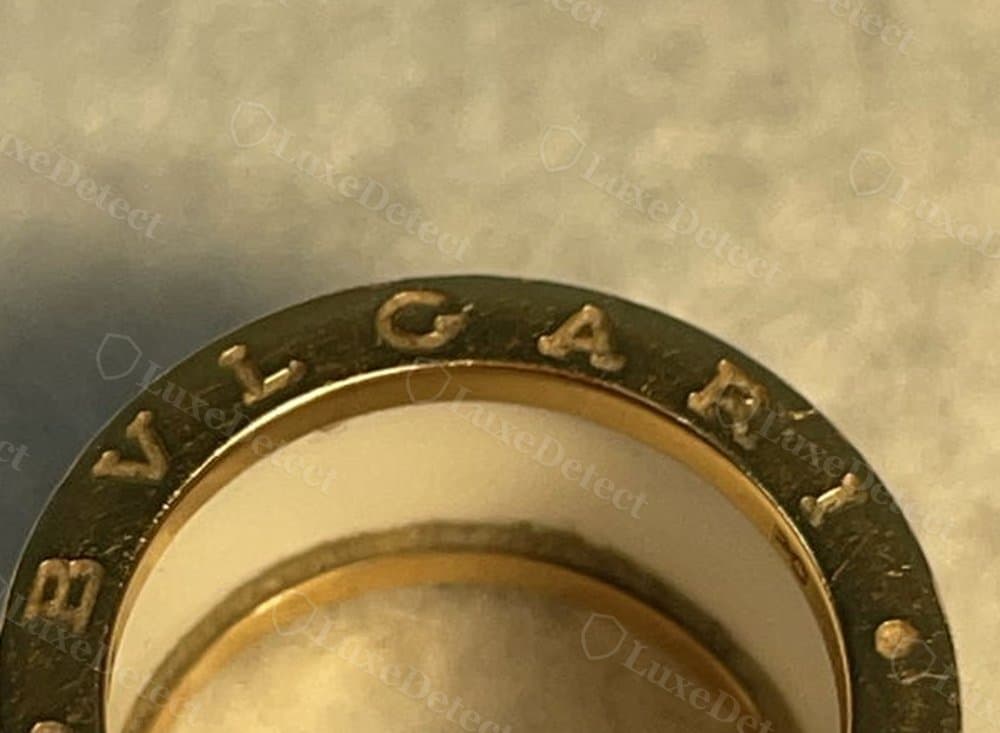
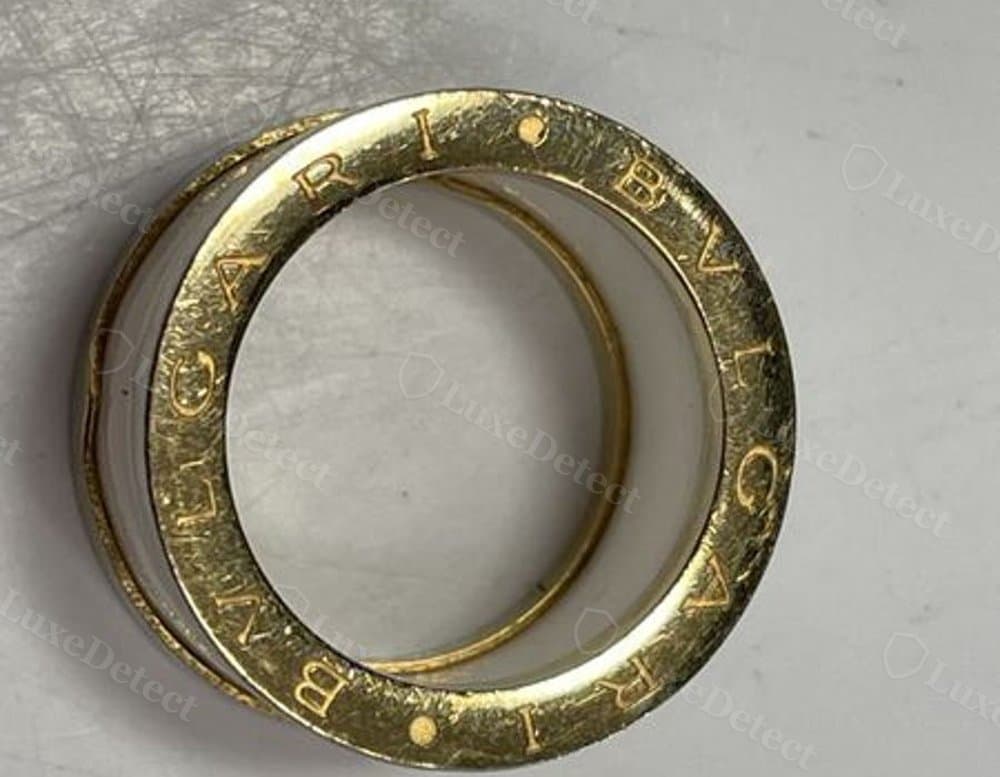
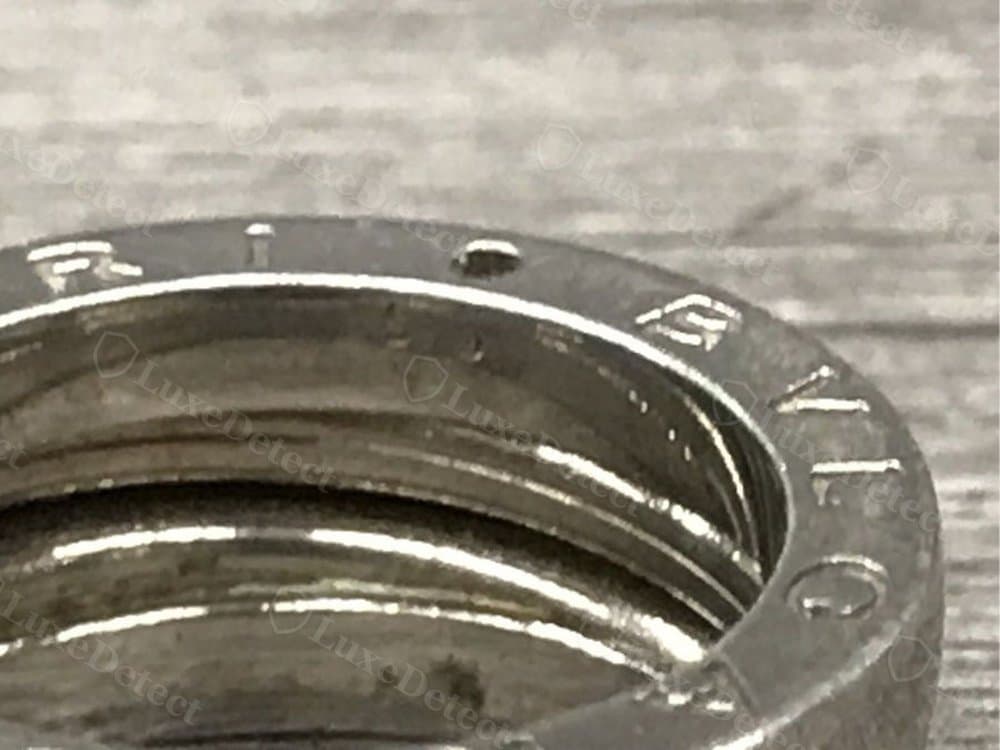
- Engraving with rough, pitted walls (acid-etched) rather than clean, sharp walls (laser-cut or hand-engraved)
| Element | Authentic | Counterfeit |
|---|---|---|
| Spelling | BVLGARI, Roman capitals, V in place of U | BULGARI with a U, or mixed casing |
| Stroke weight | Even across all seven characters | Some strokes visibly thicker or thinner |
| Cut walls | Clean and sharp, laser-cut or hand-engraved | Rough, pitted walls from acid etching |
| Depth | Moderate and identical letter to letter | Shallow, reads as a surface scratch |
| Wrap on a curved band | Spacing stays even around the full circumference | Spacing drifts or crowds at the curve |
| Repeats on a B.zero1 spiral | Every instance identical in size and depth | Instances vary in size, depth or spacing |
Red flag
Engraving with rough, pitted walls under magnification. Bvlgari cuts its lettering; acid etching leaves a ragged trench no genuine piece has, and on its own that ends the inspection.
Hallmarks — Metal Purity and Brand Mark
Inside the ring shank, on the clasp reverse, or on an inconspicuous surface of the piece, authentic Bvlgari jewelry carries:
- Metal purity: 750 for 18k gold (with Italian assay mark — a star with a number), 925 for sterling silver, 950 for platinum
- "BVLGARI" or "BVLG" brand mark
- Made in Italy mark (an M inside a hexagon for Italian manufacture, on pieces from approximately 2000 onward)
- A serial or reference number on modern pieces
Authentic hallmarks: Laser-engraved with sharp walls. The star assay mark (Italy's precious metal certification) is a small five-pointed star inside an oval. If the purity stamp shows a different assay system (UK lion, French eagle head, etc.) on a piece claimed to be current Italian production, that's worth investigating.
Fake tells:
- Missing purity stamp entirely
- 750 mark without the Italian star assay
- "Made in China" instead of "Made in Italy"
- Hallmarks that look acid-stamped rather than laser-engraved
| Element | Authentic | Counterfeit |
|---|---|---|
| Purity mark | 750 (18k), 925 (silver) or 950 (platinum) | Missing entirely, or a purity the piece cannot be |
| Italian assay | Five-pointed star in an oval, alongside the purity | 750 with no star, or a star of the wrong form |
| Origin | Made in Italy, M in a hexagon on post-2000 pieces | "Made in China", or no origin mark on a modern piece |
| Application | Laser-engraved, sharp-walled | Acid-stamped, soft and shallow edges |
| Serial / reference | Present on modern production | Absent, or repeated across listings from one seller |
Worth knowing
A correct hallmark set proves the metal and the factory claim, not the piece. Counterfeiters buy hallmarking punches; what they struggle to fake is the combination of a correct assay star, a clean laser cut and a serial that survives a boutique lookup.
B.zero1 Ring — Spiral Construction
The B.zero1 is Bvlgari's most iconic ring: a tubular band that spirals around a central disc, inspired by the Colosseum. Authentic construction details:
The spiral: The tube that spirals around the central disc is hollow and made from solid 18k gold. On authentic pieces, the spiral is uniform in width throughout — no variation between the beginning and end of the winding. The tube cross-section is perfectly circular, not slightly oval or flattened.
The central disc: The disc that the spiral wraps around is flat, polished, and laser-engraved with repeating "BVLGARI" text. Under magnification, the text is crisp and consistent across all instances.
The ends: The spiral terminates cleanly at both ends of the band with smooth, polished edges. On authentic pieces there are no sharp edges, seams, or solder points visible at the terminals.
Fake tells:
- Spiral tube that's slightly flattened (oval cross-section) — counterfeiters use cheaper tubing
- Spiral width that varies around the disc — wider at one side than the other
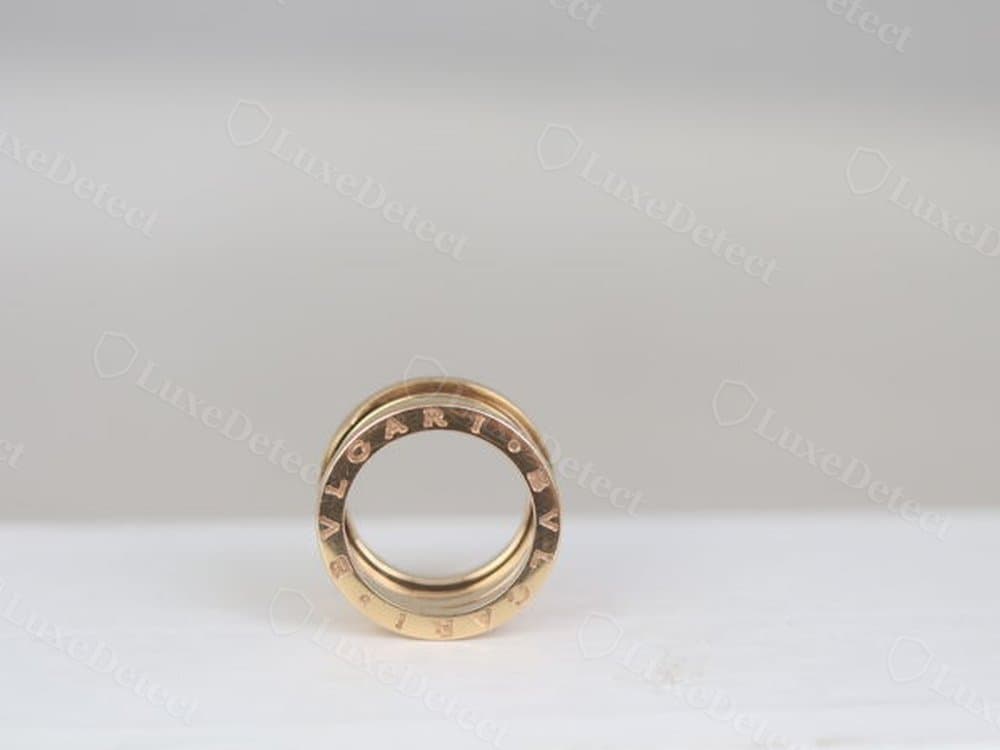
- Visible solder seam at the terminal points
- "BVLGARI" text on the disc that blurs under magnification
| Element | Authentic | Counterfeit |
|---|---|---|
| Tube cross-section | Perfectly circular the whole way round | Slightly flattened or oval (cheaper stock tubing) |
| Spiral width | Uniform from the start of the winding to the end | Visibly wider on one side than the other |
| Terminals | Smooth polished ends, no seam or solder point | Visible solder seam or a sharp edge at the terminal |
| Disc engraving | Crisp BVLGARI repeats, identical under magnification | Text blurs or softens under magnification |
Red flag
A visible solder seam at either terminal of the spiral. The B.zero1 band is formed, not assembled from cut lengths, so a joint line at the end of the winding is a construction no genuine ring has.
Serpenti — Hardware and Scales
The Serpenti collection uses a snake motif with scale-like surface detailing. The hardware is a defining quality indicator.
The scales: On authentic Serpenti pieces, the scale pattern is individually stamped or cast — each scale has consistent depth and crisp edges. Under raking light, the scales create a clear three-dimensional texture.
The head: The snake head clasp (on bracelets and necklaces) is a substantial piece of metal with precise detailing. The eyes (typically set with cabochon stones) are exactly the same size and are centered in their settings. The jaw mechanism opens and closes with clean positive action.
Fake tells:
- Scales that look printed or laser-etched rather than physically raised — flat under raking light
- Head eyes that are mismatched in size or off-center in their settings
- Jaw mechanism that's loose or doesn't close positively
- Head that feels lightweight for its visual size (hollow casting vs. solid)
| Element | Authentic | Counterfeit |
|---|---|---|
| Scales under raking light | Physically raised, clear three-dimensional relief | Flat, printed or laser-etched onto the surface |
| Scale edges | Crisp, consistent depth scale to scale | Soft, variable depth, some scales barely defined |
| Head eyes | Matched in size, centred in their settings | Mismatched or sitting off-centre |
| Jaw mechanism | Clean positive action, closes and holds | Loose, vague, or fails to close positively |
| Head weight | Substantial, solid for its visual size | Light and hollow-feeling for the size |
Red flag
Scales that stay flat under raking light. Genuine Serpenti scales are stamped or cast into the metal, so tilting the piece has to produce shadow and relief; a pattern that only exists as surface marking is decisive.
Weight and Gold Tone
Authentic Bvlgari 18k gold pieces are noticeably heavy — solid 18k is dense and warm to the touch. A B.zero1 ring in yellow gold (size 52, 1-band) weighs approximately 8–10 grams. A Serpenti bracelet will be proportionally heavier.
Gold tone: Bvlgari's yellow gold has a specific warm, rich saturation — more intense than 14k, distinct from rose gold. White gold has a cool, slightly blue-white tone. Fake gold plating tends to appear either too orange (brass base) or too pale (silver base with thin gold plate).
Magnet test: 18k gold and sterling silver are not magnetic. If any part of the piece shows strong magnetic attraction, it contains ferrous metal — definitive fake indicator.
| Element | Authentic | Counterfeit |
|---|---|---|
| Weight | Dense for its size; B.zero1 size 52 runs about 8–10 g | Noticeably light, feels hollow in the hand |
| Yellow gold tone | Warm, richly saturated, deeper than 14k | Too orange (brass base) or too pale (plated silver) |
| White gold tone | Cool, slightly blue-white | Grey, dull, or yellowing at wear points |
| Magnet | No attraction whatever | Any pull at all means ferrous content |
| Wear behaviour | Colour is the metal, so it cannot rub through | Plating wears at edges, showing a different base |
Red flag
Any magnetic attraction. Gold, silver and platinum are all non-magnetic, so a piece that responds to a magnet contains ferrous metal and cannot be what it claims. This is the one check that needs no expertise at all.
Quick Authentication Checklist
- BVLGARI engraving: Roman capitals with V not U, consistent depth and weight, laser-sharp walls
- Hallmarks: 750/925/950 purity + Italian star assay mark + "Made in Italy" + serial
- B.zero1 spiral: uniform circular tube, consistent width, no visible solder at terminals
- Serpenti scales: physically raised with clear depth under raking light; head eyes centered, jaw closes positively
- Weight: substantial for piece size (~8–10g for B.zero1 size 52); not magnetic
Two or more failures means walk away. A single failure on the engraving walls, a solder seam at a B.zero1 terminal, or any magnetic response is on its own sufficient.
When to Get a Professional Opinion
The gap that matters on Bvlgari is between a $200 grey-market copy and a $1,150 B.zero1. The cheap fakes fail the engraving check in seconds. The expensive ones use real 18k gold, carry plausible hallmarks and get the letterforms close enough that a photograph will not settle it, because engraving depth and wall quality are exactly what a listing image flattens away.
For a piece with a serial, the Bvlgari boutique lookup is the definitive route and it is free. Where that is not practical, our jewelry specialists authenticate Bvlgari from photos, from $30 for 24-hour turnaround, and return a Certificate of Authenticity you can use in a dispute.
FAQ
Why is it spelled BVLGARI with a V?
It's a deliberate stylistic choice referencing the Roman alphabet, where V served as both U and V. The founder Sotirio Bulgari opened his Roman shop in the 1880s and used the Latin/Roman inscription style as a nod to the city's classical heritage. Both "Bulgari" and "Bvlgari" are correct spellings — fakes sometimes use the wrong one.
Can I authenticate a Bvlgari piece at a boutique?
Yes. Bvlgari boutiques will examine pieces and run serial number lookups. This is the definitive authentication route. Bvlgari also offers a vintage authentication service for older pieces.
Is Bvlgari jewelry always made in Italy?
Current production is made in Italy. Some vintage pieces predate the Italian assay marking system. For any piece claiming to be current production, "Made in Italy" should be present and verifiable.
The ring fits perfectly but the BVLGARI text looks slightly off — is it fake?
Ring size and fit don't authenticate a piece. Evaluate the engraving quality independently. Take the ring to a Bvlgari boutique — they will confirm authenticity from the serial number and hallmarks even if the text appears correct to the naked eye.