Fine Jewelry Authentication Specialist
Fine jewelry authentication specialist. Focuses on hallmarks, stone setting, and metal finishing.
Last updated September 2026 · Published June 2026 · Contact
Why the B.zero1 Is the Most Faked Bvlgari Ring
Anish Kapoor designed the B.zero1 for Bvlgari in 1999, and in the 25 years since, it has become the house's most recognizable jewelry signature — the spiral band with "BVLGARI" repeated in Roman capitals around the central channel. It starts at around $1,200 in yellow gold for the single-band version and climbs to $3,000+ for the four-band.
The silhouette is simple enough to copy visually, which is why fakes proliferate. What a spiral of grooved metal cannot copy cheaply: the assembled construction that lets genuine bands compress and give, the engraving quality, and the hallmark system inside the band. Those three outrank everything else on this ring.
What to check, ranked by reliability
| Checkpoint | Reliability | What it tells you |
|---|---|---|
| Hallmarks Inside the Band | ★★★★★ | A blank interior with no fineness mark, assay symbol or brand stamp is decisive on its own. |
| The BVLGARI Engraving — Primary Check | ★★★★★ | Uneven letter spacing on a dull, unevenly plated surface is a strong, checkable tell. |
| Spiral Construction and Band Terminals | ★★★★★ | A visible seam at the terminal is useful, but a well-made fake can still pass the pinch test. |
| Gold Weight and Feel | ★★★★★ | Weight and warmth support a judgement but need the engraving or hallmarks to confirm it. |
| The B.zero1 Ring Family — Know What You're Looking At | ★★★★★ | Confirms which variant you're holding; does not by itself distinguish real from fake. |
Use our free Bvlgari Hallmark Checker to check the signature, purity mark and serial against what Bvlgari actually engraves.
Check My Hallmarks →The B.zero1 Ring Family — Know What You're Looking At
Before authenticating, confirm which variant you're examining:
- B.zero1 1-band (also called single): one spiral revolution — the slimmest
- B.zero1 3-band: three spiral loops around the central bar — the most common
- B.zero1 4-band: four loops — less common, heavier
- B.zero1 Rock: adds diamond pavé between the spirals
- B.zero1 Design Legend (Zaha Hadid): angular cuts into the spiral
The three-band is the most counterfeited. Fakes frequently miscount spiral loops or position the central bar asymmetrically.
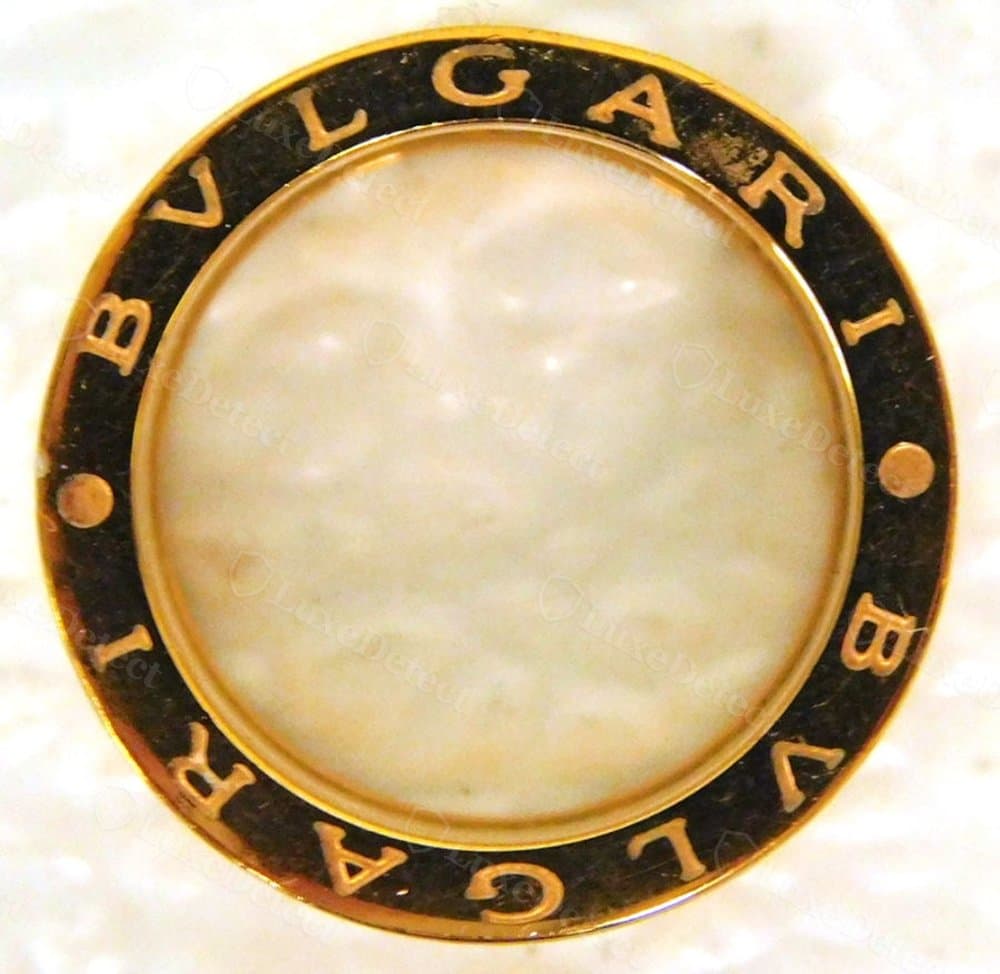
The BVLGARI Engraving — Primary Check
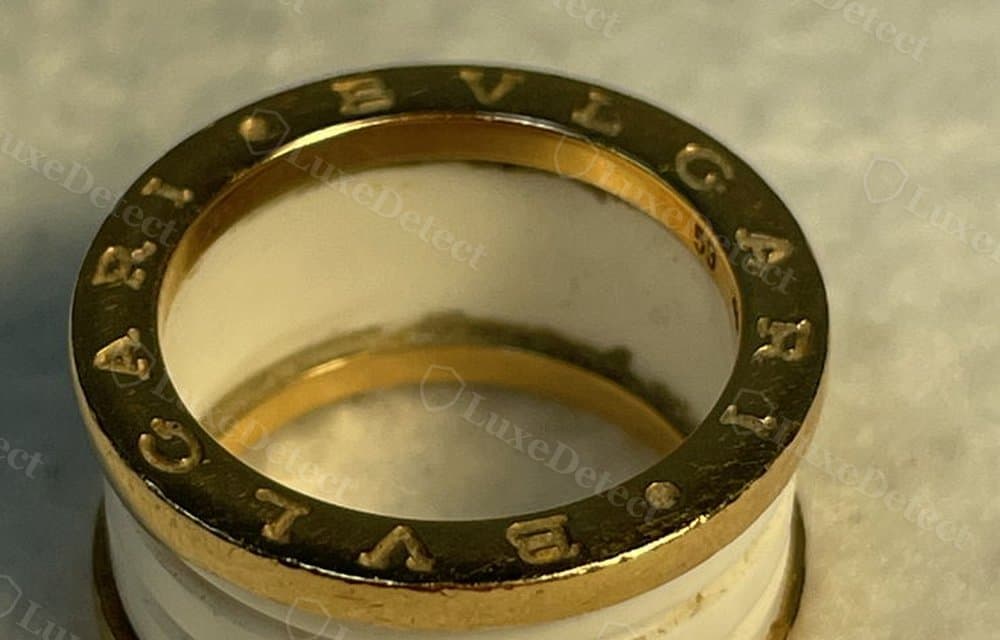
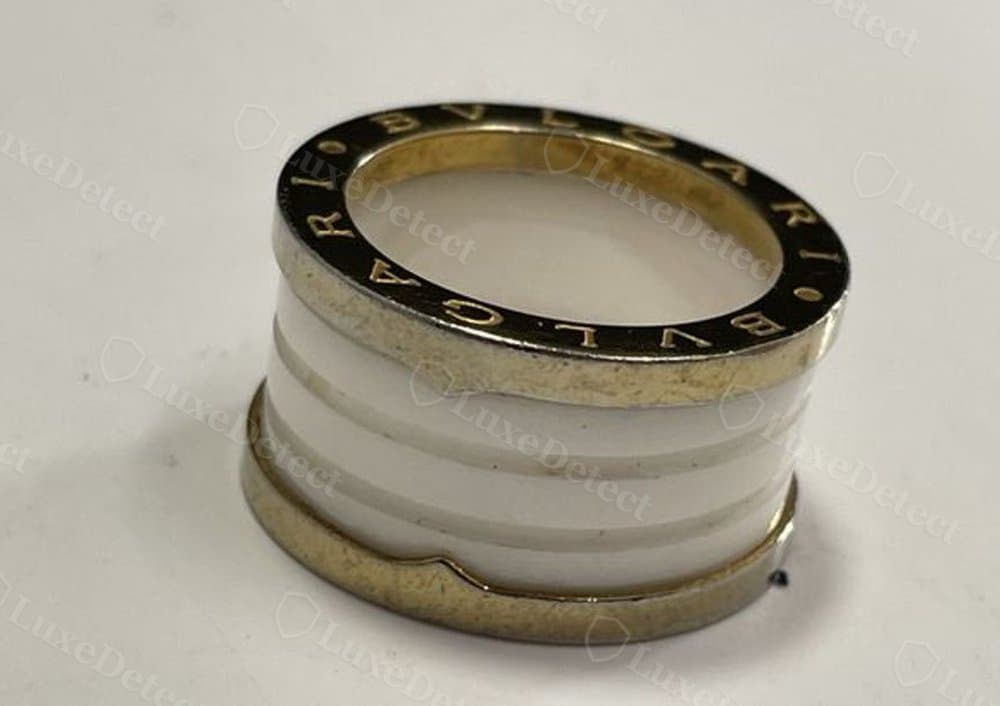
"BVLGARI" is engraved repeatedly around the outer surface of the spiral. On an authentic B.zero1:
Letterform accuracy: Bvlgari uses Roman lapidary script — the same letterform used on ancient Roman monuments. The V is correct (BVLGARI, not BULGARI). Each letter has consistent thick and thin strokes following classical proportion. These details are nearly impossible to replicate cheaply.
Engraving depth and consistency: The engraving is cut to a consistent depth around the entire circumference. Where the text wraps around the curve of the spiral, the depth doesn't change. Fakes produced by acid etching or shallow stamping show inconsistent depth and softer, less defined letter walls.
Spacing between instances: On a 3-band ring, "BVLGARI" appears approximately 8–10 times per band. The spacing between each instance is uniform. On fakes, spacing drifts — some instances are tight, others have visible extra space, and the plating on the raised letters often shows uneven wear straight out of the box.
| Element | Authentic | Counterfeit |
|---|---|---|
| Spelling | BVLGARI, Roman capitals, V in place of U | BULGARI with a U, or mixed casing |
| Stroke weight | Even across all seven characters | Some strokes visibly thicker or thinner |
| Cut walls | Clean and sharp, laser-cut or hand-engraved | Rough, pitted walls or a shallow stamped look |
| Surface finish | Mirror-polished gold around the engraving | Matte, scratched, or unevenly plated surface |
Red flag
Letters with uneven spacing or a rough, matte plating texture around the engraved band. Genuine B.zero1 engraving sits on a mirror-polished surface with consistent letter spacing; a dull, scuffed finish straight out of the box is not how 18k gold wears.
Hallmarks Inside the Band
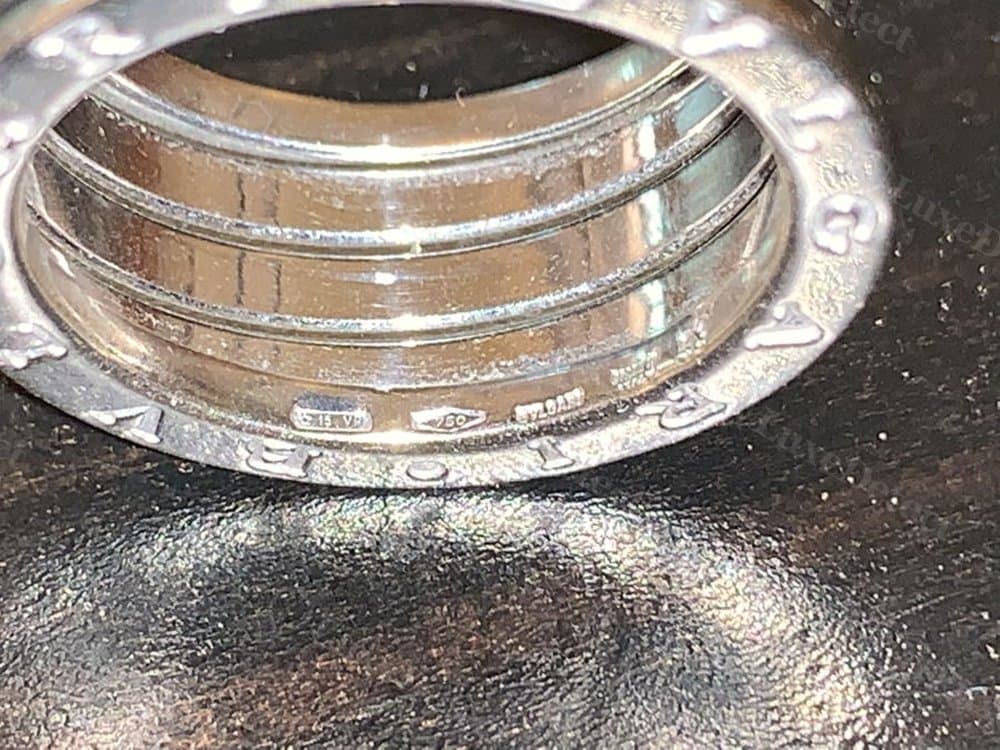
Turn the ring and look inside the flat central band (the inner channel between the spirals). Authentic B.zero1 hallmarks:
"750": The fineness mark for 18-karat gold. This must be present on all gold versions, usually stamped inside the innermost band alongside the brand mark.
Italian state assay mark: A small star or other geometric mark from the Italian assay office — required on all gold sold in Italy. On fakes, this is absent or clumsily copied.
"BVLGARI" mark: A secondary, smaller brand stamp appears inside the band alongside the fineness and assay marks. On authentic rings, this is finely engraved and consistent with the outer engraving quality.
Ring size: Clearly engraved, typically in EU sizing, alongside the other interior stamps.
| Element | Authentic | Counterfeit |
|---|---|---|
| Fineness mark | 750 stamped inside the innermost band | Missing entirely, or a mark the metal can't support |
| Italian assay | Star or geometric assay symbol present | Absent, or a symbol of the wrong form |
| Brand mark | Small "BVLGARI" stamp alongside the fineness mark | Missing, or crudely applied |
| Ring size | Engraved inside the band | Often absent on cheap fakes |
Red flag
No hallmark stamps at all inside the band. A blank interior where the fineness mark, assay symbol, and brand stamp should sit is not a manufacturing variation — every genuine gold B.zero1 carries this set, and its total absence is decisive on its own.
Spiral Construction and Band Terminals
The B.zero1 is built as an assembled spiral, not carved from one piece of stock. This is the construction detail that most consistently separates real from fake.
Assembled, not solid: Genuine multi-band B.zero1 rings are formed from separate bands joined at the spiral, which is why the ring has a very slight give when pressed. A ring cut or cast as one solid grooved piece has no such give.
Band terminals: Where the spiral bands meet, authentic construction shows a smooth, finished transition — no rough seam or visible joint line breaking the polish.
Band width consistency: Each spiral loop is the same width from start to finish around the circumference. Any variation in band width indicates poor manufacturing.
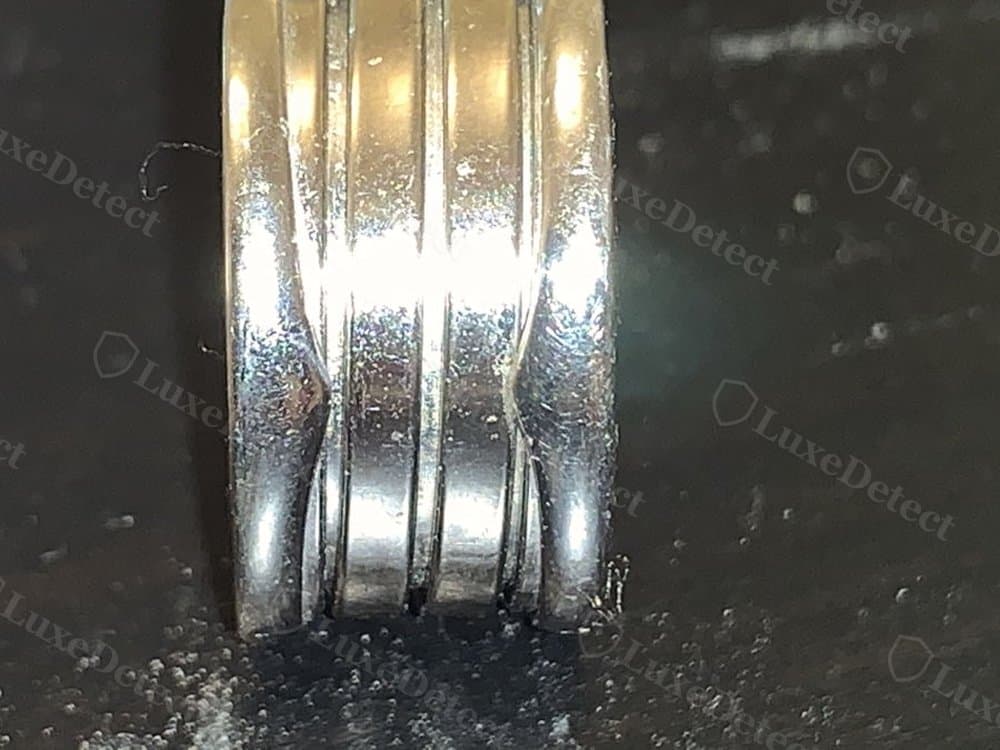
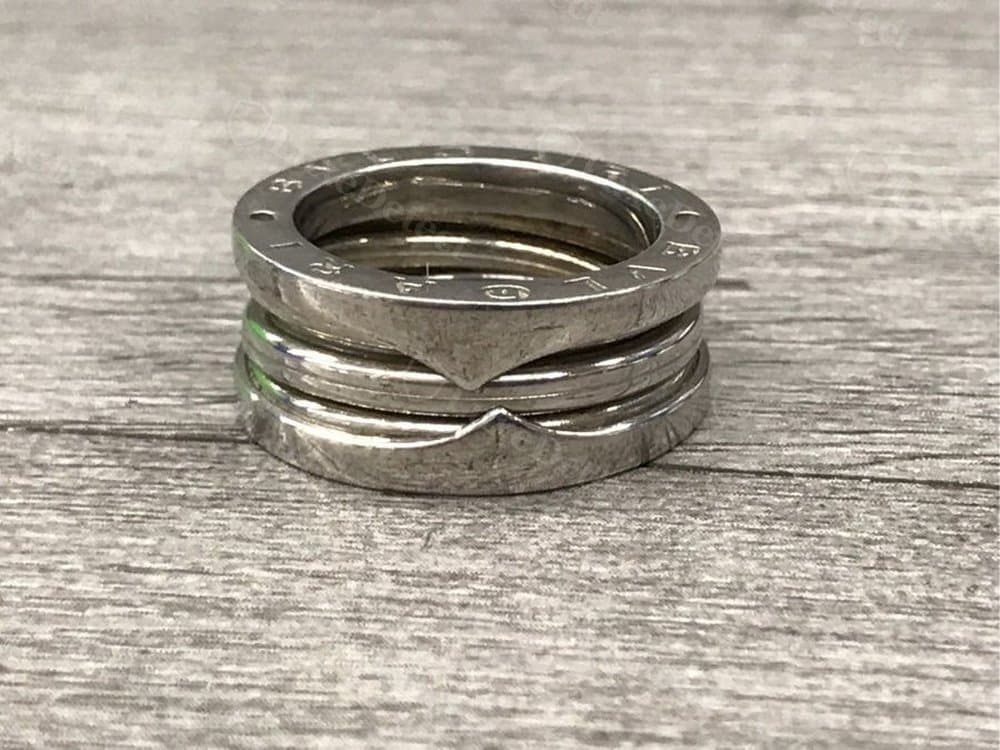
| Element | Authentic | Counterfeit |
|---|---|---|
| Construction | Assembled bands, slight give under gentle pressure | Often cast or cut as one rigid piece, no give |
| Band terminals | Smooth, polished transition where bands meet | Visible seam or joint line at the terminal |
| Band width | Uniform from the start of the winding to the end | Visibly wider on one side than the other |
| Surface finish | Consistent mirror polish across every band | Dull or matte patches, inconsistent polish |
Worth knowing
The pinch-and-give test is a useful cross-check but easy to get wrong on a well-made fake — some counterfeits use assembled bands too. Weigh it alongside the engraving and hallmark checks rather than on its own.
Gold Weight and Feel
Authentic 18-karat gold is dense. A three-band B.zero1 in yellow gold weighs approximately 11–18 grams depending on size. This weight is immediately noticeable when you hold the ring.
Temperature: Gold is a good thermal conductor — authentic gold rings feel cool and reach body temperature quickly. Gold-plated base metals warm more slowly and feel slightly different at the moment of contact.
Plating thickness on white/rose gold: Authentic white gold B.zero1 rings are rhodium-plated 18K white gold — the plating is thick enough that you don't see base metal at stress points (inner band edge, hinge areas). Fakes show brass showing through at wear points on new or barely-used rings.
| Element | Authentic | Counterfeit |
|---|---|---|
| Weight | Dense for its size; three-band runs about 11–18 g | Noticeably light, feels hollow in the hand |
| Wear at stress points | Colour is the base metal, doesn't rub through | Plating wears at edges, revealing a different metal |
| Feel at first touch | Cool, reaches body temperature quickly | Warms more slowly, slightly different feel |
Quick Authentication Checklist
- Check the BVLGARI engraving for even spacing and a mirror-polished surface around it
- Turn the ring and confirm the 750 fineness mark, assay symbol, and brand stamp inside the band
- Look for a clean, seamless transition at the spiral's band terminals
- Confirm the band count matches the stated variant (1/3/4-band)
- Weigh the ring in hand for density consistent with solid 18k gold
- Check white or rose gold versions for brass showing through at stress points
A missing hallmark set or a rough, unevenly spaced engraving is on its own sufficient to reject the ring. Two or more failures on the softer checks (weight, wear, terminal finish) together are also enough to walk away.
When to Get a Professional Opinion
The gap that matters on the B.zero1 is between a $150 grey-market copy and a genuine $1,200+ ring. Cheap fakes fail the engraving and hallmark checks in seconds — a blank interior or obviously uneven lettering settles it from a couple of photos. The harder cases are rings with real gold content and a passable spiral, where the deciding details (engraving wall sharpness, whether the bands genuinely give under pressure) are exactly what a listing photo flattens away.
For a ring with a legible interior serial, a Bvlgari boutique lookup is free and definitive. Where that isn't practical, our jewelry specialists authenticate B.zero1 rings from photos, from $30 for 24-hour turnaround, and return a Certificate of Authenticity you can use in a resale or dispute.
FAQ
What metals does the B.zero1 ring come in?
Yellow gold (18K), white gold (18K rhodium-plated), rose gold (18K), and black ceramic with gold. All gold versions carry the 750 fineness hallmark inside the band. A silver or platinum B.zero1 does not exist in standard production.
Is "BULGARI" spelled correctly or should it be "BVLGARI"?
Both spellings are used — "Bulgari" is the legal company name, while "BVLGARI" (with a V) is the stylized brand mark used on jewelry engraving, following Roman inscription tradition. On the ring exterior, you should see BVLGARI with a V. Fakes sometimes use BULGARI with a U on the outer engraving, which is incorrect for jewelry pieces.
Can I authenticate a B.zero1 at a Bvlgari boutique?
Yes. Bvlgari boutiques will authenticate pieces and can cross-reference the serial number against their records for pieces manufactured post-2000. Bring the original box and documentation if available.
Does the B.zero1 come with a certificate?
Bvlgari includes a product card and warranty booklet with new purchases. The card is not an authentication document — it's a product descriptor. Authentication relies on the physical ring's hallmarks and construction quality.
How do I read the ring size on a B.zero1?
Bvlgari uses EU ring sizes (numeric, typically 50–65). A size 52 in Bvlgari corresponds approximately to a US size 6. The size is engraved inside the band alongside the other hallmarks.