Hermès Authentication Specialist
Handbag authentication specialist. Has reviewed submissions across Hermès, Chanel, Louis Vuitton, and Dior since 2019.
Published November 2026 · Contact
How to Tell if a Vintage Hermès Bag Is Real: The Short Answer
A real vintage Hermès bag fits its own era from top to bottom: the date stamp (if it has one), the leathers, the hardware, the zip and the lock all belong to the same period, and the saddle stitching is done by hand. Worn gold plating, a softened engraving, a replaced handle and a missing stamp are normal on a bag that is 30 or 60 years old. A leather that did not exist yet, a stamp format from the wrong period or a stamp whose words run together are not.
"Vintage Hermès" covers a long stretch: the Haut à courroies of 1892 and the Sac à dépêches of the 1930s, the Kelly (named after Grace Kelly), the Constance, and the first Birkins from 1984. This guide covers what changed across those decades and what to check on each bag. It does not repeat the letter-by-letter year chart: that lives in our Hermès date codes guide, and this guide shows how to use it on an older bag.
Worth knowing
There is no single tell that separates every genuine vintage Hermès from every fake. The checks below rule bags out when something is wrong for the era; a bag that passes is consistent with a genuine one, not confirmed. There is no public Hermès registry or serial lookup, and most vintage bags have no card, so an expensive piece deserves a professional review.
What to check, ranked by reliability
| Checkpoint | Reliability | What it tells you |
|---|---|---|
| 6. Leather by Era: What Could Not Exist Yet | ★★★★★ | A leather that did not exist in the stamp year (Togo before 1997, Epsom before 2004) ends the inspection; a leather that fits clears nothing. |
| 2. The Hermès Paris Stamp: Wording, Accent and Spacing | ★★★★★ | Words run together or uneven pressing are fake patterns; the accent and the Made in France line decide nothing. |
| 1. The Date Stamp by Era, Including Before 1971 | ★★★★★ | A frame that belongs to another period contradicts the bag; a fitting stamp gives the year, not the verdict, and many genuine bags have none. |
| 3. Hardware: Plating, Plates, Strap Hooks and Feet | ★★★★★ | Blank strap plates, mixed finishes and a modern strap hook on an old bag are warnings; hardware is often replaced. |
| 5. Zippers, Linings and the Interior | ★★★★★ | Dates the bag by zip style, so an H zip stop on a 1960s bag is a contradiction; an ÉCLAIR slider is normal on older bags. |
| 7. Pre-Birkin Construction: Stitching, Edges and Shape | ★★★★★ | Hand saddle stitch and the right construction for the model; machine-uniform stitching is wrong, wear is not. |
| The Vintage Models and What to Check on Each | ★★★★★ | Rules out a bag whose details belong to another model or era; will not catch a good fake. |
| 4. Locks, Keys and the Clochette | ★★★★★ | Mismatched numbers are a warning, but locks and clochettes are sold and replaced separately. |
| What Is Normal and What Is Not a Tell | ★★★★★ | Separates wear and repairs from evidence; no card, no stamp or a loose dust bag proves nothing either way. |
Vintage Hermès Eras at a Glance
Dates for models come from auction houses and resale authenticators, and they disagree at the edges, so each row gives the most common date and the doubt where there is one.
| Period | What happened | What it means when you check a bag |
|---|---|---|
| 1892 | The Haut à courroies, a tall saddle-carrying bag, is the root of the Kelly | The oldest Hermès bag shape; very rare |
| 1922 to 1944 | First leather handbags; no date stamp yet | A bag from these years should carry no year letter |
| 1930s | The Sac à dépêches (sources give 1930, 1932 and 1935; one resale guide quotes 1928 from Hermès's own timeline) | The Kelly's ancestor; it was also sold as a men's briefcase |
| 1945 to 1970 | Year letter A to Z with no frame around it | The same plain letter returns after 2015, so the bag decides which |
| 1956 to 1977 | Grace Kelly is photographed with the bag in the 1950s; most sources say Hermès made the name Kelly official in 1977 | A "Kelly" label on a pre-1950s listing is a seller's later name |
| 1959 | The Constance (Sotheby's and Christie's date it to 1959; one source quotes Hermès as dating its H clasp to 1967) | An H-clasp Constance with a 1950s stamp needs an explanation |
| 1971 to 1996 | Year letter A to Z inside a circle | A circled letter on the strap or interior |
| 1984 | The Birkin | An early Birkin carries a circle stamp |
| 1992 | Clemence leather appears (most sources) | A Clemence bag with an earlier stamp is a contradiction |
| 1997 | Year letter inside a square; Togo leather appears (most sources) | A Togo bag stamped before 1997 is a contradiction |
| 2004 | Epsom replaces Courchevel (resale sources) | Epsom with an older stamp does not fit |
| About 2000 to 2001 | Strap rings are doubled on the Kelly; H-shaped zip stops appear in the early 2000s (a vintage-dealer guide, approximate dates) | A guide to dating hardware, not a hard cut-off |
| 2015 | Plain letter again, in an order Hermès does not publish | Not vintage |
A model name alone dates nothing, because the shapes overlap in time.
The Vintage Models and What to Check on Each
Confirm the model from the bag, not from the listing. Sellers use "Kelly" for almost any Hermès top-handle bag, and the details that are right on one shape are wrong on another.
Kelly and Sac à dépêches
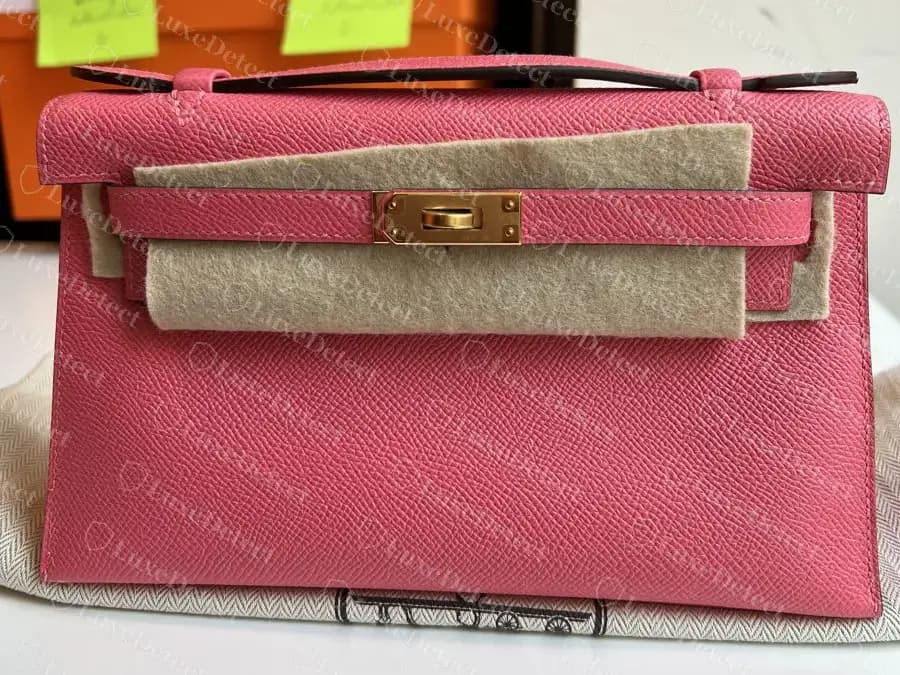
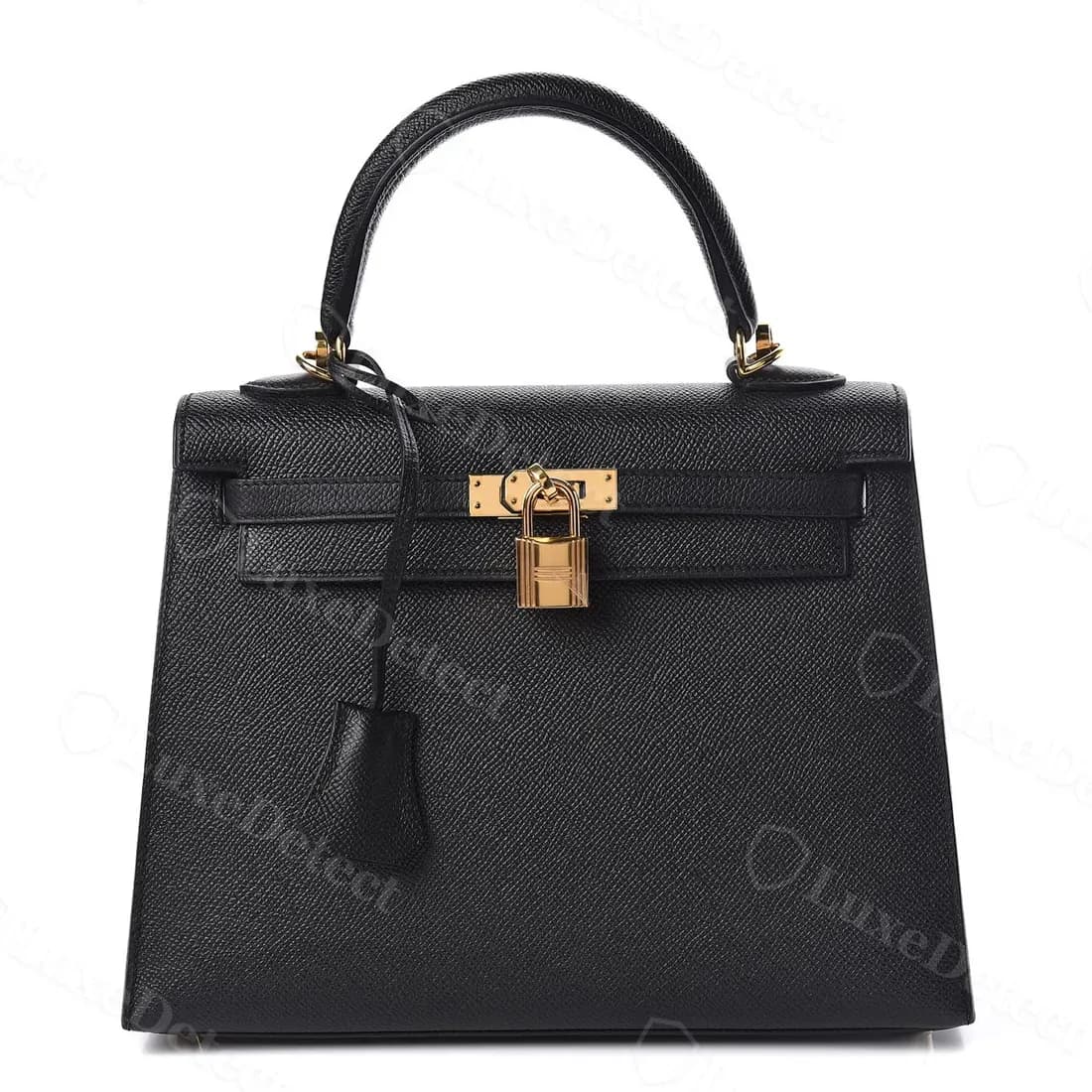
The Kelly grew out of a woman's version of the Haut à courroies that Robert Dumas reworked in the 1930s as the Sac à dépêches, which is why a briefcase-style Sac à dépêches still exists beside the Kelly. The Kelly comes in two constructions: the Sellier (rigid, stitched on the outside, sharp edges) and the Retourné (turned right side out after sewing, so the stitching is hidden and the edges are soft). The oldest Kelly most buyers can realistically find is from the 1950s, and vintage Kellys are generally in box calf or suede. The genuine Kelly on the cover of this guide is a black box calf Sellier. Our Hermès Kelly guide covers the turn-lock plate, handle and strap checks on the model.
Constance
A shoulder bag with a large H clasp, designed by Catherine Chaillet and named after her daughter; Sotheby's dates it to 1959 and notes that the earliest Constances were made in box leather. Dealers also list vintage Constances in suede. For the later exotic versions and the H clasp edge engraving, see our Constance exotic guide.
The first Birkins (1984 to the 1990s)
The Birkin dates from 1984. A Birkin from the first decade carries a circled letter on the strap, not a letter in a square, and its leathers are the ones available then (box calf is the oldest Hermès leather), with Clemence from about 1992 and Togo from about 1997. Our Hermès Birkin guide has the checks that apply to a Birkin of any age.
Haut à courroies, Bolide and Evelyne
The Haut à courroies (1892) is the rarest. The Bolide dates from 1923 and is often described as the first Hermès bag with a zip. The Evelyne was created in 1978 for the riding department. For any of these, expect the construction details below, and expect a dealer to be able to explain a very early example.
| Model | Era to expect | Check first |
|---|---|---|
| Sac à dépêches and Kelly | 1930s onward; Kelly name official 1977 | Stamp format against the date, strap plate, lock |
| Constance | 1959 onward | H clasp, leather (box or suede on the earliest) |
| Birkin | 1984 onward | Circle stamp on a 1980s and 1990s bag, leather against era |
| Bolide | 1923 onward | Zip pull, stamp, leather |
| Evelyne | 1978 onward | Perforated H, stamp, leather |
The Date Stamp by Era, Including Before 1971
The date stamp is a small mark pressed into the leather without ink, a letter whose frame tells you the period. The full table is in our date codes guide and the live decoder below it reads a stamp for you. For a vintage bag, what you need is the shape of each period:
- Before 1945: no year letter. A bag from these years with a stamp on it is not following the system.
- 1945 to 1970: one plain letter, A for 1945 up to Z for 1970. This is the stamp on the oldest Kellys and Sacs à dépêches you can find.
- 1971 to 1996: the letter inside a circle, A for 1971 up to Z for 1996.
- 1997 to 2014: the letter inside a square, A for 1997 up to R for 2014. Some late-2014 pieces show a plain R with no frame.
Use our free Hermès Date Stamp Decoder to identify the production year of any Birkin, Kelly, or Constance — circle, square, or modern alphanumeric format.
Decode Hermès Stamp →The trap on pre-1971 bags is the plain letter. Hermès went back to unframed letters in 2015, in an order it does not publish, so an unframed A could mean 1945 or 2017. A bag whose leather, hardware and construction look like a 1950s Kelly cannot carry a 2017 letter, and the reverse is just as wrong. Always read the frame together with the bag.
Three more points that catch people out:
- Position. On many Kellys and Birkins made before about 2015 the stamp sits on the inside of the strap, under the buckle; later bags carry it inside the bag. On older bags it is also found near a seam or behind a strap, so look before you decide it is missing.
- Many genuine vintage bags have no stamp. Stamps wear, repairs can remove them, and some older bags were never stamped. A missing stamp moves the weight to the rest of the bag. It is not a red flag by itself.
- A craftsman mark next to the letter is not part of the year. It identifies the workshop. A horseshoe means a special-order item and an S has been described as marking a staff-purchase bag.
Red flag
A date stamp whose frame does not belong to its own period (a squared letter on a bag whose leather and hardware are plainly 1960s, or an unframed letter on a bag with leather that did not exist when that year ended) is a strong reason to reject it, because the stamp and the bag are telling two different stories.
Worth knowing
A stamp that fits tells you the production year, not the verdict. Fakers stamp their bags, and a stamp can be pressed on a bag that was later restored with parts from another bag. See our [Birkin and Kelly special stamps guide](/blog/hermes-birkin-kelly-special-stamps-guide) for the horseshoe and exotic-skin marks.
The Hermès Paris Stamp: Wording, Accent and Spacing
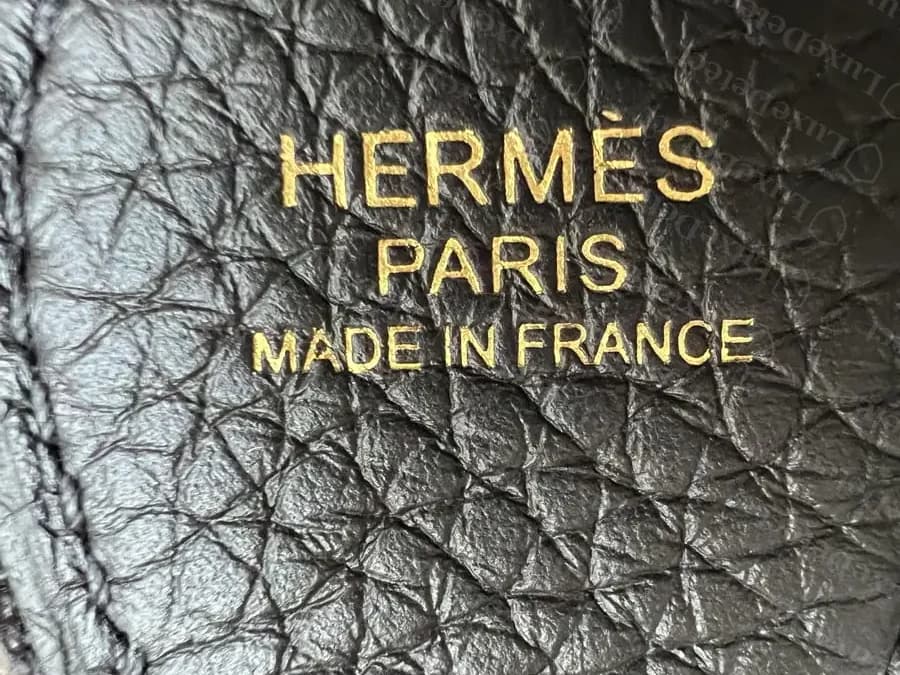
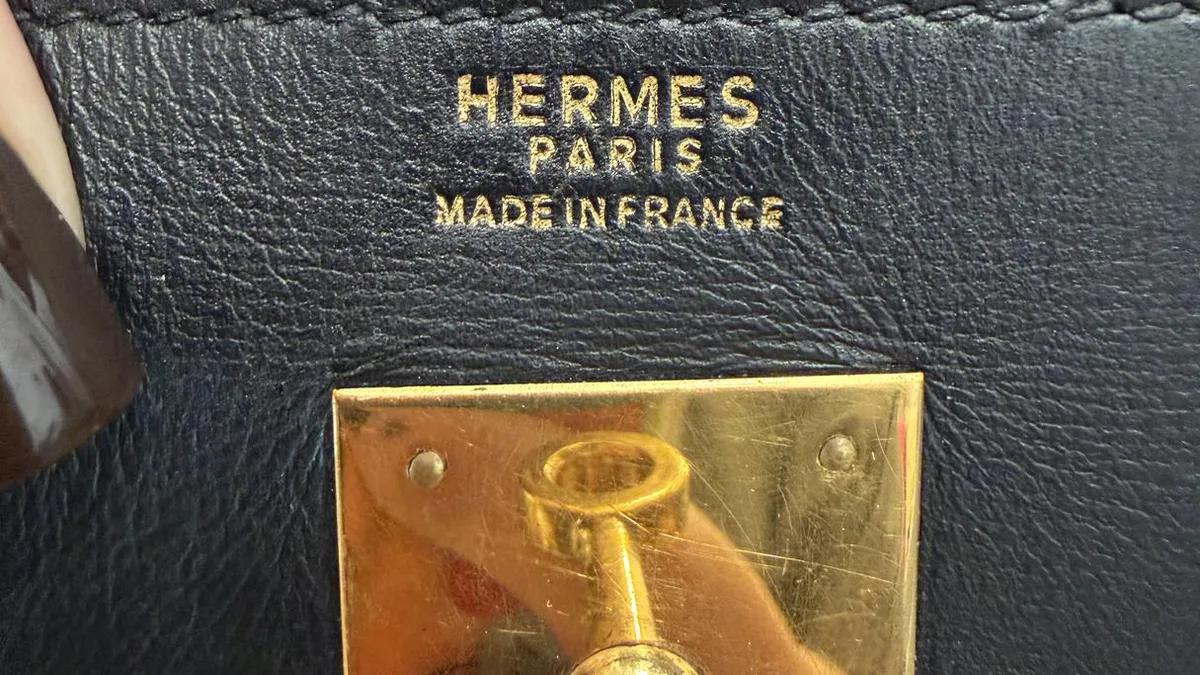
Older Kellys carry the foil stamp (HERMES or HERMÈS, PARIS, MADE IN FRANCE) on the front, under the flap and above the turn-lock plate, and later bags keep it in the same place. Genuine vintage Kellys in our archive show both normal versions of it, and they differ in one thing that surprises people: the accent.
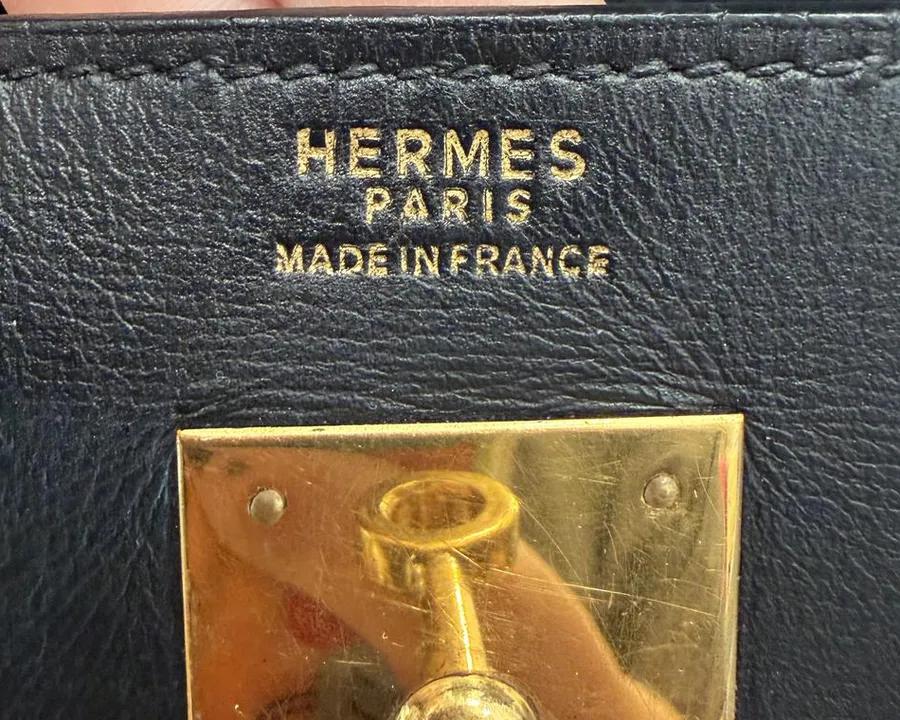
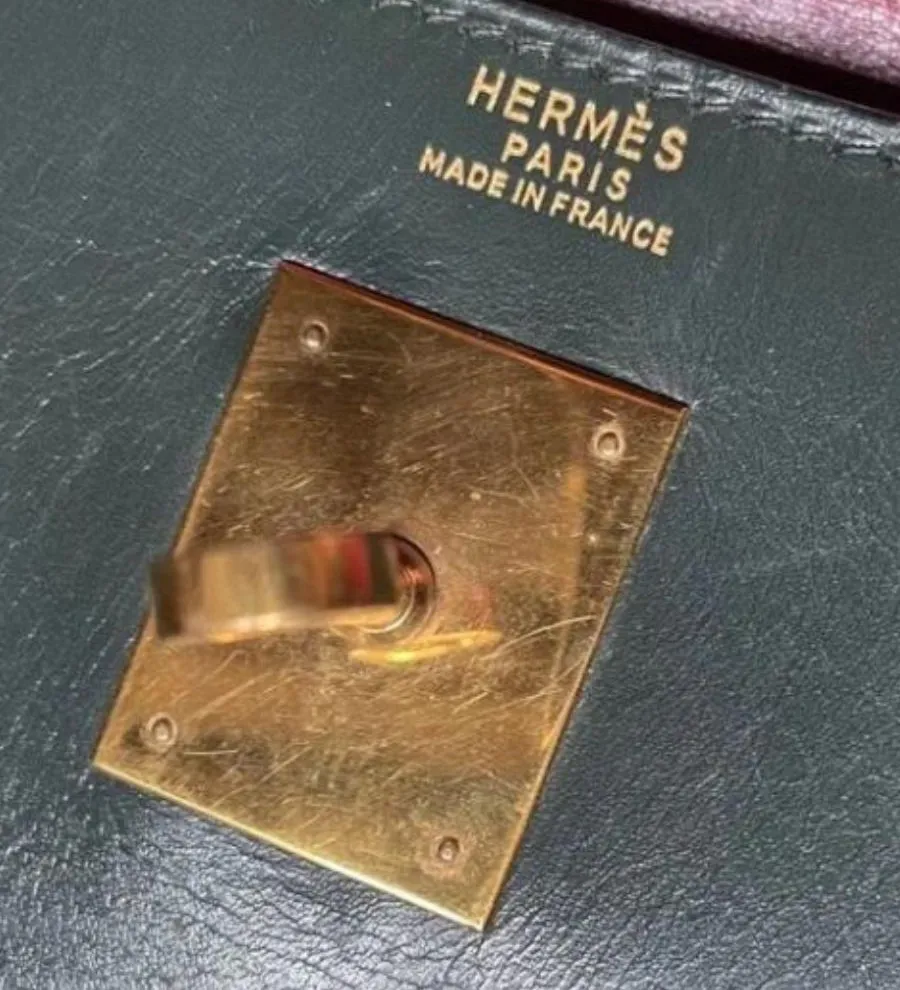
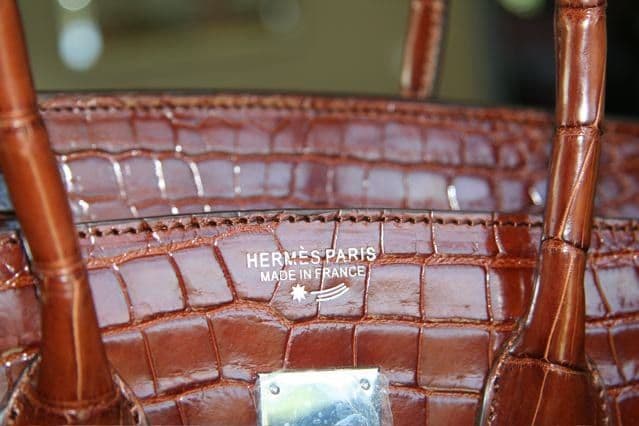
Resale authenticators say older Hermès marks have no accent and that the current stamp has one, and one guide says bags made before 1965 are simply stamped HERMÈS PARIS with no "Made in France" line; none gives a firm year for the change, and stamps are applied by hand, so the accent alone dates nothing. Both of the bags above are genuine. A guide that calls every accentless stamp fake is wrong for older bags.
What does separate real from fake is the work of the stamp: whether it is crisp, evenly pressed and well spaced. On genuine stamps the three lines are centred and the words in the last line have clear gaps between them.
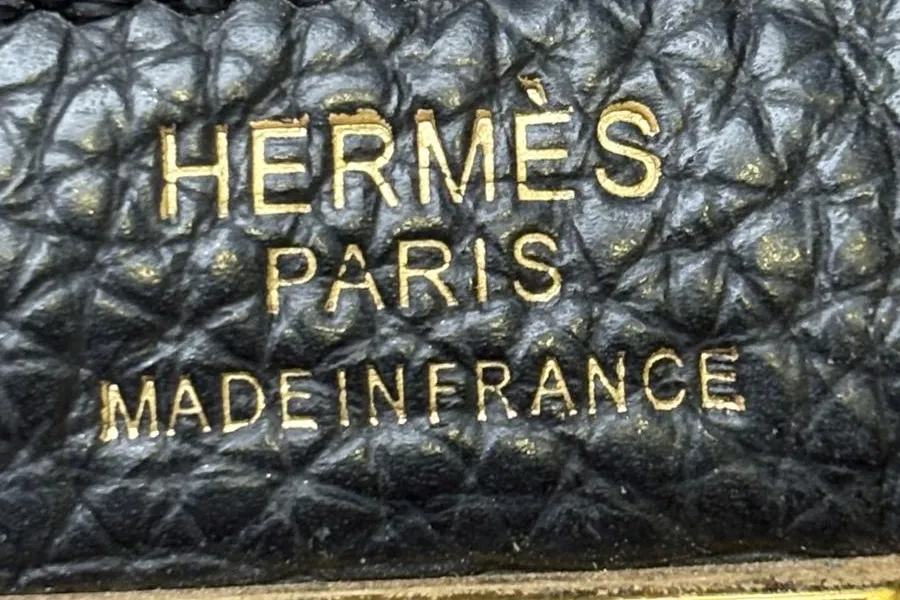
| Element | Authentic | Counterfeit |
|---|---|---|
| The accent on HERMÈS | Absent on older stamps, present on newer ones; not decisive either way | Not decisive: fakes carry both versions |
| Spacing | Clear gaps between MADE, IN and FRANCE | Words run together, as in the fake above |
| Pressing | Crisp, even depth and foil, centred above the plate | Uneven foil, shallow or smeared letters |
| The "Made in" line | Present or absent by era; the country never decides anything | Same wording, so it proves nothing |
Red flag
A foil stamp with words run together (MADEINFRANCE), or a stamp that is smudged and uneven in depth, is a fake pattern we saw and did not see on the genuine older bags we compared. The fake above is a modern-style bag, but the spacing check applies to every era.
Worth knowing
The "Made in France" wording is never a tell: fakes copy it, and a vintage bag may carry a stamp without it. Judge the stamp by how it was made, and judge the era by the date stamp, leather and hardware around it.
Hardware: Plating, Plates, Strap Hooks and Feet
Older Hermès hardware is plated: gold or palladium on bags that look the part, and worn gold with paler metal showing at the edges is normal at 30 years and beyond. The things worth checking are what is engraved, how it is made and whether the parts belong together.
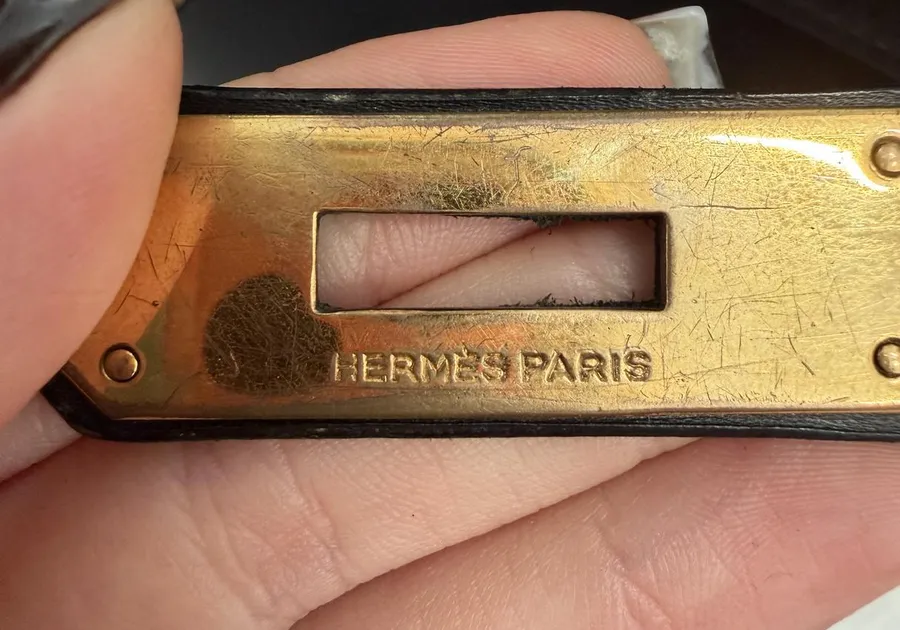
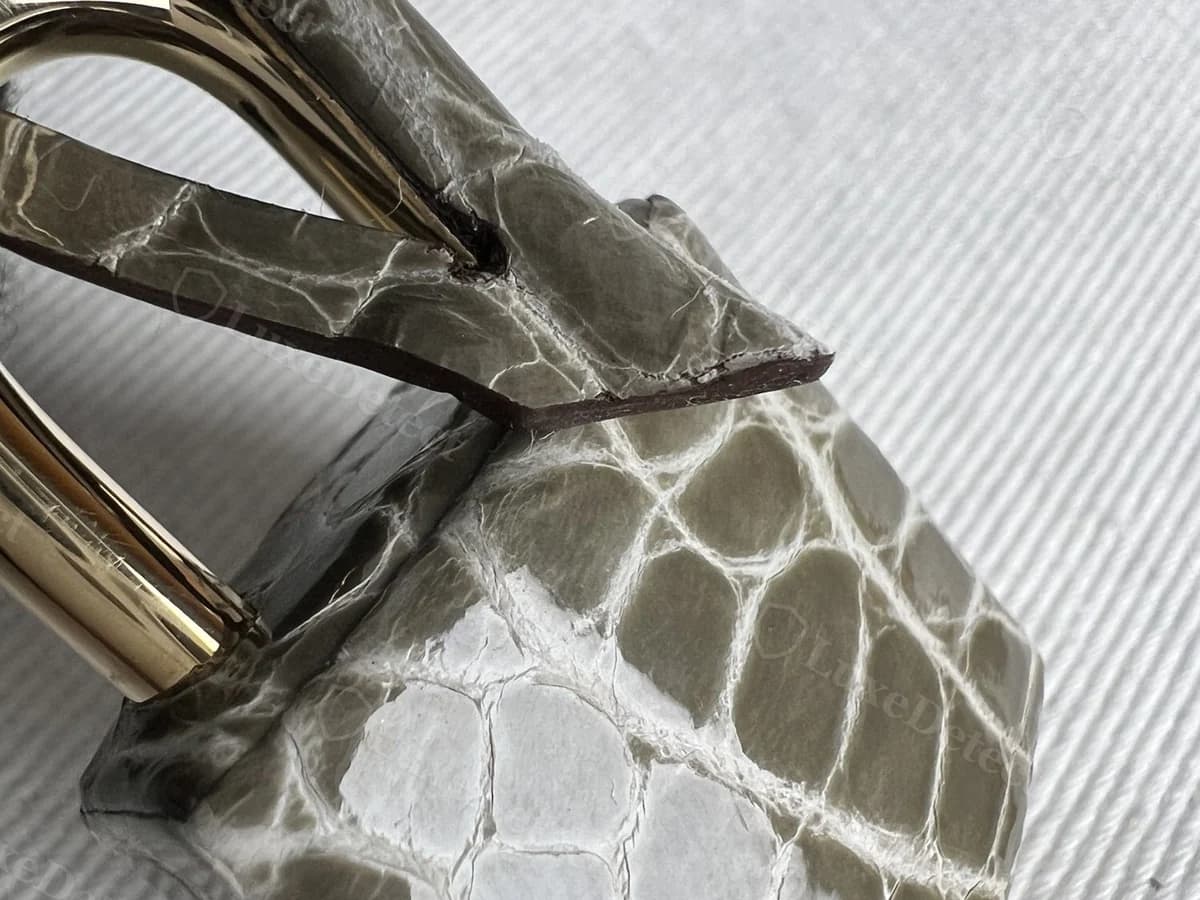
- The strap plate engraving. The slotted plate at the end of each closure strap is engraved HERMES PARIS or HERMÈS-PARIS. On the older plate shown above the engraving is softened by wear, but the letters are still evenly spaced. Our Kelly guide found blank strap plates on fakes. The plain square plate on the body that carries the lock was blank on the genuine Kellys we checked.
- Strap hooks. On Kellys from the 1970s and 1980s the shoulder-strap hook is slim and elongated with a narrow opening and a long lever; current hooks are thicker, rounder and easier to open. A bag sold as 1970s with a current-style hook has either had it replaced or is not what it says.
- Rings. One source describes a single metal ring on each side serving both the handle and the strap hook on vintage Kellys, with split rings appearing around 2000 to 2001. Treat the date as approximate.
- Feet. An authentic bag sits level on four feet that do not unscrew easily, and the feet match the plating of the other hardware.
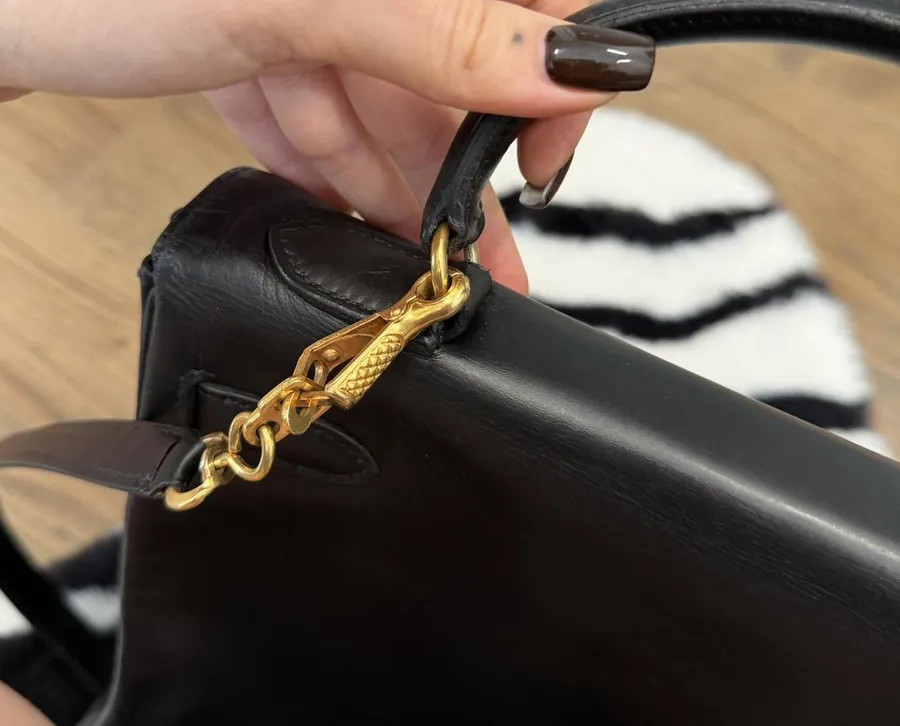
| Element | Authentic vintage | Counterfeit |
|---|---|---|
| Plating | Worn at edges and corners; gold on a gold bag, one finish across the bag | Mixed finishes on one bag, or gold showing through where the bag is supposed to be palladium |
| Strap plate | Engraving softened by wear but even | Blank or patchy engraving |
| Strap hook | Slim, long lever on a 1970s or 1980s Kelly | A current-style hook on a bag sold as much older |
| Feet | Four, flush, same plating, not removable by hand | Loose, uneven or mismatched |
Worth knowing
Hardware is the part of a vintage bag most likely to have been replaced, re-plated or swapped at a service. A single odd component is a question for the seller. Several components that contradict the bag's era are an answer.
Locks, Keys and the Clochette
The padlock (cadenas) and keys live in a leather clochette, usually hanging from the handle. They are a second, independent check, and on a vintage bag the rules are older.
- Before about 2000 locks had no serial sequence. Sources describe a Hermès stamp and a single number on the bottom of the lock, matching the number on the keys. Later locks add more engraving, and Hermès has changed the numbering style several times, so the engraving is not the same on every bag.
- Lock and keys must match each other. Any difference between the lock number and the key number is a warning.
- The clochette is one piece of leather, folded and stitched on the sides, not two pieces sewn together; a two-piece version is a counterfeit sign in several authenticator checklists.
- Weight. A genuine set feels substantial; a hollow, light lock is wrong.
Worth knowing
A matching lock and keys is a good sign but proves little on a vintage bag, because locks and clochettes can be bought separately and Hermès itself matched the clochette's dye lot to a bag when a lock was replaced. An original-looking set on an older bag may not be the original set. Our Kelly guide makes the same point about loose genuine hardware paired with a fake body.
Zippers, Linings and the Interior
Interior zip pockets are a good way to date a vintage bag, because the makers and styles changed.
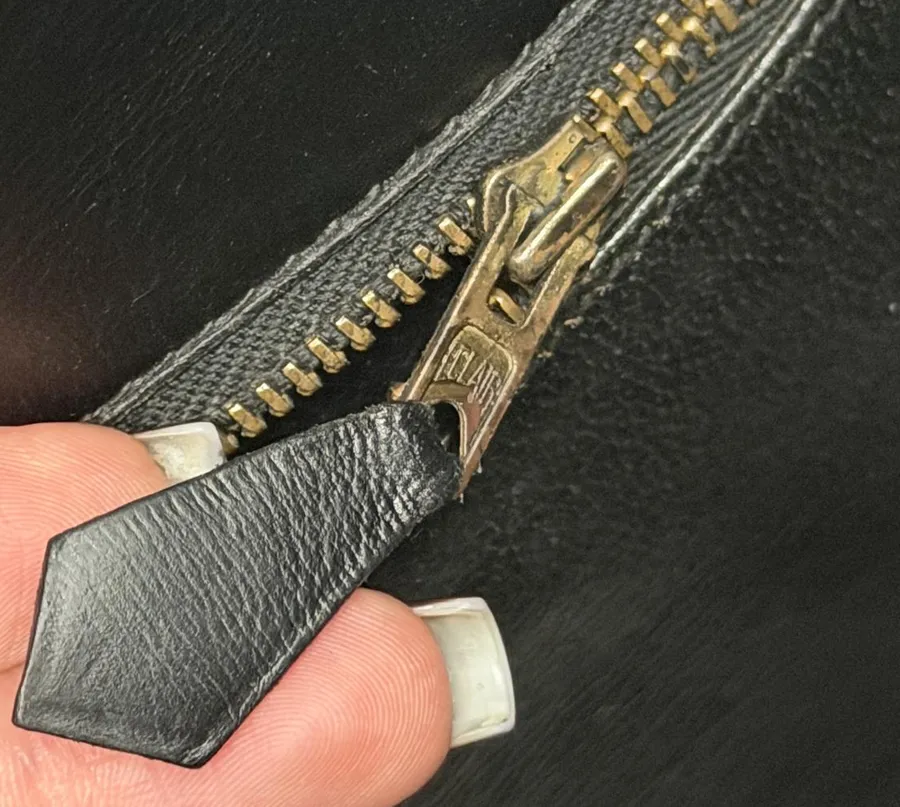
- ÉCLAIR on the slider. Éclair was a historic French zip maker, and vintage-dealer guides report Éclair zips on older Hermès bags (one says in the 1970s and 1980s, and also on Chanel). So a slider that says ÉCLAIR rather than Hermès is not a red flag on an older bag. A rule that says the pull must read Hermès fits later bags.
- The H-shaped zip stop. A small H at the end of the track began appearing around the early 2000s, and later pulls carry Hermès markings. A bag stamped 1960 with an H zip stop has had its zip changed or is mis-dated.
- Lining. Hermès lines bags in goat leather with a grainy surface, carefully sewn without loose threads. Some pieces use a leather similar to the outside, and custom orders can have a contrasting lining.
Worth knowing
Zips are replaced in repairs. A newer zip on an older bag is a repair question. A zip, a stamp and a leather that all belong to different decades is a verdict.
Leather by Era: What Could Not Exist Yet
Leather is one of the best vintage checks because you can compare it with when each type came into use. The dates below are the ones most resale sources agree on; Hermès does not publish its own.
| Leather | Era | What it means when you check a bag |
|---|---|---|
| Box calf | The 1890s on; the oldest leather Hermès still uses | Smooth and glossy; the usual leather of vintage Kellys and the first Constances |
| Suede (Doblis) | Appears on vintage Kellys and Constances in dealer listings | A suede bag is not a mismatch for the era |
| Courchevel | Used until 2004, when Epsom replaced it | Expect it, not Epsom, on a bag made before 2004 |
| Clemence | About 1992 | A Clemence bag with an earlier stamp is a contradiction |
| Togo | About 1997 (one resale guide says 2007, which contradicts the other sources we found) | A "1980s Togo Kelly" is a contradiction |
| Epsom | 2004 | An Epsom bag with a circle stamp is a contradiction |
Box calf is also the leather that shows age most: edges and corners wear first, and leather can crack or dry. A genuine vintage box calf bag looks used. A box calf Kelly that looks like new from the 1960s deserves a question about its history, not an automatic rejection.
Red flag
A leather that did not exist in the year the stamp gives is one of the strongest vintage tells, because it needs no equipment, only a date: a circle-stamped (pre-1997) bag in Togo, or a 1990s bag in Epsom, is a mismatch.
Pre-Birkin Construction: Stitching, Edges and Shape
Before the Birkin, Hermès bags were built the way the Hermès saddlers built them, and that has not changed in its logic.
- Saddle stitch. Each stitch is made by hand with two needles, slants slightly upward, and is never glued. A broken stitch does not unravel the whole seam. Minor irregularity is expected; machine-uniform spacing is not.
- Sellier or Retourné. A Sellier is stitched on the outside with a rigid body and sharp edges; a Retourné is turned right side out after sewing, hiding the stitching. Check that the construction matches the model name in the listing.
- Edges. Old box calf edges wear to a lighter colour first. That is age; paint that flakes off a thick coating is not.
- Handles. A worn handle is often replaced rather than cleaned. Ask when, and check that the new leather and thread match the body.
What Vintage Hermès Fakes Get Right and Wrong
The fakes we compared were mostly copies of current bags, in current leathers and hardware, so the fake evidence in this guide is thinner than the evidence for modern bags. What the fakes we compared get right: the shape, the foil, the colour and the plating on first sight. Where they fall down is the work: stamp spacing and pressing, blank strap plates, mixed finishes and stitching that is too even. The era checks above, leather against stamp, zip against stamp and strap hook against date, catch a bag whose seller has dressed a modern fake in vintage wear.
What Is Normal and What Is Not a Tell
| What you see | Normal on a genuine vintage bag? | What to do |
|---|---|---|
| No date stamp | Yes; many genuine vintage bags have none | Weigh the rest of the bag more heavily |
| Stamp with no accent on HERMES | Yes, on older bags | Judge the spacing and pressing instead |
| Worn, softened plating | Yes | Look for consistent finish across the hardware |
| Replaced handle, lock, zip | Yes, from repairs | Ask who did it and what was changed |
| No authenticity card | Yes; Hermès bags rarely come with one | Do not pay extra for a card |
| Dust bag colour or style | Yes; dust bags changed over the years and are sold loose | Treat as context only |
| "Made in France" on or off the stamp | Neither tells anything | Ignore the country line |
Vintage Hermès Buying Checklist
- Identify the model and construction (Sellier or Retourné) from the bag, then read its section above.
- Find the date stamp (strap, inside, near a seam). Match its frame to the period in our date codes guide, or accept that it may be absent.
- Check the leather against the stamp year. A leather that did not exist yet ends the inspection.
- Read the foil stamp: words with clear gaps, even pressing, and the accent as era-appropriate.
- Check the strap plates for even engraving, the strap hook against the claimed decade, and the feet.
- Match the lock number to the keys; check the clochette is one folded piece; remember both can be replaced.
- Open the zip pocket: an ÉCLAIR slider on an older bag is fine; an H zip stop on a 1960s bag is not.
- Treat the dust bag, box and receipt as context only, and treat wear as condition.
A contradiction between the stamp, the leather and the hardware is a strong reason to walk away. A bag that passes everything is consistent with a genuine one.
When to Get a Professional Opinion
Vintage Hermès is expensive enough that a mistake is costly, and it is the kind of bag where an honest repair and a convincing fake can look alike on a listing. If the stamp is missing, the leather or hardware look replaced, or the story from the seller does not quite fit, have the bag reviewed before you pay.
With our Hermès authentication service you start an order with Hermès selected and upload clear photos of the whole bag, the foil stamp above the lock, the strap plates, the blind date stamp, the lock and keys, the zip and the base. An authenticator compares them with verified Hermès bags of the same model and era and you get a verdict within 24 hours, with a Certificate of Authenticity.
A code that checks out doesn't prove the item is real. Counterfeiters copy genuine codes.
Our authenticators check the stamps, hardware and construction of your Hermès against verified references, from $40. You get a verdict within 24 hours, and a Certificate of Authenticity if the item passes.
Authenticate My Hermès →FAQ
How do I know if my vintage Hermès bag is real?
Check that everything fits one era: the date stamp frame (plain letter, circle or square), the leather against the stamp year, the foil stamp with clear word spacing, the strap plate engraving and the hardware, and the zip. Missing stamps, a stamp with no accent and worn plating are normal on a vintage bag. A bag that passes is consistent with a genuine one; for an expensive piece, get a professional review.
How can I tell how old my Hermès bag is?
Find the blind date stamp, usually on the inside of the strap on a Kelly or Birkin made before about 2015, and read the frame: no frame for 1945 to 1970, a circle for 1971 to 1996, a square for 1997 to 2014. Our date code checker turns the letter into a year. If there is no stamp, the leather, hardware and zip narrow the era.
Do vintage Hermès bags have date stamps?
Bags from 1945 onward often do, and before 1945 Hermès did not use year letters. Many genuine vintage bags have lost the stamp to wear or repair, or never had one, so a missing stamp is not a red flag by itself.
Is a vintage Hermès stamp without the accent fake?
No. Older genuine Hermès stamps and engravings often read HERMES PARIS with no accent, and we have seen both versions on genuine older Kellys in our archive. Judge the spacing, the evenness of the pressing and whether the stamp fits the era.
Are all vintage Hermès bags made in France?
Genuine Hermès bags are made in France, but the words "Made in France" prove nothing: fakes copy them, and some older bags are stamped without them. We never use the country line to decide a bag.
When was the Hermès Kelly first made?
The Kelly descends from the Sac à dépêches of the 1930s and the Haut à courroies of 1892. The name comes from Grace Kelly in the 1950s, and most sources say Hermès made the name official in 1977. The oldest Kelly most buyers find is from the 1950s.
Do vintage Hermès bags come with authenticity cards?
Rarely. Hermès bags seldom come with one (one reseller guide says Hermès issues none), so the lack of a card is normal and a card with a vintage bag proves nothing on its own.
Can I authenticate a vintage Hermès bag from photos?
Yes. What decides it is whether the stamp, the leather, the hardware, the lock and the construction fit one model and era when compared with verified bags. Clear close photos of each show that. A professional review is the safer route on a collector-priced bag, because fakes copy individual marks.
What is the oldest Hermès handbag?
The Haut à courroies of 1892, a tall saddle-carrying bag, is described as the first. It is rare and still produced. The Sac à dépêches followed in the 1930s.