Watch Authentication Specialist
Watch authentication specialist covering Swiss manufacture references and bracelet construction.
Published October 2026 · Contact
Why a Longines Has to Be Read by Era and Model
Longines was founded in 1832 in Saint-Imier, Switzerland, and describes its winged hourglass, registered in 1889, as the oldest unchanged trademark still in use that is registered with the World Intellectual Property Organization. That long history is the first thing to understand when you check a watch. The name covers mid-century gold-filled and solid-gold dress watches (many marked Longines-Wittnauer), 1970s to 1990s quartz and automatic pieces, and the current La Grande Classique, Dolcevita, PrimaLuna, Evidenza, Conquest and HydroConquest lines. A caseback that is correct for one of those is wrong for another.
So this guide is organised the way we read a Longines: identify the model and era first, then check the caseback, the movement, and the clasp and strap marks against what genuine examples of that family show. Our records are rich on the genuine side, with hundreds of genuine Longines watches across all of those families.
Worth knowing
This guide is built from verified genuine Longines examples. We do not yet have a set of confirmed counterfeits broad enough for a ranked real-vs-fake checklist, so there is no checklist here and no single mark that decides the question. When more confirmed fakes come in, this guide will be upgraded. Until then, use it to learn what genuine casebacks, movements and straps look like and where fakes copy them.
Identify the Model and Era First
Listings often say only "Longines watch". Work out which family you have, because the checks below depend on it.
- Modern steel and gold dress watches: La Grande Classique, Dolcevita, PrimaLuna and Evidenza. These carry the model name and a reference on the caseback.
- Sport and heritage lines: HydroConquest, Conquest, Flagship, Admiral and Olympian.
- Quartz and automatic watches from the 1970s to the 1990s: Longines-marked modules and rotors, often in gold-tone cases with mesh or link bracelets.
- Vintage dress watches: gold-filled or solid-gold cases, many marked Longines-Wittnauer, with a manual-wind movement marked Longines.
Quartz, automatic and wind-up are all genuine Longines. Which one you have is part of identifying the model, and a quartz movement in a modern La Grande Classique is not a red flag by itself.
The Caseback: What Genuine Looks Like
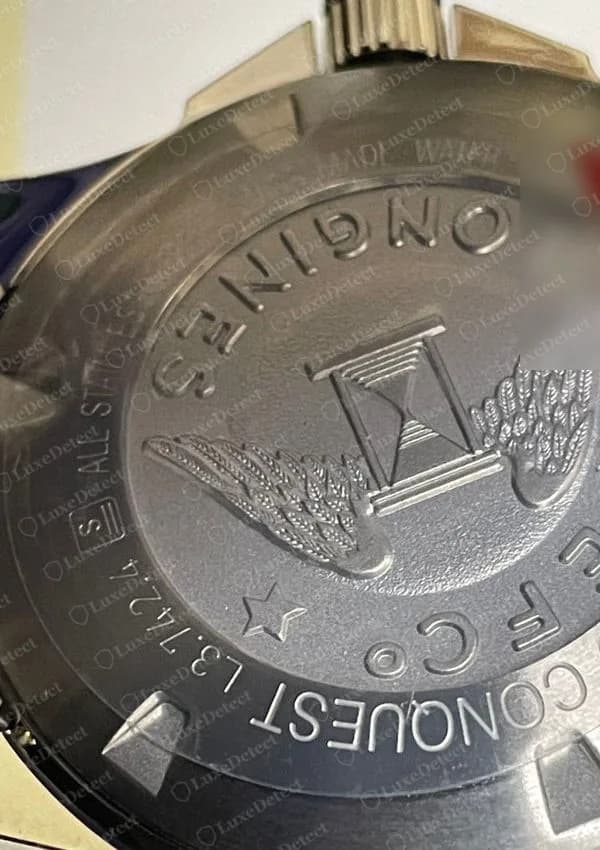
On modern steel watches the caseback carries the winged hourglass seal, the Longines name and an "EFCo" ring, with the model line and a reference around the rim. The HydroConquest shown here reads "HYDRO CONQUEST" with its reference, and a strip of digits is engraved along the rim. The engraving is sharp and evenly spaced, and the hourglass and wings are cut with fine feather detail.
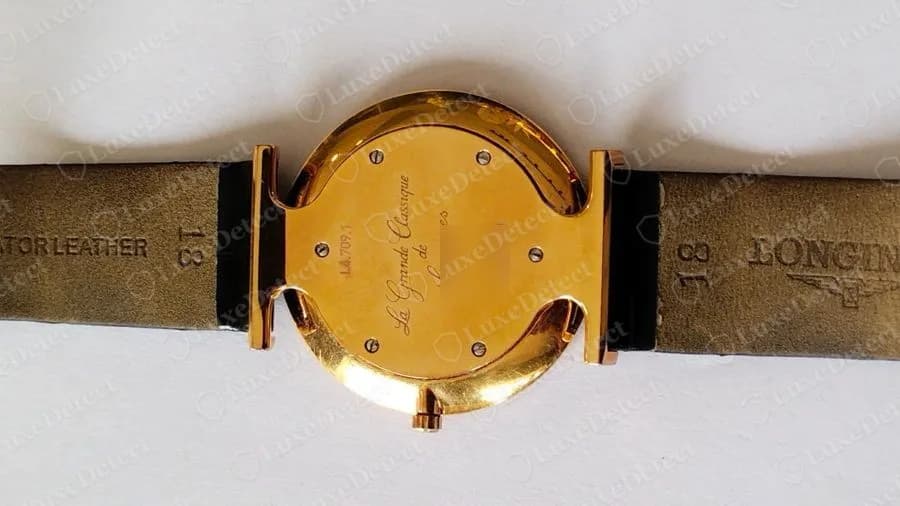
La Grande Classique has a different back: a plain gold-tone plate held by four screws, engraved with "La Grande Classique de Longines" in script and a reference that starts with L4. We have blurred the serial number on this one. The model line on the caseback should fit the dial and case in front of you.
Fakes copy casebacks well. The winged-hourglass art, the rim text, "SWISS MADE" and "WATER RESISTANT" lines, reference lines and serial numbers have all appeared on backs that looked fully convincing. A caseback that reads correctly proves nothing on its own.
The Movement: What Should Be Inside
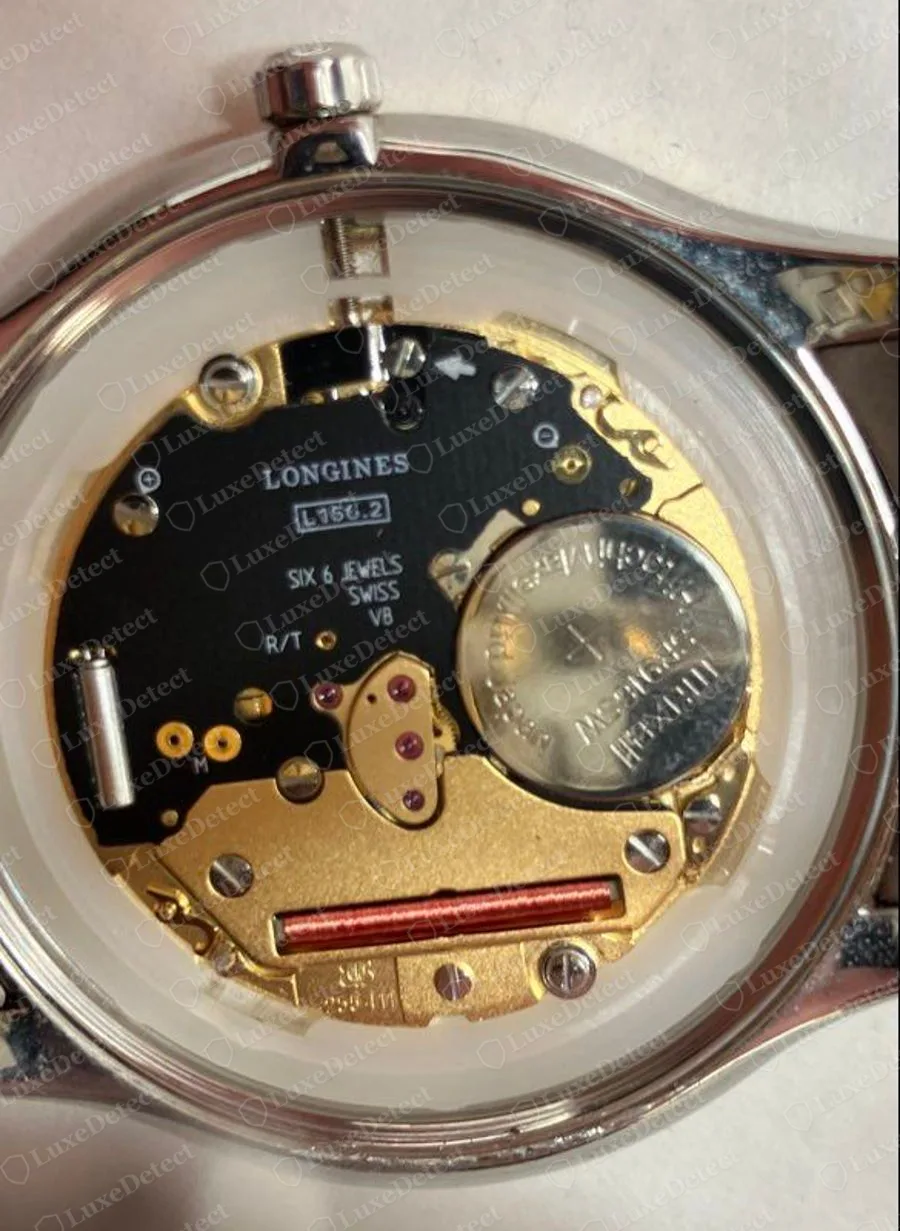
Genuine movements are marked Longines. The quartz module above has the name, a calibre-style code and the jewel count printed on the plate. On vintage watches we see Longines-marked manual-wind movements with the jewel count stamped on the bridges, sitting inside cases stamped for the retailer or case maker. The vintage cases in our records carry "Longines-Wittnauer Watch Co Inc, New York, Geneva, Montreal" inside the case, and some read "Cased and timed in U.S.A. by Longines". We do not use those lines to date a watch.
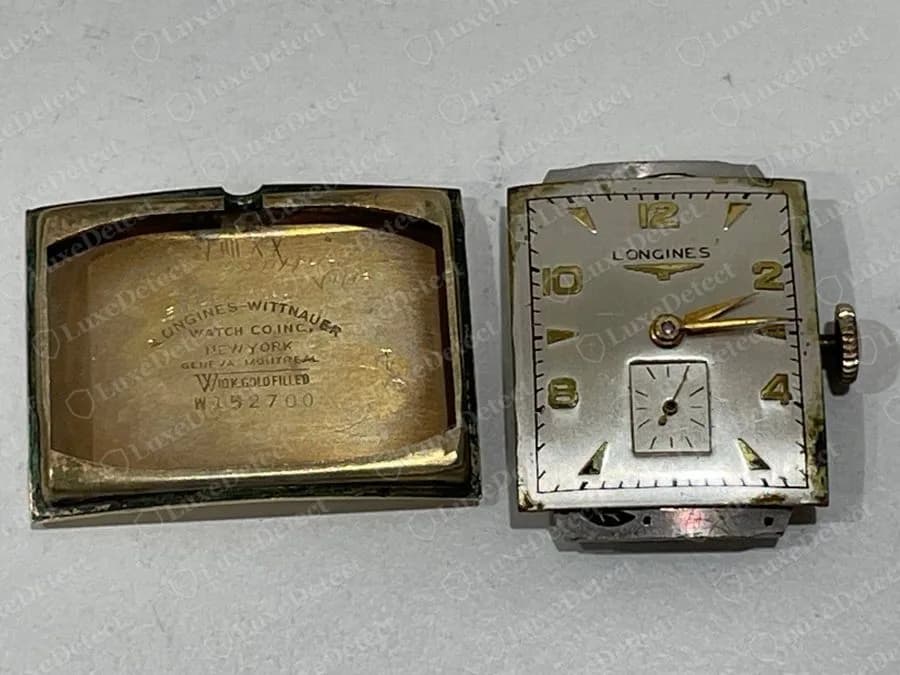
Opening a caseback is the point where an expert reads the movement against the model. It needs the right tools, and a badly opened case can scratch the watch, so do not do it unless you know how.
Clasp, Bracelet and Strap Marks
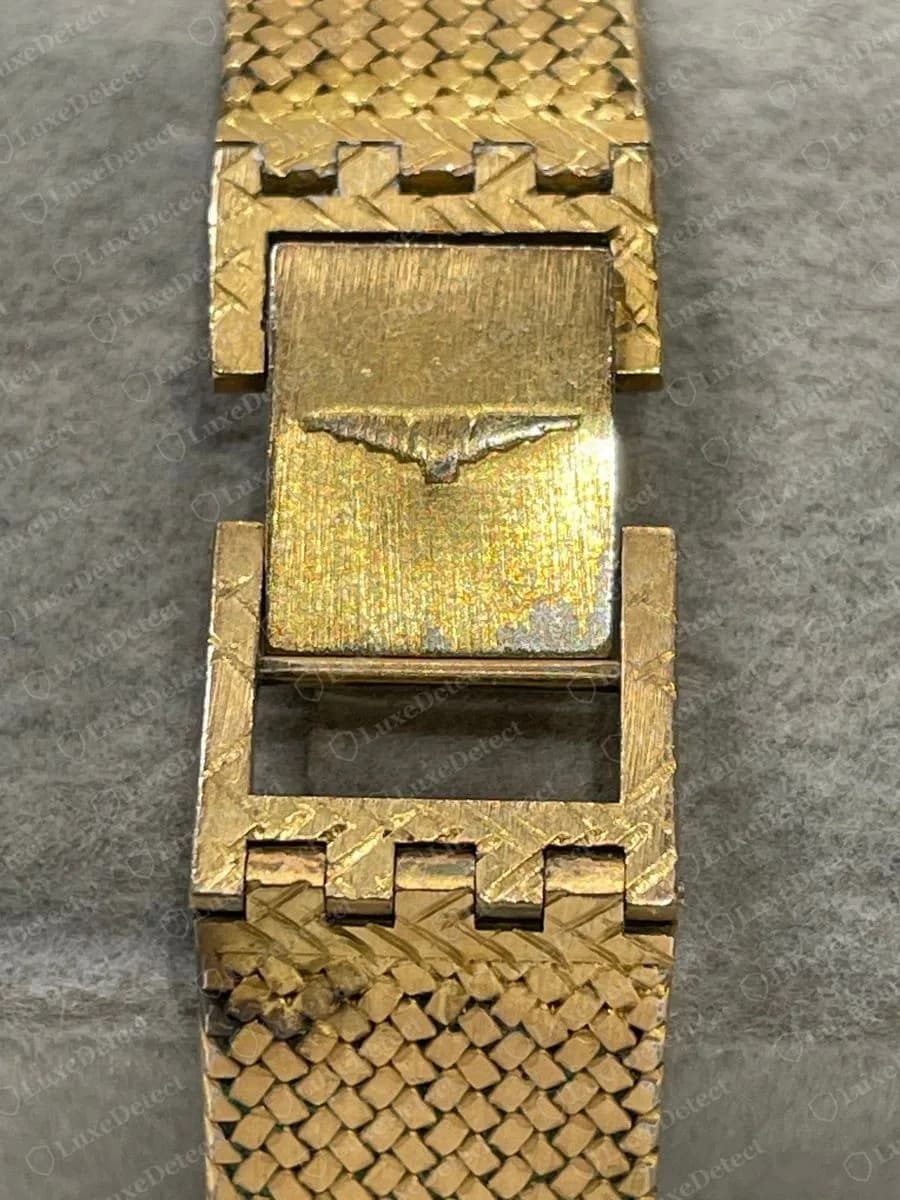
Genuine Longines clasps, buckles and strap linings carry the name, the winged hourglass or both. On the leather strap in the La Grande Classique photo above, the lining reads "LONGINES" over the winged hourglass. On the vintage mesh bracelet here the winged hourglass is stamped on the inside of the clasp. Fakes copy straps and clasps along with everything else, so these are marks to read, not marks that pass a watch.
What Else a Genuine Longines Prints
Some marks look suspicious but are not. We see "BASE METAL" printed on the backs of genuine Longines watches, and "Swiss Made" and "Made in" text on genuine dials, backs and straps.
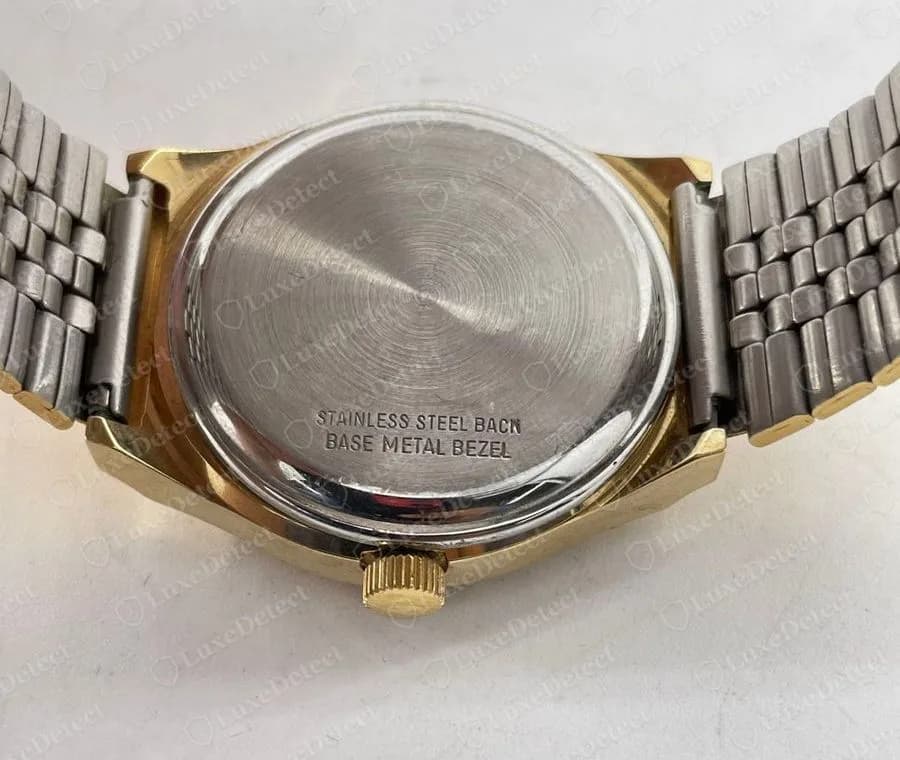
"BASE METAL" on a caseback is not a sign of a fake, and neither is "Swiss Made". A country or material line tells you what the case is made of and where it was made, not whether the watch is genuine.
Cheap Fakes and Invented Models
Alongside the genuine records, we have seen a small number of plainly cheap watches sold as Longines, and two narrow patterns are worth describing. They are observations from the pairs we reviewed, not rules for deciding a watch.
In several cheap fakes the dial carries a model name that Longines does not use, such as "360 Datomatic", or a misspelt brand, "LONGINE", sometimes with an "Astromatic" line. Their backs name a Hong Kong case or read "BASE METAL BEZEL / STAINLESS STEEL BACK" (wording that also appears on genuine watches, so it is not what gives them away), and the movement inside is a generic one. They copy the winged hourglass on the dial, so the logo does not help. We have not seen a "360 Datomatic" dial on a genuine watch.
In a few other fakes, a "The Longines Master Collection" chronograph back copies the winged-hourglass caseback art and the rim text accurately, but the movement behind it is not a Longines movement: a generic automatic with a coloured rotor, or a generic quartz chronograph module. We have not set these against a genuine Master Collection chronograph, so treat this as an observation only.
Neither pattern covers a fake that is made with more care, and a watch that avoids both is not thereby genuine.
Serial Numbers and Papers
Genuine Longines watches in our records carry engraved numbers: a strip of digits on a modern caseback rim, and numbers inside the case and on the movement on vintage pieces. We do not publish a serial table, and we do not date a watch from one. For a serial lookup, warranty papers or service history, ask Longines directly through longines.com or an authorised dealer or service centre. Papers and boxes are context, not evidence.
What a Matching Mark Does and Does Not Prove
The caseback, the movement plate, the clasp and the dial can each be copied, and the examples here are only what genuine watches in our records show. Fakes copy marks, so a matching mark proves nothing on its own. Read the model line, the movement, the case and the strap together against a verified pair of the same model. Weight, the feel of the crown and bezel, and how the watch runs are checks done with the watch in your hand.
When to Get a Professional Opinion
If you are buying a Longines at a price that matters, or the listing does not show the caseback and movement, get a second opinion before you pay. LuxeDetect authenticates watches from photos, with a verdict from a specialist and a Certificate of Authenticity. Send clear photos of the dial, the full caseback, the movement if the watch has a display back, the clasp and the strap lining, and the inside of the case on a vintage piece.
A code that checks out doesn't prove the item is real. Counterfeiters copy genuine codes.
Our authenticators check the movement, dial, case and bracelet of your Longines against verified references, from $45. You get a verdict within 24 hours, and a Certificate of Authenticity if the item passes.
Authenticate My Longines →Related guides
- How to authenticate a Tissot watch
- How to authenticate a TAG Heuer Carrera
- How to authenticate an Omega Seamaster
FAQ
How can I tell if my Longines is real?
No single mark settles it. Identify the model and era first, then check that the caseback, the movement and the clasp and strap marks fit that model, and compare them against a verified pair. Fakes copy marks, so get it checked if the purchase matters.
Can I authenticate a Longines from photos?
Yes. What decides it is how the dial, caseback, movement, clasp and strap marks fit together for that model against verified examples. Weight, feel and running behaviour are checked with the watch in hand, and a professional review is the safer route on an expensive piece.
Does "BASE METAL" on the back mean my Longines is fake?
No. Genuine Longines watches in our records have "BASE METAL" printed on the caseback or bezel line. It describes the metal, not the watch's origin.
Does "Swiss Made" on a Longines prove it is real?
No. Genuine Longines dials, backs and straps carry "Swiss Made", but so do copies, so it is not a check in either direction.
Where is the serial number on a Longines?
On modern watches we see a strip of digits engraved on the caseback rim, and on vintage watches numbers inside the case and on the movement. We do not date a watch from a serial. Longines is the place to ask about serial lookup, warranty papers and service history.
Does a quartz or automatic movement mean a Longines is fake?
No. Longines has made quartz, automatic and manual-wind watches, so the movement has to fit the model, not a single type.