Ready-to-Wear Authentication Specialist
Italian tailoring authentication specialist. Focuses on construction, interior labelling, and fabric verification for Neapolitan and Northern Italian ready-to-wear houses.
Published October 2026 · Contact
Why No Single Mark Settles an Escada
Escada is a fashion house founded in Munich by Wolfgang and Margaretha Ley, known for women's ready-to-wear, with handbags, shoes and eyewear alongside. Most of the Escada that reaches resale is clothing: blazers, dresses, trousers and skirts, so this guide starts with the woven label and the care label sewn inside a garment, then moves to the double-E logo, bags, shoes and eyewear.
The difficulty is that genuine Escada does not follow one pattern. Our authenticated records show a black woven label with "MARGARETHA LEY" under the name, a cream version of the same label, and a plainer black label with just "ESCADA" in spaced capitals. They also show "ESCADA SPORT" and other sub-labels, and a country of manufacture that changes from piece to piece. We could not find an Escada-published authentication guide, and we have not tried to date a piece from its label.
Worth knowing
This guide is built from verified genuine Escada examples. We do not yet have a set of confirmed counterfeit Escada pieces that differ visibly from genuine ones, so we are not publishing red flags or a real-vs-fake comparison. When a verified difference turns up, this guide will be upgraded. Until then, use it to learn what genuine labels, logos and hardware look like, and remember that fakes copy marks, so a match proves nothing on its own.
The Woven Label With "Margaretha Ley"
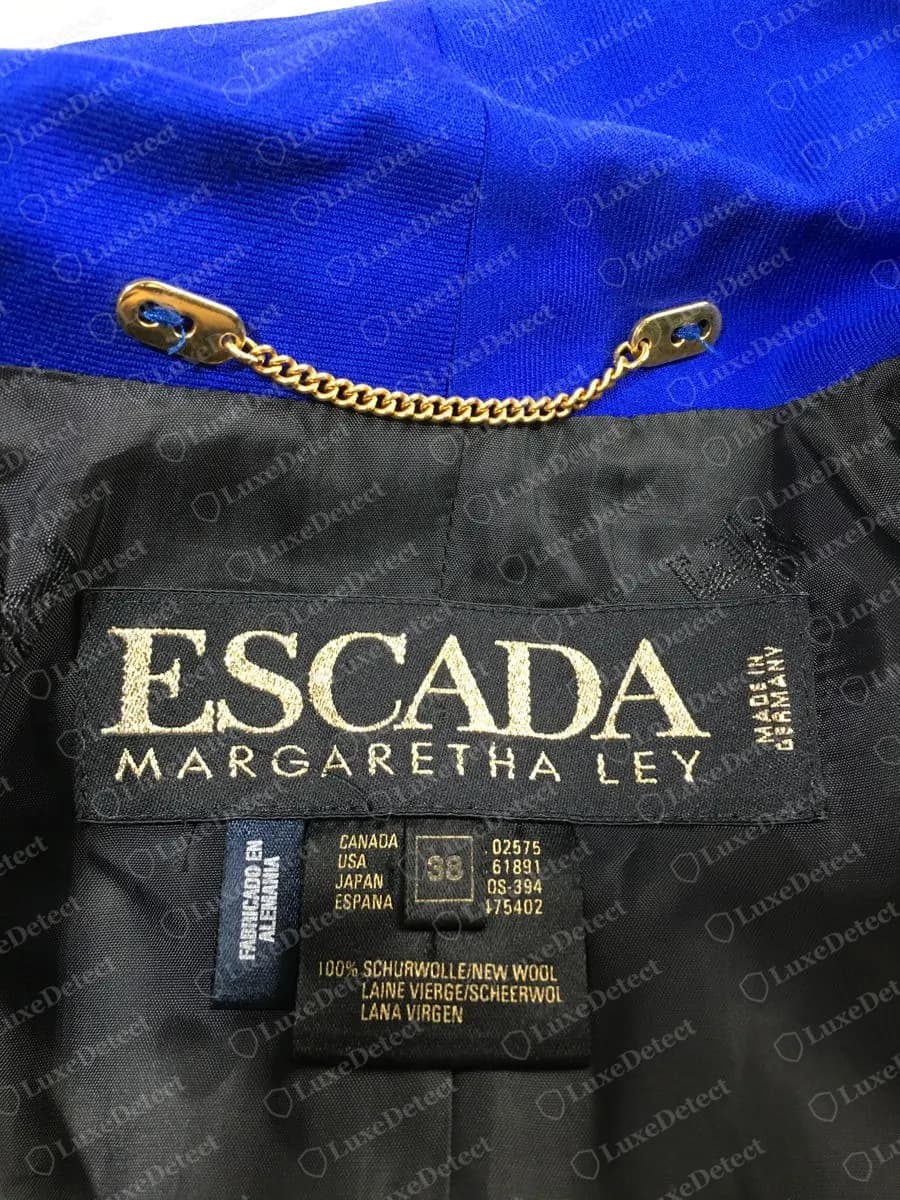
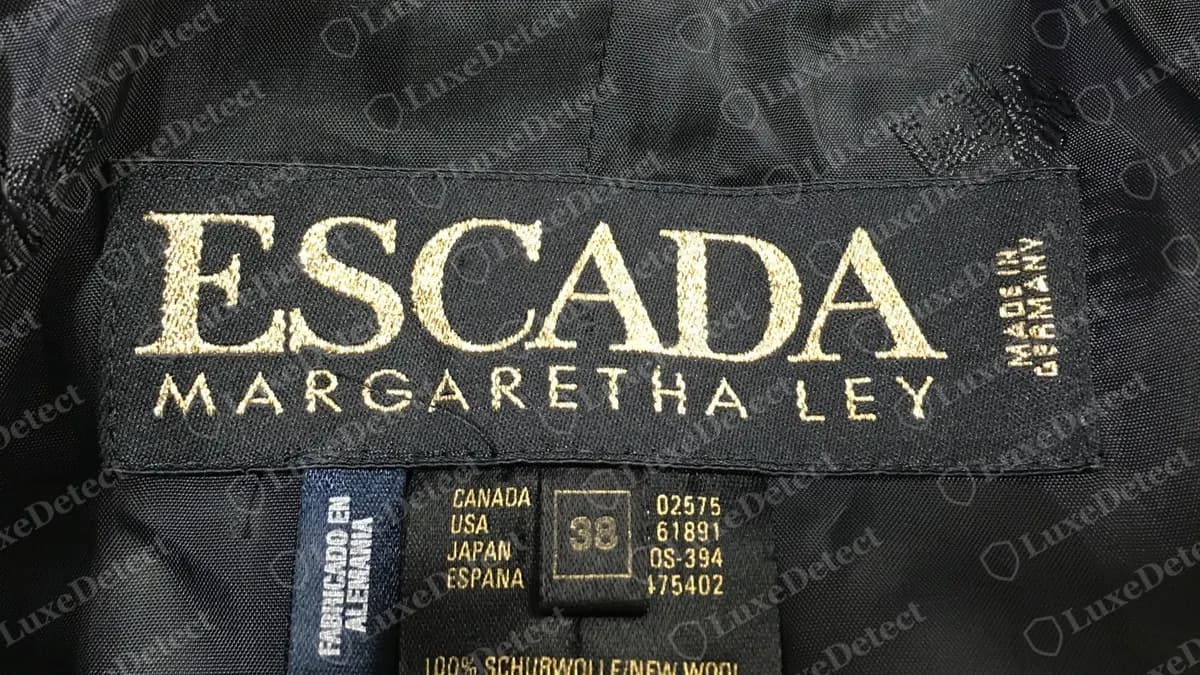
On a blue wool jacket in our records, the main label is black and woven, with a gold serif "ESCADA" over a smaller, widely spaced "MARGARETHA LEY". "MADE IN GERMANY" is printed vertically along the right edge. Beneath it sits a second block: a navy tag with the Spanish wording "FABRICADO EN ALEMANIA", a size in a box, columns of country names (CANADA, USA, JAPAN, ESPANA) with numbers beside them, and the fibre content in several languages.
Look at how the whole label is put together rather than any one line. The lettering is crisp and evenly spaced, the edges are finished, and the size block and fibre tag are stitched in a stack under the name. Another genuine piece in our records, a pair of leather trousers, carries a label that reads "ESCADA BY MARGARETHA LEY" with "MADE IN GERMANY" and a wool-mark fibre label, so the wording is not identical across pieces.
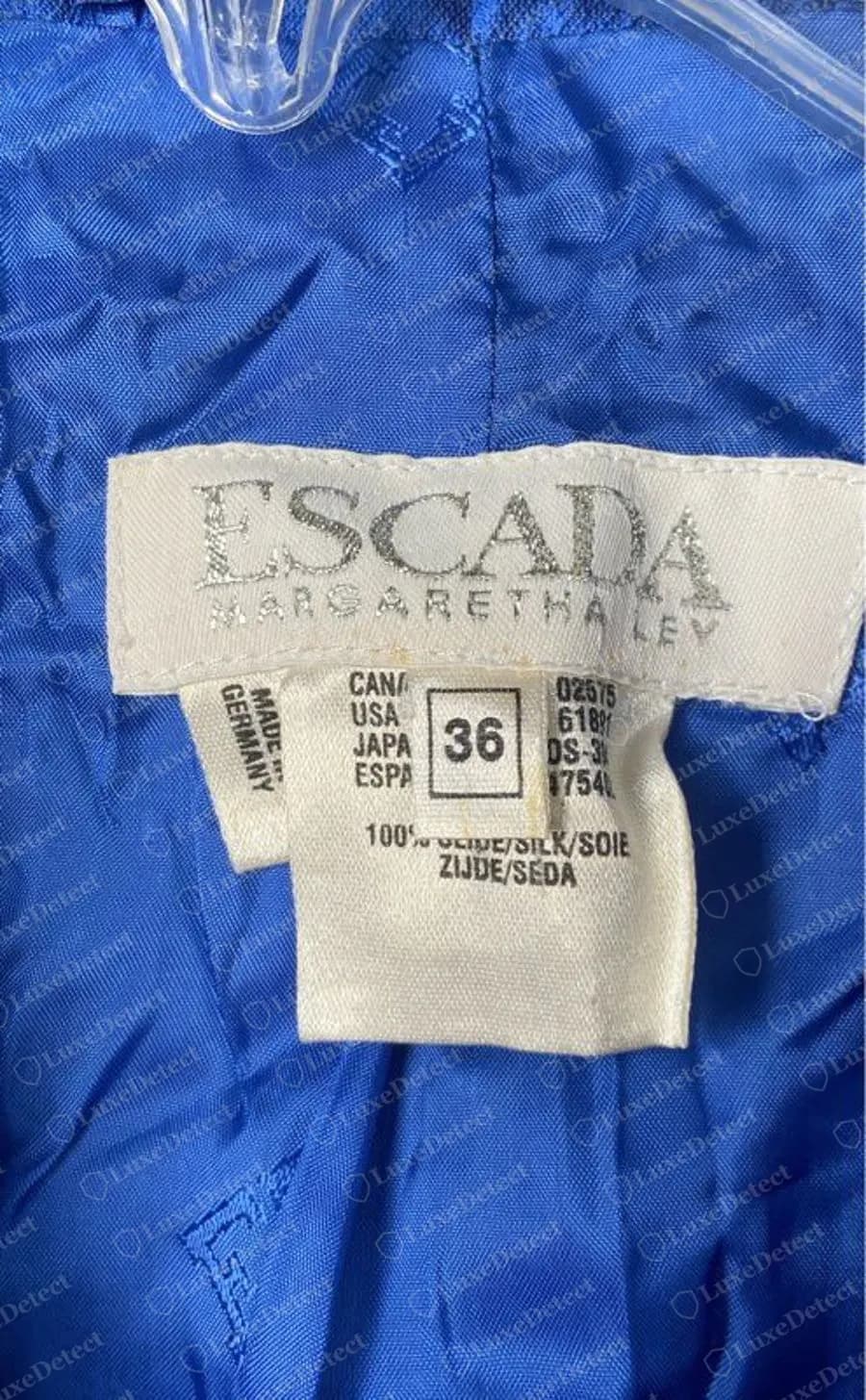
The same layout also appears in cream with silver print, here on the blue lining of a silk jacket in our records, with the origin line on the left of the size block rather than the right. A cream label is not a different brand or a warning sign.
The Later Plain "ESCADA" Label
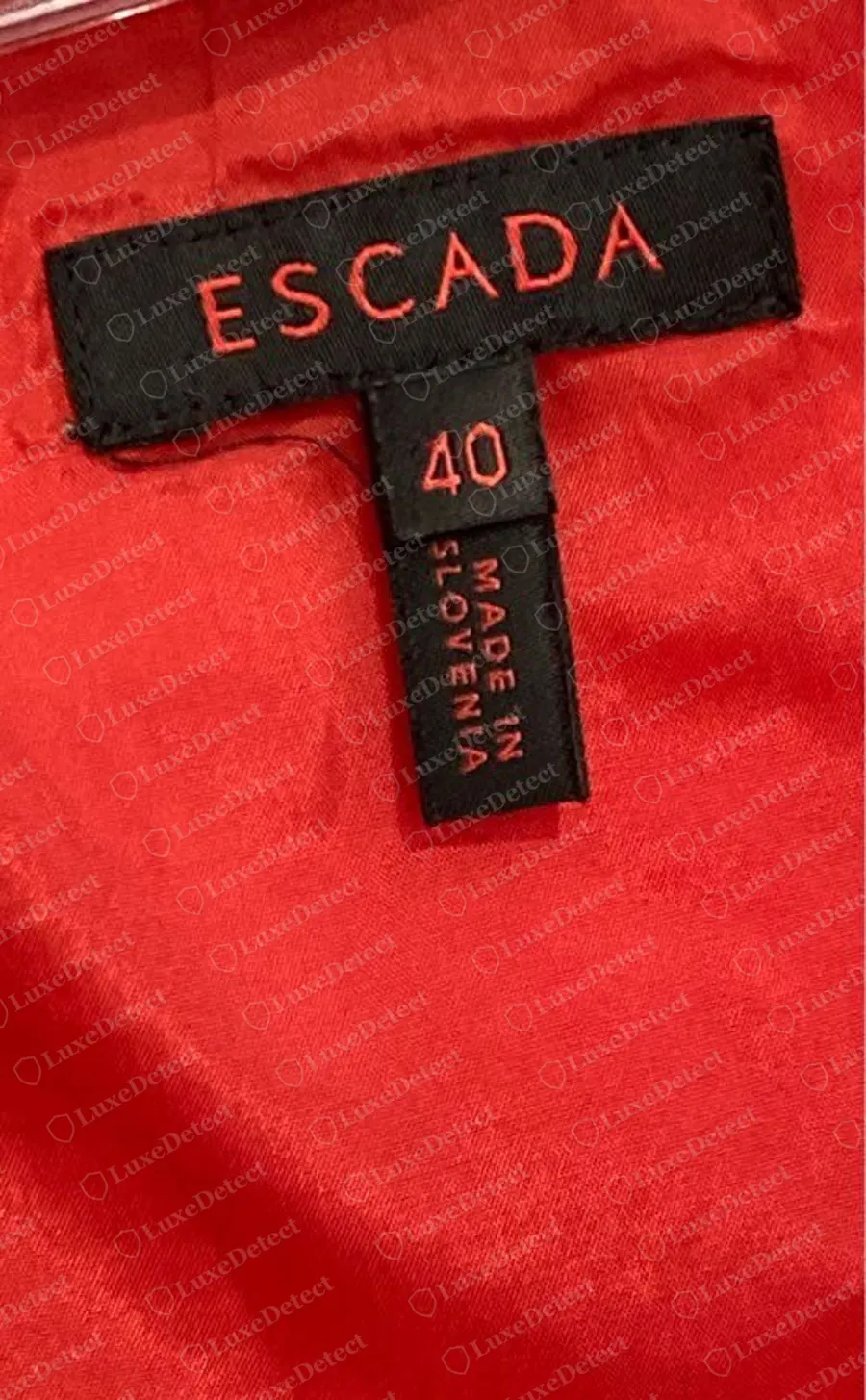
Other genuine pieces in our records use a simpler black woven label: "ESCADA" in widely spaced capitals, printed in red, gold or silver, with the size beneath it in a box or on its own, and sometimes an origin line running vertically below. We see "MADE IN SLOVENIA" and "MADE IN ROMANIA" on these labels, and one piece with a gold-print label shows only a size and no country at all.
These are facts of the individual pieces we have seen, not a rule. The country on an Escada label is never a test of whether the piece is genuine, because genuine Escada in our records was made in Germany, Italy, Romania and Slovenia. We have also not confirmed when Escada changed from one label to another, so we do not use the label to say when a piece was made.
Care Labels, Size Blocks and Other Labels
The fibre and care labels vary as much as the main label. We see multilingual fibre tags, a wool-mark tag, and a navy tag with the country in Spanish. Read the fibre content against the garment itself: a jacket labelled as silk or new wool should feel and drape like it. We have not worked out what the reference numbers printed next to the size on the older labels mean, so we do not treat any of them as a code you can look up.
Genuine pieces in our records also carry sub-labels, reading "ESCADA SPORT" (a white label with black serif lettering), "ESCADA MARINE GROUP" on a scarf, and a pink ribbon label reading "ESCADA FIESTA CARIOCA" inside a clutch. A sub-label is not a sign of a problem. It does mean the main label above is not the one to match against.
Details That Belong to One Garment
A few details in our records belong to the individual garment and are not Escada marks you should expect to find. A monogram embroidered into the lining of one jacket, a gold chain hanger loop at its collar, and mother-of-pearl buttons on a silk jacket are examples. Treat them as signs of how that piece was made, not as a checklist.
The Double-E Logo
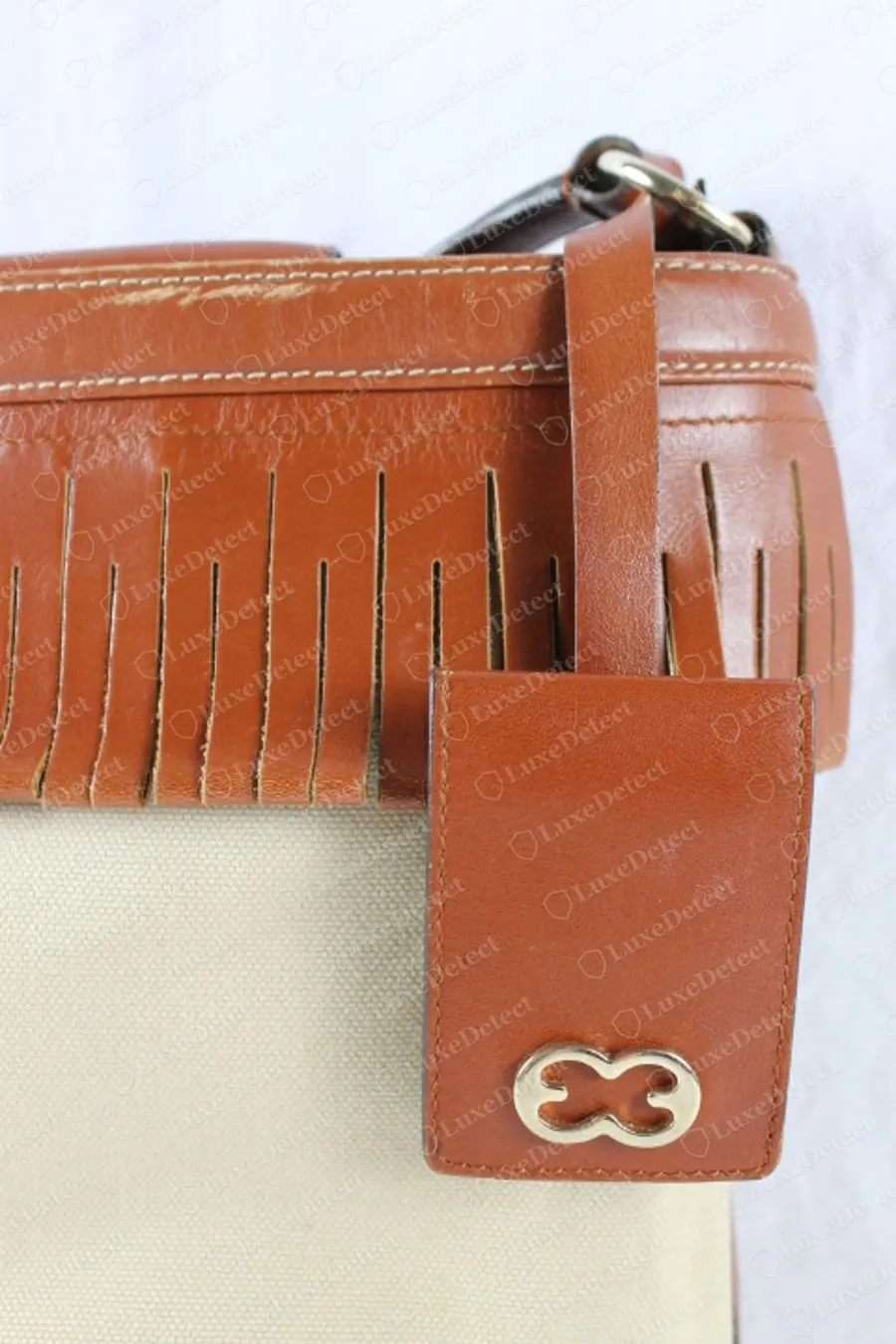
The Escada logo on accessories is an interlocking pair of letter E shapes that reads like a lying figure eight. On the fringed canvas and leather shoulder bag shown here it appears on a leather tab hanging from the strap. In our records the same mark turns up in other places: zip pulls, charms, a gold clasp on a sunglasses case, and as a repeating print on a pink bag lining beside the word "ESCADA".
The logo shows how the maker placed it, not that it is genuine. Where it sits, how crisply it is cut or stamped, and whether it matches the other hardware on the same piece are all worth comparing, but a copied logo can look right.
Handbags: Zip Pulls, Hardware and Interior Patches
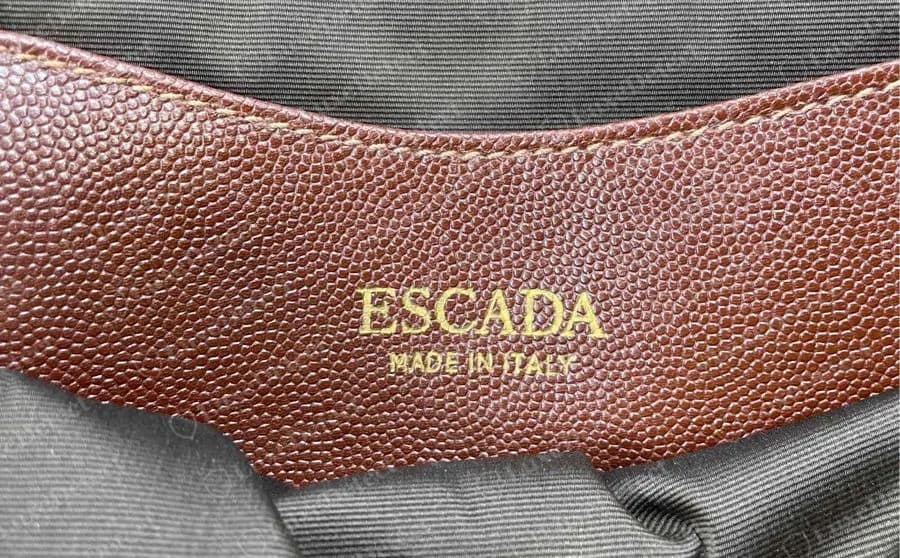
Escada bags in our records are finished in several ways, and the markings follow the bag:
- Leather interior patch: a patch of grained leather stamped in gold with "ESCADA" and "MADE IN ITALY", stitched into the lining of a structured leather bag (above).
- Zip pulls and zip tabs: metal pulls carrying "ESCADA" in capitals, in silver-tone on an orange nubuck bag and in gold on bags in a paisley coated canvas.
- Printed lining: a pink lining printed with the logo and the name on the orange nubuck bag.
- Block-letter lock: a gold plate with interlocking block letters on a red leather flap bag.
The paisley coated canvas deserves a note. The gold "ESCADA" zip pull and stamped rivets on that material turn up on genuine bags in our records, and we have seen the same paisley, rivets and zip pull on bags that did not pass. That is exactly why matching the marks is not enough: the pull, the patch and the rivet can all be reproduced.
Compare the pieces that are harder to copy against a verified bag of the same model: how the leather is cut and finished, how the lining is sewn, how heavy the hardware is, and how the zip runs. Weight and feel are checks you do with the bag in your hands.
Shoes and Eyewear
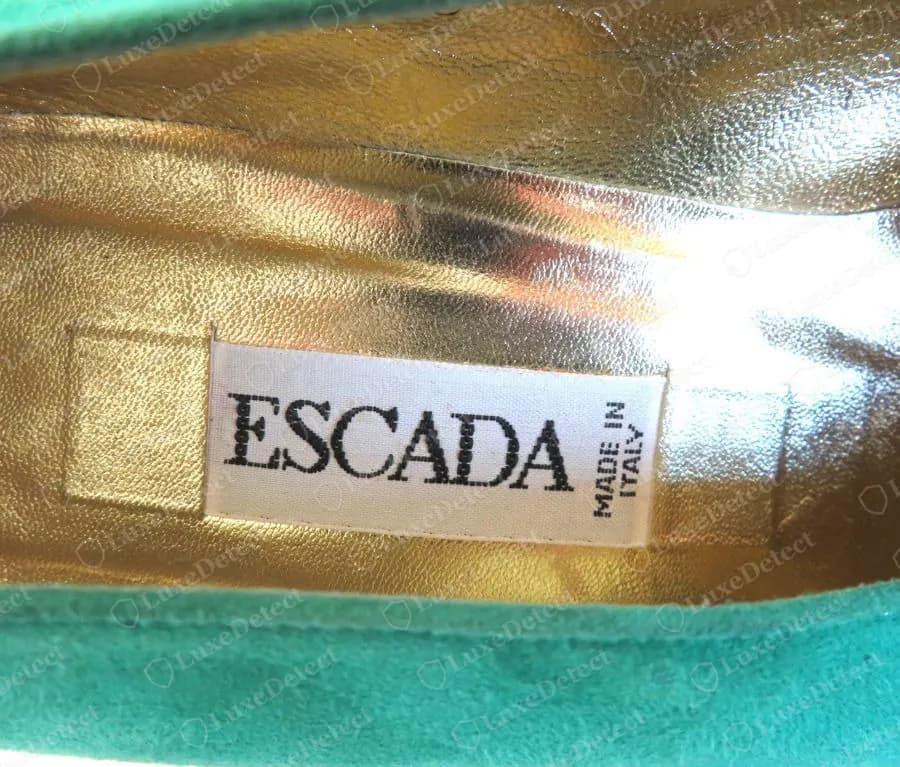
On the shoes in our records the insole carries a white label with black serif "ESCADA" and "MADE IN ITALY" printed vertically, over a gold insole. Size marks are stamped into the sole. As with the clothing labels, the country is a plain fact of that pair, not a test.
Genuine Escada eyewear in our records puts a logo plaque on the temples, and the matching case carries the double-E clasp and the name. Check that the frame, the case and the lens markings fit together on the same pair.
What a Matching Mark Does and Does Not Prove
Every mark in this guide, from the woven label to the zip pull, can be copied, and a fake can carry a label, a country line and a logo that all look right. The marks tell you what to compare, not whether the piece passes. A matching mark proves nothing on its own, so judge the label, the lining, the stitching, the hardware and the fabric together, and compare them against a verified piece of the same type. The fabric, drape and weight are checks you do with the item in your hands.
Nothing here lets you date a piece. We have not confirmed label eras or what the reference numbers mean, so a label that differs from the examples above is not proof of a problem, and one that matches is not proof of authenticity. Our records are also mostly clothing, so our coverage of bags, shoes and eyewear is thinner.
When to Get a Professional Opinion
If the price matters, or the listing does not show the inside of the garment clearly, get a second opinion before you pay. LuxeDetect authenticates clothing from $15 with a 24-hour turnaround, a verdict from a specialist and a Certificate of Authenticity. Send clear photos of the main label, the size and care labels, the lining, any hardware and the stitching, with both sides of every label visible.
A code that checks out doesn't prove the item is real. Counterfeiters copy genuine codes.
Our authenticators check the labels, stitching and fabric of your Escada against verified references, from $15. You get a verdict within 24 hours, and a Certificate of Authenticity if the item passes.
Authenticate My Escada →FAQ
How can I tell if my Escada is real?
No single detail proves it. Genuine Escada in our records carries several different labels and logos, so check that the main label, the size and fibre labels, the lining and any hardware fit together on the piece. Fakes copy marks, so get it checked if the purchase is significant.
Can I authenticate Escada from photos?
Yes. What decides it is how the labels, stitching, lining, hardware and fabric fit together against verified genuine pieces, not any single mark. Photos of both sides of every label, the lining and the hardware make that comparison possible, and a professional review is the safer route on an expensive piece.
Does "Made in Germany" or "Made in Romania" on an Escada label mean it is fake?
No. Genuine Escada in our records shows Germany, Italy, Romania and Slovenia, and some labels give no country at all. The country is a fact about that piece, not a test.
What does "Margaretha Ley" on an Escada label mean?
It is the name of the co-founder of Escada, and it appears under the Escada name on one family of labels in our records. We have not confirmed when the wording was used or dropped, so we do not use it to date a piece.
Is the double-E logo proof that an Escada bag is real?
No. It is on genuine hardware, charms and linings in our records, but a logo can be copied. Compare where it sits, how crisply it is made and whether it fits the rest of the bag.
Can I date my Escada from the label?
We would not. We have not confirmed label eras, and we do not know what the reference numbers beside the size mean, so we do not date a piece from either.