Fine Jewelry Authentication Specialist
Fine jewelry authentication specialist. Focuses on hallmarks, stone setting, and metal finishing.
Published October 2026 · Contact
Why the Inside of the Clasp Decides a Clic Clac
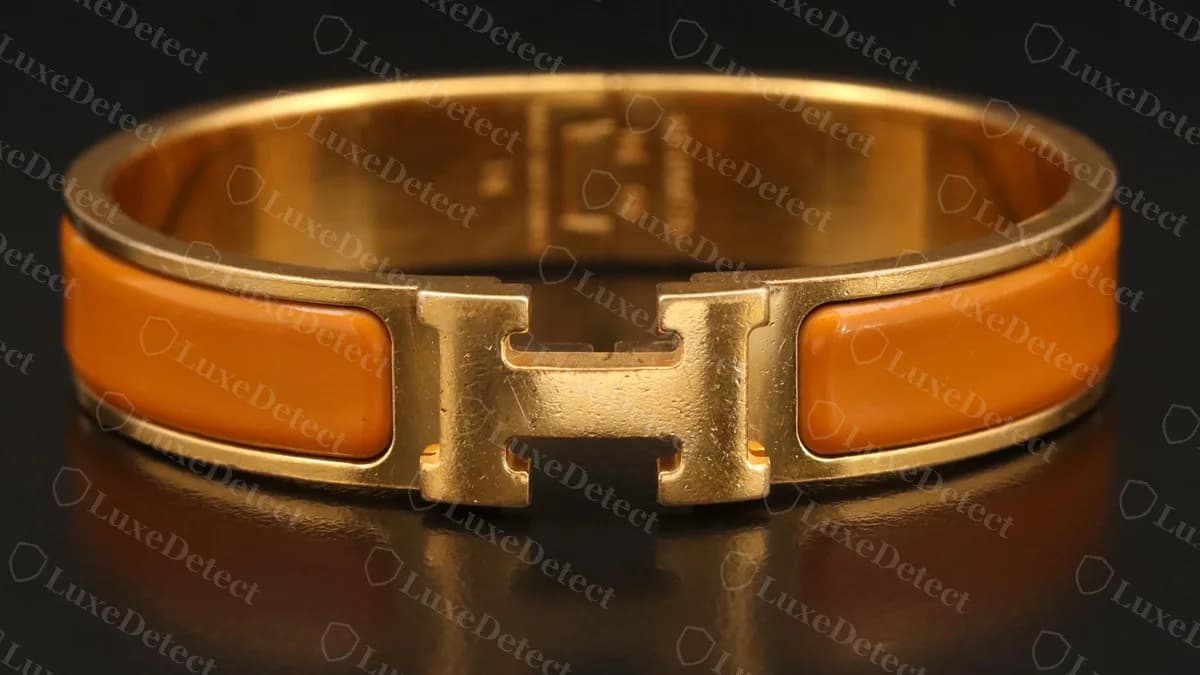
The Clic Clac is one of the most copied pieces in Hermès jewelry, and from the outside it is also one of the easiest to copy. In our own order archive the counterfeit bracelets reproduce the H clasp, the hinge, the screw head and the enamel colours closely enough that a photo of the top of the bracelet settles very little. Some come with the full orange box, the suede pouch and the ribbon too.
What the better fakes struggle with is a small block of stamping on the underside of the clasp, next to the word HERMÈS. That is where this guide spends most of its time. It is also where we need to be careful: genuine bracelets carry several different stamp layouts depending on the year and the line, and good counterfeits copy the layout as well. A stamp that looks right is therefore not a pass. A stamp that looks wrong is a much stronger warning than the reverse.
What to check, ranked by reliability
| Checkpoint | Reliability | What it tells you |
|---|---|---|
| 1. The Maker's Marks Beside HERMÈS | ★★★★★ | Two identical square boxes marked Q and CP are a strong warning; a different second mark does not clear a bracelet. |
| 2. The HERMÈS Line and the PARIS Variant | ★★★★★ | A PARIS line under HERMÈS is not part of the genuine stamps we compared, but many fakes copy the correct layout. |
| 3. Stamp Codes | ★★★★★ | A code repeated across unrelated bracelets is a warning; a plausible code proves nothing. |
| 4. Enamel, Hinge and H Clasp | ★★★★★ | Fakes copy the outside closely, so this is a first impression, not a check. |
| Model Reference Before You Start | ★★★★★ | Explains the stamp layouts and the Clic H and Clic Clac H names; it will not catch a good fake. |
| What the Box and Pouch Do and Do Not Prove | ★★★★★ | Fakes arrive with full packaging, so it is context only. |
Model Reference Before You Start
- Clic H and Clic Clac H: Hermès sells a narrower Clic H bracelet and a wider Clic Clac H, and current pieces are sized PM and GM. A listing that mixes the names up is not a verdict on its own.
- Finishes: gold, silver-colour (palladium) and rose-gold plating over enamel, in many colours and some printed and limited editions. Plating wears on genuine bracelets, so scratches and thin edges are normal on an older piece.
- Where the stamp is: on the underside of the clasp, split across its two halves. The HERMÈS line and the small marks sit on one half and MADE IN FRANCE on the other. Open the bracelet or look at the clasp from below to see both.
- More than one genuine layout: on the genuine bracelets we compared, the stamp reads -HERMÈS- with a short code such as FI 01 or ST 01 followed by digits, or HERMÈS with a single letter beside a small hallmark. Do not expect one layout, and do not fail a bracelet because it differs from a photo you have seen.
The Maker's Marks Beside HERMÈS
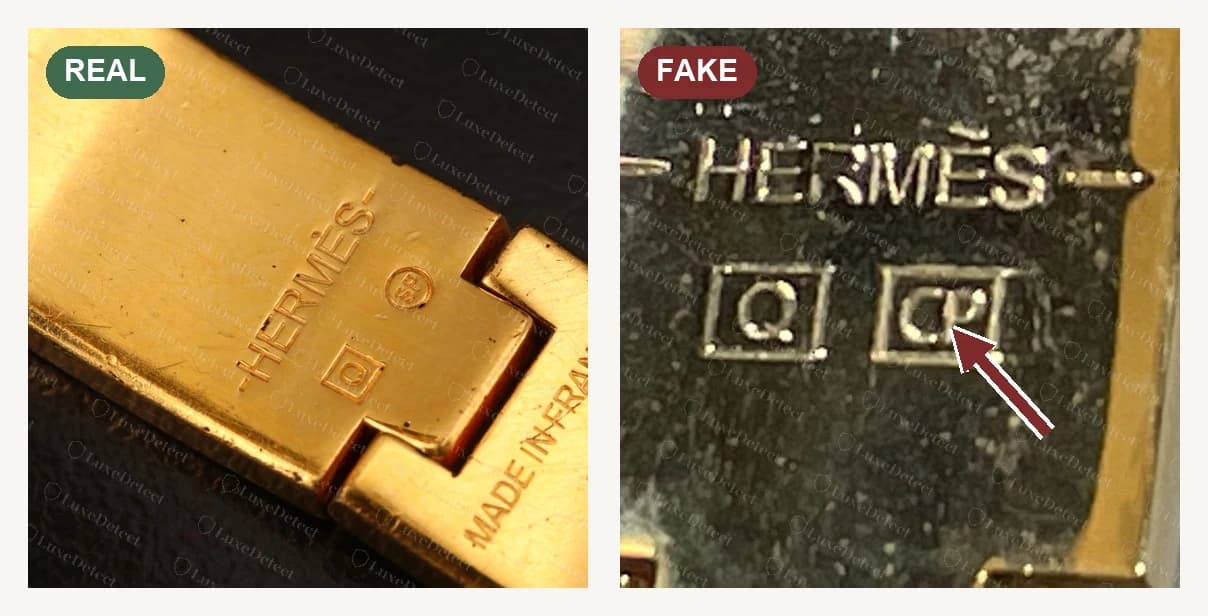
Under or beside the word HERMÈS the genuine clasps we compared carry one or two tiny hallmarks. The consistent point is that the two marks are different from each other: a boxed Q beside a second mark of another shape, for example a small circled SP or a compact block. They are finely struck, and each has its own outline.
A large group of the counterfeit bracelets in our archive carries something else: two identical square boxes side by side, one with a Q and one with CP. The boxes are the same size, drawn with the same heavy outline, and read like a template. This was the most repeated stamp on the fakes whose clasp we could read, roughly 4 in 10 of them, and we did not find it on any of the genuine stamps we compared.
| Element | Authentic | Counterfeit |
|---|---|---|
| Marks beside HERMÈS | A boxed Q plus a second mark of a different shape (circled SP, small block) | Two identical square boxes side by side, Q and CP |
| Outline | Each mark has its own shape and a fine outline | Matching heavy square outlines that read like a template |
| MADE IN FRANCE on the other half | Present | Also present on the fakes that copy the layout, so it proves nothing |
Red flag
Two identical square boxes, one marked Q and one marked CP, under HERMÈS. We found this on a large share of the fakes whose stamp we could read and on none of the genuine stamps we compared, so treat it as a strong warning on its own.
Worth knowing
A different second mark is not a pass. Some counterfeits use other mark shapes, and genuine layouts change with the year. This check can condemn a bracelet more reliably than it can clear one.
The HERMÈS Line and the PARIS Variant
On the genuine clasps we compared, the stamp reads HERMÈS with its accent, usually between two short dashes, and then the marks or a code beneath it. None of them carried a PARIS line. About 1 in 4 of the fake stamps we could read did: HERMÈS stamped large with PARIS underneath it, no marks below, and often nothing on the other half of the clasp. A smaller group had HERMES without the accent.
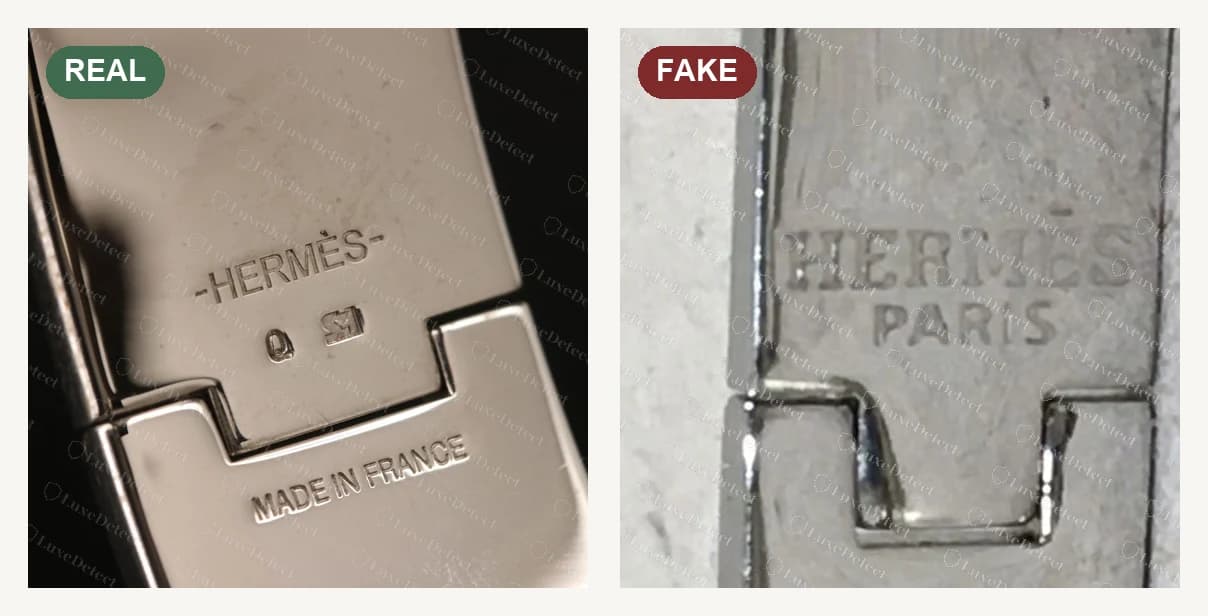
| Element | Authentic | Counterfeit |
|---|---|---|
| HERMÈS line | Accented, usually between dashes, finely struck | Large, soft lettering, sometimes without the accent |
| Second line | Marks or a short code | PARIS stamped under HERMÈS |
| Other half of the clasp | MADE IN FRANCE and a small mark | Often blank or only partly stamped |
Red flag
A PARIS line under HERMÈS on the clasp. It is not part of the genuine stamps we compared. A bracelet without it is not cleared, because many fakes copy the correct layout.
Stamp Codes
Many genuine clasps carry a short code under HERMÈS, two letters followed by digits. We saw series such as FI 01 and ST 01 on genuine bracelets, each with its own digits, and other genuine layouts with a single letter and a hallmark instead. We cannot check a code against a Hermès record, and you cannot either from a photo.
What we could see is copying. The same ST code, ST 0126, turns up on several unrelated fakes, which is what a counterfeiter does when one genuine clasp is the template for a whole batch. A code you can find on another listing is a warning; a code that looks plausible is not proof.
| Element | Authentic | Counterfeit |
|---|---|---|
| Code | Varies from bracelet to bracelet within a series, or a single letter and a hallmark | The same code repeated across unrelated bracelets |
| Format | Letters, then digits, struck evenly | Format copied correctly, so the format proves nothing |
Worth knowing
Search the code in listing photos before you trust it. A repeated code is a good reason to look harder. A code that appears nowhere else gives you no assurance.
Enamel, Hinge and H Clasp
Here we have to be direct about the limit of the photos. On the outside of the bracelet the counterfeits in our archive reproduce the H clasp, the hinge and its screw, and the enamel colours closely, and we did not find an outside detail that held across the fakes and was absent from genuine ones. Fit, snap and weight matter in the hand, but they are not something a photo can settle.
Wear is not a tell either. Genuine bracelets show chipped enamel and worn plating after years of use, and a bracelet that looks too new is no more reliable than one that looks tired.
Worth knowing
Treat the outside as a first impression. A bracelet can look perfect from the top and still fail on the underside of the clasp.
What the Box and Pouch Do and Do Not Prove
Counterfeit bracelets turn up in our archive with the orange box, the suede pouch, the ribbon and the paperwork. A genuine bracelet often arrives without any of them. Packaging is context for cross-checking, never evidence, and it does not change a verdict from the clasp.
Quick Authentication Checklist
- Open the clasp or look at its underside and find the stamp.
- Check the marks beside HERMÈS: two identical square boxes marked Q and CP is a strong warning.
- Look for a PARIS line under HERMÈS; it does not belong on the clasp.
- Read the code, if there is one, and search it for repeats on other listings.
- Compare both halves of the clasp, HERMÈS on one and MADE IN FRANCE on the other.
- Treat the box, the pouch and a clean outside as context only.
Either of the two red flags is enough to walk away. A correct-looking stamp is not a pass, because the better fakes copy the layout, so if the bracelet matters, have it checked.
When to Get a Professional Opinion
The harder bracelets are the ones that copy the stamp layout completely and differ only in the shape of a hallmark or the depth of a strike. A photo at ordinary angle rarely settles those. If you are buying secondhand, from a resale marketplace, or as a gift you cannot inspect in person, get a second opinion before the money moves. Send clear photos of the whole bracelet, both halves of the clasp stamp straight on and in good light, and the inside of the band. See also our guides to Hermès wallets and Hermès rings.
A code that checks out doesn't prove the item is real. Counterfeiters copy genuine codes.
Our authenticators check the hallmarks, engravings, clasp and settings of your Hermès against verified references, from $45. You get a verdict within 24 hours, and a Certificate of Authenticity if the item passes.
Authenticate My Hermès →FAQ
Where is the stamp on a Hermès Clic Clac bracelet?
On the underside of the clasp, split across its two halves. The HERMÈS line, the small marks or a short code sit on one half, and MADE IN FRANCE on the other. You usually have to open the bracelet or look at the clasp from below to read both.
Does a genuine Hermès Clic Clac say PARIS on the clasp?
Not on the genuine clasps we compared. A PARIS line stamped under HERMÈS appeared on a fair share of the fakes whose stamp we could read, so treat it as a warning. A bracelet without it is not proven genuine.
What do the Q and CP boxes mean?
We cannot tell you what the individual marks stand for. What we can say is that two identical square boxes marked Q and CP side by side appeared on a large share of counterfeit bracelets and on none of the genuine stamps we compared.
If the stamp looks right, is the bracelet real?
No. The better counterfeits copy the genuine layout, including MADE IN FRANCE and a plausible code, so a correct-looking stamp only means the bracelet has not failed this check.
Do all genuine Clic Clac bracelets have the same stamp?
No. We saw several genuine layouts: a short code such as FI 01 or ST 01 followed by digits, a single letter beside a hallmark, and different second marks. The checks here look for specific fake patterns, not for one fixed stamp.
Is the Clic H the same as the Clic Clac?
They are the same family. Hermès sells a narrower Clic H and a wider Clic Clac H, and the stamp checks in this guide apply to both.