Hermès Authentication Specialist
French luxury house specialist. Covers Chanel, Celine, and Saint Laurent construction and date coding.
Published September 2026 · Contact
Why the Oran Is the Most Faked Shoe in Luxury
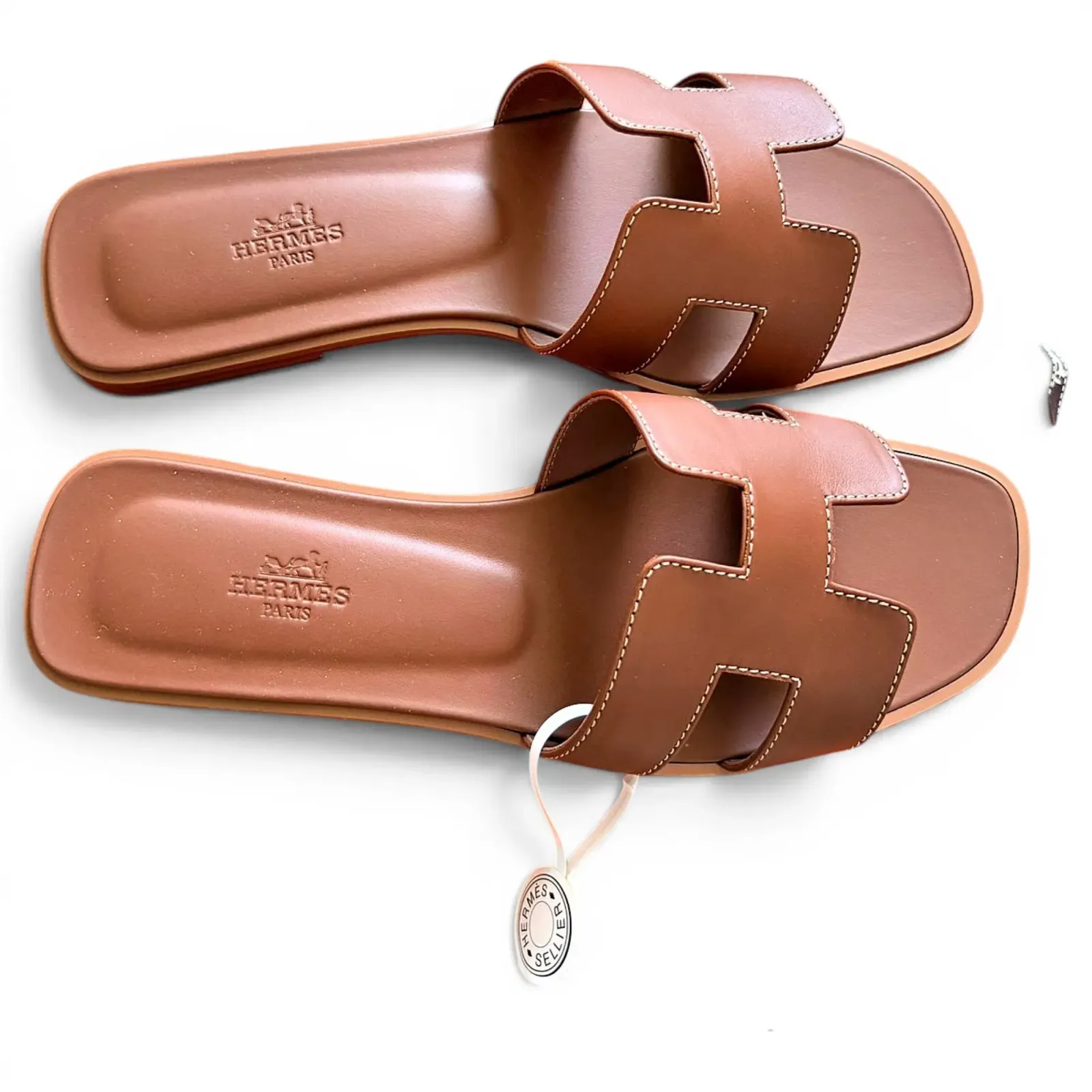
The Oran sandal has been in continuous production since 1997, sits at an accessible entry price for the house, and has one of the most recognisable silhouettes in fashion — a single wide strap cut into the Hermès H. That combination makes it the single most replicated Hermès product after the Birkin, and by unit volume it is almost certainly first.
The counterfeiter's problem is that the Oran is minimal. There is no lining to hide behind, no hardware, no zipper, no interior pocket. What exists is a strap, a footbed, a sole and four stamps. Every one of those is precisely specified, and fakes fail on the same handful of points with remarkable consistency.
That minimalism cuts both ways for you. It means fewer checks to run — but it also means the checks that exist have to be run properly, because there is no fifth signal to fall back on.
What to check, ranked by reliability
| Checkpoint | Reliability | What it tells you |
|---|---|---|
| The H Cutout — Proportion and Cut Quality | ★★★★★ | Rounded interior corners reject the pair outright — the die produces square corners. |
| The Sole Stamp | ★★★★★ | A printed rather than heat-pressed mark, or a wrong È accent, is decisive. |
| Leather, Footbed and Construction | ★★★★★ | Repeating printed grain and adhesive squeeze-out are hard to hide in person. |
| The Blind Stamp and Size Marking | ★★★★★ | Catches era contradictions, but a plausible stamp is easily copied. |
| Model Reference Before You Start | ★★★★★ | Rules out a mislabelled Oasis or Chypre; will not catch a good fake. |
| What the Box and Dust Bag Do and Do Not Prove | ★★★★★ | Packaging is context only — useful for cross-referencing, never as evidence. |
Model Reference Before You Start
Confirm what you are actually evaluating. Hermès makes several sandals built on similar lines, and listings routinely mix them up — sometimes innocently, sometimes not.
- Oran — flat, single H-cutout strap across the vamp, open toe, no heel strap. The classic.
- Oasis — the same H strap on a low block heel, roughly 4cm.
- Izmir — men's version, wider strap, chunkier footbed.
- Chypre — H strap plus an ankle strap and a sportier sole.
A listing calling a heeled sandal an "Oran" is either careless or deliberately obscuring what it is. Ask for the box end label, which names the model.
Authentic Orans are made in France and Italy, both legitimate. The country appears on the sole stamp, and it must agree with the box label.
The H Cutout — Proportion and Cut Quality
This is the fastest and most reliable check, because the H is a fixed piece of geometry that fakes consistently get slightly wrong.
On a genuine Oran the H is cut from the strap by machine die with clean, perpendicular walls. Look at the cut edges under good light: the leather is sealed and smooth, the same colour through the depth of the cut, with no fibrous fuzz and no visible glue.
Proportion: the two vertical bars of the H are parallel and of equal width. The crossbar sits at true centre height and is the same thickness as the verticals. The negative space inside each half of the H is symmetric left to right.
Corners: the interior corners of the H are sharp and square, not rounded. Rounding at the corners is the single most common tell — die wear and cheaper tooling produce soft corners.
| Element | Authentic | Counterfeit |
|---|---|---|
| Interior corners | Sharp and square | Rounded or slightly melted |
| Vertical bars | Parallel, equal width | Tapered, or one visibly wider |
| Crossbar height | True centre of the H | Sits high or low of centre |
| Cut edge finish | Sealed, smooth, colour consistent through the depth | Fibrous, raw, or visibly glued |
| Strap edge paint | Thin, even, matched to the leather | Thick, ridged, or a mismatched tone |
Red flag
Rounded interior corners on the H cutout. Hermès dies typically produce square corners, so this alone is enough to reject the pair — we have not seen a genuine Oran with soft H corners.
The Sole Stamp
Turn the sandal over. The sole carries the maker stamp, and this is where the majority of fakes are caught after the H.
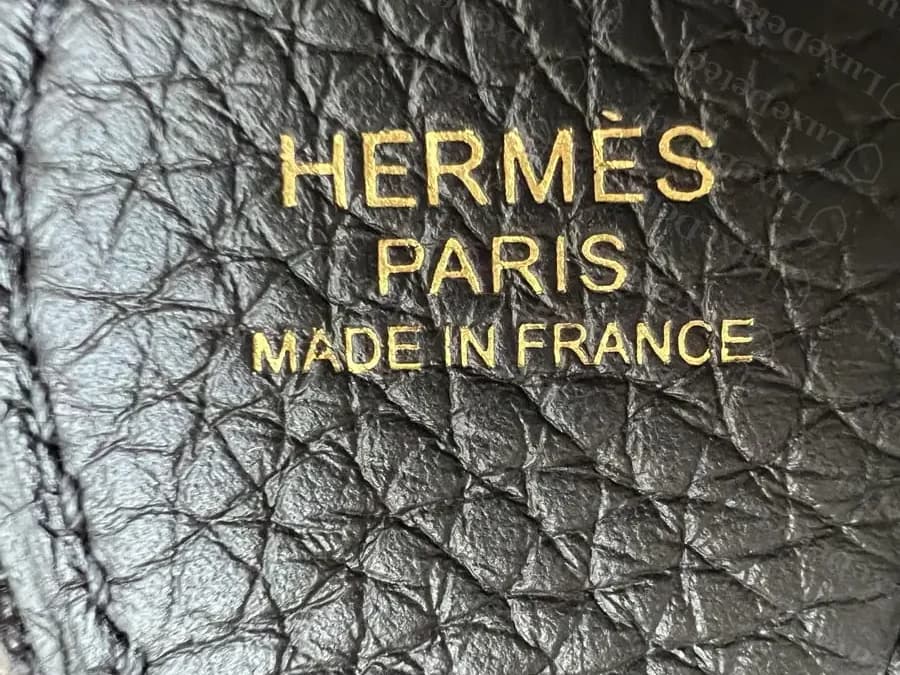
The stamp reads HERMÈS PARIS with MADE IN FRANCE (or MADE IN ITALY) beneath it. It is heat-pressed into the leather sole, not printed on it, so it should be very slightly recessed and you can feel it with a fingernail.
Font: Hermès uses a fine serif with generous letter spacing. Look specifically at the accent on the È in HERMÈS — it is present, correctly angled, and proportionate. Fakes routinely omit the accent, angle it wrongly, or render it as a straight tick.
Depth: the impression is even across every character. A stamp where some letters are crisp and others are faint indicates a poorly-set press — genuine production does not vary this way.
| Element | Authentic | Counterfeit |
|---|---|---|
| È accent | Present, correctly angled, proportionate | Missing, straight, or oversized |
| Impression | Heat-pressed, slightly recessed, feelable | Printed flat on the surface, or inked |
| Letter spacing | Generous and even | Cramped, or spacing drifts across the word |
| Depth consistency | Even across all characters | Some letters crisp, others faint |
| Country line | Agrees with the box label | Contradicts the box, or absent entirely |
Red flag
A sole marking that sits on the leather rather than in it. Genuine Hermès sole stamps are heat-pressed; an inked or printed mark that a fingernail cannot feel is decisive.
The Blind Stamp and Size Marking
Look at the underside of the strap, or the footbed near the arch depending on production year. Alongside the size you will find the craftsman's blind stamp — a small letter, sometimes enclosed in a shape, which encodes the production year.
Hermès has used four systems:
- Plain letter, 1945–1970 — the original scheme
- Letter in a circle ○, 1971–1996
- Letter in a square □, 1997–2014
- Plain letter again, 2015 onward
Because the Oran launched in 1997, a genuine pair carries either a squared letter (1997–2014) or a plain letter (2015 onward). A circled letter on an Oran is chronologically impossible — the circle system ended the year before the model existed.
Size marking: European sizing, stamped in the same fine serif as the sole. Hermès Orans run narrow and true to size in whole and half sizes. A size marked in US sizing alone is wrong for the house.
| Element | Authentic | Counterfeit |
|---|---|---|
| Stamp shape | Square (1997–2014) or plain (2015+) | Circle, or an enclosure that does not match the year |
| Letter legibility | Small but cleanly formed | Blurred, oversized, or ambiguous between letters |
| Size format | European, fine serif matching the sole stamp | US-only, or a different typeface from the sole |
| Placement | Consistent position for the production era | Arbitrary, or crowding the size marking |
Worth knowing
The blind stamp gives you the production year, not the verdict. A correct stamp does not make a pair genuine — counterfeiters copy plausible stamps. Its real value is catching contradictions: a stamp era that conflicts with the model's production history, or with the box label date.
Leather, Footbed and Construction
The final check is the one photographs serve worst, so handle the pair if you can.
Leather: genuine Orans use calfskin, goatskin (Chèvre) or box calf depending on the line. The grain is fine and natural with slight irregularity — real hide is never perfectly uniform. Fakes frequently use a printed grain that repeats visibly across the strap.
Footbed: the insole is smooth leather, stamped HERMÈS at the arch. It is glued and stitched, and the edge where footbed meets sole is clean with no adhesive squeeze-out. The footbed has a very slight contour under the arch, not a flat plane.
Stitching: where present, stitch spacing is even and the thread tone is matched to the leather. We have not seen contrast stitching on a genuine Oran.
Edge paint: applied thinly along the strap and footbed edges, evenly, with no build-up at the corners. Thick, ridged, or cracked edge paint on a pair sold as new is wrong.
| Element | Authentic | Counterfeit |
|---|---|---|
| Grain | Fine, natural, slightly irregular | Printed grain that visibly repeats |
| Footbed stamp | Crisp HERMÈS at the arch | Shallow, off-centre, or wrong font |
| Sole join | Clean, no adhesive visible | Glue squeeze-out at the seam |
| Footbed profile | Slight contour under the arch | Completely flat |
| Weight in hand | Substantial for the size | Noticeably light, feels hollow |
What the Box and Dust Bag Do and Do Not Prove
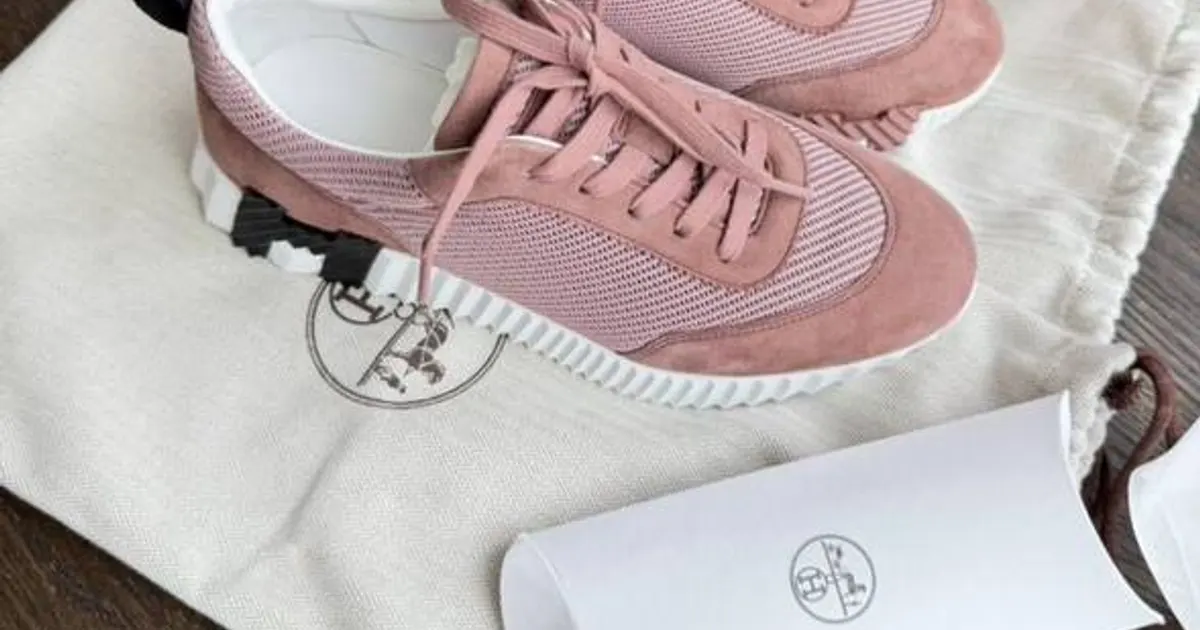
Orange box, brown ribbon, cotton dust bags. All of it is counterfeited and all of it is sold separately on secondary markets, so packaging is context, not evidence.
Where it earns its keep is consistency. The box end label names the model, colour, size and country of manufacture. Cross-reference every field against the sandals themselves. A box label reading "Made in Italy" on a pair with a France sole stamp is a genuine contradiction worth acting on — far more informative than the box's own appearance.
Quick Authentication Checklist
- H cutout corners sharp and square, bars parallel and equal
- Sole stamp heat-pressed with a correctly-angled È accent
- Blind stamp is squared or plain — never circled — and consistent with the box
- Sole stamp country matches the box label country
- Leather grain natural and non-repeating
- Footbed HERMÈS stamp crisp and centred at the arch
- No adhesive squeeze-out where footbed meets sole
- Edge paint thin and even, no build-up at corners
Two or more failures means walk away. A single failure on the H cutout or the sole stamp is on its own sufficient.
When to Get a Professional Opinion
The Oran sits in an awkward price band. At retail it is among the most accessible Hermès products, which means the margin on a convincing fake is high and the sophistication of current replicas has risen accordingly. The best of them now get the H proportion close enough that a photograph will not settle it.
If you are buying pre-owned above a few hundred, the cost of a professional check is a small fraction of the exposure. Our specialists authenticate Hermès footwear from photographs — from $30 for Hermès including the house surcharge — and return a Certificate of Authenticity you can use in a dispute.
Related guides
- Hermès date codes and blind stamps explained
- Authenticating a Hermès Constance belt
- Hermès Birkin authentication
- Hermès special stamps guide
FAQ
Where is the serial number on Hermès Oran sandals?
Orans do not carry a serial number in the sense a handbag does. What they have is a craftsman's blind stamp — a single letter, sometimes enclosed in a square — found on the underside of the strap or on the footbed near the arch, alongside the European size marking. That letter encodes the production year, not a unique identifier.
What does the letter stamped on my Hermès Oran mean?
It is the production year code. Because the Oran launched in 1997, a genuine pair carries either a letter in a square (1997–2014) or a plain letter with no enclosure (2015 onward). Enter the letter and its shape in the decoder above to get the year.
Can a Hermès Oran have a circled letter?
No. The circle system ran from 1971 to 1996 and the Oran was introduced in 1997, so a circled letter on an Oran is chronologically impossible. If you find one, the pair is counterfeit or the stamp has been added to a non-Hermès shoe.
Are Hermès Orans made in Italy authentic?
Yes. Hermès produces Oran sandals in both France and Italy and both are genuine. What matters is consistency: the country on the sole stamp must match the country on the box end label. A contradiction between the two is a real warning sign, whereas Italian manufacture on its own is not.
Do Hermès Oran sandals run true to size?
They run narrow and true to length. Most wearers take their usual European size, though anyone with a wider foot commonly sizes up a half. Sizing is not an authentication signal in itself, but a size marked only in US sizing is wrong for the house — Hermès marks European sizing.
How much does it cost to authenticate Hermès Oran sandals?
Hermès footwear authentication starts at $30 for 24-hour turnaround, which includes the Hermès house surcharge that applies across the brand. Faster options are available. The service is photo-based, and you receive a Certificate of Authenticity with the verdict either way.
Is the box enough to prove my Orans are real?
No. Hermès boxes, ribbons and dust bags are all counterfeited and are also sold separately on secondary markets, so packaging alone proves nothing. Its value is cross-referencing — the box end label lists the model, colour, size and country, and every field should agree with the sandals themselves.