Fine Jewelry Authentication Specialist
Fine jewelry authentication specialist. Focuses on hallmarks, stone setting, and metal finishing.
Last updated September 2026 · Published June 2026 · Contact
Hermès Jewelry: The Authentication Context
Hermès jewelry occupies a distinct position in the luxury market — it is less logo-dependent than Bvlgari or Cartier, relying instead on design precision and the quality of its metalwork and leather. The most faked Hermès rings are:
- Collier de Chien (CDC) ring: the iconic stud motif, originally from the dog collar design
- Kelly ring: shaped after the Kelly bag's handle bar, sometimes with a miniature Kelly silhouette
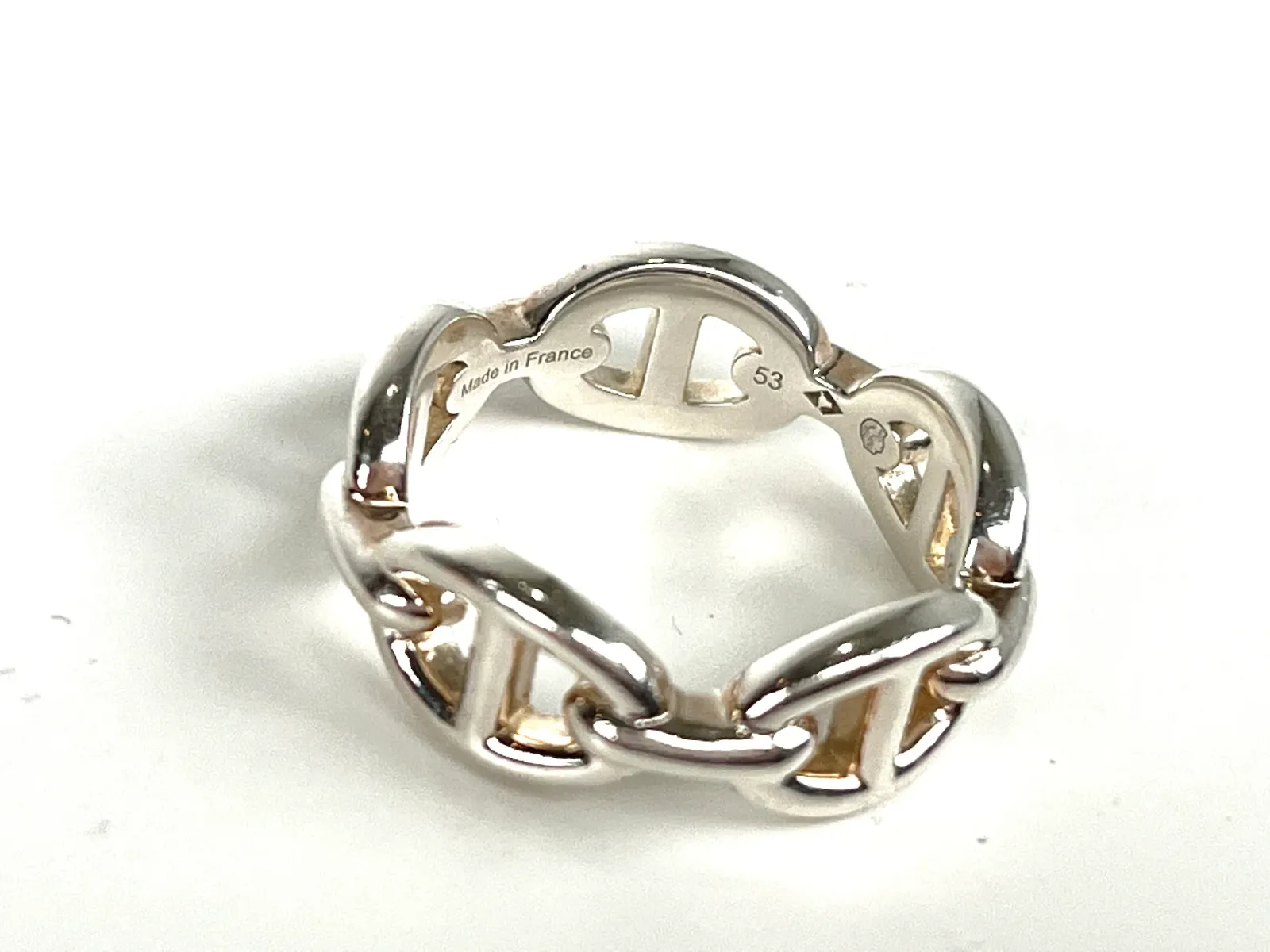
- Chaine d'Ancre ring: interlocking anchor-chain links, one of Hermès's oldest motifs
- Mors ring: based on equestrian bit hardware
All four are produced in silver (925) or gold (750/18K), and all carry Hermès's consistent hallmark and finishing standards.
Because Hermès jewelry is not logo-led, the checks that decide it are the metalwork ones: the French state assay mark, the depth of the hand polish, and the uniformity of the repeated design elements (studs, links). Those need precision casting and hand finishing a counterfeiter cannot cheaply reproduce, and they outrank the engraved signature — which fakes copy competently.
What to check, ranked by reliability
| Checkpoint | Reliability | What it tells you |
|---|---|---|
| The Hermès Hallmark System | ★★★★★ | A missing or blurred eagle's-head assay mark on 18K gold is decisive. |
| Surface Finish — The Hermès Standard | ★★★★★ | A distorted reflection means plating over base metal, not a polished solid piece. |
| Weight | ★★★★★ | Any magnetic response proves a ferrous core and needs no expertise to call. |
| Collier de Chien Ring Authentication | ★★★★★ | Pyramid studs that vary in height expose a cheaper mould and settle a CDC ring. |
| Chaine d'Ancre Ring Authentication | ★★★★★ | Roughness at the link interlock points is a casting-quality tell hard to hide. |
| Kelly Ring Authentication | ★★★★★ | Silhouette accuracy and hinge fit matter, but a good fake gets the shape close. |
Use our free Hermès Date Stamp Decoder to identify the production year of any Birkin, Kelly, or Constance — circle, square, or modern alphanumeric format.
Decode My Date Stamp →The Hermès Hallmark System
Every authentic Hermès jewelry piece carries a set of marks that form the primary authentication foundation.
Brand signature: "Hermès Paris" is engraved inside the ring band. The font is Hermès's proprietary typeface — the H has a specific crossbar height, the accent on the è is a precise angle. Compare closely against documented authentic examples. Fakes either omit "Paris," use an incorrect accent, or use a generic font.
Metal hallmark:
- Silver pieces: "925" or "Ag925" indicating sterling silver
- Gold pieces: "750" indicating 18-karat gold, often accompanied by "Au750"
- On French pieces, the guaranteed 18K gold hallmark is an eagle's head (tête d'aigle) — a small stamped image. This French state hallmark is extremely difficult to fake accurately.
Craftsman/workshop mark: A small oval or lozenge containing initials or a symbol — the identifier of the atelier that made the piece. This appears alongside the brand signature inside the band. Fakes omit this entirely.
Dating system: Unlike Hermès bags (which use a single letter year code), Hermès jewelry dating is more variable and not always present on all pieces. Its absence does not indicate a fake.
| Element | Authentic | Counterfeit |
|---|---|---|
| "Hermès Paris" | Correct proprietary font, precise è accent, "Paris" present | Generic font, wrong accent, or "Paris" omitted |
| Metal hallmark | 925 / Ag925 for silver, 750 / Au750 for gold | Missing, or a purity the piece cannot be |
| Eagle's head (18K gold) | Tiny detailed French state assay stamp, crisp | Omitted, or a blurry indistinct blob |
| Workshop mark | Small oval or lozenge with the atelier's identifier | Absent entirely |
Red flag
On an 18K gold ring, a missing or blurred eagle's-head hallmark. The French tête d'aigle assay mark is a fine stamped image struck by the state, not the maker; fakes cannot reproduce its clarity, and its absence on a piece sold as French 18K is decisive.
Collier de Chien Ring Authentication
The CDC ring translates the Collier de Chien collar's pyramid stud motif into a ring band.
Stud precision: The pyramid studs around the band are identical in height, base width, and apex angle. On authentic CDC rings, every stud is the same — a condition that requires precision casting and finishing. Fakes produce studs that vary slightly in height or apex sharpness. Look across all studs at a low angle to spot height variation.
Stud finish: Authentic studs are highly polished on all four faces. The apex comes to a precise point. Fakes frequently have rounded apexes or slightly dulled faces.
Band proportions: The CDC ring band has a specific width and the studs occupy a specific proportion of that width. Fakes sometimes make the band narrower or the studs smaller than authentic dimensions.
| Element | Authentic | Counterfeit |
|---|---|---|
| Stud uniformity | Identical height, base width and apex angle across all studs | Studs vary in height or apex sharpness |
| Apex | Comes to a precise point | Rounded or slightly flattened |
| Stud faces | Highly polished on all four faces | Dulled or unevenly polished faces |
| Band and stud proportion | Documented band width, studs a set fraction of it | Narrower band or undersized studs |
Red flag
Pyramid studs that vary in height down the row — check across all of them at a low angle. Uniform studs require precision casting and finishing; visible variation is the tell of a cheaper mould and settles it.
Kelly Ring Authentication
The Kelly ring references the Kelly bag — some versions have a miniature Kelly bag silhouette as the centerpiece, while others use the handle bar motif.
Silhouette accuracy: The miniature Kelly shape (if present) should be proportionally accurate to the real Kelly bag — the handle drop, lock position, and body proportion are all defined. Fakes produce a generic "bag shape" that doesn't match the Kelly's specific profile.
Hinge mechanism (on Kelly twist ring): The Kelly ring that "opens" to reveal a miniature Kelly inside is a hinged construction. The hinge should be smooth, precise, and invisible when closed. Fakes have visible hinge lines or a mechanism that doesn't close flush.
Handle bar detail: On versions featuring the handle bar motif, the bar's cross-section is a specific oval shape. The bar sits on saddle-shaped supports that are cleanly finished.
| Element | Authentic | Counterfeit |
|---|---|---|
| Kelly silhouette | Proportionally accurate, handle drop, lock position, body shape | Generic "bag shape" that isn't the Kelly's profile |
| Hinge (twist ring) | Smooth, precise, invisible when closed | Visible hinge line, doesn't close flush |
| Handle bar | Specific oval cross-section on cleanly finished supports | Round or flattened bar, rough supports |
Worth knowing
The Kelly ring's miniature-bag silhouette is judged against the real Kelly's proportions, not just "does it look like a handbag". Fakes reproduce a bag shape without the handle drop and lock placement that make it a Kelly.
Chaine d'Ancre Ring Authentication
The Chaine d'Ancre ("anchor chain") ring uses interlocking oval links as the design element.
Link uniformity: Every link in the chain design is identical in size, oval proportion, and wall thickness. The interlocking is clean — no link overlaps incorrectly or sits at an angle.
Link finish: Each link has a consistent polished finish. Where two links interlock, the contact points are smooth and even. Fakes show roughness at the interlocking points where casting quality was insufficient.
Spacing: The distance between each link is consistent around the entire band. Spacing variation indicates poor casting.
| Element | Authentic | Counterfeit |
|---|---|---|
| Link uniformity | Every link identical in size, oval proportion, wall thickness | Links vary; some sit at an angle or overlap wrong |
| Interlock points | Smooth and even where two links meet | Rough at the contact points from poor casting |
| Spacing | Consistent around the entire band | Visibly varies link to link |
Surface Finish — The Hermès Standard
Hermès hand-finishes all jewelry. The standard this creates is visible and distinct:
Polish depth: Authentic Hermès silver has a mirror-depth polish — not a surface coating but a polish achieved through progressive abrasion of the silver itself. The reflection in the metal is clear and undistorted. Fakes use electroplated silver on base metal, which achieves a shinier initial appearance but shows distortion in the reflection under close inspection.
Edge treatment: Where the ring band meets a design element (a stud base, a link), the transition is precisely finished — a clean, defined line. Fakes show slight roughness or an imprecise transition at these points.
Inside of band: The inner surface of an authentic Hermès ring is smooth and comfortably curved. There are no rough spots, tool marks, or casting seams. Fakes frequently have minor roughness or a visible seam line inside the band.
| Element | Authentic | Counterfeit |
|---|---|---|
| Polish depth | Mirror-depth polish of the metal itself, undistorted reflection | Electroplated shine over base metal, reflection distorts |
| Edge transitions | Clean defined line where band meets a design element | Roughness or an imprecise transition at those points |
| Inside the band | Smooth, comfortably curved, no tool marks or seam | Minor roughness or a visible casting seam inside |
Red flag
A reflection that distorts when you look into the polished surface. Genuine Hermès polish is progressive abrasion of solid silver or gold; a warped reflection means a thin plated layer over base metal and is decisive.
Weight
Sterling silver and 18K gold have specific densities. Authentic Hermès rings feel substantial for their size.
Silver rings: A CDC ring in silver should feel genuinely heavy relative to its visual size. Rings made from silver-plated copper or zinc alloy are noticeably lighter.
Gold rings: Authentic 18K gold is dense. A Kelly ring in yellow gold has an unmistakable weight. Fakes in gold-plated brass are lighter and warmer to the touch (brass conducts heat differently than gold).
| Element | Authentic | Counterfeit |
|---|---|---|
| Silver ring in hand | Genuinely heavy for its visual size | Light, silver-plated copper or zinc alloy |
| Gold ring in hand | Dense, unmistakable weight | Light gold-plated brass |
| Thermal feel | Metal-cool, warms slowly | Brass warms quickly and unevenly |
| Magnet | No attraction | Any pull means a ferrous core |
Red flag
Any magnetic response. Silver and gold are non-magnetic, so a ring that reacts to a magnet has a base-metal core and cannot be solid Hermès. No expertise needed for this one.
Quick Authentication Checklist
- "Hermès Paris" engraving: correct font, correct accent, "Paris" present
- Metal hallmark: 925 for silver, 750 for gold
- French state hallmark: eagle's head (on 18K gold pieces)
- Workshop mark: small oval with craftsman identifier
- Stud/link uniformity: all elements identical in size and finish
- Mirror-depth polish inside and out
- Substantial weight for the ring's size
- Clean edge transitions at all design junctions
Two or more failures means walk away. A single failure on the eagle's-head hallmark, a distorted polish reflection, or any magnetic response is on its own sufficient.
When to Get a Professional Opinion
Hermès jewelry is harder to fake convincingly than Bvlgari or Cartier precisely because it is not logo-led — there is no monogram to copy, only metalwork to match. The cheap fakes fail the weight and polish checks immediately. The better ones use real silver, get the engraving competent, and reproduce a plausible eagle's head that only falls apart under magnification against a known-authentic stamp.
For a gold piece in particular, the Hermès boutique will cross-reference the craftsman mark and confirm the production history, and that is the definitive route. Where that is not practical, our jewelry specialists authenticate Hermès rings from photos, from $45 for 24-hour turnaround, which includes the Hermès house surcharge applied across the brand, and return a Certificate of Authenticity.
FAQ
What metals do Hermès rings come in?
Most Hermès rings are produced in sterling silver (925) or 18-karat gold (750) in yellow, white, or rose. Some editions use combinations — silver with gold accents. Hermès does not produce fashion jewelry in plated base metals — all pieces are solid silver or solid gold.
How do I identify which Hermès ring model I have?
Compare the ring to Hermès's documented catalog for the specific motif. CDC rings have pyramid studs; Chaine d'Ancre has oval anchor-chain links; Kelly ring has the Kelly bag silhouette or handle bar. Each motif is distinct. Hermès boutiques can also identify pieces from photos or in person.
Does Hermès include a certificate with rings?
Hermès includes an orange pouch (pochette) and a receipt when purchased from a boutique. There is no hologram card or authentication certificate. Primary authentication relies on the physical markers in this guide.
Can I get a Hermès ring authenticated at a boutique?
Yes. Hermès boutiques will verify pieces, particularly for cross-referencing the craftsman mark and confirming the piece's production history. For high-value gold pieces, this is recommended before purchase.
What's the most reliable fake tell on a Hermès ring?
The eagle's head hallmark on 18K gold pieces. This French state assay mark is a tiny, detailed stamped image that requires precision — fakes either omit it or produce a blurry, indistinct version that doesn't match the clarity of an authentic French assay stamp.